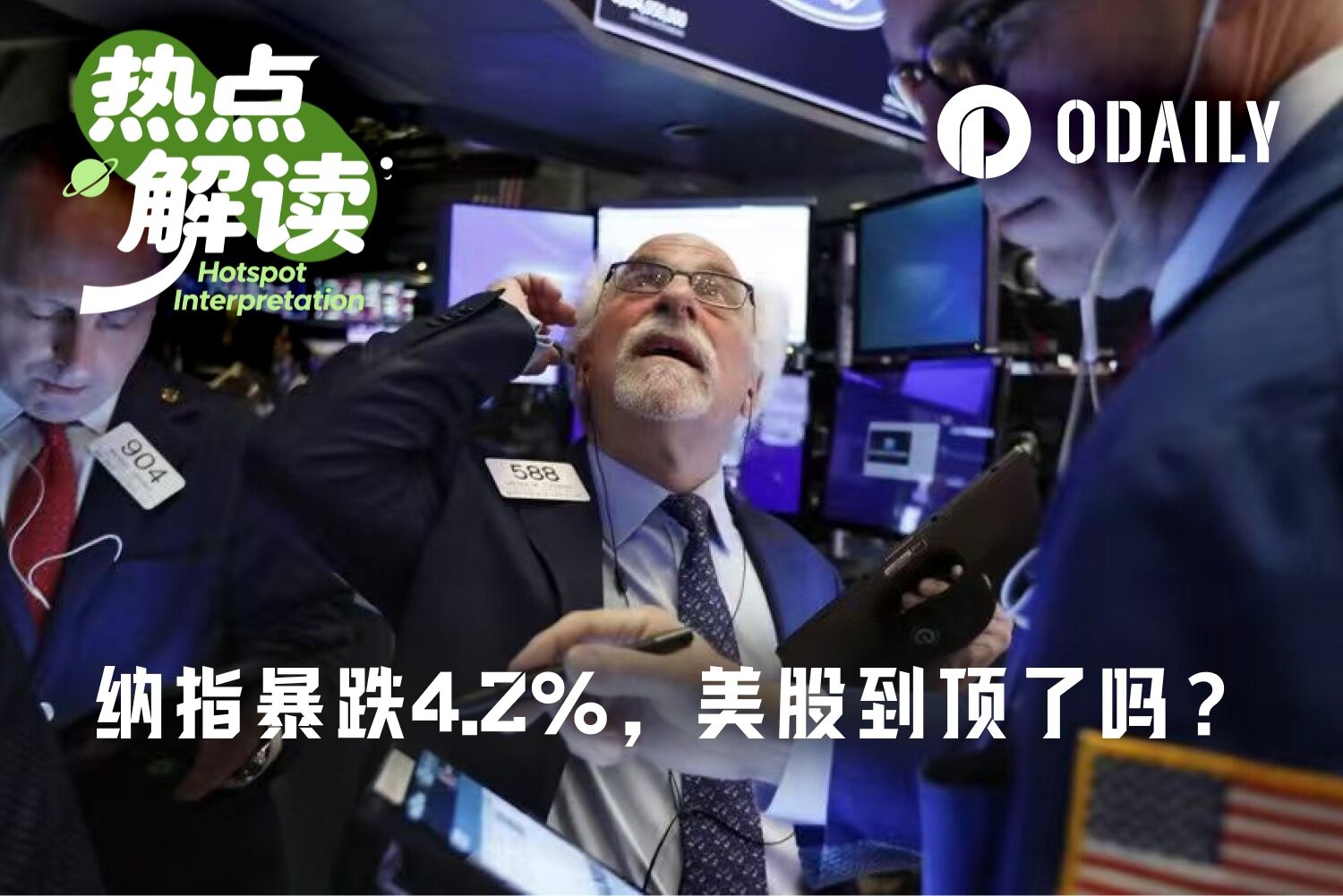
Nasdaq Plunges 4.2% in a Single Day: Does "Black Friday" Burst the U.S. Stock Market Bubble?

marsbitPublié le 2026-06-08Dernière mise à jour le 2026-06-08

Résumé

The Nasdaq plunged 4.18% on June 5, 2026, its worst single-day drop in over a year, as a much stronger-than-expected US jobs report triggered fears of economic overheating and delayed Federal Reserve interest rate cuts. The selloff, centered on high-valuation tech and AI stocks like Nvidia and Broadcom, spread across major indices. The article examines whether this signals a market top. The strong May non-farm payrolls data, nearly double expectations, pushed bond yields higher, directly hurting rate-sensitive tech stocks. This exposed vulnerabilities in the crowded AI trade, where valuations had soared on narratives of infinite growth, despite emerging signs of slowing order momentum and corporate AI monetization challenges. Prior to the drop, market indicators flashed warning signs: historically high valuations (e.g., Shiller CAPE ratio near 39.5), extreme bullish sentiment, and high levels of leverage. Technical charts showed key support levels being breached. Wall Street is divided on the outlook. Bears, citing risks of "stagflation" and AI bubble comparisons to the dot-com era, warn of a potential significant correction. Bulls view the drop as a healthy correction within a bull market, underpinned by a strong economy and expected corporate earnings growth of around 7% in 2026. The immediate future hinges on upcoming key events: the May CPI inflation data and the mid-June FOMC meeting. Their outcomes will critically shape market expectations for the Fed's rate path. T...

Original | Odaily Planet Daily (@OdailyChina)

Author | Qin Xiaofeng (@QinXiaofeng 888 )
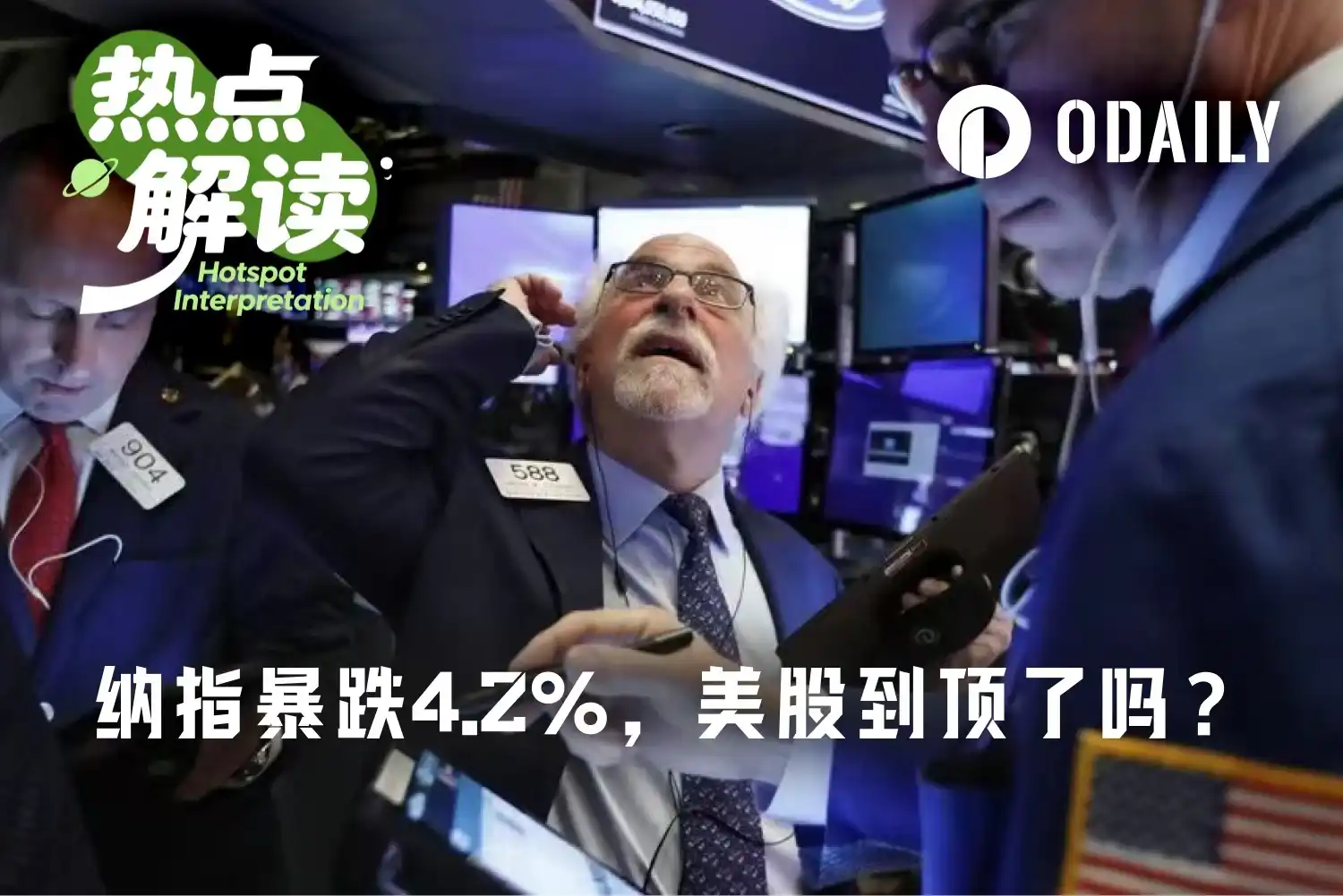
On Friday, June 5, U.S. stocks experienced the most intense single-day pullback so far in 2026.

The Nasdaq Composite Index plummeted 4.18%, closing at 25,709.43 points, marking its largest single-day drop since April 2025. The S&P 500 fell 2.64% to 7,383.74 points, ending its record nine-week winning streak. The Dow Jones Industrial Average dropped 695.15 points (1.35%) to 50,866.78 points. The Philadelphia Semiconductor Index plunged over 10%, with market capitalization evaporating by approximately $1.3 trillion in a single day, led by declines in core AI stocks such as Nvidia, Broadcom, Micron, and Marvell.

Instantly, the question of "Have U.S. stocks peaked?" loomed in the mind of every investor. Odaily Planet Daily will conduct a rigorous analysis combining recent data and historical comparisons: Are current U.S. stock valuations too high? Is this pullback a healthy correction or a trend reversal? Where are the future driving factors?

I. Panorama of the June 5th Plunge: A Data-Driven "Perfect Storm"

The Non-Farm Payrolls (NFP) report released on Friday evening was the immediate trigger for this plunge.

The U.S. Department of Labor's May NFP data showed an addition of 172,000 jobs, almost double the market expectation of 88,000, and significantly higher than April's 115,000. April's job figures were already above expectations. March's job data was revised upward by 29,000, and April's was revised upward by 64,000. Job growth over the past three months reached its strongest level in two years. This indicates a systematic underestimation of the U.S. employment situation in prior data, enough to fuel market concerns about an overheating economy.

The strong employment data pushed up inflation expectations, with the market anticipating the Federal Reserve could raise interest rates as early as October this year. Following the data release, U.S. Treasuries were sold off. The 10-year Treasury yield rose 5.8 basis points to 4.531%, and the more policy-sensitive 2-year Treasury yield jumped over 7 basis points in a single day to 4.1%.

The jump in bond yields hit technology stocks, which are high-valuation, high-growth assets and are most sensitive to interest rates, the hardest.

Broadcom's strong earnings the day before failed to surpass the market's extremely high expectations for its AI custom chip business guidance, triggering a chain reaction. Nvidia fell over 6%, Micron dropped 13.3%, Marvell fell 16.7%, and AMD declined 10.9%. Concentrated profit-taking in the semiconductor sector, coupled with doubts about the sustainability of AI capital expenditures, created an avalanche effect. Reports that Meta would add hundreds of billions in AI investment failed to reverse the sector's downturn.

Trading volume expanded, and the VIX fear index surged 37% to 21.15, indicating a rapid spread of risk-averse sentiment. Bitcoin simultaneously fell below $60,000, and gold and crude oil also adjusted, with risk assets under comprehensive pressure. However, not all sectors fell: defensive sectors like utilities, healthcare, and consumer staples closed higher, with "old blue chips" like Johnson & Johnson and Coca-Cola attracting safe-haven funds. This suggests the market was not in a state of full-blown panic but rather a targeted adjustment in high-valuation sectors.

On a weekly basis, the S&P 500 ended its nine-week winning streak, with the Nasdaq logging a weekly loss of 4.7%, its worst in over a year. The Dow showed relative resilience, falling only 0.3% for the week, reflecting signs of sector rotation.

"This was an extreme manifestation of 'good news is bad news,'" Morgan Stanley's chief U.S. equity strategist, Michael Wilson, noted in a post-market report. "Strong employment data means the Fed's tightening shackles will be fastened tighter, directly shaking the only pillar supporting the high valuations of U.S. stocks—the expectation of imminent rate cuts."

II. The AI Myth Fades: Dominoes of a Crowded Trade

If the NFP data was the trigger, then the accumulated bubble and fragility within the AI sector itself were the highly explosive powder keg.

Over the past 18 months, AI was the sole narrative driving U.S. stocks to successive new highs. Nvidia's market cap once surpassed $5 trillion, accounting for over 7% of the S&P 500 index's weighting. At one point, the entire AI ecosystem-related stocks approached 40% of the S&P 500's total market cap.

However, entering Q2 2026, cracks began to appear in this faith.

Recent supply chain surveys revealed that several cloud service providers were reportedly cutting back on some orders for Nvidia's next-generation Blackwell Ultra chips due to excessive previous stockpiling and the much slower-than-expected monetization speed of enterprise AI applications. Nvidia's earnings report at the end of May, while still impressive, showed its revenue growth guidance had slowed for the third consecutive quarter, and there were signs of a potential decline in gross margins.

The extremely crowded long positions in tech giants rapidly evolved into a stampede to close positions under the impact of interest rate shocks. When the NFP data triggered soaring rates, the attractiveness of holding these high-duration, high-valuation growth stocks plummeted abruptly. Their marginal buyers—leverage-dependent quantitative funds and retail investors—were the first to collapse, triggering a chain reaction.

"The AI trade has shifted from FOMO (fear of missing out) to fear of being caught." Renowned value investor and GMO co-founder Jeremy Grantham has long warned about excessive AI valuations. He has compared the current situation to the eve of the 2000 internet bubble, noting that revenues for many AI companies may struggle to support their current high valuations.

III. Valuation and Historical Comparison: Have U.S. Stocks Reached a Bubble Peak?

The reason this pullback sparked widespread discussion about "whether the market has peaked" lies in its occurrence against a backdrop of multiple high valuation and sentiment indicators converging.

First, valuations are at historically high levels. Prior to the June 5th correction, the S&P 500's Cyclically Adjusted Price-to-Earnings ratio (CAPE, Shiller P/E) was around 39.5, ranking third highest after the 2000 internet bubble and the post-2021 pandemic easing period, significantly above levels preceding the 2007 financial crisis. The forward P/E also reached around 22.5, far above the long-term historical average of 15.8. The "Buffett Indicator"—the ratio of total U.S. stock market capitalization to U.S. GDP—briefly touched a high of 237% in late May, far exceeding the range Buffett himself defined as "significantly overvalued" (>120%). Any unexpected negative news could accelerate mean reversion.

Second, capital and sentiment are at extreme levels. The BofA Bull & Bear Indicator rose to 8.5 in late May, firmly locked in the "Extreme Greed" zone, often considered a reliable contrarian sell signal. The American Association of Individual Investors (AAII) bullish sentiment reading was mostly in the 35%-45% range in May, indicating optimistic but not extreme euphoric sentiment. Retail margin debt balances remained near a historical high of around $1.3 trillion in April-May, showing continued aggressive use of leverage.

Meanwhile, "smart money" has shown signs of retreat: Berkshire Hathaway's Q1 13F report revealed its cash and cash equivalents reached a record high of approximately $397 billion, and the company continued to be a net seller of stocks in Q2; the insider selling-to-buying ratio climbed to a relatively high level in May, the highest since 2021.

Third, technical indicators show critical breakdowns. Last Friday, the S&P 500 not only fell below short-term moving averages but also breached the lower rail of the recent uptrend channel. The index is currently testing its 200-day moving average (around the 7000-7200 point range). Technical analysts like BTIG's chief technical strategist Jonathan Krinsky point out that if the S&P 500 fails to quickly reclaim key support levels and further loses the 200-day moving average, it would technically confirm the potential start of a mid-term correction, with an adjustment range possibly reaching 10%-15%.

IV. Bull vs. Bear Debate: Pullback, Correction, or Beginning of a Bear Market?

Faced with the market pullback, Wall Street's bulls and bears quickly took sides, engaging in a fierce debate.

The bearish camp believes this could be the beginning of a bubble adjustment. Some strategists point to emerging risks of "stagflation" in the U.S. economy—while the May ISM Manufacturing PMI rebounded to 54.0 (indicating expansion), inflation indicators remain sticky. They warn that corporate earnings growth may face downward revision pressure due to financing costs and demand uncertainty, and the current equity risk premium is at low levels.

Societe Generale's star strategist Albert Edwards, a long-term skeptic, warns that the AI bubble resembles past tech bubbles, potentially accompanied by capital misallocation and challenges for some companies, with the Nasdaq facing significant downside risk.

The bullish camp emphasizes this is a healthy, overdue correction within a bull market. Goldman Sachs' chief U.S. equity strategist, David Kostin, acknowledges high valuations but argues a market driven by earnings growth still has support. He expects S&P 500 component earnings to grow about 7% in 2026, with productivity gains from AI starting to improve corporate margins in the second half. "The strong NFP data precisely proves the economy is not heading for a hard landing, with minimal recession risk. When the rate panic subsides, capital will re-recognize the solidity of the earnings foundation." Goldman maintains a higher year-end target for the S&P 500, previously raised to the 6900-7600 range.

UBS Global Wealth Management also advises clients to "buy the dip," citing healthy household and corporate balance sheets and ongoing corporate share buyback plans providing a market buffer.

Charles Schwab's chief investment strategist, Liz Ann Sonders, offers a moderate and pragmatic perspective: "'The top' is never a point but a process. Currently, the liquidity- and sentiment-driven broad rally phase has ended. We are entering a fundamentals-driven stock-picking market. Overall market indices may range-bound and trend slightly lower over the coming months, but a 2008-style crash is unlikely unless we see a freeze in credit markets."

V. Key Future Catalysts: Inflation Data and the Fed's "Judgment"

Undoubtedly, two major events this week will serve as critical watersheds determining the nature of this adjustment. On Wednesday, June 10, the U.S. May Consumer Price Index (CPI) will be released. Market consensus expects the core CPI year-on-year increase to be around 2.8%-2.9% (April was 2.8%). If the data significantly exceeds expectations upward, it will further reinforce market concerns about "sticky inflation" and potentially push back Fed rate cut expectations further, intensifying pressure on bond and stock markets.

The Federal Reserve's Federal Open Market Committee (FOMC) meeting on June 16-17 will be an important observation window. Following the strong June 5 NFP data, several Fed officials reiterated the need for caution. Officials like Cleveland Fed President Beth Hammack emphasized that while the labor market shows resilience, interest rates may need to remain at current higher levels for longer. The Economic Projections Summary (dot plot) released then will be closely watched. If the median projection shows fewer rate cuts in 2026 than previously anticipated, or even hints at maintaining rates unchanged for the year, market expectations for the rate path will undergo significant repricing.

Additionally, geopolitical and trade policy risks could also introduce extra uncertainty. The U.S. has previously implemented import tariffs and export controls on advanced semiconductors to strengthen domestic supply chain security and restrict key technology outflow. This ongoing policy direction, when tech stock sentiment is fragile, could still have long-term impacts on the global AI supply chain, raise the inflation center, and thereby compress valuations for some companies.

Conclusion

Returning to the initial question: "Have U.S. stocks peaked?"

For investors, all the necessary conditions sufficient to confirm a long-term major peak—extreme valuations, policy shifts, core narrative cracks, retail euphoria, technical breakdowns—are appearing simultaneously for the first time in over a decade. Historical experience shows that when these signals resonate highly, even if the bull market doesn't end immediately, the risk-reward ratio has already deteriorated extremely. The current market is in a fragile transition period from "narrative" to "reality." The long-term productivity promise of the AI revolution must now begin to undergo rigorous scrutiny from every piece of macro data and earnings report.

The era of one-sided bets on a perpetually rising market may be over. Caution is the most fundamental respect for risk. Over the next two weeks, investors need to closely watch every decimal point in the May CPI report and every potential micro-shift in the Fed's dot plot. Together, they will determine whether this summer is an interlude within a bull market or the prelude to a new era.

Questions liées

QWhat was the direct trigger for the significant sell-off in the U.S. stock market on June 5th according to the article?

AThe direct trigger was the release of stronger-than-expected U.S. non-farm payroll data for May, which showed the addition of 172,000 jobs, nearly double market expectations. This raised concerns about economic overheating and pushed market expectations for a Federal Reserve rate hike forward, leading to a spike in Treasury yields.

QWhy were technology and semiconductor stocks particularly hard hit during the market decline?

ATechnology and semiconductor stocks, being high-valuation, high-growth assets, are most sensitive to interest rates. The surge in bond yields triggered by the strong jobs data made these stocks less attractive. Additionally, specific negative catalysts like Broadcom's AI chip guidance failing to exceed high expectations and reports of cloud providers cutting orders for Nvidia's next-gen chips contributed to a concentrated sell-off in the crowded AI trade.

QWhat historical valuation comparison does the article make to suggest U.S. stocks might be overvalued?

AThe article mentions that before the correction, the S&P 500's Cyclically Adjusted Price-to-Earnings (CAPE or Shiller P/E) ratio was around 39.5x, which is the third-highest level in history, after the 2000 dot-com bubble and the 2021 post-pandemic easing period. It also references the "Buffett Indicator" (U.S. stock market capitalization to GDP ratio) reaching a high of around 237%, well into the "severely overvalued" range defined by Warren Buffett.

QWhat are the two key upcoming events that the article identifies as potential turning points for the market?

AThe two key upcoming events are: 1) The release of the U.S. Consumer Price Index (CPI) for May on June 10th, which will provide crucial data on inflation trends. 2) The Federal Reserve's Federal Open Market Committee (FOMC) meeting on June 16th-17th, where the updated economic projections (dot plot) will be closely watched for any shifts in the expected path of interest rates.

QAccording to the article, what is the core debate among Wall Street analysts regarding the nature of this market pullback?

AThe core debate is between analysts who view this as a potential start of a bubble adjustment or bear market versus those who see it as a healthy, overdue correction within a bull market. Bears point to high valuations, sticky inflation risks, and potential earnings pressure. Bulls argue the strong economic data prevents a hard landing, corporate earnings growth remains supportive, and the long-term AI productivity story is intact, suggesting investors should buy the dip.

Lectures associées

Gary Yang : L'Économie des Agents et la Microéconomie Subatomique de l'IA

**Résumé en français :** L'article explore l'émergence de l'**économie des Agents IA** et de la **microéconomie subatomique de l'IA**, suite à l'accélération exponentielle post-"singularité". Il identifie un décalage générationnel ("civilisationnel") entre les régions, avec la Silicon Valley/San Francisco en avance sur la conceptualisation de l'économie A2A (Agent-to-Agent). Les points clés sont : 1. **Paiement IA & Limites de l'économie H2A :** La concurrence féroce pour les protocoles de paiement IA (comme x402, MPP) en 2026Q2 bute sur la persistance du modèle H2A (Humain-to-Agent), non natif pour l'IA, où la prise de décision reste humaine. 2. **Économie des Agents & A2A :** L'avenir est à l'**économie des Agents**, où des Agents IA autonomes créent et échangent de la valeur entre eux (A2A), formant un nouvel écosystème économique nécessitant ses propres infrastructures (protocoles) et règles. 3. **Protocoles IA vs. Protocoles Crypto :** Les **protocoles IA** (règles de communication et d'échange pour les Agents) et les **protocoles Crypto** (gestion d'actifs et de droits) sont actuellement distincts, principalement pour des raisons politico-économiques et de conformité. Une fusion future est jugée inévitable, car les Agents IA suivront les principes de première physique et d'efficacité énergétique, défiant les cadres juridico-financiers traditionnels. 4. **Microéconomie subatomique des Agents IA :** L'économie des Agents présente des caractéristiques distinctes : transactions haute fréquence/bas montant, décisions orientées efficacité (non émotion), coûts marginaux quasi nuls. Une analogie biologique est établie (LLM = noyau cellulaire, Agent = cellule, protocoles = membrane, environnement = matrice extracellulaire), décrivant un écosystème économique "subatomique". 5. **AIFi & Puce Financière (FinChip) :** L'**AIFi** (Finance IA) émerge, où la valeur est native à l'IA (via les décisions des Agents) et la finance n'en est que la forme. La **FinChip** est présentée comme une infrastructure clé, fusionnant Agent IA autonome et smart contract crypto pour créer des actifs financiers adaptés à l'économie A2A. 6. **AI-Native, une nouvelle ère :** Le passage à l'**AI-Native** est un changement de paradigme bien plus profond que l'ère "Internet+". Il requiert une pensée fondée sur les principes premiers de l'IA, rendant obsolètes de nombreuses méthodologies traditionnelles de conseil et de mise à niveau industrielle. La courbe d'apprentissage et de transformation reste très abrupte.

链捕手Il y a 16 mins

Gary Yang : L'Économie des Agents et la Microéconomie Subatomique de l'IA

链捕手Il y a 16 mins

De 'The Big Short' à San Francisco : L'ivresse et les vertiges de la bulle de l'IA

Dans un article intitulé « De The Big Short à San Francisco : Ivresse et vertige dans la bulle de l'IA », l'auteur Spencer Yen, récemment installé à San Francisco, décrit l'atmosphère frénétique qui règne dans l'épicentre de la révolution technologique et de la spéculation financière autour de l'intelligence artificielle. Il observe une énergie palpable d'agitation et d'anxiété (« les gens tremblent »), alimentée par la course aux financements et aux valorisations. San Francisco est décrite comme une ville obsédée par un seul jeu de statut : la tech et l'IA, ce qui entraîne des comparaisons constantes et une mesure de la valeur des individus à l'aune de succès financiers présumés. L'auteur note également une forte tension entre, d'une part, un discours pessimiste et parfois apocalyptique sur les risques de l'IA émanant de certains chercheurs et, d'autre part, l'optimisme des équipes commerciales. Il évoque la fascination des investisseurs pour les fondateurs issus de concours de mathématiques, vus comme des tickets gagnants. En s'inspirant du film *The Big Short* et des théories économiques, Yen compare cette période à une phase de « frénésie » spéculative. Il conclut par un conseil avisé : profiter de la musique et danser tant que la fête dure, mais sans jamais se saouler, en restant conscient des comportements irrationnels (« Big Bubble Behavior ») et en gardant un ancrage dans la réalité.

marsbitIl y a 31 mins

De 'The Big Short' à San Francisco : L'ivresse et les vertiges de la bulle de l'IA

marsbitIl y a 31 mins

L'IA crée-t-elle de nouveaux "pauvres en information" ?

L'IA ne prive pas les plus démunis de réponses, elle les leur fournit en abondance. Mais l'accès facile aux solutions masque une fracture plus profonde : la capacité à juger ces réponses et à les transformer en opportunités réelles devient la nouvelle rareté. Les "nouveaux pauvres de l'information" ne sont pas exclus de l'IA, mais ils en dépendent sans posséder le capital complémentaire nécessaire. Les inégalités se creusent à trois niveaux. D'abord, l'accès : les outils premium (comme Claude) et gratuits (comme Meta AI) sélectionnent leurs utilisateurs par le prix et le contexte d'usage, orientant les uns vers des tâches productives et les autres vers du simple confort. Ensuite, le contexte professionnel : au travail, l'usage de l'IA est fortement corrélé au salaire et, surtout, à la formation fournie par l'employeur, créant une fracture de permission. Enfin, et c'est le plus crucial, la capacité de jugement : l'IA abaisse le coût de la production de contenu crédible, mais pas celui de l'expertise nécessaire pour l'évaluer. Les utilisateurs les plus expérimentés en tirent le plus grand profit, car leur jugement valide et amplifie la production de l'outil. Des études montrent que l'IA peut, en théorie, réduire les écarts en aidant davantage les moins qualifiés. Cependant, cette promesse d'égalisation se heurte à la réalité d'une adoption et d'une utilisation socialement inégales. Comme pour les révolutions technologiques précédentes (imprimerie, informatique), l'IA récompense d'abord ceux qui possèdent déjà les compétences complémentaires. Le risque est que cette période de divergence, pouvant durer des décennies, consolide les inégalités pour toute une génération. L'ère de l'IA donne à tous l'illusion de la compétence ; le vrai défi est de transformer cette illusion en jugement authentique.

marsbitIl y a 1 h

L'IA crée-t-elle de nouveaux "pauvres en information" ?

marsbitIl y a 1 h

Huang Renxun « sauve » la bourse sud-coréenne : verrouillage de la mémoire SK Hynix, la pénurie de puces va persister

Le 5 juin, la bourse sud-coréenne a connu un « vendredi noir », avec l'indice KOSPI en chute libre. Le 8 juin, les pertes se sont accentuées, déclenchant un mécanisme de coupe-circuit. Dans ce contexte, la visite de Jensen Huang, PDG de Nvidia, a joué un rôle de stabilisateur. Lors d'un dîner le 7 juin avec les dirigeants de SK Group et de SK Hynix, Huang a confirmé que le nouveau CPU Vera de Nvidia utiliserait la DRAM de SK Hynix. Les deux entreprises ont annoncé un partenariat technologique pluriannuel couvrant les supercalculateurs IA, les robots et les jumeaux numériques. Huang a également déclaré que la pénurie de puces mémoire persisterait pendant plusieurs années. Le partenariat verra SK Hynix fournir la mémoire de nouvelle génération pour la plateforme Vera Rubin et d'autres produits Nvidia. Inversement, SK Hynix utilisera les technologies IA de Nvidia, comme CUDA-X et Omniverse, pour optimiser sa conception et sa fabrication de semi-conducteurs, visant même des usines entièrement autonomes. Cette collaboration s'appuie sur un projet d'« usine IA » annoncé en octobre 2025, qui utilisera des milliers de GPU Nvidia. Concernant la future mémoire HBM4, Huang a précisé que trois fournisseurs – Samsung, SK Hynix et Micron – étaient certifiés et en course pour alimenter Vera Rubin, SK Hynix conservant une légère avance. Huang a souligné que la pénurie affectait toute la chaîne d'approvisionnement et durerait en raison de la demande explosive pour la construction d'usines IA. Son voyage en Corée du Sud, incluant également des réunions avec Hyundai, LG, Samsung et Naver, montre la volonté de Nvidia d'approfondir systématiquement ses liens avec l'industrie technologique coréenne.

marsbitIl y a 2 h

Huang Renxun « sauve » la bourse sud-coréenne : verrouillage de la mémoire SK Hynix, la pénurie de puces va persister

marsbitIl y a 2 h

Le Nasdaq plonge de 4,2 % en une seule journée, un "Vendredi noir" perce-t-il la bulle boursière américaine ?

Le 5 juin 2026, les marchés américains ont connu une forte correction, le Nasdaq chutant de 4,18%, marquant sa pire séance depuis avril 2025. Le S&P 500 a perdu 2,64%, mettant fin à neuf semaines consécutives de hausse, tandis que l'indice Dow Jones reculait de 1,35%. Le secteur des semi-conducteurs a été particulièrement touché, avec l'indice Philadelphia SE Semiconductor en chute de plus de 10%. Le déclencheur immédiat a été la publication de solides données sur l'emploi aux États-Unis (non-farm payrolls de mai), qui ont suscité des craintes de surchauffe économique et repoussé les anticipations de baisse des taux de la Fed. Cela a provoqué une hausse des rendements obligataires, défavorable aux actions de croissance à forte valorisation, notamment dans la tech et l'IA. Le repli a mis en lumière les vulnérabilités du secteur de l'IA, pilier de la hausse des marchés depuis 18 mois. Des signes d'essoufflement apparaissent, comme des ralentissements dans les commandes de puces ou des prévisions de revenus moins optimistes. Des investisseurs de renom, comme Jeremy Grantham, avaient déjà mis en garde contre des valoritations excessives. Les indicateurs de valorisation (CAPE, indicateur de Buffett) étaient à des niveaux historiquement élevés avant la correction, et certains indicateurs de sentiment atteignaient des extrêmes. Techniquement, le S&P 500 a rompu des supports clés, testant sa moyenne mobile sur 200 jours. Les avis sont partagés sur Wall Street : les pessimistes y voient le début d'un dégonflement de bulle, tandis que les optimistes estiment qu'il s'agit d'une correction saine dans un marché toujours soutenu par la croissance des bénéfices. Les prochains événements décisifs seront la publication de l'indice des prix à la consommation (IPC) de mai et la réunion de la Fed en juin. Ils apporteront des éclaircissements sur la trajectoire de l'inflation et des taux d'intérêt, déterminant si cette correction n'est qu'une pause ou le début d'un changement de tendance plus marqué. La période de hausse uniforme pourrait être révolue, laissant place à un marché plus sélectif et volatil, où les données macroéconomiques et les résultats d'entreprise seront scrutés avec une attention accrue.

Odaily星球日报Il y a 2 h

Le Nasdaq plonge de 4,2 % en une seule journée, un "Vendredi noir" perce-t-il la bulle boursière américaine ?

Odaily星球日报Il y a 2 h

Trading

Spot
Futures
活动图片