The First Step to Becoming an On-Chain Bank: Polymarket Launches Native Stablecoin

marsbitPublié le 2026-04-07Dernière mise à jour le 2026-04-07

Résumé

Polymarket, a leading prediction market platform, has announced a major upgrade involving the replacement of its current collateral, USDC.e, with its own native stablecoin, Polymarket USD (pegged 1:1 to USDC). This transition, expected within 2-3 weeks, is designed to be seamless for most users. The introduction of its own stablecoin allows Polymarket to consolidate user funds within its own ecosystem, transforming from merely facilitating trades to holding and managing the underlying capital. This shift enables the platform to potentially generate significant revenue from the yield on the reserve assets (USDC), estimated to be tens of millions annually from its current ~$400M in open interest. This moves its business model beyond transaction fees, which recently surpassed $1M daily, towards earning "interest" on deposited funds. Furthermore, controlling a large pool of stablecoins grants Polymarket greater leverage in its relationship with Circle (issuer of USDC) and could pave the way for future financial services. This strategic upgrade signifies Polymarket's evolution from a prediction market ("casino logic") into a more comprehensive financial entity with banking-like capabilities ("bank logic"), significantly deepening its competitive moat.

Original | Odaily Planet Daily (@OdailyChina)

Author | Golem (@web3_golem)
On April 6, Polymarket announced a major upgrade to the platform in the next 2 to 3 weeks, including upgrading both CTF and CLOB to V2, and replacing the platform collateral from USDC.e to the native stablecoin Polymarket USD.

According to the official introduction, Polymarket USD is 1:1 backed by USDC. For most users, the transition from USDC.e to Polymarket USD is seamless, with the frontend handling it automatically—users only need to confirm once. For advanced users and API-only traders, the transition process might be a bit more complex but still not difficult; they need to wrap their USDC or USDC.e into Polymarket USD through the wrap() function of the collateral access contract.

On the surface, it seems like Polymarket is just changing the trading collateral in the backend. As the platform grows, continuing to use USDC.e is indeed a potential risk. Back in February, Circle and Polymarket had already announced plans to migrate from bridged USDC.e to native USDC, and this is just a normal progression of that cooperation.

However, Polymarket did not choose to directly introduce native USDC to replace USDC.e; instead, it added an extra layer, aiming to pool USDC into its own fund pool. This layer is called Polymarket USD. Therefore, the emergence of Polymarket USD is definitely a "One more thing"(Odaily Note: "One more thing" is a classic tradition of Apple keynotes, now symbolizing a company's finale, industry-disrupting moves, etc.).

Polymarket Gains the Right to Mint Currency

The first layer of significance is that Polymarket can pool user funds.

Previously, the money users deposited into Polymarket would be converted into USDC.e. You can think of it as Polymarket being a huge trading venue—it only handles matching, pricing, and清算; the money flows through it, but the money itself does not belong to its system. Polymarket is not a treasury.

But that's about to change. When USDC.e is replaced with Polymarket USD, Polymarket can reach out to that money which was merely "passing through." As Polymarket officially stated, the daily user experience is unaffected, but the actual on-chain settlement path behind the scenes has been altered. This transformation is no less significant than an exchange transitioning from relying on third-party清算机构 to building its own清算 center.

Polymarket USD is 1:1 backed by USDC, meaning that in the future, for every Polymarket USD in the market, there will be a corresponding USDC in Polymarket's fund pool. Currently, every Yes/No share pair on Polymarket is backed by USDC.e. When players place bets or settle, USDC.e also moves on-chain. But after switching to Polymarket USD, although it will also flow on-chain with user operations, the USDC in Polymarket's fund pool won't move accordingly. Therefore, as long as users don't come to redeem, this money is essentially Polymarket's.

Polymarket has transformed from a use case for stablecoins to an entity that holds the on-chain minting right. Polymarket USD diverts user assets from the "open sea" to Polymarket's "internal lake." Once funds begin to pool, Polymarket is no longer just a prediction trading platform, and its business model no longer relies solely on trading fees, because it can start playing the oldest "money makes money" game in the financial markets.

Increasing Polymarket's Revenue Channels

The second layer of significance is the expansion of Polymarket's business.

The current business model of prediction markets is simple: charging transaction fees. After Polymarket adjusted its fee mechanism on March 30(Odaily Note: Expanding the taker fee scope to include Finance, Politics, Economics, Culture, Weather, and other market categories, in addition to the original Crypto and Sports categories), its daily fee income has exceeded $1 million.
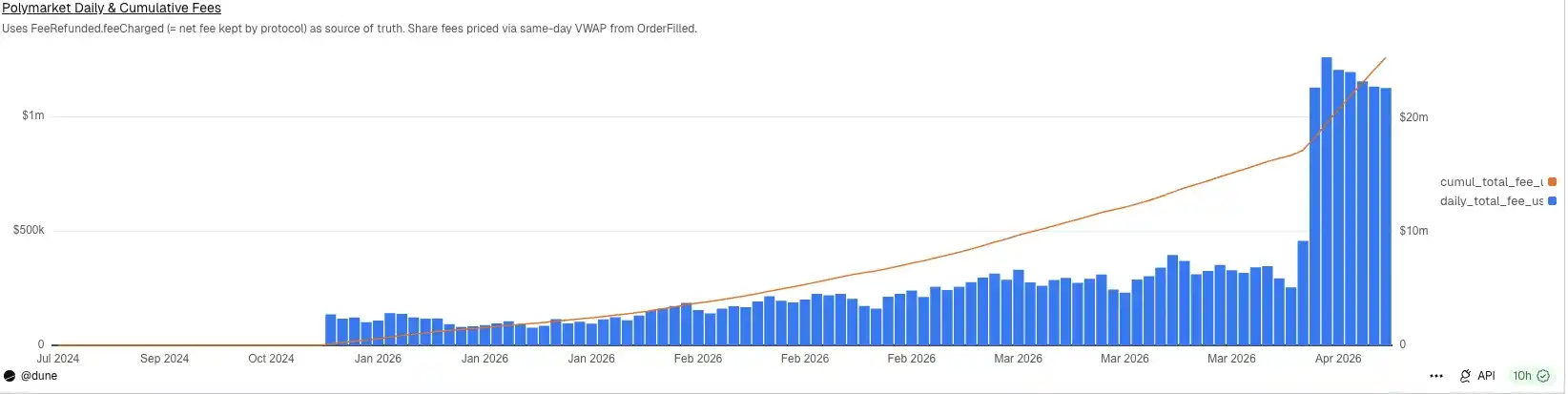
Polymarket's Daily Fee Income

Although impressive, it's not enough to satisfy Polymarket's ambitions. Prediction markets are currently the most sought-after赛道, but the business model ceiling isn't very high, the project's moat is relatively单一 (regulatory approval), and user stickiness isn't exceptionally strong. In the current landscape where everyone is doing prediction markets, how can Polymarket ensure it won't be surpassed by competitors in the future?

The answer it gives now is: I don't just match trades; I can also put players' money to work.

From a business essence perspective, the most attractive aspect of stablecoins over the years has never been fast payments and transfers, but the低调 yet highly profitable money-printing machine behind them—reserve asset yield. In 2025, the vast majority of Circle's income still came from reserve income. Polymarket understood this model, hence it launched Polymarket USD.

According to Dune data, the value of open interest on the Polymarket platform has exceeded $400 million. If all this money is converted into Polymarket USD, Polymarket simply needs to deposit the underlying collateral USDC into Circle's institutional account or place it in a U.S. Treasury protocol. At a risk-free rate of 4%-5%, it could earn tens of millions of dollars in "interest tax" annually just by sitting back.

Defillama founder 0xngmi even directly stated that Polymarket user wallets hold approximately $1.25 billion. If they keep this interest income, at current rates, they would gain an additional $54 million in annual revenue. Polymarket could even participate in DeFi wealth management with higher APYs, turning the idle funds on the prediction platform into active leverage and returning the到期收益 to users, effectively providing a hedge for users.
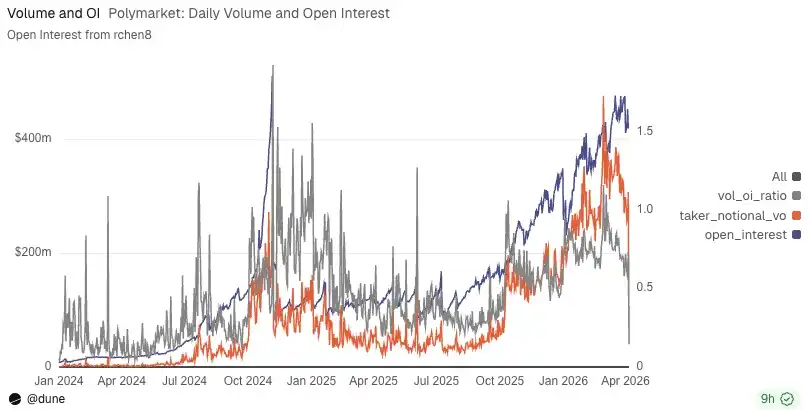
Polymarket's Daily OI and Trading Volume Curve

Prediction markets naturally have two characteristics: fund滞留 and high-frequency reallocation driven by events. Users' money doesn't truly enter and exit instantly like in a casino; it's either already in positions or sitting in accounts waiting for the next event, the next odds change. This type of money is most suitable for financial reprocessing, and for users, there's also a beautiful excuse: improving capital efficiency.

Of course, Polymarket hasn't publicly stated yet that it will definitely engage in yield extraction or on-chain wealth management after launching the stablecoin. But this path is almost a natural next step. As long as the scale of Polymarket USD grows larger in the future, it naturally gains the space to manage yields, expand collateral, and create financial combinations within the platform.

Some time ago, the《CLARITY Act》faced resistance for potentially prohibiting crypto companies from offering interest on stablecoins to users. If the outcome of the dispute remains a prohibition, all the above演绎 of Polymarket USD's potential would come to naught. But on April 6, according to U.S. media reports, the core disagreement between the U.S. crypto industry and banking over stablecoin yield mechanisms may be nearing resolution. Although details have not been disclosed, overall expectations are optimistic, and the《CLARITY Act》may enter the deliberation stage in committee in late April.

So, don't think Polymarket is far from this.

Polymarket Gains USDC Distribution Rights

The launch of the stablecoin by Polymarket has a third layer of significance: gaining USDC distribution rights.

As of today, Polymarket is still a major distribution scenario within the USDC ecosystem. Circle provides native USDC, Polymarket distributes USDC, and both sides are harmonious. Polymarket is currently experiencing strong growth momentum. Undoubtedly, the amount of USDC reserves沉淀 within its platform will grow larger in the future, potentially even becoming a distribution channel as important as Coinbase. When that time truly comes, the relationship between Polymarket and Circle might also change.

A reality in the stablecoin world is that distribution rights are as important as issuance rights, which is why Coinbase can take away over half of Circle's reserve income. Therefore, in the future, when Polymarket becomes a significant distributor of USDC, it will inevitably also gain bargaining power and be entitled to a large share of the reserve income. Furthermore, when Polymarket USD matures sufficiently, it could even explore multi-collateral backed stablecoins, not just relying solely on USDC.

This is also why I believe Polymarket USD is not an ordinary upgrade for Polymarket, but an identity update. Polymarket will evolve from "a platform collecting fees based on event volatility" to one that also兼具 "a platform organizing and清算 around the dollar".

The former is casino logic, while the latter is bank logic.

Polymarket's moat has thus gained another layer. It still maintains the beautiful narrative of information as the market and pricing facts early. But in terms of its business model, it is quietly moving itself to a more important position—no longer satisfied with being surface-level market traffic, no longer satisfied with仅仅 attracting users with odds, and no longer satisfied with continuing to cede the fattest part of the industry chain (asset reserve income) to others.


Questions liées

QWhat is the primary reason Polymarket is introducing its native stablecoin, Polymarket USD?

APolymarket is introducing Polymarket USD to transition from using USDC.e as collateral to a native stablecoin that is 1:1 backed by USDC. This allows Polymarket to settle user funds within its own ecosystem, effectively enabling it to hold and potentially generate revenue from the underlying USDC reserves.

QHow does the introduction of Polymarket USD change the platform's business model beyond transaction fees?

ABeyond transaction fees, Polymarket USD enables Polymarket to generate revenue from the idle USDC reserves backing the stablecoin. By investing these reserves in low-risk assets like U.S. Treasury bonds or Circle's institutional accounts, Polymarket could earn significant interest income, estimated at tens of millions of dollars annually.

QWhat are the potential benefits for users in the transition to Polymarket USD, according to the article?

AFor most users, the transition to Polymarket USD is seamless and requires only a single confirmation on the front end. The change also opens the possibility for Polymarket to improve capital efficiency for users by leveraging idle funds for yield-generating activities, potentially offering returns that act as a hedge.

QHow does the article describe the strategic shift in Polymarket's role within the stablecoin ecosystem?

AThe article describes the shift as Polymarket evolving from a prediction market platform that relies on external stablecoins to one that controls the issuance and distribution of its own stablecoin. This grants Polymarket greater negotiating power with partners like Circle and positions it as a key distributor of USDC, similar to Coinbase.

QWhat regulatory consideration is mentioned regarding Polymarket's ability to generate yield from stablecoin reserves?

AThe article mentions the U.S. CLARITY Act, which initially proposed banning crypto companies from offering interest on stablecoin holdings. However, recent reports suggest that disagreements between crypto and banking sectors are nearing resolution, with expectations leaning towards allowing such practices, which would enable Polymarket to pursue yield generation.

Lectures associées

Le projet de loi CLARITY atteint un moment charnière : la cryptomonnaie américaine à un carrefour réglementaire

Un tournant historique pour la régulation des cryptomonnaies aux États-Unis se joue en 2026. Le « CLARITY Act », loi cruciale pour définir la structure du marché des actifs numériques, doit être approuvé par la commission bancaire du Sénat avant fin avril, sans quoi son adoption pourrait être reportée de plusieurs années. Parallèlement, le « GENIUS Act », déjà adopté, impose un cadre prudentiel aux stablecoins, favorisant une concentration du marché autour d’acteurs conformes comme USDC et USAT (la nouvelle entité de Tether pour le marché institutionnel américain), tout en comprimant la place de l’USDT. Un compromis bipartisan, mené par les sénateurs Tillis et Alsobrooks, propose d’autoriser les récompenses sur les stablecoins liées à des activités, mais d’interdire les rendements passifs purs, une question au cœur des tensions avec le secteur bancaire traditionnel. La Maison Blanche, sous Trump, pousse pour une adoption rapide, mais fait face à des défis politiques, notamment sur les conflits d’intérêts des responsables gouvernementaux. Si la loi est adoptée, elle pourrait déclencher l’entrée de billions de dollars de capitaux institutionnels (fonds de pension, assureurs) et aligner les standards américains avec le règlement européen MiCA, renforçant la compétitivité mondiale des États-Unis. Son rejet profiterait aux places financières concurrentes comme l’UE, Hong Kong ou Singapour, et retarderait considérablement l’intégration des cryptomonnaies dans le système financier traditionnel. La conformité réglementaire devient l’avantage compétitif décisif pour l’avenir.

marsbitIl y a 3 h

Le projet de loi CLARITY atteint un moment charnière : la cryptomonnaie américaine à un carrefour réglementaire

marsbitIl y a 3 h

Trading

Spot
Futures

Articles tendance

Qu'est ce que $BANK

Banque IA : Une étape révolutionnaire vers l'avenir de la banque Introduction À une époque marquée par de rapides avancées technologiques, Banque IA se trouve à l'intersection de l'intelligence artificielle (IA) et des services bancaires. Ce projet innovant cherche à redéfinir le paysage financier, en améliorant l'efficacité opérationnelle, les mesures de sécurité et l'expérience client grâce à la puissance de l'IA. Alors que nous nous engageons dans cette exploration de Banque IA, nous allons examiner ce que le projet implique, sa dynamique opérationnelle, son contexte historique et ses jalons significatifs. Qu'est-ce que Banque IA ? Au cœur de Banque IA se trouve une initiative transformative visant à intégrer l'intelligence artificielle dans diverses opérations bancaires. Ce projet exploite les capacités de l'IA pour automatiser les processus, améliorer les protocoles de gestion des risques et améliorer l'interaction avec les clients grâce à des services personnalisés. Les objectifs principaux de Banque IA incluent : Automatisation des fonctions bancaires : En tirant parti des technologies de l'IA, Banque IA vise à automatiser les tâches routinières, réduisant ainsi la charge pesant sur les ressources humaines et améliorant l'efficacité. Gestion des risques améliorée : Le projet utilise des algorithmes d'IA pour prédire et identifier les risques, renforçant ainsi les mesures de sécurité contre la fraude et d'autres menaces. Personnalisation des services bancaires : Banque IA se concentre sur l'offre de produits et services financiers sur mesure en analysant les données et les comportements des clients. Amélioration de l'expérience client : La mise en œuvre de solutions propulsées par l'IA, telles que des chatbots et des assistants virtuels, vise à fournir aux utilisateurs des interactions plus humaines, révolutionnant ainsi la manière dont les clients interagissent avec les banques. Avec ces objectifs, Banque IA se positionne comme un acteur clé pour rendre la banque plus efficace, sécurisée et centrée sur l'utilisateur. Qui est le créateur de Banque IA ? Les détails concernant le créateur de Banque IA restent inconnus. Ainsi, aucune personne ou organisation spécifique n'a été identifiée dans les informations disponibles. L'anonymat entourant l'origine du projet soulève des questions mais ne diminue pas sa vision ambitieuse et ses objectifs. Qui sont les investisseurs de Banque IA ? Comme pour le créateur du projet, des informations spécifiques concernant les investisseurs ou les organisations de soutien de Banque IA n'ont pas été divulguées. Sans ces informations, il est difficile de décrire le soutien financier et institutionnel qui pourrait propulser le projet en avant. Néanmoins, l'importance d'une base d'investissement solide est essentielle pour soutenir le développement dans un domaine aussi innovant. Comment fonctionne Banque IA ? Banque IA opère sur plusieurs fronts novateurs, en se concentrant sur des facteurs uniques qui la différencient des cadres bancaires traditionnels. Voici les principales caractéristiques opérationnelles : Automatisation : En appliquant des algorithmes d'apprentissage automatique, Banque IA automatise divers processus manuels au sein des banques. Cela entraîne une réduction des coûts opérationnels et permet aux travailleurs humains de réorienter leurs efforts vers des activités plus stratégiques. Gestion des risques avancée : L'intégration de l'IA dans les pratiques de gestion des risques équipe les banques d'outils pour prédire avec précision les menaces potentielles telles que la fraude, garantissant ainsi que les informations et les actifs des clients restent sécurisés. Recommandations financières sur mesure : Grâce à un apprentissage continu des interactions avec les clients, les systèmes d'IA développent une compréhension nuancée des besoins des utilisateurs, leur permettant d'offrir des conseils personnalisés sur les décisions financières. Interactions client améliorées : En utilisant des chatbots et des assistants virtuels alimentés par l'IA, Banque IA permet une expérience client plus engageante, permettant aux utilisateurs de résoudre rapidement leurs questions, réduisant ainsi les temps d'attente et améliorant les niveaux de satisfaction. Ensemble, ces caractéristiques opérationnelles positionnent Banque IA comme un pionnier dans le secteur bancaire, établissant de nouvelles normes pour la prestation de services et l'excellence opérationnelle. Ligne du temps de Banque IA Comprendre la trajectoire de Banque IA nécessite un examen de son contexte historique. Voici une chronologie soulignant les jalons et développements importants : Début des années 2010 : La conceptualisation de l'intégration de l'IA dans les services bancaires a commencé à attirer l'attention alors que les institutions bancaires reconnaissaient les avantages potentiels. 2018 : Une augmentation marquée de l'implémentation des technologies d'IA s'est produite lorsque les banques ont commencé à utiliser des outils d'IA comme des chatbots pour le service client de base et des systèmes de gestion des risques pour une meilleure sécurité. 2023 : La sophistication de l'IA a continué à avancer, avec l'introduction de l'IA générative pour des tâches plus complexes telles que le traitement de documents et l'analyse d'investissement en temps réel. Cette année a marqué un bond significatif dans les capacités offertes aux banques par la technologie IA. 2024-État actuel : À partir de cette année, Banque IA est sur une trajectoire ascendante, avec des recherches et des développements en cours prêts à améliorer encore les capacités dans les opérations bancaires. Une exploration continue des applications de l'IA laisse présager des développements passionnants à venir. Points clés sur Banque IA Intégration de l'IA dans la banque : Banque IA se concentre sur l'adoption de l'intelligence artificielle pour rationaliser les processus bancaires et améliorer les expériences des utilisateurs. Concentration sur l'automatisation et la gestion des risques : Le projet met fortement l'accent sur ces domaines, visant à transférer la charge des tâches routinières tout en renforçant les cadres de sécurité grâce à l'analyse prédictive. Solutions bancaires personnalisées : En exploitant les données clients, Banque IA permet des services bancaires sur mesure qui répondent aux besoins individuels des utilisateurs. Engagement envers le développement : Banque IA reste engagée dans des efforts de recherche et développement continus, garantissant son adaptabilité et sa pertinence continue à mesure que la technologie continue d'évoluer. Conclusion En résumé, Banque IA illustre un pas crucial en avant dans l'industrie bancaire, exploitant l'intelligence artificielle pour remodeler les paradigmes opérationnels, renforcer la sécurité et promouvoir la satisfaction des clients. Malgré des lacunes d'informations concernant le créateur et les investisseurs, les objectifs clairs et les mécanismes fonctionnels de Banque IA fournissent une base solide pour son évolution continue. Alors que la technologie IA continue d'avancer et de se fusionner avec le secteur bancaire, Banque IA est bien positionnée pour avoir un impact significatif sur l'avenir des services financiers, améliorant la manière dont nous comprenons et interagissons avec la banque.

114 vues totalesPublié le 2024.04.06Mis à jour le 2024.12.03

Qu'est ce que $BANK

Comment acheter BANK

Bienvenue sur HTX.com ! Nous vous permettons d'acheter Lorenzo Protocol (BANK) de manière simple et pratique. Suivez notre guide étape par étape pour commencer votre parcours crypto.Étape 1 : Création de votre compte HTXUtilisez votre adresse e-mail ou votre numéro de téléphone pour ouvrir un compte sur HTX gratuitement. L'inscription se fait en toute simplicité et débloque toutes les fonctionnalités.Créer mon compteÉtape 2 : Choix du mode de paiement (rubrique Acheter des cryptosCarte de crédit/débit : utilisez votre carte Visa ou Mastercard pour acheter instantanément Lorenzo Protocol (BANK).Solde :utilisez les fonds du solde de votre compte HTX pour trader en toute simplicité.Prestataire tiers :pour accroître la commodité d'utilisation, nous avons ajouté des modes de paiement populaires tels que Google Pay et Apple Pay.P2P :tradez directement avec d'autres utilisateurs sur HTX.OTC (de gré à gré) : nous offrons des services personnalisés et des taux de change compétitifs aux traders.Étape 3 : stockage de vos Lorenzo Protocol (BANK)Après avoir acheté vos Lorenzo Protocol (BANK), stockez-les sur votre compte HTX. Vous pouvez également les envoyer ailleurs via un transfert sur la blockchain ou les utiliser pour trader d'autres cryptos.Étape 4 : tradez des Lorenzo Protocol (BANK)Tradez facilement Lorenzo Protocol (BANK) sur le marché Spot de HTX. Il vous suffit d'accéder à votre compte, de sélectionner la paire de trading, d'exécuter vos trades et de les suivre en temps réel. Nous offrons une expérience conviviale aux débutants comme aux traders chevronnés.

361 vues totalesPublié le 2025.05.09Mis à jour le 2025.05.09

Comment acheter BANK

Discussions

Bienvenue dans la Communauté HTX. Ici, vous pouvez vous tenir informé(e) des derniers développements de la plateforme et accéder à des analyses de marché professionnelles. Les opinions des utilisateurs sur le prix de BANK (BANK) sont présentées ci-dessous.

活动图片