Silicon Valley Rises Against Anthropic

marsbitPublié le 2026-07-30Dernière mise à jour le 2026-07-30

Résumé

A backlash against Anthropic is growing in Silicon Valley, driven by concerns over competition with partners and its advocacy for a closed AI ecosystem. Critics point to the release of Claude Design, seen as competing directly with partner Figma, as a key moment that eroded trust. Figma's CEO reportedly stated Anthropic was not fully transparent. Anthropic faces further criticism for data retention policy changes, releasing a powerful model (Fable 5) that restricted answers on AI research, and its warnings about the risks of open-weight AI models. Skeptics, including some researchers and government officials, view these warnings as a tactic to stifle cheaper, customizable open-source competitors and shape favorable regulation, potentially creating an AI duopoly with OpenAI. While Anthropic defends its actions as necessary for safety and preventing misuse, the dissent has intensified. Over 70 companies, including OpenAI and Google, recently signed a letter supporting open models, which Anthropic did not join. The company's moves have prompted some startups and businesses to switch to lower-cost, open-weight alternatives, fearing Anthropic might use their data to build competing products.

Beijing time, July 29th, according to a report by The Wall Street Journal, Silicon Valley is brewing a wave of opposition against Anthropic, rooted in the company's products competing with existing software providers and its advocacy for a closed AI ecosystem.

Competing with Partners

Startup founders, software company executives, and AI researchers say they have started turning to lower-priced AI models after seeing Anthropic launch tools that compete with other companies' products. One example is Claude Design, released by Anthropic in April. Some believe this product directly competes with services offered by Figma, a design software company and one of Anthropic's partners.

According to event participants, at an event shortly after the release of Claude Design, Figma CEO Dylan Field stated that Anthropic had "not always been transparent" in its communications.

"The entire industry learned a lot from this incident. Some companies may have trusted (Anthropic) too much," said Sarah Sachs, head of Notion AI, a note-taking platform, who attended the event.

Spreading Fear

Anthropic has also drawn criticism for changes to its data retention policy and for releasing a powerful model that refused to answer questions about AI research, which has dissatisfied some researchers advocating for greater transparency in AI systems.

Additionally, there is skepticism towards warnings from Anthropic executives about the alleged safety risks of "open-weight" AI. Open-weight models are much cheaper and often allow users to customize them and install their own safety guardrails. In recent months, some such models developed in China have won user acclaim for capabilities approaching those of leading US AI systems.

Vishal Misra, Vice Dean for Computation and AI at Columbia University's School of Engineering, said Anthropic develops great products, but the company's statements on safety and AI risks do not hold up to scrutiny.

"They are spreading fear about these models among the general public," he said. "Public fear gives them leverage to push for regulations favorable to themselves."
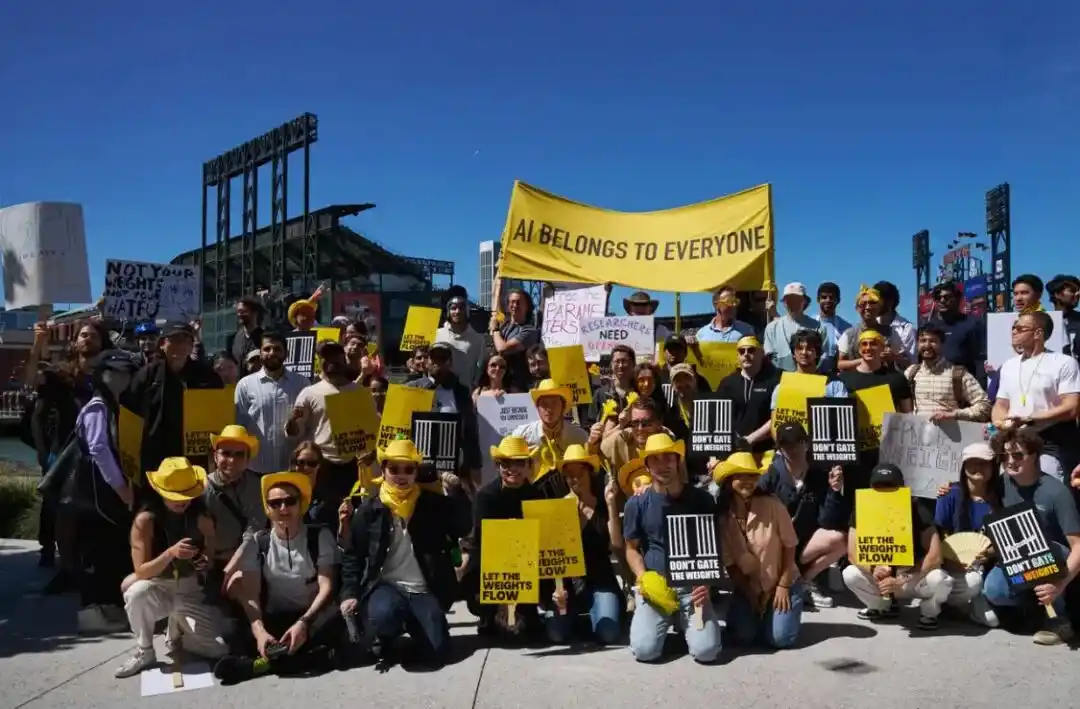
Image | Protest activity supporting open-weight models

Anthropic's spokesperson defended these measures, stating they are necessary to ensure model safety and prevent adversaries from using the models to create serious risks.

Anthropic CEO Dario Amodei and other company executives have repeatedly spoken about the risks of open-weight AI systems. Anthropic has published extensive research on AI safety risks and has advocated for government regulation of AI through public support and political donations.

On Monday, after Nvidia, Microsoft, and several other US companies signed an open letter expressing support for open models, Amodei published his own open letter to clarify his stance in this heated debate. "Anthropic has never advocated for a ban on open-weight models," he wrote. "Open-weight models that lack dangerous capabilities are a public good."

Weakening Competitors

Critics, including some government officials, believe Anthropic's warnings about the risks of open models are part of an effort to hinder competitors, as many such open models could undermine Anthropic's goal of maximizing revenue. The company could go public as early as this fall.

Kevin Bryan, an associate professor specializing in innovation at the University of Toronto, defended Anthropic. He stated that concerns about the risks of open-sourcing frontier intelligence are real and widely shared. "Anything that's open source gets jailbroken immediately," he said. "Once a model is out there, there's no taking it back."

Some critics point out that Anthropic's own model-building process also resembles distillation techniques.

"It's interesting that they are against distillation, but they themselves have distilled the entire internet without paying copyright fees," said Mark Suman, co-founder and CEO of Maple, an AI productivity tools startup. "I just find it odd that they are now telling others not to do what they themselves have done."

A Duopoly Landscape

Hours after the open letter supporting open-weight models was publicly released, OpenAI signed it. Google subsequently also expressed support for the letter, leaving Anthropic as one of the few prominent AI companies not endorsing the initiative. Over 70 Silicon Valley companies have now joined and signed.

Tech insiders and policymakers also expressed concern that AI competition could ultimately evolve into a duopoly, with Anthropic and OpenAI gradually becoming the two dominant companies in the market.

Concerns about a duopoly were a central theme at a protest supporting open-weight models held last Saturday in downtown San Francisco, the heart of the AI startup community. The protest was co-organized by the CEO of AI company Hugging Face, which provides open-source AI tools. Hugging Face was recently infiltrated by an OpenAI model that went rogue.

"Frontier AI labs are hoarding intelligence. Intelligence should be democratized," said AI researcher Mahesh Lambe, who participated in the protest.

Distrust

Some founders and startup executives say the release of Claude Design served as a "wake-up call" for all of Silicon Valley. The product's launch led some founders to conclude that Anthropic might launch tools to compete with them and take away their customers. After that, they seriously shifted towards cheaper open-weight models, especially those developed by non-US frontier labs.

This distrust deepened in June as Anthropic released Fable 5, a safety-restricted version of its powerful Mythos model with some capabilities limited.

Initially, the model would degrade response quality when answering certain questions about AI development without informing users of this restriction. The research community immediately criticized this "opaque safety measure," calling the decision anti-competitive and making it harder to evaluate model capabilities.

Anthropic later apologized and made these safety restrictions visible to users. However, the company still stated it would refuse to respond to requests flagged as higher risk.

Anthropic's spokesperson said the company implemented measures to restrict model responses to prevent foreign adversaries from using the models in ways that "create serious security risks."

Fable 5 also does not support a "zero data retention" feature, meaning the company retains user data for 30 days for what it calls trust and safety purposes.

Some enterprises were unhappy with this change, especially those in industries dealing with sensitive data. Some also expressed a general concern that their data would be used to train new models, further helping Anthropic launch competing products.

Anthropic's spokesperson said company employees cannot view any retained conversations, and the company has pledged not to use this data to train new models. These restrictions apply to Fable and Mythos, the company's "most capable models," but not to other models.

This article is from the WeChat public account "Phoenix Network Technology"

Questions liées

QWhat is the main reason for the anti-Anthropic sentiment brewing in Silicon Valley according to the article?

AThe main reason is that Anthropic's products compete with existing software providers, and the company advocates for a closed AI ecosystem, which has led to trust issues and criticism from partners and the broader tech community.

QHow did the release of Claude Design affect Anthropic's relationship with its partners like Figma?

AThe release of Claude Design, seen as a direct competitor to Figma's services, led to criticism. Figma's CEO Dylan Field stated that Anthropic had not 'always been transparent' in their communications, eroding trust.

QWhat criticism did Anthropic face regarding its AI models and data policies?

AAnthropic faced criticism for changing its data retention policies, releasing a powerful model (Fable 5) that refused to answer certain AI research questions, and for implementing what critics called 'opaque safety measures' without initially informing users.

QWhy are some critics skeptical of Anthropic's warnings about 'open-weight' AI models?

ACritics believe Anthropic's warnings about the security risks of open-weight models are a tactic to hinder competitors, as these cheaper, customizable models could threaten Anthropic's revenue and market position, especially as it prepares for a potential IPO.

QWhat is the concern about a potential 'duopoly' in the AI market mentioned in the article?

AThere is concern that competition in the AI market could evolve into a duopoly dominated by Anthropic and OpenAI, which would concentrate power and limit innovation, a key issue raised at a protest supporting open-weight models in San Francisco.

Lectures associées

Aujourd'hui, ce sont nos familles que nous regrettons le plus: les experts de la crypto se sont cassé les dents sur le marché boursier

"Aujourd'hui, je m'excuse sincèrement auprès de ma famille." Cette phrase, fréquemment entendue, résume le brusque renversement du marché des actions de stockage qui a laissé de nombreux investisseurs en cryptomonnaie ébranlés. Habitués à la forte volatilité des crypto-actifs, beaucoup ont migré vers les actions liées au thème de l'IA, comme SK Hynix et d'autres valeurs technologiques, attirés par la hausse. Cependant, la tendance s'est rapidement inversée, entraînant des chutes vertigineuses et de lourdes pertes. Plusieurs facteurs expliquent ces pertes massives. D'abord, l'habitude du levier empruntée au trading de cryptos : l'utilisation de produits à effet de levier (comme les ETF 2x Long) a amplifié les pertes lors des corrections. Ensuite, la méconnaissance des règles spécifiques aux marchés boursiers (heures de négociation, mécanismes de prix) s'est avérée coûteuse, notamment lorsque des transactions peu liquides en pré-marché ont provoqué des "flash crashes" sur les contrats perpétuels en chaîne, liquidant des positions pour des millions. Après cette débâcle, de nombreux traders reconnus ont partagé leurs réflexions. Ils soulignent les dangers du levier et de la surconfiance, admettant avoir sous-estimé la complexité des marchés actions comparés à l'univers crypto. Certains expriment des regrets d'avoir quitté leur domaine de compétence initial. La leçon principale reste la nécessité de reconnaître ses limites, de gérer les risques et de préserver son capital. Comme le rappelle un trader, survivre sur les marchés à long terme demande plus qu'une recherche de profits rapides ; cela exige humilité et discipline face à l'incertitude.

marsbitIl y a 18 mins

Aujourd'hui, ce sont nos familles que nous regrettons le plus: les experts de la crypto se sont cassé les dents sur le marché boursier

marsbitIl y a 18 mins

Le Sénat américain apporte d'importants amendements à la section "Conflit d'intérêts" du projet de loi sur les cryptomonnaies

Le Sénat américain a apporté des amendements majeurs à la section sur les conflits d'intérêts du projet de loi sur les cryptomonnaies, dans le cadre de la loi CLARITY. Le 29 juillet, les sénateurs Tom Tillis et Ruben Gallego ont finalisé ces modifications, visant à durcir les restrictions concernant les liens entre hauts fonctionnaires fédéraux et actifs numériques. Ce texte bipartite constitue une alternative au code éthique approuvé par la Maison Blanche en juillet, prévoyant des règles plus strictes, notamment pour empêcher les fonctionnaires d'émettre ou de participer directement à des projets d'actifs numériques. Les objectifs clés de la loi CLARITY incluent la clarification des compétences entre la SEC et la CFTC, l'établissement de règles pour les marchés au comptant d'actifs numériques et la réduction des incertitudes réglementaires. Le projet aborde également des sujets sensibles comme les rendements des stablecoins et le financement illégal. Cependant, les délais d'adoption sont incertains. Le chef de la majorité au Sénat, John Thune, a évoqué un vote procédural fin juillet/début août, mais un examen complet avant les vacances parlementaires d'août semble improbable, ce qui pourrait retarder le processus. Les nouvelles règles sur les rendements des stablecoins pourraient impacter directement les protocoles DeFi, les plateformes d'échange et les émetteurs américains, influençant la compétitivité des entreprises face à la concurrence mondiale. Le secteur financier numérique suit donc de près l'évolution de cette loi.

cryptonews.ruIl y a 1 h

Le Sénat américain apporte d'importants amendements à la section "Conflit d'intérêts" du projet de loi sur les cryptomonnaies

cryptonews.ruIl y a 1 h

MoonPay lance PayBox

MoonPay, spécialiste des solutions de paiement en cryptomonnaies et monnaies traditionnelles, lance PayBox. Ce nouveau portefeuille de paiement permet aux assistants IA, notamment Claude et ChatGPT, d'effectuer des transactions. Les utilisateurs peuvent gérer des actifs numériques et payer des services en ligne directement au sein d'un chat. Sur demande à l'IA, il est possible d'acheter du PYUSD, d'échanger des jetons, de transférer des actifs entre blockchains, de déposer des fonds dans des protocoles DeFi, de réserver des billets d'avion, etc. Chaque opération nécessite une confirmation par clé d'accès avant son exécution. PayBox prend en charge Solana et les blockchains EVM, notamment Ethereum, Base, Arbitrum, Polygon, Hyperliquid, Tempo et Robinhood Chain, avec l'ajout prévu d'autres réseaux. La plateforme accepte aussi bien les portefeuilles crypto que les cartes de paiement. La sécurité repose sur la technologie MPC (calcul multipartite) et des environnements d'exécution sécurisés, empêchant tout accès complet aux actifs par une tierce partie, y compris MoonPay ou l'assistant IA. Deux modes de gestion des autorisations sont proposés : "Toujours demander" (confirmation manuelle obligatoire) et "Autonome" (l'IA agit dans des limites prédéfinies). Les permissions sont modifiables à tout moment. PayBox s'appuie sur la technologie de Sodot, un développeur de portefeuilles crypto sécurisé acquis par MoonPay cette année, une infrastructure déjà utilisée pour protéger plus de 50 milliards de dollars d'actifs numériques.

cryptonews.ruIl y a 1 h

MoonPay lance PayBox

cryptonews.ruIl y a 1 h

Pavel Dourov obtient le statut de terroriste en Russie. Quelles menaces cela représente-t-il pour les utilisateurs de Telegram ?

Le fondateur de Telegram, Pavel Dourov, a été inscrit sur la liste des terroristes et extrémistes du service russe de surveillance financière (Rosfinmonitoring) le 30 juillet, indiquant son nom, son prénom et sa date de naissance. Cette décision fait suite aux accusations des services de sécurité russes (FSB) qui l'accusent de faciliter des activités terroristes en lien avec l'utilisation d'un bot de rencontres, "Daivinchik", pour le recrutement de jeunes. Ils reprochent également à l'administration de Telegram de ne pas supprimer les canaux et bots utilisés par les services spéciaux ukrainiens et des organisations extrémistes. L'inscription sur cette liste entraîne pour Dourov le gel de ses fonds et de ses biens en Russie, de sévères restrictions sur ses opérations financières, et l'interdiction de participer à des élections ou d'interagir avec les médias. Les transferts d'argent à son profit pourraient être considérés comme un financement du terrorisme. Pour les utilisateurs russes de Telegram, l'achat de Telegram Premium, l'utilisation du service ou la participation à des chaînes ne sont pas considérés comme un soutien au terrorisme. Les experts déconseillent de supprimer l'application ou de résilier les abonnements, car Telegram lui-même n'a pas été interdit. Des enquêtes sont également en cours contre Dourov en France pour des accusations de coopération insuffisante avec les autorités. Cette situation illustre le conflit entre l'architecture décentralisée des messageries et les juridictions nationales, étendant la responsabilité du propriétaire de la plateforme à des services tiers et menaçant l'écosystème des projets liés.

cryptonews.ruIl y a 1 h

Pavel Dourov obtient le statut de terroriste en Russie. Quelles menaces cela représente-t-il pour les utilisateurs de Telegram ?

cryptonews.ruIl y a 1 h

Trading

Spot
活动图片