Geopolitical Risks Persist, Bitcoin Becomes a Key Barometer?

marsbitPublié le 2026-04-20Dernière mise à jour le 2026-04-20

Résumé

Amid escalating geopolitical tensions in the Middle East, particularly around Iran and the Strait of Hormuz, and a sudden injection of nearly $200 billion in liquidity by the Federal Reserve and the U.S. Treasury, financial markets are caught in a tug-of-war between liquidity-driven gains and risk-off sentiment. Bitcoin is emerging as a key indicator in this environment due to its high sensitivity to liquidity shifts. It has historically acted as a leading signal—declining ahead of equity downturns and recovering before broader markets. Currently, its ability to break above the $80,000–$85,000 resistance level will test whether recent liquidity injections can outweigh geopolitical uncertainties. Failure to do so may signal underlying weaknesses, potentially in private credit or fading liquidity impact. Other indicators show mixed signals: The CNN Fear & Greed Index reflects greed, volatility indices are relatively calm, and major equity indices like the S&P 500 and Nasdaq have hit new highs. However, the situation remains fragile, with Iran-related risks capable of swiftly reversing sentiment. The key question is whether liquidity or geopolitical risk will dominate market pricing in the near term.

Editor's Note: Just as the market regained upward momentum driven by liquidity, new uncertainties have begun to accumulate on the other end. The situation in Iran has reversed again, and the risks in the Strait of Hormuz are emerging, bringing geopolitical conflicts back to the core variable of asset pricing. Within just a few days, the market has shifted from the single logic of "fund-driven" to a dual game of "liquidity vs. risk events."

The current market is in a tug-of-war between "liquidity-driven gains" and "risk shocks from the escalation of the Iran situation." On one hand, the Federal Reserve and the U.S. Treasury injected nearly $200 billion in liquidity into the financial system in a short period, driving a rapid rebound in stocks and risk assets; on the other hand, geopolitical uncertainty, private credit risks, and overheated sentiment continue to make the market fragile.

In this structure, Bitcoin's role is beginning to change. Unlike traditional risk assets, it is more sensitive to changes in liquidity and often gives signals first when the funding environment shifts. Historical experience shows that whether it was the early decline in October 2025 or the率先 stabilization in this round of rebound, Bitcoin has, to some extent, played the role of a "leading indicator."

Therefore, the question is no longer just "will the market rise," but—as liquidity continues to be released and war risks resurface, which force will dominate pricing? If funds cannot continuously hedge external shocks, the current gains may only be a temporary mismatch; if liquidity persists, the market may continue to rise amid fluctuations.

What matters next is not a single variable, but their relative strength. And Bitcoin may once again be the asset that provides the earliest answer.

Below is the original text:

"Oh, think twice, 'cause it's another day for you and me in paradise." —Phil Collins

For traders and investors, Friday was an unusual trading day. But Monday is still some time away, and the market is already brewing new variables—as early as Saturday morning, reports indicated that Iran's stance on the Strait of Hormuz issue had reversed, which could once again trigger market turbulence.

Additionally, Friday's rebound has pushed market sentiment indicators (see below) to a relatively fragile level, making the market more prone to corrections. This has plunged the market into a "tug-of-war": on one side is the massive liquidity injection discussed below, and on the other is the uncertainty brought by the potential reversal of the Iran war situation.

What Just Happened?

The impact of liquidity on the market is facing a test—against the potential further escalation of Iran war volatility.

Q: What happens when approximately $200 billion floods into the financial system almost simultaneously?

A: Asset prices experience a sharp "melt-up."

Lately, I've been focusing on four factors collectively suppressing the stock market: the Iran war, the liquidity crunch in the financial system that has persisted since January this year, widespread market pessimism, and insufficient understanding of the true state of the private credit market.

But last week, these factors were almost "all overturned": the liquidity crunch reversed, the Iran situation seemed to ease, and market pessimism once again proved to be—as it often is—a leading indicator of a potential stock market rebound.

Are we out of the woods? No one can be sure, as the Iran situation is heating up again. Moreover, if investors re-enter "panic mode," liquidity could dry up again. And we still lack a clear understanding of what is happening in the private credit market.

For now, however, let's focus on a relatively observable variable: liquidity.

Dual "Liquidity Tsunamis"

If you're wondering where the money driving the stock market rally over the past two weeks came from—think again: the answer is the Federal Reserve and the U.S. Treasury. Around April 15, the two injected approximately $200 billion into the financial system combined, providing traders with a "Tax Day buffer."

First, the first "barrel"—the Federal Reserve.

On April 15, the Fed injected nearly $110 billion into the market through repo operations (via Treasury bonds and mortgage-backed securities). This alone is not insignificant, but more crucially, the Fed is still injecting about $40 billion per month into the market through its Reserve Management Purchase (RMP) program.

The real focus is on the second "barrel"—the U.S. Treasury.

Drawing on Garret Baldwin's analysis, the U.S. Treasury injected approximately $140 billion to $200 billion into the market during the same period. That is, roughly speaking, without any formal quantitative easing (QE) announcement, the Fed and the Treasury quietly injected close to $240 billion in liquidity into the market.

It's not hard to understand why the stock market experienced an explosive rally.

The More Subtle Part: The Treasury's Operations

How did the Treasury accomplish this "covert operation"?

The key lies in an account—the "U.S. Treasury General Account" (TGA) held at the Fed. When the balance of this account rises, it usually signals tightening liquidity; when the balance falls, it means liquidity is being released.

According to Garret's calculations, around Tax Day, the balance of this "checking account" of the U.S. government at the Fed dropped from about $837 billion to about $697 billion. And on April 15, it rose back to about $924 billion.

The key is that about $140 billion of this had already flowed into the banking system before Tax Day, meaning the financial system was actually in a "liquidity-abundant" state before April 15.

Even more interestingly, the U.S. National Financial Conditions Index (NFCI, tracked weekly in this report) reversed its previous tightening trend in the latest data (April 10).

We pointed out this change in the daily report of "Smart Money Passport": "The Fed injected about $10.5 billion into the financial system that day, while the NFCI index fell for the first time since January 23, 2026. The combination of these two signals may indicate that the Fed has adjusted its liquidity-tightening stance."

The biggest suspense now is: will liquidity take the lead, or will a new round of escalation in the Iran war once again become the core variable for the market.

Bitcoin Starts to "Act": Why It's a Barometer of Liquidity

Bitcoin's performance next is crucial.

Because compared to stocks, Bitcoin is more sensitive to liquidity. Therefore, its performance after recently breaking through $75,000, and whether it can challenge the $80,000–$85,000 range, deserves close attention.

From a technical perspective, the resistance in the $80,000–$85,000 range is not strong. The volume-by-price (VBP) distribution in this range is relatively thin, indicating that no effective support was formed during the previous decline. Therefore, under normal circumstances, this level should not pose strong resistance during a price recovery.

If the rally fails here, it implies two things: first, the market lacks confidence in this rebound; second, there may be issues with liquidity itself. More importantly, if Bitcoin cannot break through this key range, it may also mean that the "liquidity tsunami" created by the Fed and the Treasury is rapidly receding.

If $200 billion in bank reserves are digested by the market in just a few weeks, it would be a dangerous signal. This could mean that risks are accumulating in the private credit market or elsewhere.

Don't forget, Bitcoin's decline in October 2025 accurately predicted the stock market's troubles in 2026. At the same time, Bitcoin stabilized weeks before the stock market bottomed and rallied ahead of time when the Fed and the Treasury released liquidity.

Against the backdrop of the evolving Iran situation and unresolved global risks, any weakness in Bitcoin should not be ignored.
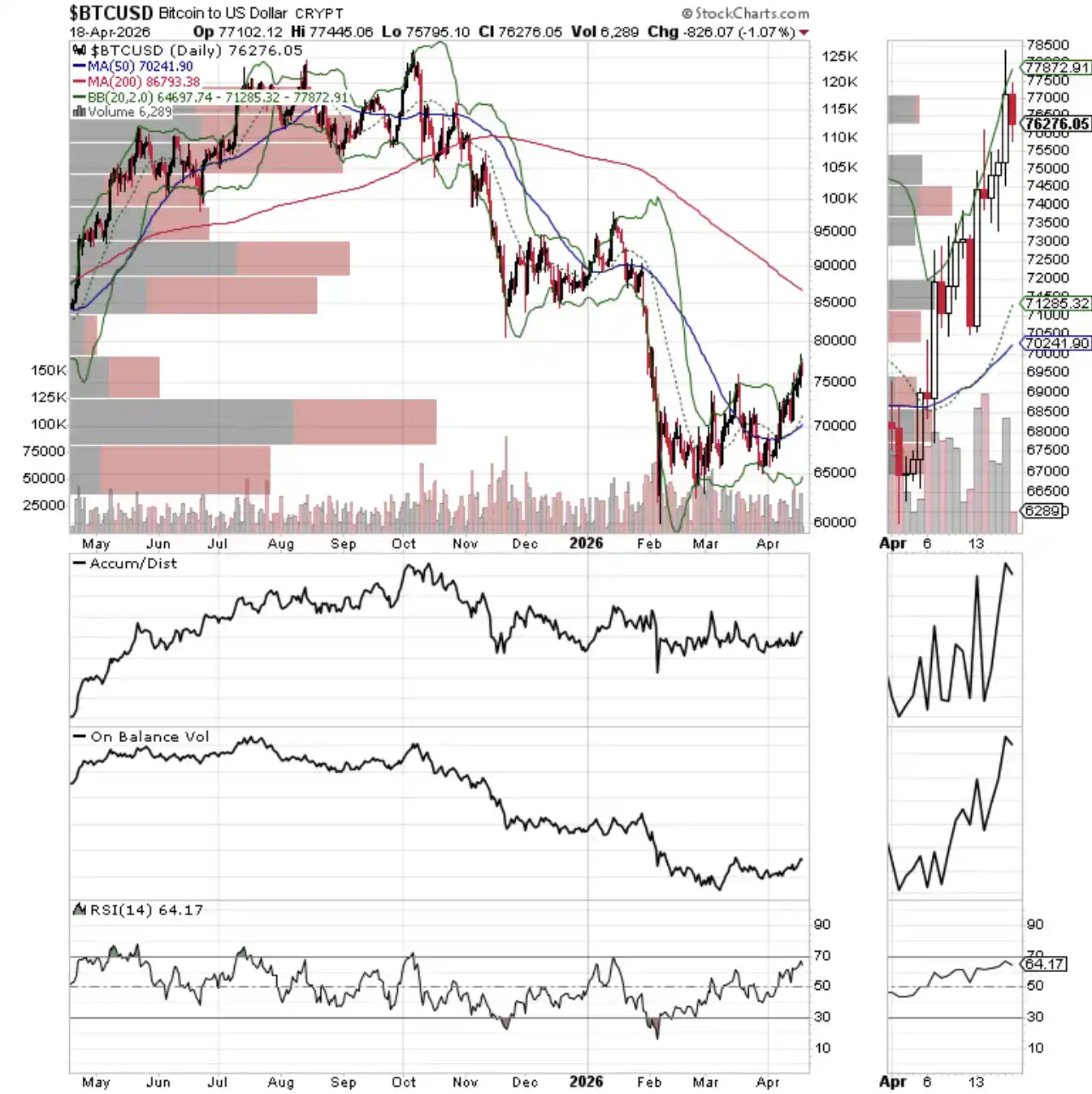
The $70,000–$75,000 range is a key support level.

Sentiment Summary: Market Suddenly Turns Fully Optimistic

The CNN Fear & Greed Index (GFI) closed at 68 on April 17, 2026, in the "Greed" zone.

CoinMarketCap's Crypto Fear & Greed Index was at 59 on Saturday morning, in the relatively high "Neutral" level.

The Chicago Board Options Exchange (CBOE) Total Put/Call Ratio was 0.65, with the index options P/C ratio closing at 0.82. The options market sentiment overall remains neutral, but as bullish sentiment heats up rapidly, it is gradually tilting towards the bearish area.

The CBOE Volatility Index (VIX) closed at 17.48, a relatively positive level. However, it could still rise back above 20 (often seen as the risk警戒线) in the short term.

It's worth noting that the VIX typically rises when traders heavily buy put options. Increased demand for puts forces market makers to hedge by selling stock index futures, thereby putting downward pressure on the market.

Conversely, when the VIX falls, it means reduced demand for puts, market sentiment turns optimistic, and more call buying often follows. This prompts market makers to buy stock index futures to hedge risks, increasing the probability of stock market gains.

Liquidity Watch

1. Bullish: Liquidity is easing

The National Financial Conditions Index (NFCI) released by the Federal Reserve, in its latest reading for March 27, 2026 (published April 10), was -0.47, down from the previous week's -0.44, indicating that financial conditions are easing and liquidity is improving.

A decline in NFCI is usually seen as a bullish signal, and a negative index means market liquidity is relatively abundant.

2. Bond yields retreat

U.S. Treasury yields fell in the latter part of the week, but could rise again depending on developments in Iran.
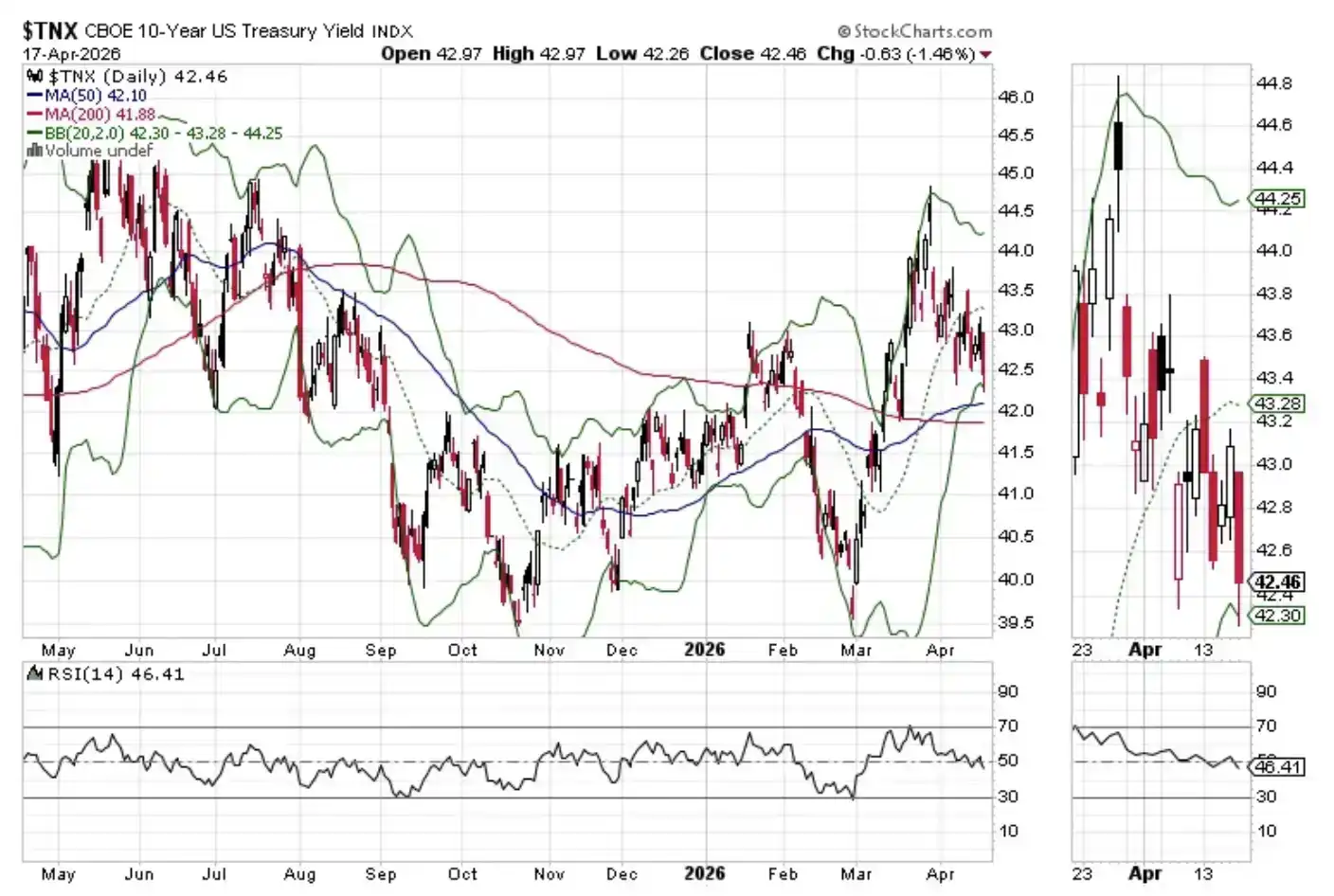
The U.S. 10-Year Treasury Yield closed the week below 4.3%, also falling below its 20-day moving average. A further break below the 200-day moving average would be seen as a bullish signal; conversely, a rise back above 4.5% could push yields back towards the highs near 4.6% seen in May 2025.

3. NYAD, SPX, and NDX all hit new highs simultaneously

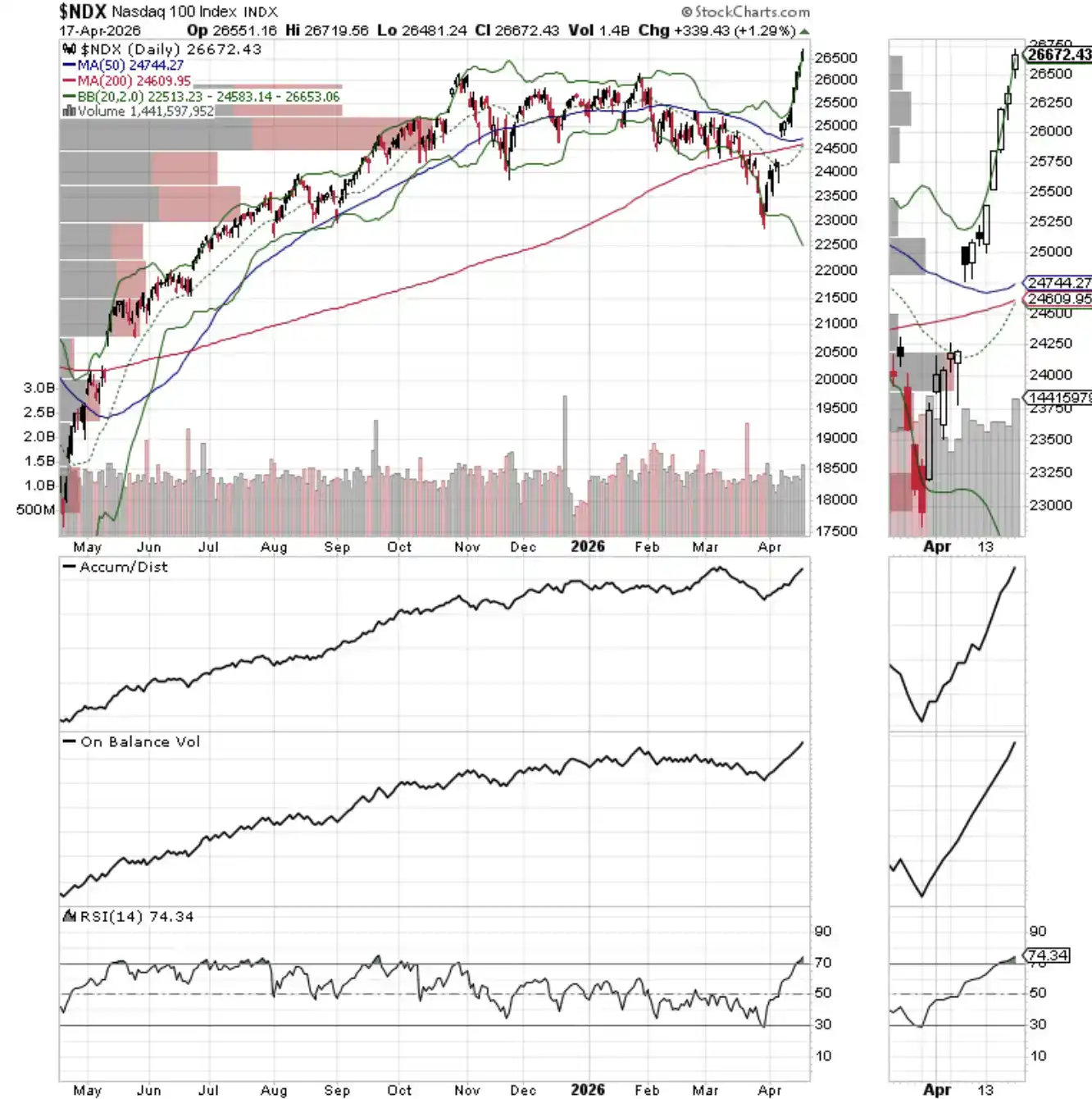
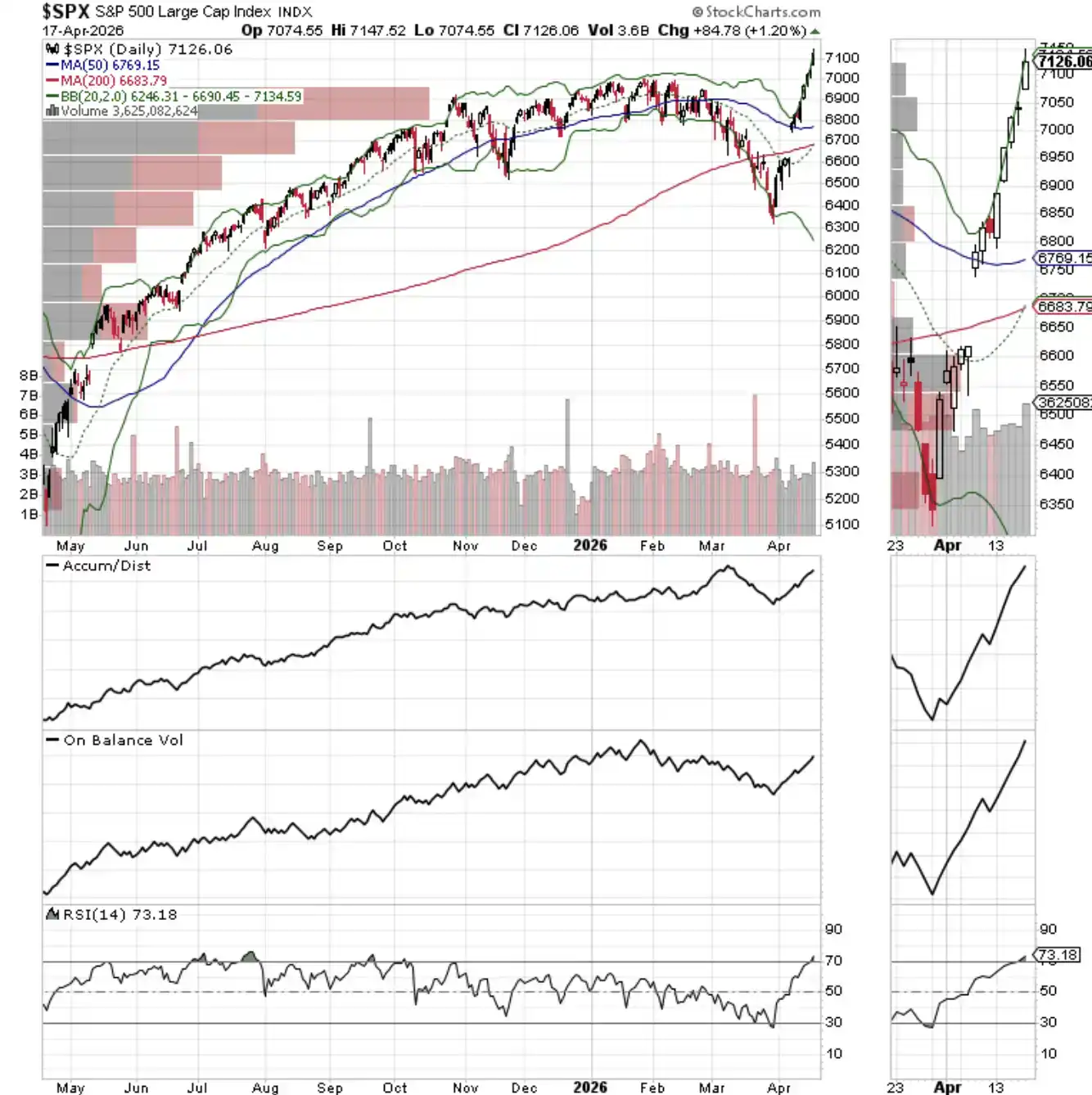
The NYSE Advance-Decline Line hit a new high, confirming the new highs in the S&P 500 Index and the NASDAQ-100 Index, forming a confirmation signal.

The current uptrend is validated—but only for now. A break below the 20-day or 50-day moving average could quickly change the market situation.

The NASDAQ-100 Index hit a new high last week, with 26,000 points now becoming a short-term support level.
The S&P 500 Index hit a new high last week and broke through the 7000 point mark. 7000 points has now become a short-term support level.
Questions liées

QWhat is the main factor that has recently driven the sharp rise in stock and risk asset prices according to the article?

AThe main factor is the injection of nearly $200 billion in liquidity into the financial system by the Federal Reserve and the U.S. Treasury around April 15, which created a massive liquidity surge.

QWhy does the article suggest that Bitcoin is a key leading indicator for the market?

ABitcoin is more sensitive to liquidity changes than traditional risk assets. It often signals turning points in the funding environment first, as seen in its early decline in October 2025 and its率先企稳 (first to stabilize) in the current rebound.

QWhat is the 'TGA' (Treasury General Account) and how does its balance affect market liquidity?

AThe TGA is the U.S. Treasury's checking account at the Federal Reserve. When its balance decreases, it releases liquidity into the financial system; when its balance increases, it tightens liquidity.

QWhat key price level for Bitcoin does the article identify as a crucial test for market confidence and liquidity?

AThe $80,000–$85,000 range is identified as a crucial test. A failure to break through this level could indicate a lack of confidence in the rally or that the liquidity surge is fading.

QWhat new uncertainty has emerged that could challenge the market's liquidity-driven rally?

AThe uncertainty is a potential escalation in the Iran situation, specifically a reversal in Iran's stance on the Strait of Hormuz, which has reintroduced geopolitical risk as a core variable in asset pricing.

Lectures associées

Le projet de loi CLARITY atteint un moment charnière : la cryptomonnaie américaine à un carrefour réglementaire

Un tournant historique pour la régulation des cryptomonnaies aux États-Unis se joue en 2026. Le « CLARITY Act », loi cruciale pour définir la structure du marché des actifs numériques, doit être approuvé par la commission bancaire du Sénat avant fin avril, sans quoi son adoption pourrait être reportée de plusieurs années. Parallèlement, le « GENIUS Act », déjà adopté, impose un cadre prudentiel aux stablecoins, favorisant une concentration du marché autour d’acteurs conformes comme USDC et USAT (la nouvelle entité de Tether pour le marché institutionnel américain), tout en comprimant la place de l’USDT. Un compromis bipartisan, mené par les sénateurs Tillis et Alsobrooks, propose d’autoriser les récompenses sur les stablecoins liées à des activités, mais d’interdire les rendements passifs purs, une question au cœur des tensions avec le secteur bancaire traditionnel. La Maison Blanche, sous Trump, pousse pour une adoption rapide, mais fait face à des défis politiques, notamment sur les conflits d’intérêts des responsables gouvernementaux. Si la loi est adoptée, elle pourrait déclencher l’entrée de billions de dollars de capitaux institutionnels (fonds de pension, assureurs) et aligner les standards américains avec le règlement européen MiCA, renforçant la compétitivité mondiale des États-Unis. Son rejet profiterait aux places financières concurrentes comme l’UE, Hong Kong ou Singapour, et retarderait considérablement l’intégration des cryptomonnaies dans le système financier traditionnel. La conformité réglementaire devient l’avantage compétitif décisif pour l’avenir.

marsbitIl y a 51 mins

Le projet de loi CLARITY atteint un moment charnière : la cryptomonnaie américaine à un carrefour réglementaire

marsbitIl y a 51 mins

Trading

Spot
Futures

Articles tendance

Qu'est ce que BITCOIN

Comprendre HarryPotterObamaSonic10Inu (ERC-20) et sa position dans l'espace crypto Ces dernières années, le marché des cryptomonnaies a connu une augmentation de la popularité des monnaies mèmes, suscitant l'intérêt non seulement des traders, mais aussi de ceux qui recherchent un engagement communautaire et une valeur divertissante. Parmi ces jetons uniques, HarryPotterObamaSonic10Inu (ERC-20) est un projet intrigant qui mêle des références culturelles à l'univers des cryptomonnaies. Cet article explore les aspects clés de HarryPotterObamaSonic10Inu, en examinant ses mécanismes, son ethos axé sur la communauté, et son engagement avec le paysage crypto plus large. Qu'est-ce que HarryPotterObamaSonic10Inu (ERC-20) ? Comme son nom l'indique, HarryPotterObamaSonic10Inu est une monnaie mème construite sur la blockchain Ethereum, classée selon la norme ERC-20. Contrairement aux cryptomonnaies traditionnelles qui peuvent mettre l'accent sur l'utilité pratique ou le potentiel d'investissement, ce jeton prospère grâce à sa valeur divertissante et à la force de sa communauté. Le projet vise à favoriser un environnement où des utilisateurs engagés peuvent se rassembler, partager des idées et participer à des activités inspirées par divers phénomènes culturels. Une caractéristique notable de HarryPotterObamaSonic10Inu est son absence de taxe sur les transactions. Cet élément attrayant vise à encourager le trading et l'implication de la communauté, sans frais supplémentaires pouvant décourager les petits traders. L'offre totale de la monnaie est fixée à un milliard de jetons, un chiffre qui marque son intention de maintenir une circulation substantielle au sein de la communauté. Créateur de HarryPotterObamaSonic10Inu (ERC-20) Les origines de HarryPotterObamaSonic10Inu sont quelque peu obscures ; les détails concernant le créateur restent inconnus. Le développement de ce jeton ne comporte pas d'équipe identifiable ou de plan explicite, ce qui n'est pas rare dans le secteur des monnaies mèmes. Au lieu de cela, le projet a émergé de manière organique, son progrès s'appuyant fortement sur l'enthousiasme et la participation de sa communauté. Investisseurs de HarryPotterObamaSonic10Inu (ERC-20) En ce qui concerne les investissements externes et le soutien, HarryPotterObamaSonic10Inu reste également ambigu. Le jeton ne mentionne aucune fondation d'investissement connue ou un soutien organisationnel significatif. Au lieu de cela, le cœur battant du projet est sa communauté de base, qui informe sa croissance et sa durabilité par des actions collectives et un engagement dans l'espace crypto. Comment fonctionne HarryPotterObamaSonic10Inu (ERC-20) ? En tant que monnaie mème, HarryPotterObamaSonic10Inu opère principalement en dehors des cadres traditionnels qui régissent souvent la valeur des actifs. Plusieurs aspects distinctifs définissent comment le projet fonctionne : Transactions sans taxe : Sans frais de taxe sur les transactions, les utilisateurs peuvent acheter et vendre librement le jeton sans se préoccuper de frais cachés. Engagement communautaire : Le projet prospère grâce à l'interaction communautaire, exploitant les plateformes de médias sociaux pour créer du bruit et faciliter l'implication. Les discussions, le partage de contenu et l'engagement sont des éléments cruciaux qui aident à étendre sa portée et à favoriser la loyauté parmi les supporters. Pas d'utilité pratique : Il est important de noter que HarryPotterObamaSonic10Inu n'offre pas d'utilité concrète au sein de l'écosystème financier. Au contraire, il est classé comme un jeton principalement pour des activités de divertissement et communautaires. Référence culturelle : Le jeton intègre habilement des éléments de la culture populaire pour susciter l'intérêt, s'adressant à la fois aux amateurs de mèmes et aux suiveurs de crypto. HarryPotterObamaSonic10Inu illustre comment les monnaies mèmes fonctionnent différemment des projets de cryptomonnaies plus traditionnels, entrant sur le marché en tant que constructions sociales innovantes plutôt qu'actifs utilitaires. Chronologie de HarryPotterObamaSonic10Inu (ERC-20) L'histoire de HarryPotterObamaSonic10Inu est jalonnée de plusieurs étapes notables : Création : Le jeton est né d'un mème viral, captivant l'imagination de nombreux passionnés de crypto. Les dates de création spécifiques ne sont pas disponibles, soulignant son ascension organique. Listing sur les échanges : HarryPotterObamaSonic10Inu a fait son apparition sur divers échanges, permettant un accès et un trading plus faciles par la communauté. Initiatives d'engagement communautaire : Activités en cours visant à améliorer l'interaction communautaire, y compris des concours, des campagnes sur les réseaux sociaux, et la génération de contenu par des fans et des défenseurs. Plans d'expansion futurs : La feuille de route du projet comprend le lancement d'une collection NFT, de marchandises, et d'un site eCommerce lié à ses thèmes culturels, engageant davantage la communauté et tentant d'ajouter plus de dimensions à son écosystème. Points clés concernant HarryPotterObamaSonic10Inu (ERC-20) Nature axée sur la communauté : Le projet privilégie l'apport collectif et la créativité, garantissant que l'implication des utilisateurs est au cœur de son développement. Classification de monnaie mème : Il représente l'apogée de la cryptomonnaie basée sur le divertissement, se distinguant des véhicules d'investissement traditionnels. Pas d'affiliation directe avec Bitcoin : Malgré la similitude dans le nom du ticker, HarryPotterObamaSonic10Inu est distinct et n'a aucun lien avec Bitcoin ou d'autres cryptomonnaies établies. Focus sur la collaboration : HarryPotterObamaSonic10Inu est conçu pour créer un espace de collaboration et de partage d'histoires parmi ses détenteurs, offrant une voie pour la créativité et le lien communautaire. Perspectives d'avenir : L'ambition de s'étendre au-delà de son concept initial vers des NFT et des marchandises dessine un chemin pour le projet afin de potentiellement entrer dans des avenues plus grand public au sein de la culture numérique. Alors que les monnaies mèmes continuent de captiver l'imagination de la communauté des cryptomonnaies, HarryPotterObamaSonic10Inu (ERC-20) se distingue par ses liens culturels et son approche centrée sur la communauté. Bien qu'il ne corresponde pas au modèle typique d'un jeton axé sur l'utilité, son essence réside dans la joie et la camaraderie cultivées parmi ses supporters, soulignant la nature en évolution des cryptomonnaies dans un âge de plus en plus numérique. À mesure que le projet continue de se développer, il sera important de surveiller comment les dynamiques communautaires influencent sa trajectoire dans le paysage toujours changeant de la technologie blockchain.

1.4k vues totalesPublié le 2024.04.01Mis à jour le 2024.12.03

Qu'est ce que BITCOIN

Comment acheter BTC

Bienvenue sur HTX.com ! Nous vous permettons d'acheter Bitcoin (BTC) de manière simple et pratique. Suivez notre guide étape par étape pour commencer votre parcours crypto.Étape 1 : Création de votre compte HTXUtilisez votre adresse e-mail ou votre numéro de téléphone pour ouvrir un compte sur HTX gratuitement. L'inscription se fait en toute simplicité et débloque toutes les fonctionnalités.Créer mon compteÉtape 2 : Choix du mode de paiement (rubrique Acheter des cryptosCarte de crédit/débit : utilisez votre carte Visa ou Mastercard pour acheter instantanément Bitcoin (BTC).Solde :utilisez les fonds du solde de votre compte HTX pour trader en toute simplicité.Prestataire tiers :pour accroître la commodité d'utilisation, nous avons ajouté des modes de paiement populaires tels que Google Pay et Apple Pay.P2P :tradez directement avec d'autres utilisateurs sur HTX.OTC (de gré à gré) : nous offrons des services personnalisés et des taux de change compétitifs aux traders.Étape 3 : stockage de vos Bitcoin (BTC)Après avoir acheté vos Bitcoin (BTC), stockez-les sur votre compte HTX. Vous pouvez également les envoyer ailleurs via un transfert sur la blockchain ou les utiliser pour trader d'autres cryptos.Étape 4 : tradez des Bitcoin (BTC)Tradez facilement Bitcoin (BTC) sur le marché Spot de HTX. Il vous suffit d'accéder à votre compte, de sélectionner la paire de trading, d'exécuter vos trades et de les suivre en temps réel. Nous offrons une expérience conviviale aux débutants comme aux traders chevronnés.

5.0k vues totalesPublié le 2024.12.12Mis à jour le 2025.03.21

Comment acheter BTC

Qu'est ce que $BITCOIN

OR DÉMATÉRIEL ($BITCOIN) : Une Analyse Complète Introduction à OR DÉMATÉRIEL ($BITCOIN) OR DÉMATÉRIEL ($BITCOIN) est un projet basé sur la blockchain opérant sur le réseau Solana, qui vise à combiner les caractéristiques des métaux précieux traditionnels avec l'innovation des technologies décentralisées. Bien qu'il partage un nom avec Bitcoin, souvent appelé “or numérique” en raison de sa perception en tant que réserve de valeur, OR DÉMATÉRIEL est un jeton distinct conçu pour créer un écosystème unique au sein du paysage Web3. Son objectif est de se positionner comme un actif numérique alternatif viable, bien que les spécificités concernant ses applications et fonctionnalités soient encore en développement. Qu'est-ce qu'OR DÉMATÉRIEL ($BITCOIN) ? OR DÉMATÉRIEL ($BITCOIN) est un jeton de cryptomonnaie explicitement conçu pour une utilisation sur la blockchain Solana. Contrairement à Bitcoin, qui joue un rôle de stockage de valeur largement reconnu, ce jeton semble se concentrer sur des applications et caractéristiques plus larges. Les aspects notables incluent : Infrastructure Blockchain : Le jeton est construit sur la blockchain Solana, connue pour sa capacité à gérer des transactions rapides et peu coûteuses. Dynamique de l'Offre : OR DÉMATÉRIEL a une offre maximale plafonnée à 100 quadrillions de jetons (100P $BITCOIN), bien que les détails concernant son offre en circulation soient actuellement non divulgués. Utilité : Bien que les fonctionnalités précises ne soient pas explicitement décrites, il y a des indications que le jeton pourrait être utilisé pour diverses applications, impliquant potentiellement des applications décentralisées (dApps) ou des stratégies de tokenisation d'actifs. Qui est le Créateur d'OR DÉMATÉRIEL ($BITCOIN) ? À l'heure actuelle, l'identité des créateurs et de l'équipe de développement derrière OR DÉMATÉRIEL ($BITCOIN) reste inconnue. Cette situation est typique parmi de nombreux projets innovants dans l'espace blockchain, en particulier ceux alignés avec la finance décentralisée et les phénomènes de meme coin. Bien qu'une telle anonymité puisse favoriser une culture axée sur la communauté, elle intensifie les préoccupations concernant la gouvernance et la responsabilité. Qui sont les Investisseurs d'OR DÉMATÉRIEL ($BITCOIN) ? Les informations disponibles indiquent qu'OR DÉMATÉRIEL ($BITCOIN) n'a pas de bailleurs de fonds institutionnels connus ou d'investissements en capital-risque notables. Le projet semble fonctionner sur un modèle peer-to-peer axé sur le soutien et l'adoption de la communauté plutôt que sur des voies de financement traditionnelles. Son activité et sa liquidité se situent principalement sur des échanges décentralisés (DEX), tels que PumpSwap, plutôt que sur des plateformes de trading centralisées établies, soulignant davantage son approche de base. Comment fonctionne OR DÉMATÉRIEL ($BITCOIN) Les mécanismes opérationnels d'OR DÉMATÉRIEL ($BITCOIN) peuvent être élaborés en fonction de sa conception blockchain et des attributs du réseau : Mécanisme de Consensus : En s'appuyant sur le mécanisme de preuve d'historique (PoH) unique de Solana combiné à un modèle de preuve d'enjeu (PoS), le projet assure une validation efficace des transactions contribuant à la haute performance du réseau. Tokenomics : Bien que des mécanismes déflationnistes spécifiques n'aient pas été largement détaillés, l'immense offre maximale de jetons implique qu'elle pourrait répondre à des microtransactions ou à des cas d'utilisation de niche qui restent à définir. Interopérabilité : Il existe un potentiel d'intégration avec l'écosystème plus large de Solana, y compris diverses plateformes de finance décentralisée (DeFi). Cependant, les détails concernant des intégrations spécifiques restent non spécifiés. Chronologie des Événements Clés Voici une chronologie qui met en évidence des jalons significatifs concernant OR DÉMATÉRIEL ($BITCOIN) : 2023 : Le déploiement initial du jeton a lieu sur la blockchain Solana, marqué par son adresse de contrat. 2024 : OR DÉMATÉRIEL gagne en visibilité en devenant disponible à la négociation sur des échanges décentralisés comme PumpSwap, permettant aux utilisateurs de l'échanger contre SOL. 2025 : Le projet connaît une activité de trading sporadique et un intérêt potentiel pour des engagements dirigés par la communauté, bien qu'aucun partenariat notable ou avancée technique n'ait été documenté jusqu'à présent. Analyse Critique Forces Scalabilité : L'infrastructure sous-jacente de Solana prend en charge des volumes de transactions élevés, ce qui pourrait améliorer l'utilité de $BITCOIN dans divers scénarios de transaction. Accessibilité : Le potentiel faible prix de négociation par jeton pourrait attirer les investisseurs de détail, facilitant une participation plus large grâce aux opportunités de propriété fractionnée. Risques Manque de Transparence : L'absence de bailleurs de fonds, de développeurs ou de processus d'audit connus publiquement peut susciter du scepticisme quant à la durabilité et à la fiabilité du projet. Volatilité du Marché : L'activité de trading dépend fortement du comportement spéculatif, ce qui peut entraîner une volatilité des prix significative et une incertitude pour les investisseurs. Conclusion OR DÉMATÉRIEL ($BITCOIN) émerge comme un projet intrigant mais ambigu au sein de l'écosystème Solana en rapide évolution. Bien qu'il tente de tirer parti du récit de “l'or numérique”, son éloignement du rôle établi de Bitcoin en tant que réserve de valeur souligne la nécessité d'une différenciation plus claire de son utilité prévue et de sa structure de gouvernance. L'acceptation et l'adoption futures dépendront probablement de la résolution de l'opacité actuelle et de la définition plus explicite de ses stratégies opérationnelles et économiques. Remarque : Ce rapport englobe des informations synthétisées disponibles jusqu'en octobre 2023, et des développements peuvent avoir eu lieu au-delà de la période de recherche.

83 vues totalesPublié le 2025.05.13Mis à jour le 2025.05.13

Qu'est ce que $BITCOIN

Discussions

Bienvenue dans la Communauté HTX. Ici, vous pouvez vous tenir informé(e) des derniers développements de la plateforme et accéder à des analyses de marché professionnelles. Les opinions des utilisateurs sur le prix de BTC (BTC) sont présentées ci-dessous.

活动图片