Forbes: These Investors Stand To Lose The Most From FTX’s Implosion

ForbesPublié le 2022-11-11Dernière mise à jour le 2022-11-11

Résumé

o one is set to lose more from FTX’s implosion than Sam Bankman-Fried, the crypto wunderkind who founded the exchange and then drove it into the ground this week. His net worth, once as high as $26.5 billion, has plummeted to less than a billion dollars–one of the fastest falls from the billionaires ranks ever. FTX users and employees may be in for big losses too, with Bankman-Fried now trying to cobble together emergency funding to cover a shortfall of up to $8 billion as customers demand their money back. “I can't make any promises,” he tweeted Thursday. “But I'm going to try.”

No one is set to lose more from FTX’s implosion than Sam Bankman-Fried, the crypto wunderkind who founded the exchange and then drove it into the ground this week. His net worth, once as high as $26.5 billion, has plummeted to less than a billion dollars–one of the fastest falls from the billionaires ranks ever. FTX users and employees may be in for big losses too, with Bankman-Fried now trying to cobble together emergency funding to cover a shortfall of up to $8 billion as customers demand their money back. “I can't make any promises,” he tweeted Thursday. “But I'm going to try.”

Then there are FTX’s investors.

As the crypto exchange ballooned in size, it became a huge draw for venture capitalists eager to get in on the Bitcoin boom. In June 2021, FTX raised $1 billion at an $18 billion valuation from venture investors such as Paradigm, SoftBank and Sequoia Capital. Three months later, FTX brought in a $421 million haul, pushing its valuation to $25 billion, from investors like Singapore-government owned investment firm Temasek, Tiger Global Management and the Ontario Teachers’ Pension Plan. By January of this year, crypto prices were on the decline, but FTX charged ahead. Investors, many of whom had also pumped money into the earlier rounds, put another $400 million into FTX–at a $32 billion valuation.

That $32 billion figure has gone up in smoke. So has the $1.8 billion-plus of capital that investors pumped into FTX over the course of three years: At least two major shareholders are marking their investment in FTX down to $0: venture capital firm Sequoia and, reportedly, crypto-focused firm Paradigm. Forbes did the same, dropping Bankman-Fried and cofounder Gary Wang from our billionaire’s list Wednesday, based on the collapse of both FTX and the pair’s trading firm, Alameda Research.

In a strict sense, FTX’s investors’ losses are limited to the $1.8 billion or so they put into the business. But their paper losses are much, much higher. If any of these investors had cashed out in January, when FTX peaked at the $32 billion valuation, they’d be tens or even hundreds of millions dollars richer. Instead, they could well end up with nothing.

Who will lose the most? Forbes has a list of FTX shareholders, sent to us by Sam Bankman-Fried in August during our reporting for The Forbes 400 list. Here are the venture capital firms, the pension plan–and two celebrity endorsers–who have a lot to lose if FTX can’t be saved.

(This analysis does not include shares of FTX U.S., the exchange’s American operations, which raised $400 million at an $8 billion valuation concurrent with FTX’s series C round in January. It remains unclear how the troubles facing FTX will impact the value of FTX U.S.. It’s possible that losses from FTX U.S. will push some investors’ total investment in Sam Bankman-Fried’s empire even higher.)
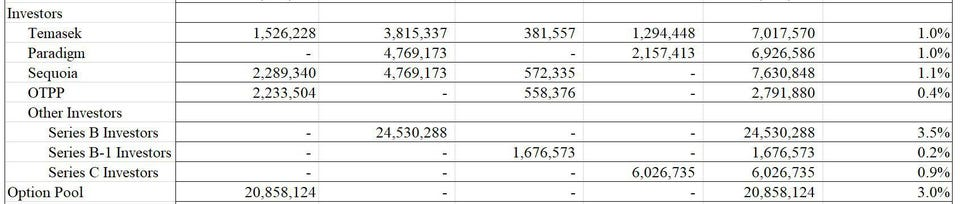
According to the capitalization table Sam Bankman-Fried sent Forbes in August, investors who stand to lose big if FTX goes to zero include employees, investment firms and Ontario teachers'' pensions.FORBES

SEQUOIA CAPITAL

Stake in FTX: 1.1%

Estimated amount invested (FTX only): $200 million

Value at January 2022 peak: $350 million

The Silicon Valley VC fund–famed for its investments in tech giants like Apple, Google and Airbnb–bought into FTX’s series B and B-1 rounds alongside Sequoia Capital Global Equities, a separate entity–to the tune of more than $200 million, according to a letter Sequoia shared on Twitter Wednesday. “FTX is the high-quality, global crypto exchange the world needs,” Sequoia partner Alfred Lin said in June 2021, after the series B round. “Sam is the perfect founder to build this business, and the team's execution is extraordinary.”

The warm feelings were mutual: According to a report published by The Information on Thursday, Alameda Research and Bankman-Fried-backed VC fund FTX Ventures committed “hundreds of millions of dollars” to funds run by Sequoia and two other firms.

The value of Sequoia’s investments in FTX peaked at $350 million earlier this year, marking what is the largest likely loss for an outside investor in the exchange. Sequoia said in its letter to its investors that its FTX stake represented less than 3% of the committed capital of one fund, and the fund’s $150 million loss is offset by about $7.5 billion in realized and unrealized gains.

TEMASEK

Stake in FTX: 1%

Est. amount invested: $205 million

Value at January 2022 peak: $320 million

An investment company owned by the government of Singapore, Temasek is the second-largest outside investor on the capitalization table, with 7 million shares. The $297 billion (assets) business, which owns big stakes in Singapore’s DBS Group and Singapore Airlines, invested in all three of FTX’s major funding rounds. With its $320 million stake on the brink of being worthless, a Temasek spokesperson told Reuters on Wednesday that they were “aware of the developments” and were “engaging FTX in our capacity as shareholder."

PARADIGM

Stake in FTX: 1%

Est. amount invested: $215 million

Value at January 2022 peak: $315 million

Paradigm, an investment firm “focused on supporting the crypto/Web3 companies and protocols of tomorrow,” invested in the exchange’s series B and C rounds and owned nearly 7 million shares of FTX as of August. “There's a bright future ahead for Sam and FTX,” Paradigm cofounder Matt Huang said in July 2021, “and Paradigm is excited to be a part of it."

According to The Information, Alameda Research also invested at least $20 million in Paradigm.

ONTARIO TEACHERS’ PENSION PLAN

Stake in FTX: 0.4%

Est. amount invested: $80 million

Value at January 2022 peak: $125 million

The Ontario Teachers' Pension Plan, which manages the retirement funds of 333,000 teachers in the Canadian province, invested a total of $95 million between FTX and FTX U.S. in late 2021 and early 2022. The FTX portion of that investment alone was worth an estimated $130 million following FTX’s series C round–before the crypto winter and current crisis. “While there is uncertainty about the future of FTX,” Ontario Teachers’ wrote in a statement, “any financial loss on this investment will have limited impact on the plan, given this investment represents less than 0.05% of our total net assets.”


Lectures associées

Décryptage approfondi de FWA : une expérience intéressante qui transforme les NFT en "capsules surprises" sur la blockchain

Le projet Fake World Assets (FWA), accessible sur fwa.fun, introduit un concept innovant de "distributeur automatique de capsules" (gashapon) pour NFTs sur Ethereum. Il permet aux utilisateurs de déposer un NFT accompagné d'une garantie en ETH (le "Backing") pour créer une "Position" dans un pool. Les autres participants paient un prix d'acquisition unique pour tenter de gagner aléatoirement un de ces NFTs. Le mécanisme clé repose sur un poids de sélection inversement proportionnel au Backing : plus la garantie est faible, plus le NFT a de chances d'être gagné. Le prix de tirage est calculé sur la moyenne harmonique de tous les Backings, le maintenant abordable même avec des NFTs de grande valeur dans le pool. Deux rôles principaux existent : le Dépositaire, qui gagne des frais de tirage distribués également et des récompenses en $FWA ; et le Tirer-au-sort, qui, s'il gagne, peut soit garder le NFT, soit le revendre au dépositaire pour 85% de sa garantie (en ETH ou en $FWA acheté sur le marché, créant ainsi une demande constante). Le jeton $FWA, à offre fixe, est principalement distribué via la participation au protocole. Son modèle économique lie directement son utilité et sa demande à l'activité du protocole, avec des mécanismes conçus pour soutenir son prix et favoriser un lancement progressif.

marsbitIl y a 35 mins

Décryptage approfondi de FWA : une expérience intéressante qui transforme les NFT en "capsules surprises" sur la blockchain

marsbitIl y a 35 mins

La filiale de Samsung explore l'infrastructure des stablecoins avec l'opérateur d'Upbit

Samsung SDS, la filiale de services informatiques du groupe Samsung, explore actuellement l'infrastructure des stablecoins, les systèmes d'actifs numériques et les modèles de paiement basés sur l'IA en collaboration avec Dunamu, l'opérateur de la grande plateforme coréenne d'échange de cryptomonnaies Upbit. Cette coopération potentielle a été confirmée par le PDG Lee Jun-hee lors de la présentation des résultats du deuxième trimestre. Samsung SDS s'appuie sur son expérience acquise via un projet de plateforme de titres tokenisés pour la dépositaire centrale coréenne et la validation du processus complet des stablecoins, de l'émission au règlement. Cette initiative fait suite à l'annonce récente de Samsung Electronics d'ajouter la prise en charge des stablecoins dans Samsung Wallet. En mai 2026, plusieurs filiales Samsung (Samsung Securities, SDS et Card) ont acquis une participation conjointe de 4% dans Dunamu, un investissement qualifié de stratégique visant à raffiner des modèles commerciaux pour l'infrastructure financière numérique. L'objectif est de combiner l'expertise en cloud et sécurité de Samsung SDS avec celle en blockchain de Dunamu pour mener ce marché. Parallèlement, Samsung SDS connaît une forte croissance dans les services cloud et IA, qui ont contribué à une augmentation de 5,9% de son chiffre d'affaires au T2. La société prévoit une expansion significative de sa capacité d'infrastructure IA d'ici 2031, soulignant sa double stratégie de développement des services de finance numérique et de l'IA.

cointelegraphIl y a 41 mins

La filiale de Samsung explore l'infrastructure des stablecoins avec l'opérateur d'Upbit

cointelegraphIl y a 41 mins

Après un désengagement de 4,4 milliards par l'actionnaire principal, rachat de 2 milliards, quelle est l'opération de GigaDevice ?

L'action de GigaDevice, leader chinois des semi-conducteurs mémoire, a chuté de près de 60% en un mois, perdant plus de 330 milliards de yuans de capitalisation boursière. Cette chute spectaculaire suit le record historique atteint fin juin 2026. Peu avant ce pic, le contrôleur majoritaire, Zhu Yiming, a vendu pour 4,4 milliards de yuans d'actions. Après la chute des cours, il a annoncé un plan de sauvetage incluant son projet d'achat personnel d'actions pour au moins 1 milliard de yuans et une proposition de rachat d'actions par la société pouvant aller jusqu'à 2 milliards. Trois facteurs principaux expliquent la débâcle boursière : 1. L'introduction en bourse de ChangXin Technology, dont GigaDevice était considérée comme l'action "reflet", a drainé les capitaux vers la nouvelle valeur. 2. Un rapport de Morgan Stanley avertissant d'un potentiel ralentissement du cycle haussier des mémoires. 3. La vente massive de 4,4 milliards de yuans par le fondateur a érodé la confiance des investisseurs. Bien que techniquement légale, cette opération de vente avant la chute et d'annonce de rachat après est perçue négativement par le marché. Malgré des résultats semestriels 2026 excellents (bénéfice net multiplié par 11), incluant une part importante de gains non récurrents, l'entreprise évolue dans un secteur cyclique. Le plan de soutien, avec un délai de 6 mois avant le début des achats du fondateur, laisse un net surplus de liquidités de 1,4 milliard de yuans pour ce dernier. Cela place les 240 000 actionnaires minoritaires en position d'avoir potentiellement absorbé la vente à haut prix, interrogeant la confiance et la nature réelle de l'investissement dans cette entreprise pourtant clé dans la substitution des puces mémoire en Chine.

marsbitIl y a 43 mins

Après un désengagement de 4,4 milliards par l'actionnaire principal, rachat de 2 milliards, quelle est l'opération de GigaDevice ?

marsbitIl y a 43 mins

10 000 scientifiques utilisent gratuitement pendant 1 an, OpenAI déplace la chaîne de production de la recherche dans ChatGPT

OpenAI lance « ChatGPT for Academic Researchers », offrant un accès gratuit d'un an à ses modèles avancés pour 100 000 chercheurs universitaires. L'objectif est d'embarquer l'ensemble du flux de travail de la recherche scientifique dans un seul environnement, intégrant la lecture de littérature, le codage, l'analyse de données, la rédaction de manuscrits et la connexion à des outils comme Zotero et GitHub. Le programme, qui cible initialement 10 000 chercheurs cet été, fournit des modèles spécialisés comme GPT-5.6 Sol Pro pour les tâches complexes, ainsi que des compétences en sciences de la vie et une fenêtre de contexte étendue. OpenAI souligne que 1,3 million de personnes utilisent déjà ChatGPT chaque semaine pour des tâches scientifiques avancées. Cette initiative gratuite comporte des limites : quotas d'utilisation, absence d'accès à l'API et aucun accès aux poids des modèles. Elle vise principalement les chercheurs en sciences « dures », contournant ainsi les demandes de transparence de la communauté en IA. Anthropic propose une approche similaire avec des crédits API, mais les deux entreprises gardent leurs modèles fermés. L'objectif sous-jacent est clair : ancrer les habitudes des chercheurs dans l'écosystème OpenAI, rendant la transition coûteuse après la période gratuite.

marsbitIl y a 43 mins

10 000 scientifiques utilisent gratuitement pendant 1 an, OpenAI déplace la chaîne de production de la recherche dans ChatGPT

marsbitIl y a 43 mins

Trading

Spot
活动图片