Abstract
This week, we focus on the following events: 1) DeFi Platform Kyber Network Discloses $265K Exploit, Vows to Reimburse All Funds; 2) Crypto Influencer Cooper Turley Creates $10M ‘Coop Records’ Music Startup Fund; 3) GoDaddy Sued Over Sale of Ethereum Domain Name Service's Vital Eth.link Address.
______________________________________________________________________________
Project Analysis: In the crypto bear market, most decentralized spot and perpetual exchanges’ volumes have declined. However, GMX, one of the on-chain exchanges, has seen its TVL grow and almost touch US$400 million. We will analyze GMX by evaluating its strengths, token design, mechanisms, and risks, to find the reasons for its success.
1. Industry overview
I. Overall market trend
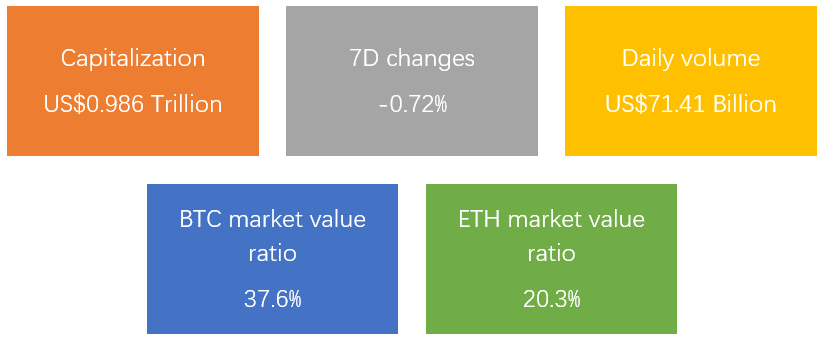
Figure 1. Overall market data
Source: CoinMarketCap
The global cryptocurrency market’s market cap this week was basically the same as last week’s, with less than 0.1% change. Bitcoin is currently trading at US$19,422, a rather low point within the past few weeks. Meanwhile, Ethereum, the second largest cryptocurrency currently trading at US$1,643, has a 7-day price change of 4.49%, basically offsetting the decrease last week and maintaining a stable price over the past 30 days. Terra Classic, the original Terra coin that crashed down during May, had a 7-day price change of 93.25%, and a 30-day change of 454.34%, which could be due to speculation. TerraClassicUSD and Bitgert recorded a 30-day change of 46.26% and 105.29%, respectively. These two are the tokens with the biggest changes apart from Terra Classic.
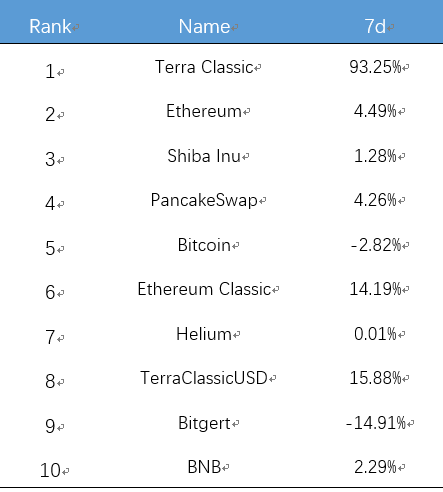
Table 1. Last week's hot currencies
Source: CoinMarketCap
II.NFT
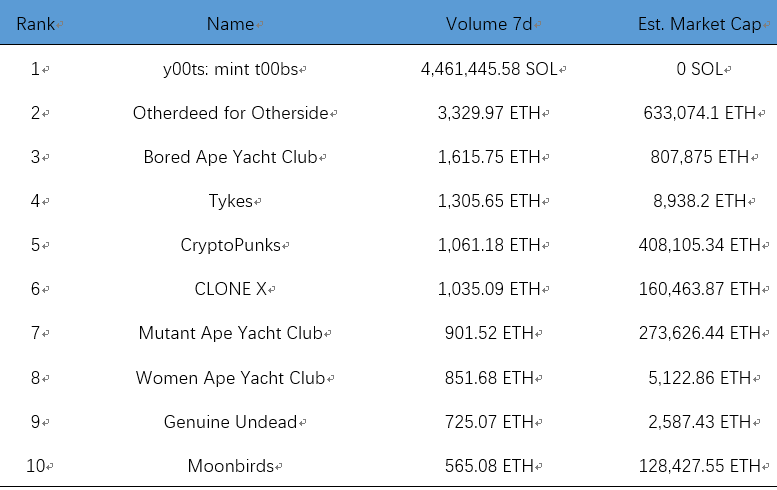
Table 2. NFT Collections Listed By Sales Volume (7d)
Source: CoinMarketCap
The NFT market last week saw a decrease of 53.21%, with a market cap of $2,240,631,533.46 this week. However, 7-day sales volume rose 329.77% to $182,661,006.80 and the total sales didn’t change very much at -0.18%. Overall, the NFT market had substantive fluctuations this week, with the brand y00ts leading the top 10 NFT brands this week (also a Solana NFT brand), while most of the other top 10 are familiar brands. Tykes and Genuine Undead were also in the top 10 for the first time. Most of the volume and the average price of other top 10 brands, like BAYC and CryptoPunks, remained stable last week (below 0.1%).
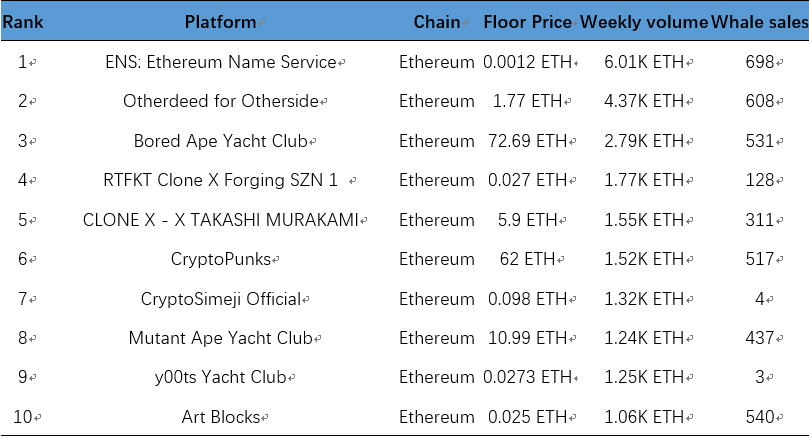
Table 3. Top trending collections on NFTGO (by daily volume)
Source: NFTGO
III.DeFi
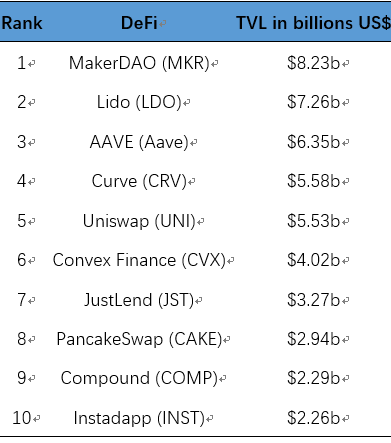
Table 4. DeFi market TVL ranking
Source: DefiLlama
IV.Layer 2
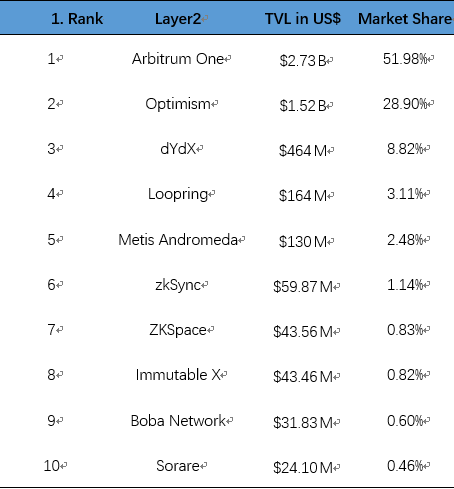
Table 5. Layer2 protocols ranking and market share
Source: l2beat
2. Market news (Source: Coindesk, Odaily)
I. Industry news
DeFi Platform Kyber Network Discloses $265K Exploit, Vows to Reimburse All Funds
Kyber, a multi-chain decentralized finance (DeFi) platform, discovered a vulnerability in its website code that allowed exploiters to steal approximately $265,000.Two “whale” addresses appeared to be impacted by the attack, according to Kyber, which plans to reimburse the losses. Kyber said it discovered the exploit, which let attackers insert a “false approval, allowing a hacker to transfer a user’s funds to his address,” on Sept. 1 and “neutralized” the threat within two hours. The exploit hit KyberSwap, a decentralized exchange that allows users to swap between currencies on different blockchains. KyberSwap’s blockchain contracts were not affected. The problem stemmed from malicious a Google Tag Manager code on the KyberSwap website, according to a statement from Kyber.
Crypto Terra Luna Classic Surges as Traders Speculate on New Supply Burn Rule
Luna classic (LUNC), the renamed native token of the Terra blockchain that dramatically imploded in May, is rising in value as traders bet that a soon-to-be implemented rule may breathe some life into the much-maligned token. LUNC gained 22% in the past 24 hours, and doubled its price in a week, according to data by crypto intelligence platform Messari. Still, the token is changing hands at a fraction of a cent ($0.00052 to be precise) and it is down more than 99.99% since the start of the year. The community approved a proposal that introduces a 1.2% tax rate on every transaction on the blockchain. According to the proposal, the “tax” will automatically be sent to a wallet to destroy (burn) the tokens to gradually bring down LUNC’s bloated circulating supply. The fee rate is expected to take effect on Sept. 20, according to a statement from Binance.
II. Investment and Financing
Crypto Influencer Cooper Turley Creates $10M ‘Coop Records’ Music Startup Fund
Cryptocurrency influencer and NFT song collector Cooper Turley is spinning up a $10 million fund to invest in artists and startup founders bringing crypto and music together. His so-called Coop Records – backed by crypto culture influence brokers from Audius to OpenSea – will seek to solve what Turley sees as a big problem in the modern music industry: Labels and streaming services hold all the power; artists lack autonomy over their creative work. Turley’s trying to change that with non-fungible tokens (NFTs).
Andrew Yang Is Raising $1.5M for a Company That Plans to Reward Volunteers With Crypto
Former U.S. presidential candidate and cryptocurrency proponent Andrew Yang has a new project in the works that will use crypto to incentivize charitable work.
A new filing registered with the U.S. Securities and Exchange Commission on Wednesday listed Yang and his former presidential campaign manager, Zach Graumann, among the directors and executive officers for a company called Samarity Inc.
A trademark filing reveals that Samarity will, in part, promote “the charities of others by means of the issuance, custody and settlement of cryptocurrency to volunteers in exchange for participation in charitable service.”
Crypto Startup Slide Raises $12.3M to Connect New Users to Web3 Apps
Slide, a startup that provides user experience infrastructure for decentralized applications (dapps), has raised $12.3 million in a seed funding round that was co-led by crypto-focused investment firms Polychain Capital and Framework Ventures. The funding will help Slide continue to hire more staff, build out its infrastructure and distribute its product to dapps.
A new user who wants to interact with a Web3 application often has to find third-party sources for buying crypto and holding the assets in order to spend the crypto in the app. Slide offers an all-in-one tool that keeps users within the app with features that include non-fungible token (NFT) purchases via credit card and a non-custodial wallet that’s set up with an email address rather than a browser extension.
III. Supervision
GoDaddy Sued Over Sale of Ethereum Domain Name Service's Vital Eth.link Address
The developer of the Ethereum Name Service, which is responsible for all the web addresses ending in .eth used by the Ethereum community, sued GoDaddy over the sale of the eth.link domain name that was vital to running ENS.
In a complaint filed on Monday, True Names Ltd., the company behind the Web3 domain name service, alleged that GoDaddy not only falsely announced to eth.link users the domain registration had expired, but it also sold the domain off before it was supposed to return to the registry and be available for re-purchase.
US Treasury to Recommend Issuing Digital Dollar if in National Interest: Source
The U.S. Treasury Department will advise the federal government to press forward on work to issue a digital dollar, though it should only take the final step if there’s sign-off that the government-created tokens are in the “national interest,” according to a person familiar with a report emerging soon.
The question of national interest will depend on further approval of the Biden administration and – potentially – action by Congress, said the person, who requested anonymity because the Treasury’s “Future of Money” report hasn’t yet been released. This national-interest decision is made murkier by the question of whether U.S. legislators need to pass a law to authorize the Federal Reserve to create a central bank digital currency (CBDC) – a question that may be answered soon in a separate analysis.
3. Trending project analysis – GMX
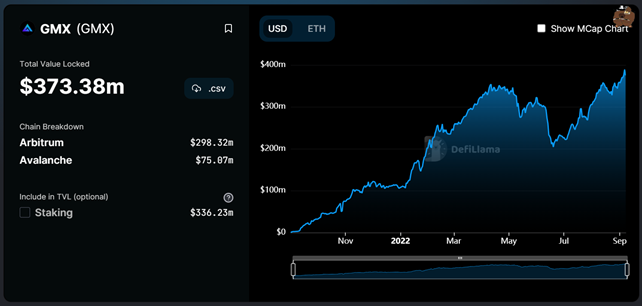
Figure 2. GMX’s TVL
Source: https://defillama.com/protocol/gmx?denomination=USD
I. What is GMX?
GMX is a decentralized spot and perpetual exchange that supports low swap fees and zero price impact trades. Different from other DEXs, GMX designates a multi-asset pool to be the liquidity provider. Because the liquidity providers risk losses, they can earn fees from market making, swap fees, and leverage trading.
Figure 3. GMX’s Website
Source: https://app.gmx.io/#/trade
II. GMX functions
GMX provides leverage trading with up to 30x leverage and spot trading with zero price impact on Arbitrum and Avalanche. Users should transfer their money on their Arbitrum or Avalanche wallets first and connect the wallet to GMX.
Trading Information:
Users can open long or short positions of BTC, ETH, LINK, and UNI.
Users can use one of the ETH, WETH, BTC, LINK, UNI, USDC, USDT, DAI, and FRAX to be their margin.
The entry price, exit price, and liquidation price are shown below. Users can refer to them, and open new positions.
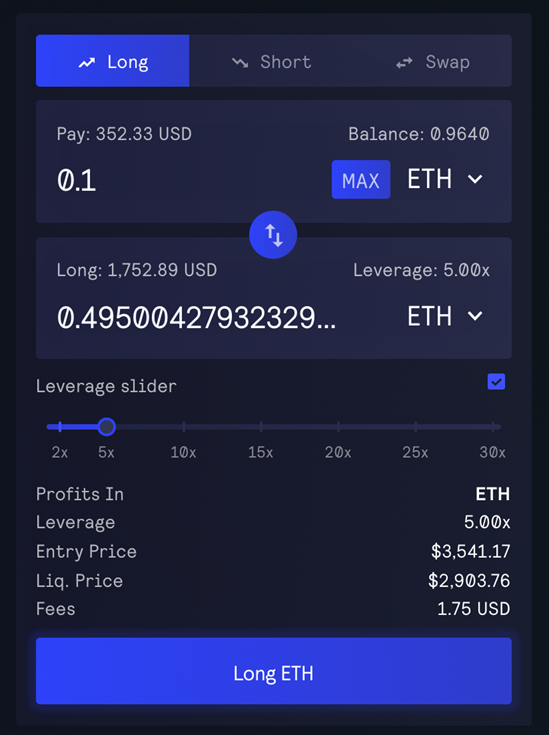
Fgure 4. GMX trading pad
Source: https://gmxio.gitbook.io/gmx/trading
Trading fee: Users should pay 0.1% of the position size when they open and close positions.
Borrow fee: Users should pay the borrowing fee per hour. The fee per hour will vary based on utilization, it is calculated as (assets borrowed) / (total assets in the pool) * 0.01%. The "Borrow Fee" for longing or shorting is shown below the swap box.
Although there are no price impacts for trades, there can be slippage due to price movements between when your trade transaction is submitted and when it is confirmed on the blockchain. Slippage is the difference between the expected price of the trade and the execution price, this can be customized by clicking on the "..." icon next to your address at the top right of the page.
Why do users buy GMX?
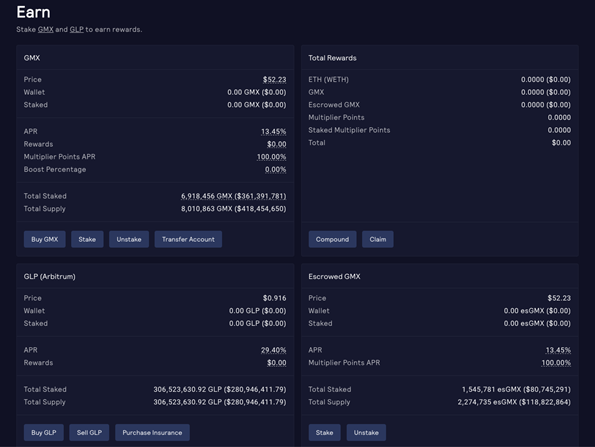
Staked GMX receives three types of rewards: Escrowed GMX, Multiplier Points, ETH / AVAX Rewards.
30% of fees generated from swaps and leverage trading are converted to ETH / AVAX and distributed to staked GMX tokens. If you are staking on Arbitrum you would receive ETH, if you are staking on Avalanche then you would receive AVAX. Note that the fees distributed are based on the number after deducting referral rewards and the network costs of keepers, keeper costs are usually around 1% of the total fees. esGMX needs to be staked for one year to be fully unlocked as GMX, during which time users also need to stake GMX/esGMX or hold GLP. esGMX can also be used for staking and can earn the same benefits as GMX.
For now, staking GMX or esGMX can get around 13.45% APR on Arbitrum and 13.41% on Avalanche.
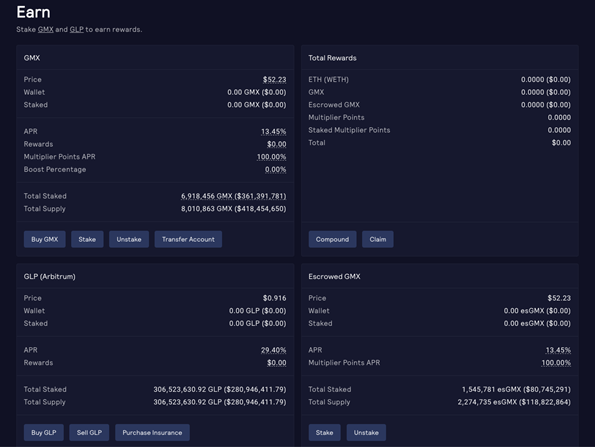
Fgure 4. GMX Pool Page
Source: https://app.gmx.io/#/earn
III. Why do users stake tokens in the pool?
GLP consists of an index of assets used for swaps and leverage trading. It can be minted using any index asset and burnt to redeem any index asset. The price for minting and redemption is calculated based on (total worth of assets in index including profits and losses of open positions) / (GLP supply).
For Arbitrum, holders of the GLP token earn Escrowed GMX rewards and 70% of platform fees distributed in ETH. For Avalanche, holders of the GLP token earn Escrowed GMX rewards and 70% of platform fees distributed in AVAX. Note that the fees distributed are based on the number after deducting referral rewards and the network costs of keepers, keeper costs are usually around 1% of the total fees.
For now, GLP staking rewards are around 23.15% APR on Avalanche and 29.41% on Arbitrum.
As GLP holders provide liquidity for leverage trading, they will make a profit when leverage traders make a loss and vice versa. However, In the history data, the leverage traders keep losing money, so the GLP holders can also get profit from their losses. The long bear market is one of the reasons.
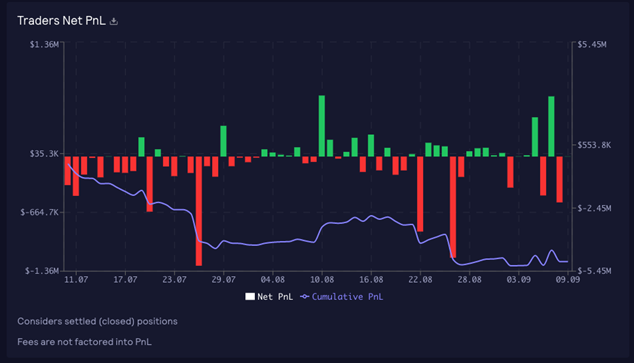
Fgure 5. GMX traders Net PnL
Source: https://stats.gmx.io/
IV. Opportunities and Risks
As a new perpetual protocol, the mechanism of GMX is totally different from other perpetual DEXes. It sets a pool for the liquidity providers with a zero price impact. It uses oracle to get prices from many main exchanges to reduce the impact of large transactions on market prices.
For leverage traders, it is a good perpetual protocol, because it provides max 30x leverage trading, 0% price impact, and fair market price.
For people who want to get rewards from staking, it is also a good protocol. GMX staking users can get rewards from a 30% swap and leverage trading fees with a high APR. GLP holders can get a 70% swap and leverage trading fees with a high APR to incentivize users to provide liquidity.
Because of GMX’s mechanisms, it also has risks. Because GMX provides liquidity from pools, not from users, the long and short positions are not the same. If there is a significant mismatch between the long positions and short positions, the pools will be borrowed out. When extreme market conditions occur and the overall market falls rapidly, the liquidity pool will continue to reduce its value. If a very big position gets a very large profit by leverage trading, the pool may not pay for the profit.
Users should take into account the capital status and incentive measures of the GMX protocol, and also analyze the current market environment to decide how to use GMX to gain benefits and avoid risks.
About Huobi Research Institute
Huobi Blockchain Application Research Institute (referred to as "Huobi Research Institute") was established in April 2016. Since March 2018, it has been committed to comprehensively expanding the research and exploration of various fields of blockchain. As the research object, the research goal is to accelerate the research and development of blockchain technology, promote the application of blockchain industry, and promote the ecological optimization of the blockchain industry. The main research content includes industry trends, technology paths, application innovations in the blockchain field, Model exploration, etc. Based on the principles of public welfare, rigor and innovation, Huobi Research Institute will carry out extensive and in-depth cooperation with governments, enterprises, universities and other institutions through various forms to build a research platform covering the complete industrial chain of the blockchain. Industry professionals provide a solid theoretical basis and trend judgments to promote the healthy and sustainable development of the entire blockchain industry.
Official website:
https://research.huobi.com/#/
Consulting email:
research@huobi.com
Twitter: @Huobi_Research
https://twitter.com/Huobi_Research
Medium: Huobi Research
https://medium.com/huobi-research
Disclaimer
1. The authors of this report and their organization do not have any relationship that affects the objectivity, independence, and fairness of the report with other third parties involved in this report.
2. The information and data cited in this report are from compliance channels. The sources of the information and data are considered reliable by the author, and necessary verifications have been made for their authenticity, accuracy and completeness, but the author makes no guarantee for their authenticity, accuracy or completeness.
3. The content of the report is for reference only, and the facts and opinions in the report do not constitute business, investment and other related recommendations. The author does not assume any responsibility for the losses caused by the use of the contents of this report, unless clearly stipulated by laws and regulations. Readers should not only make business and investment decisions based on this report, nor should they lose their ability to make independent judgments based on this report.
4. The information, opinions and inferences contained in this report only reflect the judgments of the researchers on the date of finalizing this report. In the future, based on industry changes and data and information updates, there is the possibility of updates of opinions and judgments.
5. The copyright of this report is only owned by Huobi Blockchain Research Institute. If you need to quote the content of this report, please indicate the source. If you need a large amount of reference, please inform in advance (see "About Huobi Blockchain Research Institute" for contact information) and use it within the allowed scope. Under no circumstances shall this report be quoted, deleted or modified contrary to the original intent.