Predicting the Dormant Period of Market Heat, Polymarket Prepares a Killer Move to Catch Up with Kalshi

marsbitPublié le 2026-08-12Dernière mise à jour le 2026-08-12

Résumé

Following a period of lower trading activity after the World Cup and during a sports offseason, Polymarket is restructuring in preparation for upcoming major sports events and the US midterm elections in November. Key personnel changes include the appointment of Travis VanderZanden, former Bird founder and Uber/Lyft executive, as Chief Growth Officer to oversee marketing. The company has also hired executives from Robinhood, Coinbase, Nasdaq, and the FBI to strengthen compliance, risk management, and regulatory functions. This push supports Polymarket's renewed focus on the US market after its 2022 exit due to regulatory issues. Its US re-entry accelerated with the 2025 acquisition of licensed exchange QCEX, rebranded as Polymarket US. After launching on iOS in May, a web version recently went live. Trading volume on Polymarket US has surged, growing from $1.77 billion in May to approximately $5 billion in July. This represents 62% of the international platform's volume, up from just 25% two months prior. VanderZanden's immediate task involves addressing past marketing controversies, including CFTC investigations into promotional practices that used simulated trades. The company has since reformed its marketing rules and partner vetting. Despite rapid growth, Polymarket US still trails the US prediction market leader, Kalshi, which saw about $37.7 billion in July volume compared to Polymarket's combined ~$13 billion. Kalshi's valuation also significantly outpaces Polymark...

Author | Asher(@Asher_ 0210)
After the World Cup, with most other popular sports events also being in the off-season recently, trading enthusiasm on Polymarket has declined. The platform recently conducted a round of intensive adjustments to management, market direction, and promotion strategies to prepare for upcoming popular sports events and the US midterm elections in November.

In terms of personnel, Travis VanderZanden, founder of shared electric scooter company Bird and former executive at Uber and Lyft, has joined Polymarket as Chief Growth Officer, responsible for the company's marketing system. Additionally, Polymarket has recruited several executives from institutions like Robinhood, Coinbase, Nasdaq, and the FBI, covering compliance, regulation, investigation, and risk management roles.

Furthermore, Polymarket continues to exert efforts in returning to the US market. The series of upcoming sports events and political events are also expected to further boost trading heat for its US business.

One Year After Returning to the US, Polymarket US Enters Growth Phase

From Acquiring a Licensed Exchange to Launching a Web Version, Polymarket US Accelerates Rollout

In 2022, Polymarket reached a settlement with the CFTC for unregistered derivatives trading business and exited the US market.

It wasn't until July 2025 that Polymarket paved the way for its US return by acquiring CFTC-licensed derivatives exchange and clearing agency QCEX for $112 million. Subsequently, QCX LLC operated under the name Polymarket US and, in November of that year, obtained an amended order from the CFTC, further solidifying its foundation for conducting regulated trading in the US.

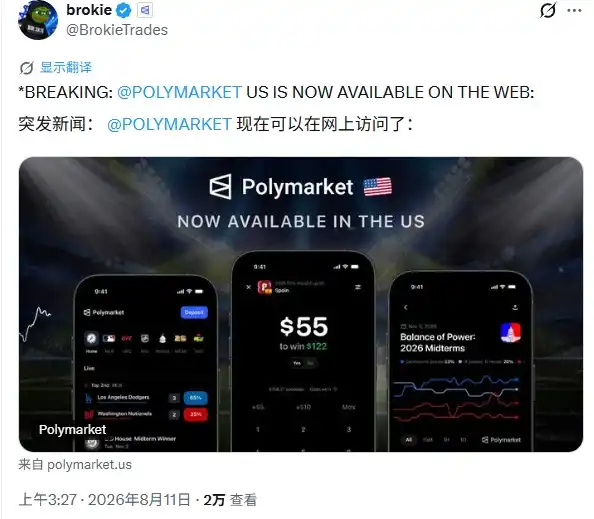
In December of the same year, Polymarket US began opening to users on the waitlist; in May this year, Polymarket US was fully opened to US iOS users. Just yesterday, community members reported that Polymarket US has launched a web version, continuing to expand channels accessible to US users.
Polymarket US Trading Volume Continues to Grow, Gradually Approaching Polymarket International

In May this year, as access for US users gradually opened, Polymarket US trading volume began to show significant growth.

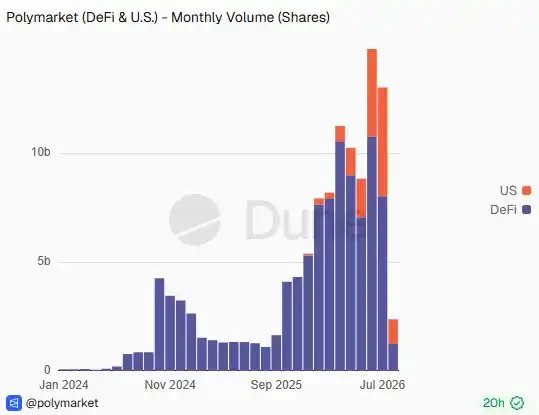
According to Dune data, Polymarket US trading volume in May was $1.769 billion, while Polymarket International's volume was $7.077 billion during the same period, with US volume being about 25% of International's. By June, Polymarket US trading volume rapidly increased to $4.041 billion, more than doubling from May. International volume for the same period was $10.773 billion, bringing the ratio to about 38%.

In July, this gap narrowed further. Polymarket US monthly trading volume reached approximately $5 billion, setting a new high, while International's July volume was only $8.044 billion. US volume was equivalent to 62% of International's, whereas just two months prior this ratio was only 25%.
With user access increasing and trading scale continuing to rise, Polymarket now needs not only to further acquire US users but also to face a series of more specific issues like marketing, compliance, and risk management. Therefore, growth, marketing, compliance, and risk control have become the most concentrated areas in this round of team adjustments.

Simultaneously Adding Staff for Growth and Compliance, But First Must Address Previous Marketing Issues

After taking over marketing operations, Travis VanderZanden, founder of Bird and former Uber and Lyft executive, must first deal with the promotional controversies left from earlier actions.

Previously, a Wall Street Journal investigation found that Polymarket had used promotional partners to have content creators display simulated trading. Some videos used website interfaces highly similar to the real Polymarket, leading viewers to believe the creators were conducting real trades and making profits. The related investigation stated that approximately $1.9 million in bets shown across over 1,100 related videos were simulated trades. Subsequently, the CFTC launched an investigation into Polymarket's related marketing practices.

Polymarket then began rectifying its marketing system, including restructuring the marketing department, updating rules for promotion partners, and conducting relevant training for employees. The company also hired consulting firm AlixPartners to review content released by partners, checking for compliance with new promotion guidelines.

Therefore, VanderZanden's task upon joining Polymarket is not merely to continue expanding the user base. He is taking over a marketing system still under adjustment. Polymarket US is currently continuing to expand user access, with trading volume also in a growth phase. With more sports events and political events on the horizon, the platform hopes to further attract US users and increase trading activity. However, previous regulatory investigations also mean that some of the more aggressive promotion methods used in the past can no longer be readily employed.

Autumn is the Real Test, Polymarket Still Needs to Catch Up with Kalshi

In the US prediction market, Kalshi still holds a significant lead over Polymarket US. In July, Kalshi's monthly trading volume was approximately $37.7 billion, Polymarket US about $5 billion, and Polymarket International about $8 billion for the same period—the two platforms combined about $13 billion, less than one-third of Kalshi's. Moreover, Kalshi's business is almost entirely concentrated in the US market.

This gap is also reflected in capital market valuations. At the end of June, Kalshi was negotiating a new round of financing with a target valuation of about $40 billion; just a month earlier, the company had completed a $1 billion funding round with a valuation of $22 billion at that time. In contrast, Polymarket was valued at about $9 billion in October 2025. After completing approximately $1 billion in financing in April this year, its valuation rose to $15 billion. Entering August, it began seeking another round of about $1 billion in financing, targeting a valuation exceeding $20 billion.

After September, a series of popular sports events and the US midterm elections in November will arrive. The US compliant prediction market is Kalshi's foundation and is also becoming Polymarket's most important growth engine. For Polymarket, the next few months will be a critical window for US to further expand trading scale. How effective this round of team adjustments will be will also soon be put to the test.


Cryptos en tendance

Questions liées

QAccording to the article, what was the key reason behind Polymarket's recent management and strategy adjustments?

AThe article states that Polymarket is adjusting its management, market direction, and promotion strategies in preparation for upcoming hot sports events and the US mid-term elections in November.

QWhat steps did Polymarket take to facilitate its return to the US market in 2025?

AIn 2025, Polymarket acquired CFTC-licensed derivatives exchange and clearing agency QCEX for $112 million, paving the way for its US return. The entity QCX LLC then operated as Polymarket US and obtained a revised CFTC Designation Order in November of that year.

QHow did the trading volume of Polymarket US change from May to July, and how did it compare to Polymarket International?

AThe trading volume of Polymarket US grew significantly from $1.769 billion in May to over $5 billion in July. Its proportion compared to Polymarket International's volume increased from 25% in May to 62% in July.

QWhat was the main marketing controversy Polymarket faced, and what actions did the company take in response?

APolymarket faced a controversy where promotional partners used simulated trading on websites that looked very similar to the real Polymarket platform, misleading viewers. Over 1,100 videos showcased about $1.9 million in simulated bets. In response, Polymarket restructured its marketing department, updated partner rules, trained employees, and hired AlixPartners to audit partner content for compliance.

QWhat is the competitive landscape between Polymarket and Kalshi in the US prediction market as described in the article?

AKalshi holds a significant lead over Polymarket in the US. In July, Kalshi's monthly trading volume was about $37.7 billion, while Polymarket US and International combined had about $13 billion, which is less than one-third of Kalshi's volume. Kalshi's valuation was also much higher, targeting around $40 billion in June compared to Polymarket's valuation of over $20 billion in August.

Lectures associées

5.47 milliards d'OP transférés de l'airdrop utilisateur vers le fonds écosystème, le vote DAO se transforme en démocratie factice

Le 19 août, une proposition de gouvernance sur Optimism visant à transférer 546,9 millions de jetons OP (12,7% de l'offre totale) des allocations d'airdrop utilisateur vers un "Fonds stratégique pour l'écosystème" contrôlé par la Fondation, a été approuvée in extremis. Le vote décisif, émis dans les 17 dernières minutes par l'équipe de développement principale "Test in Prod" – intégralement financée par la Fondation –, a fait basculer le résultat en faveur de la proposition. La Fondation justifie ce transfert en arguant que les airdrops massifs sont inefficaces pour la rétention des utilisateurs à ce stade, et que ces ressources sont désormais nécessaires pour séduire des clients institutionnels via le programme OP Enterprise. Cependant, des voix opposées, dont L2BEAT et le chercheur Polynya, soulèvent des préoccupations majeures. Ils pointent un manque de transparence et d'évaluation concernant l'utilisation des 686 millions d'OP déjà dépensés via les fonds écosystémiques, ainsi que la redéfinition d'une promesse initiale claire (19% de l'offre allouée aux airdrops utilisateurs). Cet épisode met en lumière des tensions fondamentales dans la gouvernance des DAO : le conflit d'intérêts potentiel lorsque des entités financées par la Fondation votent sur ses budgets, et la capacité d'un vote majoritaire à modifier substantiellement les engagements initiaux envers la communauté, érodant la confiance. Le mécanisme conçu pour remplacer la prise de décision opaque reproduit ainsi un dilemme classique de gouvernance : qui contrôle les contrôleurs, et jusqu'où peut aller le pouvoir de la majorité.

marsbitIl y a 22 mins

5.47 milliards d'OP transférés de l'airdrop utilisateur vers le fonds écosystème, le vote DAO se transforme en démocratie factice

marsbitIl y a 22 mins

Arthur Hayes affirme que le 'séisme yen' pourrait remettre le Bitcoin au centre des préoccupations en matière de liquidités

Arthur Hayes, dans son essai « Yen-quake » d'août 2026, avance une thèse macroéconomique spéculative centrée sur le yen japonais et la Facilité de pension FIMA de la Réserve fédérale américaine. Il soutient que des pressions sur le yen pourraient inciter le Japon à utiliser davantage ce mécanisme, qui permet aux institutions officielles d'obtenir des dollars contre des garanties de Treasuries. Cela injecterait potentiellement plus de liquidités en dollars sur les marchés mondiaux. Selon Hayes, cette expansion de la liquidité pourrait bénéficier aux actifs sensibles aux conditions monétaires, dont le Bitcoin. Il souligne que les traders de crypto-monnaies surveillent ces dynamiques, le BTC étant désormais considéré comme un actif réagissant à la liquidité globale. Cependant, l'article insiste sur le fait qu'il s'agit d'une analyse théorique et non d'une politique confirmée. La différence entre un scénario macroéconomique plausible et une action officielle de la Fed est cruciale. Bien que le cadre soit utile pour comprendre les interconnexions entre les devises, les banques centrales et les actifs risqués, il ne doit pas être interprété comme une garantie de hausse pour le Bitcoin. Pour l'instant, le « séisme du yen » reste une hypothèse dans le paysage macroéconomique du crypto.

bitcoinistIl y a 42 mins

Arthur Hayes affirme que le 'séisme yen' pourrait remettre le Bitcoin au centre des préoccupations en matière de liquidités

bitcoinistIl y a 42 mins

L'impact des rachats de bons du Trésor ne dure-t-il que 24 heures ? Bessent : Nous avons beaucoup d'outils, on verra

Le secrétaire au Trésor américain, Besant, a répondu aux fluctuations du marché obligataire après l'annonce du doublement des rachats de bons du Trésor à long terme. Il a qualifié la volatilité de 24 heures de « simple bruit » et souligné que le Trésor disposait d'une « vaste boîte à outils » pour intervenir davantage si nécessaire, laissant entendre que les opérations de rachat pourraient dépasser 40 milliards de dollars par opération. Il a estimé que les rendements actuels ne reflètent pas les fondamentaux de l'économie américaine, pointant particulièrement la faible liquidité des obligations à 30 ans. Besant a également annoncé un nouveau plan d'assainissement budgétaire, qui devrait être dévoilé fin de semaine ou début de semaine prochaine, visant à réduire les coûts d'emprunt à long terme. Il a réaffirmé la politique de dollar fort, notant que la devise revenait à ses niveaux d'il y a deux mois. Concernant l'Iran, Besant a déclaré qu'une conférence de presse se tiendrait lundi pour détailler les actions américaines, privilégiant une pression économique « maximale » pour éviter un conflit militaire majeur. Il s'est dit surpris par la hausse des prix du pétrole jeudi, anticipant que les mesures américaines les feraient baisser. Enfin, il a évoqué l'impact des investissements en IA, rendant les entreprises moins sensibles aux coûts d'emprunt, et a exprimé son optimisme quant à une future croissance de la productivité.

marsbitIl y a 1 h

L'impact des rachats de bons du Trésor ne dure-t-il que 24 heures ? Bessent : Nous avons beaucoup d'outils, on verra

marsbitIl y a 1 h

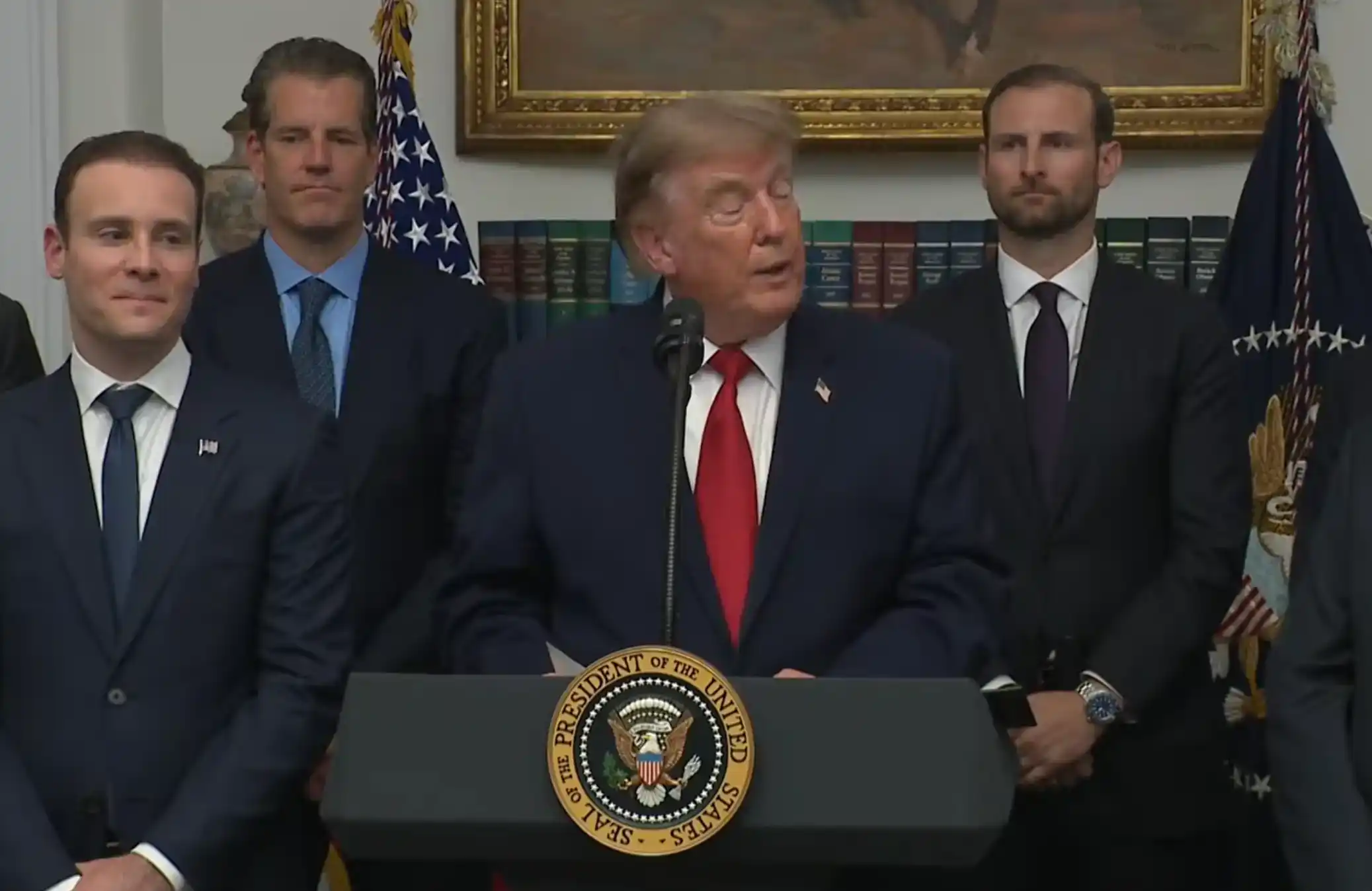
Introduction d'Hyperliquid, appel à l'adoption d'un projet de loi : synthèse du discours clé de Trump

Le président américain Donald Trump a récemment organisé une table ronde à la Maison Blanche, rassemblant des dirigeants de la finance, de la cryptomonnaie, de la technologie et des régulateurs. L'objectif était de renforcer la compétitivité américaine dans la finance et l'IA, en mettant particulièrement l'accent sur l'industrie des cryptomonnaies. Lors de son intervention, Trump a évoqué deux projets de loi clés : le « GENIUS Act », déjà signé, qui favorise l'adoption des stablecoins adossés au dollar, et le « Clarity Act », en cours d'examen au Congrès, qui vise à clarifier la distinction juridique entre les « titres numériques » et les « matières premières numériques ». Il a appelé à une adoption rapide de ce dernier. Les régulateurs ont également présenté des avancées majeures. La CFTC a confirmé le lancement du premier contrat perpétuel bitcoin conforme aux États-Unis et travaille à l'introduction du protocole décentralisé Hyperliquid dans un cadre réglementaire. La SEC a proposé de nouvelles règles pour permettre aux startups de lever des fonds via des actifs numériques de manière légale. Interrogé sur les réserves de bitcoin du gouvernement, Trump s'est dit ouvert à leur expansion. La réunion a également abordé brièvement les politiques énergétiques pour soutenir le développement de l'IA. Ces annonces sont perçues comme très positives pour le secteur des cryptomonnaies.

marsbitIl y a 1 h

Introduction d'Hyperliquid, appel à l'adoption d'un projet de loi : synthèse du discours clé de Trump

marsbitIl y a 1 h

Trading

Spot

Articles tendance

Comment acheter MOVE

Bienvenue sur HTX.com ! Nous vous permettons d'acheter Movement (MOVE) de manière simple et pratique. Suivez notre guide étape par étape pour commencer votre parcours crypto.Étape 1 : Création de votre compte HTXUtilisez votre adresse e-mail ou votre numéro de téléphone pour ouvrir un compte sur HTX gratuitement. L'inscription se fait en toute simplicité et débloque toutes les fonctionnalités.Créer mon compteÉtape 2 : Choix du mode de paiement (rubrique Acheter des cryptosCarte de crédit/débit : utilisez votre carte Visa ou Mastercard pour acheter instantanément Movement (MOVE).Solde :utilisez les fonds du solde de votre compte HTX pour trader en toute simplicité.Prestataire tiers :pour accroître la commodité d'utilisation, nous avons ajouté des modes de paiement populaires tels que Google Pay et Apple Pay.P2P :tradez directement avec d'autres utilisateurs sur HTX.OTC (de gré à gré) : nous offrons des services personnalisés et des taux de change compétitifs aux traders.Étape 3 : stockage de vos Movement (MOVE)Après avoir acheté vos Movement (MOVE), stockez-les sur votre compte HTX. Vous pouvez également les envoyer ailleurs via un transfert sur la blockchain ou les utiliser pour trader d'autres cryptos.Étape 4 : tradez des Movement (MOVE)Tradez facilement Movement (MOVE) sur le marché Spot de HTX. Il vous suffit d'accéder à votre compte, de sélectionner la paire de trading, d'exécuter vos trades et de les suivre en temps réel. Nous offrons une expérience conviviale aux débutants comme aux traders chevronnés.

633 vues totalesPublié le 2024.12.13Mis à jour le 2026.06.02

Comment acheter MOVE

Discussions

Bienvenue dans la Communauté HTX. Ici, vous pouvez vous tenir informé(e) des derniers développements de la plateforme et accéder à des analyses de marché professionnelles. Les opinions des utilisateurs sur le prix de MOVE (MOVE) sont présentées ci-dessous.

活动图片