Dark Pools Prevail, Whales Vanish: How Credible Are Public Market Signals?

marsbitPublié le 2026-08-07Dernière mise à jour le 2026-08-07

Résumé

Institutional cryptocurrency trading is increasingly shifting towards dark pools and over-the-counter (OTC) desks, with data from sFOX showing such venues accounted for 15% of total monthly volume by June, up from negligible levels in April. In July, 77.7% of institutional capital on sFOX's platform was routed through OTC desks, while only 18.4% went to public exchanges. A key driver is institutions' need to conceal large orders to avoid revealing trading patterns, preventing front-running and minimizing price impact. Firms like Jane Street and Citadel use dark pools and order-splitting across multiple venues to execute trades discreetly. This structural shift mirrors earlier developments in equities and forex markets. As a result, public order books now reflect only a fraction of actual market activity, eroding the once-significant advantage retail traders had in tracking large wallets and exchange flows. The proliferation of prime brokers and aggregation platforms is also rapidly closing simple arbitrage opportunities. The market may evolve toward a brokerage model for retail, similar to traditional stocks. Two scenarios emerge: an optimistic one where retail gains from narrower spreads and better order routing, and a pessimistic one where transparency declines faster than benefits trickle down, leaving smaller investors in the dark. Regardless, traders must adapt by not relying solely on exchange volume, comparing total execution costs, and using limit orders in thin marke...

Original Author: Gino Matos

Original Compilation: Saoirse, Foresight News

Data from sFOX shows that cryptocurrency dark pool trading volume continues to climb, growing from negligible levels in April to account for 15% of total monthly volume by June. The firm's July 30th report also noted that 77.7% of institutional capital on its platform was matched through OTC desks, with only 18.4% flowing to public exchanges. In May alone, dark pool transaction volume reached $147 million.

In an interview with CryptoSlate, sFOX's Diana Pires described this as a structural shift, similar to the industry transformation experienced by stock and foreign exchange markets years ago.

Why Institutions Choose Crypto Dark Pools

Large orders placed on public order books leave clear footprints. Other traders can identify these trading patterns, execute trades ahead of the order, or push prices in the opposite direction before the order is filled, thereby increasing trading slippage.

Pires gave an example: institutions like Jane Street and Citadel have strong incentives to hide their trading trails. Once trading patterns are identified by the market, other participants will conduct targeted reverse trades.

This is also the fundamental reason why more and more crypto orders are choosing dark pools, OTC desks, and platforms that can route single orders to over a dozen trading venues simultaneously.

sFOX alone is connected to over 40 exchanges and OTC desks, and its institutional clients typically use 14 to 19 of these channels to complete trades each month on average.

OTC desks that receive large orders typically break them down into smaller orders before distributing them to avoid single transactions from causing severe market fluctuations.

Pires summarized the core logic of crypto dark pools as follows: trading platforms privately take on large positions, then split them into small orders to be sent to exchanges; these small orders hardly disturb the order book. She believes that this type of capital inflow into the public market helps deepen the order book and further narrow the bid-ask spread.

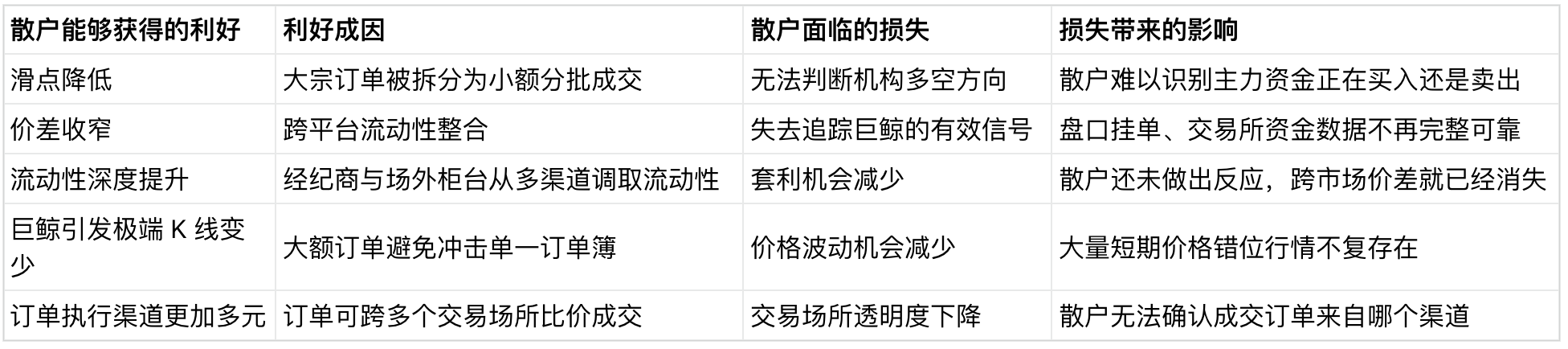
In the past, public order books could reflect the vast majority of real market trading activity, but now they only represent a small fraction of it. Quiet exchange order books do not mean institutions are not trading. Large buyers can accumulate positions over weeks without posting any visible buy orders; large sellers can complete significant reductions in holdings without massive sell pressure appearing on the order book.
The Information Advantage of Tracking Whales Is Being Actively Diminished

Bitcoin and crypto traders once had a natural advantage over participants in other markets: everyone could continuously monitor exchange fund balances, large orders on the order book, and large on-chain holdings.

Pires pointed out that dark pools, by design, eliminate this advantage. Trading platforms, OTC desks, and brokers can see the underlying fund flows. This information is protected by regulatory rules and client agreements, preventing retail traders from knowing whether institutions are buying or selling.

Simple cross-market arbitrage opportunities are also disappearing. Information once spread slower than capital flows, allowing investors to buy low on one exchange and sell high on another for profit. Pires stated that as prime brokers and aggregation platforms simultaneously scan dozens of trading venues, completing arbitrage and closing price gaps before retail traders can capture them, such opportunities are shrinking year by year.

She predicts the crypto trading market will eventually evolve towards a structure similar to the stock market: individual investors will no longer connect directly to exchanges but will instead go through brokers, who will seek the best prices across major trading venues on their behalf.

Retail account trading volumes typically struggle to meet the minimum fee tier thresholds set by exchanges, while brokers aggregating massive institutional orders can easily meet them. Pires believes this disparity will continue to drive ordinary traders towards brokers, although this shift won't be mandated by regulation as it was in the stock market.

Two Market Outlook Scenarios

Optimistic Scenario

Order aggregation platforms and mainstream trading venues handle retail orders in the same way they handle institutional orders. Market spreads continue to narrow, slippage decreases further, and instances of large orders piercing thin order books diminish.

Trading opportunities lost from public exchanges shift to other arenas. On-chain and DeFi markets still maintain public data on large holdings, providing channels for traders wanting to speculate on price volatility; regulated, compliant trading markets will exhibit more stable trends.

Pessimistic Scenario

For traders with ordinary capital sizes, the loss of trading transparency outpaces the realization of expected trading optimization benefits. Retail and medium-sized investors completely lose the ability to discern institutional capital movements.

Spread optimization and premium order routing services remain exclusively for large clients with sufficient capital to access prime brokers and aggregation platforms. Public exchange price signals continue to weaken, with participants relying on monitoring exchange order books being the first to feel the change.

Regardless of the market's direction, traders need to adjust their habits: do not treat the trading volume of a single exchange as a reflection of the entire market; compare total trading costs across different channels before referencing exchange-listed fee rates; when order book depth is insufficient, use limit orders as much as possible to guard against market orders impacting prices.

Beneath seemingly calm order books may lurk large-scale institutional trading.

As the crypto market matures and trading experiences continuously optimize, the difficulty of interpreting the market increases. Retail traders encounter fewer sudden price shocks from whales, but they also find it harder to observe the movements of the most influential capital.


Cryptos en tendance

Questions liées

QWhat is the main trend highlighted in the sFOX report regarding cryptocurrency trading?

AThe sFOX report highlights a significant structural shift, showing that dark pool and OTC trading volumes are rising sharply. In April, dark pool volume was negligible, but by June it accounted for 15% of the total monthly volume. In May alone, dark pool transaction volume reached $147 million.

QWhy are institutional players increasingly using crypto dark pools according to the article?

AInstitutions use dark pools to hide their trading patterns. Large orders on public order books leave clear traces, allowing other traders to front-run them or push prices against them before execution, increasing slippage. Dark pools and OTC desks allow them to break large orders into smaller ones executed across multiple venues, minimizing market impact.

QHow does the rise of dark pools affect the information advantage previously held by crypto traders?

AIt actively dismantles that advantage. Dark pools are designed to obscure large trade flows. Information on institutional buying or selling is protected by regulations and client agreements, making it inaccessible to retail traders. Furthermore, opportunities for simple cross-exchange arbitrage are disappearing as prime brokers and aggregators execute trades faster than retail can.

QWhat are the two potential future scenarios for the crypto market outlined in the article?

AThe article outlines one optimistic and one pessimistic scenario. The optimistic scenario envisions benefits like tighter spreads and lower slippage trickling down to retail traders via aggregators. The pessimistic scenario predicts that transparency will erode faster than benefits materialize for retail, leaving them unable to gauge institutional moves, with premium services remaining exclusive to large clients.

QWhat practical adjustments does the article suggest for traders in light of the rising use of dark pools?

ATraders should adjust by: 1) Not treating a single exchange's volume as representative of the whole market. 2) Comparing comprehensive transaction costs across different channels before referencing exchange-listed fees. 3) Using limit orders over market orders when order book depth is insufficient to prevent price impact.

Lectures associées

Elon Musk construit Terafab : la plus grande usine de puces pour l'IA, les robots et les centres de données spatiaux

Elon Musk lance Terafab, une méga-usine de puces pour l'IA, les robots et les data centers spatiaux. SpaceX et Tesla ont lancé le projet Terafab, une usine de semi-conducteurs de plus de 9,3 millions de m² au Texas. La première phase nécessitera 16,8 milliards de dollars d'investissements pour produire des équipements de calcul dépassant 1 térawatt par an, destinés aux robots Optimus, aux véhicules autonomes Cybercab et aux data centers orbitaux. Le gouverneur du Texas, Greg Abbott, a confirmé le projet, promettant 3 000 emplois et un financement de 30 millions de dollars. Elon Musk a souligné l'importance stratégique de regrouper sous un même toit la conception de logique, la production de mémoire et l'assemblage de puces. Il a décrit le complexe comme potentiellement "le plus grand et le plus précieux bâtiment sur Terre", avec une capacité de production allouée à 25% pour la robotique Tesla et 75% pour les systèmes d'IA spatiaux de SpaceX. Intel est le partenaire technologique clé, fournissant son procédé de fabrication 14A. Ce choix vise à diversifier la chaîne d'approvisionnement face à la domination de TSMC. Le projet s'inscrit dans le cadre de l'initiative "Pax Silica" des États-Unis, visant à sécuriser les chaînes d'approvisionnement en semi-conducteurs. D'un point de vue analytique, la réalisation d'un projet de cette envergure reste un défi, comme le montre les retards rencontrés par des projets similaires (ex: Intel en Ohio). Le succès de Terafab dépendra de nombreux facteurs externes et ne sera pas confirmé avant la fin de la décennie.

cryptonews.ruIl y a 1 h

Elon Musk construit Terafab : la plus grande usine de puces pour l'IA, les robots et les centres de données spatiaux

cryptonews.ruIl y a 1 h

La faillite du "Dieu de l'IA" entraîne des pertes de 15 milliards de dollars pour Jane Street en juillet, sa première perte mensuelle depuis dix ans

"Jane Street, l'un des géants du trading proprietary les plus secrets et rentables de Wall Street, a subi une perte rare d'environ 15 milliards de dollars au mois de juillet, sa première perte mensuelle depuis environ dix ans. Cette perte est principalement liée à deux facteurs : des investissements dans le fonds spéculatif axé sur l'IA, Situational Awareness, qui a fait face à des appels de marge et a dû liquider massivement ses positions, ainsi que des pertes sur des positions longues sur des actions non liées à l'IA en Asie. Il s'agit essentiellement d'un revers brutal pour des stratégies de trading qui avaient très bien performé au deuxième trimestre, notamment sur les actions technologiques, semiconducteurs et IA, avant un renversement soudain du marché en juillet. Malgré ce choc, Jane Street maintient une rentabilité globale solide, avec un revenu net de trading dépassant 400 milliards de dollars depuis le début de l'année. La société a réagi en réduisant activement son exposition au risque, fermant une partie des positions problématiques et abaissant le niveau de risque sur d'autres stratégies. Parallèlement, Jane Street procède à une importante restructuration de sa dette, d'environ 14,6 milliards de dollars, pour transférer une partie de son financement du marché public vers des investisseurs privés, acceptant des coûts plus élevés pour plus de confidentialité. L'incident met en lumière les risques de la chaîne du prime brokerage moderne, où des fonds très endettés partageant des expositions similaires (comme à l'IA) et des sources de financement communes peuvent amplifier les crises via des ventes forcées. Pour Jane Street, cet épisode représente un ajustement significatif mais ciblé de sa prise de risque, plutôt qu'une remise en cause de son modèle central."

marsbitIl y a 1 h

La faillite du "Dieu de l'IA" entraîne des pertes de 15 milliards de dollars pour Jane Street en juillet, sa première perte mensuelle depuis dix ans

marsbitIl y a 1 h

Analystes de QCP Capital expliquent pourquoi le Bitcoin est coincé à 63 000 $

L'analyse de QCP Capital explique pourquoi le Bitcoin reste bloqué autour de 63 000 $. Le rapport souligne que l'actif, après avoir testé la résistance de sa fourchette de trading récente (62 500 $ - 64 000 $), n'a pas réussi à générer un élan significatif malgré des données macroéconomiques américaines favorables, comme un ralentissement de l'inflation et un marché du travail plus faible. Plusieurs facteurs transversaux pèsent actuellement sur les actifs numériques : des risques géopolitiques accrus (notamment les tensions autour du détroit d'Ormuz maintenant les prix du pétrole élevés), des incertitudes sur la liquidité mondiale et une réaction atone des prix aux bonnes nouvelles macro. L'attention se tourne désormais vers l'indice PCE de fin août et la réunion de la FED en septembre. Par ailleurs, le paysage réglementaire américain évolue sur deux voies parallèles (législative et administrative), et les flux des trésoreries d'entreprises, comme les ventes occasionnelles de MicroStrategy, sont devenus plus conditionnels, ajoutant à la complexité du marché. Enfin, bien que la saisonnalité historique (août et septembre étant traditionnellement faibles) offre un contexte, elle n'est pas considérée comme prédictive. La conclusion principale est que le Bitcoin a démontré une résilience en absorbant les mauvaises nouvelles, mais il lui manque toujours un élan catalysateur pour sortir de son range. La persistance de cette fourchette sera testée par les événements macro à venir.

cryptonews.ruIl y a 1 h

Analystes de QCP Capital expliquent pourquoi le Bitcoin est coincé à 63 000 $

cryptonews.ruIl y a 1 h

Trading

Spot

Articles tendance

Comment acheter DATA

Bienvenue sur HTX.com ! Nous vous permettons d'acheter DATA Network (DATA) de manière simple et pratique. Suivez notre guide étape par étape pour commencer votre parcours crypto.Étape 1 : Création de votre compte HTXUtilisez votre adresse e-mail ou votre numéro de téléphone pour ouvrir un compte sur HTX gratuitement. L'inscription se fait en toute simplicité et débloque toutes les fonctionnalités.Créer mon compteÉtape 2 : Choix du mode de paiement (rubrique Acheter des cryptosCarte de crédit/débit : utilisez votre carte Visa ou Mastercard pour acheter instantanément DATA Network (DATA).Solde :utilisez les fonds du solde de votre compte HTX pour trader en toute simplicité.Prestataire tiers :pour accroître la commodité d'utilisation, nous avons ajouté des modes de paiement populaires tels que Google Pay et Apple Pay.P2P :tradez directement avec d'autres utilisateurs sur HTX.OTC (de gré à gré) : nous offrons des services personnalisés et des taux de change compétitifs aux traders.Étape 3 : stockage de vos DATA Network (DATA)Après avoir acheté vos DATA Network (DATA), stockez-les sur votre compte HTX. Vous pouvez également les envoyer ailleurs via un transfert sur la blockchain ou les utiliser pour trader d'autres cryptos.Étape 4 : tradez des DATA Network (DATA)Tradez facilement DATA Network (DATA) sur le marché Spot de HTX. Il vous suffit d'accéder à votre compte, de sélectionner la paire de trading, d'exécuter vos trades et de les suivre en temps réel. Nous offrons une expérience conviviale aux débutants comme aux traders chevronnés.

539 vues totalesPublié le 2026.07.01Mis à jour le 2026.07.01

Comment acheter DATA

Discussions

Bienvenue dans la Communauté HTX. Ici, vous pouvez vous tenir informé(e) des derniers développements de la plateforme et accéder à des analyses de marché professionnelles. Les opinions des utilisateurs sur le prix de DATA (DATA) sont présentées ci-dessous.

活动图片