According to Federal Authorities, FBI Agent in Charge of Hunting Spies Stole $1 Million in Cryptocurrency from His Own Suspect

cryptonews.ruPublié le 2026-08-04Dernière mise à jour le 2026-08-04

Résumé

FBI agent Patrick Stephen Yaroch, who specialized in counterintelligence and espionage cases, was arrested for stealing approximately $1.18 million in cryptocurrency from a foreign national security suspect. Yaroch, who had access to high-level intelligence systems, allegedly found the suspect's wallet seed phrases during an investigation in late 2024/early 2025. Using these phrases, he transferred funds to his own controlled wallets over 10-12 transactions. The investigation began when Yaroch confessed his actions to a DOJ official in July 2025, stating poor decisions had "eaten away at him." The FBI tracked the funds to accounts on Kraken and the Suilend DeFi protocol, later seizing about $925,000. Investigators also found ChatGPT discussions on retiring abroad with the money and undisclosed travel plans to Portugal. Yaroch was fired by the FBI and faces federal charges of transporting and selling stolen property.

Patrick Stephen Jaroch, 41, was arrested on July 31 at his home in Ashburn, Virginia, and taken to the Alexandria detention center. The same day, federal prosecutors filed a criminal complaint in the U.S. District Court for the Eastern District of Virginia, charging him with interstate transportation of stolen property and disposal of stolen property.

Both charges relate to cryptocurrency which, prosecutors allege, he surreptitiously removed from wallets belonging to a counterintelligence target deemed a national security threat. Jaroch had worked national security investigations for about eight years at the FBI's Boston field office before moving to a supervisory position at FBI Headquarters in early 2025.

This assignment placed him in the Counterintelligence and Espionage Section, where he had access to highly classified intelligence systems. Cryptocurrency cases often require investigators to seize wallet credentials as evidence, making the custody chain and internal access controls just as critical as the blockchain itself.

Turning Seed Phrases into Cash

According to a sworn affidavit from an FBI Washington Field Office counterintelligence agent, Jaroch discovered seed phrases — the recovery words that grant full control over a cryptocurrency wallet — while working on an investigation concerning a foreign target in late 2024 or early 2025. Prosecutors allege he input these recovery phrases into wallets under his control and transferred funds from the suspect's accounts approximately 10 to 12 times.

Investigators note the alleged theft was not based on complex blockchain tricks or hidden vulnerabilities. Possession of valid recovery phrases essentially equates to ownership of the cryptocurrency. Once those words are entered into compatible wallet software, transactions on the blockchain appear legitimate, as the network cannot distinguish the authorized owner from someone who improperly obtained the credentials.

According to the affidavit, Jaroch told investigators that, observing law enforcement's inaction regarding the victim's cryptocurrency activity, he became frustrated and decided to "take matters into his own hands." He also stated he never communicated with anyone connected to these wallets and emphasized that the majority of the funds remained in wallets under his control, rather than being widely spent.

A Confession Before Investigators Arrived

The investigation began with Jaroch walking into authorities himself, not with agents tracking his activity on the blockchain. On July 28, he contacted a Department of Justice National Security Division official via the Signal app and later met with him in person. According to the affidavit, he became emotional, admitted to making "very poor decisions regarding crypto wallets," and described the situation as "eating at him from the inside." The DOJ official advised him to get a lawyer and turn himself in immediately.

Jaroch then contacted FBI headquarters and told security staff he had "messed up." Later that evening, agents arrived at his home to retrieve government property and relieve him of duty. He briefly provided a written list of wallet recovery phrases but then withdrew his consent. Investigators said he then stated, "I f**ked up," before invoking his right to remain silent. The FBI fired him two days later, the same day he was arrested.

Following the Blockchain Trail

Investigators traced the alleged proceeds across several platforms, rather than finding them hidden behind complex money-laundering schemes. Approximately $188,570 was held in a Kraken account linked to a TD Bank account, which prosecutors allege Jaroch accessed using his phone's facial recognition feature. Another $1.02 million was transferred into Suilend — a decentralized lending protocol — via an app called Slush in late July.

According to investigators, Jaroch stated he chose Suilend partly because he liked its droplet logo and placed the funds there to earn yield while the cryptocurrency was idle. This detail is notable because DeFi lending protocols typically leave permanent records on the blockchain, providing investigators a clear evidentiary trail once the wallet owner is identified.

With Jaroch's consent on July 31, the FBI transferred approximately $925,426 from the Kraken and Suilend accounts to government-controlled wallets. Another $165,582 remained in the Kraken account because that balance had already been converted to U.S. dollars and could not be returned using the same cryptocurrency transfer procedure.

Portugal Plans Raise New Questions

Analysis of Jaroch's phone data broadened the investigation beyond the alleged cryptocurrency theft and into the realm of generative artificial intelligence (AI). Investigators found ChatGPT conversations from May and June where he pondered how roughly $1 million could fund his retirement by age 40, allowing him to live on a vineyard in Italy or Portugal. Other chats involved inquiries about obtaining European Union residency, with Portugal discussed in the context of his family circumstances.

Investigators also found flight bookings for Jaroch, his wife, and child for a September 3 flight from Washington to Lisbon with a return on September 11. Power of attorney documents dated mid-June, authorizing Portuguese lawyers to handle tax and registration matters, were reportedly found on the phone. Agents also identified earlier trips this year to Germany, Portugal, and Grenada that allegedly were never disclosed despite reporting requirements tied to his security clearance.

Jaroch denied any intention to transfer the cryptocurrency overseas, telling investigators the Portugal trip was solely intended to visit friends.

Close Watch for the Next Filing

The FBI stated that upon learning of the allegations, it acted promptly by firing Jaroch and initiating a full criminal investigation. The case now moves to federal court in Alexandria, where prosecutors will seek an indictment if the matter isn't resolved otherwise.

Documents to watch for on the docket are likely to include a motion for detention, a formal indictment or plea agreement, and any additional charges related to undisclosed foreign travel or security clearance reporting. The identity of the foreign intelligence target and adversary country remain undisclosed, suggesting some of the most significant details may only emerge much later in the investigation.

end-content
Cryptos en tendance

Questions liées

QWhat were the primary charges filed against former FBI agent Patrick Stephen Yaroch by federal prosecutors?

APatrick Stephen Yaroch was charged with interstate transportation of stolen property and sale of stolen property.

QHow did Yaroch allegedly gain access to and transfer the stolen cryptocurrency according to the prosecutors?

AHe allegedly discovered the seed phrases (recovery words) for the cryptocurrency wallets during an investigation, entered them into wallets he controlled, and transferred the funds 10-12 times from the suspect's accounts.

QWhat key event triggered the initial investigation into Yaroch's activities?

AThe investigation began when Yaroch himself contacted a Department of Justice National Security Division employee on July 28, admitted to making 'very poor decisions involving crypto wallets,' and was advised to surrender.

QWhat were the two main platforms where the allegedly stolen cryptocurrency funds were traced to, and what were the approximate amounts?

AApproximately $188,570 was traced to a Kraken account, and about $1.02 million was traced to the Suilend decentralized lending protocol.

QWhat additional concerning activities did investigators uncover from Yaroch's phone data beyond the cryptocurrency theft?

AInvestigators found ChatGPT conversations where he discussed retiring early with $1 million, inquired about EU residency (specifically Portugal), and discovered undisclosed trips to Germany, Portugal, and Grenada, along with booked flights and power of attorney documents related to Portugal.

Lectures associées

Grayscale : « Si les propositions sont adoptées, les prix de ces deux altcoins pourraient augmenter »

Zach Pandl, responsable de la recherche chez Grayscale, estime que des modifications envisagées de la tokenomique d'Ethereum (ETH) et de Solana (SOL) pourraient ralentir considérablement la croissance de leur offre, exerçant ainsi une pression haussière sur leurs prix. Ces propositions visent à réduire le taux d'inflation annuel des jetons ETH et SOL. Un ralentissement de la création de nouveaux jetons augmenterait la rareté des actifs existants. Grayscale prévoit que, si elles sont adoptées, l'inflation annuelle de l'offre d'Ethereum pourrait tomber à environ 0,4% d'ici fin 2031, se rapprochant ainsi du Bitcoin, tandis que celle de Solana pourrait atteindre environ 1,1%. En comparaison, l'offre d'or croît d'environ 1,8% par an et l'inflation (IPC) aux États-Unis est d'environ 3,3%. Pandl note que les propositions pour Solana semblent rencontrer un soutien plus large et ont donc une probabilité de mise en œuvre plus élevée. Cependant, il souligne un compromis potentiel : une inflation réduite pourrait diminuer les récompenses pour les investisseurs pratiquant le staking, une partie importante de leurs revenus provenant de l'émission de nouveaux jetons. En conclusion, un ralentissement de l'offre pourrait profiter aux prix des deux actifs, les détenteurs de jetons sans staking étant particulièrement bien placés pour en bénéficier. Ces changements restent à l'étude et ne sont pas encore approuvés.

cryptonews.ruIl y a 3 h

Grayscale : « Si les propositions sont adoptées, les prix de ces deux altcoins pourraient augmenter »

cryptonews.ruIl y a 3 h

Les experts ont nommé les raisons de la chute du bitcoin après la baisse de l'inflation aux États-Unis

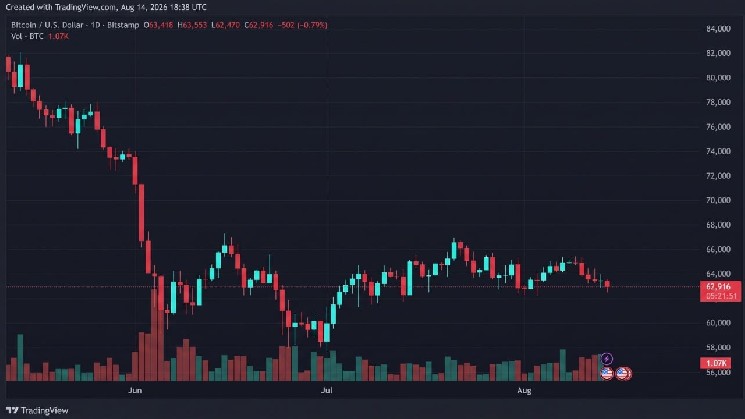
Les données favorables sur l’inflation aux États‑Unis n’ont pas réussi à soutenir le bitcoin. Selon les analystes de CryptoQuant, la principale raison est la faible demande sur le marché au comptant. Le bitcoin n’a pas réagi aux chiffres de l’inflation de juillet, publiés le 12 août, et a même légèrement baissé, passant d’environ 64 500 $ à près de 63 000 $. Pourtant, l’indice des prix à la production (PPI) était meilleur que prévu. Alors que les rendements des obligations du Trésor américain ont reculé et que les marchés actions ont progressé, le bitcoin est resté dans une fourchette de 63 000 à 64 000 $. Cette absence de réaction s’explique notamment par la faible demande au comptant : les entrées de capitaux dans les ETF américains spot de bitcoin restent limitées, et l’indice Coinbase Premium (reflétant l’écart de prix entre Coinbase et les autres grandes plateformes) est négatif depuis mai, indiquant une pression d’achat modérée de la part des investisseurs américains. Dans le même temps, le positionnement des traders sur le marché à terme reste élevé, créant un déséquilibre entre une faible liquidité, une demande spot atone et un volume important de positions à effet de levier. Les analystes estiment que dans ces conditions, même des nouvelles macroéconomiques positives pourraient ne pas déclencher de hausse. Si le prix n’évolue pas malgré un contexte favorable, les traders pourraient commencer à clôturer leurs positions longues à effet de levier, ce qui exercerait une pression supplémentaire à la baisse. Un niveau de résistance clé se situe autour de 68 700 $, coût moyen approximatif pour les détenteurs à court terme, au‑delà duquel une prise de bénéfices est possible. Pour CryptoQuant, une reprise soutenue nécessiterait : une reprise des entrées dans les ETF américains, un retour de l’indice Coinbase Premium en territoire positif, une hausse des volumes de trading au comptant et un franchissement stable des 68 700 $.

cryptonews.ruIl y a 4 h

Les experts ont nommé les raisons de la chute du bitcoin après la baisse de l'inflation aux États-Unis

cryptonews.ruIl y a 4 h

Trading

Spot

Articles tendance

Comment acheter HOME

Bienvenue sur HTX.com ! Nous vous permettons d'acheter Defi.app (HOME) de manière simple et pratique. Suivez notre guide étape par étape pour commencer votre parcours crypto.Étape 1 : Création de votre compte HTXUtilisez votre adresse e-mail ou votre numéro de téléphone pour ouvrir un compte sur HTX gratuitement. L'inscription se fait en toute simplicité et débloque toutes les fonctionnalités.Créer mon compteÉtape 2 : Choix du mode de paiement (rubrique Acheter des cryptosCarte de crédit/débit : utilisez votre carte Visa ou Mastercard pour acheter instantanément Defi.app (HOME).Solde :utilisez les fonds du solde de votre compte HTX pour trader en toute simplicité.Prestataire tiers :pour accroître la commodité d'utilisation, nous avons ajouté des modes de paiement populaires tels que Google Pay et Apple Pay.P2P :tradez directement avec d'autres utilisateurs sur HTX.OTC (de gré à gré) : nous offrons des services personnalisés et des taux de change compétitifs aux traders.Étape 3 : stockage de vos Defi.app (HOME)Après avoir acheté vos Defi.app (HOME), stockez-les sur votre compte HTX. Vous pouvez également les envoyer ailleurs via un transfert sur la blockchain ou les utiliser pour trader d'autres cryptos.Étape 4 : tradez des Defi.app (HOME)Tradez facilement Defi.app (HOME) sur le marché Spot de HTX. Il vous suffit d'accéder à votre compte, de sélectionner la paire de trading, d'exécuter vos trades et de les suivre en temps réel. Nous offrons une expérience conviviale aux débutants comme aux traders chevronnés.

715 vues totalesPublié le 2025.06.10Mis à jour le 2026.06.10

Comment acheter HOME

Discussions

Bienvenue dans la Communauté HTX. Ici, vous pouvez vous tenir informé(e) des derniers développements de la plateforme et accéder à des analyses de marché professionnelles. Les opinions des utilisateurs sur le prix de HOME (HOME) sont présentées ci-dessous.

活动图片