Cardano Price Forecast: Can Hoskinson's $1B RealFi Bet Stop ADA's Fall to $0.14?

cryptonews.ruPublié le 2026-07-28Dernière mise à jour le 2026-07-28

Résumé

Cardano Price Forecast: Can Hoskinson's $1B RealFi Bet Halt ADA's Drop to $0.14? Cardano (ADA) gained 1% on July 28, testing a key Fibonacci support level at $0.1618 after breaking below a consolidating triangle. Technical analysis shows a descending trend line from May's peak maintaining resistance, with the 20-day and 50-day EMAs also capping upside moves. A daily close below $0.1618 could see ADA fall towards the June low of $0.1386. During a recent AMA, founder Charles Hoskinson identified RealFi as Cardano's most likely product to achieve $1 billion in Total Value Locked (TVL) within a year, citing the operational independence of the Real5 Foundation and its team's microfinance experience. Other development updates included the beta launch of 'Midnight City,' the public testnet for Ouroboros Leios, and commentary on the unlikely passage of the CLARITY Act in the US. Following a June exploit that drained 16.1 million ADA, SecondFi launched a recovery roadmap featuring a ZK-proof-based fund return portal, allowing users to claim compensation without exposing private keys. Derivatives data shows a 159% surge in trading volume as ADA tested support, accompanied by a drop in open interest. The liquidation ratio was 58:1 in favor of longs, indicating leveraged long positions were being washed out. Retail traders are net short, creating potential for a short squeeze if a price rebound occurs. The bullish scenario targets a rebound to the 20-day EMA at $0.1650 and the 0.382...

Cardano rose 1% on July 28, reaching the last Fibonacci support before the June low, while Hoskinson used a Sunday AMA to call RealFi the single product most likely to bring $1 billion TVL to the network within a year.

$ADA Tests Last Fibonacci Support Before June Low
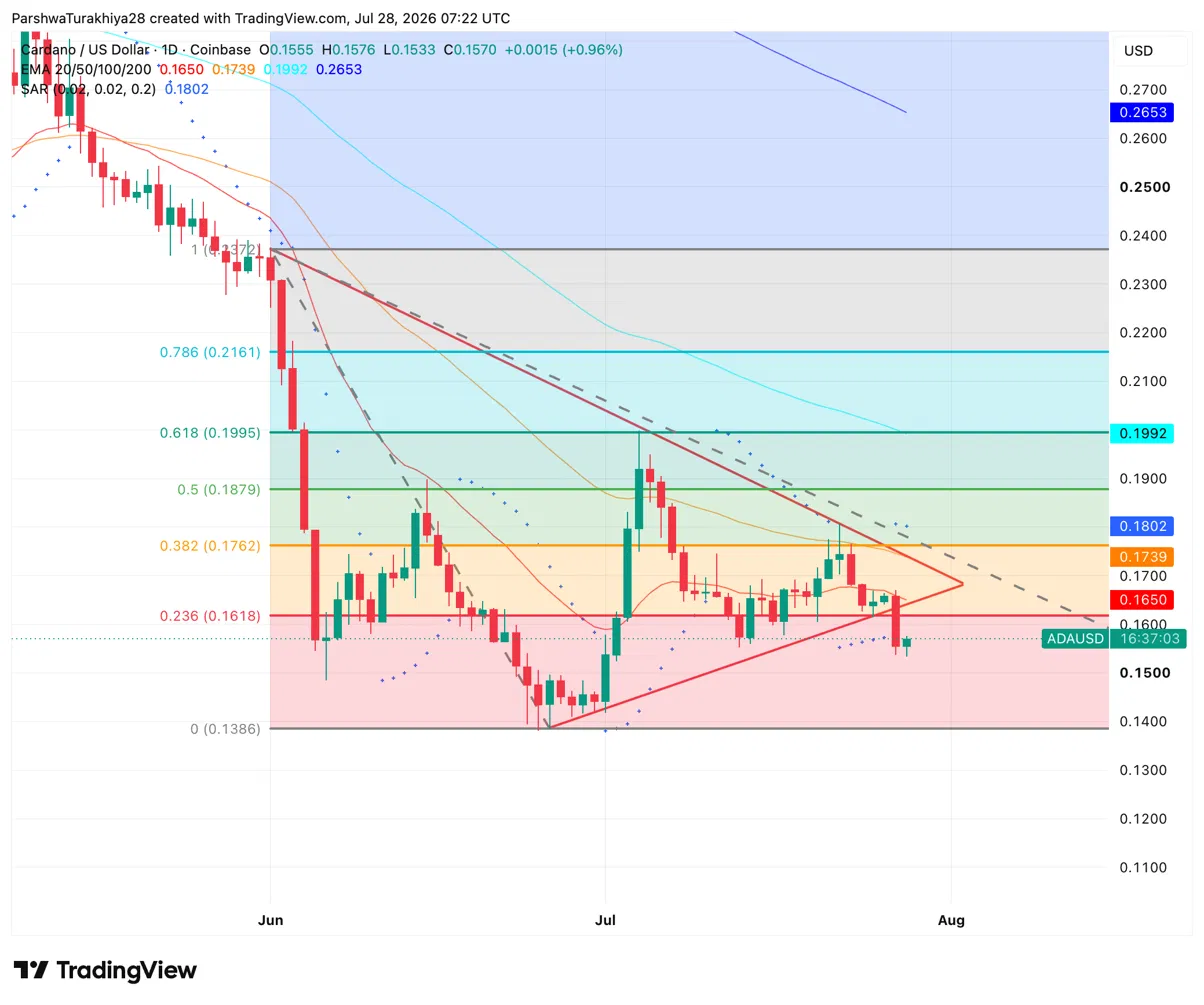
$ADA 1D Price Movement (Source: TradingView)

The daily chart shows how $ADA is testing the 0.236 Fibonacci level at $0.1618 after failing to hold a triangle that had been tightening since mid-July. The descending trendline from May's peak continues to slope down through the $0.17 zone, keeping the 20-day EMA at $0.1650 and the 50-day at $0.1739 firmly in the resistance stack above. The Parabolic SAR at $0.1802 is significantly above price and remains in a bearish tempo.

Related: Pi Network Price Forecast: Can a $12 Million Robotics Bet Save PI from a New All-Time Low?

The 0.382 Fibonacci level at $0.1762 and the ascending trendline from the June low failed to hold support last week, leaving the 0.236 Fibonacci at $0.1618 as the last technical stand before the Fibonacci zero point at $0.1386 and the June low. A daily close below $0.1618 would put $ADA into uncharted territory on this Fibonacci grid with no established support below until $0.1386.

What Are the Key Support and Resistance Levels for $ADA Today?

Resistance
  1. $0.1650 — 20-day EMA, capping and limiting short-term bounces
  2. $0.1739 — 50-day EMA, part of the overhead structure
  3. $0.1762 — 0.382 Fibonacci, former support now acting as resistance
  4. $0.1992 — 100-day EMA, extended ceiling for any sustained recovery
Support
  1. $0.1618 — 0.236 Fibonacci, current test and final floor of this grid
  2. $0.1386 — Fibonacci zero point and June low, last line before uncharted territory

Hoskinson: RealFi Is Cardano's Best Chance for $1B TVL in 12 Months

Surprise AMA 07-27-2026 https://t.co/agI4wNTRlQ

— Charles Hoskinson (@IOHK_Charles) July 27, 2026

In an unexpected AMA on July 27, Hoskinson named RealFi as the single Cardano product most likely to reach $1 billion in TVL within 12 months. He cited two reasons: the full operational independence of the Real5 Fund and John O'Connor's hands-on experience with microfinance across Africa. IO Labs will invest and provide technical support while the fund makes all strategic decisions.

Three Other Development Updates from the Same AMA Worth Noting:

  • Midnight City is entering beta, with thousands of users being onboarded in tranches. Hoskinson noted that two key metrics are watchability—how interesting the world is to observe—and the empathy of the user's connection with the agent. Agent-based trading is the next major integration point between Midnight City and the shielded infrastructure of the Midnight Foundation. The product is expected to look substantially different by Token 2049.
  • Ouroboros Leios Testnet is live on musashi.network with a public five-phase roadmap covering the current Earth phase through November.
  • CLARITY Act — On a direct question, Hoskinson said it likely won't pass, reiterating the same version as Anthony Scaramucci this week, citing Washington's political dynamics rather than an issue with the bill itself.

SecondFi Deployed First ZK Proof-Based Refund Portal in Web3

🛡 Recovery Process Update

Work on the recovery process is continuing across several fronts. Here is where things stand and what to expect in the coming weeks:

1. Streamlined ticket submission (Available today)

We have streamlined the ticket claim submission process to make...

— SecondFi (@secondfiapp) July 27, 2026

Following the June 2026 exploit that drained 374 wallets of 16.1 million $ADA worth about $2.5 million, SecondFi suspended operations and launched a phased recovery roadmap in cooperation with IOG and the Cardano Foundation.

Related: Chainlink (LINK) Price Forecast for 2026, 2027, 2028, 2029, 2030-2050

The refund mechanism uses zero-knowledge proofs to allow affected users to prove wallet ownership and claim compensation without disclosing private keys. The phased plan runs through September. The exploit hit a third-party application, not the base protocol, and the more relevant signal for long-term network resilience is the coordinated recovery effort involving Cardano's core entities.

Volume Spiked 159% as Longs Absorbed Most of the Pain
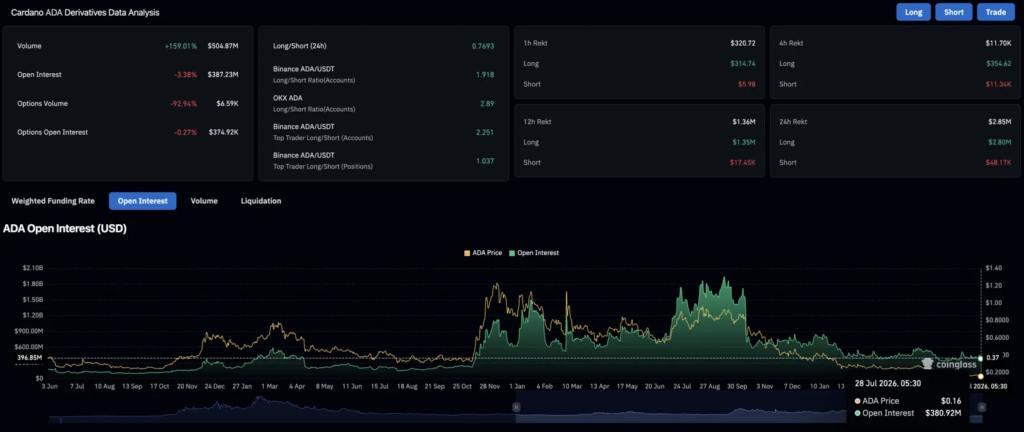
$ADA Derivatives Analysis (Source: Coinglass)
Metric Value Signal
24h Volume $504.87M (+159.01%) Active trading towards support test—not a quiet drift lower
Open Interest $387.23M (-3.38%) Decline—over-leveraged positions closing
Long Liquidations (24h) $2.80M Over-leveraged longs getting washed out at the 0.236 Fib level
Short Liquidations (24h) $48.17K 58:1 Ratio—Longs taking nearly all the pain
Top Trader L/S (Accounts) 2.25 Net long bias among large accounts
Top Trader L/S (Positions) 1.04 Barely long by position size—large clients are cautious
Retail L/S Ratio 0.7693 Short-bias—retail on the opposite side of top trader positioning

A 159% volume spike on the support test alongside declining open interest is a specific signature: active buying and selling at this price level with net positioning decreasing. The 58:1 liquidation ratio between longs and shorts confirms that over-leveraged long positions are being flushed as $ADA squeezes the 0.236 Fibonacci level.

Retail short skew at 0.7693 and top trader long lean of 2.25 by accounts creates divergence—if $ADA holds here and bounces, a retail short squeeze adds fuel. If it breaks, retail shorts are positioned correctly.

$ADA Price Forecast: Upside & Downside Targets

Bull Case — Target: $0.1650 (20-day EMA) to $0.1762

The 0.236 Fibonacci level at $0.1618 holds on a daily close. Progress on RealFi and Midnight City adoption draw fresh attention to Cardano development. The FOMC confirmed a rate hold on July 29, sparking a broader risk-on move in crypto. $ADA reclaims the 20-day EMA at $0.1650 as first confirmation of support, then targets the 0.382 Fibonacci at $0.1762 as the next logical level. Retail short skew at 0.7693 adds squeeze fuel if a bounce confirms.

Bear Case — Target: $0.1386 (June Low / Fibonacci Zero)

The 0.236 Fibonacci level at $0.1618 fails on a daily close. $ADA moves towards the Fibonacci zero point at $0.1386 and the June low with no established support in between. Retail positioning with a short skew at 0.7693 accelerates the move as an immediate buyer catalyst fails to appear. Last week's failures of the 0.382 Fibonacci and the ascending trendline confirm the bearish structure, with each level acting as resistance, not support, on any bounce attempt.

Related: Meme Coin Price Forecast: Dogecoin, Shiba Inu, MemeCore

end-content

Cryptos en tendance

Questions liées

QAccording to the article, what is the key technical support level for ADA to hold to avoid a deeper decline?

AAccording to the article, the key technical support level is the 0.236 Fibonacci retracement level at $0.1618. If ADA fails to hold this level on a daily close, it would likely move towards the June low of $0.1386 without established support in between.

QWhat did Charles Hoskinson identify as the single Cardano product most likely to bring $1 billion in TVL within 12 months?

AIn the AMA, Charles Hoskinson identified RealFi as the single Cardano product most likely to bring $1 billion in Total Value Locked (TVL) to the network within 12 months.

QWhat caused the significant 159% increase in ADA's 24-hour trading volume mentioned in the article?

AThe 159% surge in 24-hour trading volume was driven by active buying and selling as ADA tested a major support level (the 0.236 Fibonacci level at $0.1618). This indicates active trading rather than a quiet downward drift.

QWhat was the ratio of long to short liquidations in the derivatives market, and what does it indicate?

AThe ratio of long to short liquidations was 58:1. This indicates that leveraged long positions were being heavily liquidated, bearing almost all the selling pressure during the price decline to test the support level.

QWhat are the primary bearish and bullish price targets for ADA outlined in the article's forecast?

AThe primary bullish target is for ADA to reclaim the 20-day EMA at $0.1650 and then target the 0.382 Fibonacci level at $0.1762. The primary bearish target is a drop to the June low and Fibonacci zero point at $0.1386, should it fail to hold the $0.1618 support.

Lectures associées

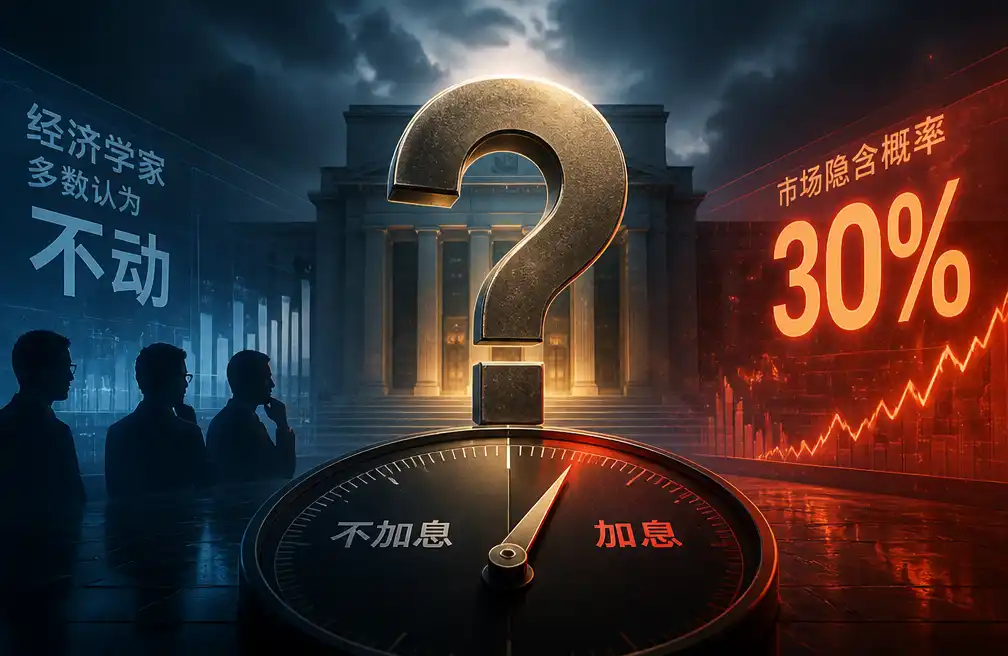
Ce soir, une hausse des taux ou non ? Les économistes sont catégoriques, les marchés donnent une probabilité de 30 %

Les contrats à terme sur les fonds fédéraux se repriçent avant la décision de juillet du FOMC, les traders payant un prix plus élevé pour se couvrir contre une hausse inattendue des taux ou un signal plus hawkish de la Fed. Ce mouvement contraste avec le consensus des économistes, qui anticipent unanimement un statu quo en juillet. Le marché évalue à environ 30 % la probabilité d'une hausse de 25 points de base, reflétant une prime pour le risque de queue hawkish plutôt qu'une conviction ferme. La divergence porte sur l'interprétation du choc pétrolier. Les institutions hawkish, comme BofA, soulignent le risque pour la crédibilité anti-inflation de la Fed si elle minimise la pression des prix. Les positions plus dovish, comme celle de Citi, considèrent la hausse du pétrole comme un choc d'offre temporaire, où une réaction excessive pourrait nuire à la croissance. La nomination du nouveau président de la Fed, Kevin Warsh, amplifie l'incertitude. L'absence de références sur son style de communication élargit la distribution perçue des taux futurs, poussant les marchés à couvrir davantage leurs risques. Même sans hausse en juillet, une déclaration ou une conférence de presse mettant fortement l'accent sur les risques inflationnistes pourrait maintenir la pression sur les actifs. Ainsi, l'enjeu immédiat n'est pas tant la décision de juillet, mais la façon dont Warsh qualifiera le choc pétrolier et la probabilité qu'il laisse ouverte la fenêtre de hausse en septembre. Cela déterminera la trajectoire du dollar, la pression sur le yen et l'ajustement des valorisations des actifs à risque.

marsbitIl y a 31 mins

Ce soir, une hausse des taux ou non ? Les économistes sont catégoriques, les marchés donnent une probabilité de 30 %

marsbitIl y a 31 mins

Le matériau le plus discret de la chaîne d'étranglement des semi-conducteurs, dont le prix a été multiplié par plusieurs fois sans que personne ne s'en aperçoive, vient d'être interdit par la Chine

L'hélium, élément abondant dans l'univers mais rare sur Terre et non renouvelable, est un matériau crucial et irremplaçable pour la fabrication de puces semi-conductrices avancées, notamment pour le refroidissement précis des wafers et la détection de fuites. Pourtant, son importance est souvent méconnue. En mars, une attaque au missile a gravement endommagé la plus grande installation de production d'hélium au monde au Qatar, coupant un tiers de l'approvisionnement mondial. Combiné à l'arrêt des exportations russes et à la vente des réserves stratégiques américaines, cela a provoqué une pénurie mondiale, faisant plus que doubler les prix. La Chine, qui dépend à 84% des importations (principalement du Qatar et de Russie), a vu ses approvisionnements gravement perturbés. Face à cette crise, la Chine a interdit les exportations d'hélium le 10 juillet pour garantir ses propres besoins nationaux, notamment pour son industrie semi-conductrice en pleine expansion. Pour réduire sa dépendance, la Chine a développé une technologie pour extraire l'hélium des usines de GNL, produisant même de l'hélium ultra-pur. Cependant, la capacité nationale ne couvre encore que moins de 20% de la demande. La pénurie mondiale, aggravée par des réparations qui prendront des années au Qatar, devrait durer, mettant en lumière la vulnérabilité stratégique de cette ressource invisible mais essentielle pour les technologies de pointe.

marsbitIl y a 1 h

Le matériau le plus discret de la chaîne d'étranglement des semi-conducteurs, dont le prix a été multiplié par plusieurs fois sans que personne ne s'en aperçoive, vient d'être interdit par la Chine

marsbitIl y a 1 h

Un investisseur précoce d'Unitree mise sur une entreprise d'interface cerveau-machine

L'investisseur précoce d'Unitree mise sur une société d'interface cerveau-ordinateur. Wabo Technology, fondée fin 2025 par Zhang Xingzhi, un docteur de l'Université Tsinghua inspiré par le film "Avatar", a levé un nouveau tour de financement. Les investisseurs incluent Vertex Ventures (Singapour) du groupe Temasek, la société de capital-risque Hongtai Fund, le fonds futuriste de Chengdu et Huifengda Capital. Contrairement à de nombreuses entreprises d'interface cerveau-ordinateur, Wabo se positionne comme une entreprise de modèles. Elle développe un "modèle d'intention neuronale humaine" visant à interpréter les intentions d'action avant leur exécution physique, en fusionnant des signaux EEG, EMG, le comportement et le contexte visuel. Ce modèle se caractérise par sa capacité à s'adapter à des tâches spécifiques, sa généralisation entre différents utilisateurs et appareils, et son fonctionnement en boucle fermée pour une fiabilité accrue. Fondée à Chengdu, l'entreprise attire rapidement des talents et des capitaux. Après un tour initial (seed) par Ceyuan Capital, elle a rapidement bouclé un tour angel avec une due diligence accélérée. Les investisseurs, dont Vertex (également investisseur précoce d'Unitree) et Hongtai (actif dans l'aérospatiale commerciale), valorisent la capacité de Wabo à créer un système complet liant les signaux neuronaux à des applications réelles, au-delà du simple matériel. Wabo explore des applications dans la rééducation médicale, les robots incarnés, la domotique et même l'aérospatiale, collaborant avec l'Université de Tianjin sur des interfaces cerveau-ordinateur pour l'espace. L'entreprise établit désormais un double siège à Chengdu (recherche produit, ingénierie) et à Shanghai (recherche de pointe, modèle d'intention), s'installant dans la zone "Brain-Intelligence World" de Shanghai. Le secteur de l'interface cerveau-ordinateur connaît un boom financier en Chine. Zhang Xingzhi estime que la concurrence future portera sur la capacité à créer une boucle vertueuse "entrée de données neuronales - modèle d'intention - contrôle physique - retour de données". Il prédit une consolidation dans les trois prochaines années, seuls les acteurs maîtrisant cette boucle survivront, rapprochant ainsi la vision fictionnelle d'"Avatar" de la réalité.

marsbitIl y a 1 h

Un investisseur précoce d'Unitree mise sur une entreprise d'interface cerveau-machine

marsbitIl y a 1 h

Trading

Spot

Articles tendance

Comment acheter ADA

Bienvenue sur HTX.com ! Nous vous permettons d'acheter Cardano (ADA) de manière simple et pratique. Suivez notre guide étape par étape pour commencer votre parcours crypto.Étape 1 : Création de votre compte HTXUtilisez votre adresse e-mail ou votre numéro de téléphone pour ouvrir un compte sur HTX gratuitement. L'inscription se fait en toute simplicité et débloque toutes les fonctionnalités.Créer mon compteÉtape 2 : Choix du mode de paiement (rubrique Acheter des cryptosCarte de crédit/débit : utilisez votre carte Visa ou Mastercard pour acheter instantanément Cardano (ADA).Solde :utilisez les fonds du solde de votre compte HTX pour trader en toute simplicité.Prestataire tiers :pour accroître la commodité d'utilisation, nous avons ajouté des modes de paiement populaires tels que Google Pay et Apple Pay.P2P :tradez directement avec d'autres utilisateurs sur HTX.OTC (de gré à gré) : nous offrons des services personnalisés et des taux de change compétitifs aux traders.Étape 3 : stockage de vos Cardano (ADA)Après avoir acheté vos Cardano (ADA), stockez-les sur votre compte HTX. Vous pouvez également les envoyer ailleurs via un transfert sur la blockchain ou les utiliser pour trader d'autres cryptos.Étape 4 : tradez des Cardano (ADA)Tradez facilement Cardano (ADA) sur le marché Spot de HTX. Il vous suffit d'accéder à votre compte, de sélectionner la paire de trading, d'exécuter vos trades et de les suivre en temps réel. Nous offrons une expérience conviviale aux débutants comme aux traders chevronnés.

1.2k vues totalesPublié le 2024.12.10Mis à jour le 2026.06.02

Comment acheter ADA

Discussions

Bienvenue dans la Communauté HTX. Ici, vous pouvez vous tenir informé(e) des derniers développements de la plateforme et accéder à des analyses de marché professionnelles. Les opinions des utilisateurs sur le prix de ADA (ADA) sont présentées ci-dessous.

活动图片