Pennsylvania Bill Could Bar Sportsbooks from Participating in Prediction Market-Making

cryptonews.ruPublié le 2026-07-28Dernière mise à jour le 2026-07-28

Résumé

A bipartisan group of lawmakers in Pennsylvania introduced House Bill 2711, which could prohibit gambling companies, including sportsbooks, from serving as liquidity providers or market makers on prediction market platforms. The bill aims to separate prediction market infrastructure from gambling entities. It would ban platforms from contracting or sharing revenue with companies engaged in gambling and imposes consumer protections, including age restrictions and bans on markets related to minors, health, and death. Unlike proposals in other states, it seeks to regulate rather than ban prediction markets, focusing on restricting liquidity sources. The bill contrasts with another Pennsylvania proposal (HB 2497) that would license and tax such platforms. This legislative push occurs amid a national debate over whether prediction contracts are gambling or financial derivatives, following a recent federal court ruling that federal commodity law preempts state gambling laws for CFTC-registered exchanges.

A group of bipartisan Pennsylvania legislators has introduced a bill that could prohibit sportsbooks and other gambling companies from serving as liquidity providers or market makers on prediction platforms. House Bill 2711 was introduced on July 22 by Representative Tarik Khan and referred to the House Consumer Protection, Technology and Utilities Committee. It has a total of 24 co-sponsors—20 Democrats and four Republicans.

The bill would ban a provider from offering a prediction market in Pennsylvania if its liquidity provider or market maker knowingly engages in gambling activities in the course of regular business, both within and outside the state. The restriction applies to parent companies, subsidiaries, affiliates, joint ventures, employees, and legal entities operating for the financial interest of another company.

Prediction platforms would also be barred from entering into contracts or sharing revenue with companies ordinarily engaged in gambling. A new chapter in the bill dedicated to prediction markets does not define the term “gambling activity” nor clarify how these provisions would apply to platforms affiliated with sports betting operators, leaving uncertainty about how broadly courts or regulators would apply this restriction.

This provision emerges as traditional sports betting groups move beyond consumer-facing prediction apps to the infrastructure underpinning their contracts. Companies like DraftKings and Flutter engage in market-making activities, and DraftKings recently launched its own DKeX exchange after acquiring CFTC-registered firm Railbird Technologies.

If HB 2711 is passed and applied broadly, it could prevent sportsbook-controlled market makers from supporting contracts offered to Pennsylvania residents. It could also complicate partnerships where a prediction exchange shares revenue with a casino, sportsbook, or gambling-affiliated company. Furthermore, unlike proposals in several other states, this bill treats prediction markets as an activity to be regulated, not banned. Thus, the focus of the restrictions imposed on gambling operators is limiting liquidity, not an outright prohibition.

The bill sets a minimum age of 21 and requires platforms to exclude self-excluded users, company employees, employees of settling organizations, and individuals with insider information. Providers would need to implement commercially reasonable safeguards against fraud, manipulation, and misuse of material nonpublic information. Additionally, the bill prohibits markets related to scholastic sports, sporting events involving minors, individual health conditions, and so-called “death markets”—contracts tied to a person’s death, attempted murder, assassination, or mass casualty events. Athletes, coaches, officials, candidates, campaign staff, and others capable of influencing an event’s outcome could be held liable for trading related contracts.

Since this proposal does not establish a licensing regime, enforcement functions are assigned to the Attorney General, who would gain powers to investigate, impose fines, and shut down platforms operating in violation. This distinguishes it from House Bill 2497, introduced on May 8 by Representative Danilo Burgos and co-sponsored by Khan, which is before the House Gaming Oversight Committee. The earlier bill proposed licensing by the Pennsylvania Gaming Control Board, with fees of $1 million for an initial permit and $1 million annually, a tax of 20% on prediction betting gross revenue plus a 2% local assessment, and fines for unlicensed operators of up to $25,000.

A combined 22% rate would be significantly lower than what Pennsylvania already charges its licensed operators, who pay 36% on sports betting revenue and 54% on online slots revenue—among the highest rates in the nation. Burgos framed his bill around what he calls “regulatory arbitrage,” arguing that platforms claiming to offer financial derivatives rather than gambling products circumvent safeguards established for casinos and sportsbooks.

These two measures did not emerge as competing initiatives but developed in parallel: in March, Burgos circulated a memo on licensing and taxation, and in late April, Khan filed his insider trading bill. Khan is a co-sponsor of both bills, and in contemporary publications they are described as complementary measures: HB 2497 treats sports event contracts as bets regulated by the state, while HB 2711 supplements them with conduct and consumer protection rules.

Pennsylvania’s gambling regulator has taken a more confrontational stance. In May, the PGCB informed the Commodity Futures Trading Commission (CFTC) that sports event contracts constitute illegal wagers under state law and accused federally regulated exchanges of operating as unlicensed sportsbooks accessible to individuals under 21. Pennsylvania also joined a coalition of 40 states arguing that sports event contracts should fall under state gambling oversight.

On April 6, the Third Circuit Court of Appeals in KalshiEX LLC v. Flaherty ruled 2–1 that the Commodity Exchange Act preempts state gambling laws concerning sports event contracts on CFTC-registered exchanges and upheld an injunction preventing New Jersey from taking enforcement action against Kalshi. This precedent is binding on federal courts in Pennsylvania. In her dissent, Judge Jane Roth argued that Kalshi’s contracts are “virtually indistinguishable” from products offered by DraftKings and FanDuel—the very intersection targeted by HB 2711’s liquidity provisions, but from the opposite side.

Neither Pennsylvania bill has received a committee vote or hearing. Nevertheless, HB 2711 introduces a new fault line in the nationwide struggle: states may not only challenge whether prediction markets can function but also attempt to separate their trading infrastructure from the gambling companies increasingly seeking to control it.

end-content

Cryptos en tendance

Questions liées

QWhat is the main objective of Pennsylvania House Bill No 2711?

AThe bill aims to prohibit sportsbooks and other gambling companies from serving as liquidity providers or market makers on prediction markets platforms in Pennsylvania.

QHow might HB 2711 affect companies like DraftKings if passed broadly?

AIt could prevent their affiliated market makers from supporting contracts offered to Pennsylvania residents and complicate revenue-sharing partnerships between prediction exchanges and gambling entities.

QHow does HB 2711 differ from the earlier Pennsylvania bill HB 2497 in its regulatory approach?

AHB 2711 focuses on consumer protection rules and conduct, granting enforcement power to the Attorney General without a licensing regime, while HB 2497 proposes a state licensing and taxation system for prediction markets as gambling activities.

QWhat significant legal precedent is mentioned that could impact Pennsylvania's ability to regulate prediction markets?

AThe Third Circuit Court's ruling in KalshiEX LLC v. Flaherty, which held that the Commodity Exchange Act preempts state gambling laws for event contracts on CFTC-registered exchanges, setting a binding precedent for federal courts in Pennsylvania.

QWhat key consumer protection measures are outlined in HB 2711?

AIt sets a minimum age of 21, requires platforms to exclude certain individuals (like those self-excluded or with insider information), mandates fraud protections, and bans markets on topics like youth sports, individual health, and 'death markets'.

Lectures associées

3% de cashback, 6% d'intérêts annuels et une carte de débit : Elon Musk lance X Money aux États-Unis

Le réseau social X (anciennement Twitter) a annoncé le lancement de son service financier intégré, X Money, accessible aux abonnés Premium et Premium+ aux États-Unis. Ce service permet de gérer son argent directement sur la plateforme. Les résidents américains de plus de 18 ans avec un compte vérifié peuvent y accéder. Les fonds sont détenus par Cross River Bank et assurés FDIC jusqu'à 250 000 $, avec une couverture pouvant atteindre 10 millions $ via le programme Cash Sweep. Le service s'articule autour de la carte de débit X Card (Visa). Ses fonctionnalités incluent : virements instantanés gratuits entre utilisateurs, cashback de 3% sur la plupart des achats, retraits sans frais dans le monde entier, pas de commissions à l'étranger et compatibilité avec Apple/Google Pay. Un taux d'intérêt annuel allant jusqu'à 6,00% est offert sur le solde du compte. Le service propose également la réception anticipée des salaires, des virements bancaires et le paiement de factures. La sécurité repose sur des clés d'accès (empreinte digitale, reconnaissance faciale) et la politique de responsabilité nulle de Visa. Ce lancement public fait suite à une phase de test bêta. X transforme ainsi sa plateforme en un produit numérique combinant réseautage et opérations financières quotidiennes. D'un point de vue analytique, l'approche de X diffère des tentatives précédentes (comme le projet Diem de Meta) en s'appuyant sur l'infrastructure bancaire traditionnelle, réduisant mais n'éliminant pas les risques réglementaires.

cryptonews.ruIl y a 1 mins

3% de cashback, 6% d'intérêts annuels et une carte de débit : Elon Musk lance X Money aux États-Unis

cryptonews.ruIl y a 1 mins

Des positions longues sur Bitcoin d'une valeur de 134 millions de dollars se sont «évaporées» alors que le BTC passait sous les 63 000 $ à l'approche d'une réunion cruciale de la Fed

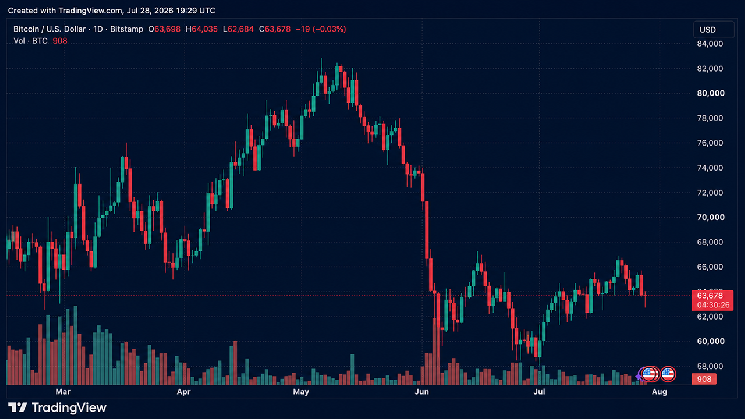
Le bitcoin a chuté brusquement mardi, tombant brièvement sous les 63 000 dollars, entraînant des liquidations massives de positions longues. Alors que la cryptomonnaie a en partie récupéré ses pertes pour se négocier autour de 63 660 dollars (-2% sur la journée), la capitalisation boursière du BTC est tombée à 1 277 milliards de dollars. Sur les marchés dérivés, la baisse soudaine a provoqué la liquidation de positions longes sur le bitcoin d'une valeur de 134 millions de dollars, portant le total des liquidations liées au BTC à plus de 156 millions de dollars. Cette volatilité intervient à l'approche d'une semaine cruciale, avec la réunion de la Fed, la publication des données sur l'indice PCE de base et les résultats d'entreprises comme Apple. Les experts estiment que ces événements pourraient déterminer la trajectoire du bitcoin pour le reste de l'année 2026. L'accent sera notamment mis sur la conférence de presse du président de la Fed, Kevin Warsh, pour obtenir des indications sur la politique monétaire future. Un scénario favorable (PCE en baisse, tonalité « accommodante » de la Fed) pourrait permettre au bitcoin de tenter une hausse vers 68 000-70 000 dollars en août. À l'inverse, un discours « dur » de la Fed combiné à de mauvais résultats d'entreprises pourrait faire rechuter le cours vers la fourchette des 58 000-60 000 dollars.

cryptonews.ruIl y a 21 mins

Des positions longues sur Bitcoin d'une valeur de 134 millions de dollars se sont «évaporées» alors que le BTC passait sous les 63 000 $ à l'approche d'une réunion cruciale de la Fed

cryptonews.ruIl y a 21 mins

La Loi sur la clarté (Clarity Act), une loi sur les cryptomonnaies soutenue par les 'bulls', a des lacunes : des mesures doivent être prises dès aujourd'hui

La journaliste spécialisée en cryptomonnaies Eleanor Terrett rapporte que la probabilité d'un vote du Sénat américain sur le projet de loi CLARITY Act avant les vacances d'été en août est faible. Ce projet vise à établir un cadre réglementaire pour le marché des cryptomonnaies. Les espoirs s'amenuisent quant à une initiative du leader de la majorité au Sénat, John Thune, pour mettre fin aux débats et enclencher le processus de vote cette semaine. Selon les procédures du Sénat, Thune devait soumettre une motion pour clore les débats sur l'inscription du projet à l'ordre du jour afin qu'un vote puisse avoir lieu jeudi. Cependant, des sources proches du dossier indiquent que la priorité sera probablement donnée à un projet de loi incluant des sanctions contre la Russie et l'Iran. L'attention du secteur des cryptomonnaies se tourne donc vers la semaine prochaine. Les représentants du secteur soulignent que même si un vote final sur le CLARITY Act n'a pas lieu avant les vacances, il est crucial que le processus de clôture des débats soit au moins initié avant la pause d'août. Sans cet engagement préalable aux vacances, l'examen du texte pourrait être reporté à la session législative d'automne, retardant davantage l'établissement d'une régulation complète du marché des cryptomonnaies aux États-Unis.

cryptonews.ruIl y a 42 mins

La Loi sur la clarté (Clarity Act), une loi sur les cryptomonnaies soutenue par les 'bulls', a des lacunes : des mesures doivent être prises dès aujourd'hui

cryptonews.ruIl y a 42 mins

Trading

Spot

Articles tendance

Comment acheter BILL

Bienvenue sur HTX.com ! Nous vous permettons d'acheter Billions Network (BILL) de manière simple et pratique. Suivez notre guide étape par étape pour commencer votre parcours crypto.Étape 1 : Création de votre compte HTXUtilisez votre adresse e-mail ou votre numéro de téléphone pour ouvrir un compte sur HTX gratuitement. L'inscription se fait en toute simplicité et débloque toutes les fonctionnalités.Créer mon compteÉtape 2 : Choix du mode de paiement (rubrique Acheter des cryptosCarte de crédit/débit : utilisez votre carte Visa ou Mastercard pour acheter instantanément Billions Network (BILL).Solde :utilisez les fonds du solde de votre compte HTX pour trader en toute simplicité.Prestataire tiers :pour accroître la commodité d'utilisation, nous avons ajouté des modes de paiement populaires tels que Google Pay et Apple Pay.P2P :tradez directement avec d'autres utilisateurs sur HTX.OTC (de gré à gré) : nous offrons des services personnalisés et des taux de change compétitifs aux traders.Étape 3 : stockage de vos Billions Network (BILL)Après avoir acheté vos Billions Network (BILL), stockez-les sur votre compte HTX. Vous pouvez également les envoyer ailleurs via un transfert sur la blockchain ou les utiliser pour trader d'autres cryptos.Étape 4 : tradez des Billions Network (BILL)Tradez facilement Billions Network (BILL) sur le marché Spot de HTX. Il vous suffit d'accéder à votre compte, de sélectionner la paire de trading, d'exécuter vos trades et de les suivre en temps réel. Nous offrons une expérience conviviale aux débutants comme aux traders chevronnés.

368 vues totalesPublié le 2026.05.07Mis à jour le 2026.06.02

Comment acheter BILL

Discussions

Bienvenue dans la Communauté HTX. Ici, vous pouvez vous tenir informé(e) des derniers développements de la plateforme et accéder à des analyses de marché professionnelles. Les opinions des utilisateurs sur le prix de BILL (BILL) sont présentées ci-dessous.

活动图片