Data Review: How Much Profit Did Prediction Markets Reap from a Single World Cup?

Odaily星球日报Publié le 2026-07-27Dernière mise à jour le 2026-07-27

Résumé

**How Much Did the 2026 World Cup Boost Prediction Markets? A Data Review.** The 2026 World Cup provided a major, temporary boost to leading prediction markets, according to an analysis of Kalshi, Polymarket, and predict.fun. During the tournament, total nominal trading volume reached $543.38 billion on Kalshi, $209.88 billion on Polymarket, and $10.92 billion on predict.fun. While Kalshi maintained an overall lead, Polymarket narrowed the gap significantly in World Cup-specific markets. All platforms saw daily trading volumes roughly double or more during the event compared to pre-tournament levels, but activity largely retreated to baseline shortly after the final. Fee revenue also surged. Kalshi's weekly fees peaked at over $100 million in the fourth week, totaling $473.2 million for the tournament. Polymarket's weekly fees stabilized around $20 million, totaling $111.4 million. Predict.fun saw its weekly fee income rise from a pre-tournament $159k to a peak of $755k, with a six-week total of $3.48 million. Post-tournament, daily fee income declined for all three. Analysis of Total Value Locked (TVL) showed Polymarket's deposits remained flat around $4.4-$4.8 billion during the World Cup and later fell, suggesting the event spurred high-frequency trading but not long-term capital commitment. In contrast, predict.fun's TVL saw a clear inflow during the tournament's knockout stages, rising to a peak near $25 million before easing. The data confirms that mega-sports even...

Original | Odaily Planet Daily (@OdailyChina)

Author | Asher (@Asher_ 0210)

The 2026 World Cup has concluded, and prediction markets are undergoing a phased review.

Over the past six weeks, many users engaged in trading predictions on match outcomes, qualification scenarios, and championship winners, adding a layer of real-time interaction to viewing. Now that the tournament is over, Odaily Planet Daily will review the performance of leading prediction market platforms Kalshi, Polymarket, and predict.fun before, during, and after the World Cup from three dimensions: trading volume, fee revenue, and TVL.

World Cup Drove Prediction Market Trading Volume to New Highs, But the Momentum Didn't Last

Kalshi Maintains Lead, Polymarket Narrows Gap, predict.fun Breaks Through with World Cup

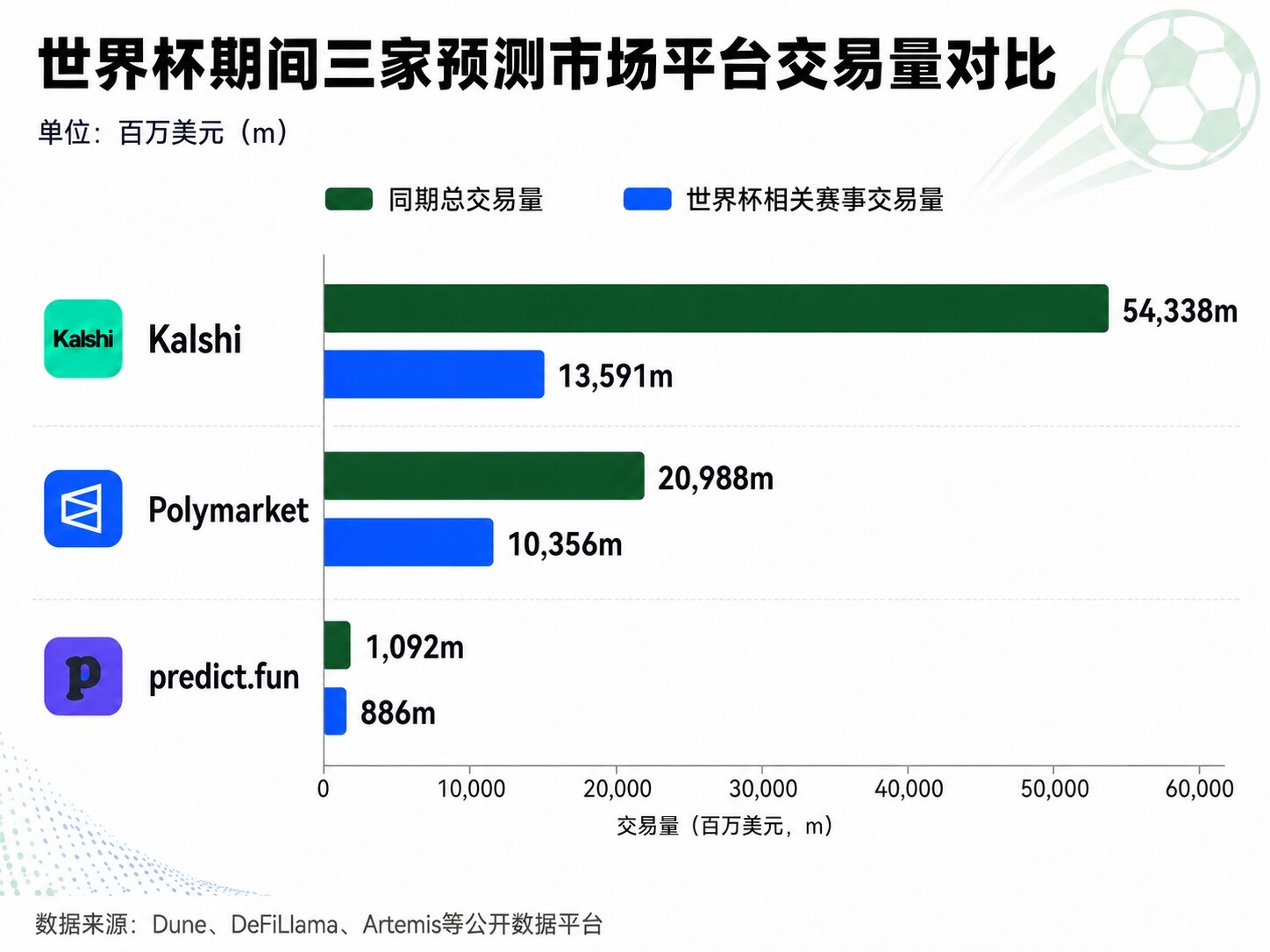
Looking at total platform trading volume during the World Cup period, Kalshi still maintains a clear lead. During the same period, Kalshi's total trading volume reached $54.338 billion, while Polymarket's was $20.988 billion, the former being about 2.6 times the latter. However, considering only World Cup-related events, the gap between the two narrows significantly. Kalshi's related trading volume was $13.591 billion, while Polymarket reached $10.356 billion, the former being only about 1.3 times the latter.(Note: Trading volume discussed in this article is nominal trading volume.)

In the past, Polymarket's representative markets were more concentrated in US elections, cryptocurrency, and geopolitical events. The World Cup further elevated the importance of sports markets on the platform, shifting them from a supplementary category to a core trading segment. Kalshi's advantage lies in its more dispersed trading structure; besides the World Cup, other sports events, politics, and macro markets continue to contribute trading volume, providing more scenarios to sustain activity after the tournament ends.

predict.fun's total platform trading volume during the World Cup reached $1.092 billion, with World Cup-related markets contributing $886 million. Although the overall scale still shows a clear gap compared to Kalshi and Polymarket, for a platform launched just over half a year ago, achieving nearly $900 million in trading volume from this World Cup has made predict.fun one of the most prominent new platforms benefiting from this round of tournament gains.
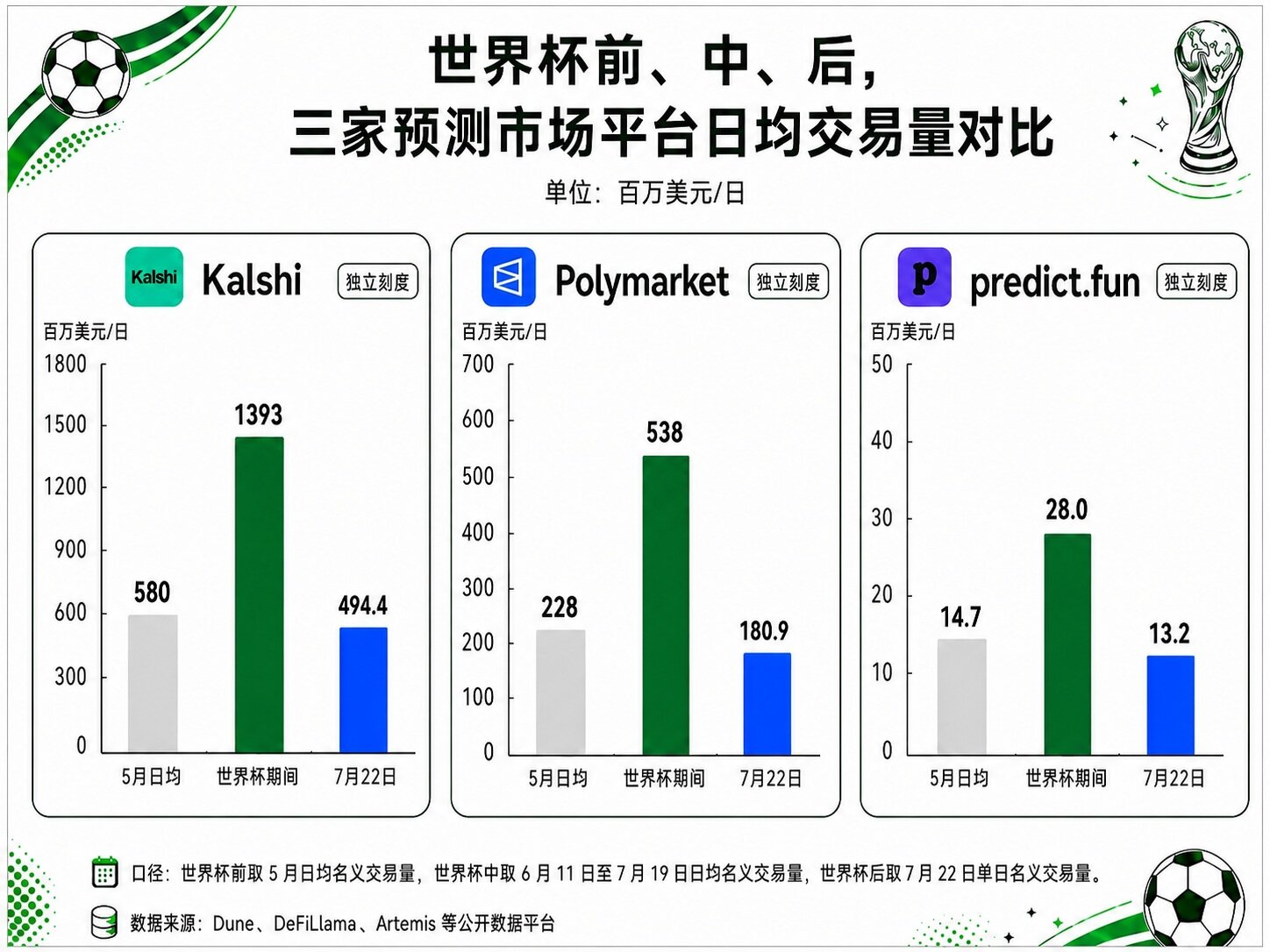
Changes in Average Daily Trading Volume for the Three Prediction Market Platforms Before, During, and After the World Cup

Kalshi's increase in trading volume during the World Cup was the most significant. Its average daily nominal trading volume in May was $580 million, rising to $1.393 billion during the tournament, an increase of about 140%. By July 22nd, trading volume fell back to $494.4 million, already below the May average daily level.

Polymarket's change magnitude was similar to Kalshi's. Its average daily nominal trading volume in May was $228 million, rising to $538 million during the World Cup, an increase of about 136%. By July 22nd, trading volume dropped to $180.9 million, also below pre-tournament levels.

predict.fun had a lower base, but the boost from the World Cup was still clear. Its average daily nominal trading volume in May was $14.7 million, rising to $28 million during the tournament, nearly doubling. By July 22nd, trading volume was $13.2 million, basically returning to pre-tournament levels.

Taking just one day's trading volume after the World Cup for comparison, the growth brought by the World Cup appears more like a concentrated release of event traffic, rather than elevating the platform's daily trading volume to a permanently higher level. Whether it can rise again in the future depends on whether other sports events and non-sports markets can capture the trading demand left after the World Cup.
How Much Fee Revenue Did the World Cup Generate for the Three Prediction Market Platforms?

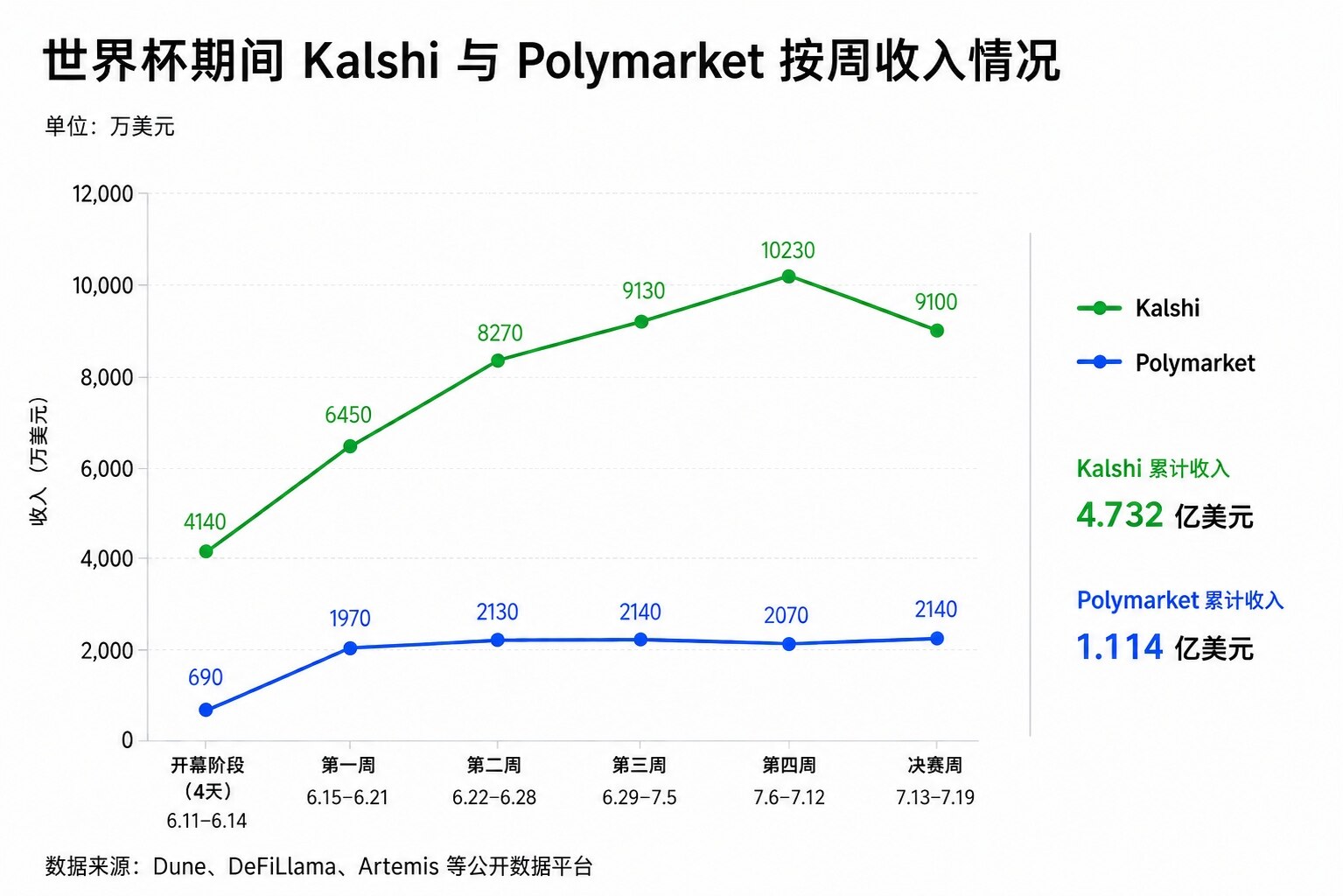
Kalshi's Fee Revenue Rose Continuously as the Tournament Progressed, Exceeding $100 Million in a Single Week in Week 4

Kalshi's fee revenue curve showed a strong overall upward trend. Revenue for the opening four-day period was $41.4 million, rising to $64.5 million in the first week, further increasing to $82.7 million in the second week, reaching $91.3 million in the third week, and rising another step in the fourth week with single-week revenue reaching $102.3 million, the highest point during the entire World Cup period. The final week saw a slight drop to $91 million. Throughout the World Cup, Kalshi's cumulative fee revenue reached $473.2 million.

The World Cup's impact on Kalshi not only brought initial attention at the start but, more importantly, sustained trading heat into the latter stages of the tournament. Single-week revenue exceeding $100 million also means Kalshi not only benefited from World Cup gains in trading volume but also successfully converted this wave of traffic into platform revenue at the monetization level.

Polymarket's Fee Revenue Was More Stable, But Didn't See Accelerated Volume Growth Like Kalshi in the Latter Stages

Polymarket's fee revenue trend was noticeably flatter. Revenue for the opening four-day period was $6.9 million, rising to $19.7 million in the first week. Subsequent weeks two, three, four, and the final week were $21.3 million, $21.4 million, $20.7 million, and $21.4 million respectively. Throughout the World Cup, Polymarket's cumulative fee revenue reached $111.4 million.

Starting from the first week, Polymarket's weekly fee revenue remained largely stable around $20 million. The World Cup did elevate Polymarket's fee revenue to a higher level, but from the second week onward, the platform did not continue to amplify gains as the tournament progressed like Kalshi did, instead operating within a relatively stable range.
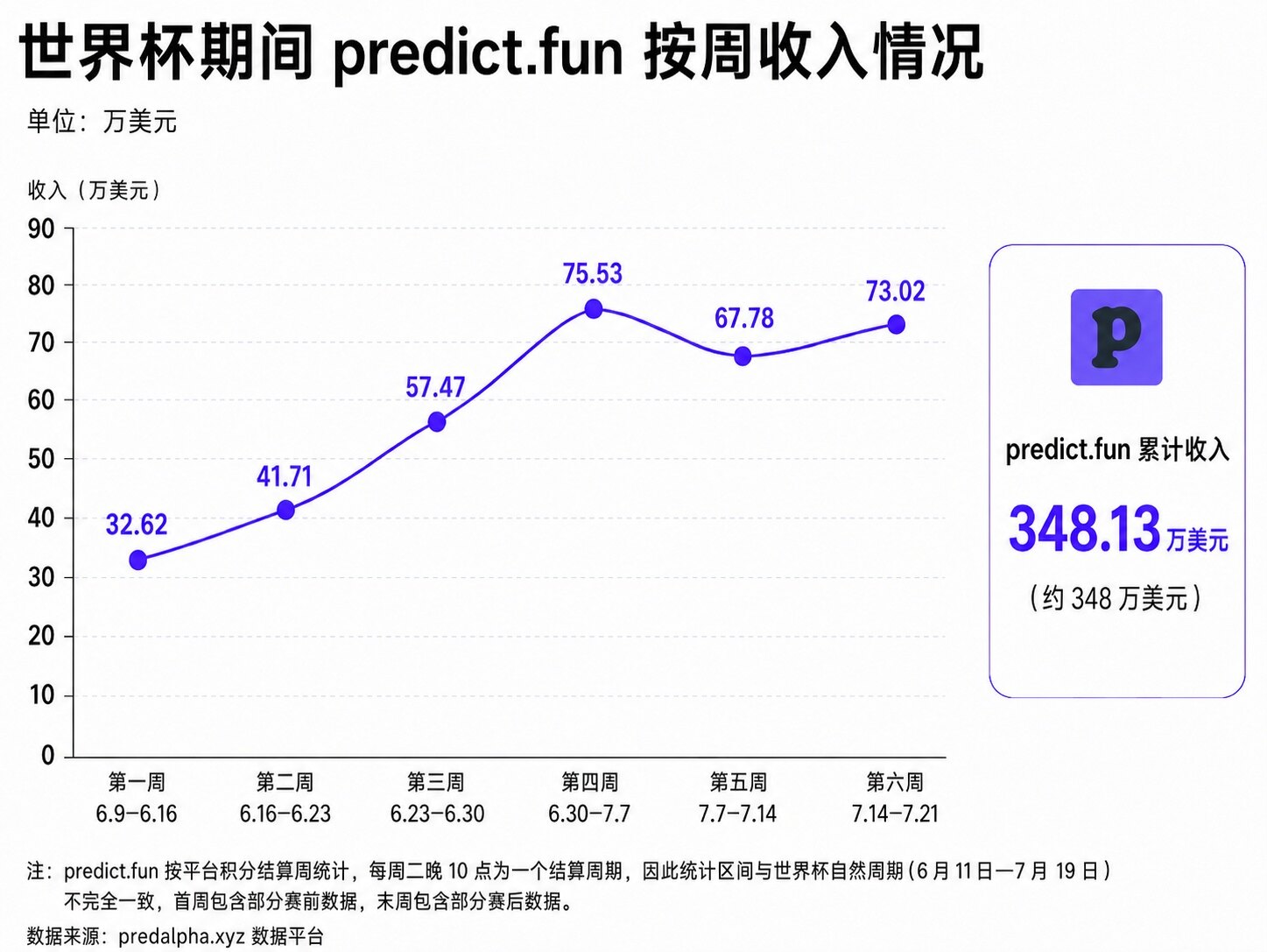
predict.fun's Fee Revenue Gradually Increased as the Tournament Progressed, Cumulative $3.481 Million Over Six Settlement Weeks

predict.fun's fee revenue is counted by platform settlement weeks, switching cycles every Tuesday at 10 PM, so it does not perfectly align with the natural World Cup schedule from June 11th to July 19th. The first settlement week was June 9th to June 16th, including two days of pre-tournament data; the last settlement week was July 14th to July 21st, also incorporating two days of post-tournament data.

Looking at the revenue trend, predict.fun's fee revenue for the first settlement week was $326.2 thousand. It then increased for three consecutive weeks, reaching $755.3 thousand from June 30th to July 7th, setting the single-week high during the World Cup period. The subsequent two weeks recorded $677.8 thousand and $730.2 thousand respectively. Although not setting new highs, these were still significantly higher than early in the tournament. The cumulative fee revenue for the six settlement weeks during the World Cup reached $3.4813 million.

The settlement week before the World Cup, June 2nd to June 9th, predict.fun's fee revenue was only $159.4 thousand. Entering the World Cup period, revenue for the first week rose to $326.2 thousand, an increase of about 105%. Subsequently, most settlement weeks further increased to over $500 thousand. Even though the first and last periods included some pre- and post-tournament data, the World Cup's boost to predict.fun's fee revenue remained significant.
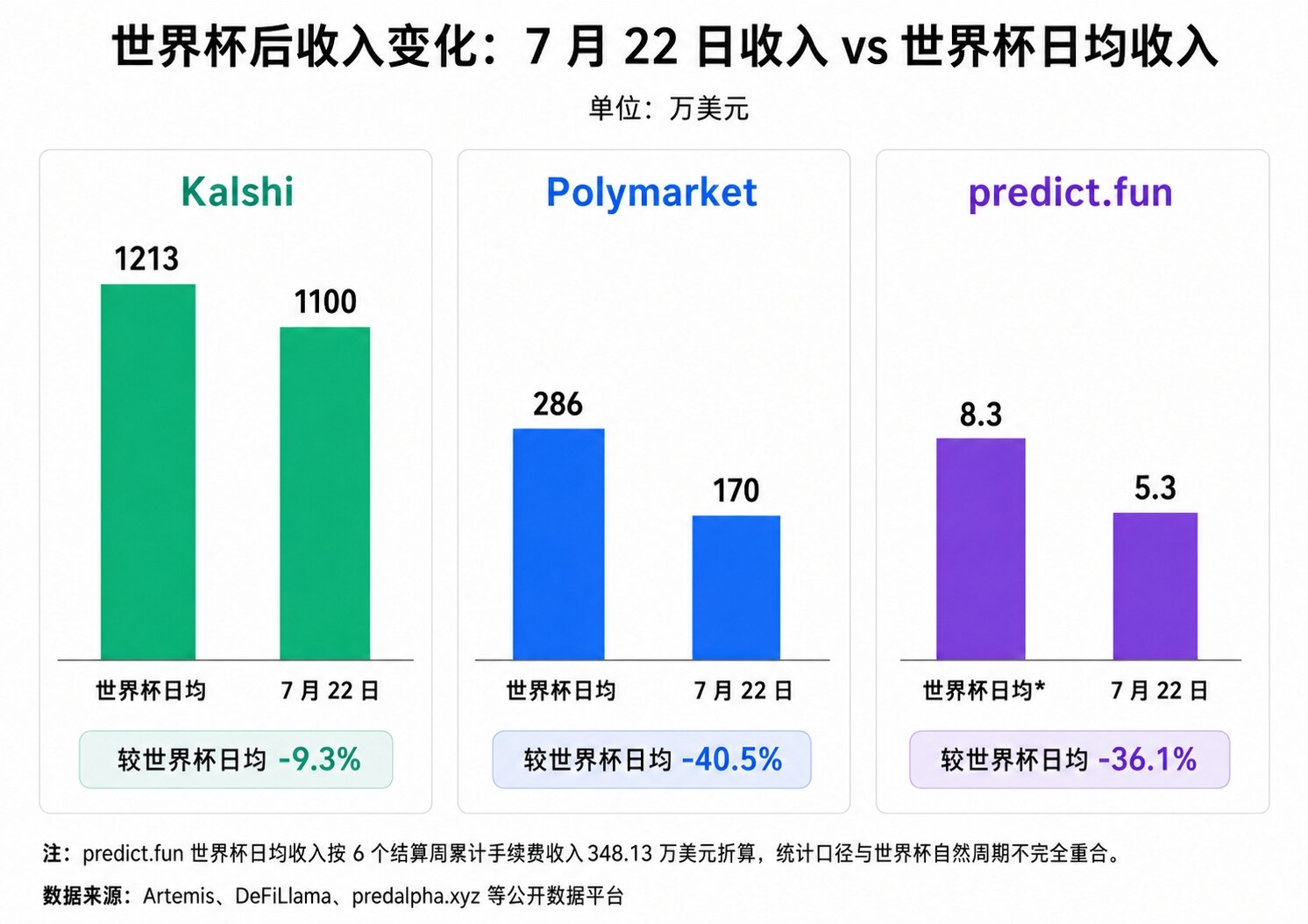
After the World Cup, Fee Revenue Generally Declined Across Platforms, with Kalshi Experiencing the Smallest Drop

Kalshi's average daily fee revenue during the World Cup was $12.13 million, dropping to $11 million on July 22nd, a decrease of 9.3%. Among the three platforms, Kalshi's post-tournament decline was the smallest. Although fee revenue fell from the peak levels during the tournament, it remained close to the World Cup daily average.

Polymarket's drop was more pronounced. Its average daily fee revenue during the World Cup was $2.86 million, dropping to $1.7 million on July 22nd, a decrease of 40.5%. The revenue increment the World Cup brought to Polymarket was relatively concentrated, and as the tournament ended, this increment quickly dissipated.

predict.fun's average daily fee revenue during the World Cup was approximately $83 thousand, dropping to $53 thousand on July 22nd, a decrease of 36.1%, similar in magnitude to Polymarket's decline. Although the statistical method differs slightly from the first two, the post-tournament trend is clear. The World Cup also provided a significant boost to predict.fun's fee revenue, which similarly receded relatively quickly after the event.
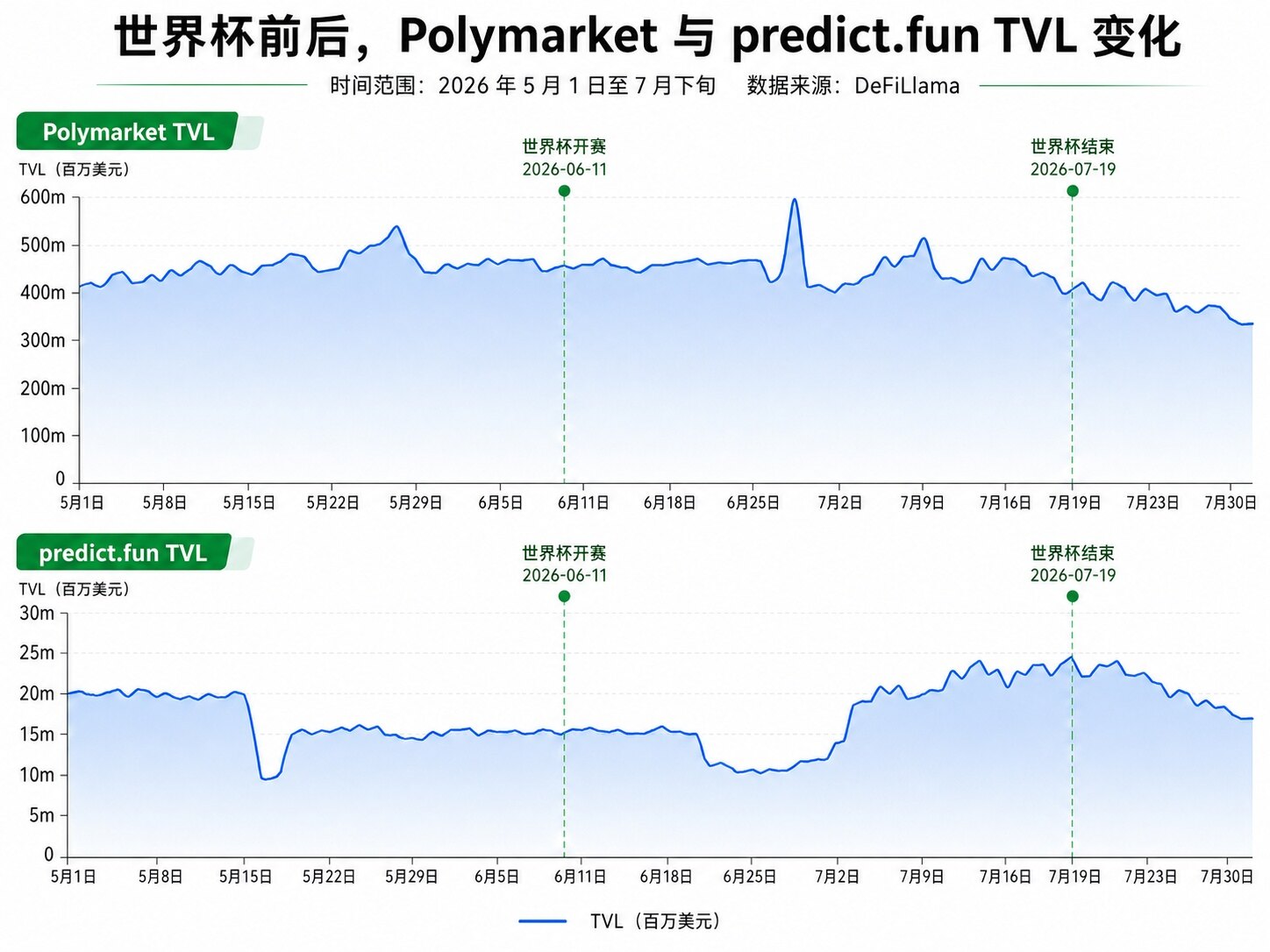
World Cup Didn't Elevate Polymarket's TVL, While predict.fun Saw Capital Inflow in the Latter Stages

Polymarket's TVL did not rise in sync with trading volume during the World Cup. In early May, the platform's TVL was around $410 million, and for most of the subsequent period, it remained in the range of $440 million to $480 million. After the World Cup began, TVL continued to fluctuate mainly around this level. Although it briefly spiked in late June and early July, it did not form a sustained upward trend.

After mid-July, TVL began to decline noticeably, dropping to around $400 million by the end of the World Cup, and has since fallen further to about $340 million. While trading volume significantly expanded during the tournament, the platform's settled capital did not correspondingly convert into long-term retained funds, indicating that the World Cup brought more high-frequency trading demand rather than simultaneously translating into persistent capital.

predict.fun's trend was more phased. In early May, its TVL was around $20 million. By mid-May, it had dropped to about $10 million, then maintained around $15 million until mid-June. At the start of the World Cup, TVL did not immediately rise. It wasn't until early July that it began to rebound quickly, reaching the $20-25 million range during the latter half of the tournament and hitting a phase high around the end of the World Cup.

After the tournament, TVL gradually declined, currently at about $17 million, but still higher than the low point in late June. Compared to Polymarket, predict.fun's capital changes were more closely linked to the World Cup's progress, especially with more noticeable capital inflows during the knockout stages.

(Note: As Kalshi's TVL data is not available on-chain, this section only discusses Polymarket and predict.fun.)
Summary

The World Cup indeed brought substantial trading volume and fee revenue to prediction markets, but post-tournament data also shows that this growth did not naturally continue. The average daily trading volume and fee revenue for all three platforms declined after the event, and Polymarket's TVL continued to fall. Mega-events can concentrate and amplify trading demand in the short term but may not directly elevate a platform's long-term activity level.

However, the World Cup benefits are not confined to short-term data alone. It at least validated that sports events can provide prediction markets with continuous, high-frequency, short-cycle trading scenarios and helped more users develop the habit of repeated trading across consecutive matches.

The World Cup has ended, but the competition around user retention, market supply, and normalized trading is just beginning.


Cryptos en tendance

Questions liées

QAccording to the article, which prediction market platform achieved the highest total nominal trading volume during the 2026 World Cup?

AKalshi achieved the highest total nominal trading volume during the 2026 World Cup, reaching $54.338 billion.

QWhat was the key difference between Kalshi's and Polymarket's fee income trends during the World Cup, as highlighted in the article?

AKalshi's fee income showed a strong upward trend throughout the tournament, peaking at over $100 million in a single week. In contrast, Polymarket's fee income was more stable, leveling off after an initial rise and not showing the same accelerated growth in the latter stages of the tournament.

QThe article mentions that the post-tournament transaction volume data indicates the World Cup growth did not 'naturally extend'. Which platform's data is used to illustrate a significant drop in daily fee income after the event?

APolymarket is used to illustrate a significant post-tournament drop. Its daily fee income fell from $2.86 million during the tournament to $1.7 million on July 22nd, a drop of 40.5%. Predict.fun also saw a 36.1% drop in daily fee income.

QHow did the Total Value Locked (TVL) on predict.fun change during the World Cup, according to the article's analysis?

APredict.fun's TVL showed a delayed but clear correlation with the World Cup. It did not rise immediately at the start but began a rapid increase in early July, peaking between $20-25 million during the tournament's knockout stages (the latter half). After the event, it gradually declined but remained above its pre-tournament lows.

QWhat positive long-term effect did the article suggest the World Cup had on the prediction market space, beyond just short-term data?

AThe article suggested that the World Cup validated that major sports events can provide high-frequency, short-cycle trading scenarios for prediction markets. It also helped more users develop a habit of repeated trading across consecutive matches, which is beneficial for the industry's long-term growth.

Lectures associées

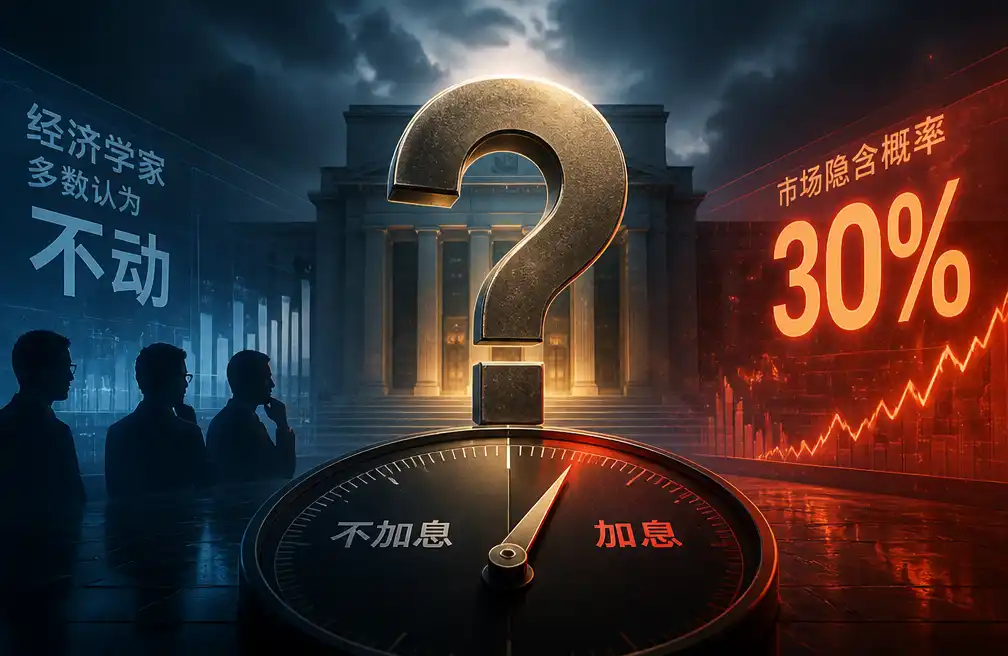
Ce soir, une hausse des taux ou non ? Les économistes sont catégoriques, les marchés donnent une probabilité de 30 %

Les contrats à terme sur les fonds fédéraux se repriçent avant la décision de juillet du FOMC, les traders payant un prix plus élevé pour se couvrir contre une hausse inattendue des taux ou un signal plus hawkish de la Fed. Ce mouvement contraste avec le consensus des économistes, qui anticipent unanimement un statu quo en juillet. Le marché évalue à environ 30 % la probabilité d'une hausse de 25 points de base, reflétant une prime pour le risque de queue hawkish plutôt qu'une conviction ferme. La divergence porte sur l'interprétation du choc pétrolier. Les institutions hawkish, comme BofA, soulignent le risque pour la crédibilité anti-inflation de la Fed si elle minimise la pression des prix. Les positions plus dovish, comme celle de Citi, considèrent la hausse du pétrole comme un choc d'offre temporaire, où une réaction excessive pourrait nuire à la croissance. La nomination du nouveau président de la Fed, Kevin Warsh, amplifie l'incertitude. L'absence de références sur son style de communication élargit la distribution perçue des taux futurs, poussant les marchés à couvrir davantage leurs risques. Même sans hausse en juillet, une déclaration ou une conférence de presse mettant fortement l'accent sur les risques inflationnistes pourrait maintenir la pression sur les actifs. Ainsi, l'enjeu immédiat n'est pas tant la décision de juillet, mais la façon dont Warsh qualifiera le choc pétrolier et la probabilité qu'il laisse ouverte la fenêtre de hausse en septembre. Cela déterminera la trajectoire du dollar, la pression sur le yen et l'ajustement des valorisations des actifs à risque.

marsbitIl y a 32 mins

Ce soir, une hausse des taux ou non ? Les économistes sont catégoriques, les marchés donnent une probabilité de 30 %

marsbitIl y a 32 mins

Le matériau le plus discret de la chaîne d'étranglement des semi-conducteurs, dont le prix a été multiplié par plusieurs fois sans que personne ne s'en aperçoive, vient d'être interdit par la Chine

L'hélium, élément abondant dans l'univers mais rare sur Terre et non renouvelable, est un matériau crucial et irremplaçable pour la fabrication de puces semi-conductrices avancées, notamment pour le refroidissement précis des wafers et la détection de fuites. Pourtant, son importance est souvent méconnue. En mars, une attaque au missile a gravement endommagé la plus grande installation de production d'hélium au monde au Qatar, coupant un tiers de l'approvisionnement mondial. Combiné à l'arrêt des exportations russes et à la vente des réserves stratégiques américaines, cela a provoqué une pénurie mondiale, faisant plus que doubler les prix. La Chine, qui dépend à 84% des importations (principalement du Qatar et de Russie), a vu ses approvisionnements gravement perturbés. Face à cette crise, la Chine a interdit les exportations d'hélium le 10 juillet pour garantir ses propres besoins nationaux, notamment pour son industrie semi-conductrice en pleine expansion. Pour réduire sa dépendance, la Chine a développé une technologie pour extraire l'hélium des usines de GNL, produisant même de l'hélium ultra-pur. Cependant, la capacité nationale ne couvre encore que moins de 20% de la demande. La pénurie mondiale, aggravée par des réparations qui prendront des années au Qatar, devrait durer, mettant en lumière la vulnérabilité stratégique de cette ressource invisible mais essentielle pour les technologies de pointe.

marsbitIl y a 1 h

Le matériau le plus discret de la chaîne d'étranglement des semi-conducteurs, dont le prix a été multiplié par plusieurs fois sans que personne ne s'en aperçoive, vient d'être interdit par la Chine

marsbitIl y a 1 h

Un investisseur précoce d'Unitree mise sur une entreprise d'interface cerveau-machine

L'investisseur précoce d'Unitree mise sur une société d'interface cerveau-ordinateur. Wabo Technology, fondée fin 2025 par Zhang Xingzhi, un docteur de l'Université Tsinghua inspiré par le film "Avatar", a levé un nouveau tour de financement. Les investisseurs incluent Vertex Ventures (Singapour) du groupe Temasek, la société de capital-risque Hongtai Fund, le fonds futuriste de Chengdu et Huifengda Capital. Contrairement à de nombreuses entreprises d'interface cerveau-ordinateur, Wabo se positionne comme une entreprise de modèles. Elle développe un "modèle d'intention neuronale humaine" visant à interpréter les intentions d'action avant leur exécution physique, en fusionnant des signaux EEG, EMG, le comportement et le contexte visuel. Ce modèle se caractérise par sa capacité à s'adapter à des tâches spécifiques, sa généralisation entre différents utilisateurs et appareils, et son fonctionnement en boucle fermée pour une fiabilité accrue. Fondée à Chengdu, l'entreprise attire rapidement des talents et des capitaux. Après un tour initial (seed) par Ceyuan Capital, elle a rapidement bouclé un tour angel avec une due diligence accélérée. Les investisseurs, dont Vertex (également investisseur précoce d'Unitree) et Hongtai (actif dans l'aérospatiale commerciale), valorisent la capacité de Wabo à créer un système complet liant les signaux neuronaux à des applications réelles, au-delà du simple matériel. Wabo explore des applications dans la rééducation médicale, les robots incarnés, la domotique et même l'aérospatiale, collaborant avec l'Université de Tianjin sur des interfaces cerveau-ordinateur pour l'espace. L'entreprise établit désormais un double siège à Chengdu (recherche produit, ingénierie) et à Shanghai (recherche de pointe, modèle d'intention), s'installant dans la zone "Brain-Intelligence World" de Shanghai. Le secteur de l'interface cerveau-ordinateur connaît un boom financier en Chine. Zhang Xingzhi estime que la concurrence future portera sur la capacité à créer une boucle vertueuse "entrée de données neuronales - modèle d'intention - contrôle physique - retour de données". Il prédit une consolidation dans les trois prochaines années, seuls les acteurs maîtrisant cette boucle survivront, rapprochant ainsi la vision fictionnelle d'"Avatar" de la réalité.

marsbitIl y a 1 h

Un investisseur précoce d'Unitree mise sur une entreprise d'interface cerveau-machine

marsbitIl y a 1 h

Trading

Spot

Articles tendance

Comment acheter DATA

Bienvenue sur HTX.com ! Nous vous permettons d'acheter DATA Network (DATA) de manière simple et pratique. Suivez notre guide étape par étape pour commencer votre parcours crypto.Étape 1 : Création de votre compte HTXUtilisez votre adresse e-mail ou votre numéro de téléphone pour ouvrir un compte sur HTX gratuitement. L'inscription se fait en toute simplicité et débloque toutes les fonctionnalités.Créer mon compteÉtape 2 : Choix du mode de paiement (rubrique Acheter des cryptosCarte de crédit/débit : utilisez votre carte Visa ou Mastercard pour acheter instantanément DATA Network (DATA).Solde :utilisez les fonds du solde de votre compte HTX pour trader en toute simplicité.Prestataire tiers :pour accroître la commodité d'utilisation, nous avons ajouté des modes de paiement populaires tels que Google Pay et Apple Pay.P2P :tradez directement avec d'autres utilisateurs sur HTX.OTC (de gré à gré) : nous offrons des services personnalisés et des taux de change compétitifs aux traders.Étape 3 : stockage de vos DATA Network (DATA)Après avoir acheté vos DATA Network (DATA), stockez-les sur votre compte HTX. Vous pouvez également les envoyer ailleurs via un transfert sur la blockchain ou les utiliser pour trader d'autres cryptos.Étape 4 : tradez des DATA Network (DATA)Tradez facilement DATA Network (DATA) sur le marché Spot de HTX. Il vous suffit d'accéder à votre compte, de sélectionner la paire de trading, d'exécuter vos trades et de les suivre en temps réel. Nous offrons une expérience conviviale aux débutants comme aux traders chevronnés.

140 vues totalesPublié le 2026.07.01Mis à jour le 2026.07.01

Comment acheter DATA

Discussions

Bienvenue dans la Communauté HTX. Ici, vous pouvez vous tenir informé(e) des derniers développements de la plateforme et accéder à des analyses de marché professionnelles. Les opinions des utilisateurs sur le prix de DATA (DATA) sont présentées ci-dessous.

活动图片