Token Watch, Based on RootData, Launches Interactive Relationship Graph for Projects, Investors, and Key Figures

marsbitPublié le 2026-07-27Dernière mise à jour le 2026-07-27

Résumé

Token Watch, operated by Token Post, has launched a new "Interactive Relationship Graph" feature. This tool visually maps the connections between cryptocurrency projects listed on the Korean Won market, their investors, and key individuals. The graph allows users to explore investment backgrounds, see which investors co-invest in other projects, and track the past and present affiliations of core team members. Key features include the ability to filter by project, investor, or person, and to view different relationship types: general investment, lead investment, current affiliation, and past affiliation. A focus mode lets users isolate connections within two degrees of a selected node for clearer analysis. The graph is designed to help users identify co-investors, frequent VC partnerships, investor overlap between competing projects, and recurring key figures across the ecosystem. The underlying data for investors and individuals is sourced from RootData, with some verification by the Token Post editorial team. The web-based tool is available in both Korean and English. Token Watch emphasizes that the information is for reference and analysis purposes only and does not constitute investment advice.

Author: Han Jae-ho

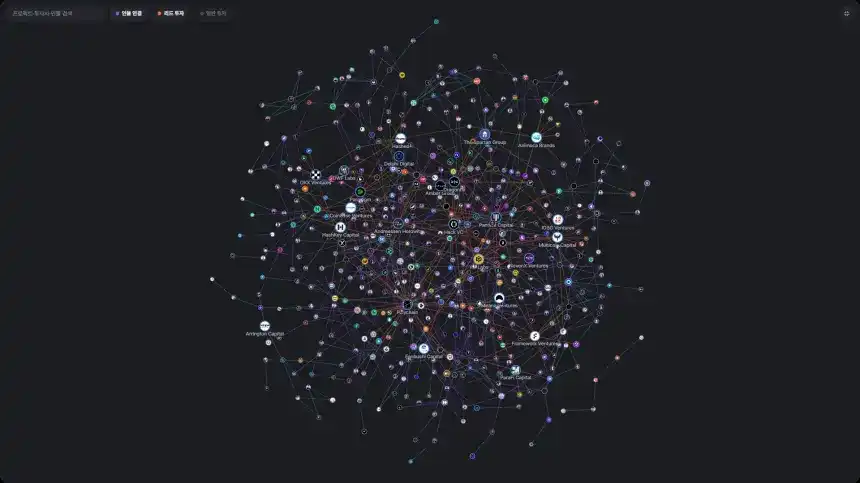
The cryptocurrency asset data platform "Token Watch," operated by Token Post, has unveiled an "Interactive Relationship Graph" feature that allows users to see the interconnected structure between projects, investors, and key figures at a glance.

This newly added relationship graph is a function that visually displays how investors and key individuals are connected, centering on cryptocurrency asset projects listed in the Korean won market. Users can not only check the investment background of a single project but also explore other projects participated in by the same investor and the past and present affiliations of individuals within the same screen.


Currently, the relationship graph shows the top 30 investors by portfolio and key figures confirmed across multiple projects. Users can directly search for projects, investors, or individuals, or filter by type to extract only the desired relationships.

The connecting lines are divided into ▲ General Investment ▲ Lead Investor ▲ Current Affiliation ▲ Past Affiliation. Through this classification, users can confirm not only which investors participated in a specific project but also who led the investment round, and the organizations with which key figures are currently or were previously associated.
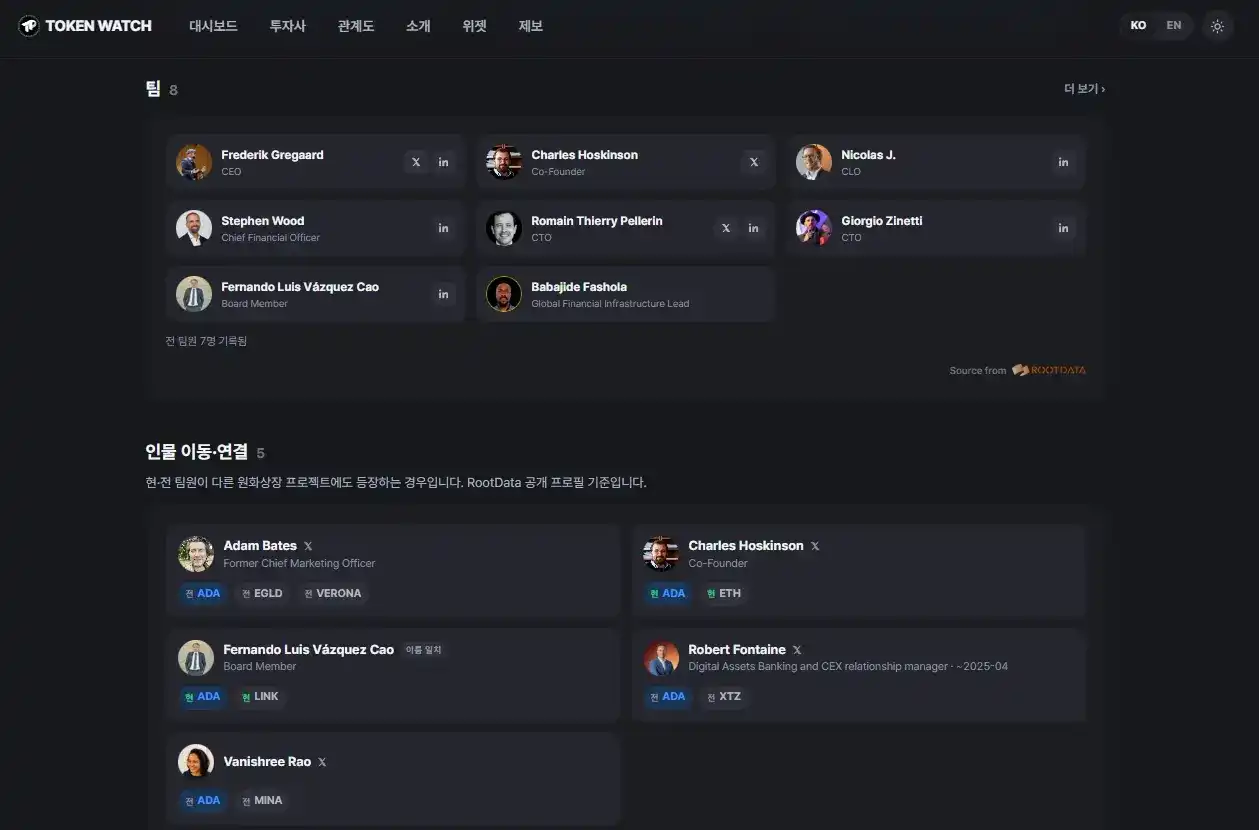
For example, selecting a specific project will display the investors in that project and related individuals. Conversely, with an investor as the center, users can view that investor's portfolio of Korean won-listed projects and co-investment relationships with other investors.

After clicking on a node, using the "View Centered on This Node" function allows users to keep only connections within two degrees of separation from the selected object. Even when the overall network appears complex, this enables quick focus on a specific project or investor, narrowing down to the core relationships. The feature also supports node dragging and screen zooming.

With this relationship graph, Token Watch moves beyond simple investor lists, allowing users to three-dimensionally explore the capital and human networks within the cryptocurrency asset market.


This feature can be used to grasp information that was difficult to confirm previously with just a project's published investor logos, such as:

  • Co-investors

  • Frequent VC co-investor combinations

  • Investor overlap between competing projects

  • Core individuals recurring across multiple projects

Particularly for investors, it can serve as a reference to verify the background of projects of interest; for journalists and researchers, it can be a tool for interviews and analysis to uncover hidden commonalities between projects; and for industry professionals and business developers, it can be used to examine connection paths between projects, investors, and key figures.
The investor and individual data used in the relationship graph is based on RootData, and some information (such as whether a project has responded) is based on records from the Token Post editorial department. Regarding individual relationships, to reduce erroneous connections of the same person, associations are made only when X account IDs match or two or more full names match.

The Token Watch relationship graph requires no additional installation and can be used directly on the web, supporting both Korean and English interfaces.

A representative from Token Post stated: "To understand a cryptocurrency asset project, one must not only look at price and listing information but also understand which capital and individuals are connected behind the project. We will continue to optimize the relationship graph so that dispersed investment and individual information can be explored intuitively."

Simultaneously, Token Watch states that the information displayed in the relationship graph may differ from the actual latest status due to variations in collection and verification timing. All data is for reference only and does not constitute investment advice.


This article is written based on market data and chart analysis and does not constitute investment advice for specific projects.

Cryptos en tendance

Questions liées

QWhat is the main function of the 'Interaction Relationship Map' feature launched by Token Watch?

AToken Watch launched an 'Interaction Relationship Map' feature that visually displays the interconnected structure between cryptocurrency projects, their investors, and key personnel. It allows users to see investment backgrounds, explore other projects funded by the same investor, and track the past and present affiliations of core individuals.

QWhat types of relationship lines are distinguished in the Token Watch Relationship Map?

AThe relationship lines in the map are categorized into four types: General Investment, Lead Investment, Current Affiliation, and Former Affiliation. This categorization helps users understand not only who invested in a project but also who led the investment round and the past/current organizational ties of key people.

QBased on which data provider is the investor and personnel information in the Relationship Map primarily built?

AThe investor and personnel data used in the Relationship Map is based on the data platform RootData. Additional information, such as whether a project has responded to inquiries, is based on records from the Token Post editorial team.

QWhat practical uses does the article list for the new Relationship Map feature?

AThe article lists several practical uses for the feature: identifying co-investors, spotting frequently co-investing VC combinations, observing investor overlap between competing projects, and recognizing key personnel who appear across multiple projects. It serves as a reference for investors, a research tool for journalists, and a way for professionals to explore connection paths.

QHow does the feature handle privacy and data accuracy according to the article?

ATo reduce incorrect links for individuals, connections are only made when X (formerly Twitter) accounts match or when two or more full names are identical. Token Watch also notes that the information may differ from the latest actual status due to collection and verification timing, and all data is for reference only, not constituting investment advice.

Lectures associées

Le FSB déclare Pavel Dourov recherché internationalement pour complicité de terrorisme

Le service russe du FSB a annoncé qu'il avait placé Pavel Dourov, le fondateur de Telegram, sur la liste des personnes recherchées au niveau international. Il est accusé d'avoir facilité des activités terroristes dans le cadre d'une enquête pénale. Les autorités affirment que de nombreux canaux, chats et bots sur Telegram sont utilisés par les services spéciaux ukrainiens, des terroristes et des extrémistes pour planifier des sabotages et des meurtres de masse en Russie. Elles soulignent que ces groupes n'ont pas été supprimés de la plateforme. L'enquête met en cause un bot Telegram appelé "Daivinchik", présenté comme un outil de recrutement et de coordination pour ces activités criminelles. Les services de sécurité déclarent avoir arrêté 46 personnes, âgées de 12 à 22 ans, dans plusieurs régions russes au cours de l'année. Ces individus seraient accusés d'avoir agi pour le compte de services de renseignement ennemis. Le Comité d'enquête a engagé des poursuites pénales, ce qui a conduit aux accusations contre Dourov. Le FSB rappelle également que le bot "Daivinchik" avait été ajouté à la liste noire fin décembre 2025 pour hébergement de contenus illégaux, mais que ces informations n'ont toujours pas été supprimées. Cette affaire s'inscrit dans un conflit plus large entre les États et les plateformes de communication transnationales concernant la modération des contenus. Pavel Dourov n'a pas encore commenté ces accusations.

cryptonews.ruIl y a 4 mins

Le FSB déclare Pavel Dourov recherché internationalement pour complicité de terrorisme

cryptonews.ruIl y a 4 mins

Virtuals lance Hyperboost : 14 jours de récompenses supplémentaires pour chaque token diplômé, pour lutter contre la malédiction du "pic du premier jour"

Virtuals Protocol a lancé le mécanisme "Hyperboost" le 27 juillet, destiné à lutter contre la tendance où plus de 75% des tokens voient leur volume de transactions culminer dans les 24 heures suivant leur "graduation" (lancement public), puis déclinent rapidement. Le mécanisme réaffecte une partie de l'offre de token jusqu'alors inactive après la graduation pour créer un pool de récompenses distribué quotidiennement sur 14 jours. Les récompenses sont divisées en deux catégories : pour les transactions (selon la part du volume quotidien d'un portefeuille) et pour la création de contenu sur les réseaux sociaux comme X. Le système s'applique automatiquement à tous les tokens ayant terminé leur graduation après le 27 juillet. Cependant, dans les deux premiers jours suivant le lancement, certains tokens récemment gradués comme AMARA, MAGE et GTR ont toujours enregistré des baisses importantes (jusqu'à -78% en 24h), montrant que le schéma classique de déclin post-graduation persiste. La communauté soulève des questions sur les risques de *wash trading* pour capter les récompenses transactionnelles et sur le manque de transparence des critères d'évaluation pour les récompenses de contenu. Bien que l'impact à court terme sur le token natif VIRTUAL semble limité, Hyperboost représente une tentative de prolonger la fenêtre de découverte des prix pour les nouveaux tokens. Son efficacité réelle devra être évaluée après au moins un cycle complet de 14 jours.

marsbitIl y a 16 mins

Virtuals lance Hyperboost : 14 jours de récompenses supplémentaires pour chaque token diplômé, pour lutter contre la malédiction du "pic du premier jour"

marsbitIl y a 16 mins

Faux boom entrepreneurial : 5,8 millions de nouvelles entreprises enregistrées chaque année aux États-Unis, 70 % n’embaucheront jamais

L'année dernière, les États-Unis ont enregistré un nombre record de près de 6 millions de nouvelles entreprises. Cependant, une réalité cachée se révèle : 70 % d'entre elles, classées comme « probables non-employeurs », ne prévoient jamais de créer d'emplois. Ce phénomène, qualifié de « fausse vague entrepreneuriale », reflète une tendance croissante depuis vingt ans où de nombreuses « entreprises » sont en réalité des passe-temps ou des projets secondaires enregistrés sous forme de LLC, souvent avec peu ou pas de ventes. Cette prolifération s'explique par la facilité et le faible coût de création d'une LLC (environ 130 $ et 15 minutes), ainsi que par le statut social glamour associé au titre de « fondateur ». Porté par les célébrités entrepreneuriales et la culture des réseaux sociaux, ce titre est devenu un atout pour les profils personnels, notamment sur LinkedIn où son utilisation a bondi de 69 %. Pour beaucoup, notamment parmi la Génération Z, il s'agit davantage d'acquérir une identité que de bâtir une entreprise viable. L'article met en garde contre la dilution de l'esprit entrepreneurial authentique et le mythe selon lequel entreprendre serait facile. Les statistiques rappellent la dure réalité : une entreprise sur cinq échoue dans sa première année, et seule une infime minorité obtient du capital-risque. Le véritable sens et le succès, soutient l'auteur, proviennent de l'engagement profond et des sacrifices, et non d'un engagement à temps partiel. Il invite à un choix délibéré plutôt qu'à rester dans l'indécision, que ce soit dans l'entrepreneuriat ou dans d'autres aspects de la vie.

marsbitIl y a 17 mins

Faux boom entrepreneurial : 5,8 millions de nouvelles entreprises enregistrées chaque année aux États-Unis, 70 % n’embaucheront jamais

marsbitIl y a 17 mins

Trading

Spot

Articles tendance

Comment acheter DATA

Bienvenue sur HTX.com ! Nous vous permettons d'acheter DATA Network (DATA) de manière simple et pratique. Suivez notre guide étape par étape pour commencer votre parcours crypto.Étape 1 : Création de votre compte HTXUtilisez votre adresse e-mail ou votre numéro de téléphone pour ouvrir un compte sur HTX gratuitement. L'inscription se fait en toute simplicité et débloque toutes les fonctionnalités.Créer mon compteÉtape 2 : Choix du mode de paiement (rubrique Acheter des cryptosCarte de crédit/débit : utilisez votre carte Visa ou Mastercard pour acheter instantanément DATA Network (DATA).Solde :utilisez les fonds du solde de votre compte HTX pour trader en toute simplicité.Prestataire tiers :pour accroître la commodité d'utilisation, nous avons ajouté des modes de paiement populaires tels que Google Pay et Apple Pay.P2P :tradez directement avec d'autres utilisateurs sur HTX.OTC (de gré à gré) : nous offrons des services personnalisés et des taux de change compétitifs aux traders.Étape 3 : stockage de vos DATA Network (DATA)Après avoir acheté vos DATA Network (DATA), stockez-les sur votre compte HTX. Vous pouvez également les envoyer ailleurs via un transfert sur la blockchain ou les utiliser pour trader d'autres cryptos.Étape 4 : tradez des DATA Network (DATA)Tradez facilement DATA Network (DATA) sur le marché Spot de HTX. Il vous suffit d'accéder à votre compte, de sélectionner la paire de trading, d'exécuter vos trades et de les suivre en temps réel. Nous offrons une expérience conviviale aux débutants comme aux traders chevronnés.

140 vues totalesPublié le 2026.07.01Mis à jour le 2026.07.01

Comment acheter DATA

Discussions

Bienvenue dans la Communauté HTX. Ici, vous pouvez vous tenir informé(e) des derniers développements de la plateforme et accéder à des analyses de marché professionnelles. Les opinions des utilisateurs sur le prix de DATA (DATA) sont présentées ci-dessous.

活动图片