Gate Research Institute: The 'Wall Street-ization' Wave of Crypto Financial Products – Competition or Integration?

marsbitPublié le 2026-07-22Dernière mise à jour le 2026-07-22

Résumé

The article titled "Gate Research Institute: Are Crypto Financial Products Sparking a 'Wall Street' Wave—Competition or Convergence?" explores the evolving relationship between the crypto ecosystem and traditional finance (TradFi). The piece begins by reflecting on Bitcoin's original 2009 vision of decentralization, disintermediation, and moving away from banks. It then contrasts this with the 2024 landscape, where key crypto assets like Bitcoin are increasingly held through Wall Street products like ETFs issued by giants like BlackRock. The article questions whether this signifies that TradFi is systematically taking over the rights to issue, price, custody, and distribute crypto financial assets. The core argument is that this is not a zero-sum takeover but rather a bidirectional convergence where each side addresses the other's weaknesses. Crypto offers 24/7 global markets, programmable settlement, and open access but lacks compliant channels, institutional-grade custody, deep fiat liquidity, and mainstream distribution. TradFi possesses these but is constrained by legacy systems, limited operating hours, and slow settlement. Two primary convergence paths are highlighted: * **Path A (CEX to TradFi):** Exemplified by Gate, which has progressed from offering tokenized stocks and CFDs to providing direct, real stock trading (US, Hong Kong, South Korea) within its platform, using USDT. * **Path B (TradFi to Crypto):** Exemplified by Robinhood, which has integrated crypt...

In January 2009, Satoshi Nakamoto embedded a line in the Bitcoin genesis block: "The Times 03/Jan/2009 Chancellor on brink of second bailout for banks." This line served as a timestamp and is often seen as a critique of the bank bailout system following the 2008 financial crisis: Bitcoin aimed to establish a peer-to-peer value transfer system that didn't rely on banks or trusted third parties.

Yet, seventeen years later, one of the mainstream ways to hold Bitcoin is to buy a share of an ETF issued by BlackRock, the world's largest asset manager, or hold shares of related Bitcoin treasury companies. Does this mean the crypto market has strayed from its founding purpose? Is Wall Street systematically seizing the issuance, pricing, custody, and distribution rights of crypto-financial assets?

1. Is Wall Street Seizing the Issuance, Pricing, Custody, and Distribution Rights of Crypto Assets?

1.1 The Ideal: Bitcoin's Founding Intent in 2009

This goes back to Bitcoin's original intent. The Bitcoin whitepaper envisioned a financial order built around three "de-" principles:

• Decentralization: No central issuer, no headquarters, no servers that can be shut down. The ledger is maintained by a global network of nodes, with rules written into the code.

• Disintermediation: Peer-to-peer value transfer without the need for banks, brokerages, or clearinghouses to act as intermediaries or guarantors. "Private key equals ownership," with self-custody as the default.

• Debanking: Anyone can hold and transfer assets and participate in new coin issuance (through mining) without needing to open an account, undergo KYC, or have accredited investor status.

The core ethos of this ideal was to reclaim the four powers of finance—issuance, pricing, custody, and distribution—from the hands of a few institutions and distribute them among every participant in the network. This was both a direct response to the 2008 financial crisis and a benchmark, declaring to the market that if the centralized financial system could fail, then build a system that doesn't need it.

1.2 Reality: Are These Four Powers Being Seized?

However, this decentralized order seems to have lost its purity following the approval of spot Bitcoin ETFs in 2024. In other words, traditional finance is incorporating crypto technology into its own asset issuance, settlement, and distribution systems.

Asset management giants like BlackRock, Fidelity, and Franklin Templeton have packaged BTC and ETH into products that can be bought in traditional financial accounts. When BTC and ETH are packaged as ETFs, they transform from "on-chain assets requiring an understanding of wallets and private keys" into "financial products that can be bought in traditional securities accounts." As of May 2026, ETFs hold approximately 1.5 million Bitcoin. In just two years, ETFs represent about 7.14% of Bitcoin's total capped supply of 21 million.

A similar shift is happening in the derivatives market. CME's Bitcoin and Ethereum futures and options provide institutions with a regulated venue for trading, hedging, and integrating into risk models. Increasingly, institutions can gain crypto exposure without directly touching on-chain assets, through futures, options, ETFs, structured products, and fund shares.

RWA and tokenized government bonds further expand the boundaries of this "Wall Street-ization." The tokenized US Treasury market grew from about $380 million in early 2023 to over $11 billion by 2026, making it the fastest-growing segment in the entire RWA space. The list of issuers reads almost like a roll call of Wall Street: BlackRock's BUIDL, Franklin Templeton's Benji, JPMorgan's Kinexys, Ondo's tokenized Treasury products—all are moving traditional financial assets on-chain.

Institutions like Coinbase, Fidelity Digital Assets, and BNY Mellon handle custody, trading, and compliance infrastructure. Furthermore, in August 2025, a US executive order allowed cryptocurrencies, private equity, and other alternative assets into 401(k) retirement plans, opening the door to the approximately $12.5 trillion in retirement account funds. As more institutions participate, numerous brokerages and wealth managers are gradually incorporating parts of the distribution rights.

This is not just a change in product form; it's a change in power structure: asset managers handle issuance, brokerages and advisors handle distribution, compliant custodians handle safekeeping, market makers and authorized participants handle primary market creation/redemption, exchanges handle listing, and regulatory frameworks define the boundaries. Crypto assets are thus entering the language system of traditional finance.

2. A Two-Way Convergence: 1+1>2

But Wall Street's "centralization" is only one side of the coin. Zooming out, the other side is the two systems complementing each other's shortcomings. This is not a zero-sum game where one side swallows the other, but a two-way convergence of two systems.

The crypto-native system has permissionless openness, 24/7 global markets, and programmable on-chain settlement. However, it has always lacked four things: compliant issuance channels, institutional-grade custody trust, deep fiat liquidity, and distribution networks that can reach mainstream users. These four are precisely what Wall Street has in abundance.

Conversely, Wall Street has licenses, custody, trillion-dollar capital pools, and global distribution channels. But its assets are trapped in an archaic system: markets open only on weekdays, cross-border barriers are high, settlement takes T+2, and products cannot be freely combined. These limitations are precisely what the crypto rails can inherently solve. Thus, this 1+1>2 dynamic is not just a theoretical exercise.

Over the past year, crypto exchanges have successively launched real stock trading. This wave presents two completely opposite yet converging directions. One starts from crypto exchanges and moves towards traditional finance; the other starts from traditional finance and moves towards crypto. Gate and Robinhood are the clearest representatives of these two paths.

2.1 Path A: From CEX to Traditional Finance

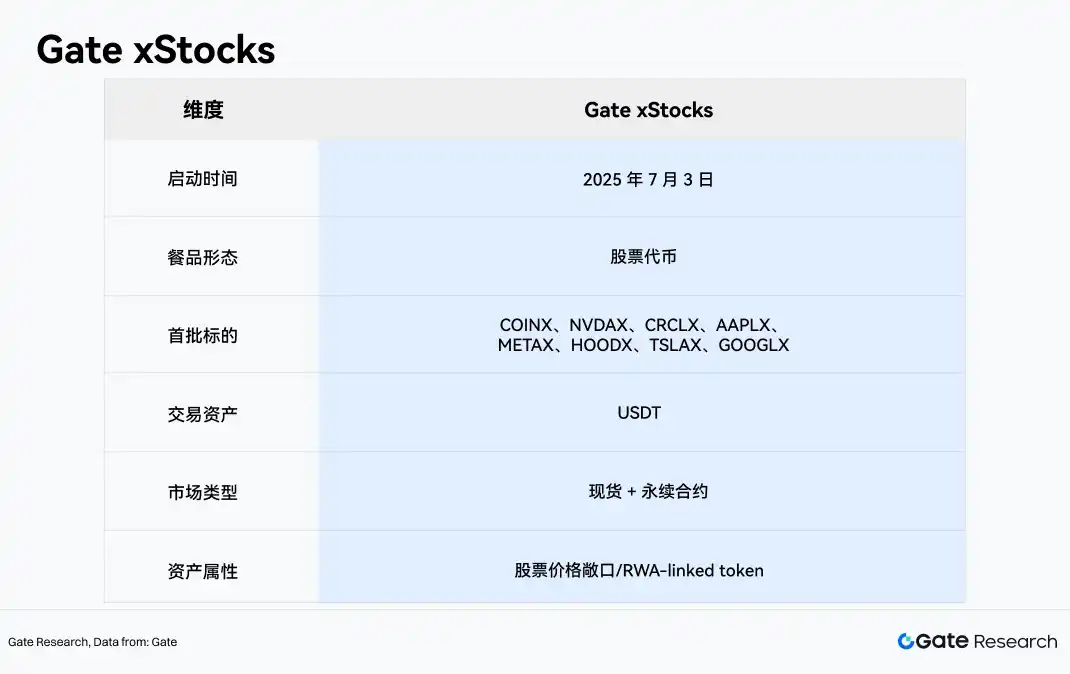
Gate's TradFi path can be divided into four stages. The first stage is the tokenization of traditional assets/stocks. Gate officially launched the xStocks Trading Section on July 3, 2025, becoming one of the earliest crypto exchanges to offer tokenized asset trading. Partnering with xStocks and Ondo, it allows users to trade spot and perpetual contracts for stocks like Apple, Tesla, and Meta directly with USDT, 24/7, without needing a traditional securities account. The core of this path is the "third-party compliant issuance + CEX distribution" model represented by xStocks. The underlying structure involves compliant Swiss entity Backed Finance holding the real underlying stocks 1:1 via an SPV structure under DLT law (purchased through brokers like Interactive Brokers and custodied at regulated custodians like InCore Bank). Tokens are issued on the Solana SPL standard, with Chainlink oracles synchronizing prices with off-chain markets at high frequency.
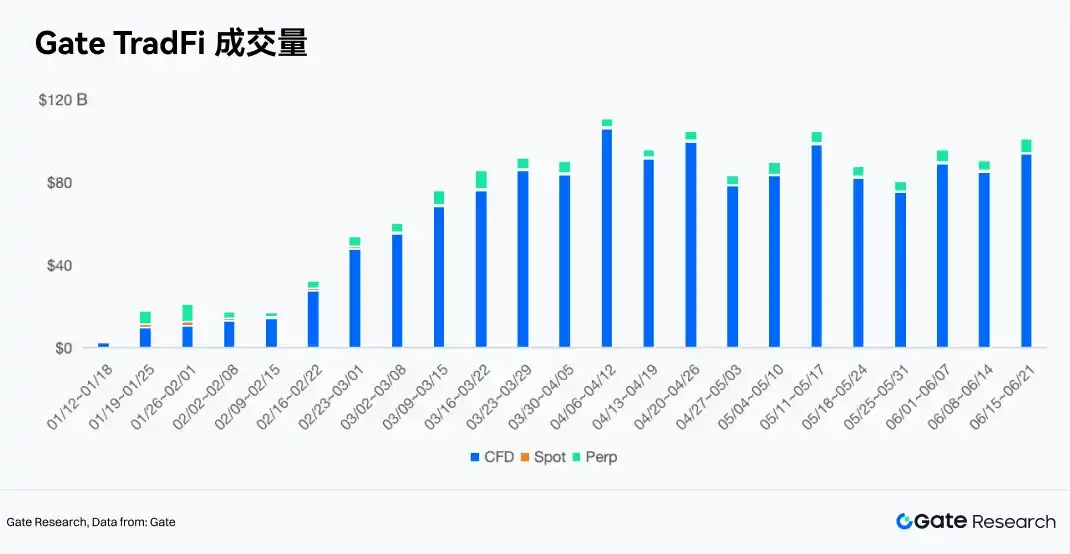
The second stage is the CFD-ization of traditional assets, providing price exposure to gold, forex, indices, commodities, and select stocks via contracts for difference. In January 2026, Gate expanded its TradFi CFD products to cover gold, forex, indices, commodities, and popular stocks, integrating the trading experience using USDx, an internal unit of account pegged to USDT. In this stage, the exchange acts as a price exposure gateway; users trade derivatives without directly holding the underlying stock assets.
The third stage is the launch of real stock trading in June 2026. On June 1, Gate officially launched real stock trading, currently supporting over 10,000 US stocks and ETFs, covering major markets like NYSE and Nasdaq. Users can trade directly using USDT. This means a native crypto trading platform is no longer content with offering spot, futures, Launchpad, copy trading, wallets, and on-chain tools to native users; it has begun to include stock, ETF, bond, forex, and fund traders into its trading ecosystem.

The difference from the previous CFD stage is that Gate emphasizes its connection to real securities markets through compliant brokerage infrastructure, not via stock tokens or synthetic assets. On June 3, Gate also announced a strategic partnership with Alpaca to expand access to real stock trading for eligible users. Alpaca is an SEC-registered clearing broker, and the partnership focuses on trade execution, clearing, and custody infrastructure. In other words, Gate isn't issuing stocks itself; it's acting as the front-end gateway between crypto accounts, stablecoin funds, and the traditional brokerage clearing system.
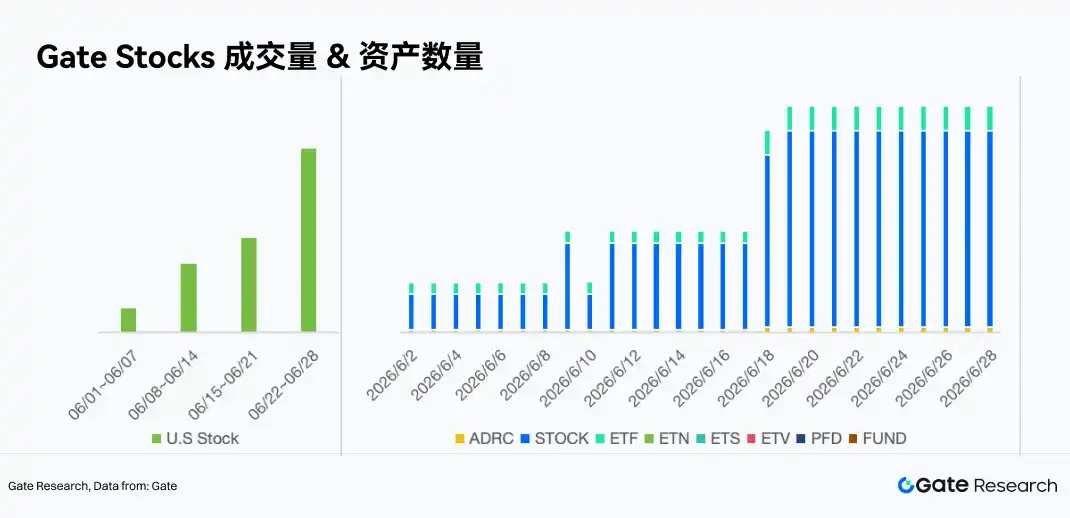
The fourth stage is geographical expansion in stock markets. Following US stocks, Gate launched Hong Kong stock trading on June 15, initially covering over 1,000 stocks listed on the Hong Kong Exchange. Users can trade assets like Tencent, HSBC, Xiaomi, Meituan, BYD, and China Mobile using USDT, sharing the same stock account system as for US stocks. On June 22, Gate further launched Korean stock trading, supporting stocks listed on the KRX exchange, initially covering the top 1,000 companies by market cap, including Samsung Electronics, SK Hynix, NAVER, Hyundai Motor, and Celltrion, covering both KOSPI and KOSDAQ markets. Within June, Gate rapidly deployed a "US-Hong Kong-Korean stocks" matrix, forming a multi-market product portfolio with USDT as the unified funding entry point and global stocks as the allocation targets.

These four stages reflect a shift in CEX growth logic. In the past, CEXs primarily relied on spot, futures, Launchpad, wealth management, and Web3 wallets to build user ecosystems. However, as crypto trading penetration increases, fee competition intensifies, and regulatory demands rise, growth space relying solely on crypto-to-crypto trading is narrowing. Traditional assets like stocks, ETFs, and commodities can expand the pool of tradable assets and improve user asset retention. For Gate, real stock trading not only serves the cross-asset allocation needs of crypto users but also helps attract traditional finance users into its account system.

2.2 Path B: From Traditional Finance to Crypto

Opposite to Gate's direction, traditional brokerages represented by Robinhood have been gradually penetrating the crypto market. The advantage of these traditional brokerages lies in their established retail brokerage user base, compliance frameworks, and experience in retail trading products. This allows them to integrate traditional finance products like stocks, ETFs, and options with crypto assets on the same trading platform at a relatively low customer acquisition cost. Traditional financial institutions not only incorporate crypto assets as a supplement to their traditional wealth management systems but also leverage characteristics like 24/7 trading and high volatility to explore new revenue streams and enhance platform competitiveness.

The most representative among traditional brokerages is Robinhood. Originally a typical retail brokerage and fintech platform starting with stocks, options, cash management, margin, and subscription services, crypto assets have become one of its growth engines in recent years. In Q4 2024, Robinhood's crypto trading revenue reached $358 million, a year-on-year increase of over 700%, driving a more than 200% increase in trading revenue. For the full year 2025, Robinhood's total revenue reached $4.5 billion, net deposits for the year reached $68 billion, and Gold subscription users reached 4.2 million, indicating its evolution from a single stock trading app into a comprehensive financial account.
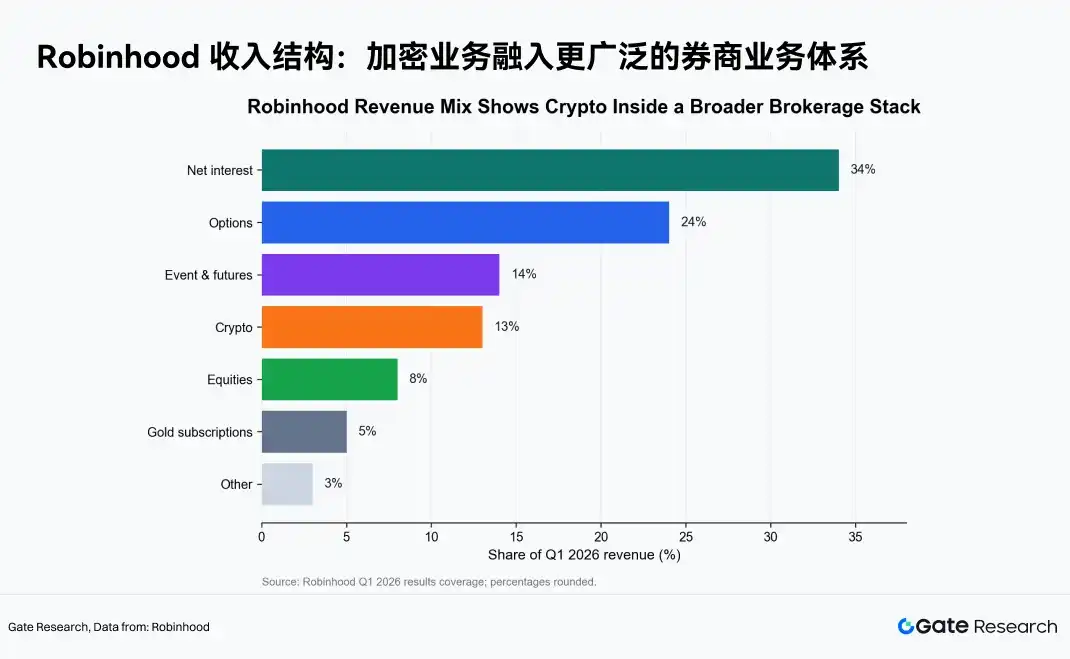
Robinhood's crypto strategy is not limited to listing coins for trading. In June 2025, Robinhood completed its acquisition of Bitstamp, integrating Bitstamp's retail and institutional crypto trading businesses covering the EU, UK, US, and Asia, and strengthening its global crypto licensing and institutional capabilities. This shows Robinhood isn't simply adding crypto as another trading category within its stock app; it's acquiring crypto exchange capabilities, licenses, institutional clients, and global operations through M&A.

More importantly, it is working on moving traditional stock assets on-chain. On June 30, 2025, Robinhood announced the launch of Stock Tokens in Europe and disclosed plans to build the Robinhood Layer 2 to support real-world asset tokenization, 24/7 trading, cross-chain functionality, and self-custody. Its stock tokens were initially issued on Arbitrum, with plans to migrate to its own Layer 2 based on Arbitrum's tech stack. These Classic Stock Tokens are derivative contracts with Robinhood reflecting the price performance of the underlying stocks and ETPs.

This contrasts with Gate's path emphasizing real stock trading. Robinhood leans more towards encapsulating traditional stock exposure as on-chain or quasi-on-chain tokenized exposure, while Gate is connecting to real securities brokerage infrastructure starting from its CEX account.

2.3 The Common Goal of Both Paths: Competing for the Next-Generation Integrated Financial Account

For the average user, the financial classification behind an asset may not be that important. Most people don't care whether they're trading stocks, cryptocurrencies, ETFs, event contracts, or tokenized securities. What users truly care about is whether they can execute trades in the same account, enter and exit positions at low cost, see price changes in real-time, and quickly switch positions during market volatility.

And this is precisely the core motivation for traditional brokerages to embrace crypto assets. They don't simply want to become another Gate or CEX; they want to avoid the next generation of financial gateways being captured by crypto platforms.

Therefore, the key isn't whether a particular product succeeds in the short term, but that the direction of industry convergence is clear: Traditional brokerages want the trading speed, global liquidity, younger user base, and high-frequency trading behavior of the crypto market. Crypto platforms want the real assets, compliant identity, institutional trust, and broader asset supply of traditional finance.

Both sides are moving towards the most valuable parts of the other. The boundary between Crypto and TradFi is being broken at the product level. The core competition in the next phase will be around compliance capabilities, asset coverage, capital efficiency, user experience, and global account systems.

3. RWA and On-Chain Treasuries: The Middle Layer Unifying Capital Markets

The Gate and Robinhood examples mentioned above represent convergence at the user gateway level, while RWA and on-chain Treasuries represent convergence at the asset layer.

Historically, one of the biggest issues in the crypto market was the relatively closed supply of on-chain assets. Beyond native tokens, stablecoins, NFTs, and a few derivative assets, the on-chain world struggled to host a sufficiently rich, low-volatility, and institutionally suitable pool of real-yield assets.

On-chain Treasuries change this. When US Treasuries, money market funds, and short-term bond funds are tokenized, they become the on-chain world's approximation of "risk-free yield." They can serve as collateral, be integrated into DeFi compositions, facilitate institutional treasury management, and become the yield source backing stablecoins and other on-chain financial products.

However, this market is still nascent. Data from May 2026 shows the tokenized US Treasury market is around $15 billion, while the entire US Treasury market is approximately $30 trillion. There is a difference of over three orders of magnitude.
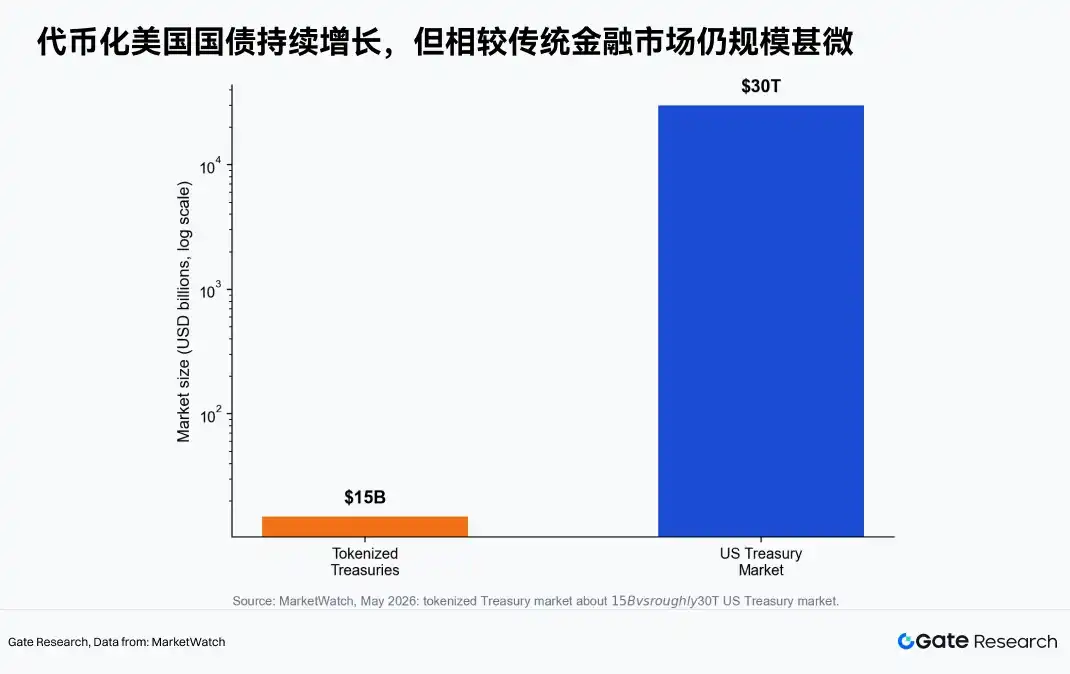
This gap indicates two things. First, RWA is not a completed market but a market just beginning its institutionalization. Second, its ceiling isn't determined by crypto-native users but by whether traditional financial assets can enter the on-chain environment in a compliant, auditable, settleable, and distributable manner. This is why traditional institutions like JPMorgan, BlackRock, Franklin Templeton, BNY, DTCC, and Nasdaq simultaneously appear in the tokenization narrative. In the long run, they are not creating a separate crypto product but testing the underlying settlement and asset registration methods for future capital markets.

And data proves this convergence is not a narrative bubble but a real structural trend. In H1 2026, while the broader crypto market fell 28% and DeFi TVL shrank over 25%, the RWA sector grew over 40% against the trend, surpassing $32 billion in scale. Tokenized stocks were the growth engine: the number of holding wallets grew 188% in six months, reaching about 350,000, making it the largest RWA category by wallet count, surpassing tokenized gold. This means many users already in the crypto world who wanted exposure to US stocks found an entry point without returning to traditional brokerages. Meanwhile, DTCC, US, and Japanese banks plan to enter in 2026–2027, aiming to "infrastructure-ize" tokenized stocks.

4. The Logical Endpoint: Stocks, Crypto, RWA, On-Chain Treasuries Trading Side-by-Side

4.1 Unified Capital Markets and the "Super Account"

In the old financial system, different assets were segregated into different accounts: stocks in brokerage accounts, funds in asset management accounts, bonds in institutional systems, deposits in bank accounts, crypto on exchanges or wallets, and on-chain assets in self-custody addresses. Each asset class had its own trading hours, settlement cycles, custody rules, compliance requirements, and user interfaces. But the new generation of platforms is attempting to compress these divisions into a single account.

Crypto exchanges are expanding from coins to stocks, ETFs, RWA, payments, and on-chain yield. Traditional brokerages are expanding from stocks to crypto, tokenized securities, prediction markets, stablecoins, and 24/7 trading. Asset managers are expanding from funds to ETFs, tokenized funds, and on-chain distribution. Banks are expanding from deposits and settlement to tokenized deposits, on-chain payments, and institutional clearing networks.

On the surface, they offer different products. In reality, they are all competing for the same thing: the default entry point for the next-generation multi-asset account. Whoever controls this gateway controls distribution; whoever controls distribution can influence liquidity, pricing, custody, and asset issuance.

The future taking shape likely involves users trading BTC, ETH, Apple stock, Nvidia stock, S&P ETFs, on-chain US Treasuries, money market funds, gold, RWA, prediction market contracts, and even tokenized shares of private companies—all within the same interface. Stablecoins may become the cross-market funding layer, on-chain Treasuries may serve as collateral and yield base, ETFs and tokenized funds may become bridges for traditional assets to enter crypto accounts, and the boundaries between brokerage apps and crypto exchange apps will increasingly blur.

This market will likely not be fully decentralized nor fully controlled by Wall Street. A hybrid structure is more probable. Asset issuance will remain regulated, custody will require compliant institutions, securities trading will still have geographic and investor suitability restrictions, but the trading interface, fund flow, settlement speed, and asset composition methods will increasingly resemble the crypto market.

The competition for the next generation of capital markets isn't between crypto exchanges and stock exchanges; it's about who can compress the most assets, deepest liquidity, most trustworthy custody, and smoothest user experience into the same account.

4.2 Conclusion: Wall Street Hasn't Conquered Crypto, and Crypto Hasn't Bypassed Wall Street

The "Wall Street-ization" of crypto financial products should not be interpreted as the crypto market being taken over by traditional finance. More accurately, it is a mutual transformation. Future industry competition may no longer be point-to-point between CEXs and brokerages, but among financial super-gateways. CEXs will continue expanding into stocks, ETFs, bonds, funds, gold, forex, payments, and wealth management. Traditional brokerages will continue expanding into crypto spot, staking, tokenized assets, stablecoin payments, and on-chain settlement. What end-users eventually see might not be a "crypto exchange" or a "stock brokerage," but a unified account containing BTC, ETH, USDT, US stocks, ETFs, gold, on-chain yield products, and more.

Long-term, asset categories will remain important, regulatory boundaries will persist, but the user experience will become far less fragmented than today. Stocks, crypto, RWA, and on-chain Treasuries will no longer belong to separate worlds but will be repriced within the same funding layer, the same account system, and the same trading interface.

Wall Street hasn't simply conquered crypto. Crypto hasn't bypassed Wall Street. They are jointly reshaping capital markets into another form.

Returning to that line in Satoshi's genesis block. Seventeen years ago, Bitcoin aimed to bypass Wall Street and build its own financial order. Seventeen years later, Bitcoin and Wall Street are co-building a new track. The decentralized ideal hasn't faded; it continues operating at the protocol's foundational layer. And at the application layer accessible to ordinary people, a more efficient, more global, and freer unified capital market is quietly taking shape at the intersection of these two converging paths.

Data Sources

• Gate, https://www.gate.com

• CryptoTimes, https://www.cryptotimes.io/insights/how-etfs-are-driving-bitcoin-in-2026-big-players-shaping-the-trend/

• InvestaX, https://investax.io/blog/q1-2026-real-world-asset-tokenization-market-report

• RWA.xyz, https://app.rwa.xyz/

• CoinGape, https://coingape.com/best-crypto-exchanges-to-trade-real-world-assets/

• Eco, https://eco.com/support/en/articles/15083160-robinhood-tokenized-stocks-what-s-live-and-how-it-works

• Eco, https://eco.com/support/en/articles/15254023-tokenized-equities-2026-backed-dinari-robinhood

• CEX.IO, https://blog.cex.io/ecosystem/tokenized-stocks-q2-2026-trends-35636

Gate Research Institute is a comprehensive blockchain and cryptocurrency research platform, providing readers with in-depth content including technical analysis, hot topic insights, market reviews, industry research, trend forecasts, and macroeconomic policy analysis.

Disclaimer

Investing in cryptocurrency markets involves high risks. Users are advised to conduct independent research and fully understand the nature of the assets and products they purchase before making any investment decisions. Gate assumes no responsibility for any losses or damages arising from such investment decisions.

Cryptos en tendance

Questions liées

QWhat were the original three 'de-' principles of Bitcoin's creation as described in the article?

AThe original three 'de-' principles of Bitcoin's creation were: decentralization (no central issuer, global node maintenance), de-intermediation (peer-to-peer value transfer without banks or brokers), and de-banking (anyone can hold, transfer, and issue new coins without needing a bank account, KYC, or accredited investor status).

QHow is the 'Wall Street-ization' of crypto assets manifested according to the article?

AThe 'Wall Street-ization' of crypto assets is manifested through several key developments: the approval and growth of Bitcoin and Ethereum ETFs managed by giants like BlackRock and Fidelity, the rise of regulated derivatives on CME, the rapid expansion of tokenized real-world assets (RWA) like U.S. Treasuries, and the integration of crypto assets into traditional retirement accounts like 401(k)s. This shifts control over issuance, pricing, custody, and distribution towards traditional financial institutions.

QWhat are the two opposite but converging paths described for the fusion of crypto and traditional finance (TradFi)?

AThe two converging paths are: Path A, where a crypto-native exchange (CEX) like Gate expands into traditional finance by offering tokenized stocks, CFDs, and eventually direct access to real stock trading. Path B, where a traditional brokerage like Robinhood expands into crypto by integrating crypto trading, acquiring crypto exchanges (e.g., Bitstamp), and tokenizing traditional stocks on-chain. Both aim to create a comprehensive, multi-asset financial account.

QWhat role do Real-World Assets (RWA) and tokenized Treasuries play in the fusion of financial markets?

ARWA and tokenized Treasuries act as a unifying middle layer or 'risk-free yield proxy' for the on-chain world. They bring low-volatility, yield-generating traditional assets onto the blockchain, serving as collateral in DeFi, a source of yield for stablecoins, and meeting institutional demand. Their growth, especially in tokenized equities, provides crypto users exposure to traditional assets without leaving the crypto ecosystem, while attracting traditional financial infrastructure providers to build on-chain.

QWhat is the article's conclusion about the relationship between Wall Street and crypto, and the likely future of capital markets?

AThe article concludes that the relationship is not a zero-sum game where one conquers the other. Instead, it's a process of mutual transformation and convergence. The future likely holds a hybrid structure where a 'unified capital market' emerges. Users will access a 'super account' or unified interface to trade diverse assets—like crypto, stocks, ETFs, RWA, and tokenized Treasuries—seamlessly. Competition will shift to who can build the best multi-asset platform with deep liquidity, strong custody, and smooth user experience, blurring the lines between crypto exchanges and traditional brokerages.

Lectures associées

Après trois trimestres consécutifs de baisse, le marché des cryptomonnaies pourra-t-il connaître une fenêtre de stabilisation au troisième trimestre ?

Le marché des cryptomonnaies a enregistré son pire trimestre depuis 2022, avec une capitalisation totale chutant de 12,6% à 2 100 milliards de dollars. Tous les indicateurs clés (volume des échanges, valeur des stablecoins) montrent une sortie nette de capitaux. Le Bitcoin a perdu 14,2% et l'Ethereum 25,4% sur le trimestre, rompant sa corrélation antérieure avec les actions technologiques. Les ETF spot américains sur le Bitcoin ont subi des rachats massifs, avec une sortie nette de 4,67 milliards de dollars au Q2, indiquant une pression de vente continue. Le resserrement de la politique de la Fed et les ventes d'entreprises comme Strategy ont accentué la déleveragisation du secteur. L'attention du marché se porte désormais presque exclusivement sur la réunion de la Fed fin juillet. Une position accommodante pourrait stabiliser le Bitcoin entre 68 000 et 84 000 dollars, tandis qu'un ton hawkish pourrait le faire osciller autour de 50 000-56 000 dollars. Parallèlement, la progression du *CLARITY Act*, une loi cruciale pour la clarté réglementaire, est au point mort au Sénat, réduisant les chances d'adoption en 2026 et maintenant une prime de risque élevée sur l'ensemble du secteur. Malgré ce contexte difficile, quelques secteurs résistent : les marchés de prédiction ont vu leur volume nominal augmenter de 48,7% et les biens collectionnables tokenisés ont progressé d'environ 143%. La tokenisation d'actifs du monde réel (RWA) continue également sa croissance régulière, portée par des fondamentaux indépendants du cycle crypto. Les bases d'un effondrement extrême semblent absentes, mais le marché est désormais guidé par les politiques monétaires, les prix et les attentes de taux, plutôt que par le simple récit haussier. La fin des sorties massives des ETF et le retour des achats des détenteurs à long terme pourraient indiquer une phase de stabilisation potentielle.

marsbitIl y a 15 h

Après trois trimestres consécutifs de baisse, le marché des cryptomonnaies pourra-t-il connaître une fenêtre de stabilisation au troisième trimestre ?

marsbitIl y a 15 h

The SpaceX Trade, Unlocked: SPCXON Débarque sur WEEX

En juin 2026, SpaceX a réalisé la plus grande introduction en bourse de l'histoire, mais l'accès à l'action a été limité pour de nombreux investisseurs en raison de restrictions régionales et de frictions liées aux courtiers. La plateforme WEEX propose désormais une solution via SPCXON/USDT, un instrument tokenisé sur le marché au comptant qui permet d'obtenir une exposition au cours de SpaceX en utilisant l'USDT, sans nécessiter de compte de courtage américain. SPCXON est un produit tokenisé construit sur l'infrastructure d'Ondo, conçu pour refléter l'économie de la détention d'actions SpaceX pour les traders éligibles en dehors des États-Unis, avec des dividendes réinvestis. Le cas d'investissement repose sur la croissance des revenus de Starlink et les progrès de Starship, malgré un valorisation déjà élevée et des risques liés à un flottant public réduit et à des déblocages d'actions internes à venir. Il est important de noter que SPCXON offre une exposition, et non la propriété directe d'actions ou de droits de vote. Son prix peut évoluer avec une prime ou une décote par rapport à la valeur liquidative. WEEX propose également d'autres produits tokenisés comme MSTRON et MUON dans un compte unifié, permettant une rotation entre crypto-monnaies et actions traditionnelles sans transfert de fonds. La plateforme souligne ainsi comment les barrières entre la finance traditionnelle et les actifs numériques s'estompent.

TheNewsCryptoIl y a 15 h

The SpaceX Trade, Unlocked: SPCXON Débarque sur WEEX

TheNewsCryptoIl y a 15 h

BIT Trading Moment : Le BTC reste sous la pression de l'EMA 200 hebdomadaire, un rejet pourrait relancer la baisse, les actions de stockage et de semi-conducteurs qui ont bondi cette nuit ont baissé en séance de nuit

**Résumé des marchés : Bitcoin sous pression, actions technologiques en réajustement** Le marché crypto poursuit son rebond, avec Bitcoin évoluant autour de 66 000 $. Il fait face à une résistance clé vers 68 000 $, niveau correspondant au coût moyen des investisseurs sur cinq mois. Les traders surveillent les moyennes mobiles clés (200 MA à ~63 333 $ et 200 EMA à ~68 328 $ en hebdomadaire). Une rupture au-dessus de 68 000 $ ouvrirait la voie à une hausse, tandis qu'un échec pourrait entraîner un retest des 63 000 $. L'analyse suggère que la dynamique actuelle ressemble à un rebond estival à faible liquidité plutôt qu'au début d'un véritable marché haussier. Sur le marché actions américain, après une forte séance mardi portée par les semi-conducteurs et les titres du stockage (Micron, AMD, Intel...), les contrats à terme indiquent une ouverture en baisse. Les secteurs ayant récemment bondi, comme les semi-conducteurs et le stockage, reculent en séance de nuit. Certaines valeurs se démarquent néanmoins, comme Super Micro Computer (SMCI), en hausse après des résultats et des perspectives robustes liées à la demande de serveurs IA. Des vents contraires persistent : les prix du pétrole (Brent >91$) et les rendements des obligations d'État américaines grimpent, ravivant les craintes inflationnistes. En Asie, les marchés ont suivi le rebond technologique américain, mais de manière hésitante. La tension reste forte sur le yen japonais, qui atteint son plus bas niveau depuis des décennies. **Points clés à surveiller :** * **Crypto :** Niveaux techniques de Bitcoin (68k$/63k$), flux des ETF spot. * **Actions :** Saison des résultats (Tesla, Alphabet, Intel...), activité d'AMD sur l'IA. * **Économie :** Données américaines sur l'emploi, décision de la BCE, tensions géopolitiques et prix de l'énergie.

marsbitIl y a 15 h

BIT Trading Moment : Le BTC reste sous la pression de l'EMA 200 hebdomadaire, un rejet pourrait relancer la baisse, les actions de stockage et de semi-conducteurs qui ont bondi cette nuit ont baissé en séance de nuit

marsbitIl y a 15 h

Gate Research Institute : La vague de « Wall Streetisation » des produits financiers cryptographiques, concurrence ou fusion ?

Le titre de l'article est : "Gate Institute : La vague de 'Wall Street-isation' des produits financiers cryptos, est-ce une compétition ou une fusion ?" Résumé en français (environ 1400 caractères) : Il y a dix-sept ans, Bitcoin fut créé avec une vision décentralisée et anti-establishment financier. Aujourd'hui, paradoxalement, son adoption massive passe souvent par des ETF émis par des géants comme BlackRock. Cet article analyse cette "Wall Street-isation" apparente des actifs cryptos : les institutions traditionnelles s'emparent-elles du pouvoir d'émission, de tarification, de garde et de distribution ? La réalité est plus nuancée. C'est une convergence à double sens. D'un côté, les plateformes cryptos comme Gate.io étendent leurs services aux actions traditionnelles (états-uniennes, hongkongaises, sud-coréennes), aux CFD et aux produits tokenisés, offrant un compte unifié. De l'autre, des courtiers traditionnels comme Robinhood intègrent les cryptomonnaies et explorent la tokenisation d'actions sur blockchain. Cette fusion vise à créer le "super-compte" financier de demain, où actions, cryptos, ETF et obligations tokenisées (RWA) coexistent dans une même interface, comblant les faiblesses de chaque écosystème. Les RWA, notamment les obligations d'État tokenisées, agissent comme une couche intermédiaire unificatrice. En conclusion, Wall Street n'a pas conquis la crypto, et la crypto n'a pas contourné Wall Street. Ils construisent ensemble une nouvelle forme de marché des capitaux, plus efficace et mondial, où l'idéal décentralisé persiste dans les protocoles, tandis qu'une expérience utilisateur unifiée émerge à l'interface.

marsbitIl y a 15 h

Gate Research Institute : La vague de « Wall Streetisation » des produits financiers cryptographiques, concurrence ou fusion ?

marsbitIl y a 15 h

Trading

Spot

Articles tendance

Qu'est ce que BITCOIN

Comprendre HarryPotterObamaSonic10Inu (ERC-20) et sa position dans l'espace crypto Ces dernières années, le marché des cryptomonnaies a connu une augmentation de la popularité des monnaies mèmes, suscitant l'intérêt non seulement des traders, mais aussi de ceux qui recherchent un engagement communautaire et une valeur divertissante. Parmi ces jetons uniques, HarryPotterObamaSonic10Inu (ERC-20) est un projet intrigant qui mêle des références culturelles à l'univers des cryptomonnaies. Cet article explore les aspects clés de HarryPotterObamaSonic10Inu, en examinant ses mécanismes, son ethos axé sur la communauté, et son engagement avec le paysage crypto plus large. Qu'est-ce que HarryPotterObamaSonic10Inu (ERC-20) ? Comme son nom l'indique, HarryPotterObamaSonic10Inu est une monnaie mème construite sur la blockchain Ethereum, classée selon la norme ERC-20. Contrairement aux cryptomonnaies traditionnelles qui peuvent mettre l'accent sur l'utilité pratique ou le potentiel d'investissement, ce jeton prospère grâce à sa valeur divertissante et à la force de sa communauté. Le projet vise à favoriser un environnement où des utilisateurs engagés peuvent se rassembler, partager des idées et participer à des activités inspirées par divers phénomènes culturels. Une caractéristique notable de HarryPotterObamaSonic10Inu est son absence de taxe sur les transactions. Cet élément attrayant vise à encourager le trading et l'implication de la communauté, sans frais supplémentaires pouvant décourager les petits traders. L'offre totale de la monnaie est fixée à un milliard de jetons, un chiffre qui marque son intention de maintenir une circulation substantielle au sein de la communauté. Créateur de HarryPotterObamaSonic10Inu (ERC-20) Les origines de HarryPotterObamaSonic10Inu sont quelque peu obscures ; les détails concernant le créateur restent inconnus. Le développement de ce jeton ne comporte pas d'équipe identifiable ou de plan explicite, ce qui n'est pas rare dans le secteur des monnaies mèmes. Au lieu de cela, le projet a émergé de manière organique, son progrès s'appuyant fortement sur l'enthousiasme et la participation de sa communauté. Investisseurs de HarryPotterObamaSonic10Inu (ERC-20) En ce qui concerne les investissements externes et le soutien, HarryPotterObamaSonic10Inu reste également ambigu. Le jeton ne mentionne aucune fondation d'investissement connue ou un soutien organisationnel significatif. Au lieu de cela, le cœur battant du projet est sa communauté de base, qui informe sa croissance et sa durabilité par des actions collectives et un engagement dans l'espace crypto. Comment fonctionne HarryPotterObamaSonic10Inu (ERC-20) ? En tant que monnaie mème, HarryPotterObamaSonic10Inu opère principalement en dehors des cadres traditionnels qui régissent souvent la valeur des actifs. Plusieurs aspects distinctifs définissent comment le projet fonctionne : Transactions sans taxe : Sans frais de taxe sur les transactions, les utilisateurs peuvent acheter et vendre librement le jeton sans se préoccuper de frais cachés. Engagement communautaire : Le projet prospère grâce à l'interaction communautaire, exploitant les plateformes de médias sociaux pour créer du bruit et faciliter l'implication. Les discussions, le partage de contenu et l'engagement sont des éléments cruciaux qui aident à étendre sa portée et à favoriser la loyauté parmi les supporters. Pas d'utilité pratique : Il est important de noter que HarryPotterObamaSonic10Inu n'offre pas d'utilité concrète au sein de l'écosystème financier. Au contraire, il est classé comme un jeton principalement pour des activités de divertissement et communautaires. Référence culturelle : Le jeton intègre habilement des éléments de la culture populaire pour susciter l'intérêt, s'adressant à la fois aux amateurs de mèmes et aux suiveurs de crypto. HarryPotterObamaSonic10Inu illustre comment les monnaies mèmes fonctionnent différemment des projets de cryptomonnaies plus traditionnels, entrant sur le marché en tant que constructions sociales innovantes plutôt qu'actifs utilitaires. Chronologie de HarryPotterObamaSonic10Inu (ERC-20) L'histoire de HarryPotterObamaSonic10Inu est jalonnée de plusieurs étapes notables : Création : Le jeton est né d'un mème viral, captivant l'imagination de nombreux passionnés de crypto. Les dates de création spécifiques ne sont pas disponibles, soulignant son ascension organique. Listing sur les échanges : HarryPotterObamaSonic10Inu a fait son apparition sur divers échanges, permettant un accès et un trading plus faciles par la communauté. Initiatives d'engagement communautaire : Activités en cours visant à améliorer l'interaction communautaire, y compris des concours, des campagnes sur les réseaux sociaux, et la génération de contenu par des fans et des défenseurs. Plans d'expansion futurs : La feuille de route du projet comprend le lancement d'une collection NFT, de marchandises, et d'un site eCommerce lié à ses thèmes culturels, engageant davantage la communauté et tentant d'ajouter plus de dimensions à son écosystème. Points clés concernant HarryPotterObamaSonic10Inu (ERC-20) Nature axée sur la communauté : Le projet privilégie l'apport collectif et la créativité, garantissant que l'implication des utilisateurs est au cœur de son développement. Classification de monnaie mème : Il représente l'apogée de la cryptomonnaie basée sur le divertissement, se distinguant des véhicules d'investissement traditionnels. Pas d'affiliation directe avec Bitcoin : Malgré la similitude dans le nom du ticker, HarryPotterObamaSonic10Inu est distinct et n'a aucun lien avec Bitcoin ou d'autres cryptomonnaies établies. Focus sur la collaboration : HarryPotterObamaSonic10Inu est conçu pour créer un espace de collaboration et de partage d'histoires parmi ses détenteurs, offrant une voie pour la créativité et le lien communautaire. Perspectives d'avenir : L'ambition de s'étendre au-delà de son concept initial vers des NFT et des marchandises dessine un chemin pour le projet afin de potentiellement entrer dans des avenues plus grand public au sein de la culture numérique. Alors que les monnaies mèmes continuent de captiver l'imagination de la communauté des cryptomonnaies, HarryPotterObamaSonic10Inu (ERC-20) se distingue par ses liens culturels et son approche centrée sur la communauté. Bien qu'il ne corresponde pas au modèle typique d'un jeton axé sur l'utilité, son essence réside dans la joie et la camaraderie cultivées parmi ses supporters, soulignant la nature en évolution des cryptomonnaies dans un âge de plus en plus numérique. À mesure que le projet continue de se développer, il sera important de surveiller comment les dynamiques communautaires influencent sa trajectoire dans le paysage toujours changeant de la technologie blockchain.

1.9k vues totalesPublié le 2024.04.01Mis à jour le 2024.12.03

Qu'est ce que BITCOIN

Comment acheter BTC

Bienvenue sur HTX.com ! Nous vous permettons d'acheter Bitcoin (BTC) de manière simple et pratique. Suivez notre guide étape par étape pour commencer votre parcours crypto.Étape 1 : Création de votre compte HTXUtilisez votre adresse e-mail ou votre numéro de téléphone pour ouvrir un compte sur HTX gratuitement. L'inscription se fait en toute simplicité et débloque toutes les fonctionnalités.Créer mon compteÉtape 2 : Choix du mode de paiement (rubrique Acheter des cryptosCarte de crédit/débit : utilisez votre carte Visa ou Mastercard pour acheter instantanément Bitcoin (BTC).Solde :utilisez les fonds du solde de votre compte HTX pour trader en toute simplicité.Prestataire tiers :pour accroître la commodité d'utilisation, nous avons ajouté des modes de paiement populaires tels que Google Pay et Apple Pay.P2P :tradez directement avec d'autres utilisateurs sur HTX.OTC (de gré à gré) : nous offrons des services personnalisés et des taux de change compétitifs aux traders.Étape 3 : stockage de vos Bitcoin (BTC)Après avoir acheté vos Bitcoin (BTC), stockez-les sur votre compte HTX. Vous pouvez également les envoyer ailleurs via un transfert sur la blockchain ou les utiliser pour trader d'autres cryptos.Étape 4 : tradez des Bitcoin (BTC)Tradez facilement Bitcoin (BTC) sur le marché Spot de HTX. Il vous suffit d'accéder à votre compte, de sélectionner la paire de trading, d'exécuter vos trades et de les suivre en temps réel. Nous offrons une expérience conviviale aux débutants comme aux traders chevronnés.

5.6k vues totalesPublié le 2024.12.12Mis à jour le 2026.06.02

Comment acheter BTC

Qu'est ce que $BITCOIN

OR DÉMATÉRIEL ($BITCOIN) : Une Analyse Complète Introduction à OR DÉMATÉRIEL ($BITCOIN) OR DÉMATÉRIEL ($BITCOIN) est un projet basé sur la blockchain opérant sur le réseau Solana, qui vise à combiner les caractéristiques des métaux précieux traditionnels avec l'innovation des technologies décentralisées. Bien qu'il partage un nom avec Bitcoin, souvent appelé “or numérique” en raison de sa perception en tant que réserve de valeur, OR DÉMATÉRIEL est un jeton distinct conçu pour créer un écosystème unique au sein du paysage Web3. Son objectif est de se positionner comme un actif numérique alternatif viable, bien que les spécificités concernant ses applications et fonctionnalités soient encore en développement. Qu'est-ce qu'OR DÉMATÉRIEL ($BITCOIN) ? OR DÉMATÉRIEL ($BITCOIN) est un jeton de cryptomonnaie explicitement conçu pour une utilisation sur la blockchain Solana. Contrairement à Bitcoin, qui joue un rôle de stockage de valeur largement reconnu, ce jeton semble se concentrer sur des applications et caractéristiques plus larges. Les aspects notables incluent : Infrastructure Blockchain : Le jeton est construit sur la blockchain Solana, connue pour sa capacité à gérer des transactions rapides et peu coûteuses. Dynamique de l'Offre : OR DÉMATÉRIEL a une offre maximale plafonnée à 100 quadrillions de jetons (100P $BITCOIN), bien que les détails concernant son offre en circulation soient actuellement non divulgués. Utilité : Bien que les fonctionnalités précises ne soient pas explicitement décrites, il y a des indications que le jeton pourrait être utilisé pour diverses applications, impliquant potentiellement des applications décentralisées (dApps) ou des stratégies de tokenisation d'actifs. Qui est le Créateur d'OR DÉMATÉRIEL ($BITCOIN) ? À l'heure actuelle, l'identité des créateurs et de l'équipe de développement derrière OR DÉMATÉRIEL ($BITCOIN) reste inconnue. Cette situation est typique parmi de nombreux projets innovants dans l'espace blockchain, en particulier ceux alignés avec la finance décentralisée et les phénomènes de meme coin. Bien qu'une telle anonymité puisse favoriser une culture axée sur la communauté, elle intensifie les préoccupations concernant la gouvernance et la responsabilité. Qui sont les Investisseurs d'OR DÉMATÉRIEL ($BITCOIN) ? Les informations disponibles indiquent qu'OR DÉMATÉRIEL ($BITCOIN) n'a pas de bailleurs de fonds institutionnels connus ou d'investissements en capital-risque notables. Le projet semble fonctionner sur un modèle peer-to-peer axé sur le soutien et l'adoption de la communauté plutôt que sur des voies de financement traditionnelles. Son activité et sa liquidité se situent principalement sur des échanges décentralisés (DEX), tels que PumpSwap, plutôt que sur des plateformes de trading centralisées établies, soulignant davantage son approche de base. Comment fonctionne OR DÉMATÉRIEL ($BITCOIN) Les mécanismes opérationnels d'OR DÉMATÉRIEL ($BITCOIN) peuvent être élaborés en fonction de sa conception blockchain et des attributs du réseau : Mécanisme de Consensus : En s'appuyant sur le mécanisme de preuve d'historique (PoH) unique de Solana combiné à un modèle de preuve d'enjeu (PoS), le projet assure une validation efficace des transactions contribuant à la haute performance du réseau. Tokenomics : Bien que des mécanismes déflationnistes spécifiques n'aient pas été largement détaillés, l'immense offre maximale de jetons implique qu'elle pourrait répondre à des microtransactions ou à des cas d'utilisation de niche qui restent à définir. Interopérabilité : Il existe un potentiel d'intégration avec l'écosystème plus large de Solana, y compris diverses plateformes de finance décentralisée (DeFi). Cependant, les détails concernant des intégrations spécifiques restent non spécifiés. Chronologie des Événements Clés Voici une chronologie qui met en évidence des jalons significatifs concernant OR DÉMATÉRIEL ($BITCOIN) : 2023 : Le déploiement initial du jeton a lieu sur la blockchain Solana, marqué par son adresse de contrat. 2024 : OR DÉMATÉRIEL gagne en visibilité en devenant disponible à la négociation sur des échanges décentralisés comme PumpSwap, permettant aux utilisateurs de l'échanger contre SOL. 2025 : Le projet connaît une activité de trading sporadique et un intérêt potentiel pour des engagements dirigés par la communauté, bien qu'aucun partenariat notable ou avancée technique n'ait été documenté jusqu'à présent. Analyse Critique Forces Scalabilité : L'infrastructure sous-jacente de Solana prend en charge des volumes de transactions élevés, ce qui pourrait améliorer l'utilité de $BITCOIN dans divers scénarios de transaction. Accessibilité : Le potentiel faible prix de négociation par jeton pourrait attirer les investisseurs de détail, facilitant une participation plus large grâce aux opportunités de propriété fractionnée. Risques Manque de Transparence : L'absence de bailleurs de fonds, de développeurs ou de processus d'audit connus publiquement peut susciter du scepticisme quant à la durabilité et à la fiabilité du projet. Volatilité du Marché : L'activité de trading dépend fortement du comportement spéculatif, ce qui peut entraîner une volatilité des prix significative et une incertitude pour les investisseurs. Conclusion OR DÉMATÉRIEL ($BITCOIN) émerge comme un projet intrigant mais ambigu au sein de l'écosystème Solana en rapide évolution. Bien qu'il tente de tirer parti du récit de “l'or numérique”, son éloignement du rôle établi de Bitcoin en tant que réserve de valeur souligne la nécessité d'une différenciation plus claire de son utilité prévue et de sa structure de gouvernance. L'acceptation et l'adoption futures dépendront probablement de la résolution de l'opacité actuelle et de la définition plus explicite de ses stratégies opérationnelles et économiques. Remarque : Ce rapport englobe des informations synthétisées disponibles jusqu'en octobre 2023, et des développements peuvent avoir eu lieu au-delà de la période de recherche.

149 vues totalesPublié le 2025.05.13Mis à jour le 2025.05.13

Qu'est ce que $BITCOIN

Discussions

Bienvenue dans la Communauté HTX. Ici, vous pouvez vous tenir informé(e) des derniers développements de la plateforme et accéder à des analyses de marché professionnelles. Les opinions des utilisateurs sur le prix de BTC (BTC) sont présentées ci-dessous.

活动图片