Infighting Erupted on Launch Day: Robinhood Chain's Launch Platform vlad.fun Sabotaged by Its Own People

Foresight NewsPublié le 2026-07-20Dernière mise à jour le 2026-07-20

Résumé

On July 15th, the Robinhood Chain token launchpad vlad.fun experienced internal sabotage on its launch day. Two external developers secretly hardcoded their own token into the platform's frontend, making it the only token visible to users and hiding all others. The core team detected the anomaly within two hours, fired the developers, and removed the malicious code. The developers claimed the action was for "clicks." They refunded approximately $15,000 in creator fees and test token profits, totaling about 7.8 ETH, to the team. An additional 4.16 ETH in protocol fees from the launch is held in a team multisig wallet. Built by a five-person team in 48 hours, vlad.fun's code was provided by the two external developers. Their last commit added the hardcoded line. When confronted, they initially blamed technical issues, but later attempted to delete the evidence before confessing. The platform is currently paused. A community member, Will Mexi, clarified he was not involved and was the one who discovered and reported the issue, having previously enabled branch protection which preserved the evidence. vlad.fun's design allows token deployment and direct listing on Uniswap V3/V4 in one transaction, with liquidity permanently locked to reduce rug pull risks. It features anti-whale measures and flexible fee routing. Despite this incident, the Robinhood Chain launchpad ecosystem remains active, with platforms like PONS gaining significant traction.


Author: Nicky, Foresight News


On July 15th, the Robinhood Chain token launch platform vlad.fun experienced malicious actions by internal developers on its launch day. According to official sources, two external developers involved in building the platform secretly created their own token and hardcoded it into the frontend code, causing only that token to be visible to users upon platform launch, while all other creators' tokens were completely hidden. The team discovered the anomaly within two hours, promptly dismissed the involved developers, and removed the malicious code.


The official statement emphasized that the team never approved issuing a vlad.fun platform token, and the two individuals unilaterally decided to launch one for "page views." After negotiation, the duo returned approximately $15,000 in creator fees and test token proceeds. The recovered funds, totaling about 7.8 ETH, have been deposited into the team's secure wallet. Additionally, approximately 4.16 ETH in protocol fees generated from the platform launch are held in the team's multi-signature address.


Public information shows that vlad.fun was rapidly built by a small team of 5 within 48 hours. Currently, two project-affiliated members have issued statements, but the specific identities of the two external developers have not been disclosed as of publishing. According to the incident explanation thread posted by the project's official account on July 18th, the two external developers were responsible for providing the core codebase for the launchpad. In the final code commit before the platform went live, they manually added a line of hardcoded logic to the frontend, forcing their own token to be displayed on the homepage, while other creators' tokens were completely obscured due to loading issues.


After the launch, users quickly noticed the anomaly, with the entire platform displaying only one token. Team members began reviewing the code and found the manually added hardcoded line in the commit history. When questioned by the team, the two developers initially blamed technical issues such as RPC failures, environment variable problems, and caching, but the persistent visibility of the relevant token contradicted such explanations.


According to the official account, one of the developers later requested the disabling of the branch protection feature on the code repository, claiming a need to "rollback some content." Before removing the protection, the team performed a timestamp backup of the entire repository and observed the two deleting the line containing the hardcoded logic. The official statement noted that this attempt to destroy evidence ultimately revealed their intent. Confronted with the evidence, the two developers admitted to their actions.


This incident highlights the trust risks faced by rapidly built crypto projects when involving external developers. The identities of the two involved developers have not been publicly disclosed, with the team stating they have taken advice to withhold their identities for now. vlad.fun stated that in the future, external personnel will no longer be allowed access to sensitive systems, and the team prefers developing based on open-source contracts.


The official website shows that vlad.fun is currently in a suspended operational state. The team stated they will prioritize handling matters for affected users.


Community member Will Mexi publicly clarified his role after the incident. He stated he was responsible for project application listings, frontend optimization, design, branding, and animations, and was not one of the two developers involved, nor did he participate in planning or executing the operation. According to his account, he tested a normal version of the website about 20 minutes before launch, so he did not notice the anomaly.


Will Mexi said that after the platform officially launched, he saw the token appearing illogically, immediately read the newly committed code, discovered the hardcoded line, and promptly reported it to the core team. He also mentioned that enabling branch protection earlier was due to caution regarding external code, and this setting ultimately preserved the complete commit history and evidence of intent. He simultaneously denied purchasing any platform tokens and claimed to have incurred losses due to expensive RPC, API, and server deployment costs.


Core team member @SOLsesame also expressed support in the incident thread. He belongs to the core small team that has collaborated with Will Mexi and others for over a year and is not one of the involved external developers. His background shows he is an active builder in the Solana ecosystem, having been deeply involved in the ai16z ecosystem and its PartnersNFT and PartnersDAO projects. Recently, he collaborated with Will Mexi to build and launch the Black Bull NFT series from scratch for the ANSEM community within 24 hours.


As a token launchpad on Robinhood Chain, vlad.fun differs from traditional bonding curve launchpads. Its design goal is to complete token deployment and direct launch to Uniswap V3 or V4 in a single transaction, making tokens instantly tradable on decentralized exchanges without going through a "graduation" migration step. Liquidity pool positions are permanently locked via a locker contract and cannot be withdrawn by the team, reducing the risk of rug pulls at the mechanism level.


In terms of fairness design, the platform employs mechanisms such as a fixed supply, no presale, and no large team allocations. It also offers an optional developer priority buy feature, allowing developers to buy at launch with zero transaction fees. An anti-whale mechanism limits single wallet holdings to 2%, preventing concentrated holdings by a single address. For fee routing, the platform supports setting a 1% to 5% transaction fee, which can be instantly directed to specified recipients, including wallet addresses, social accounts, or buyback/burn proxies. Fees are locked at launch and cannot be changed. Additionally, the platform plans optional models such as staking for rewards.


Despite vlad.fun hitting pause due to the internal incident, the launchpad ecosystem on Robinhood Chain has not cooled down. According to DefiLlama data, the chain's current TVL is approximately $258 million, with 24-hour fees around $118,000 and revenue about $106,000. Uniswap's 24-hour fee expenditure on the chain reached $1.95 million. The ecosystem has already gathered multiple launchpads, each forming a differentiated competitive landscape: the latecomer PONS holds the leading launchpad position with intensive development and continuous updates. Its platform token has a market cap of about $12 million, with a gain of over 4200% in the past 7 days. Furthermore, the Butterfly platform focuses on stock-like meme tokens but has yet to produce a hit. Native Uniswap innovative mechanism tokens, such as RWA dividend-sharing tokens like index, which received official attention, once surged to a market cap of $30 million on July 17th.


Cryptos en tendance

Questions liées

QWhat was the primary technical action taken by the two external developers that led to the incident on vlad.fun?

AThey secretly added a line of hardcoded script to the platform's front-end code, which forced only their own token to be displayed on the homepage, while hiding all other creators' tokens.

QAccording to the article, what was the main reason given by the developers for their actions, and what key evidence contradicted this reason?

AThey claimed it was for 'page views.' However, the key contradictory evidence was that when questioned, they initially tried to blame technical issues like RPC failures or cache problems, but the fact that their token remained consistently visible made these excuses implausible.

QHow did the core team discover and prove the malicious intent of the external developers?

AAfter users reported seeing only one token, the team reviewed the code commit history and found the manually added hardcoded line. The developers then tried to delete this code and asked to disable branch protection on the repository, which the team had already backed up. Their attempt to destroy evidence confirmed their malicious intent.

QWhat are two key design features of the vlad.fun platform aimed at reducing scam risks compared to traditional launchpads?

A1. Tokens are launched directly to Uniswap V3/V4 in a single transaction, making them instantly tradable without a migration step. 2. The liquidity pool is permanently locked via a locker contract, preventing the team from withdrawing it and reducing 'rug pull' risks.

QWhat is the current status of the vlad.fun platform following the incident, and what does the article suggest about the broader launchpad ecosystem on Robinhood Chain?

AThe vlad.fun platform is currently paused. The article suggests that despite this incident, the launchpad ecosystem on Robinhood Chain remains active, with platforms like PONS gaining significant traction and others exploring different niches.

Lectures associées

La crise pétrolière en Russie s'atténue : les régions commencent à supprimer les limites aux stations-service

La crise des carburants en Russie, qui avait conduit plus de 20 régions à imposer des limites dans les stations-service fin juin 2026, commence à s’atténuer. Fin juillet, plusieurs régions ont annoncé l’assouplissement ou la levée de ces restrictions. Le territoire de Transbaïkalie a ainsi entièrement aboli le système de codes QR pour le réservation, tandis que l’oblast d’Omsk a supprimé tous les quotas. L’oblast de Saratov a augmenté la limite quotidienne d’essence de 30 à 40 litres et celui de Samara a prolongé ses limites sans les durcir. La crise avait été déclenchée par des attaques de drones ukrainiens contre des infrastructures pétrolières, perturbant la logistique. À son pic, les limitations variaient par région, allant de 30 à 100 litres d’essence et de 60 à 200 litres de diesel par véhicule. Les autorités les présentaient comme un outil pour freiner la demande, qui avait bondi de 20 à 30%. Une analyse de Reuters indique que les attaques ont mis hors service environ 17% des capacités de raffinage russes. Si l’assouplissement actuel reflète une stabilisation temporaire de la distribution, la cause profonde – l’état de la raffinerie – persiste. Sans réparations suffisantes avant la saison de chauffage, une nouvelle vague de restrictions pourrait survenir à l’automne. La stabilisation actuelle reste donc fragile face au risque de futures attaques.

cryptonews.ruIl y a 10 mins

La crise pétrolière en Russie s'atténue : les régions commencent à supprimer les limites aux stations-service

cryptonews.ruIl y a 10 mins

Le nombre de partisans de la loi CLARITY atteint 1 million 7 jours avant la suspension des travaux du Sénat

Stand With Crypto, une organisation à but non lucratif de défense des intérêts de la communauté des crypto-monnaies, a annoncé que ses partisans ont contacté les législateurs un million de fois, les appelant à adopter la loi CLARITY avant la pause parlementaire du Sénat le 7 août. L'organisation a lancé un compte à rebours de sept jours pour intensifier la pression. Ce projet de loi vise à créer un cadre réglementaire pour les actifs numériques, répartissant les compétences entre les agences fédérales. Il bénéficie du soutien d'institutions comme BlackRock et Fidelity, mais Galaxy Research a réduit sa probabilité d'adoption en 2026 à 30%, citant des désaccords persistants. Le texte est au cœur de vifs débats. D'un côté, la procureure générale de New York, Letitia James, plaide pour un contrôle plus strict, craignant que la loi ne limite la capacité des États à lutter contre la fraude. De l'autre, les républicains soutiennent qu'elle renforce la lutte contre le blanchiment d'argent. Les conflits d'intérêts potentiels, notamment liés aux activités en crypto-monnaies de l'ancien président Donald Trump, compliquent également les discussions. Les démocrates, comme la sénatrice Elizabeth Warren, exigent des garde-fous éthiques plus solides. Alors que le Sénat s'apprête à partir en vacances, les sénateurs doivent concilier pression publique, soutien institutionnel et exigences de régulation. L'adoption du texte, nécessitant 60 voix, dépend du maintien d'un soutien bipartite dans les derniers jours.

cryptonews.ruIl y a 10 mins

Le nombre de partisans de la loi CLARITY atteint 1 million 7 jours avant la suspension des travaux du Sénat

cryptonews.ruIl y a 10 mins

Saylor et l'entreprise Strategy soutiennent officiellement le projet de loi CLARITY Act concernant les cryptomonnaies aux États-Unis

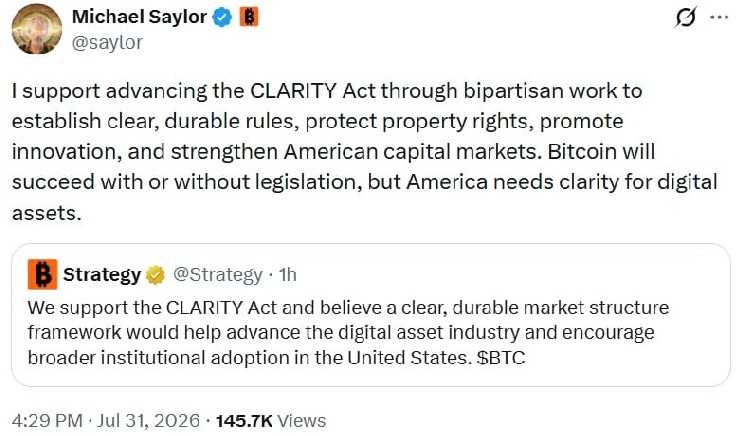
Le 31 juillet, Strategy Inc. (Nasdaq : MSTR), le plus grand détenteur corporatif de Bitcoin au monde, a annoncé son soutien au projet de loi bipartite « CLARITY Act » (Digital Asset Market Clarity Act). La société y voit un cadre propice à la croissance du marché des actifs numériques, à l'adoption institutionnelle, à la protection des consommateurs et aux droits de propriété des individus. Le soutien de Michael Saylor, son président exécutif, renforce la campagne législative. Il affirme que des règles claires sont nécessaires pour protéger la propriété, encourager l'innovation et consolider les marchés américains, tout en estimant que le Bitcoin réussira avec ou sans législation. Ce soutien intervient alors que le Sénat examine une structure de marché attribuant des rôles clairs à la SEC et à la CFTC. Le texte, approuvé en comité le 14 mai, a été révisé fin juillet en vue d'un examen plus large. Parallèlement, les résultats du Q2 de Strategy, marqués par une perte nette importante due à la volatilité du Bitcoin, illustrent l'impact direct de la régulation sur ses finances et sa stratégie de financement par émissions d'actions. La société continue d'accumuler des Bitcoins. La pression politique monte, avec près d'un million d'appels lancés aux législateurs. Cependant, les chances d'adoption du projet de loi sont jugées incertaines, une analyse récente ayant réduit sa probabilité de 50% à 30%, malgré l'influence croissante des questions numériques sur l'électorat.

cryptonews.ruIl y a 19 mins

Saylor et l'entreprise Strategy soutiennent officiellement le projet de loi CLARITY Act concernant les cryptomonnaies aux États-Unis

cryptonews.ruIl y a 19 mins

Trading

Spot

Articles tendance

Comment acheter PEOPLE

Bienvenue sur HTX.com ! Nous vous permettons d'acheter ConstitutionDAO (PEOPLE) de manière simple et pratique. Suivez notre guide étape par étape pour commencer votre parcours crypto.Étape 1 : Création de votre compte HTXUtilisez votre adresse e-mail ou votre numéro de téléphone pour ouvrir un compte sur HTX gratuitement. L'inscription se fait en toute simplicité et débloque toutes les fonctionnalités.Créer mon compteÉtape 2 : Choix du mode de paiement (rubrique Acheter des cryptosCarte de crédit/débit : utilisez votre carte Visa ou Mastercard pour acheter instantanément ConstitutionDAO (PEOPLE).Solde :utilisez les fonds du solde de votre compte HTX pour trader en toute simplicité.Prestataire tiers :pour accroître la commodité d'utilisation, nous avons ajouté des modes de paiement populaires tels que Google Pay et Apple Pay.P2P :tradez directement avec d'autres utilisateurs sur HTX.OTC (de gré à gré) : nous offrons des services personnalisés et des taux de change compétitifs aux traders.Étape 3 : stockage de vos ConstitutionDAO (PEOPLE)Après avoir acheté vos ConstitutionDAO (PEOPLE), stockez-les sur votre compte HTX. Vous pouvez également les envoyer ailleurs via un transfert sur la blockchain ou les utiliser pour trader d'autres cryptos.Étape 4 : tradez des ConstitutionDAO (PEOPLE)Tradez facilement ConstitutionDAO (PEOPLE) sur le marché Spot de HTX. Il vous suffit d'accéder à votre compte, de sélectionner la paire de trading, d'exécuter vos trades et de les suivre en temps réel. Nous offrons une expérience conviviale aux débutants comme aux traders chevronnés.

666 vues totalesPublié le 2024.12.12Mis à jour le 2026.06.02

Comment acheter PEOPLE

Discussions

Bienvenue dans la Communauté HTX. Ici, vous pouvez vous tenir informé(e) des derniers développements de la plateforme et accéder à des analyses de marché professionnelles. Les opinions des utilisateurs sur le prix de PEOPLE (PEOPLE) sont présentées ci-dessous.

活动图片