Aave Withdrawal, TVL Plunges: Where is MegaETH's Valuation Anchor?

marsbitPublié le 2026-07-13Dernière mise à jour le 2026-07-13

Résumé

MegaETH, once a highly anticipated new blockchain, has seen a dramatic decline in its Total Value Locked (TVL) and token price. According to DefiLlama data, its TVL plummeted nearly 60% in 24 hours, falling to just over $30 million from a May peak, with the Aave V3 protocol withdrawing 80% of its liquidity. The MEGA token price dropped to around $0.048, with a market cap of ~$54 million and a fully diluted valuation (FDV) of ~$480 million. The analysis identifies three key mismatches between MegaETH's valuation and its fundamentals. First, its high FDV contrasts with minimal real usage: low protocol revenue (~$90k/30 days) and few daily active addresses. Second, its DeFi narrative is contradicted by its revenue structure, where a collectible card game (Monster) generates most income, not major DeFi protocols like Aave. Third, initial hype from VC backing and airdrop farming has faded without sustained user adoption or clear applications. The TVL was heavily concentrated in Aave and largely driven by cyclical arbitrage strategies involving stablecoins like USDm and USDe. As the yield for these strategies diminished, funds rapidly exited. The departure of this speculative capital has exposed a lack of substantial, organic ecosystem activity. While the sharp drop could be seen as a correction from inflated expectations, the article suggests MegaETH's valuation lacks a solid foundation. Future price movements may rely on short-term market sentiment rather than genuine improvem...

Author: Zhou, ChainCatcher

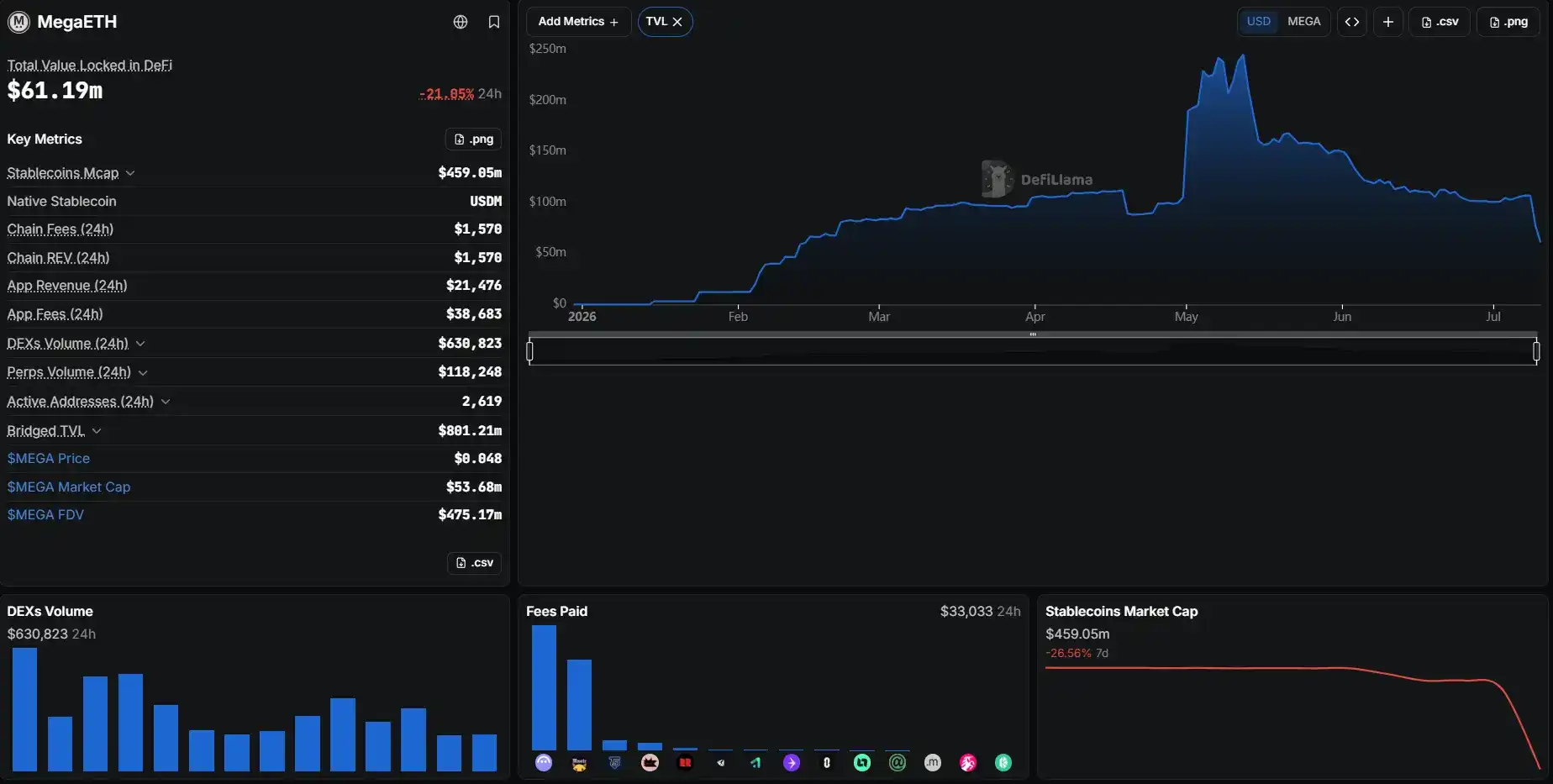
According to the latest data fromDefiLlama, MegaETH's full-chain TVL experienced violent fluctuations from July 9 to 10, once falling to just over $30 million, a 24-hour drop of nearly 60%, and evaporating about 70% compared to its peak in May. The on-chain top protocol Aave V3withdrew 80% of its liquiditywithin a day.

In terms of market performance,the price of MEGA fell to around $0.048, with a market capitalization of only about $54 million and an FDV of approximately $4.8 billion.
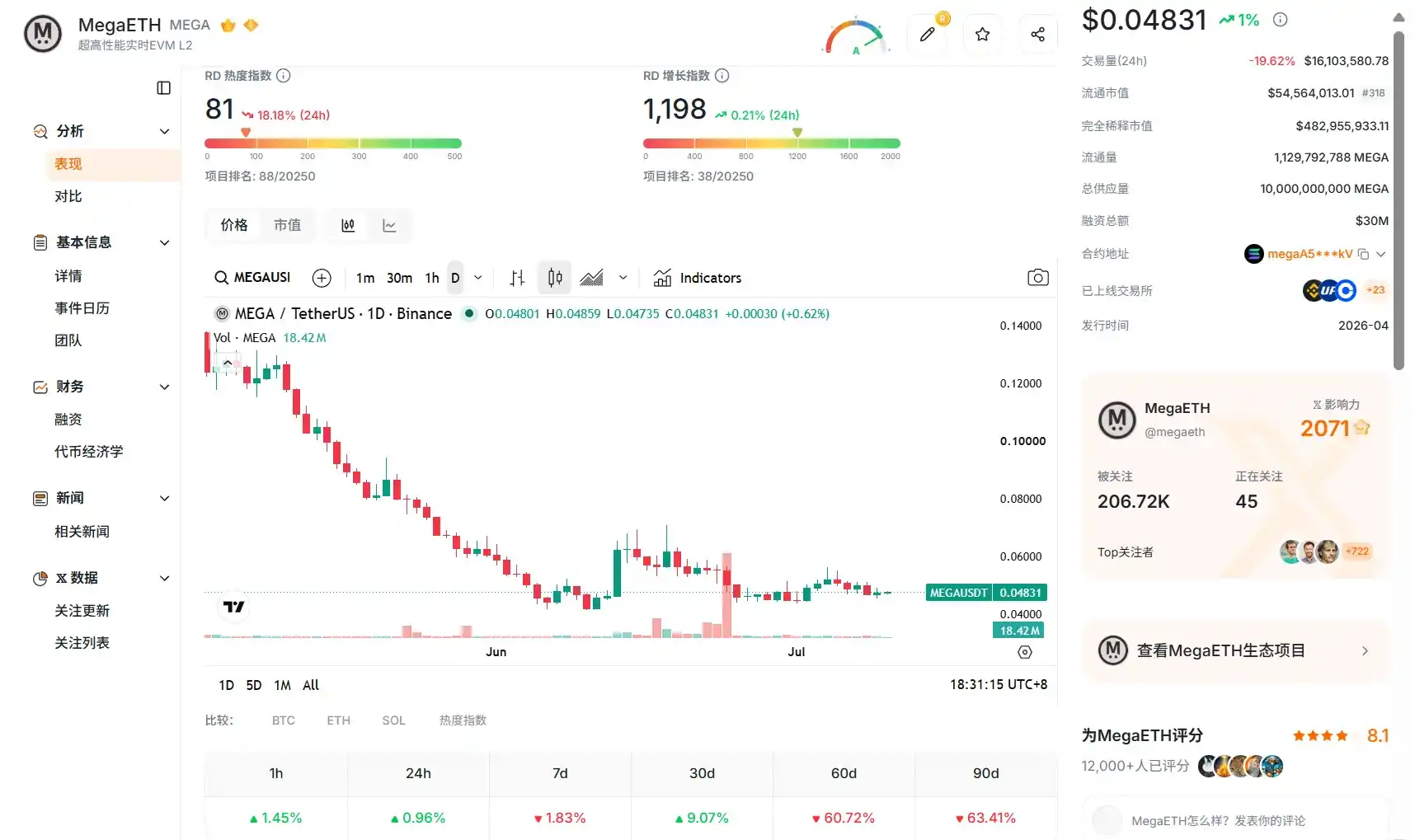
MegaETH was once one of the most anticipated new public chains in this cycle. It launched right into a market hotspot, backed by a luxurious VC lineup and KOL enthusiasm for new listings, with its token FDV once soaring to about $20 billion. In May of this year, its DeFi TVL reached $245 million, once squeezing into the top 11 public chains by TVL ranking.

From a widely viewed star public chain to experiencing sharp TVL retraction in a short time, MegaETH took only a few months. With the capital base supporting its valuation loosening, has its price already bottomed out? Or, after the paper prosperity fades, does its valuation still lack support.

TVL Highly Dependent on a Single Protocol and Circular Strategies

In MegaETH's ecosystem, at its peak, Aave once contributed about ninety percent of the chain's TVL.Currently, the total TVL fluctuates around $60 million, of which Aave still accounts for about 65%.
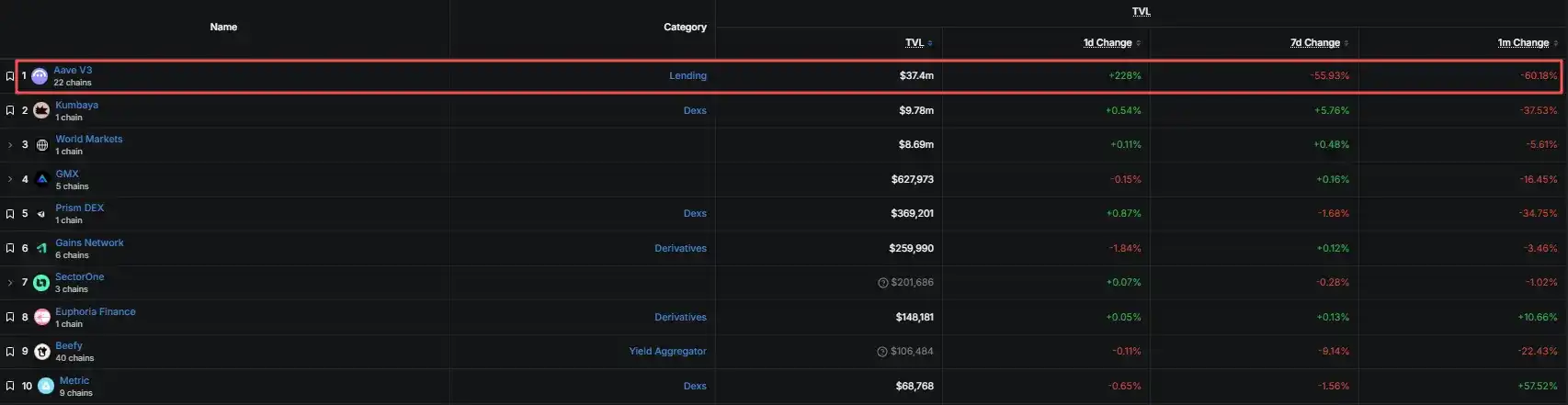
In fact,just over two months ago, the biggest source of TVL on MegaETH was someone else. On the day of the token's listing, the native DEX protocol Kumbaya accounted for $59.03 million out of the $98.43 million total TVL, about sixty percent.

At the same time, projects like Aave V3, GMX, and Chainlink Scale integrated and launched on the chain. After that, the dominant TVL contributor gradually became Aave.

Risk assessment firm LlamaRisk previously pointed out that MegaETH's TVL is highly dependent on Aave, while its stablecoin structure is highly concentrated in USDm and USDe. In its view, after excluding native assets, the proportion of external assets entering MegaETH through third-party and specific asset channels is relatively high, with highly concentrated funding sources, asset types, and protocol methods, raising stability concerns.

Specifically regarding the gameplay, the market generally questions that a large part of this volume comes from Ethena-related stablecoin circular strategies, which involve repeatedly collateralizing, borrowing, and re-collateralizing stablecoins, artificially inflating the books through leveraged stacking.

This means that when the yield of USDe falls below Aave's borrowing cost, this arbitragemechanismloses its interest rate spread space, the circular positions start unwinding, and funds withdraw accordingly.

Whether it's points incentives during the launch period or the interest rate spread profits in circular strategies, this type of capital essentially comes for returns. Once the expected returns disappear, they will leave. This is common commercial behavior in DeFi and is not surprising in itself.

What truly alerted the market is what remains on the MegaETH chain after this disproportionately large capital is withdrawn, and whether what remains can support its current valuation.

Valuation and Fundamentals, Separated by Three Layers of Mismatch

The first layer of mismatch occurs between valuation and real usage

As of writing, MEGA's market capitalization is about $54 million, and its FDV is about $470 million. According to RootData, currently 88.7% of MEGA tokens are not in circulation, and a large number of holders cannot exit due to a one-year lockup arrangement, meaning there is still a batch of potential sell pressure in the future.
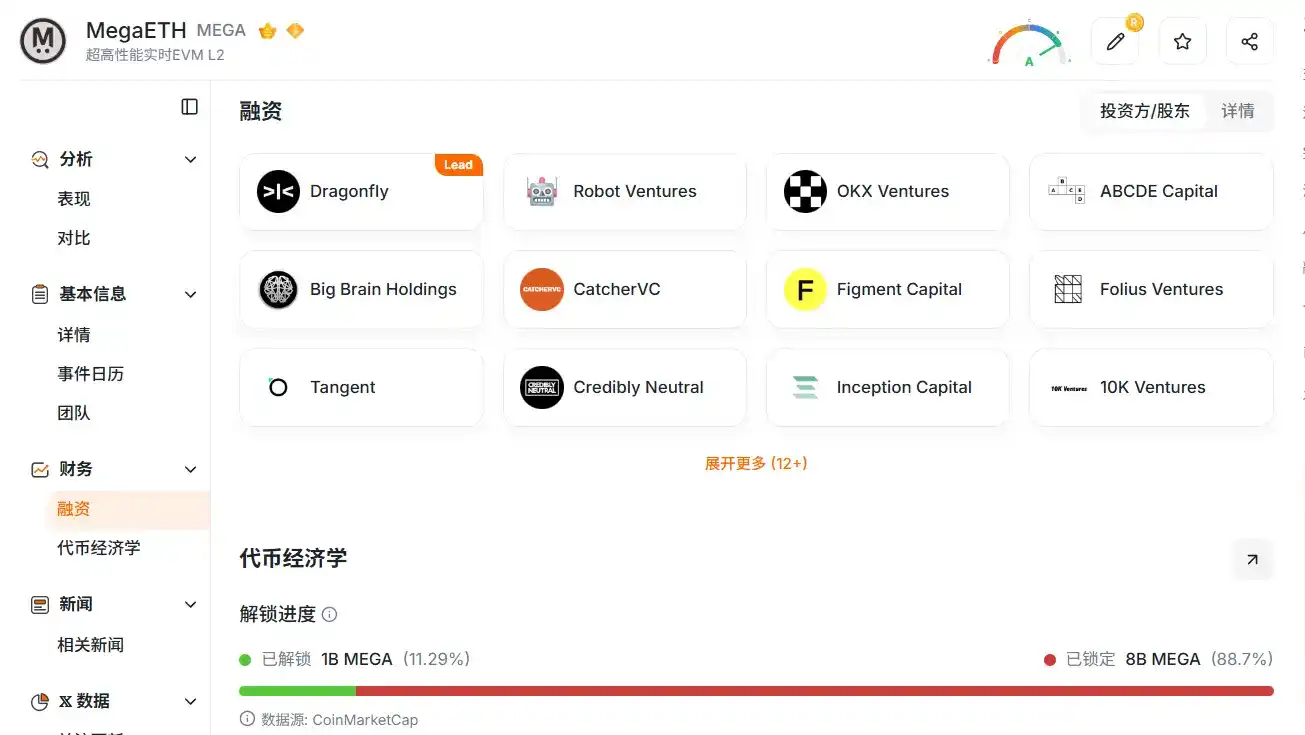
Now, look at how much real usage the current valuation corresponds to. Data shows that the 30-day real revenue of all protocols on MegaETH is less than $900,000, annualized at about $10 million, with only 2,619 daily active addresses.

Averaged per daily active address, MegaETH carries an FDV of about $180,000, while the real protocol revenue contributed by each address in a month is less than $350.

Clearly, its price is not anchored to the current scale of real economic activity, but to the market's imagination of its future. And this expectation is crumbling step by step.
The second layer of mismatch is between token narrative and ecosystem quality

The market buys MEGA, buying the story of a high-performance DeFi public chain. However, looking at the revenue structure, there is a certain degree of contrast.

DefiLlama data shows that the highest-earning protocol on MegaETH is Monster, which is a physical collectible card game, with a 30-day revenue of about $670,000, accounting for nearly eighty percent of the chain's protocol revenue.

Aave, which carries the DeFi narrative and accounted for about ninety percent of the chain's TVL at its peak, had a revenue of only about $90,000 during the same period.

The same misalignment is also reflected in stablecoins. The supply of the native stablecoin USDM on the MegaETH chain is about $460 million, while DEX daily volume is only about $630,000, and perpetual contracts volume per day is only about $120,000. Moreover, this supply is also draining, with USDM's market cap dropping over 26% in the past 7 days, indicating real capital is leaving, even more so than the TVL decline.

A long-term participant@OlricOnlyfornftpointed out that MegaETH once had a very strong community early on, but the team has long been more focused on technology and applications, with insufficient communication with the community. Many promising projects ultimately migrated to other chains. Nowadays, there are not many applications that can be clearly identified as success cases, and only a few are still persisting in building.

This kind of view may not be enough to form a conclusion alone, but it indicates that after the market hype fades, MegaETH still needs clearer application examples to prove the quality of its ecosystem.

The third layer of mismatch lies between short-term expectations and long-term delivery

MegaETH carried excessively high expectations at launch: TGE, blue-chip integration, KOL participation in new listings, TVL surge, all together formed the early valuation anchor. Looking back a few months later, the chain's delivery capability has consistently failed to catch up.

In February of this year, Uniswap deployed v2, v3, and v4 on MegaETH. As of writing, Uniswap's TVL on MegaETH is less than $20,000, evaporating about 97% in the past 7 days. In the last day, Aave V3's TVL once rebounded over 240% in a single day, but over a 7-day period, it still declined over 50%.

The dramatic inflows and outflows of capital precisely indicate that this portion of TVL is driven by arbitrage capital, not stable, settled real demand.

It's worth noting that MEGA's situation is not an isolated case. Another star new public chain highly valued in this cycle, Monad's token MON, has also been declining. MON is currently around $0.022, down more than 50% from its high in November 2025, with a current market cap of about $2.69 billion.
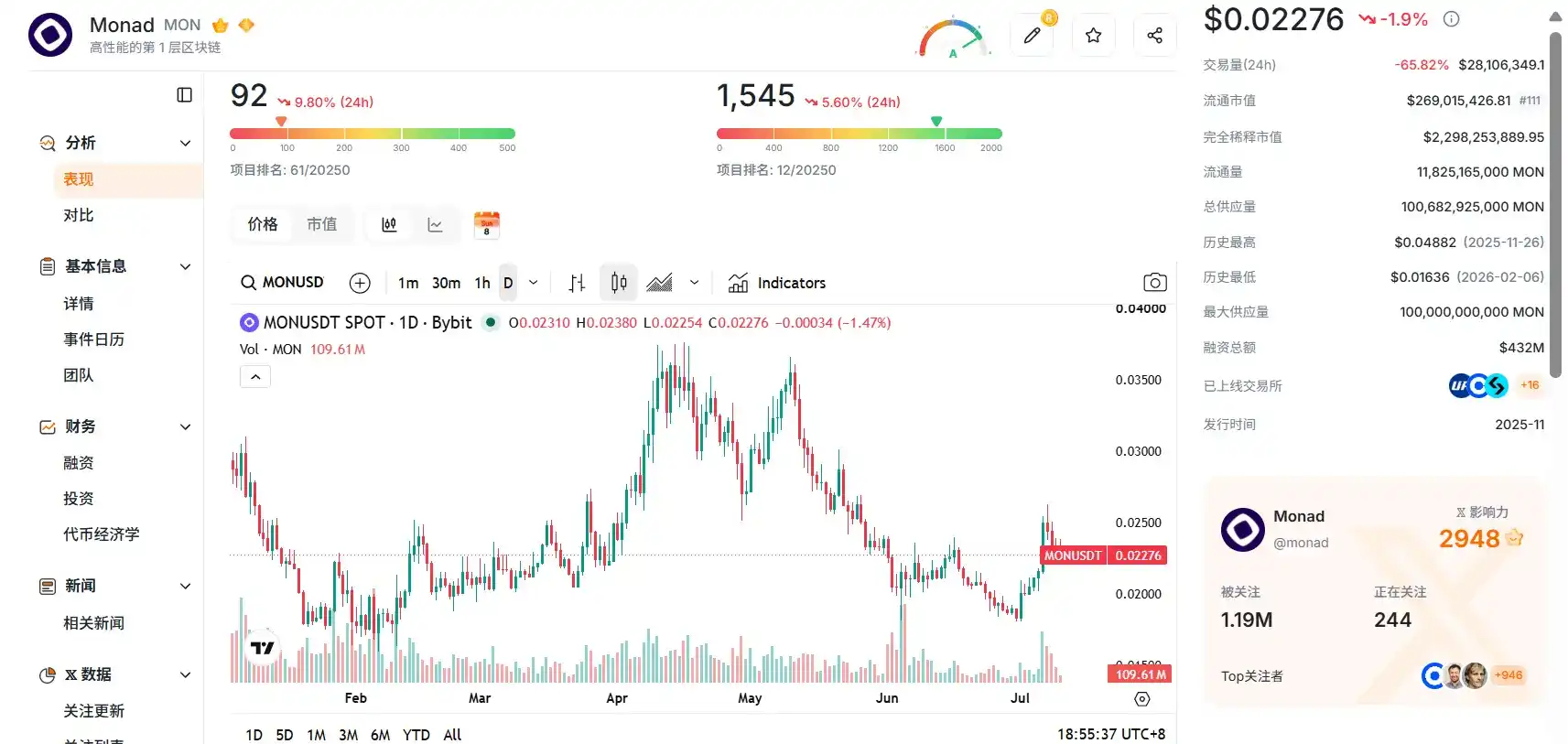
Although Monad's recent TVL has rebounded due to fund inflows into lending protocols, the market reaction has been tepid. This points to the same judgment as MegaETH's situation: when pricing this type of public chain, the market increasingly does not recognize paper TVL but looks at real value support.

In other words, this round of adjustment may not just be MegaETH's single-point slowdown, but more like the market starting to reduce the premium for paper TVL and star narratives,转而 demanding clearer transactions, revenue, and ecosystem capacity as support.

Moreover, competition in the public chain track is still intensifying, with new players including Robinhood continuously entering, continuously diverting market attention and capital.

For MEGA, although the decline has been huge, if a rebound occurs, it is more likely to come from short-term market sentiment repair rather than a genuine improvement in fundamentals.

Paper Prosperity Fades, MEGA is Still Waiting for a Value Anchor Point

Looking at these mismatches together, the conclusion becomes gradually clear.

When the paper prosperity propped up by incentive and arbitrage capital recedes, what is missing between MEGA's current market capitalization and its real on-chain fundamentals is precisely a solid value anchor point.

Market sentiment has also clearly shifted towards caution. One view holds that this is a normal valuation regression after incentive capital recedes. Points incentives stop, the interest rate spread for circular arbitrage disappears, capital leaving is an inevitable result. MegaETH simply leveraged this play higher, hence the exceptionally severe retraction.

At the community level, many users have persistently questioned the team's communication and transparency, pointing out that Discord has closed community discussions, Telegram is only open to users holding large amounts of tokens, and the team's public appearances are far fewer than before the launch.

However, these claims are mostly one-sided user statements and have not been officially confirmed. As of writing, the MegaETH team has not publicly responded to the relevant criticisms.

For MEGA, whether it is viewed as still in the process of returning to fundamentals or having already fallen into a significant mismatch between valuation and fundamentals, the follow-up focus falls on the same thing: whether the team can convert short-term liquidity into real usage and turn the massive funds previously raised into tangible ecosystem results.

Before these deliveries appear, aside from short-term rebounds driven by market sentiment, it seems there isno other solid reason yet seen for the valuation to firmly stabilize again.


Cryptos en tendance

Questions liées

QWhat major event triggered the sharp decline in MegaETH's Total Value Locked (TVL) and price?

AThe sharp decline was triggered by a massive withdrawal of liquidity, where the leading on-chain protocol Aave V3 pulled out 80% of its liquidity from MegaETH in a single day. This led to a 60% drop in TVL within 24 hours, causing the MEGA token price to fall significantly.

QAccording to the article, what are the three main mismatches affecting MegaETH's valuation?

AThe three main mismatches are: 1) Between valuation and real usage, where the FDV is high but real protocol revenue and active addresses are low. 2) Between token narrative and ecosystem quality, where the top revenue-generating protocol is a card game, not a DeFi application. 3) Between short-term hype and long-term delivery, as initial high expectations from integrations like Uniswap and Aave have not translated into sustained, stable TVL and usage.

QWhy was MegaETH's TVL considered fragile and unsustainable, according to risk assessments?

ARisk assessments considered the TVL fragile because it was highly dependent on a single protocol (Aave) and specific assets (USDm and USDe). Furthermore, a significant portion of the TVL was believed to be driven by leveraged cyclical arbitrage strategies involving Ethena's stablecoin, rather than stable, long-term user demand.

QHow does MegaETH's current situation reflect a broader trend in the market's evaluation of new Layer 1 blockchains?

AIt reflects a market trend where investors are becoming less willing to pay a premium based solely on high TVL numbers or 'star project' narratives. Instead, the market is increasingly demanding clearer evidence of real transaction volume, protocol revenue, and sustainable ecosystem growth as the foundation for valuation, as seen with similar chains like Monad.

QWhat does the article suggest is needed for MegaETH's valuation to find a stable footing in the future?

AThe article suggests that MegaETH's team needs to convert the short-term, incentive-driven liquidity into genuine, sustained usage. They must deliver on their promised ecosystem developments with the funds raised and build real value-adding applications. Until such tangible results are achieved, any price recovery is likely to be driven only by short-term market sentiment, not fundamental improvement.

Lectures associées

L'affaire de divorce de Chey Tae-won finalisée : Révélations sur les lignes cachées de succession derrière le conglomérat de mille milliards de SK Hynix

L'affaire de divorce de Chey Tae-won, président du groupe SK, s'est conclue par un jugement historique, mettant en lumière les complexités successorales derrière le géant SK Hynix, dont la valorisation a dépassé 1 000 billions de wons. Contrairement aux scénarios traditionnels de succession des chaebols sud-coréens, qui privilégient l'aîné masculin, les trois enfants de Chey Tae-won suivent des trajectoires distinctes et modernes. L'aînée, Chey Yun-jeong, considérée comme la successeure la plus probable, occupe un poste de direction au sein de SK Inc. et dirige des projets stratégiques dans la biopharmacie, alliant formation scientifique et compétences en consulting. La seconde fille, Chey Min-jeong, ancienne officière de marine et ex-employée de SK Hynix aux États-Unis, a fondé une startup dans la santé numérique et épousé un ancien officier du Corps des Marines américain, incarnant les dimensions géopolitiques de l'industrie des semi-conducteurs. Le fils cadet, Chey In-geon, bien que suivant un parcours académique et professionnel classique (Brown University, McKinsey), reste discret et ne détient aucun rôle opérationnel visible au sein du groupe. Leur héritage est marqué par le divorce très médiatisé et coûteux de leurs parents, mais aussi par la transformation de SK Hynix en un acteur mondial de l'ère de l'IA. La succession ne se résume plus à une simple transmission d'actions ou de titre ; elle exige des héritiers qu'ils prouvent leurs compétences dans un paysage où la technologie, la politique internationale et l'innovation disruptive redéfinissent les règles du pouvoir.

marsbitIl y a 12 h

L'affaire de divorce de Chey Tae-won finalisée : Révélations sur les lignes cachées de succession derrière le conglomérat de mille milliards de SK Hynix

marsbitIl y a 12 h

2 mois pour passer de 8,8 à 68 milliards d'euros d'évaluation ! La plus grande plateforme de transit d'IA, OpenRouter, sur le point d'être rachetée

**Résumé en français :** Stripe, le géant du paiement en ligne, négocierait l'acquisition d'OpenRouter, une place de marché et couche d'IA de type "routeur" ou "agrégateur", pour près de 100 milliards de dollars. Cette valorisation représente une multiplication par près de sept par rapport à l'évaluation d'OpenRouter il y a deux mois (13 milliards de dollars). Fondée en 2023 par Alex Atallah (cofondateur d'OpenSea), OpenRouter agit comme un intermédiaire crucial pour les développeurs d'applications d'IA. Sa plateforme permet d'accéder via une seule API à plus de 400 grands modèles de langage (comme GPT, Claude, et de nombreux modèles open source) et choisit automatiquement le modèle le plus adapté à chaque tâche en fonction du coût, des performances et de la vitesse. Cela permet aux applications en aval de réduire leurs factures de "réflexion" (inference) sans que l'utilisateur final ne voie la différence. Pour Stripe, cette acquisition stratégique s'inscrit dans une volonté de devenir l'infrastructure de paiement et de gestion de la consommation pour l'économie de l'IA. Fin 2025, Stripe avait déjà acquis Metronome, une plateforme de facturation à l'usage pour l'IA. En combinant OpenRouter (choix du modèle) et Metronome (facturation précise), Stripe cherche à offrir une solution intégrée pour le routage, la mesure et le paiement de la consommation d'IA, consolidant ainsi son rôle de "caisse" et de "centre de régulation" de cette nouvelle économie.

链捕手Il y a 12 h

2 mois pour passer de 8,8 à 68 milliards d'euros d'évaluation ! La plus grande plateforme de transit d'IA, OpenRouter, sur le point d'être rachetée

链捕手Il y a 12 h

D'OpenSea à OpenRouter : le scénario de la « sortie en haut de cycle » d'Alex Atallah se répète ?

**OpenRouter, la plateforme d'agrégation de modèles d'IA fondée par Alex Atallah, pourrait être rachetée par Stripe pour près de 100 milliards de dollars**, selon le Wall Street Journal. Cette transaction potentielle, si elle se concrétise, marquerait le deuxième succès d'Atallah à construire une entreprise valorisée à des dizaines de milliards, après avoir cofondé la place de marché NFT OpenSea. OpenRouter, décrit comme le "Stripe de l'IA", sert de point d'accès unifié à plus de 400 modèles d'IA pour environ 10 millions d'utilisateurs. Sa croissance a été fulgurante, passant d'une valorisation de 1,3 milliard de dollars en mars 2026 à une évaluation potentielle de 100 milliards aujourd'hui. L'article souligne un parallèle avec le parcours d'Atallah chez OpenSea, qu'il a quittée avant le refroidissement du marché NFT. Aujourd'hui, face à une concurrence croissante dans l'agrégation de modèles d'IA et à une activité essentiellement basée sur des frais de plateforme (5-5,5%), la vente à un géant comme Stripe pourrait apparaître comme un choix stratégique pour "sortir au sommet". La valeur réelle d'OpenRouter pour un acquéreur résiderait moins dans ses revenus actuels que dans les vastes quantités de données d'utilisation réelle de l'IA qu'elle a accumulées. Ces informations sur les performances, les préférences des développeurs et la dynamique du marché sont un atout unique. La transaction, si elle aboutit, pose la question : s'agit-il d'une juste reconnaissance de la valeur des infrastructures d'IA ou d'un possible signal de sommet pour le secteur ?

链捕手Il y a 13 h

D'OpenSea à OpenRouter : le scénario de la « sortie en haut de cycle » d'Alex Atallah se répète ?

链捕手Il y a 13 h

Trading

Spot

Articles tendance

Comment acheter AAVE

Bienvenue sur HTX.com ! Nous vous permettons d'acheter Aave Protocol (AAVE) de manière simple et pratique. Suivez notre guide étape par étape pour commencer votre parcours crypto.Étape 1 : Création de votre compte HTXUtilisez votre adresse e-mail ou votre numéro de téléphone pour ouvrir un compte sur HTX gratuitement. L'inscription se fait en toute simplicité et débloque toutes les fonctionnalités.Créer mon compteÉtape 2 : Choix du mode de paiement (rubrique Acheter des cryptosCarte de crédit/débit : utilisez votre carte Visa ou Mastercard pour acheter instantanément Aave Protocol (AAVE).Solde :utilisez les fonds du solde de votre compte HTX pour trader en toute simplicité.Prestataire tiers :pour accroître la commodité d'utilisation, nous avons ajouté des modes de paiement populaires tels que Google Pay et Apple Pay.P2P :tradez directement avec d'autres utilisateurs sur HTX.OTC (de gré à gré) : nous offrons des services personnalisés et des taux de change compétitifs aux traders.Étape 3 : stockage de vos Aave Protocol (AAVE)Après avoir acheté vos Aave Protocol (AAVE), stockez-les sur votre compte HTX. Vous pouvez également les envoyer ailleurs via un transfert sur la blockchain ou les utiliser pour trader d'autres cryptos.Étape 4 : tradez des Aave Protocol (AAVE)Tradez facilement Aave Protocol (AAVE) sur le marché Spot de HTX. Il vous suffit d'accéder à votre compte, de sélectionner la paire de trading, d'exécuter vos trades et de les suivre en temps réel. Nous offrons une expérience conviviale aux débutants comme aux traders chevronnés.

493 vues totalesPublié le 2024.12.11Mis à jour le 2026.06.02

Comment acheter AAVE

Discussions

Bienvenue dans la Communauté HTX. Ici, vous pouvez vous tenir informé(e) des derniers développements de la plateforme et accéder à des analyses de marché professionnelles. Les opinions des utilisateurs sur le prix de AAVE (AAVE) sont présentées ci-dessous.

活动图片