Crypto market’s weekly winners and losers – DEXE, LIT, BONK, JUP

ambcryptoPublié le 2026-07-12Dernière mise à jour le 2026-07-12

Résumé

This week's crypto market was driven by macro events, with Bitcoin showing resilience above $63,000. The top weekly gainers were primarily protocol-based altcoins. DeXe (DEXE) surged 73%, approaching key resistance, though signs of exhaustion emerged. Arbitrum (ARB) gained 20%, nearing a crucial technical barrier. Lighter (LIT) rose 5%, breaking above a key resistance level. Major speculative assets led the losers. Bonk (BONK) fell 18%, erasing last week's gains and hitting a new low. Audiera (BEAT) dropped 12%, testing a vital support zone. Jupiter (JUP) declined over 10% but maintained its broader uptrend structure. The week highlighted a rotation toward fundamentally stronger projects amid ongoing volatility.

This week, macro events drove the crypto market.

Renewed geopolitical tensions in the Middle East triggered a brief risk-off move, sending Bitcoin [BTC] and altcoins lower before BTC recovered and held above the $63,000 support level, highlighting its resilience.

Against this backdrop, protocol-based altcoins dominated the winners’ list with strong double-digit rallies, while most of the week’s biggest losers came from speculative assets, reflecting a clear rotation toward fundamentally stronger projects.

Weekly winners

How did DeXe [DEXE] reinforce its bullish structure?

DeXe [DEXE] led this week’s gainers with a massive 73% rally, marking its strongest weekly performance on record. The move reflects strong investor demand for decentralized governance protocols despite mixed sentiment across the broader crypto market.

From a technical perspective, DEXE is now approaching the $50 resistance level, putting another breakout within reach. However, the rally is also beginning to flash signs of exhaustion. At press time, the RSI has pushed deep into overbought territory, suggesting buyers may be getting stretched.

At the same time, DEXE has gained 73% in less than four trading days, highlighting an aggressive buying spree that often precedes a period of cooling. With the broader market turning risk-off again as geopolitical tensions weigh on sentiment, short-term profit-taking could increase.
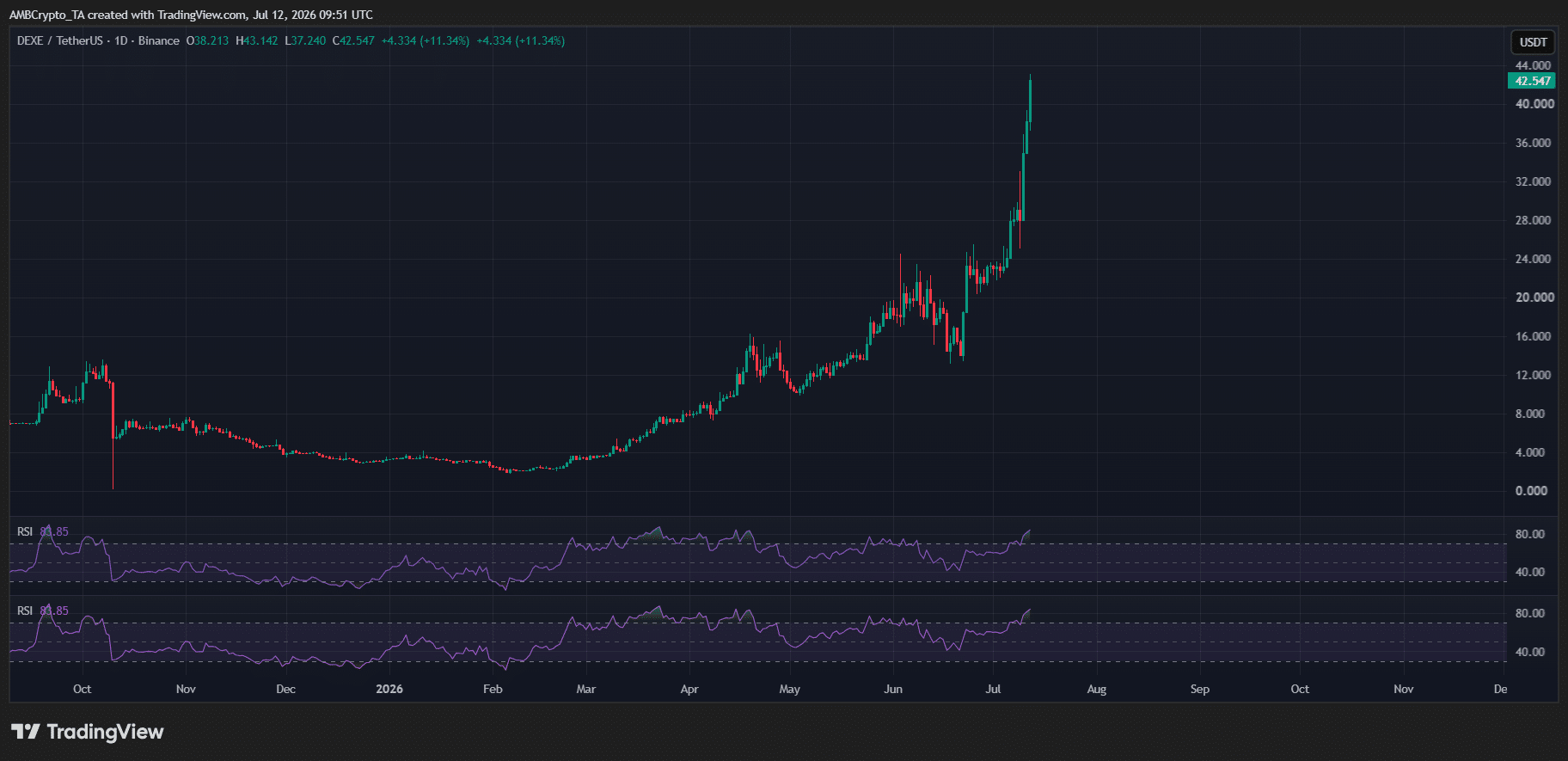
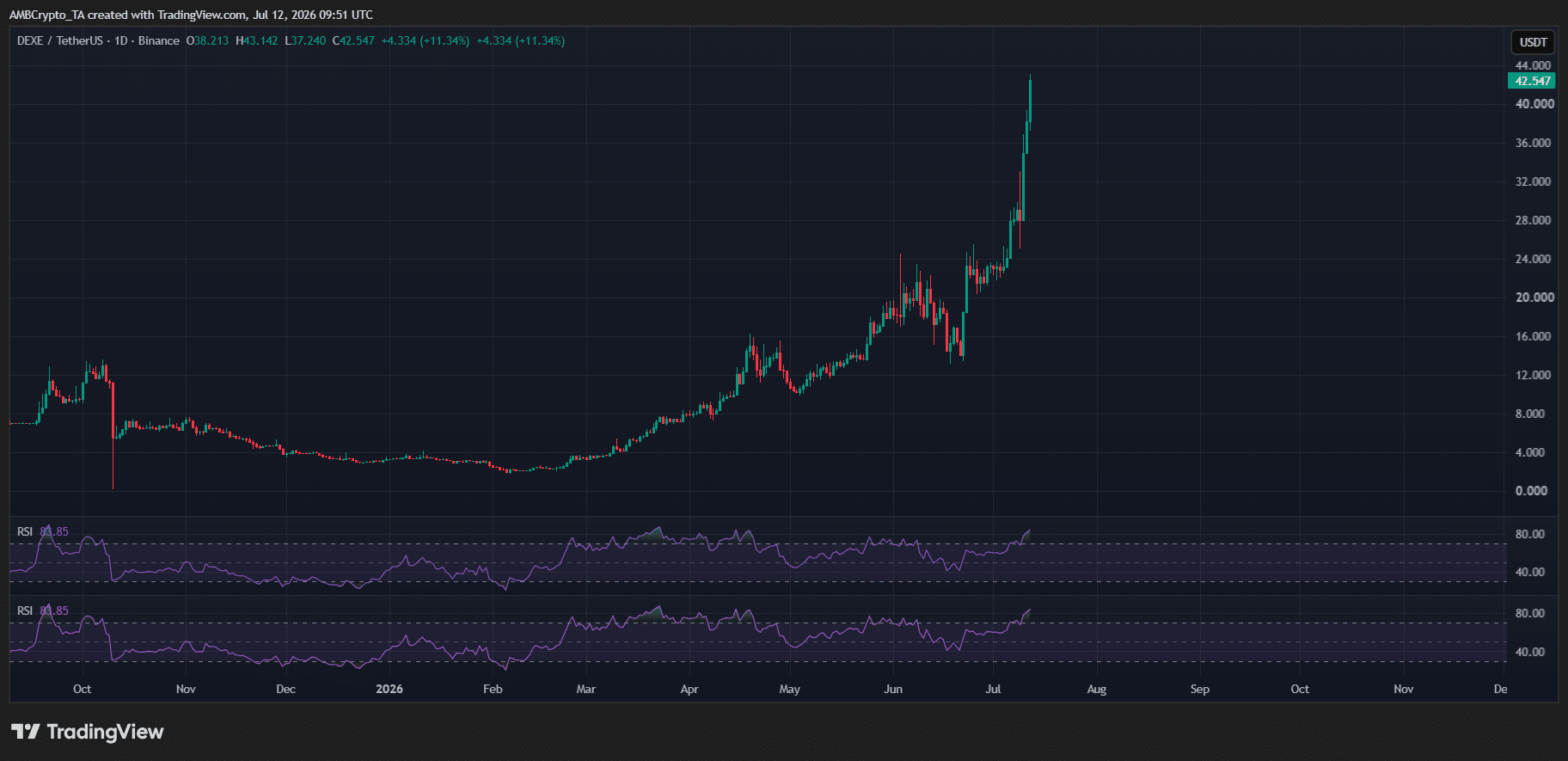
Source: TradingView (DEXE/USDT)

If that happens, $35 is the first key support level to watch. However, if buyers continue to absorb selling pressure, DEXE could still break above $50 and extend its rally.

Overall, DEXE enters the week with strong momentum but elevated risk as technicals become overextended.

Arbitrum [ARB] is approaching a KEY resistance zone

Arbitrum [ARB] was the second-biggest gainer this week, climbing 20% after posting an 8% rally the week before. The back-to-back gains suggest buyers are steadily taking control, with bullish momentum continuing to build. Technically, ARB still doesn’t look overheated.

Despite the strong move, the weekly RSI remains below overbought territory, suggesting there is still room for the rally to extend. The daily chart also continues to print higher highs, showing buyers remain in control. The next key level to watch is the $0.10 resistance zone. ARB hasn’t reclaimed this level since losing it during the late May correction, making it an important technical barrier.

If buying pressure continues at its current pace, a breakout above $0.10 looks increasingly likely. That would open the door for another leg higher, making ARB one of the stronger technical setups to watch this week.

Lighter [LIT] continues to outrun bearish control

Lighter [LIT] secured the third spot among this week’s top gainers with a 5% rally. While the gain was smaller than the week’s biggest winners, it suggests LIT has continued to hold onto its recent strength.

Technically, the more important development is that LIT has broken above the $2.70 resistance level. This comes after the token rallied more than 50% over the past two weeks, showing buyers are still willing to accumulate even after a strong uptrend.

The successful reclaim of resistance also shifts market sentiment in favor of the bulls. If buying pressure continues, the breakout could attract fresh momentum traders, increasing the chances of a move toward $3.

Other notable winners

Outside the majors, altcoin movers also stole the spotlight this week.

TCC [TCC] led the market with a staggering 66,301% gain, followed by Cash Cat [CASHCAT], which surged 3,928%, while Yei Finance [CLO] climbed 76%, rounding out the week’s top performers.

Weekly losers

How did Bonk [BONK] erase its previous week’s gains?

Bonk [BONK] led this week’s losers with an 18% decline, completely wiping out last week’s 18.6% rally. The move is another reminder of the sharp swings that are common across the meme coin sector.

What’s interesting is that the sell-off came despite 110 million BONK being burned this week. That suggests the token burn wasn’t enough to shift sentiment. Technically too, BONK looks weak. The weekly chart has been printing lower lows since the mid-Q3 2025 cycle, showing the broader downtrend remains intact.

Even though the RSI was deep in oversold territory as of writing, buyers have yet to step in with enough conviction to reverse the trend. This week’s decline also pushed BONK to a new all-time low around $0.0000039, reinforcing the bearish structure.
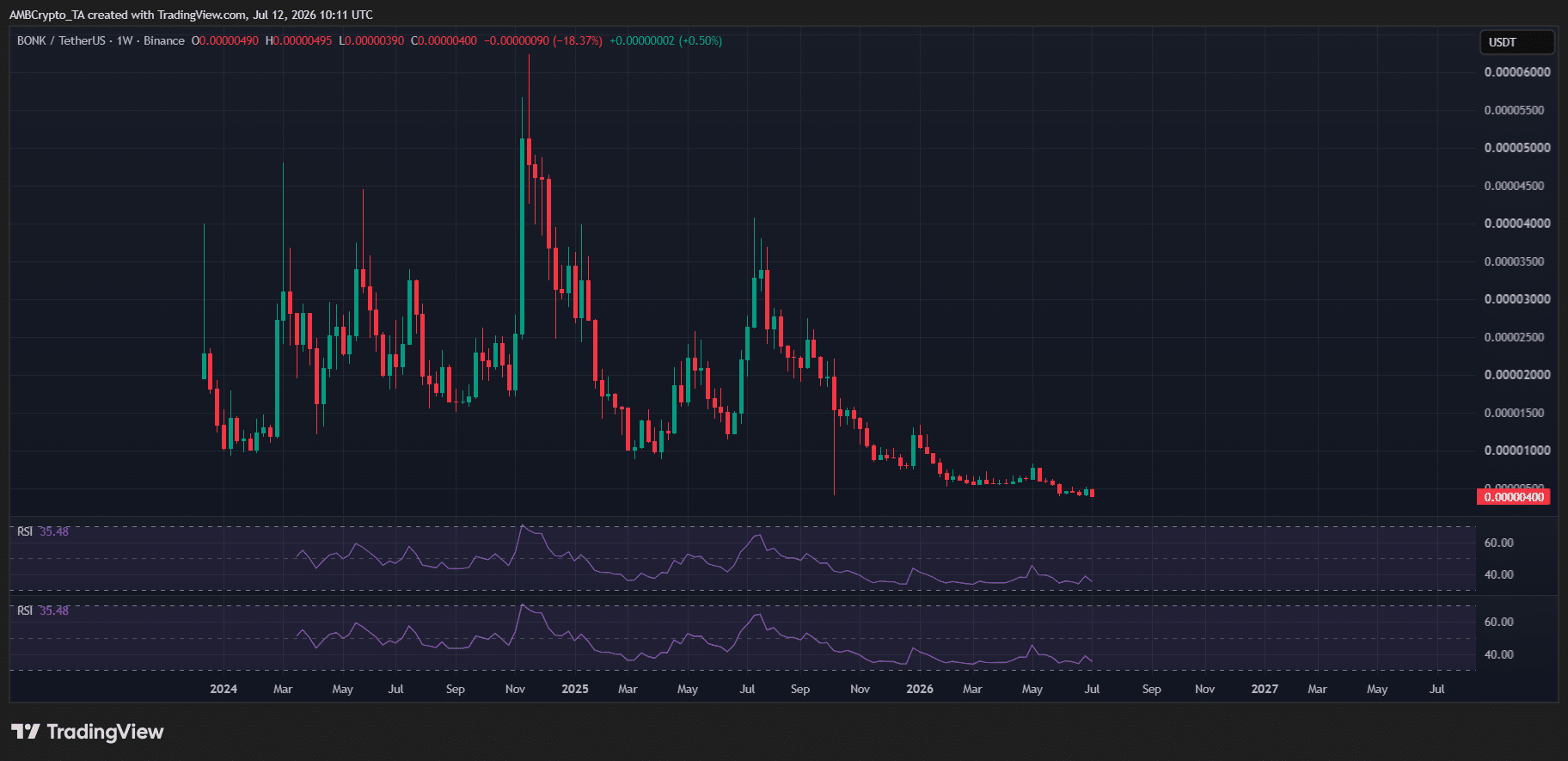
Source: TradingView (BONK/USDT)

Unless market sentiment improves or buyers reclaim key resistance levels, BONK is likely to remain under pressure, making it one of the weaker technical setups heading into next week.

Audiera [BEAT] is testing the strength of a KEY support

Audiera [BEAT] was the second-biggest loser this week, dropping 12% after posting two straight weeks of gains. Despite the pullback, BEAT is still holding above levels it reclaimed during its recent breakout, suggesting bulls haven’t lost control just yet.

Technically, the focus is now on the $2.00–$2.50 support zone. Since mid-May, buyers have consistently stepped in around this area, triggering several weekly rebounds and keeping the broader uptrend intact. That makes this week’s decline look more like a cooldown than a trend reversal.

If bulls defend support once again, BEAT could build enough momentum for another run at the $3.50 resistance. A successful breakout above that level would confirm another higher high and keep BEAT among the stronger bullish setups to watch next week.

Why did Jupiter [JUP] post its weakest weekly rally in over a month?

Jupiter [JUP] was the third-biggest loser this week, falling just over 10%. The pullback came after numerous weeks of gains and pushed the token back below the $0.25 resistance level.

Technically, though, the trend still favors the bulls. JUP continues to hold a pattern of higher highs and higher lows, suggesting the broader uptrend remains intact. The next key level to watch is $0.20, where buyers have consistently stepped in during previous pullbacks.

That puts JUP in a healthy consolidation phase rather than a full trend reversal. If bulls continue to defend support, the current pullback could provide the base for another move higher.

A reclaim of $0.25 would strengthen the bullish structure and increase the chances of another breakout, making JUP one of the key altcoins to watch heading into next week.

Other notable losers

In the broader market, downside volatility hit hard.

LAB [LAB] led the losers with a 96% decline, followed by ETHGas [GWEI], which fell 54%, while BUILDon [B] dropped 47.7% as bearish momentum intensified.

Conclusion

This week was a rollercoaster for crypto. Big pumps, sharp dips, and nonstop action. As always, stay sharp, do your own research, and trade smart.


Final Summary

  • DeXe [DEXE], Arbitrum [ARB], and Lighter [LIT] led the week in gains.
  • Bonk [BONK], Audiera [BEAT], and Jupiter [JUP] saw significant declines.

Cryptos en tendance

Questions liées

QWhat are the main macroeconomic factors mentioned in the article that impacted the crypto market this week?

ARenewed geopolitical tensions in the Middle East triggered a brief risk-off move, which initially sent Bitcoin and altcoins lower before Bitcoin recovered.

QAccording to the article, what was the technical indicator suggesting that DeXe's (DEXE) rally might be due for a cool-down period?

AThe RSI (Relative Strength Index) had pushed deep into overbought territory, suggesting buyers may be getting stretched and that short-term profit-taking could increase.

QWhich token led the week's losers, and what key event failed to shift its negative sentiment?

ABonk (BONK) led the week's losers with an 18% decline. The negative sentiment continued despite 110 million BONK being burned, which wasn't enough to shift market dynamics.

QFor Arbitrum (ARB), what is identified as the next key resistance level to watch for a potential breakout?

AThe next key resistance level for Arbitrum (ARB) is the $0.10 zone. ARB hasn't reclaimed this level since losing it in the late May correction.

QWhat general market trend does the article describe regarding the types of altcoins that dominated the winners' list versus the losers' list?

AProtocol-based altcoins with strong fundamentals dominated the winners' list, while most of the week's biggest losers came from speculative assets (like meme coins), reflecting a clear rotation toward fundamentally stronger projects.

Lectures associées

Le modèle MicroStrategy en difficulté ? Un imitateur détenant 30 000 bitcoins voit ses investisseurs se désister en masse avant son introduction en bourse

**Titre :** Le modèle de stratégie bitcoiné en difficulté ? Les investisseurs se retirent avant l'introduction en bourse d'un imitateur détenant 30 000 bitcoins **Résumé :** BSTR Holdings, une société trésorerie bitcoin fondée par Adam Back de Blockstream, a annulé son projet de fusion avec la SPAC Cantor Equity Partners I (CEPO) et le financement privé (PIPE) associé, qui devait lui apporter jusqu'à 15 milliards de dollars et 30 021 bitcoins pour son introduction en bourse. Le report indéfini de l'opération, due aux conditions de marché défavorables, met en lumière les difficultés du modèle d'entreprise "accumulatrice de bitcoin". Ce modèle, popularisé par MicroStrategy, repose sur une prime boursière (mNAV) permettant d'émettre des actions au-dessus de la valeur des bitcoins détenus pour en acheter davantage. Avec la chute du bitcoin (environ 64 000 $, loin des sommets de 126 000 $), cette prime s'est érodée ou a disparu pour plusieurs sociétés du secteur, rendant le mécanisme de financement inopérant. Le secteur est sous pression, comme le montrent les difficultés d'American Bitcoin ou de Metaplanet. L'avenir du modèle pour BSTR et ses pairs dépendra des nouveaux termes négociés, qui devront être détaillés dans un prochain dépôt à la SEC.

marsbitIl y a 4 mins

Le modèle MicroStrategy en difficulté ? Un imitateur détenant 30 000 bitcoins voit ses investisseurs se désister en masse avant son introduction en bourse

marsbitIl y a 4 mins

Qingyan Jingzhun lève plusieurs centaines de millions de yuans, le fonds national de l'équipement industriel investit

La société chinoise Qingyan Precision a clôturé sa série de financement de série B en levant des milliards de yuans en juin, attirant des investisseurs industriels majeurs. Le tour B2 a été dirigé par Xingyuan Capital avec la participation de FAW Fusheng, suivi du tour B3 dirigé par BAIC Capital avec la participation de Yulon Group. Le fonds d'État China National Machinery Industry Fund a également rejoint. Ce consortium, comprenant six constructeurs automobiles, reflète la reconnaissance de l'écosystème automobile pour la plateforme d'ingénierie d'IA physique et le système de test de Qingyan Precision. L'investissement démontre un changement de logique du marché : le capital mise désormais sur les infrastructures d'IA physique ayant une capacité d'industrialisation dans des scénarios industriels réels, aligné avec le plan gouvernemental "Action spéciale pour la formation en situation réelle des robots humanoïdes et de l'intelligence incarnée" lancé en juin 2026. Fondée en 2018 par Dong Han, docteur de l'Université Tsinghua, Qingyan Precision a évolué d'un spécialiste des tests pour véhicules neufs énergétiques vers un fournisseur de plateforme d'ingénierie d'IA physique pour l'intelligence incarnée industrielle. L'entreprise dispose de plus de 2000 points de perception déployés sur site. Sa pipeline de données multimodales TsingLoop transforme les données brutes en actifs standardisés, alimentant un système de test en boucle fermée "Robot-in-the-Loop" qui connecte simulation et environnement réel pour valider et optimiser les performances des robots. Avec une équipe de direction combinant expertise de Tsinghua, de Stanford et d'industriels chevronnés, Qingyan Precision construit une "base de données physique" visant "une plateforme, un cerveau, des centaines d'applications scénarisées". Positionnée comme un acteur clé de l'infrastructure, elle fournit les capacités nécessaires pour déployer l'intelligence incarnée dans des environnements industriels complexes.

marsbitIl y a 1 h

Qingyan Jingzhun lève plusieurs centaines de millions de yuans, le fonds national de l'équipement industriel investit

marsbitIl y a 1 h

Trading

Spot

Articles tendance

Comment acheter JUP

Bienvenue sur HTX.com ! Nous vous permettons d'acheter Jupiter (JUP) de manière simple et pratique. Suivez notre guide étape par étape pour commencer votre parcours crypto.Étape 1 : Création de votre compte HTXUtilisez votre adresse e-mail ou votre numéro de téléphone pour ouvrir un compte sur HTX gratuitement. L'inscription se fait en toute simplicité et débloque toutes les fonctionnalités.Créer mon compteÉtape 2 : Choix du mode de paiement (rubrique Acheter des cryptosCarte de crédit/débit : utilisez votre carte Visa ou Mastercard pour acheter instantanément Jupiter (JUP).Solde :utilisez les fonds du solde de votre compte HTX pour trader en toute simplicité.Prestataire tiers :pour accroître la commodité d'utilisation, nous avons ajouté des modes de paiement populaires tels que Google Pay et Apple Pay.P2P :tradez directement avec d'autres utilisateurs sur HTX.OTC (de gré à gré) : nous offrons des services personnalisés et des taux de change compétitifs aux traders.Étape 3 : stockage de vos Jupiter (JUP)Après avoir acheté vos Jupiter (JUP), stockez-les sur votre compte HTX. Vous pouvez également les envoyer ailleurs via un transfert sur la blockchain ou les utiliser pour trader d'autres cryptos.Étape 4 : tradez des Jupiter (JUP)Tradez facilement Jupiter (JUP) sur le marché Spot de HTX. Il vous suffit d'accéder à votre compte, de sélectionner la paire de trading, d'exécuter vos trades et de les suivre en temps réel. Nous offrons une expérience conviviale aux débutants comme aux traders chevronnés.

245 vues totalesPublié le 2024.12.12Mis à jour le 2026.06.02

Comment acheter JUP

Discussions

Bienvenue dans la Communauté HTX. Ici, vous pouvez vous tenir informé(e) des derniers développements de la plateforme et accéder à des analyses de marché professionnelles. Les opinions des utilisateurs sur le prix de JUP (JUP) sont présentées ci-dessous.

活动图片