Claude Engineer Finally Unveils Fable 5's Ultimate Strategy, Teaching You How to Bridge the Information Gap with AI Models

marsbitPublié le 2026-07-06Dernière mise à jour le 2026-07-06

Résumé

This article, titled "Claude Engineer Finally Releases Fable 5 'Skill-Burning' Guide, Teaching How to Bridge the Information Gap with Models," details a blog post by Claude Code engineer Thariq Shihipar. The core concept is the "information gap" or "unknowns"—the disconnect between a user's instructions (the "map") and the actual task requirements (the "territory"). The article argues that with powerful models like Claude Fable 5, work quality depends on the user's ability to identify and clarify these unknowns. Shihipar categorizes unknowns into four types: Known Knowns (explicit instructions), Known Unknowns (awareness of gaps), Unknown Knowns (implicit, unstated knowledge), and Unknown Unknowns (unforeseen issues). The blog provides a framework for addressing these gaps throughout the workflow: * **Before Implementation:** Techniques include "Blindspot Scanning" to uncover Unknown Unknowns, brainstorming/prototyping for visual or complex tasks, having Claude ask clarifying questions, using reference code/examples, and creating implementation plans. * **During Implementation:** Maintaining an "implementation notes" file for Claude to document deviations and decisions made due to encountered edge cases. * **After Implementation:** Creating summary documents for review and having Claude generate quizzes to ensure the user fully understands the completed changes. The article concludes that as models become more capable, the key to success is systematically discovering...

The fate of Fable 5 has been as mystifying as its model's name since its release.

From the highly anticipated "AI's Defining Moment" to being forced offline by a U.S. government ban, and then restricting access to non-Americans, it has captivated global attention.

Now, the storm has gradually subsided. Ultimately, models must return to productivity.

To this end, Claude Code engineer Thariq Shihipar published a detailed blog post on social media, outlining techniques for using Fable 5.

This article addresses a long-standing question. With models having evolved to such powerful capabilities, why do I still feel they perform tasks incorrectly when I use them?

Thariq's blog post is an eye-opener. In short: there is an information gap between humans and models, a disparity between the prompts, Skills, and context provided by the user and the actual task execution.

Thus, the entire blog post teaches you how to bridge this information gap. Below, Machine Heart provides the full blog post for our readers.

Blog Title: A Field Guide to Fable: Finding Your Unknowns

Blog Link: https://x.com/trq212/status/2073100352921215386

Working with Claude Fable 5 constantly reminds me of an old adage: the map is not the territory.

The "map" is the representation of the work to be done—my prompts, skills, and context—what I give to Claude. The "territory" is where the work actually needs to happen: the codebase, the real world, and the real constraints within.
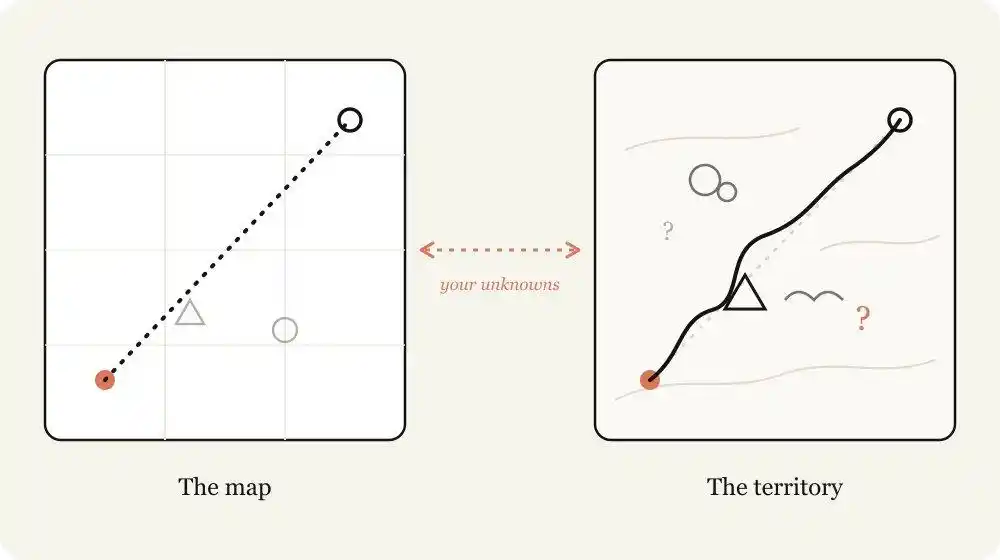
I call the gap between the map and the territory "unknowns." When Claude encounters an unknown, it must make a decision based on its best guess of my intent. The more complex the work, the more unknowns Claude might encounter.

Fable is the first model where I've strongly felt that the bottleneck of work quality depends on my ability to clarify its unknowns.

Importantly, mere upfront planning isn't always enough. You might discover unknowns deep in implementation; you might also find these unknowns point to the fact that you should be solving the problem in a completely different way.

I find that collaborating with Fable is essentially an iterative process of discovering unknowns before, during, and after implementation.

The author provides some examples of discovering "unknowns." Readers are encouraged to review them alongside the full article.
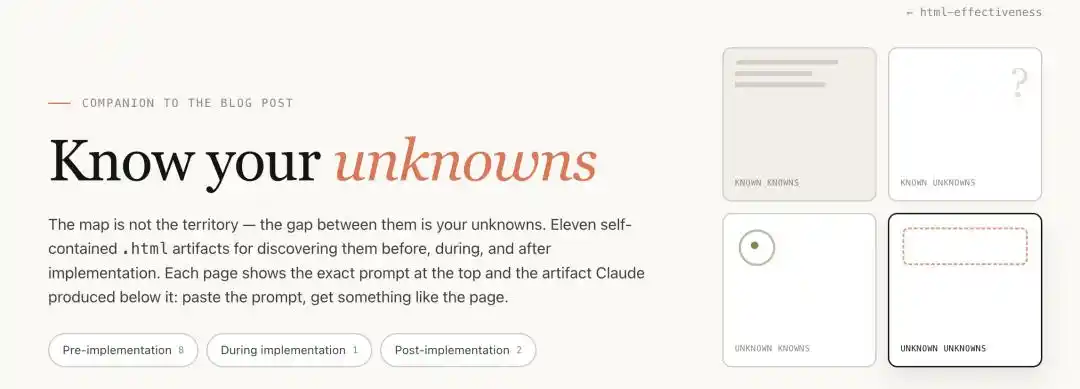
Example Link: https://thariqs.github.io/html-effectiveness/unknowns/

Know Your Unknowns

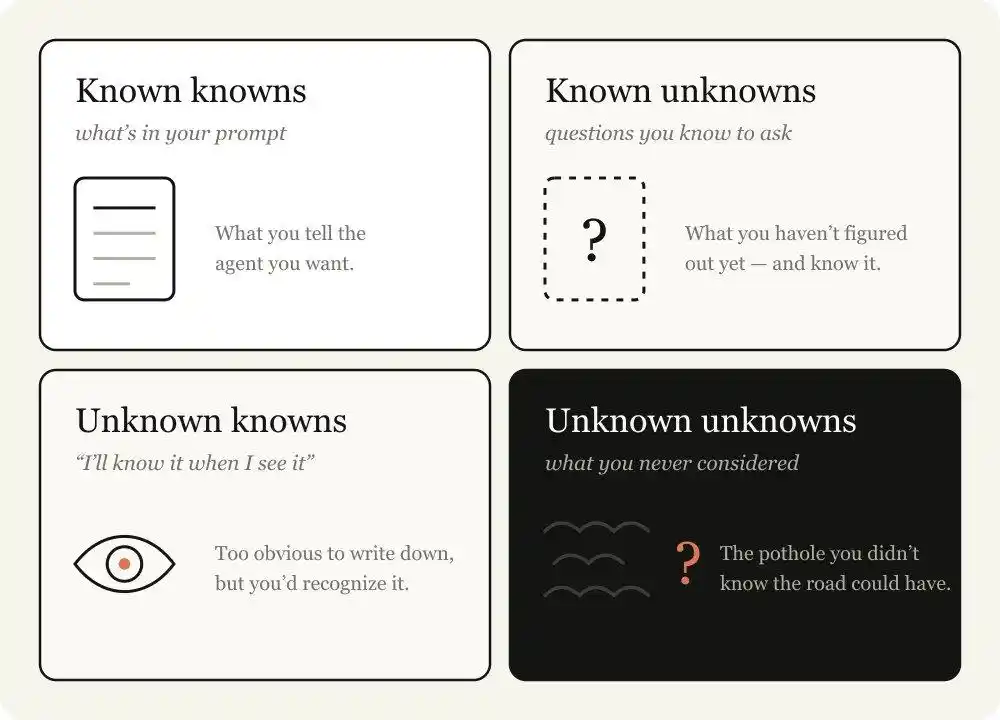
What are unknowns? When I approach Claude with a problem, I typically break it down from four perspectives:

Known knowns: This is basically what I write in the prompt. I tell the agent what I want.

Known unknowns: What things haven't I figured out yet, but I know I haven't figured them out?

Unknown knowns: What things are so obvious to me that I wouldn't even write them down, but I'd recognize them if I saw them?

Unknown unknowns: What things haven't I considered at all? What knowledge do I not yet know I don't know? Do I know how well something can be done?
The most skilled agent-style programmers tend to have relatively fewer unknowns. They know exactly what they want, in great detail. They are highly synchronized with both the codebase and model behavior.

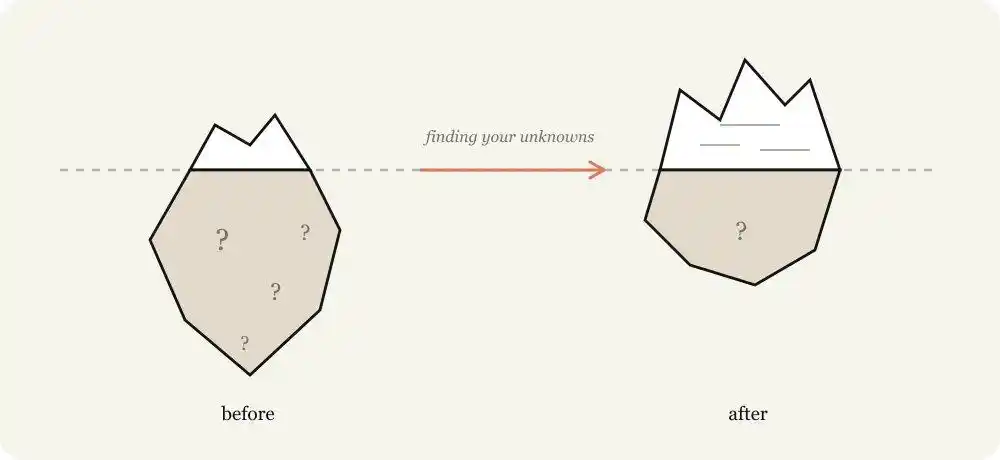
But they also presuppose the existence of unknowns. In many ways, reducing and planning for your unknowns ahead of time is the core skill of agent-style programming. Fortunately, this is a skill that can be honed by collaborating with Claude.

Help Claude Help You
Giving instructions to Claude is a delicate balance. If you're too specific, Claude will follow your instructions strictly, even if pivoting to a different approach might be better. If you're too vague, Claude will often make choices and assumptions based on industry best practices, which may not be right for your task.

Both can fail when you haven't adequately considered your unknowns. You don't know when the road ahead is fraught with obstacles, nor do you know when it's actually smooth, but you still want Claude to make adjustments if necessary.

Claude can help you discover unknowns faster. It can search your codebase and the internet incredibly quickly, and it possesses more general knowledge on most topics than you do. It can also iterate faster from failures.

The most important part of this process is giving Claude enough starting context. For example, tell it what step you're currently thinking about; explain your level of familiarity with the problem and codebase; let it collaborate with you as a thinking partner.

I've previously written about generating HTML with Claude. In almost all those scenarios, the HTML artifact is the best way to visualize and express ideas.

In this article, I'll detail some patterns I use to discover these unknowns. I don't use all these tricks every time, but having them as a toolkit to call upon is incredibly useful.
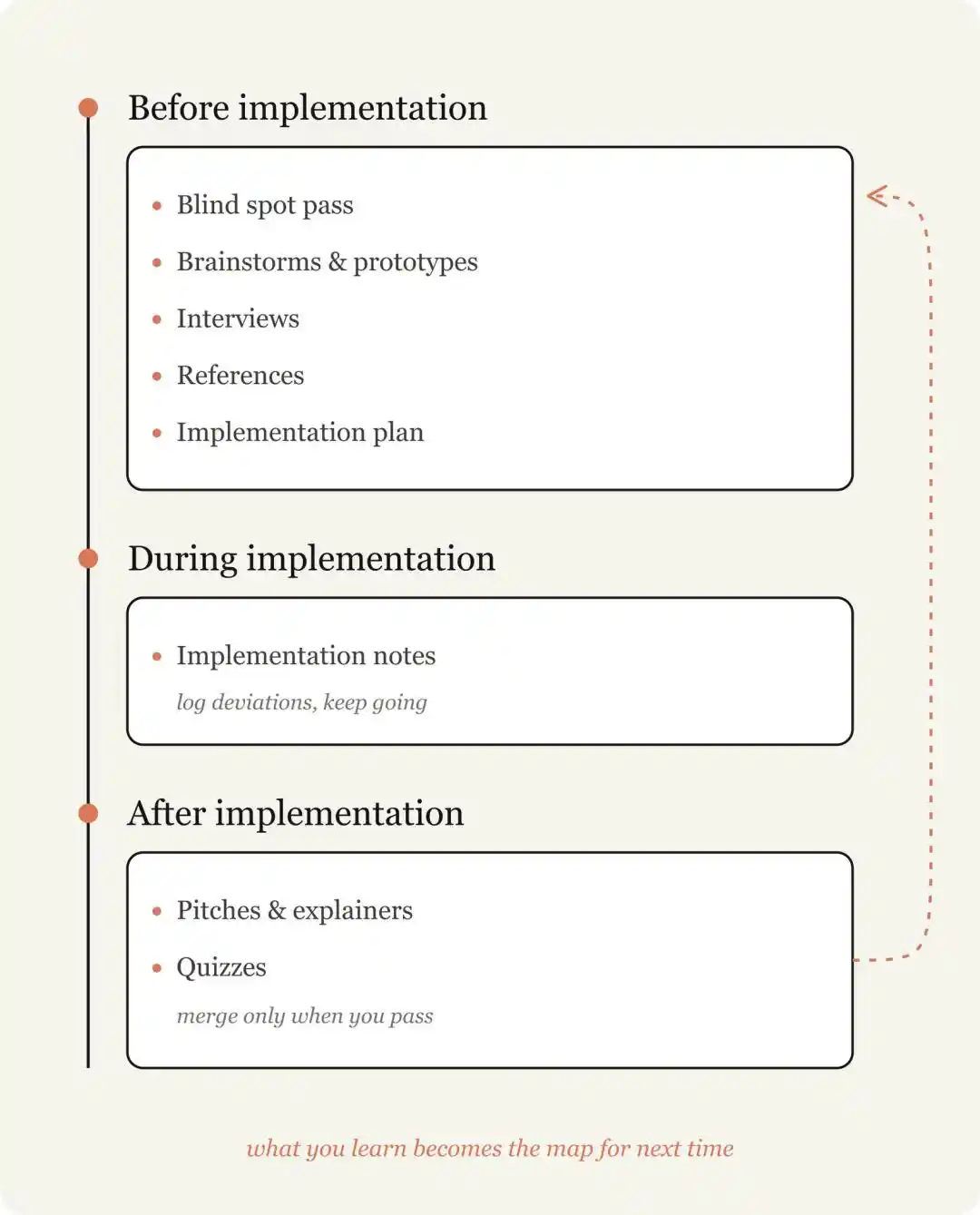
Before Implementation

Blindspot Scan

One of the most useful things when starting work is understanding your blind spots. For example, if you're writing a feature in a new module of the codebase, or having Claude handle a type of work you're unfamiliar with, like iterating on a design, you're likely to have many "unknown unknowns."

You might not know what questions to ask, what constitutes "good," what historical work has been done before, or what pitfalls to avoid.

To do this, you can ask Claude to help find your "unknown unknowns" and explain them. I like to use the terms "blindspot pass" and "unknown unknowns" directly. Usually, it's also important to tell it who you are and what you know.

Example prompts:

"I'm adding a new identity authentication provider, but I know nothing about the auth module in this codebase. Can you do a blindspot pass, help me find relevant unknown unknowns, and assist me in writing better prompts for you?"

"I don't understand color grading, but I need to grade this video. Can you teach me to understand my unknown unknowns about color grading so I can write better prompts?"

Brainstorming & Prototyping

When I'm working in a domain with many "unknown knowns"—things I only know how to define standards for once I see them—I have Claude brainstorm and prototype with me.

Identifying and expressing these "unknown knowns" early in the prototyping stage is valuable because discovering them during implementation often carries a higher relative cost. Small changes in features or specifications can lead to vastly different code implementations, and it's harder to get the agent to backtrack on previous changes.

For example, you might just want to see what adding a button looks like in a certain framework, without actually hooking up the backend routes or maintaining extra frontend state.

Visual design is something I find hard to articulate clearly, but I know what I want when I see it. In such cases, I ask Claude to provide several different design directions for an artifact.

I also start almost every coding session with exploration or brainstorming. This helps me define the project scope with clear intent. Claude often discovers high-value approaches I would have missed, but it can also miss the forest for the trees. Brainstorming prevents me from setting the scope too narrowly or too broadly from the start.

Example prompts:

"I want to make a dashboard for this dataset, but I have no visual taste and don't know what's possible. Help me create an HTML page with 4 vastly different design styles so I can provide feedback based on the results."

"Before wiring anything up, create a standalone HTML file with fake data to simulate the new editor toolbar. I want to give feedback on the layout first before you touch the real app."

"Here's my rough problem: user churn after completing onboarding. Search the codebase and brainstorm 10 places we could intervene, from lowest cost to most ambitious. I'll tell you which directions feel better."

Reverse Interview

After enough brainstorming, I usually still have unknowns.

In such cases, I have Claude interview me around anything unclear or ambiguous. When having Claude interview you, try to provide context about the problem so it can ask more targeted questions. Here are some examples.

Example prompts:

"Please ask me one question at a time, interviewing me around any points of ambiguity. Prioritize questions where my answer would change the architectural design."

Reference Materials

Sometimes, you can't describe in detail what you want. Maybe you lack the language to express it, or it's too complex to describe fully within a reasonable time.

In such cases, the best answer is reference materials. You can provide diagrams, documentation, or images, but the best reference is often source code.

If you have a library that implements a feature in a specific way, or a design component you really like, just point Fable to the corresponding folder and tell it what to look at. Even if the reference code is in another language, that's okay.

This is also how Claude Design works. You don't necessarily have to give it a file, though you can. You can point it to a module on a website you like, and it will read the underlying code, not just a screenshot. This provides richer detail—markup structure, component organization, and how the component is actually built.

Example prompts:

"This Rust crate in vendor/rate-limiter implements exactly the exponential backoff retry behavior I want. Please read it and reimplement the same semantics in our TypeScript API client."

Implementation Plan

When I feel ready to start implementation, I usually have Claude first compile an implementation plan for my review, focusing on parts most likely to change, such as data models, type interfaces, or UX flows. This lets Claude surface areas I might indeed need to adjust ahead of time.

Example prompts:

"Write an implementation plan in HTML, but start by presenting the decision points I'm most likely to change: data model changes, new type interfaces, and any user-facing content. Put mechanical refactoring at the bottom; I trust you can handle that part."

During Implementation

Implementation Notes

When satisfied with the plan, I start a new session and pass the relevant artifacts into the prompt. For example, I might pass a specification file and a prototype, then ask the agent to implement it.

But the truth is, no matter how much you plan, unknown unknowns will always lurk. The agent might discover mid-work that it must take a different approach due to an edge case in the code.

I ask Claude Code to maintain a temporary implementation-notes.md file, or an .html file, to record the decisions it makes, so we can learn from them for the next attempt.

Example prompts:

"Please maintain an implementation-notes.md file. If you encounter an edge case forcing you to deviate from the original plan, choose the conservative option, record the reason under 'Deviations,' and continue."

After Implementation

Pitch & Explanation Documentation
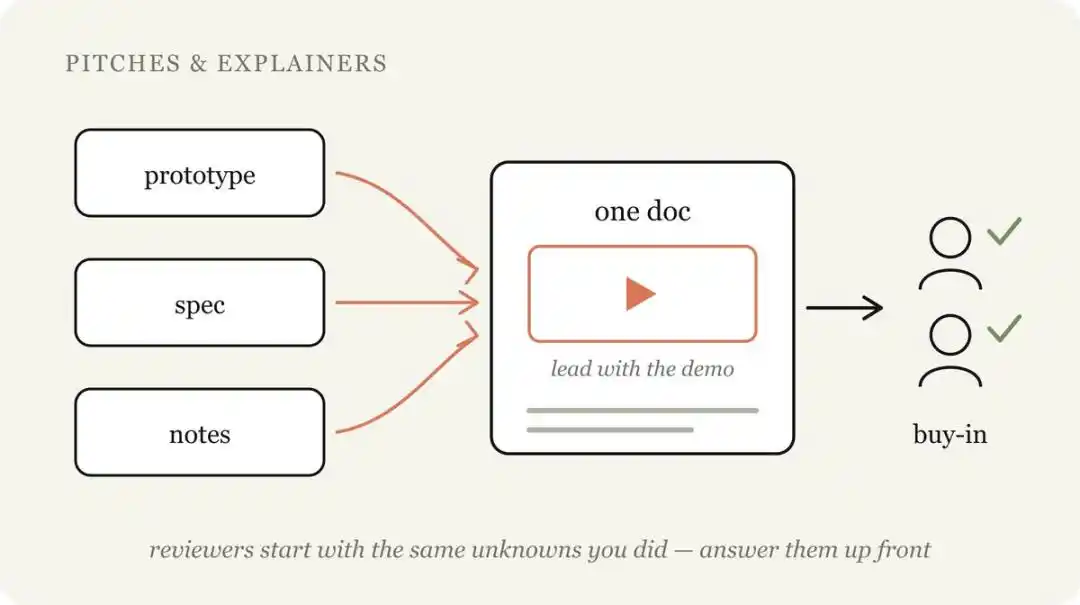
One of the most important things when shipping something is getting others' understanding, support, and approval. Building pitch and explanation artifacts into the final documentation helps:

Accelerate reviewers' understanding when they start with the same unknowns you had.

Accelerate approval from experts when they want to confirm you've considered the unknowns and common failure points they would have foreseen.

Example prompts:

"Package the prototype, spec, and implementation notes into a single document I can directly post on Slack to seek support. Start with a demo GIF."

Quizzes

After a long work session, Claude might have accomplished more than I realize. Just looking at the code diff often gives me only a shallow understanding of what happened, as much behavior depends on existing code paths.

Having Claude test me on the changes after providing substantial context helps me truly understand what occurred. I only merge the code after perfectly passing the quiz.

Example prompts:

"I want to ensure I understand everything that happened in this change. Please give me an HTML report to help me read and understand these changes, including context, intuitive explanations, what was done concretely, etc., and attach a quiz at the bottom that I must pass."

Putting It All Together: The Fable Launch Example

The launch video for Fable was entirely edited by Claude Code. This was a completely new field for me, and I am by no means an expert.

So I started with what I knew. I knew Claude could use code to edit videos and transcribe, but I wasn't sure if its accuracy was sufficient. So I had Claude explain how transcription technologies like Whisper work and whether I could use ffmpeg to accurately cut filler words like "um" or long pauses.

I wanted Claude to create a UI synchronized with my spoken words in time, but I wasn't sure if it could. So I had Claude create a video prototype using Remotion and transcript text to see if the idea was feasible.

Finally, the video itself looked somewhat dark. I knew this was a color grading issue, but I didn't truly understand what color grading was. My first attempt was to have Claude make a few versions for me to choose from, but I realized that when it comes to color grading, I didn't know what "good" was. So, instead of having it generate versions blindly, I had Claude teach me color grading to discover my unknowns.

Matching the Map to the Territory

The more powerful the model, the more you can accomplish with the right approach. When a long-cycle task returns an incorrect result, it likely means you need to spend more time defining your unknowns or creating an implementation plan that allows Claude to navigate these unknowns flexibly.

Every explanation document, brainstorming session, interview, prototype, and reference material is a low-cost way to discover things you didn't know before the cost of fixing them becomes high.

So, when starting your next project, first let Claude help you find your unknowns.

This article is from the WeChat public account "Machine Heart," edited by the Machine Heart Editorial Department.


Cryptos en tendance

Questions liées

QWhat is the core issue that prevents AI models like Claude Fable 5 from performing tasks correctly, according to the article?

AAccording to the article, the core issue is the information gap or 'unknowns' between the user (the map) and the actual task execution environment (the territory). This gap exists in the prompts, skills, and context provided versus what is truly needed in the codebase or real world.

QWhat are the four categories of 'unknowns' mentioned in Thariq Shihipar's framework for breaking down a problem?

AThe four categories are: Known Knowns (what is written in the prompt), Known Unknowns (things the user knows they haven't figured out), Unknown Knowns (things obvious to the user that aren't written down but can be recognized), and Unknown Unknowns (things the user hasn't considered or knowledge they don't know they lack).

QWhat is one specific technique recommended for the 'Before Implementation' phase to help identify blind spots?

AOne recommended technique is a 'Blindspot Scan.' The user can ask Claude to help identify 'Unknown Unknowns' by using prompts like, 'Can you do a blindspot pass for me to identify relevant unknown unknowns to help me write better prompts?'

QHow can providing references, especially source code, help when working with Claude Fable 5?

AProviding references, especially source code, helps when the user cannot fully describe what they want. It gives Claude a concrete example of the desired implementation, style, or component structure, even if the reference code is in a different language, allowing for more accurate and detailed task execution.

QWhat practice does the author recommend for the 'After Implementation' phase to ensure a reviewer's understanding and approval?

AThe author recommends creating 'Pitch and Explanation Documentation.' This involves packaging prototypes, specifications, and implementation notes into a single document (often starting with a demo GIF) to quickly bring reviewers up to speed and address potential concerns they might have.

Lectures associées

La probabilité chute en dessous de 50 % : la loi Clarity n'aura pas lieu cette année ?

Le projet de loi Clarity Act, destiné à établir le premier cadre fédéral complet de régulation des actifs numériques aux États-Unis, est confronté à des incertitudes quant à son adoption cette année. Initialement visé pour une signature le 4 juillet, cet objectif n'a pas été atteint, et la fenêtre législative avant les élections de mi-mandat se réduit rapidement. Le texte, qui vise à clarifier les compétences de la SEC et de la CFTC, ainsi qu'à régir les stablecoins, le blanchiment d'argent et les règles pour les développeurs DeFi, a été adopté par la Chambre des représentants en juillet 2025 et par la commission bancaire du Sénat en mai 2026. Cependant, des désaccords persistants sur les revenus des stablecoins, l'exemption de responsabilité des développeurs DeFi et des questions éthiques liées à l'application de la loi ont bloqué un vote final avant les vacances parlementaires. Des négociations en juin ont échoué sur une clause éthique controversée. Malgré quelques signes positifs, comme le changement de position d'une association de shérifs, les principaux obstacles subsistent. Le marché, selon Polymarket, n'évalue la probabilité d'une promulgation cette année qu'à 49%. Les analystes soulignent que l'adoption du loi pourrait accélérer l'adoption institutionnelle de la cryptomonnaie, tandis qu'un retard prolongerait l'incertitude réglementaire.

Foresight NewsIl y a 9 mins

La probabilité chute en dessous de 50 % : la loi Clarity n'aura pas lieu cette année ?

Foresight NewsIl y a 9 mins

Trading

Spot

Articles tendance

Qu'est ce que $S$

Comprendre SPERO : Un aperçu complet Introduction à SPERO Alors que le paysage de l'innovation continue d'évoluer, l'émergence des technologies web3 et des projets de cryptomonnaie joue un rôle central dans la façon dont se dessine l'avenir numérique. Un projet qui a attiré l'attention dans ce domaine dynamique est SPERO, désigné comme SPERO,$$s$. Cet article vise à rassembler et à présenter des informations détaillées sur SPERO, afin d'aider les passionnés et les investisseurs à comprendre ses fondations, ses objectifs et ses innovations dans les domaines du web3 et de la crypto. Qu'est-ce que SPERO,$$s$ ? SPERO,$$s$ est un projet unique dans l'espace crypto qui cherche à tirer parti des principes de décentralisation et de la technologie blockchain pour créer un écosystème qui favorise l'engagement, l'utilité et l'inclusion financière. Le projet est conçu pour faciliter les interactions entre pairs de nouvelles manières, offrant aux utilisateurs des solutions et des services financiers innovants. Au cœur de SPERO,$$s$, l'objectif est d'autonomiser les individus en fournissant des outils et des plateformes qui améliorent l'expérience utilisateur dans l'espace des cryptomonnaies. Cela inclut la possibilité de méthodes de transaction plus flexibles, la promotion d'initiatives dirigées par la communauté et la création de voies pour des opportunités financières via des applications décentralisées (dApps). La vision sous-jacente de SPERO,$$s$ tourne autour de l'inclusivité, visant à combler les lacunes au sein de la finance traditionnelle tout en exploitant les avantages de la technologie blockchain. Qui est le créateur de SPERO,$$s$ ? L'identité du créateur de SPERO,$$s$ reste quelque peu obscure, car il existe peu de ressources publiques fournissant des informations détaillées sur son ou ses fondateurs. Ce manque de transparence peut découler de l'engagement du projet envers la décentralisation—une éthique que de nombreux projets web3 partagent, privilégiant les contributions collectives plutôt que la reconnaissance individuelle. En centrant les discussions autour de la communauté et de ses objectifs collectifs, SPERO,$$s$ incarne l'essence de l'autonomisation sans désigner des individus spécifiques. Ainsi, comprendre l'éthique et la mission de SPERO reste plus important que d'identifier un créateur unique. Qui sont les investisseurs de SPERO,$$s$ ? SPERO,$$s$ est soutenu par une diversité d'investisseurs allant des capital-risqueurs aux investisseurs providentiels dédiés à favoriser l'innovation dans le secteur crypto. L'objectif de ces investisseurs s'aligne généralement avec la mission de SPERO—priorisant les projets qui promettent des avancées technologiques sociétales, l'inclusivité financière et la gouvernance décentralisée. Ces fondations d'investisseurs s'intéressent généralement à des projets qui non seulement offrent des produits innovants, mais qui contribuent également positivement à la communauté blockchain et à ses écosystèmes. Le soutien de ces investisseurs renforce SPERO,$$s$ en tant que concurrent notable dans le domaine en rapide évolution des projets crypto. Comment fonctionne SPERO,$$s$ ? SPERO,$$s$ utilise un cadre multifacette qui le distingue des projets de cryptomonnaie conventionnels. Voici quelques-unes des caractéristiques clés qui soulignent son unicité et son innovation : Gouvernance décentralisée : SPERO,$$s$ intègre des modèles de gouvernance décentralisée, permettant aux utilisateurs de participer activement aux processus de décision concernant l'avenir du projet. Cette approche favorise un sentiment de propriété et de responsabilité parmi les membres de la communauté. Utilité du token : SPERO,$$s$ utilise son propre token de cryptomonnaie, conçu pour servir diverses fonctions au sein de l'écosystème. Ces tokens permettent des transactions, des récompenses et la facilitation des services offerts sur la plateforme, améliorant ainsi l'engagement et l'utilité globaux. Architecture en couches : L'architecture technique de SPERO,$$s$ supporte la modularité et l'évolutivité, permettant une intégration fluide de fonctionnalités et d'applications supplémentaires à mesure que le projet évolue. Cette adaptabilité est primordiale pour maintenir la pertinence dans le paysage crypto en constante évolution. Engagement communautaire : Le projet met l'accent sur des initiatives dirigées par la communauté, utilisant des mécanismes qui incitent à la collaboration et aux retours d'expérience. En cultivant une communauté forte, SPERO,$$s$ peut mieux répondre aux besoins des utilisateurs et s'adapter aux tendances du marché. Accent sur l'inclusion : En proposant des frais de transaction bas et des interfaces conviviales, SPERO,$$s$ vise à attirer une base d'utilisateurs diversifiée, y compris des individus qui n'ont peut-être pas engagé auparavant dans l'espace crypto. Cet engagement envers l'inclusion s'aligne avec sa mission globale d'autonomisation par l'accessibilité. Chronologie de SPERO,$$s$ Comprendre l'histoire d'un projet fournit des aperçus cruciaux sur sa trajectoire de développement et ses jalons. Voici une chronologie suggérée cartographiant les événements significatifs dans l'évolution de SPERO,$$s$ : Phase de conceptualisation et d'idéation : Les idées initiales formant la base de SPERO,$$s$ ont été conçues, s'alignant étroitement avec les principes de décentralisation et de concentration sur la communauté au sein de l'industrie blockchain. Lancement du livre blanc du projet : Suite à la phase conceptuelle, un livre blanc complet détaillant la vision, les objectifs et l'infrastructure technologique de SPERO,$$s$ a été publié pour susciter l'intérêt et les retours de la communauté. Construction de la communauté et engagements précoces : Des efforts de sensibilisation actifs ont été entrepris pour construire une communauté d'adopteurs précoces et d'investisseurs potentiels, facilitant les discussions autour des objectifs du projet et recueillant du soutien. Événement de génération de tokens : SPERO,$$s$ a organisé un événement de génération de tokens (TGE) pour distribuer ses tokens natifs aux premiers soutiens et établir une liquidité initiale au sein de l'écosystème. Lancement de la première dApp : La première application décentralisée (dApp) associée à SPERO,$$s$ a été mise en ligne, permettant aux utilisateurs d'interagir avec les fonctionnalités principales de la plateforme. Développement continu et partenariats : Des mises à jour et des améliorations continues des offres du projet, y compris des partenariats stratégiques avec d'autres acteurs de l'espace blockchain, ont façonné SPERO,$$s$ en un acteur compétitif et évolutif sur le marché crypto. Conclusion SPERO,$$s$ se dresse comme un témoignage du potentiel du web3 et de la cryptomonnaie pour révolutionner les systèmes financiers et autonomiser les individus. Avec un engagement envers la gouvernance décentralisée, l'engagement communautaire et des fonctionnalités conçues de manière innovante, il ouvre la voie vers un paysage financier plus inclusif. Comme pour tout investissement dans l'espace crypto en rapide évolution, les investisseurs et utilisateurs potentiels sont encouragés à mener des recherches approfondies et à s'engager de manière réfléchie avec les développements en cours au sein de SPERO,$$s$. Le projet illustre l'esprit d'innovation de l'industrie crypto, invitant à une exploration plus approfondie de ses nombreuses possibilités. Bien que le parcours de SPERO,$$s$ soit encore en cours, ses principes fondamentaux pourraient en effet influencer l'avenir de nos interactions avec la technologie, la finance et entre nous dans des écosystèmes numériques interconnectés.

129 vues totalesPublié le 2024.12.17Mis à jour le 2024.12.17

Qu'est ce que $S$

Qu'est ce que AGENT S

Agent S : L'avenir de l'interaction autonome dans Web3 Introduction Dans le paysage en constante évolution de Web3 et des cryptomonnaies, les innovations redéfinissent constamment la manière dont les individus interagissent avec les plateformes numériques. Un projet pionnier, Agent S, promet de révolutionner l'interaction homme-machine grâce à son cadre agentique ouvert. En ouvrant la voie à des interactions autonomes, Agent S vise à simplifier des tâches complexes, offrant des applications transformantes dans l'intelligence artificielle (IA). Cette exploration détaillée plongera dans les subtilités du projet, ses caractéristiques uniques et les implications pour le domaine des cryptomonnaies. Qu'est-ce qu'Agent S ? Agent S se présente comme un cadre agentique ouvert révolutionnaire, spécifiquement conçu pour relever trois défis fondamentaux dans l'automatisation des tâches informatiques : Acquisition de connaissances spécifiques au domaine : Le cadre apprend intelligemment à partir de diverses sources de connaissances externes et d'expériences internes. Cette approche double lui permet de construire un riche répertoire de connaissances spécifiques au domaine, améliorant ainsi sa performance dans l'exécution des tâches. Planification sur de longs horizons de tâches : Agent S utilise une planification hiérarchique augmentée par l'expérience, une approche stratégique qui facilite la décomposition et l'exécution efficaces de tâches complexes. Cette fonctionnalité améliore considérablement sa capacité à gérer plusieurs sous-tâches de manière efficace et efficiente. Gestion d'interfaces dynamiques et non uniformes : Le projet introduit l'Interface Agent-Ordinateur (ACI), une solution innovante qui améliore l'interaction entre les agents et les utilisateurs. En utilisant des Modèles de Langage Multimodaux de Grande Taille (MLLMs), Agent S peut naviguer et manipuler sans effort diverses interfaces graphiques. Grâce à ces fonctionnalités pionnières, Agent S fournit un cadre robuste qui aborde les complexités impliquées dans l'automatisation de l'interaction humaine avec les machines, préparant le terrain pour d'innombrables applications en IA et au-delà. Qui est le créateur d'Agent S ? Bien que le concept d'Agent S soit fondamentalement innovant, des informations spécifiques sur son créateur restent insaisissables. Le créateur est actuellement inconnu, ce qui souligne soit le stade naissant du projet, soit le choix stratégique de garder les membres fondateurs sous le radar. Quoi qu'il en soit, l'accent reste mis sur les capacités et le potentiel du cadre. Qui sont les investisseurs d'Agent S ? Étant donné qu'Agent S est relativement nouveau dans l'écosystème cryptographique, des informations détaillées concernant ses investisseurs et soutiens financiers ne sont pas explicitement documentées. Le manque d'aperçus publiquement disponibles sur les fondations d'investissement ou les organisations soutenant le projet soulève des questions sur sa structure de financement et sa feuille de route de développement. Comprendre le soutien est crucial pour évaluer la durabilité du projet et son impact potentiel sur le marché. Comment fonctionne Agent S ? Au cœur d'Agent S se trouve une technologie de pointe qui lui permet de fonctionner efficacement dans divers environnements. Son modèle opérationnel est construit autour de plusieurs caractéristiques clés : Interaction homme-ordinateur semblable à l'humain : Le cadre offre une planification IA avancée, s'efforçant de rendre les interactions avec les ordinateurs plus intuitives. En imitant le comportement humain dans l'exécution des tâches, il promet d'élever l'expérience utilisateur. Mémoire narrative : Utilisée pour tirer parti des expériences de haut niveau, Agent S utilise la mémoire narrative pour suivre les historiques de tâches, améliorant ainsi ses processus de prise de décision. Mémoire épisodique : Cette fonctionnalité fournit aux utilisateurs un accompagnement étape par étape, permettant au cadre d'offrir un soutien contextuel au fur et à mesure que les tâches se déroulent. Support pour OpenACI : Avec la capacité de fonctionner localement, Agent S permet aux utilisateurs de garder le contrôle sur leurs interactions et flux de travail, s'alignant avec l'éthique décentralisée de Web3. Intégration facile avec des API externes : Sa polyvalence et sa compatibilité avec diverses plateformes IA garantissent qu'Agent S peut s'intégrer sans effort dans des écosystèmes technologiques existants, en faisant un choix attrayant pour les développeurs et les organisations. Ces fonctionnalités contribuent collectivement à la position unique d'Agent S dans l'espace crypto, alors qu'il automatise des tâches complexes en plusieurs étapes avec un minimum d'intervention humaine. À mesure que le projet évolue, ses applications potentielles dans Web3 pourraient redéfinir la manière dont les interactions numériques se déroulent. Chronologie d'Agent S Le développement et les jalons d'Agent S peuvent être encapsulés dans une chronologie qui met en évidence ses événements significatifs : 27 septembre 2024 : Le concept d'Agent S a été lancé dans un document de recherche complet intitulé “Un cadre agentique ouvert qui utilise les ordinateurs comme un humain”, présentant les bases du projet. 10 octobre 2024 : Le document de recherche a été rendu publiquement disponible sur arXiv, offrant une exploration approfondie du cadre et de son évaluation de performance basée sur le benchmark OSWorld. 12 octobre 2024 : Une présentation vidéo a été publiée, fournissant un aperçu visuel des capacités et des caractéristiques d'Agent S, engageant davantage les utilisateurs et investisseurs potentiels. Ces jalons dans la chronologie illustrent non seulement les progrès d'Agent S, mais indiquent également son engagement envers la transparence et l'engagement communautaire. Points clés sur Agent S Alors que le cadre Agent S continue d'évoluer, plusieurs attributs clés se distinguent, soulignant sa nature innovante et son potentiel : Cadre innovant : Conçu pour offrir une utilisation intuitive des ordinateurs semblable à l'interaction humaine, Agent S propose une approche nouvelle de l'automatisation des tâches. Interaction autonome : La capacité d'interagir de manière autonome avec les ordinateurs via une interface graphique signifie un bond vers des solutions informatiques plus intelligentes et efficaces. Automatisation des tâches complexes : Avec sa méthodologie robuste, il peut automatiser des tâches complexes en plusieurs étapes, rendant les processus plus rapides et moins sujets aux erreurs. Amélioration continue : Les mécanismes d'apprentissage permettent à Agent S de s'améliorer grâce à ses expériences passées, améliorant continuellement sa performance et son efficacité. Polyvalence : Son adaptabilité à travers différents environnements d'exploitation comme OSWorld et WindowsAgentArena garantit qu'il peut servir un large éventail d'applications. Alors qu'Agent S se positionne dans le paysage Web3 et crypto, son potentiel à améliorer les capacités d'interaction et à automatiser les processus représente une avancée significative dans les technologies IA. Grâce à son cadre innovant, Agent S incarne l'avenir des interactions numériques, promettant une expérience plus fluide et efficace pour les utilisateurs à travers divers secteurs. Conclusion Agent S représente un saut audacieux en avant dans le mariage de l'IA et de Web3, avec la capacité de redéfinir notre interaction avec la technologie. Bien qu'il soit encore à ses débuts, les possibilités de son application sont vastes et convaincantes. Grâce à son cadre complet abordant des défis critiques, Agent S vise à mettre les interactions autonomes au premier plan de l'expérience numérique. À mesure que nous plongeons plus profondément dans les domaines des cryptomonnaies et de la décentralisation, des projets comme Agent S joueront sans aucun doute un rôle crucial dans la façon dont la technologie et la collaboration homme-machine évolueront à l'avenir.

890 vues totalesPublié le 2025.01.14Mis à jour le 2025.01.14

Qu'est ce que AGENT S

Comment acheter S

Bienvenue sur HTX.com ! Nous vous permettons d'acheter Sonic (S) de manière simple et pratique. Suivez notre guide étape par étape pour commencer votre parcours crypto.Étape 1 : Création de votre compte HTXUtilisez votre adresse e-mail ou votre numéro de téléphone pour ouvrir un compte sur HTX gratuitement. L'inscription se fait en toute simplicité et débloque toutes les fonctionnalités.Créer mon compteÉtape 2 : Choix du mode de paiement (rubrique Acheter des cryptosCarte de crédit/débit : utilisez votre carte Visa ou Mastercard pour acheter instantanément Sonic (S).Solde :utilisez les fonds du solde de votre compte HTX pour trader en toute simplicité.Prestataire tiers :pour accroître la commodité d'utilisation, nous avons ajouté des modes de paiement populaires tels que Google Pay et Apple Pay.P2P :tradez directement avec d'autres utilisateurs sur HTX.OTC (de gré à gré) : nous offrons des services personnalisés et des taux de change compétitifs aux traders.Étape 3 : stockage de vos Sonic (S)Après avoir acheté vos Sonic (S), stockez-les sur votre compte HTX. Vous pouvez également les envoyer ailleurs via un transfert sur la blockchain ou les utiliser pour trader d'autres cryptos.Étape 4 : tradez des Sonic (S)Tradez facilement Sonic (S) sur le marché Spot de HTX. Il vous suffit d'accéder à votre compte, de sélectionner la paire de trading, d'exécuter vos trades et de les suivre en temps réel. Nous offrons une expérience conviviale aux débutants comme aux traders chevronnés.

1.9k vues totalesPublié le 2025.01.15Mis à jour le 2026.06.02

Comment acheter S

Discussions

Bienvenue dans la Communauté HTX. Ici, vous pouvez vous tenir informé(e) des derniers développements de la plateforme et accéder à des analyses de marché professionnelles. Les opinions des utilisateurs sur le prix de S (S) sont présentées ci-dessous.

活动图片