$8 Billion Valuation, 2x Growth in 8 Months! What Makes Crypto-Friendly Bank Erebor Bank So Special?

链捕手Publié le 2026-07-04Dernière mise à jour le 2026-07-04

Résumé

Erebor Bank, a crypto-friendly U.S. bank founded by Palmer Luckey, is reportedly in talks for a new funding round targeting a valuation of at least $8 billion, double its $4.35 billion valuation from December. Despite being operational for only a few months, its rapid growth—deposits surged from $1.1 billion in March to approximately $4.05 billion within a quarter, adding nearly 400 clients—has attracted investor interest. The bank aims to fill the void left by Silicon Valley Bank's collapse, targeting startups and businesses with non-traditional assets like defense contracts and digital tokens. Its strategy involves holding its own banking license to offer services like stablecoin deposits, payments, and 24/7 on-chain settlement. While digital assets are a core long-term focus, recent growth has been driven more by financing for U.S. manufacturing and defense sectors. Erebor's leadership combines Luckey's tech/defense background with a seasoned financial team. It received a national bank charter from the OCC in early 2026, benefiting from a favorable regulatory climate for digital assets. However, the bank faces significant risks, including reliance on a concentrated client base, exposure to crypto market volatility, potential regulatory shifts, and the unproven demand for its integrated banking model. Investors are betting on its future potential to monetize deposits through lending and crypto services, despite current losses typical for a new bank.

Author: Chloe, ChainCatcher

According to a Bloomberg report, digital bank Erebor, initiated by Anduril founder Palmer Luckey and backed by billionaire investor Peter Thiel, is in talks with investors for a new round of financing, targeting a valuation of at least $8 billion, roughly double its December 2025 round ($350 million raised, $4.35 billion valuation). The financing is still in early stages, with the valuation not yet finalized. An Erebor spokesperson declined to comment on the negotiations.

A bank that has only been operating for a few months, doubling its valuation, stands as one of the highest valuation increases among newly licensed U.S. banks in recent years. What likely makes investors willing to reprice it is the expansion speed revealed in its financial reports.

What Potential Do Investors See in the Financials?

According to sources familiar with the matter, Erebor's deposit base surged from $1.1 billion disclosed to regulators at the end of March to approximately $4.05 billion within three months, nearly quadrupling in a single quarter. It also added nearly 400 new clients, with the bank expecting to become profitable by the end of 2026.
This growth rate has also sparked external skepticism—whether Erebor's ties to Silicon Valley tech circles and government/defense circles are too close, raising suspicions of a "friends and family" game.

Luckey responded directly, emphasizing that none of the quarterly growth came from his own companies, and new clients independently chose Erebor. He added that a significant portion of the recent expansion focused on companies rebuilding U.S. manufacturing capacity, and the bank has correspondingly expanded equipment financing, venture debt, and credit businesses supporting industrial and defense enterprises.

Looking back at the Q1 financials, Erebor's total assets were $1.703 billion, deposits $1.098 billion, and bank equity $600.6 million. There were no loans, leases, or borrowings other than deposits (items like federal funds purchased, repurchase agreements, other borrowed money, subordinated debt were all zero). The asset structure was extremely liquid: approximately $1.411 billion in cash and due from banks, and about $275 million in available-for-sale debt and equity securities (of which bonds $116 million, equity securities $159 million).

Additionally, quarterly net interest income was only $3.36 million, non-interest expenses were $10.56 million, resulting in a net loss of $6.01 million. However, for a newly launched bank still amortizing technology, compliance, and operational costs, such losses are considered necessary expenditures.

In other words, investors are willing to pay an $8 billion valuation not for Erebor's current monetization potential, but for its growth speed—deposits surging from $1.1 billion to $4.05 billion—and the expectation that it will eventually lend out these deposits and develop stablecoin business.

Founder Unfamiliar with Wall Street, Yet Comes with Considerable Pedigree

To understand Erebor, one must first understand the recurring product-building pattern behind it.

Founder Palmer Luckey's trajectory spans Oculus VR and Anduril, consistently focusing on capital-intensive industries at the intersection of hardware, regulatory moats, and government-adjacent ecosystems. In 2012, he entered the not-yet-formed VR market, solving long-standing industry issues like latency and spatial tracking, selling Oculus to Facebook for $2 billion in 2014. His second venture, Anduril, applied the same playbook to the defense industry: using private venture capital to build defense systems first, then selling them to the government as "products" rather than through traditional "cost-plus" contracts, thereby building deep relationships with the Department of Defense and intelligence agencies. Luckey explicitly stated that Erebor would "work with the intelligence community from day one" to prevent fraud, adopting a proactive compliance posture.

However, Luckey himself is an outsider to banking. Erebor's brand partly relies on his and Thiel's reputations, but prestige ultimately cannot replace regulatory and operational track records. Once entering Wall Street, the bank will ultimately be judged by the standards of a regulated institution.

Therefore, the real operators are a team with deep financial backgrounds: President Michael Hagedorn from Wells Fargo's regional banking; CEO Owen Rapaport with crypto compliance experience through Aer Compliance; Chief Strategy Officer Jacob Hirshman, who worked on Circle's stablecoin business and practiced at Sullivan & Cromwell; Growth VP Noah Pompan with a background at MoonPay. The investor lineup includes Joe Lonsdale's 8VC, Thiel's Founders Fund, Lux Capital, and a fund associated with a16z.
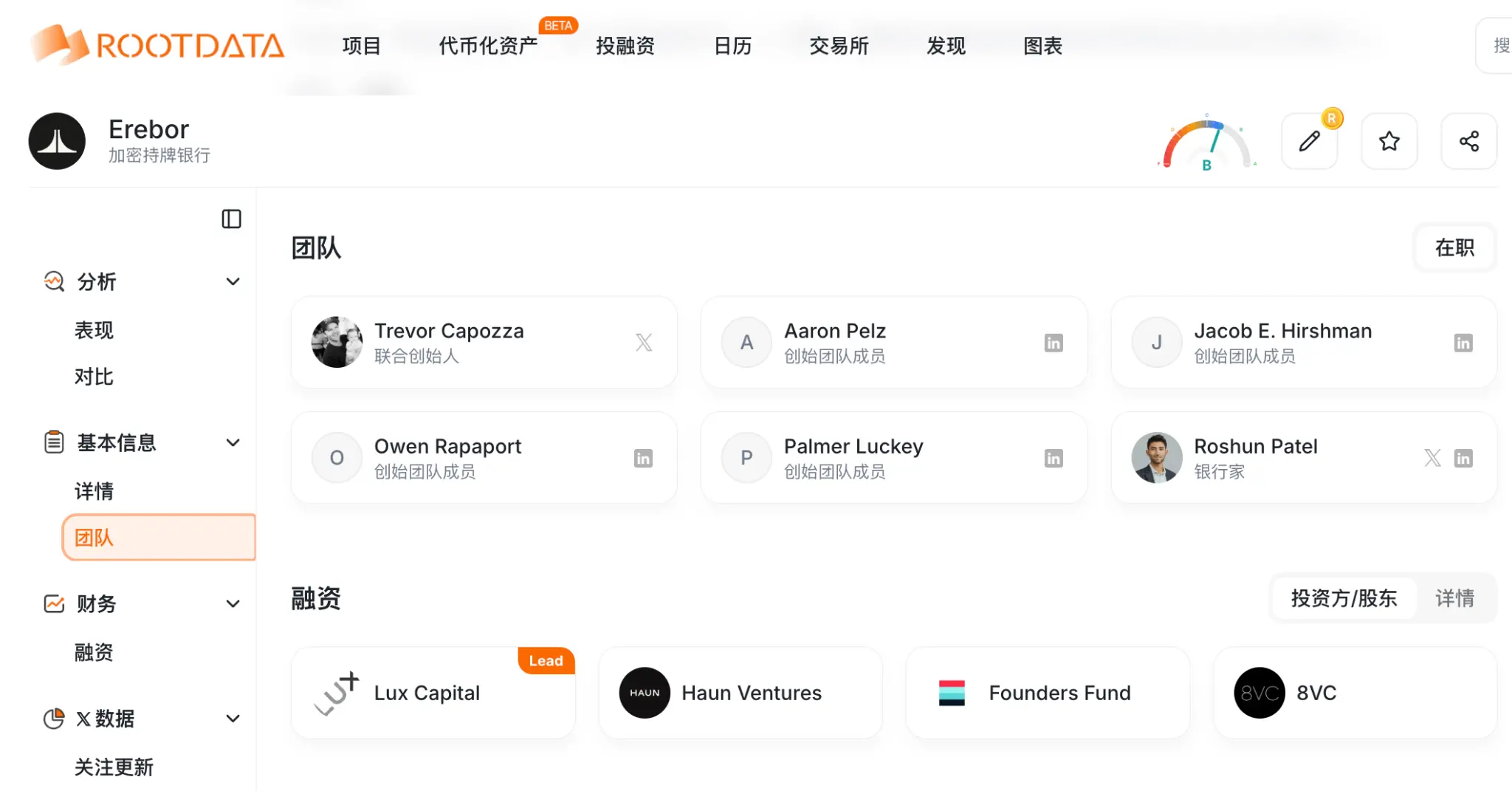
Image Source:RootData

Furthermore, a key strategic choice for Erebor is: insisting on obtaining its own license and being responsible for its financials, unlike Mercury or Brex which rely on partner banks. Luckey's argument is that relying on third-party infrastructure exposes one to risks of "de-platforming," policy pressure, and product limitations; only by holding the license and ledger can it fulfill promises of on-chain settlement, stablecoin minting, and redemption.

Looking back at Erebor's origin, it is almost entirely tied to the collapse of Silicon Valley Bank (SVB) in 2023. That failure left a large number of startups and venture capitalists suddenly without banking partners and deposit protection. Luckey and investors believed this left a "structural vacuum"—the disappearance of banks specializing in serving startups, while traditional banks were too conservative or slow for startups holding non-standard assets (defense contracts, AI hardware, digital tokens).

Erebor claims to address roughly four pain points: First, providing credit for physical assets—traditional banks are good at lending against real estate or receivables but not at valuing "GPUs" or "aerospace research." Second, bridging the on-chain/off-chain divide, bringing fiat banking and stablecoin settlement onto the same regulated balance sheet. Third, meeting 24/7 settlement needs, replacing SWIFT and ACH still operating on decades-old schedules. Fourth, providing USD access for high-growth international companies, combating the "de-banking" friction they often face.

Of course, how much of this operational potential is real versus marketing remains debatable. Venture-backed companies now have alternatives like non-bank lenders and DeFi lending, and some incumbent banks had already started targeting tech niches before SVB's collapse. Erebor's founders clearly believe existing institutions are insufficient, and the fact that it obtained a full banking license suggests regulators might also see some merit in this assessment?

Additionally, digital assets are core to Erebor's long-term strategy. It plans to handle deposits and payments for dollar stablecoins, provide instant fiat/stablecoin conversion, 24/7 settlement rails, and gradually support stablecoin minting and redemption within a regulated framework. Its OCC license even explicitly allows it to hold small amounts of crypto assets on its own books to pay for on-chain transaction fees, with supervisory letters defining such holdings as "incidental" to banking business—a noteworthy precedent in compliance.

On April 2nd, the Sui Foundation announced that Erebor now supports the Sui network, allowing clients to deposit and withdraw stablecoins. This is one of the first public pieces of evidence of it connecting regulated bank infrastructure to on-chain payments.

However, reality also presents gaps. Sources indicate demand for crypto-collateralized loans has been lower than the bank initially expected. This aligns with the earlier financials: the recent growth has actually been driven by companies rebuilding U.S. manufacturing capacity and their equipment financing and venture debt needs. In other words, Erebor currently resembles more of a "defense + advanced manufacturing + crypto" hybrid than a purely native crypto bank.

Perfect Timing—Even Its License Application Timing Was Fortuitous?

Breaking down the licensing: Erebor received preliminary conditional approval from the OCC on October 15, 2025, FDIC deposit insurance approval on December 16, final license in early February 2026, and officially launched on February 8 with approximately $625 million in initial capital (significantly increased from about $275 million during the preliminary approval phase). It is the first newly issued (de novo) national bank charter under the current U.S. administration.
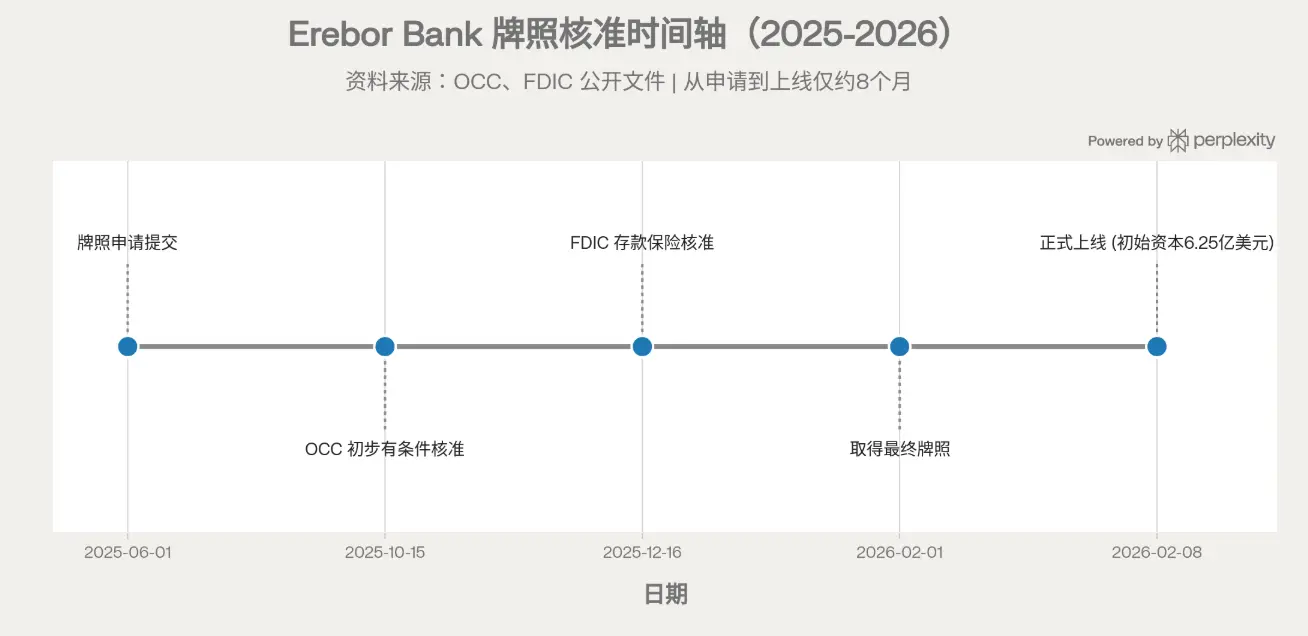
All this occurred against the backdrop of a clear shift in U.S. banking policy: Under the leadership of Acting Comptroller Jonathan Gould, the OCC has adopted an explicitly open regulatory stance toward digital asset banks, with Gould himself hailing this license as an example of a "dynamic and diverse financial system"; coupled with the advancement of federal-level stablecoin framework (GENIUS Act), once-fuzzy legal territories have been clarified considerably.

Notably, regulators did not grant approval without conditions. In exchange for approval, the OCC and FDIC imposed strict requirements: maintaining a Tier 1 leverage ratio of at least 12% for the first three years (roughly double the "well-capitalized" threshold) and a capital maintenance commitment. It could be said that Erebor's feasibility is partly tied to the current political cycle. If future regulatory stances shift, or stablecoin and anti-money laundering rules tighten, its entire narrative built on "token-friendly rules" could face headwinds.

Finally, synthesizing external media judgments, Erebor's model replicates almost every risk that contributed to SVB's downfall.

It serves early-stage, tech-heavy companies with non-traditional collateral. It caters to a small number of large accounts (startups, founders, investment funds) rather than thousands of retail customers; any single client's failure or withdrawal (crypto market volatility, venture capital pullback) could significantly impact liquidity. Regulators have long pointed out that SVB's "monoculture" client structure was a key driver of its run.

Crypto correlation makes the issue more tricky. If a supported stablecoin de-pegs or crypto prices crash, the deposit base and loan collateral could shrink simultaneously. Further down are policy reversal risks (its entire narrative bets on lenient token rules), execution risks of building core systems and on-chain settlement from scratch, and the unverified premise of "whether stablecoins will be widely adopted by clients." Finally, reputational and political risks—Luckey's highly controversial political affiliations plus the novelty of a "crypto bank" itself could amplify market confidence loss if the bank ever faces trouble.

It could be said Erebor is a high-profile experiment happening at the intersection of banking, crypto, and industrial policy.

The market need it advocates emerged from the financing gap left by SVB's collapse and friction in crypto payments. Now, regulators have given paper endorsement, the team combines tech prestige with Wall Street backgrounds. The execution of this new model, the continuity of regulatory stances, and the genuine market demand for its integrated services are precisely the points under rigorous market scrutiny.


Cryptos en tendance

Questions liées

QWhat are the key factors driving Erebor Bank's rapid valuation increase to $8 billion?

AThe rapid valuation increase to $8 billion is primarily driven by the bank's exceptional deposit growth, which surged from $1.1 billion to approximately $4.05 billion in a single quarter. Investors are betting on its future potential to deploy these deposits into profitable lending and stablecoin operations, its strategic positioning to fill the void left by Silicon Valley Bank's collapse, and its unique combination of founder reputation (Palmer Luckey, Peter Thiel) and a seasoned financial and crypto-compliance team.

QHow does Erebor Bank's business model differ from that of traditional banks and other fintech companies like Mercury?

AErebor Bank's business model differs from traditional banks by focusing on niche, capital-intensive clients like defense, advanced manufacturing, and crypto-native businesses, offering services like equipment financing for non-traditional assets (e.g., GPUs) and crypto integration. Unlike fintechs like Mercury or Brex that operate on third-party bank infrastructure, Erebor holds its own national bank charter, giving it direct control over its ledger, compliance, and the ability to offer regulated stablecoin minting/redemption and 24/7 on-chain settlement services.

QWhat are the main risks associated with Erebor Bank's strategy as outlined in the article?

AThe main risks include: 1) Concentrated client risk similar to SVB, relying on a small number of large depositors from volatile sectors (tech startups, crypto). 2) Execution risk in building core banking and on-chain settlement systems from scratch. 3) Regulatory and policy risk, as its model depends on a favorable crypto regulatory environment which could reverse. 4) Market adoption risk for its core crypto/stablecoin services, which currently have lower-than-expected demand. 5) Reputational and political risk tied to its founders' controversial profiles and the novel nature of a 'crypto bank'.

QWhat role does digital asset integration play in Erebor Bank's long-term strategy?

ADigital asset integration is central to Erebor's long-term strategy. It plans to offer deposit and payment services for US dollar stablecoins, provide instant fiat-to-stablecoin conversions, enable 24/7 settlement rails, and support the minting and redemption of stablecoins within a regulated framework. Its OCC charter even allows it to hold small amounts of crypto assets on its balance sheet for operational purposes. The bank has already taken steps like integrating with the Sui network for stablecoin transactions.

QWhy was the timing of Erebor Bank's regulatory approval considered favorable?

AThe timing was favorable due to a significant shift in U.S. banking policy under the current administration. The OCC, led by Acting Comptroller Jonathan Gould, adopted an explicitly open stance toward digital asset banks. This coincided with legislative progress on a federal stablecoin framework (the GENIUS Act), which helped clarify the legal landscape. Erebor's charter is the first *de novo* national bank charter issued under this administration, making it a beneficiary of this specific regulatory and political moment.

Lectures associées

Ethereum allège-t-il son fardeau ? Que pensent les 'Gardes de l'E' de l'upgrade Lean Ethereum et de ses perspectives ?

L'Ethereum s'efforce-t-il de voyager léger ? Comment les partisans d'ETH (E-soldiers) perçoivent-ils l'annonce de Lean Ethereum et ses perspectives pour l'avenir du cours ? Après une période de baisse en juin, le prix de l'ETH remonte avec le retour des anticipations de baisse des taux d'intérêt. Sur ce fond, Vitalik Buterin a présenté la feuille de route "Lean Ethereum", qualifiée de troisième mise à jour majeure du réseau. L'objectif est une refonte des couches de consensus, de données et d'exécution pour rendre Ethereum **plus simple, plus sûr (résistance quantique), plus vérifiable et plus évolutif**. Cette annonce s'inscrit dans un contexte de réorganisation, avec une réduction des effectifs de l'Ethereum Foundation et l'émergence de nouvelles entités comme EthLabs. Les partisans optimistes y voient un recentrage crucial : * **Sassal.eth** estime que cela réduira radicalement les besoins des nœuds, renforçant la décentralisation, et représente l'état final idéal de la blockchain. * **Ryan Sean Adams** considère cela comme un retour aux fondamentaux du protocole (sécurité, évolutivité) après une phase d'expansion narrative. * **BITWU** et **蓝狐 (Lanhu)** y voient une phase de simplification et de durcissement du protocole pour en faire une base durable pour la prochaine décennie. * **gigi发财猪 (gigiz_eth)** et **Xiyu** interprètent cela comme une réorganisation stratégique pour une exécution plus agile et un nouveau récit porteur pour le marché. Les voix prudentes saluent la direction mais pointent des défis : * **Ignas** souligne que les délais de livraison de l'Ethereum Foundation sont cruciaux et que la question de la capture de valeur par l'ETH (tokenomics) n'est pas abordée, face à la concurrence d'autres projets. * **Dankrad Feist** (ancien chercheur de l'Ethereum Foundation) approuve la vision mais juge le calendrier de 3-4 ans trop lent pour le marché actuel. En résumé, les optimistes voient dans Lean Ethereum une refonte essentielle pour la crédibilité à long terme, tandis que les prudents craignent que le rythme de développement ne réponde pas aux attentes immédiates du marché. Malgré les critiques habituelles sur sa complexité, Ethereum tente de reprendre l'initiative narrative avec cette nouvelle orientation.

marsbitIl y a 24 mins

Ethereum allège-t-il son fardeau ? Que pensent les 'Gardes de l'E' de l'upgrade Lean Ethereum et de ses perspectives ?

marsbitIl y a 24 mins

AI, Fable 5 et GPT-5.6 deviennent le privilège d'une minorité

**L'IA en voie de « pliage » : comment GPT-5.6 et Fable 5 deviennent des privilèges pour une élite** Le monde de l'IA est de plus en plus divisé. D'un côté, une infime minorité (environ 0,3% de la population) a accès à des modèles de pointe et coûteux comme Fable 5 ou le futur GPT-5.6. De l'autre, le grand public se contente de versions gratuites et limitées (ChatGPT basique, Copilot), perçues comme des « jouets » ou des produits « castrés ». Cette fracture crée un véritable fossé d'expérience. Les élites technologiques utilisent ces IA avancées comme de véritables systèmes de travail autonomes, capables de concevoir des architectures complexes, d'exécuter du code sophistiqué en minutes (tâches qui prendraient des semaines à un humain) ou de fournir des conseils médicaux fiables. Pour elles, l'IA est un outil de productivité révolutionnaire. À l'inverse, pour la majorité, l'IA reste un simple chatbot, déconnecté des besoins quotidiens (gestion des courses, des factures, des rendez-vous) et trop peu fiable pour des domaines critiques comme la santé. Un problème majeur est le coût exorbitant de l'utilisation des modèles de pointe, pouvant atteindre 1000 dollars par jour, rendant cet accès impossible au commun des mortels. Certains estiment cependant que pour 90% des tâches de bureau, des modèles comme GPT-5.5, plus abordables, suffisent amplement. Le vrai défi serait moins la puissance brute de l'IA que son intégration dans les flux de travail et l'accès aux données contextuelles. La conclusion est sans appel : une nouvelle forme d'inégalité, silencieuse mais profonde, est en train de naître. Les bénéfices les plus transformateurs de l'IA risquent de devenir l'apanage d'une minorité, laissant le reste de la société dans un univers parallèle de démonstrations futuristes et d'outils grand public aux capacités limitées.

marsbitIl y a 57 mins

AI, Fable 5 et GPT-5.6 deviennent le privilège d'une minorité

marsbitIl y a 57 mins

Trading

Spot

Articles tendance

Qu'est ce que $BANK

Banque IA : Une étape révolutionnaire vers l'avenir de la banque Introduction À une époque marquée par de rapides avancées technologiques, Banque IA se trouve à l'intersection de l'intelligence artificielle (IA) et des services bancaires. Ce projet innovant cherche à redéfinir le paysage financier, en améliorant l'efficacité opérationnelle, les mesures de sécurité et l'expérience client grâce à la puissance de l'IA. Alors que nous nous engageons dans cette exploration de Banque IA, nous allons examiner ce que le projet implique, sa dynamique opérationnelle, son contexte historique et ses jalons significatifs. Qu'est-ce que Banque IA ? Au cœur de Banque IA se trouve une initiative transformative visant à intégrer l'intelligence artificielle dans diverses opérations bancaires. Ce projet exploite les capacités de l'IA pour automatiser les processus, améliorer les protocoles de gestion des risques et améliorer l'interaction avec les clients grâce à des services personnalisés. Les objectifs principaux de Banque IA incluent : Automatisation des fonctions bancaires : En tirant parti des technologies de l'IA, Banque IA vise à automatiser les tâches routinières, réduisant ainsi la charge pesant sur les ressources humaines et améliorant l'efficacité. Gestion des risques améliorée : Le projet utilise des algorithmes d'IA pour prédire et identifier les risques, renforçant ainsi les mesures de sécurité contre la fraude et d'autres menaces. Personnalisation des services bancaires : Banque IA se concentre sur l'offre de produits et services financiers sur mesure en analysant les données et les comportements des clients. Amélioration de l'expérience client : La mise en œuvre de solutions propulsées par l'IA, telles que des chatbots et des assistants virtuels, vise à fournir aux utilisateurs des interactions plus humaines, révolutionnant ainsi la manière dont les clients interagissent avec les banques. Avec ces objectifs, Banque IA se positionne comme un acteur clé pour rendre la banque plus efficace, sécurisée et centrée sur l'utilisateur. Qui est le créateur de Banque IA ? Les détails concernant le créateur de Banque IA restent inconnus. Ainsi, aucune personne ou organisation spécifique n'a été identifiée dans les informations disponibles. L'anonymat entourant l'origine du projet soulève des questions mais ne diminue pas sa vision ambitieuse et ses objectifs. Qui sont les investisseurs de Banque IA ? Comme pour le créateur du projet, des informations spécifiques concernant les investisseurs ou les organisations de soutien de Banque IA n'ont pas été divulguées. Sans ces informations, il est difficile de décrire le soutien financier et institutionnel qui pourrait propulser le projet en avant. Néanmoins, l'importance d'une base d'investissement solide est essentielle pour soutenir le développement dans un domaine aussi innovant. Comment fonctionne Banque IA ? Banque IA opère sur plusieurs fronts novateurs, en se concentrant sur des facteurs uniques qui la différencient des cadres bancaires traditionnels. Voici les principales caractéristiques opérationnelles : Automatisation : En appliquant des algorithmes d'apprentissage automatique, Banque IA automatise divers processus manuels au sein des banques. Cela entraîne une réduction des coûts opérationnels et permet aux travailleurs humains de réorienter leurs efforts vers des activités plus stratégiques. Gestion des risques avancée : L'intégration de l'IA dans les pratiques de gestion des risques équipe les banques d'outils pour prédire avec précision les menaces potentielles telles que la fraude, garantissant ainsi que les informations et les actifs des clients restent sécurisés. Recommandations financières sur mesure : Grâce à un apprentissage continu des interactions avec les clients, les systèmes d'IA développent une compréhension nuancée des besoins des utilisateurs, leur permettant d'offrir des conseils personnalisés sur les décisions financières. Interactions client améliorées : En utilisant des chatbots et des assistants virtuels alimentés par l'IA, Banque IA permet une expérience client plus engageante, permettant aux utilisateurs de résoudre rapidement leurs questions, réduisant ainsi les temps d'attente et améliorant les niveaux de satisfaction. Ensemble, ces caractéristiques opérationnelles positionnent Banque IA comme un pionnier dans le secteur bancaire, établissant de nouvelles normes pour la prestation de services et l'excellence opérationnelle. Ligne du temps de Banque IA Comprendre la trajectoire de Banque IA nécessite un examen de son contexte historique. Voici une chronologie soulignant les jalons et développements importants : Début des années 2010 : La conceptualisation de l'intégration de l'IA dans les services bancaires a commencé à attirer l'attention alors que les institutions bancaires reconnaissaient les avantages potentiels. 2018 : Une augmentation marquée de l'implémentation des technologies d'IA s'est produite lorsque les banques ont commencé à utiliser des outils d'IA comme des chatbots pour le service client de base et des systèmes de gestion des risques pour une meilleure sécurité. 2023 : La sophistication de l'IA a continué à avancer, avec l'introduction de l'IA générative pour des tâches plus complexes telles que le traitement de documents et l'analyse d'investissement en temps réel. Cette année a marqué un bond significatif dans les capacités offertes aux banques par la technologie IA. 2024-État actuel : À partir de cette année, Banque IA est sur une trajectoire ascendante, avec des recherches et des développements en cours prêts à améliorer encore les capacités dans les opérations bancaires. Une exploration continue des applications de l'IA laisse présager des développements passionnants à venir. Points clés sur Banque IA Intégration de l'IA dans la banque : Banque IA se concentre sur l'adoption de l'intelligence artificielle pour rationaliser les processus bancaires et améliorer les expériences des utilisateurs. Concentration sur l'automatisation et la gestion des risques : Le projet met fortement l'accent sur ces domaines, visant à transférer la charge des tâches routinières tout en renforçant les cadres de sécurité grâce à l'analyse prédictive. Solutions bancaires personnalisées : En exploitant les données clients, Banque IA permet des services bancaires sur mesure qui répondent aux besoins individuels des utilisateurs. Engagement envers le développement : Banque IA reste engagée dans des efforts de recherche et développement continus, garantissant son adaptabilité et sa pertinence continue à mesure que la technologie continue d'évoluer. Conclusion En résumé, Banque IA illustre un pas crucial en avant dans l'industrie bancaire, exploitant l'intelligence artificielle pour remodeler les paradigmes opérationnels, renforcer la sécurité et promouvoir la satisfaction des clients. Malgré des lacunes d'informations concernant le créateur et les investisseurs, les objectifs clairs et les mécanismes fonctionnels de Banque IA fournissent une base solide pour son évolution continue. Alors que la technologie IA continue d'avancer et de se fusionner avec le secteur bancaire, Banque IA est bien positionnée pour avoir un impact significatif sur l'avenir des services financiers, améliorant la manière dont nous comprenons et interagissons avec la banque.

135 vues totalesPublié le 2024.04.06Mis à jour le 2024.12.03

Qu'est ce que $BANK

Comment acheter BANK

Bienvenue sur HTX.com ! Nous vous permettons d'acheter Lorenzo Protocol (BANK) de manière simple et pratique. Suivez notre guide étape par étape pour commencer votre parcours crypto.Étape 1 : Création de votre compte HTXUtilisez votre adresse e-mail ou votre numéro de téléphone pour ouvrir un compte sur HTX gratuitement. L'inscription se fait en toute simplicité et débloque toutes les fonctionnalités.Créer mon compteÉtape 2 : Choix du mode de paiement (rubrique Acheter des cryptosCarte de crédit/débit : utilisez votre carte Visa ou Mastercard pour acheter instantanément Lorenzo Protocol (BANK).Solde :utilisez les fonds du solde de votre compte HTX pour trader en toute simplicité.Prestataire tiers :pour accroître la commodité d'utilisation, nous avons ajouté des modes de paiement populaires tels que Google Pay et Apple Pay.P2P :tradez directement avec d'autres utilisateurs sur HTX.OTC (de gré à gré) : nous offrons des services personnalisés et des taux de change compétitifs aux traders.Étape 3 : stockage de vos Lorenzo Protocol (BANK)Après avoir acheté vos Lorenzo Protocol (BANK), stockez-les sur votre compte HTX. Vous pouvez également les envoyer ailleurs via un transfert sur la blockchain ou les utiliser pour trader d'autres cryptos.Étape 4 : tradez des Lorenzo Protocol (BANK)Tradez facilement Lorenzo Protocol (BANK) sur le marché Spot de HTX. Il vous suffit d'accéder à votre compte, de sélectionner la paire de trading, d'exécuter vos trades et de les suivre en temps réel. Nous offrons une expérience conviviale aux débutants comme aux traders chevronnés.

420 vues totalesPublié le 2025.05.09Mis à jour le 2026.06.02

Comment acheter BANK

Discussions

Bienvenue dans la Communauté HTX. Ici, vous pouvez vous tenir informé(e) des derniers développements de la plateforme et accéder à des analyses de marché professionnelles. Les opinions des utilisateurs sur le prix de BANK (BANK) sont présentées ci-dessous.

活动图片