DeepSeek's New Technology Ported to Apple Silicon, Mac Local LLM Accelerated by 60%

marsbitPublié le 2026-07-03Dernière mise à jour le 2026-07-03

Résumé

DeepSeek's newly open-sourced DSpark inference acceleration technology has been ported to Apple Silicon, yielding significant speedups for running large language models locally on Macs. The port, called mlx-dspark, was developed by engineer Abdur Rahim and supports models like Gemma-4 12B and Qwen3-4B. DSpark uses speculative decoding, where a smaller "draft" model proposes candidate tokens which are then verified in a batch by the target model. Rahim adapted this approach for Apple's MLX framework, implementing 4-bit quantization for the draft model. On an M4 Pro Mac, this resulted in generation speeds increasing by approximately 1.6x for Gemma-4 12B (to ~30 tok/s) and 1.4x for Qwen3-4B (to ~73 tok/s). Crucially, the port maintains bitwise identical output to the original models, including support for temperature sampling, not just greedy decoding. The project also integrated DFlash, an alternative block-based speculative decoding method from z-lab. Benchmarks show DFlash excels in predictable contexts like code/math tasks (achieving ~2.1x speedup), while DSpark's Markov head provides better performance for open-ended chat. The latest mlx-dspark version allows users to switch between these methods. The work demonstrates efficient, high-fidelity local LLM inference on consumer Apple hardware.

Kressey from the Aofeisi Quantum Bit | Official Account QbitAI

Just one week after DeepSeek open-sourced DSpark, it's been ported to Apple computers.

The ported version is called mlx-dspark, running the Gemma-4 12B and Qwen3-4B models.

After installation, the generation speed of these two models on Mac increased by 1.6x and 1.4x respectively.
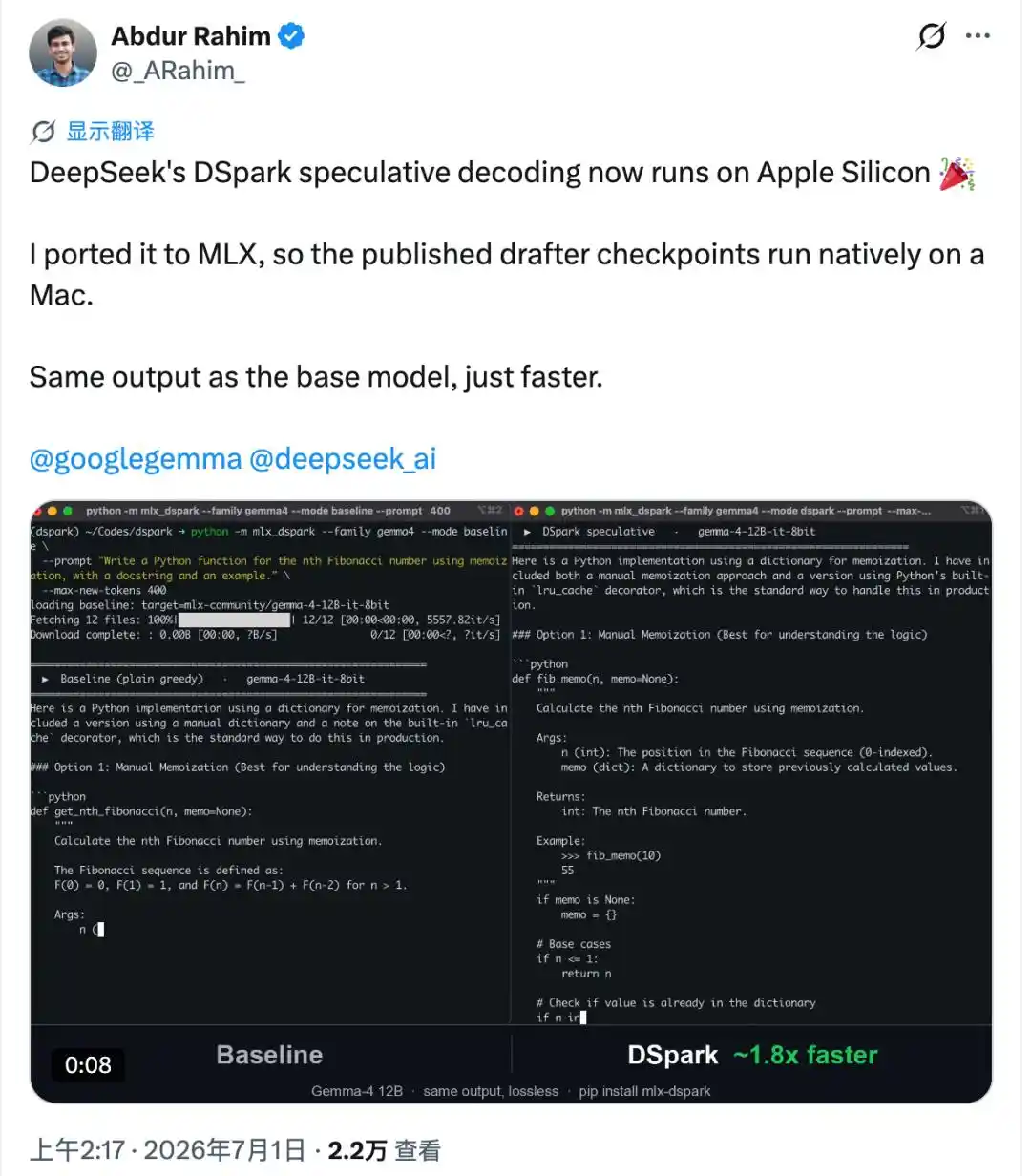
More importantly, it achieved something most ported versions can't — the output is byte-for-byte identical to the original model, not a single character off.

In other words, speed is gained without sacrificing any quality.

The person behind this is Abdur Rahim, an engineer who tinkers with open-source projects in his spare time. He single-handedly created the first native Mac version since DSpark was open-sourced.

Mac Running LLMs, Speed Boost of 60%

For DeepSeek's DSpark, open-sourced on June 27th, the official figures show a speed improvement of 60% to 85% in server-side scenarios.

However, this technology initially only had implementations for data center GPUs, with no version adapted for Apple Silicon.

mlx-dspark is the first native Apple Silicon version of this technology.
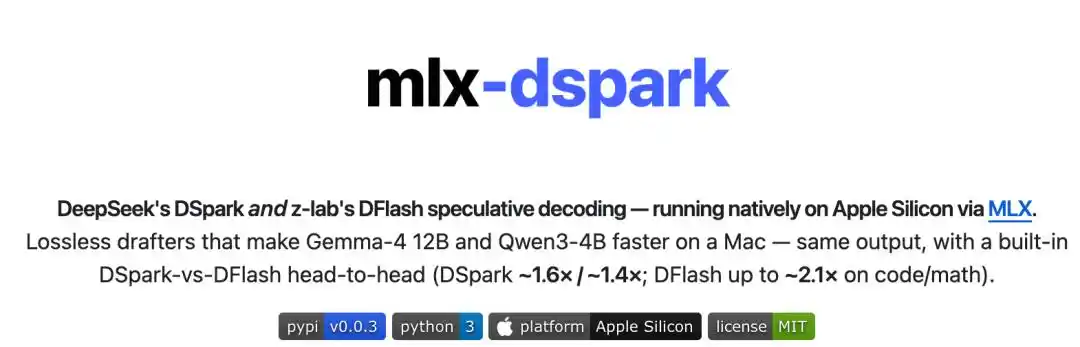
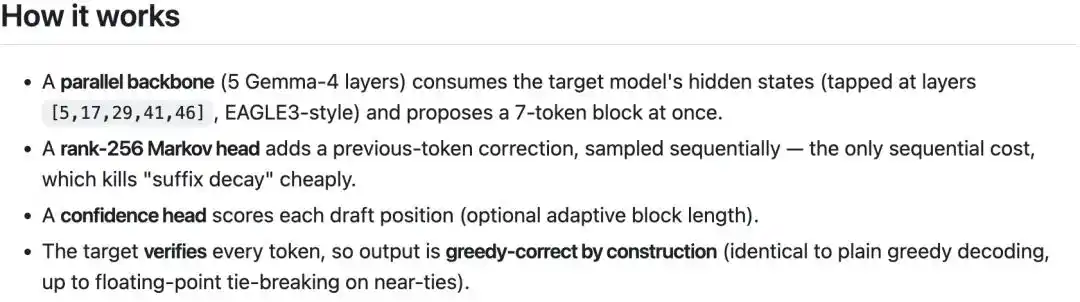
The idea behind DSpark is to pair a smaller model to assist the target model. The small model first generates several candidate tokens in one go, then the target model verifies them all at once, accepting the correct ones and rejecting the wrong ones for re-guessing.

The cost of this step differs between data centers and Apple computers.

On data center GPUs, verifying a batch of candidate tokens is more like chartering a bus—the fare is fixed regardless of the number of passengers. Since decoding is already memory-bound, verifying a few more tokens hardly adds any time.

Apple Silicon is more like a metered taxi—the more candidate tokens verified, the higher the meter runs.

Rahim tested it practically. For Gemma-4 12B, each additional token verified costs about 14 milliseconds. He calculated this into a cost model, concluding that the speed ceiling on Apple Silicon is around 2.2x.

In short, Rahim ported this assisting small model from HuggingFace's checkpoint and paired it with the target models Gemma-4 12B and Qwen3-4B.

He also rebuilt the verification process within the MLX framework and quantized the weights to 4-bit.
As a result, on the M4 Pro, compared to Apple's official MLX tool, Gemma-4 12B's generation speed increased from 18.4 tok/s to about 30 tok/s, about 1.6x the original; Qwen3-4B increased from 52.9 tok/s to about 73 tok/s, about 1.4x the original.

Additionally, in mlx-dspark, Rahim did something most porting work doesn't.

Ported Version, High-Fidelity Reproduction Possible

Most versions that port large models locally only support greedy decoding, meaning they pick the highest probability token at each step.

In mlx-dspark, Rahim implemented the temperature sampling method originally described in the DSpark paper. The draft model provides candidate tokens, and the acceptance probability is min(1, p/q), with unaccepted parts resampled from the residual.

He personally verified that the output from this process strictly equals the exact distribution the target model would give at the same temperature, not a discounted approximation.

Most speculative decoding implementations only do the greedy version because verifying the correctness of greedy mode is simple—just compare byte-by-byte.

The extra step Rahim took was personally checking the output distribution generated in sampling mode to confirm it wasn't distorted.

What precision the target model responsible for verification should be was a pitfall he figured out through trial.

If the small model was paired with a base target model without instruction fine-tuning, only 47% of the candidate tokens passed verification; switching to the corresponding instruction-tuned version increased this ratio to 82%.

He also tested switching the target model to bf16 precision. The increase in verification cost outweighed the increase in acceptance rate, making it slower, so leaving the target model at 8-bit by default is most cost-effective.

The small model responsible for generating candidate tokens uses a different precision.

The draft model itself was compressed by him. After 4-bit quantization, it's only 1.8GB, easily fitting into memory, and runs without loss.

The result is that DSpark not only achieved acceleration but also successfully reproduced the 16% to 18% acceptance rate improvement mentioned in the paper on the device.

DFlash Also Integrated, Faster on Code Tasks

After the tweet was posted, a comment appeared in the replies. Jian Chen, one of the authors of the DFlash paper, asked if they could try his team's model.

DFlash is another speculative decoding scheme proposed in a paper published by z-lab in May. The team lead author is Zhijian Liu, an assistant professor at UCSD and simultaneously a research scientist at NVIDIA.
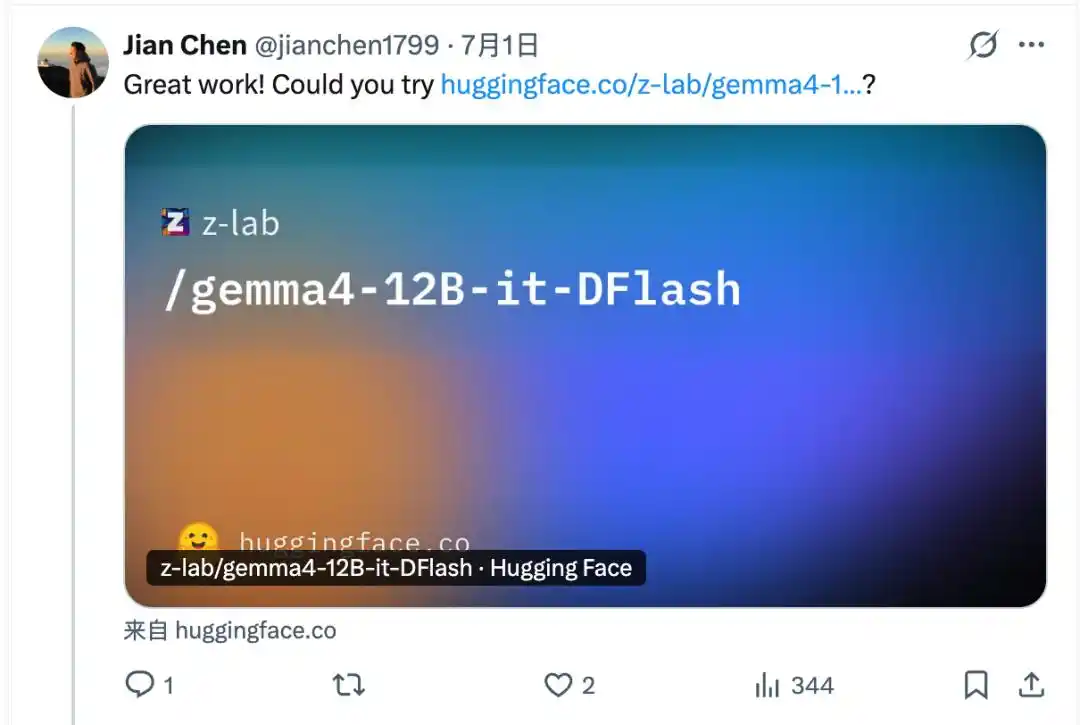
DFlash's approach is different from DSpark. It uses a single parallel "block diffusion" to denoise an entire block of 16 tokens, rather than guessing step-by-step with dependencies like DSpark.

Rahim got to work quickly.

Using a porting script written by Jian himself, he connected the z-lab released gemma4-12B-it-DFlash to the Gemma-4 target model in mlx-vlm. On the same Mac, he ran another head-to-head comparison against the DSpark he just tested.

On code and math tasks, DFlash's block decoding acceptance length reached 5.95 to 6.20, speed about 36 tok/s, achieving about 2.1x, beating DSpark.
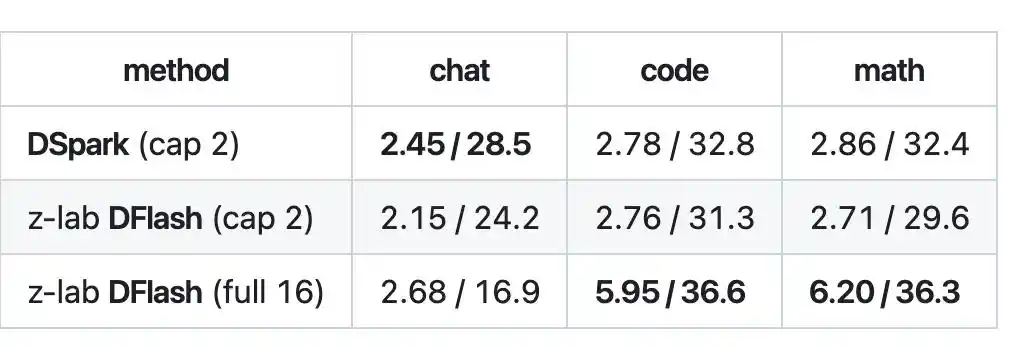
However, DFlash generates an entire block of 16 tokens at once, but the target model may not accept all of them. The portion that actually passes verification is only a part, referred to in the industry as the "acceptance length"—it's not always possible to fill all 16.

Therefore, in scenarios like open chat where content is unpredictable, the acceptance length doesn't increase, the block isn't fully utilized, and DFlash's advantage doesn't show.

DSpark's Markov head exists precisely to address this same issue. Parallel generation of an entire block of tokens means positions further back are calculated independently, making them prone to misalignment. The Markov head adds a layer of dependency between these positions specifically to correct this.

The result is, in chat scenarios, DSpark is actually faster than DFlash.
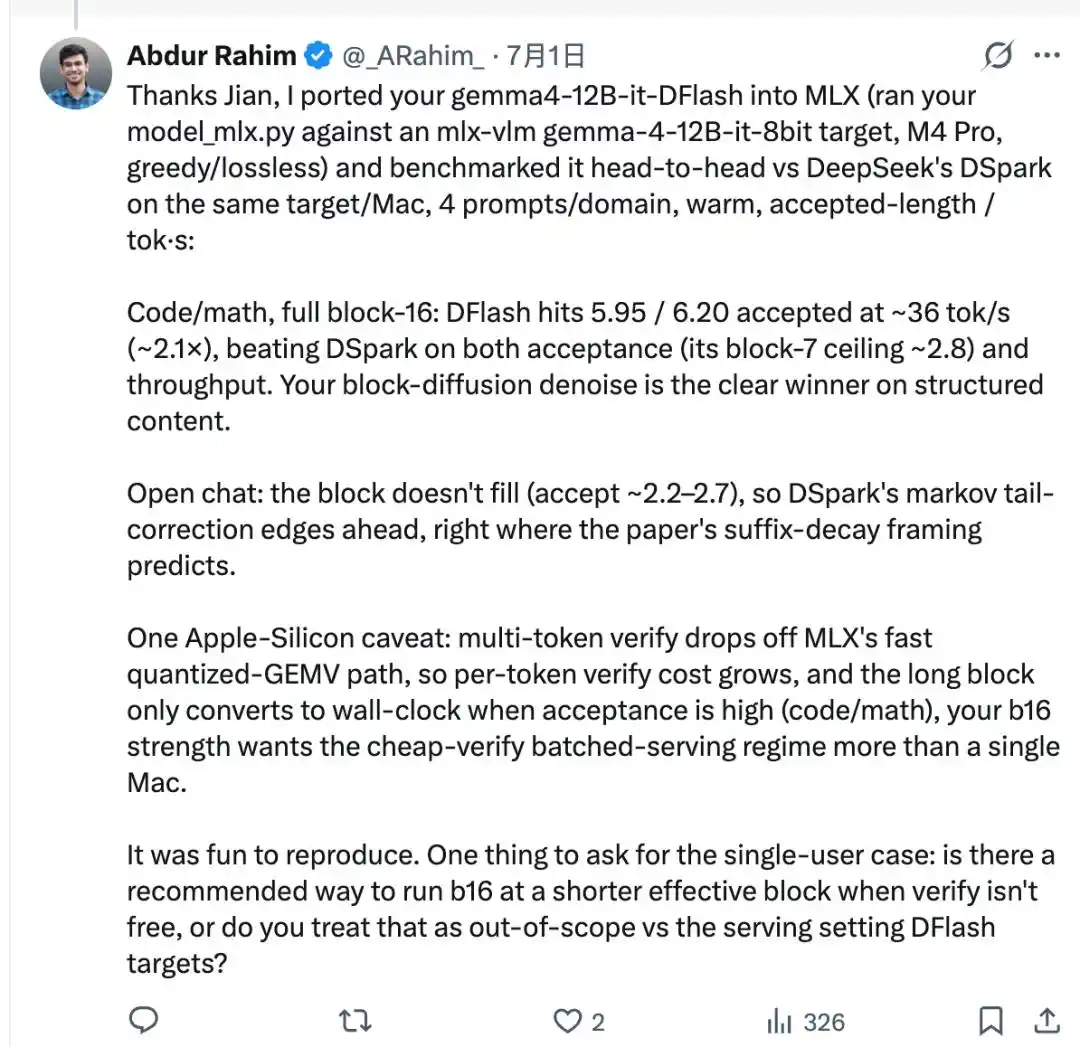
The subsequently updated mlx-dspark v0.0.3 officially integrated the z-lab original DFlash into the package, adding a parameter to manually shorten DFlash's effective block length—use short blocks for chat scenarios, and still use the full 16-token block for code and math scenarios.

After this, the same Mac, the same package, can handle both chat and code/math tasks, no longer needing to switch between the DSpark and DFlash projects.

Rahim said in his tweet that the same method should also work on larger Qwen3-8B and 14B draft models.

Reference Links:[1]https://x.com/_ARahim_/status/2072021710602432577[2]https://github.com/ARahim3/mlx-dspark

This article is from the official WeChat account "QbitAI", author: Focus on Frontier Technology

Cryptos en tendance

Questions liées

QWhat is the main achievement of the mlx-dspark project described in the article?

Amlx-dspark is the first native Apple Silicon port of DeepSeek's DSpark technology. It significantly speeds up the inference of models like Gemma-4 12B and Qwen3-4B on Macs (by ~1.6x and ~1.4x respectively) while maintaining output quality identical to the original models, byte-for-byte.

QHow does DSpark's speculative decoding method work to accelerate inference?

ADSpark uses a smaller 'draft' model to rapidly generate multiple candidate tokens (speculative decoding). The larger, target model then verifies these candidates in a batch. Correct tokens are accepted, and incorrect ones are rejected and regenerated. This reduces the number of times the slower target model needs to run.

QWhat key difference did Abdur Rahim implement in mlx-dspark that many other ports do not?

AUnlike many ports that only support greedy decoding, Rahim implemented the full temperature sampling method as described in the DSpark paper. This ensures the output distribution is mathematically identical to the target model's, not just an approximation, preserving generation quality.

QHow does the performance of DFlash compare to DSpark on Mac, according to the tests in the article?

ADFlash, which decodes in parallel blocks of 16 tokens, outperforms DSpark on code and math tasks, achieving speeds around 36 tok/s (~2.1x speedup). However, in open-ended chat scenarios where content is less predictable, DSpark's Markov head (which adds dependencies between candidate tokens) performs better than DFlash's block decoding.

QWhat practical feature was added in mlx-dspark v0.0.3 to handle different types of tasks?

AVersion 0.0.3 integrated the original DFlash model and added a parameter to manually adjust the effective block length. Users can use shorter blocks for chat scenarios and full 16-token blocks for code/math tasks, allowing a single package to handle different task types efficiently.

Lectures associées

« Ne peut être censuré » - La proposition Bitcoin visant à bloquer les Ordinals recueille moins de 1 % de soutien

La proposition controversée de soft fork Bitcoin, BIP-110, visant à limiter les données non financières comme les inscriptions Ordinals et Runes, n'a pas obtenu le soutien nécessaire des mineurs. À la date limite du 4 juillet, moins de 1% de la puissance de hachage du réseau (seulement 10 blocs sur 2016) avait signalé son soutien, bien loin du seuil de 55% requis pour l'activation. Les partisans du BIP-110, comme le développeur Luke Davis Jr., y voyaient un moyen de préserver la fonction première de Bitcoin en tant qu'argent numérique en empêchant les transactions de spam et les memecoins qui augmentent les coûts. Cependant, les critiques, dont BitMEX Research et Adam Back de Blockstream, ont vivement contesté la proposition. Ils ont averti qu'elle pourrait casser des portefeuilles existants, interdire des transactions légitimes impliquant plus de 1,7 million de BTC et aller à l'encontre du principe fondamental de Bitcoin : un réseau ouvert et non censurable. La faible adoption par les mineurs est considérée par certains, comme David Bailey de Bitcoin Conference, comme un signe positif ("bullish") pour l'avenir de Bitcoin. La dernière fenêtre d'activation par les utilisateurs est prévue en août, mais son succès semble très improbable compte tenu de l'opposition majoritaire exprimée. La communauté Bitcoin reste profondément divisée sur la question de la régulation des types de transactions autorisées sur son réseau.

ambcryptoIl y a 2 h

« Ne peut être censuré » - La proposition Bitcoin visant à bloquer les Ordinals recueille moins de 1 % de soutien

ambcryptoIl y a 2 h

Trading

Spot

Articles tendance

Comment acheter ONE

Bienvenue sur HTX.com ! Nous vous permettons d'acheter Harmony (ONE) de manière simple et pratique. Suivez notre guide étape par étape pour commencer votre parcours crypto.Étape 1 : Création de votre compte HTXUtilisez votre adresse e-mail ou votre numéro de téléphone pour ouvrir un compte sur HTX gratuitement. L'inscription se fait en toute simplicité et débloque toutes les fonctionnalités.Créer mon compteÉtape 2 : Choix du mode de paiement (rubrique Acheter des cryptosCarte de crédit/débit : utilisez votre carte Visa ou Mastercard pour acheter instantanément Harmony (ONE).Solde :utilisez les fonds du solde de votre compte HTX pour trader en toute simplicité.Prestataire tiers :pour accroître la commodité d'utilisation, nous avons ajouté des modes de paiement populaires tels que Google Pay et Apple Pay.P2P :tradez directement avec d'autres utilisateurs sur HTX.OTC (de gré à gré) : nous offrons des services personnalisés et des taux de change compétitifs aux traders.Étape 3 : stockage de vos Harmony (ONE)Après avoir acheté vos Harmony (ONE), stockez-les sur votre compte HTX. Vous pouvez également les envoyer ailleurs via un transfert sur la blockchain ou les utiliser pour trader d'autres cryptos.Étape 4 : tradez des Harmony (ONE)Tradez facilement Harmony (ONE) sur le marché Spot de HTX. Il vous suffit d'accéder à votre compte, de sélectionner la paire de trading, d'exécuter vos trades et de les suivre en temps réel. Nous offrons une expérience conviviale aux débutants comme aux traders chevronnés.

455 vues totalesPublié le 2024.12.12Mis à jour le 2026.06.02

Comment acheter ONE

Discussions

Bienvenue dans la Communauté HTX. Ici, vous pouvez vous tenir informé(e) des derniers développements de la plateforme et accéder à des analyses de marché professionnelles. Les opinions des utilisateurs sur le prix de ONE (ONE) sont présentées ci-dessous.

活动图片