US CFTC Launches Broad Investigation into Polymarket, Is the Prediction Market Party Coming to an End?

marsbitPublié le 2026-06-30Dernière mise à jour le 2026-06-30

Résumé

The U.S. Commodity Futures Trading Commission (CFTC) is conducting a broad investigation into the prediction market platform Polymarket, focusing on its business practices including social media promotions. This follows a bipartisan letter from U.S. senators urging the CFTC to probe alleged fraudulent marketing tactics used to promote gambling-like products. The action coincides with a period of explosive growth for the prediction market sector, driven by events like the World Cup, with platforms like Kalshi and Robinhood reporting record trading volumes and revenue. The investigation signals a potential end to the sector's unregulated expansion and may lead to clearer federal oversight, particularly regarding investor protection and distinguishing prediction markets from traditional sports betting. The CFTC's move has also intensified a jurisdictional conflict with multiple U.S. states (including Kentucky and New York), which have sued platforms like Polymarket and Kalshi, accusing them of operating illegal sports betting and threatening state gambling tax revenues. Furthermore, the CME Group has sued the CFTC, challenging its approval of certain prediction market products. The report also highlights the political and capital interests intertwined with the industry. Donald Trump Jr. holds advisory and investment roles in both Kalshi and Polymarket, and the Trump administration has previously emphasized federal regulatory authority over these markets. The CFTC's investigati...

Original | Odaily Planet Daily (@OdailyChina)

Author | Wenser(@wenser2010 )

Polymarket's deceptive marketing has finally caught the attention of regulatory authorities.

Recently, the U.S. Commodity Futures Trading Commission (CFTC) has initiated a broad investigation into the prediction market platform Polymarket, covering its business activities including social media campaigns. Previously, U.S. Republican Senator John Curtis and Democratic Senator Adam Schiff co-signed a letter to CFTC Chairman Mike Selig, urging an investigation into Polymarket's practices of paying KOLs for deceptive marketing and using fraudulent marketing tactics to promote gambling-like products to American audiences.

At a time when the World Cup is driving a surge in prediction market trading volumes, this move may pour cold water on the development of this sector. More importantly, the CFTC's investigation into Polymarket has brought to light conflicts of interest between U.S. federal and state authorities, as well as between officials and capital. (Recommended reading: "WSJ: Fake Websites, Fake Trades, Real Promotion, Polymarket's Traffic Scam").

End of the Wild West Era for Prediction Market Marketing, Regulatory Policies May Enter Deep Waters

If the earlier incidents involving Polymarket—such as university students posting fake profit videos and paid KOLs exaggerating prediction profits—were seen as the wild attempts of the early expansion phase of prediction markets, then the formal CFTC investigation is clear proof that this wild growth period is over.

Prediction Market Platform Data Sees Explosive Growth, Attracting Strong Attention from Traditional Internet Giants

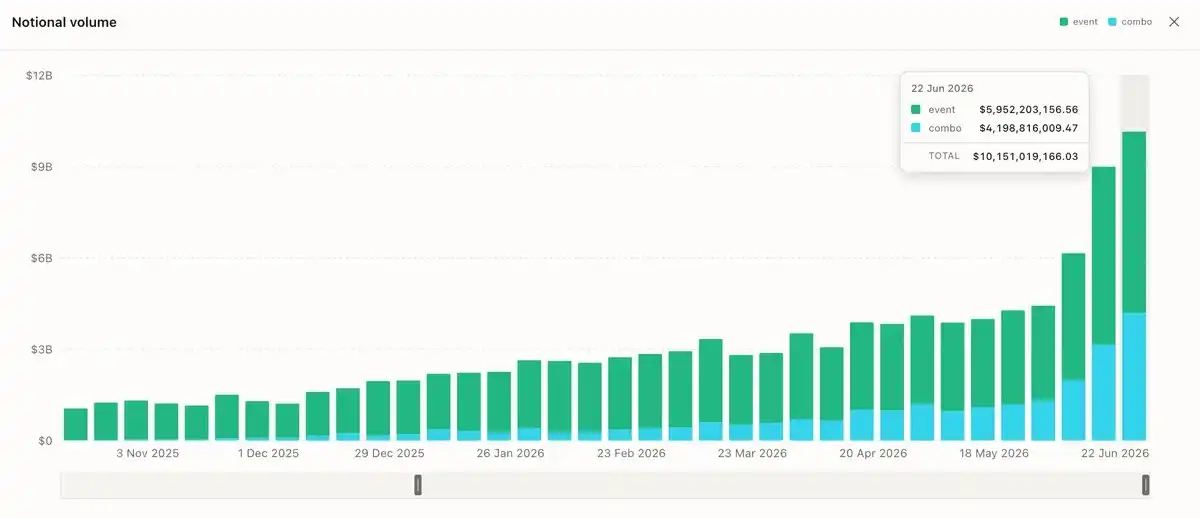
As we entered June 2026, with the official start of the World Cup, prediction markets have received unprecedented attention, leading to a continuous rise in trading volumes.

Data from a16z crypto shows that prediction market trading volume has hit record highs for three consecutive weeks. The total market trading volume reached a historic first of $144 billion last week, a significant increase from approximately $50–60 billion at the beginning of the year. The previous record high of around $100 billion was set just the week before. From the platform side, the data has also seen substantial growth:

  • Latest data shows Kalshi's weekly notional trading volume surpassed $100 billion for the first time.
  • Polymarket officially stated that its annualized revenue has significantly exceeded $1 billion, a development occurring just six weeks after the removal of the waitlist for its U.S. trading platform; data shows that the U.S. platform's daily trading volume grew from about $50 million in mid-May to over $200 million on June 20 (based on Dune Analytics data).
  • Robinhood's prediction market platform business is growing rapidly, with annualized revenue reaching $500 million. In Q2 as of June 25, Robinhood's active contract trading volume was approximately 12.3 billion contracts. Based on a standard rate of 1 cent per contract, the prediction market revenue for this quarter is estimated to be at least $123 million. Its recently launched Rothera prediction market platform achieved over 900 million contract trades in its first week, contributing nearly 60% growth in active contract trading volume for Robinhood.
Such impressive data has also attracted the attention of stock market giant Meta. According to media reports, Meta CEO Mark Zuckerberg has urged the company to explore partnerships with prediction markets Polymarket and Kalshi. Meanwhile, Meta is developing a similar prediction market application called Arena.

All signs indicate that prediction markets have leapt from a niche sector a few years ago to a hot industry experiencing exponential expansion. In the face of this trend, regulatory authorities are unlikely to stand idly by. The recent deceptive marketing incidents at Polymarket serve as a timely and fitting 'soft knife,' providing an opportunity for regulatory intervention. The author believes that subsequent regulations may gradually clarify the boundaries for prediction market platforms regarding marketing, event contract content, and trading fees, aiming to strengthen investor protection and clearly distinguish them from traditional gambling businesses.

Simultaneously, as the investigation deepens, the power struggle between federal regulatory agencies represented by the U.S. CFTC and state-level regulators is also coming to light.

When U.S. CFTC and Nine U.S. States Lock Horns: The Battle for Prediction Market Regulatory Power

Last Tuesday, the U.S. CFTC formally filed a lawsuit against Kentucky, attempting to reaffirm the agency's jurisdiction over prediction market platforms.

In the complaint filed with the U.S. District Court for the Eastern District of Kentucky, the CFTC stated that Kentucky's attempt to shut down federally regulated designated contract markets interferes with the federal regulatory system Congress established for the national swaps market. It claims "exclusive jurisdiction" over related event contracts and prediction market products.

Previously, Kentucky sued platforms like Kalshi and Polymarket, accusing them of operating unlicensed illegal sports betting and gambling businesses within the state. As of June, over 12 U.S. states, including Kentucky and New York, have taken legal action against Polymarket and Kalshi, alleging they operate illegal sports betting. Kentucky has become the ninth state sued by the CFTC in the prediction market regulatory dispute.

This action highlights the escalating conflict between federal derivatives regulation and state-level gambling regulation.

There are two main reasons behind this dispute:

  • First, the practical interests of state and local gambling industries, such as tax revenue. Traditional sports betting previously brought significant tax revenue to various states (e.g., high-tax-rate online gambling). If prediction markets completely replace the gambling industry, potential tax losses for states could amount to hundreds of millions of dollars annually (one estimate is around $600 million).
  • Second, the definition of the regulatory boundary between the gambling industry and prediction markets as an emerging industry. The CFTC seeks to maintain the classification of "event contracts" as commodity derivatives, futures, or swaps, enforcing a policy of federal law preemption.

The final outcome and specific definitions may depend on the interpretation and rulings by state courts, and potentially the U.S. Supreme Court, regarding the Commodity Exchange Act (CEA).

Furthermore, the battle between exchanges and the U.S. CFTC has also ignited. The CFTC's previous approval of Kalshi's application for perpetual futures trading triggered CME's lawsuit—

Reportedly, CME has sued the U.S. Commodity Futures Trading Commission and its Chairman Michael Selig in the U.S. District Court for the District of Columbia. Regarding the CFTC's May 29th approval for prediction market platform Kalshi to launch perpetual futures contracts linked to the Bitcoin spot price, among other actions, the CFTC's treatment of "futures" with expiration dates as "swaps" violates U.S. Congressional directives and the Commodity Exchange Act. CME requests the court to overturn the related perpetual futures actions. CME also claimed that Selig acted unilaterally without the presence of the full five-member panel of commissioners.

A CFTC spokesperson responded that CME is waging a "legal war" against the agency and the government's crypto policy, stating that "the act of filing the lawsuit is extremely imprudent." (Essentially saying "your lawsuit is filed too hastily" right on its forehead.)

Of course, it's no wonder CME is so agitated. The CFTC's move to allow Kalshi to trade crypto perpetual futures contracts essentially lets prediction market platforms like Kalshi, along with crypto exchanges like Coinbase and Kraken, encroach upon CME's "trading territory." As for the driving force behind this, it might have some connection to the Trump family.

The Trump Family's Prediction Market 'Double-Down Strategy': Don Jr. Bets on Kalshi and Polymarket

Recently, it was revealed that Kalshi is negotiating a new round of funding at a valuation of approximately $40 billion, with the deal potentially closing as early as Q3. Following a $10 billion financing round in May (investors included Sequoia Capital, Andreessen Horowitz, Coatue, and Morgan Stanley), Kalshi's valuation rose from its previous $12 billion to $22 billion. Now, that number is about to double.

Kalshi CEO Tarek Mansour stated that the company is considering an IPO no earlier than late 2027 or 2028. Kalshi officially stated that as of April 2026, its annualized trading volume reached $178 billion, a 32-fold increase year-over-year.

Such remarkable market data and the high enthusiasm from capital markets are hard to separate from one of the Trump family's prominent figures, Donald Trump Jr.

It is understood that Don Jr. is essentially "hedging his bets" in the prediction market sector:

On one hand, he served as a paid strategic advisor for Kalshi in early 2025, receiving approximately $300,000 worth of company equity at a time when Kalshi's valuation was less than $2 billion. That investment alone has yielded over a 10x return;

On the other hand, he also serves as an advisor to Polymarket and has made a strategic investment in the latter through his venture capital firm, 1789 Capital, where he is a partner.

Coupled with Trump's previous emphasis on federal government regulatory authority over prediction markets, and his mention that "Kalshi and Polymarket will thrive under his leadership,"

To some extent, the conflict of interest between capital and official regulatory agencies has been eased; and the Trump family serves as the "best lubricant" in this contradictory situation.

Thus, a network of interests connecting the U.S. CFTC and other federal regulatory agencies, U.S. state governments, and Trump family investment entities gradually takes shape.

As for the U.S. CFTC's investigation into Polymarket, it may just be an inevitable step in regulating the prediction market industry.

The era of wild growth, the 'Spring of Prediction Markets,' is coming to an end, while the 'Prosperous Summer' for the prediction market industry is slowly approaching.


Cryptos en tendance

Questions liées

QWhat is the US CFTC investigating regarding Polymarket?

AThe US Commodity Futures Trading Commission (CFTC) is conducting a broad investigation into the prediction market platform Polymarket, covering aspects of its business including social media activities. The investigation is prompted by concerns over paid KOLs engaging in deceptive marketing, using fraudulent methods to promote gambling-like products to a US audience.

QWhat is the core conflict highlighted between the US CFTC and certain US states in the article?

AThe core conflict is a jurisdictional battle between federal regulatory authority (the CFTC) and state-level power. The CFTC asserts exclusive federal jurisdiction over event contracts and prediction market products under the Commodity Exchange Act. However, states like Kentucky and New York are suing platforms like Polymarket and Kalshi, accusing them of operating illegal sports betting and gambling businesses within their borders, which are traditionally regulated by the states. This conflict involves both regulatory boundaries and potential state tax revenue losses from the traditional gambling industry.

QWhat role does Donald Trump Jr. play in the prediction market sector according to the article?

AAccording to the article, Donald Trump Jr. is involved with both major prediction market platforms. He serves as a paid strategic advisor for Kalshi, receiving company equity, and also acts as an advisor for Polymarket through his venture capital firm, 1789 Capital, which made a strategic investment in the platform. His involvement is presented as part of a network connecting capital, political influence, and regulatory bodies.

QWhat significant legal action did the CME Group take against the CFTC, and why?

AThe CME Group filed a lawsuit against the US CFTC and its Chairman, Michael Selig, in the US District Court for the District of Columbia. The lawsuit challenges the CFTC's approval for Kalshi to launch perpetual futures contracts tied to Bitcoin's spot price. CME argues the CFTC violated the Commodity Exchange Act by treating futures with expiration dates as 'swaps' and that Chairman Selig acted unilaterally without a full commission. The move is seen as CME protecting its trading turf from encroachment by prediction market and crypto exchanges.

QHow does the article characterize the current stage and future of the prediction market industry?

AThe article characterizes the current massive growth, driven by events like the World Cup, as the end of a 'wild spring' or野蛮生长期 (barbaric growth period) for prediction markets, marked by early expansion tactics like deceptive marketing. The CFTC's investigation is seen as the start of increased regulatory scrutiny. However, the conclusion suggests this is a necessary step, and a 'prosperous summer' for a more regulated and mature prediction market industry is slowly approaching.

Lectures associées

C'est avéré : Claude Code espionne les utilisateurs, le fuseau horaire et les laboratoires chinois d'IA sont des mots-clés

Aujourd'hui, Anthropic a connu une journée contrastée. D'un côté, la société a lancé Claude Sonnet 5, un modèle présenté comme très performant, et a annoncé que le département américain du Commerce levait les restrictions à l'exportation sur ses modèles Claude Fable 5 et Mythos 5, suite à des engagements de sécurité. D'un autre côté, une controverse majeure a émergé concernant Claude Code, l'assistant de programmation. Des développeurs ont exposé qu'il intégrerait discrètement un mécanisme de collecte de données des utilisateurs, notamment chinois. Selon des rapports publiés sur GitHub et Reddit, l'outil détecterait le fuseau horaire (comme Asia/Shanghai), l'utilisation de proxies ou de connexions à des domaines liés à des laboratoires d'IA chinois (Baidu, Alibaba, etc.). Ces informations seraient ensuite encodées de manière stéganographique dans l'invite système envoyée au modèle, par de subtiles variations de caractères (comme le format de la date ou le type d'apostrophe dans "Today's date"), rendant la pratique invisible à l'œil nu. Bien que la télémétrie soit courante, la méthode employée – non documentée et difficile à détecter – soulève de sérieuses questions sur la confiance et la transparence, surtout pour un outil ayant accès au code et aux commandes système. Anthropic a répondu qu'un correctif supprimant ce code serait déployé.

marsbitIl y a 38 mins

C'est avéré : Claude Code espionne les utilisateurs, le fuseau horaire et les laboratoires chinois d'IA sont des mots-clés

marsbitIl y a 38 mins

Grayscale : après une division par deux, le BTC se rapproche du creux de ce cycle

Le prix du Bitcoin est tombé sous les 60 000 $ cette semaine, en baisse de plus de 50 % depuis son pic d'octobre. Selon Zach Pandl de Grayscale, cette correction s'inscrit dans un schéma historique de ralentissements cycliques au sein d'une tendance haussière à long terme, et ne marque pas un renversement de tendance. Plusieurs facteurs ont pesé récemment : un changement des anticipations du marché concernant la politique de la Fed (attentes de hausse des taux sous la présidence de Kevin Warsh), les incertitudes autour de l'adoption du projet de loi CLARITY au Sénat américain, les pressions sur le bilan de certaines sociétés comme Strategy et les craintes liées à l'informatique quantique. Cependant, les facteurs structurels positifs demeurent : l'adoption institutionnelle de la technologie blockchain progresse, soutenue par des avancées réglementaires, tandis que les dynamiques sous-jacentes (dette publique, défiance envers les intermédiaires, ascension de l'IA) continuent de soutenir la thèse d'actifs numériques. Pour sortir de ce marché baissier, deux scénarios sont envisagés : * **Scénario optimiste (de base)** : Adoption du CLARITY, consolidation des bilans, et maintien des taux par la Fed. Le Bitcoin pourrait alors être proche de son creux. * **Scénario pessimiste** : Échec du CLARITY, poursuite du désendettement et hausse des taux de la Fed. Le prix du Bitcoin pourrait alors connaître une nouvelle baisse modérée, bien que probablement moins sévère que les corrections historiques (-80%) en raison d'une hausse antérieure plus mesurée et d'une demande institutionnelle plus résiliente. En conclusion, Grayscale reste très optimiste sur les perspectives à long terme des actifs numériques. Le point bas du cycle dépendra des prochains catalyseurs (décisions de la Fed, vote du CLARITY). Les valorisations actuelles représentent, selon l'analyse, un point d'entrée attractif pour les investisseurs à long terme souhaitant anticiper la croissance structurelle des blockchains et des actifs numériques.

marsbitIl y a 1 h

Grayscale : après une division par deux, le BTC se rapproche du creux de ce cycle

marsbitIl y a 1 h

Guide de survie en marché baissier pour le Web3 : dix livres essentiels pour traverser le cycle

Guide de survie pour le marché baissier Web3 : 10 livres pour traverser le cycle En 17 ans, la crypto a connu 4 cycles haussiers et baissiers. Chaque marché baissier transforme l'industrie, éliminant certains et permettant à d'autres d'évoluer. Pour les bâtisseurs, c'est un temps d'accumulation de connaissances. Cette liste de 10 livres, sans conseils d'investissement, offre des perspectives fondamentales pour naviguer dans l'hiver crypto. 1. **"2049: The Future 10000 Days" de Kevin Kelly** : Un télescope à long terme pour retrouver une vision face à l'incertitude, explorant la place future de la crypto et de l'IA. 2. **"L'Action Humaine" de Ludwig von Mises** : Explore les fondements philosophiques de l'action et de la spéculation, essentiel pour maintenir la conviction dans un marché stagnant. 3. **"La Nature de la Technologie" de Brian Arthur** : Explique comment la technologie évolue par combinaison, un cadre clé pour comprendre le développement du Web3. 4. **"L'Éternel Salut" (遥远的救世主) de Dou Dou** : Un roman sur les "attributs culturels", distinguant la culture forte (agir) de la culture faible (attendre un sauveur), crucial pour l'autonomie en crypto. 5. **"Le Souverain Individu" de James Dale Davidson & William Rees-Mogg** : Prophétise (1997) l'essor de la monnaie numérique et le passage de la souveraineté des États à celle des individus. 6. **"Le Japon comme Miroir : Guide de Survie à l'Ère du Déclin" (以日为鉴)** : Analyse la stagnation japonaise pour identifier les opportunités structurelles même en période de récession, applicable au Web3 global. 7. **"La Dé-nationalisation de la Monnaie" de Friedrich Hayek** : La base théorique de la concurrence monétaire et de la critique du monopole étatique, fondement intellectuel du Bitcoin. 8. **"Enregistrement des Questions-Réponses sur l'Investissement de Duan Yongping"** : Prône la simplicité, la concentration sur l'essentiel et une liste de "choses à ne pas faire" pour une stratégie robuste. 9. **"The Network State: How to Start a New Country" de Balaji Srinivasan** : Une vision audacieuse d'un futur façonné par la crypto, proposant des idées concrètes comme les marchés prédictifs pour les médias. 10. **"Œuvres Choisies de Mao Zedong"** : Une méthodologie pour analyser les rapports de force, identifier les alliés et les adversaires, et progresser à partir d'une position faible, pertinente pour toute révolution technologique. Ces livres aident à renforcer les convictions, affiner le cadre de pensée et maintenir une action disciplinée. Ceux qui traversent les cycles le font grâce à la profondeur de leur cognition et la résilience de leur caractère, non à la chance.

Foresight NewsIl y a 1 h

Guide de survie en marché baissier pour le Web3 : dix livres essentiels pour traverser le cycle

Foresight NewsIl y a 1 h

Qui est l'homme le plus doué pour gagner de l'argent dans la cryptosphère ? Trump engrange plus de 1,4 milliard de dollars en 2025

Le Bureau de l'éthique du gouvernement américain a publié le rapport financier 2025 de l'ancien président Donald Trump, révélant des revenus liés à la cryptomonnaie d'environ 1,427 milliard de dollars. Ces actifs, détenus via plusieurs entités, proviennent principalement de redevances sur des memecoins portant son nom (635 millions de dollars via CIC Digital LLC) et de bénéfices tirés de la vente de jetons de World Liberty Financial (près de 594 millions de dollars via DT Marks Defi LLC). Contrairement à la plupart des investisseurs subissant la baisse du marché, la fortune cryptographique de Trump, alimentée par son rôle d'émetteur, semble immunisée contre les risques de baisse. Le rapport soulève des questions éthiques cruciales, alors que le projet de loi CLARITY Act, visant à réguler le secteur, est en débat au Sénat. Des élus démocrates réclament l'interdiction pour les hauts fonctionnaires de détenir des actifs cryptos, arguant d'un conflit d'intérêts flagrant lorsque le principal bénéficiaire réglemente l'industrie. En comparaison, la divulgation du vice-président JD Vance, détenant pour 250 000 à 500 000 dollars de Bitcoin, paraît modeste. L'issue des négociations législatives déterminera si cette fusion des rôles de régulateur et de bénéficiaire restera une exception ou deviendra une norme.

Foresight NewsIl y a 1 h

Qui est l'homme le plus doué pour gagner de l'argent dans la cryptosphère ? Trump engrange plus de 1,4 milliard de dollars en 2025

Foresight NewsIl y a 1 h

Trump 25 ans de rapports financiers : la famille rapporte plus de 1 milliard de dollars par an grâce au crypto, tandis que les investisseurs individuels perdent de l'argent sur $TRUMP

Le rapport financier 2025 de Donald Trump révèle que ses entreprises liées aux crypto-monnaies ont généré près de 12 milliards de dollars de revenus, dépassant la plupart de ses actifs immobiliers historiques. Ces revenus proviennent principalement de deux sources : World Liberty Financial (plus de 5 milliards de dollars grâce à la vente de jetons de gouvernance) et CIC Digital LLC (environ 635 millions de dollars de redevances sur le memecoin $TRUMP). Cependant, la valeur de ces crypto-actifs s'est effondrée depuis leur lancement : $TRUMP est passé de 74 dollars à 1,68 dollar, et le jeton de World Liberty Financial a chuté de 80%. La majorité des investisseurs particuliers subissent des pertes, tandis que les entités liées à Trump détiennent encore environ 80% de l'offre de $TRUMP. Parallèlement, les activités immobilières de Trump à l'étranger ont également connu une expansion significative, avec des revenus provenant de projets dans des pays comme les Émirats arabes unis, l'Arabie saoudite et le Vietnam. La Maison Blanche affirme qu'il n'y a aucun conflit d'intérêts, soulignant que les affaires sont gérées par une fiducie familiale et que le président agit dans l'intérêt public. Cette croissance coïncide avec l'assouplissement par l'administration Trump de la réglementation fédérale sur les crypto-monnaies.

marsbitIl y a 1 h

Trump 25 ans de rapports financiers : la famille rapporte plus de 1 milliard de dollars par an grâce au crypto, tandis que les investisseurs individuels perdent de l'argent sur $TRUMP

marsbitIl y a 1 h

Trading

Spot

Articles tendance

Comment acheter POL

Bienvenue sur HTX.com ! Nous vous permettons d'acheter Polygon Ecosystem Token (POL) de manière simple et pratique. Suivez notre guide étape par étape pour commencer votre parcours crypto.Étape 1 : Création de votre compte HTXUtilisez votre adresse e-mail ou votre numéro de téléphone pour ouvrir un compte sur HTX gratuitement. L'inscription se fait en toute simplicité et débloque toutes les fonctionnalités.Créer mon compteÉtape 2 : Choix du mode de paiement (rubrique Acheter des cryptosCarte de crédit/débit : utilisez votre carte Visa ou Mastercard pour acheter instantanément Polygon Ecosystem Token (POL).Solde :utilisez les fonds du solde de votre compte HTX pour trader en toute simplicité.Prestataire tiers :pour accroître la commodité d'utilisation, nous avons ajouté des modes de paiement populaires tels que Google Pay et Apple Pay.P2P :tradez directement avec d'autres utilisateurs sur HTX.OTC (de gré à gré) : nous offrons des services personnalisés et des taux de change compétitifs aux traders.Étape 3 : stockage de vos Polygon Ecosystem Token (POL)Après avoir acheté vos Polygon Ecosystem Token (POL), stockez-les sur votre compte HTX. Vous pouvez également les envoyer ailleurs via un transfert sur la blockchain ou les utiliser pour trader d'autres cryptos.Étape 4 : tradez des Polygon Ecosystem Token (POL)Tradez facilement Polygon Ecosystem Token (POL) sur le marché Spot de HTX. Il vous suffit d'accéder à votre compte, de sélectionner la paire de trading, d'exécuter vos trades et de les suivre en temps réel. Nous offrons une expérience conviviale aux débutants comme aux traders chevronnés.

335 vues totalesPublié le 2024.12.11Mis à jour le 2026.06.02

Comment acheter POL

Discussions

Bienvenue dans la Communauté HTX. Ici, vous pouvez vous tenir informé(e) des derniers développements de la plateforme et accéder à des analyses de marché professionnelles. Les opinions des utilisateurs sur le prix de POL (POL) sont présentées ci-dessous.

活动图片