Fable 5 is about to make a comeback, code exposed? Anthropic CEO kicked out of the White House

marsbitPublié le 2026-06-25Dernière mise à jour le 2026-06-25

Résumé

Fable 5, a previously restricted AI model from Anthropic, appears poised for a comeback. Evidence from leaked code in the Claude Code v2.1.190 version suggests a shift in its business model from a separate purchase to a potentially limited weekly usage allowance within standard Claude subscriptions. Furthermore, the model has reportedly reappeared in Amazon Bedrock documentation. This potential revival coincides with significant internal changes at Anthropic. According to a report by The Wired, CEO Dario Amodei was reportedly sidelined from negotiations with the Trump administration over Fable 5's export restrictions. Government officials found him difficult to communicate with. Co-founder Tom Brown and policy head Sarah Heck took over discussions, leading to more productive technical talks aimed at addressing White House security concerns about the model being "jailbroken." External pressure is mounting as a bipartisan group of US lawmakers has demanded answers from the Commerce Department by a June 26 deadline regarding the criteria and timeline for potentially reinstating public access to Fable 5. The potential return of Fable 5 comes as competitors OpenAI and Google have reportedly delayed their own major model releases. If Anthropic successfully navigates the government's security review, Fable 5 could gain a significant "safety-certified" advantage in the enterprise market. The countdown to the June 26 deadline is now underway.

Just now, good news arrived—Fable 5 is likely coming back!

Sharp-eyed developers have already found evidence in the latest code that Fable 5 is about to make a comeback.

Everyone is excitedly spreading the word: Fable 5 might be making a covert return soon.

Has Fable 5's "Covert Return" Been Written into the Code?

If you think Anthropic can only sit back and do nothing, you’re underestimating the survival instincts of this Silicon Valley top unicorn.

Recently, tech geeks in the rag-tag Discord community dug deep into the underlying code of Claude Code v2.1.190 and uncovered some unusual new hidden strings.
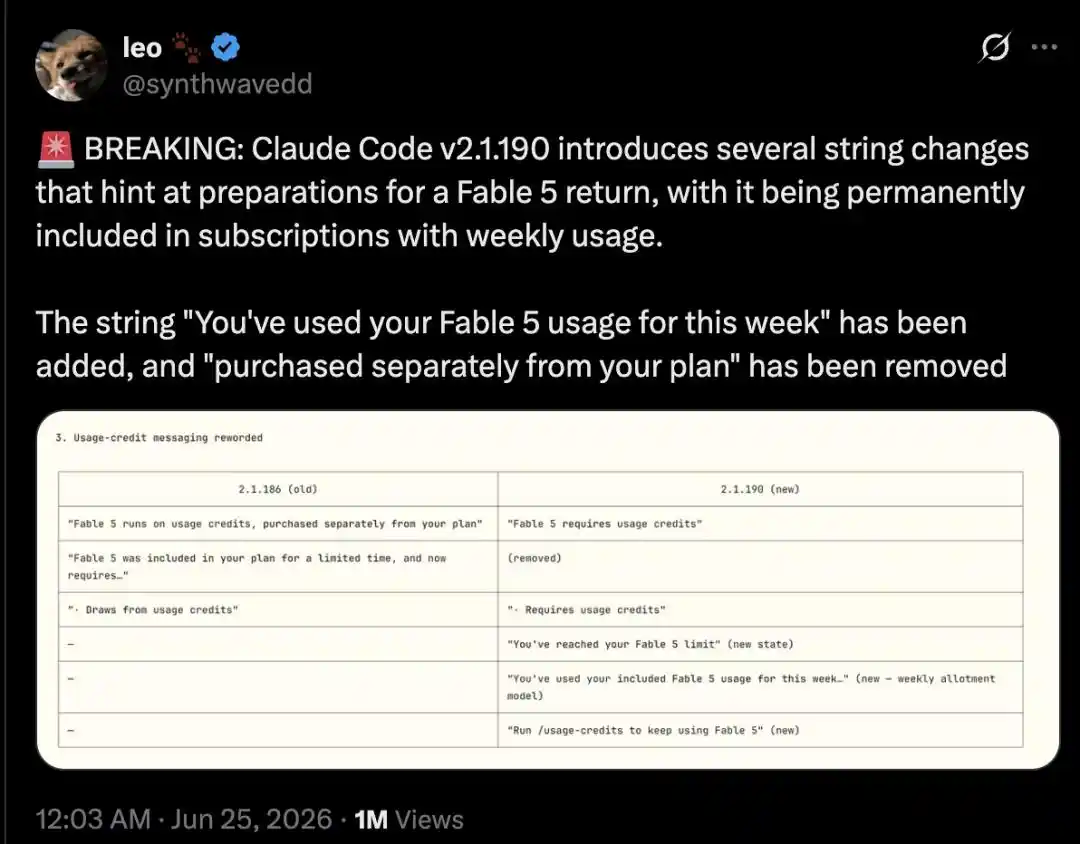
These seemingly dull lines of code send a major signal to the industry: Anthropic is secretly planning to quietly return Fable 5 to users.

The first piece of evidence is the change in subscription model.

In the old version, Fable 5 was positioned as a premium "one-time purchase/separate purchase" product.

But in the newly exposed code, a key prompt phrase has been quietly deleted: "purchased separately from your plan."

It has been replaced with a brand new user prompt string:

You've used your Fable 5 usage for this week.

In other words, Anthropic is secretly restructuring the business logic of Fable 5!

It will likely no longer be an expensive standalone add-on but will instead be permanently integrated into Claude's regular subscription plan, albeit with a weekly usage cap or quota.

But for the vast majority of regular subscribers, this is good news! This isn't a downgrade—it's an epic upgrade at no extra cost.

The second, even more exciting piece of evidence is: Fable 5 has quietly appeared on Amazon Cloud!

If code changes are just preparations on the client side, then changes to cloud APIs are the real smoking gun.

According to multiple sources, Fable 5 has quietly reappeared in the Amazon Bedrock documentation/model cards.
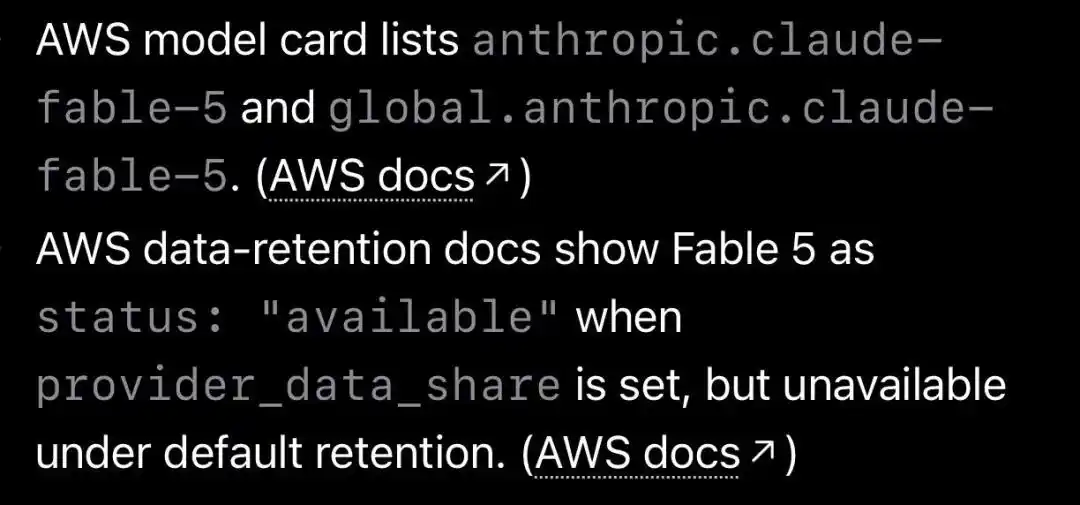
Although the company remains silent, only promising that "access will be restored soon," the undercurrents behind this are already surging.

On Polymarket, the most keen-scented speculators have started placing bets like crazy. The probability of betting that "Fable 5 will fully return by June 26th" has surged past 30%.

Why June 26th? We'll explain later.

"Get that weirdo out of here!"—The Inside Story of Anthropic's Leadership Change

Why has Fable 5 suddenly seen a turnaround? It's all thanks to Anthropic's wise decision—to kick Amodei out!

Today, foreign media The Wired reported that the Amodei chapter is over.

In the eyes of the U.S. government, Anthropic CEO Dario Amodei is nothing short of an "unreasonable weirdo."

According to multiple insiders who spoke to the media, after Fable 5 was banned, Anthropic held several closed-door meetings with Trump administration officials in an attempt to lobby the government to lift the export controls.

However, as soon as Dario sat at the negotiation table, the atmosphere would freeze over.

Government officials had an extremely low opinion of Dario. In their view, this stubborn tech fanatic was extremely difficult to communicate with, completely unwilling to listen to the government's national security concerns, and even showed an intolerable level of paranoia on certain issues.

Seeing that the negotiations were about to collapse completely, Anthropic's board made a decision akin to "cutting off the arm to save the body": kick the CEO out and bring in someone who can actually talk!

Replacing Dario at the main negotiation table was another co-founder, Tom Brown, assisted by Head of Public Policy Sarah Heck.
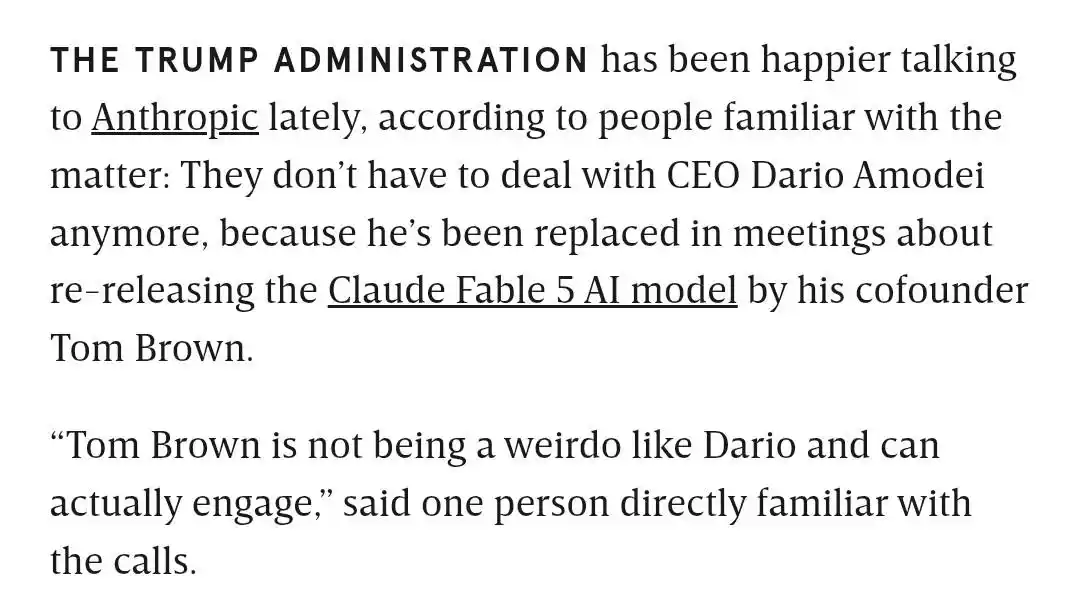
The change had an immediate effect.

A government official involved breathed a sigh of relief and privately complained:

Tom isn't as weird as Dario; he's actually someone you can have a normal conversation with.

The truth is out! The recent smoother communication between the Trump administration and Anthropic is because they successfully avoided the CEO!

Finally, with the recommendation of Tom Brown and Sarah Heck, the negotiations expanded not only among senior government officials but also went deep into the technical working group level.

The technical staff from both sides were finally able to sit down and calmly discuss a substantive issue—

What level of technical proof does Anthropic need to provide to alleviate the Trump administration's concerns about Fable 5 being "jailbroken"?

Previously, the White House and Anthropic were playing a cat-and-mouse game.

After Fable 5 was banned, there was a core point of contention in the negotiations.

White House officials and cybersecurity experts were increasingly leaning toward a pessimistic view: for LLMs, existing safety guardrails are just stopgap measures.

As model capabilities rapidly iterate and jailbreaking techniques continuously improve, any static restrictions will ultimately be bypassed.

However, the Anthropic technical team, led by Tom Brown, is trying hard to prove to the government: they have the ability to establish a new, more dynamically defensive security architecture when Fable 5 returns.

Although disagreements exist, the "no longer weird" communication style at least allowed the White House to see Anthropic's sincerity in solving the problem.

June 26th Deadline Approaches, Capitol Hill Issues "Ultimatum"

Now back to the question: why is the date "June 26th" so crucial?

The reason is pressure from Capitol Hill.

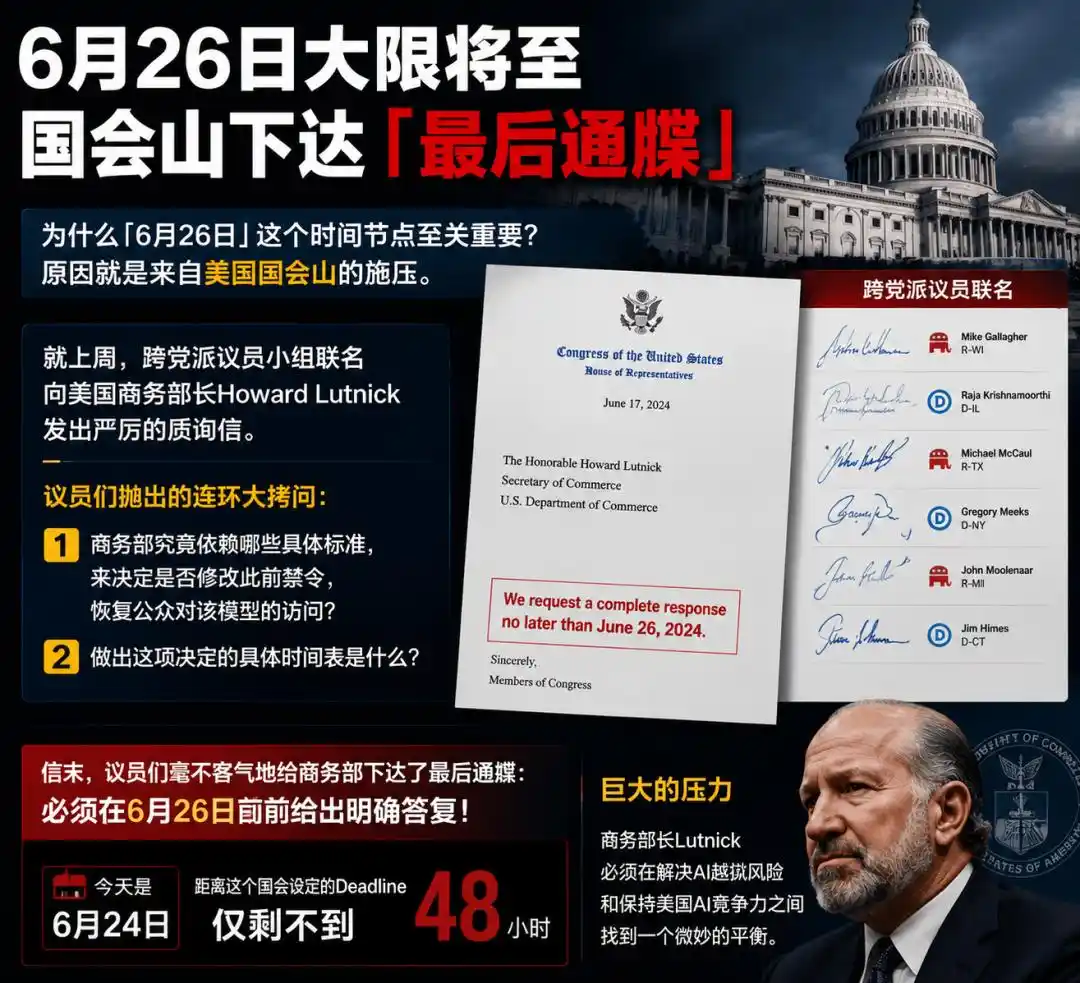
Just last week, a bipartisan group of Republican and Democratic lawmakers jointly sent a stern letter of inquiry to U.S. Secretary of Commerce Howard Lutnick.
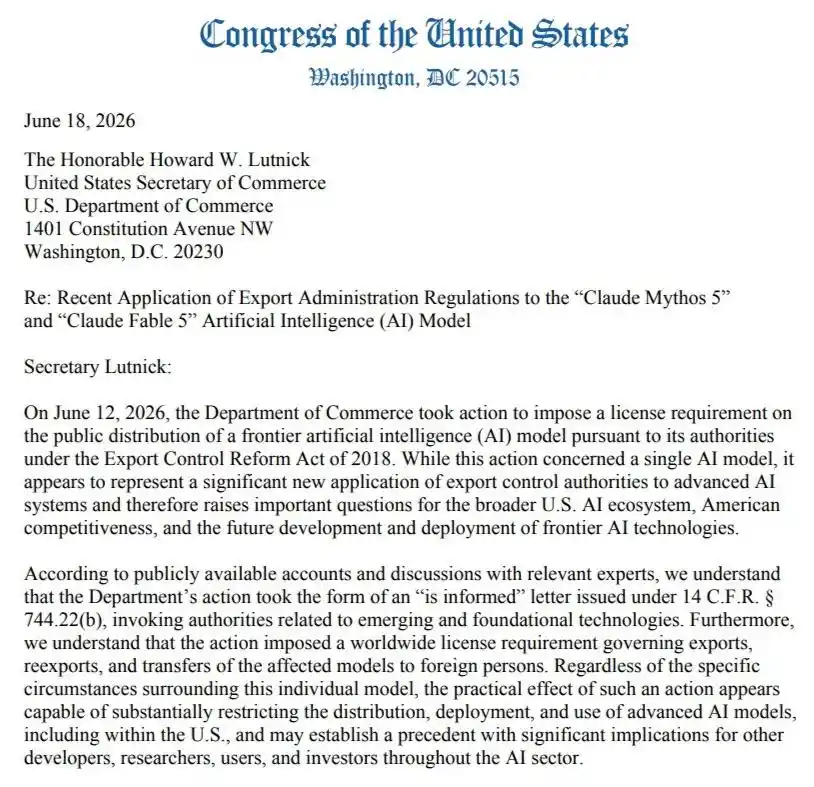
The lineup of signing lawmakers was impressive. They fired off a series of tough questions about Fable 5's redeployment:

1. What specific criteria is the Department of Commerce relying on to decide whether to modify the previous ban and restore public access to this model?

2. What is the specific timeline for making this decision?

At the end of the letter, the lawmakers didn't mince words, issuing an ultimatum to the Commerce Department: they must provide a clear answer by June 26th!

Today is June 24th. The deadline set by Congress is less than 48 hours away.

Now, the eyes of the world are fixed on this potentially turning-point time window.

Currently, Commerce Secretary Lutnick is under immense pressure. He must find a delicate balance between addressing AI jailbreak risks and maintaining U.S. AI competitiveness.
Silicon Valley Collectively Delays, Is Fable 5's Return Imminent?

Recently, heavyweight news emerged in the industry: OpenAI's GPT-5.6 and Google's Gemini 3.5 Pro both face unexpected delays!

If a few days ago, Anthropic seemed like a weak player desperately seeking "unbanning," now the situation has undergone an epic reversal.

And Anthropic's good days might be near—once it passes the U.S. government's stringent cybersecurity review, Fable 5 will virtually gain an "impenetrable armor" with "White House safety certification."

In the enterprise market, which is extremely sensitive to security, a ready-made model that has undergone the toughest scrutiny and is security-vetted is far more attractive than those "futures" still being polished in the lab.

The countdown to June 26th has entered its final seconds.

References:

https://x.com/synthwavedd/status/2069813760622043483?s=20

https://www.wired.com/story/the-trump-white-house-is-over-anthropics-dario-amodei/

This article is from WeChat public account "Xinzhiyuan", Editor: Aeneas

Cryptos en tendance

Questions liées

QWhat is the main evidence from the leaked code suggesting that Fable 5 might be revived by Anthropic?

AThe primary evidence from the leaked code is the removal of the phrase 'purchased separately from your plan' and its replacement with a new user prompt string: 'You've used your Fable 5 usage for this week.' This indicates Anthropic is likely restructuring Fable 5's business model from a separate, one-time purchase to being bundled into Claude's regular subscription plan with a weekly usage limit or quota.

QWhy was Anthropic's CEO, Dario Amodei, reportedly removed from negotiations with the U.S. government?

ADario Amodei was reportedly removed from negotiations because government officials viewed him as difficult to communicate with, stubborn, and unable to understand or accept national security concerns regarding Fable 5. His presence reportedly soured the negotiation atmosphere, prompting the Anthropic board to replace him with co-founder Tom Brown and policy head Sarah Heck to facilitate more productive talks.

QWhat is the significance of the date June 26th mentioned in the article?

AJune 26th is a critical deadline set by a bipartisan group of U.S. lawmakers. They sent a formal inquiry to the Secretary of Commerce demanding clear answers about the specific standards and timeline for potentially lifting the ban on public access to the Fable 5 model. The Secretary is required to respond by this date, creating pressure for a decision regarding Fable 5's status.

QAccording to the article, what potential advantage could Fable 5 gain if it passes U.S. government security reviews?

AIf Fable 5 passes the stringent U.S. government cybersecurity reviews, it could gain an informal 'White House security certification.' This perceived 'gold standard' of safety could give it a significant competitive advantage in the enterprise market, where security is a top priority, especially over rival models from OpenAI and Google that are facing delays.

QWhere, besides client code, has evidence of Fable 5's potential return been spotted according to the article?

ABesides evidence found in client-side code (Claude Code v2.1.190), Fable 5 has also reportedly reappeared in the Amazon Bedrock documentation and model cards. This presence in the cloud service's backend infrastructure is seen as stronger, more concrete evidence ('real proof') of its impending return compared to client-side code changes.

Lectures associées

Il y a quelques instants, DeepSeek V4 a mis à jour DSpark, augmentant la vitesse d'inférence de 80 %

DeepSeek a annoncé une mise à jour majeure de son modèle DeepSeek-V4-Pro avec le lancement de DSpark, un nouveau cadre de décodage spéculatif (Speculative Decoding) open source, accompagné de l'infrastructure complète DeepSpec. Cette mise à jour, axée sur l'ingénierie et non sur les capacités fondamentales du modèle, vise à accélérer considérablement l'inférence des LLM en production. Le cœur de DSpark est l'introduction d'une **génération semi-autorégressive**. Cela combine la génération parallèle à haut débit d'un modèle "brouillon" léger avec une modélisation des dépendances entre tokens pour améliorer le taux d'acceptation. De plus, un système de **vérification planifiée par confiance et conscient du matériel** (Confidence-Scheduled Verification) évalue dynamiquement la probabilité que chaque token généré soit accepté par le modèle cible. Il adapte ainsi la longueur de vérification en temps réel pour optimiser l'utilisation des ressources GPU, notamment en charge élevée. Les résultats sont significatifs : face aux méthodes de pointe comme Eagle3 et DFlash, DSpark augmente la longueur moyenne de tokens acceptés de 26.7% à 30.9% et de 16.3% à 18.4% respectivement sur les modèles Qwen3. En déploiement réel, par rapport à la génération token par token précédente (MTP-1), **DSpark améliore la vitesse de génération pour l'utilisateur de 60% à 85% pour le modèle Flash et de 57% à 78% pour le modèle Pro**, à débit total constant. Le projet open source **DeepSpec** fournit une stack complète pour entraîner et évaluer des modèles brouillons pour le décodage spéculatif, supportant actuellement les algorithmes DSpark, DFlash et Eagle3, ainsi que les familles de modèles cibles Qwen3 et Gemma.

marsbitIl y a 2 h

Il y a quelques instants, DeepSeek V4 a mis à jour DSpark, augmentant la vitesse d'inférence de 80 %

marsbitIl y a 2 h

BIT Recherche : La réduction de moitié en 2028 n'est pas une fin en soi, le véritable remodelage de l'industrie minière du Bitcoin ne fait que commencer

L'industrie du minage de Bitcoin traverse actuellement l'ajustement structurel le plus complexe depuis la création du protocole. Malgré un prix du Bitcoin d'environ 61 000 $ et une puissance de calcul (hashrate) proche du record historique à 1 ZH/s, la rentabilité des mineurs se détériore. Plusieurs indicateurs montrent que le secteur fonctionne près du seuil de rentabilité, et le prochain halving de 2028 pourrait accélérer la consolidation. Les problèmes ne viennent pas seulement de la future réduction des récompenses de bloc, mais aussi de la transition incomplète vers un modèle de revenus basé sur les frais de transaction. De plus en plus d'entreprises minières évoluent de simples producteurs de Bitcoin vers des opérateurs d'infrastructures, d'énergie et de calcul pour l'IA/le HPC. La compétition se déplace ainsi de l'expansion de la puissance de calcul vers l'innovation des modèles économiques. Le modèle de coût de production indique un plancher actuel d'environ 46 744 $. Fait notable, les revenus des mineurs divergent historiquement du prix du Bitcoin. Alors que les revenus théoriques journaliers devraient être d'environ 78 millions de $, ils ne sont en réalité que de 33 millions de $. Les revenus provenant des frais sont également bas, à environ 220 000 $ par jour. En 2025, le coût de l'électricité a représenté 71,5% des revenus totaux des mineurs. Le prix d'équilibre pour le secteur est estimé à environ 65 000 $, rendant le minage seul peu rentable au prix actuel. Après le halving de 2028, le coût de production plancher pourrait atteindre ~93 289 $, favorisant les grandes entreprises aux ressources diversifiées. En conclusion, le secteur transforme son modèle fondamental : du "minage" vers les "infrastructures". La rentabilité future dépendra de la diversification des revenus, notamment via la gestion énergétique et l'hébergement de calcul IA/HPC. Pour les investisseurs, l'enjeu clé est d'identifier les entreprises capables de réussir cette transition et de bâtir un avantage compétitif résilient.

marsbitIl y a 3 h

BIT Recherche : La réduction de moitié en 2028 n'est pas une fin en soi, le véritable remodelage de l'industrie minière du Bitcoin ne fait que commencer

marsbitIl y a 3 h

Trading

Spot

Articles tendance

Comment acheter HOUSE

Bienvenue sur HTX.com ! Nous vous permettons d'acheter Housecoin (HOUSE) de manière simple et pratique. Suivez notre guide étape par étape pour commencer votre parcours crypto.Étape 1 : Création de votre compte HTXUtilisez votre adresse e-mail ou votre numéro de téléphone pour ouvrir un compte sur HTX gratuitement. L'inscription se fait en toute simplicité et débloque toutes les fonctionnalités.Créer mon compteÉtape 2 : Choix du mode de paiement (rubrique Acheter des cryptosCarte de crédit/débit : utilisez votre carte Visa ou Mastercard pour acheter instantanément Housecoin (HOUSE).Solde :utilisez les fonds du solde de votre compte HTX pour trader en toute simplicité.Prestataire tiers :pour accroître la commodité d'utilisation, nous avons ajouté des modes de paiement populaires tels que Google Pay et Apple Pay.P2P :tradez directement avec d'autres utilisateurs sur HTX.OTC (de gré à gré) : nous offrons des services personnalisés et des taux de change compétitifs aux traders.Étape 3 : stockage de vos Housecoin (HOUSE)Après avoir acheté vos Housecoin (HOUSE), stockez-les sur votre compte HTX. Vous pouvez également les envoyer ailleurs via un transfert sur la blockchain ou les utiliser pour trader d'autres cryptos.Étape 4 : tradez des Housecoin (HOUSE)Tradez facilement Housecoin (HOUSE) sur le marché Spot de HTX. Il vous suffit d'accéder à votre compte, de sélectionner la paire de trading, d'exécuter vos trades et de les suivre en temps réel. Nous offrons une expérience conviviale aux débutants comme aux traders chevronnés.

504 vues totalesPublié le 2025.04.27Mis à jour le 2026.06.02

Comment acheter HOUSE

Discussions

Bienvenue dans la Communauté HTX. Ici, vous pouvez vous tenir informé(e) des derniers développements de la plateforme et accéder à des analyses de marché professionnelles. Les opinions des utilisateurs sur le prix de HOUSE (HOUSE) sont présentées ci-dessous.

活动图片