Standard Chartered Bank Places a 40x 'Bet', Calls for UNI to Rise to $100

marsbitPublié le 2026-06-16Dernière mise à jour le 2026-06-16

Résumé

Standard Chartered Bank’s digital asset research head, Geoff Kendrick, initiated coverage on Uniswap with a highly bullish long-term price target of $100 for its UNI token by 2030—a roughly 40-fold increase from its ~$2.60 trading price at the time of the report. The bank’s thesis hinges on the exponential growth of tokenized real-world assets (RWA), projected to surge from ~$340 billion to $4 trillion by 2028. It expects the share of these assets deployed in DeFi to rise from 3.5% to 30%, driving total DeFi TVL to around $2.7 trillion. As the leading decentralized exchange (DEX), Uniswap is positioned to capture a significant portion of this liquidity influx. A key catalyst is Uniswap’s “fee switch,” activated in late 2024, which directs a portion of protocol fees to UNI token buybacks and burns. This transforms UNI from a pure governance token into a yield-generating, deflationary asset, narrowing its valuation gap with centralized exchanges like Coinbase. The report draws an analogy: Coinbase operates like Netflix (centralized, high-cost), while Uniswap functions like YouTube (open, user-generated, network-effect driven). Despite its dominant market share and recent institutional adoption—such as BlackRock’s BUIDL fund and Fidelity’s stablecoin using Uniswap for liquidity—the path faces challenges. Competition from Solana-based DEXs and aggregators threatens user mindshare, while regulatory delays or setbacks in RWA adoption could slow the projected growth. Furthermore,...

Author: Jae, PANews

A research report from a traditional bank has ignited the somewhat quiet DeFi sector.

On June 15, Geoff Kendrick, Global Head of Digital Assets Research at Standard Chartered Bank, released a first-time coverage report on the DEX (decentralized exchange) Uniswap, making a radical prediction that turned heads in the crypto market: the price of Uniswap's governance token UNI is expected to surge approximately 40-fold before the end of 2030, reaching the $100 milestone.

At the time, UNI was trading at only around $2.6.

Once derided as a "governance token with no substance," UNI is being repriced by Wall Street as a productive asset with network effects. Although the distant narrative of a 40x gain is tempting enough, the journey to that endpoint may not be entirely smooth.

Wall Street's 40x Growth Script for UNI: Four Numbers, One Main Theme

In Standard Chartered's deconstruction logic, Uniswap is being embedded within a valuation framework for the deep integration of traditional finance and the on-chain world.

Exponential Expansion of RWA Tokenization ($340B → $4T)

The starting point for growth is the wave of RWA (Real World Asset) tokenization. Standard Chartered predicts that the global scale of on-chain tokenized assets will experience exponential growth, soaring from the current approximately $340 billion to $4 trillion by the end of 2028. Asset management giants like Fidelity and BlackRock are batch-uploading traditional assets like stocks, government bonds, and money market funds onto blockchains, meaning the liquidity of on-chain tokenized assets will expand at a pace far exceeding industry expectations.

This is equivalent to building a much larger reservoir for the DeFi track: the asset scale must be established first, and only then can subsequent financial activities like trading, lending, and staking have sufficient underlying assets to carry them.

DeFi Penetration Rate Leap (3.5% → 30%) Drives TVL Higher (37x)

Getting assets on-chain is only the first step; stagnant water needs to become flowing water. Simply put, only when assets flow into DeFi protocols can they be converted into protocol revenue and value. Standard Chartered expects that currently only about 3.5% of tokenized assets are deployed in the DeFi ecosystem. This proportion is projected to increase to 30% by 2030.

Driven by the dual engines of native crypto asset growth and RWA migration to chains, the overall DeFi TVL (Total Value Locked) is projected to skyrocket 37-fold from current levels by 2030, reaching approximately $2.7 trillion.

Fee Switch Provides Price Support (40x)

Uniswap, as the primary hub for on-chain liquidity, will become the biggest beneficiary of this tidal wave of capital. Its token, UNI, is also expected to rise from $2.6 to $100, capturing a near 40-fold increase.

The long-term price path for UNI provided by Standard Chartered is: $6.5 by end of 2026 → $20 by end of 2027 → $40 by end of 2028 → $65 by end of 2029 → $100 by end of 2030.

In the past, UNI was once mocked by the market as an "air token" because it only conferred governance rights and had no cash flow capture capability. At the end of last year, Uniswap activated the fee switch, officially ushering UNI into a deflationary era.

The report points out that on December 28th of last year, Uniswap destroyed 100 million UNI in a single move, and additionally burned 5 million UNI, reducing the total supply from 1 billion to 895 million. The circulating supply has also dropped to 622 million. This contraction in supply will provide support for the UNI price.

Furthermore, Uniswap has also generated approximately $21 million in protocol fees. The linear relationship between fees and trading volume means that as tokenized assets flood into the protocol, the fee switch will automatically trigger more burn. This signifies that UNI is transitioning from a "pure governance tool" to a "productive asset with deflationary properties," directly narrowing the valuation multiple gap between Uniswap and listed exchanges like Coinbase.

It is worth mentioning that Geoffrey Kendrick also proposed a vivid business analogy in the report: likening Uniswap to YouTube, and Coinbase to Netflix.

  • Coinbase (Netflix model): Centralized operation, heavy asset investment, requiring high capital support. Listing assets and compliance involve multi-layered screening, with high marginal costs for expansion, making it easier to limit the variety of asset classes covered.

  • Uniswap (YouTube model): An open liquidity pool architecture where any user can be a "content creator" (liquidity provider). The platform does not incur high costs for listing assets. In scenarios like stablecoin trading, liquid staking derivatives, and niche tokens, the network effects and long-tail advantages of this open model are hard for centralized exchanges (CEXs) to match.

This two-sided effect, which grows more prosperous with use, is precisely the moat that allows Uniswap to maintain its leading position in the long run.

More importantly, Standard Chartered believes Uniswap is far from a simple "retail DEX application." Its essence is a set of integrable market infrastructure. Once RWA scales up, traditional financial institutions can directly "plug" assets into Uniswap's liquidity pools for trading. This is a functionality that traditional financial markets themselves cannot achieve.

Uniswap Becomes Preferred On-ramp for Traditional Funds, Yet Faces Pincer Attack from Emerging DEXs and Aggregators

Wall Street's distant lens is captivating enough, but returning to the reality of the crypto market, Uniswap's actual situation is not as straightforwardly linear as portrayed in the research report.

Since its founding in 2018, Uniswap's cumulative trading volume has exceeded $3.7 trillion, with cumulative fees as high as $5.6 billion. Its TVL is approximately $2.88 billion.
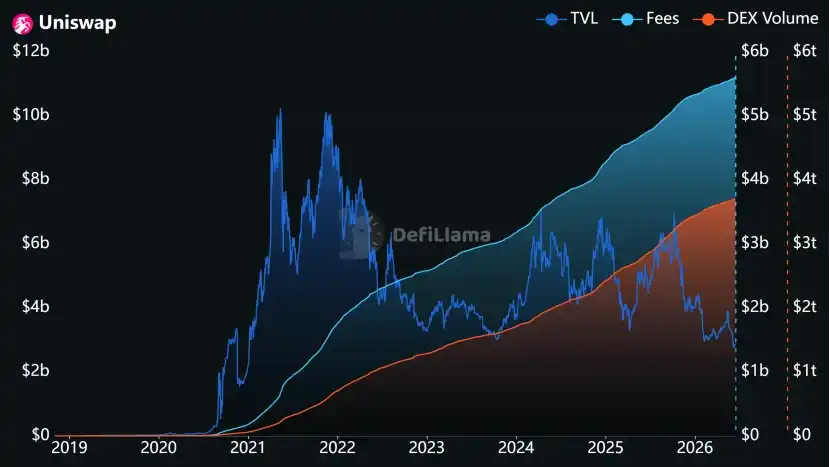
In terms of market share, Uniswap's DEX throne remains solid. Whether on the Ethereum mainnet or across major L2 ecosystems, Uniswap's trading volume and liquidity depth hold a dominant position, with no competitor posing a substantive threat.

More significant signals come from the institutional side. In February this year, BlackRock's tokenized money market fund BUIDL announced it would be available for trading on UniswapX and strategically purchased UNI tokens. With the adoption of UniswapX, which introduces features like off-chain routing, gasless transactions, and MEV (Miner Extractable Value) resistance, the experience gap between DEXs and CEXs is significantly narrowed, making it the preferred on-ramp for traditional capital.

Similarly, last Friday (June 12th), Fidelity also deployed liquidity for its stablecoin, FIDD, on Uniswap. The protocol's concentrated liquidity model is currently the most efficient pricing mechanism on-chain. Once compliant RWA assets are tokenized on a large scale, Uniswap is poised to become the "New York Stock Exchange" on-chain, holding the power of asset pricing.

Wall Street's water is flowing on-chain. And Uniswap is that faucet. Wall Street institutions are treating Uniswap as the on-chain interface for compliant assets, and UNI is also moving towards a pricing logic akin to "on-chain routing infrastructure."

Although the vision of a $100 endpoint is quite enticing, two major obstacles still lie in Uniswap's path to the summit, which could significantly delay or even nullify this distant promise.

  • Traffic Hijacking by Emerging DEXs and Aggregators (Competitive Risk): Solana-based DEXs like Jupiter and Raydium, riding on Meme mania and extremely low transaction costs, have captured a massive amount of retail traffic. Meanwhile, aggregators like 1inch and CowSwap intercept users at the front-end, reducing Uniswap to a mere "backend liquidity pool" in certain ecosystems, continuously eroding its brand premium and user mindshare.

  • Delays in Tokenization Adoption (Macro Risk): Standard Chartered's valuation heavily relies on the assumption that "DeFi TVL will reach $2.7 trillion by 2030." If global legislative progress on tokenization falls short of expectations, or if large-scale security incidents or systemic risks occur, the penetration rate of RWA could slow down significantly, potentially severely postponing the realization cycle of this grand narrative.

Returning to the most intuitive price perspective, UNI is currently trading below $3, down more than 92% from its all-time high in May 2021.

The fee switch brought deflation but not a price reversal. Market apathy towards the DeFi narrative, depleted liquidity, and high macro interest rates have all put significant pressure on UNI's valuation.

However, this might be precisely the source of the "40x potential" in Standard Chartered's eyes: starting from a low base.

Standard Chartered's first-time coverage of UNI with a $100 target price carries more symbolic significance than the price itself. In reality, the accuracy of the prediction is not the most important thing; what matters is that Wall Street's perception of DeFi is evolving: shifting from the early days of "unbridled growth and speculative bubbles" towards a rational business judgment based on "capital efficiency, network effects, and cash flow value."

It should be noted that Wall Street research reports are often strong on macro logic but short on micro risks. For investors immersed in this space, the 40x endpoint is undoubtedly attractive, but the road to 2030 is also destined to be strewn with thorns.

Whether UNI can truly capture the $4 trillion tokenization红利 depends on how skillfully it performs the high-difficulty dance between the principles of decentralization and global regulatory compliance in the real world.

More challenging than a 40x gain might be the four-year wait, which tests faith even more.

Questions liées

QWhat is the key prediction made by Standard Chartered Bank's research report on Uniswap's UNI token?

AStandard Chartered Bank predicts that Uniswap's governance token, UNI, will surge approximately 40 times, reaching $100 by the end of 2030.

QWhat are the two main business models Geoffrey Kendrick compares Uniswap and Coinbase to in the report?

AThe report compares Coinbase to Netflix (centralized, high capital costs, curated assets) and Uniswap to YouTube (open, user-generated liquidity, low marginal costs, strong network effects).

QAccording to the report, what two major factors are critical for achieving the $100 UNI price target?

AThe $100 price target relies on: 1) The massive expansion of tokenized real-world assets (RWA) to $4 trillion, and 2) A significant increase in the proportion of these assets flowing into DeFi, from 3.5% to 30% by 2030.

QWhat recent development changed UNI's economic model from a 'pure governance tool'?

AThe activation of the 'fee switch' mechanism. It initiated token burns (reducing total supply) and allows UNI to capture protocol fees, transforming it into a deflationary, revenue-generating asset.

QWhat are the two main challenges or risks identified for Uniswap's growth path to 2030?

AThe two main challenges are: 1) Competitive pressure from emerging DEXs (like Jupiter, Raydium) and aggregators that can divert user flow. 2) The macro risk of delayed adoption of tokenized assets if regulatory progress or market conditions slow down.

Lectures associées

Début de Warsh : le président de la Fed le plus au fait du Crypto de l'histoire apportera-t-il des surprises ou des chocs au marché ?

**Résumé :** Kevin Warsh, nouveau président de la Réserve fédérale américaine, s'apprête à tenir sa première conférence de presse monétaire. Sa nomination est historique : il est le premier président de la Fed à détenir personnellement des actifs numériques (investissements indirects dans Solana, dYdX, etc.), montrant une compréhension unique du secteur. Son dilemme est majeur : il doit faire face à une résurgence de l'inflation, qui exige une politique monétaire stricte (position "de faucon"), tout en répondant aux pressions politiques pour des baisses de taux. Parallèlement, son attitude envers les crypto-actifs diffère fondamentalement de celle de son prédécesseur. Il ne les considère pas comme de simples actifs spéculatifs, mais plutôt comme un "bon policier" pour la politique économique et une composante de la compétitivité américaine. Son impact potentiel sur le marché crypto s'articule autour de trois axes : 1. Un changement de paradigme réglementaire, passant de la prévention à l'intégration et à l'innovation. 2. Une reprixation des actifs liée aux taux d'intérêt, où sa clarté de communication pourrait réduire la prime d'incertitude. 3. Une légitimation accrue pouvant attirer les capitaux institutionnels traditionnels. Deux scénarios principaux sont envisagés pour sa première intervention : * **Scénario "Surprise"** : Un ton modéré ("de colombe") sur les taux combiné à des signaux favorables à l'innovation numérique pourrait booster le marché. * **Scénario "Choc"** : Un message excessivement restrictif sur les taux pourrait entraîner une vente généralisée des actifs risqués, y compris les cryptos. Bien qu'il ait dû vendre ses actifs crypto pour des raisons d'éthique, la compréhension intrinsèque de Warsh pour la technologie blockchain pourrait, à long terme, poser les bases d'une intégration plus structurelle des actifs numériques dans le système financier.

marsbitIl y a 2 h

Début de Warsh : le président de la Fed le plus au fait du Crypto de l'histoire apportera-t-il des surprises ou des chocs au marché ?

marsbitIl y a 2 h

XRP Ledger Lance le Rebranding XRPld Avec la Mise à Niveau Version 3.2.0

La version 3.2.0 du XRP Ledger (XRPL) est désormais disponible, introduisant une refonte majeure incluant le changement de nom du logiciel principal de « rippled » à « xrpld ». Cette mise à niveau se concentre principalement sur les améliorations des performances, de la sécurité et de l'évolutivité de l'infrastructure sous-jacente, plutôt que sur de nouvelles fonctionnalités utilisateur. Les principales avancées incluent des optimisations de mémoire pouvant réduire jusqu'à 40% l'utilisation de la mémoire serveur. Sur le plan de la sécurité, la modification `fixCleanup3_2_0` renforce plusieurs modules, notamment les coffres-forts à actif unique, le protocole de prêt, les échanges décentralisés et les jetons multi-usages. De nouveaux contrôles d'invariance garantissent la cohérence du registre après la suppression de comptes. Pour les développeurs, la mise à jour permet désormais de récupérer des informations sur les définitions du protocole et du serveur XRPL sans nécessiter de connexion active, facilitant ainsi la création de portefeuilles, d'explorateurs de blockchain et d'APIs. En termes d'évolutivité et de stabilité, les améliorations comprennent des tailles de bloc configurables, un stockage de base de données optimisé via nuDB, et le support optionnel de TLS/mutual TLS pour le serveur gRPC. Le port de peering par défaut est également passé du 51235 au 2459. Divers correctifs ont été apportés aux fonctions liées aux Market Makers Automatisés, aux paiements, aux séquestres de jetons et aux carnets d'ordres. Une note importante : les invariants de transaction ont été temporairement désactivés dans la v3.2.0 en raison d'un impact sur les performances, mais cela ne présente pas de risque pour la sécurité.

TheNewsCryptoIl y a 2 h

XRP Ledger Lance le Rebranding XRPld Avec la Mise à Niveau Version 3.2.0

TheNewsCryptoIl y a 2 h

L'AGI n'est pas l'arrivée, nouveau document de DeepMind : Vers l'ASI, le véritable progrès de l'IA ne fait que commencer

Si l'intelligence artificielle générale (IAG) était atteinte demain, quelle serait la prochaine étape ? Une étude de Google DeepMind suggère que l'IAG n'est pas un point final, mais une étape vers une superintelligence artificielle (ISA) dépassant les collectifs d'experts humains. L'étude distingue trois concepts : l'IAG (niveau médian humain), l'ISA (supérieure aux meilleurs collectifs humains dans presque tous les domaines) et l'IA universelle (limite théorique). Elle propose quatre voies potentielles vers l'ISA : 1. **Extension des ressources** : augmentation de la puissance de calcul, des données et des modèles. 2. **Évolution algorithmique** : améliorations incrémentales ou nouveaux paradigmes (apprentissage continu, utilisation d'outils, modèles du monde). 3. **Auto-amélioration récursive** : des IA plus performantes conçoivent la génération suivante, créant une boucle de rétroaction positive. 4. **Coordination multi-agents** : des systèmes IAG collaborant atteignent une intelligence collective supérieure. L'étude identifie six principaux goulets d'étranglement : 1. **Le mur des données** : les données humaines de haute qualité pourraient s'épuiser. 2. **Pressions économiques et ressources naturelles** : coûts énergétiques et matériels. 3. **Limites des paradigmes neuronaux actuels** : problèmes d'apprentissage continu, de raisonnement robuste, d'hallucinations. 4. **Difficulté croissante de la recherche**. 5. **Barrières à l'abstraction** : difficulté à former de nouveaux concepts fondamentaux. 6. **Régulation, gouvernance et réaction sociale**. Un défi crucial est l'évaluation des capacités de l'IA au-delà du niveau humain, nécessitant de nouveaux benchmarks. L'étude conclut que la progression vers l'ISA reste incertaine, soumise à des contraintes physiques et de ressources, et appelle à un effort de recherche interdisciplinaire pour mieux anticiper cette évolution.

marsbitIl y a 3 h

L'AGI n'est pas l'arrivée, nouveau document de DeepMind : Vers l'ASI, le véritable progrès de l'IA ne fait que commencer

marsbitIl y a 3 h

Trading

Spot
Futures

Articles tendance

Comment acheter UNI

Bienvenue sur HTX.com ! Nous vous permettons d'acheter Uniswap (UNI) de manière simple et pratique. Suivez notre guide étape par étape pour commencer votre parcours crypto.Étape 1 : Création de votre compte HTXUtilisez votre adresse e-mail ou votre numéro de téléphone pour ouvrir un compte sur HTX gratuitement. L'inscription se fait en toute simplicité et débloque toutes les fonctionnalités.Créer mon compteÉtape 2 : Choix du mode de paiement (rubrique Acheter des cryptosCarte de crédit/débit : utilisez votre carte Visa ou Mastercard pour acheter instantanément Uniswap (UNI).Solde :utilisez les fonds du solde de votre compte HTX pour trader en toute simplicité.Prestataire tiers :pour accroître la commodité d'utilisation, nous avons ajouté des modes de paiement populaires tels que Google Pay et Apple Pay.P2P :tradez directement avec d'autres utilisateurs sur HTX.OTC (de gré à gré) : nous offrons des services personnalisés et des taux de change compétitifs aux traders.Étape 3 : stockage de vos Uniswap (UNI)Après avoir acheté vos Uniswap (UNI), stockez-les sur votre compte HTX. Vous pouvez également les envoyer ailleurs via un transfert sur la blockchain ou les utiliser pour trader d'autres cryptos.Étape 4 : tradez des Uniswap (UNI)Tradez facilement Uniswap (UNI) sur le marché Spot de HTX. Il vous suffit d'accéder à votre compte, de sélectionner la paire de trading, d'exécuter vos trades et de les suivre en temps réel. Nous offrons une expérience conviviale aux débutants comme aux traders chevronnés.

477 vues totalesPublié le 2024.12.12Mis à jour le 2026.06.02

Comment acheter UNI

Discussions

Bienvenue dans la Communauté HTX. Ici, vous pouvez vous tenir informé(e) des derniers développements de la plateforme et accéder à des analyses de marché professionnelles. Les opinions des utilisateurs sur le prix de UNI (UNI) sont présentées ci-dessous.

活动图片













