From Identity Protocol to AI Gateway: How Ambitious Is World?

marsbitPublié le 2026-06-16Dernière mise à jour le 2026-06-16

Résumé

The article discusses Worldcoin's (WLD) evolution from a "proof of personhood" network to a potential identity infrastructure for the AI era. Initially focused on unique digital identities via iris scans, Worldcoin faced skepticism over real-world use cases. However, entering "The Simple Plan" Phase 3, it's shifting from token incentives to utility-driven growth. Key applications are emerging: enterprise solutions (e.g., deepfake verification with Zoom, Okta), consumer use cases (e.g., reducing bots on Tinder or in ticket sales), and notably, the AI Agent sector via AgentKit, which aims to establish trusted authorization between humans and AI agents. The author argues AI's proliferation makes authentic human identity a scarce and valuable resource. Worldcoin's strategy is now focused on key markets for network effects and developing self-service Orb hardware to scale sustainably. The launch of World ID 4.0 introduces a fee model for issuers/protocols, creating a potential revenue stream. In conclusion, WLD's rise reflects a market reassessment. Worldcoin's ambition is to become the foundational identity layer and crucial entry point for the coming AI Agent economy, moving crypto narratives beyond finance into verifiable human identity.

Author:Flora,CryptoPulse Labs

Recently, in the cryptocurrency market, WLD has become one of the focal points of market attention. Market data shows that WLD has continued to rise, breaking through $0.6, with a total market capitalization exceeding $3 billion.

The main driver behind the warming market sentiment is World's announcement that it has officially entered the third stage of "The Simple Plan," shifting its growth logic from early-stage token incentives to utility-driven mechanisms. Therefore, the question worth considering now is: is World truly evolving into a critical piece of infrastructure for the AI era?

一、From Iris Scanning to Real-World Application: World Enters a New Phase

From its inception, World's core objective has been unequivocally clear: to build a global "proof-of-personhood" network.

Simply put, it aims to address an increasingly critical problem in the internet world: how to prove you are a real human being, not a bot, script, or AI-generated identity.
In the past few years, this problem seemed distant. However, with the explosion of generative AI, it is rapidly becoming a real-world necessity. Today, AI can generate highly realistic images, videos, and audio, even operate social media accounts in bulk and execute complex tasks autonomously.

In the future, a significant portion of active users on the internet may not be real people but rather AI Agents. Against this backdrop, verifying that the entity on the other end is human is becoming a fundamental issue for the internet.

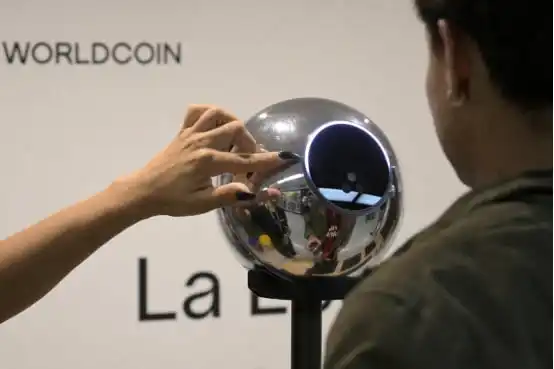
This is precisely the market World aims to capture. Its core product, World ID, uses the Orb device to scan a user's iris, generating a unique digital identity credential for each individual. This system attempts to achieve a "one person, one ID" principle, verifying authenticity while protecting user privacy as much as possible, and supporting on-chain calls.

Previously, the biggest market skepticism towards World was that, while the identity system held great imaginative potential, it consistently lacked real-world use cases. However, as it enters the third stage, this is changing. World has explicitly stated it will promote adoption across three main directions: enterprise, individual users, and AI Agents.

On the enterprise front, World is collaborating with companies like Zoom, Okta, and DocuSign to launch identity verification products targeting deepfake issues. As AI scams and deepfake attacks become more common, the demand for real-person verification is rising rapidly. Whether for video conferencing, remote work, or electronic signing, verifying identity authenticity is becoming crucial.

On the individual user front, World is targeting higher-frequency pain points on the internet. For example, Tinder could use World ID to verify if a user is a real person, and the Concert Kit for ticket purchases could reduce bot scalping and ticket touting.

This means World is attempting to solve the long-standing internet industry problems of fake accounts and bot traffic.

The most noteworthy aspect is the AI Agent front. World has launched AgentKit, aiming to establish a trusted authorization relationship between humans and AI. In the future, if everyone has their own AI assistant, these Agents might help users manage assets, execute transactions, sign agreements, or even participate in on-chain governance.

But before that, the system must be able to verify whom an AI represents and whether it has obtained authorization from a real human. The value of AgentKit lies in establishing a foundational trust framework for the future AI economy.

二、The AI Era: "Real Human Identity" is Becoming Scarce

The core reason for WLD's price increase isn't merely news-driven hype but the market beginning to reprice the scarcity value of "real human identity."

Over the past few years, numerous identity-focused projects have emerged in the crypto market, but most struggled to sustain themselves, fundamentally due to insufficient demand. While traditional internet had identity verification needs, it wasn't enough to support a massive, independent sector. However, the arrival of the AI era has completely changed this logic.

When the cost of generating AI content approaches zero, the truly scarce resource becomes human beings themselves. In the past, the internet's most important resources were traffic, content, and attention. In the future, scarcer resources might be real human identity, real human behavior, and real human authorization.

The reason is simple. AI can infinitely replicate text, images, audio, and even video, but it cannot naturally possess an independent human identity. This means that in the future internet, real humans could become an increasingly scarce resource. Whoever can verify a "real person" holds the key gateway.

This is also why the market is beginning to reassess World's long-term value. It is no longer betting on just a crypto narrative but on a crucial infrastructure need for the AI era.

Simultaneously, World's operational strategy has undergone a significant shift. The team announced it will concentrate resources on a few high-density, high-value cities, including San Francisco, New York, as well as regions like the UK, Germany, Japan, and South Korea, while scaling back operations in non-priority areas. This indicates the team is no longer pursuing widespread expansion but prioritizing establishing network effects in high-value markets first.

The business logic behind this strategy is clear. The value of an identity system inherently comes from network effects. Only when a region has enough users, enterprises, and application scenarios can the true value of World ID be realized. Otherwise, even with user growth, it's difficult to form a stable value loop.

Another key change is hardware upgrades. The next-generation Orb will move towards self-service, aiming to achieve 95% autonomous operation by the end of 2026. This is crucial.

Previously, the bottleneck in Orb expansion was the high labor cost, requiring offline operational support for each additional user. Once the device can achieve large-scale self-service operation, customer acquisition and expansion costs will significantly decrease, making the business model healthier.

三、The AI Agent Era: World Could Become a Key Gateway

From a broader perspective, World's advancement could have profound implications for the crypto industry.

First, it could drive the crypto narrative further from finance into identity. In the past, market discussions about Crypto primarily revolved around DeFi, stablecoins, ETFs, and RWA, essentially financial logic. But World represents another path: identity infrastructure.
In the future, identity itself could become a composable asset. Users with a trusted identity might gain access to airdrops, credit scores, governance rights, and even AI usage permissions.

Around the identity layer, new market sectors could emerge, such as identity protocols, human credit protocols, and AI authorization protocols.

Second, World could become important infrastructure for the AI Agent economy. If AI Agents truly become the next generation of productivity tools, the entire industry must solve three problems: who does the Agent belong to, is the Agent trustworthy, and is the Agent verifiable. World is addressing these three core needs.

From this angle, World's ambition isn't merely to be a crypto project but to become the identity gateway for the AI era. Just as Google became the gateway for information and Meta for social interaction, World aims to become the gateway for identity. If this positioning holds, the valuation logic for WLD would be fundamentally reconstructed.

Finally, the market's most pressing concern remains: how does WLD capture value? This is also a significant change brought by World ID 4.0. The new protocol introduces a fee mechanism, allowing credential issuers and the protocol to charge users (the service consumers), while end-users can still use it for free.

The significance of this model is that it gives World a real source of revenue. Users use the protocol for free, while ecosystem participants pay, which is highly similar to the business model of internet platforms.

As the number of identity verifications increases, enterprise adoption scales up, and protocol call frequency rises, the entire network has the potential to generate sustainable cash flow.

For the market, this might be the most crucial change, as it means World is no longer just telling a future story but beginning to establish a verifiable business model and value capture path.

Conclusion

WLD's price rise appears, on the surface, to be a recovery in market sentiment. At a deeper level, it reflects a shift in market perception. World's true bet isn't on short-term token price, but on the most fundamental question of the AI era: how to prove you are human.

As AI becomes more human-like, the value of a real human's identity will likely continue to appreciate. And whoever masters the proof-of-personhood network might control a key gateway to the next-generation internet. For World, this might just be the beginning.


Questions liées

QWhat is the core goal of World, according to the article?

AAccording to the article, World's core goal is to build a global 'proof of personhood' network, aimed at solving the critical internet problem of verifying that a user is a real human and not a bot, script, or AI-generated identity.

QWhat are the three key directions World is pushing for adoption in its third stage 'The Simple Plan'?

AIn the third stage of 'The Simple Plan,' World is pushing for adoption in three key directions: the enterprise side (e.g., partnerships with Zoom, Okta for deepfake verification), the individual user side (e.g., verifying real users on Tinder, preventing bots in ticket sales), and the AI Agent side (providing a trusted authorization framework between humans and AI via AgentKit).

QWhy does the article suggest that 'real human identity' is becoming a scarce resource in the AI era?

AThe article suggests that as the cost of AI-generated content approaches zero, what becomes truly scarce are genuine human identity, human behavior, and human authorization. AI can replicate content infinitely but cannot inherently possess an independent human identity, making verified human presence a critical and increasingly scarce resource on the future internet.

QWhat significant change does the introduction of World ID 4.0 protocol bring regarding value capture?

AThe introduction of the World ID 4.0 protocol brings a fee mechanism that allows credential issuers and the protocol to charge usage fees from parties utilizing the service, while end-users can still use it for free. This change provides World with a potential real revenue stream, moving towards a verifiable business model similar to internet platforms.

QWhat broader impact might World's development have on the cryptocurrency industry, as mentioned in the article?

AThe article mentions that World's development could expand the crypto narrative from primarily finance to include identity infrastructure. It could make identity a composable asset and establish itself as crucial infrastructure for the AI Agent economy. Furthermore, by aiming to become the 'identity gateway' for the AI era, it could fundamentally reshape valuation logic for projects like WLD.

Lectures associées

Début de Warsh : le président de la Fed le plus au fait du Crypto de l'histoire apportera-t-il des surprises ou des chocs au marché ?

**Résumé :** Kevin Warsh, nouveau président de la Réserve fédérale américaine, s'apprête à tenir sa première conférence de presse monétaire. Sa nomination est historique : il est le premier président de la Fed à détenir personnellement des actifs numériques (investissements indirects dans Solana, dYdX, etc.), montrant une compréhension unique du secteur. Son dilemme est majeur : il doit faire face à une résurgence de l'inflation, qui exige une politique monétaire stricte (position "de faucon"), tout en répondant aux pressions politiques pour des baisses de taux. Parallèlement, son attitude envers les crypto-actifs diffère fondamentalement de celle de son prédécesseur. Il ne les considère pas comme de simples actifs spéculatifs, mais plutôt comme un "bon policier" pour la politique économique et une composante de la compétitivité américaine. Son impact potentiel sur le marché crypto s'articule autour de trois axes : 1. Un changement de paradigme réglementaire, passant de la prévention à l'intégration et à l'innovation. 2. Une reprixation des actifs liée aux taux d'intérêt, où sa clarté de communication pourrait réduire la prime d'incertitude. 3. Une légitimation accrue pouvant attirer les capitaux institutionnels traditionnels. Deux scénarios principaux sont envisagés pour sa première intervention : * **Scénario "Surprise"** : Un ton modéré ("de colombe") sur les taux combiné à des signaux favorables à l'innovation numérique pourrait booster le marché. * **Scénario "Choc"** : Un message excessivement restrictif sur les taux pourrait entraîner une vente généralisée des actifs risqués, y compris les cryptos. Bien qu'il ait dû vendre ses actifs crypto pour des raisons d'éthique, la compréhension intrinsèque de Warsh pour la technologie blockchain pourrait, à long terme, poser les bases d'une intégration plus structurelle des actifs numériques dans le système financier.

marsbitIl y a 2 h

Début de Warsh : le président de la Fed le plus au fait du Crypto de l'histoire apportera-t-il des surprises ou des chocs au marché ?

marsbitIl y a 2 h

XRP Ledger Lance le Rebranding XRPld Avec la Mise à Niveau Version 3.2.0

La version 3.2.0 du XRP Ledger (XRPL) est désormais disponible, introduisant une refonte majeure incluant le changement de nom du logiciel principal de « rippled » à « xrpld ». Cette mise à niveau se concentre principalement sur les améliorations des performances, de la sécurité et de l'évolutivité de l'infrastructure sous-jacente, plutôt que sur de nouvelles fonctionnalités utilisateur. Les principales avancées incluent des optimisations de mémoire pouvant réduire jusqu'à 40% l'utilisation de la mémoire serveur. Sur le plan de la sécurité, la modification `fixCleanup3_2_0` renforce plusieurs modules, notamment les coffres-forts à actif unique, le protocole de prêt, les échanges décentralisés et les jetons multi-usages. De nouveaux contrôles d'invariance garantissent la cohérence du registre après la suppression de comptes. Pour les développeurs, la mise à jour permet désormais de récupérer des informations sur les définitions du protocole et du serveur XRPL sans nécessiter de connexion active, facilitant ainsi la création de portefeuilles, d'explorateurs de blockchain et d'APIs. En termes d'évolutivité et de stabilité, les améliorations comprennent des tailles de bloc configurables, un stockage de base de données optimisé via nuDB, et le support optionnel de TLS/mutual TLS pour le serveur gRPC. Le port de peering par défaut est également passé du 51235 au 2459. Divers correctifs ont été apportés aux fonctions liées aux Market Makers Automatisés, aux paiements, aux séquestres de jetons et aux carnets d'ordres. Une note importante : les invariants de transaction ont été temporairement désactivés dans la v3.2.0 en raison d'un impact sur les performances, mais cela ne présente pas de risque pour la sécurité.

TheNewsCryptoIl y a 3 h

XRP Ledger Lance le Rebranding XRPld Avec la Mise à Niveau Version 3.2.0

TheNewsCryptoIl y a 3 h

L'AGI n'est pas l'arrivée, nouveau document de DeepMind : Vers l'ASI, le véritable progrès de l'IA ne fait que commencer

Si l'intelligence artificielle générale (IAG) était atteinte demain, quelle serait la prochaine étape ? Une étude de Google DeepMind suggère que l'IAG n'est pas un point final, mais une étape vers une superintelligence artificielle (ISA) dépassant les collectifs d'experts humains. L'étude distingue trois concepts : l'IAG (niveau médian humain), l'ISA (supérieure aux meilleurs collectifs humains dans presque tous les domaines) et l'IA universelle (limite théorique). Elle propose quatre voies potentielles vers l'ISA : 1. **Extension des ressources** : augmentation de la puissance de calcul, des données et des modèles. 2. **Évolution algorithmique** : améliorations incrémentales ou nouveaux paradigmes (apprentissage continu, utilisation d'outils, modèles du monde). 3. **Auto-amélioration récursive** : des IA plus performantes conçoivent la génération suivante, créant une boucle de rétroaction positive. 4. **Coordination multi-agents** : des systèmes IAG collaborant atteignent une intelligence collective supérieure. L'étude identifie six principaux goulets d'étranglement : 1. **Le mur des données** : les données humaines de haute qualité pourraient s'épuiser. 2. **Pressions économiques et ressources naturelles** : coûts énergétiques et matériels. 3. **Limites des paradigmes neuronaux actuels** : problèmes d'apprentissage continu, de raisonnement robuste, d'hallucinations. 4. **Difficulté croissante de la recherche**. 5. **Barrières à l'abstraction** : difficulté à former de nouveaux concepts fondamentaux. 6. **Régulation, gouvernance et réaction sociale**. Un défi crucial est l'évaluation des capacités de l'IA au-delà du niveau humain, nécessitant de nouveaux benchmarks. L'étude conclut que la progression vers l'ISA reste incertaine, soumise à des contraintes physiques et de ressources, et appelle à un effort de recherche interdisciplinaire pour mieux anticiper cette évolution.

marsbitIl y a 4 h

L'AGI n'est pas l'arrivée, nouveau document de DeepMind : Vers l'ASI, le véritable progrès de l'IA ne fait que commencer

marsbitIl y a 4 h

Trading

Spot
Futures

Articles tendance

Comment acheter WLD

Bienvenue sur HTX.com ! Nous vous permettons d'acheter Worldcoin (WLD) de manière simple et pratique. Suivez notre guide étape par étape pour commencer votre parcours crypto.Étape 1 : Création de votre compte HTXUtilisez votre adresse e-mail ou votre numéro de téléphone pour ouvrir un compte sur HTX gratuitement. L'inscription se fait en toute simplicité et débloque toutes les fonctionnalités.Créer mon compteÉtape 2 : Choix du mode de paiement (rubrique Acheter des cryptosCarte de crédit/débit : utilisez votre carte Visa ou Mastercard pour acheter instantanément Worldcoin (WLD).Solde :utilisez les fonds du solde de votre compte HTX pour trader en toute simplicité.Prestataire tiers :pour accroître la commodité d'utilisation, nous avons ajouté des modes de paiement populaires tels que Google Pay et Apple Pay.P2P :tradez directement avec d'autres utilisateurs sur HTX.OTC (de gré à gré) : nous offrons des services personnalisés et des taux de change compétitifs aux traders.Étape 3 : stockage de vos Worldcoin (WLD)Après avoir acheté vos Worldcoin (WLD), stockez-les sur votre compte HTX. Vous pouvez également les envoyer ailleurs via un transfert sur la blockchain ou les utiliser pour trader d'autres cryptos.Étape 4 : tradez des Worldcoin (WLD)Tradez facilement Worldcoin (WLD) sur le marché Spot de HTX. Il vous suffit d'accéder à votre compte, de sélectionner la paire de trading, d'exécuter vos trades et de les suivre en temps réel. Nous offrons une expérience conviviale aux débutants comme aux traders chevronnés.

234 vues totalesPublié le 2024.12.11Mis à jour le 2026.06.02

Comment acheter WLD

Discussions

Bienvenue dans la Communauté HTX. Ici, vous pouvez vous tenir informé(e) des derniers développements de la plateforme et accéder à des analyses de marché professionnelles. Les opinions des utilisateurs sur le prix de WLD (WLD) sont présentées ci-dessous.

活动图片