Over $31 Million Stolen from Humanity, Is the Team Behind It Paving the Way for a New Project?

Odaily星球日报Publié le 2026-06-09Dernière mise à jour le 2026-06-09

Résumé

The article reports a major security incident involving Humanity Protocol (H), resulting in over $31 million stolen. The team attributes the hack to a private key leak from a Humanity Foundation member, leading to a rapid sale of H tokens and a 90% price drop. However, prominent on-chain investigator ZachXBT suggests the event might be an "exit scam" orchestrated by the team, rather than an external hack. This suspicion is fueled by the team's controversial history, including past management failures, legal issues, and previous scandals like outsourced technology and problematic airdrops. Further investigation reveals that the core team behind Humanity is already involved with a new project called "Everything," which recently secured funding. This has led to community speculation that the alleged hack is a deliberate scheme to abandon the H project while shifting focus and resources to their new venture, leaving investors to bear the losses. The article questions whether this is a genuine security failure or a premeditated "rug pull" strategy.

Original | Odaily Planet Daily(@OdailyChina)

Author | Wenser(@wenser 2010)

When it rains, it pours. The crypto market has once again been hit by a major security incident with over $30 million in stolen funds.

In the early hours this morning, on-chain monitoring showed that the Humanity Protocol was hacked, with over 17 wallets holding H tokens compromised, resulting in total losses exceeding $19 million. Subsequently, the scale of the lost funds expanded to over $31 million. After the successful attack, the hacker quickly swapped the H tokens for ETH to facilitate subsequent money laundering.

Terence, the founder of Humanity, later confirmed that the incident was due to the private key of a Humanity Foundation member being leaked and exploited by hackers. Following this news, the price of the H token plummeted below $0.08, with a 24-hour drop of over 90%.

Against the backdrop of a minor rebound in the broader market, the "bear market staple" has played out once again. Is it hackers being unpreventable, or is there more to the story?

When a "Human-Induced Security Incident" Occurs at Humanity: Team Member Private Key Leak OR Project Team's Deliberate Plot?

According to the latest official response from Humanity, project founder Terence confirmed that the private key of a Humanity Foundation member had been leaked. As a precaution, please do not interact with cross-chain bridges or any liquidity pools until safety is confirmed. The Foundation is working with security experts and exchange partners to handle the matter and will provide ongoing updates. Furthermore, the official advises users to temporarily revoke permissions granted to the project's contract addresses until the official investigation results are disclosed.

Meanwhile, the "hack" continues. According to LookonChain monitoring, the Humanity hacker minted an additional 100 million H tokens on BSC, valued at $11.4 million, indicating that the sell-off may continue.

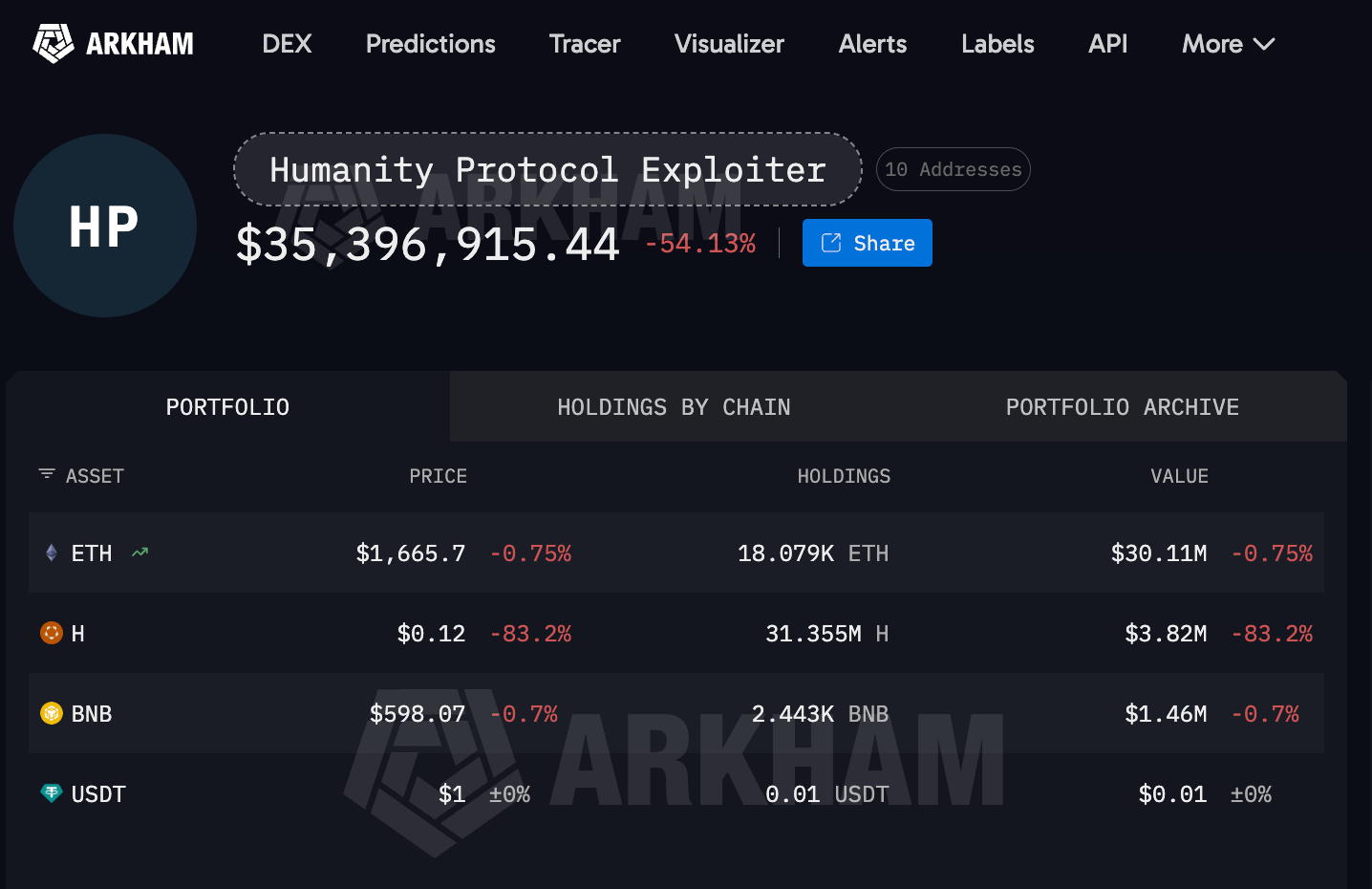
As of the time of writing, the address associated with the Humanity hacker holds over 31.35 million H tokens, valued at approximately $3.82 million; holds about 18,000 ETH, valued at over $30.11 million; its BNB holdings have also increased to 2,443, worth nearly $1.5 million; and it continues to mint more H tokens.

On-chain address monitoring information for the hacker can be found at: https://arkm.com/explorer/entity/dcfac174-1b67-46d6-8cab-5b8e955ca921.
Regarding this major security incident with over $30 million in stolen funds, on-chain detective ZachXBT also offered his preliminary investigation conclusions:

He first posted, "Unclear if hack or team maliciously rugged. Looking at the chart and the concentrated supply, the H team was likely working with an active market maker. However, all H tokens were sold on (on-chain) DEXs, not CEXs."

Subsequently, he gave a preliminary conclusion, stating: "This 'security incident' was likely planned. I don't believe the team's corresponding story at all; it's just an excuse made by ill-intentioned people to get away." It's worth mentioning that the Humanity project team does indeed have a "dark history."

Humanity Team's Dark History: Technical Outsourcing, Airdrop Drama, and Team Scandals

In fact, the crypto community's dissatisfaction with Humanity is not without reason.

Previously, when WorldCoin gained fame as a "human iris identity verification project," Humanity, as a "palm print verification identity security protocol," quickly capitalized on the hot concept and rose to prominence. At that time, it was highly sought after as a partner for KYC or identity verification in numerous crypto project airdrops. However, on the other hand, its background team, its promoted "palm print security verification technology," and its token airdrop process all sparked market controversy. For more details, see "From Palm Print 'Revolution' to Access Control Manufacturer, Tearing Apart Humanity's Two-Faced 'Technological' Charade."

Not only that, in June last year, on-chain investigator Specter pointed out in a post: "After understanding the team composition of Humanity, it's concerning: Among the 4 team leaders, 3 have problematic past records involving mismanagement, lawsuits, or financial irregularities."
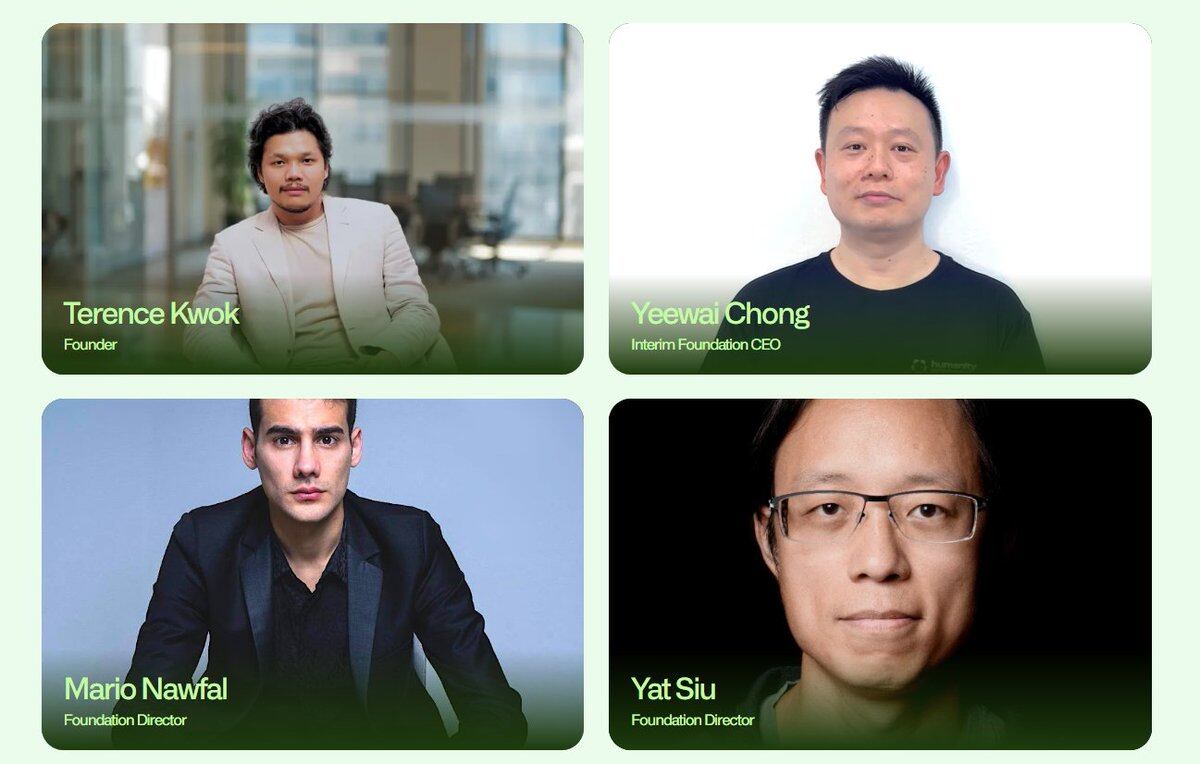
Among them, project founder and CEO Terence Kwok has a previous "entrepreneurial history." He founded Tink Labs, which once raised $200 million and reached a peak valuation of $1.5 billion, but ultimately went bankrupt in 2019 due to "mismanagement."

Foundation head Mario Nawfal has previously been accused of withholding wages and is implicated in improper financing, false promises, and coercing whistleblowers into silence. He also has a series of "blemished histories": the project Froothie was fined in Australia for false advertising; sued by Juicero; accused of invoice manipulation during his tenure at NFT Tech; and engaged in controversial behavior with BitClout token trading.

As for Yat Siu, founder of Animoca Brands, one of Humanity's backers, he was previously involved in violations related to blockchain and crypto investments, leading to his company being delisted from the Australian Securities Exchange.

Coupled with Humanity's past incidents being exposed, such as "Shenzhen technical outsourcing," large-scale sybil attacks in token airdrops, and airdrops worth single-digit amounts for loyal users, this theft incident is hard not to be seen as having ulterior motives.

Appearing Hacked, Actually a Golden Cicada Shedding Its Shell? Humanity Team Accused of Already Shifting to a New Project

Soon, more information was revealed by the crypto community and on-chain detective ZachXBT.

After suggesting that the Humanity theft might be a planned event, ZachXBT again posted, questioning Humanity's official account: "You chose to hype your token for weeks without any real substance and think the crypto community would blindly believe your story? Please disclose all your active market-making agreements with related entities in Hong Kong first."

Subsequently, he even shared a previous tweet from crypto KOL Irene Zhao, which mentioned: "2 years ago, I made a 100x return on my KOL round investment in H tokens; now, I have also participated in the KOL round financing for Everything, a new project incubated by the Humanity team."

In January this year, Everything, which promotes the concept of an "all-in-one exchange," announced the completion of a $6.9 million seed round. The round was led by Humanity's venture capital arm, Humanity Investments, with participation from Animoca Brands, Hex Trust, WallStreetBets creator Jamie Rogozinski, and Three Point Capital. The platform emphasizes its advantage in integrating perpetual contracts, spot markets, prediction markets, and payment functions.

Looking at it now, it's a familiar taste (combining current hotspots), a familiar recipe (similar investor team composition). Often, we have to admire the keen sense and superb execution of these "entrepreneurial veterans." As for the KOLs and investors involved, perhaps all benefits have already been divided behind the scenes, leaving the losses for the token traders on stage.

Of course, in the crypto market, projects and token prices are always two sides of the same coin. As for how the H token price performs subsequently, it may still depend on the handling plan of the Humanity project team and the stage performance of the market makers.


Questions liées

QAccording to the article, what was the official explanation given by the Humanity Protocol team for the massive security breach?

AThe official explanation, as confirmed by Humanity founder Terence, was that a private key belonging to a member of the Humanity Foundation was compromised and exploited by hackers.

QWhat was the estimated total loss from the Humanity Protocol attack as detailed in the report?

AThe estimated total loss from the attack exceeded $31 million. Initially, over 17 wallets holding H tokens were drained for over $19 million, and the scale later expanded to over $31 million.

QWho is ZachXBT and what was his preliminary conclusion about the nature of the incident?

AZachXBT is a well-known on-chain investigator. His preliminary conclusion was that the security event was likely a deliberate, man-made scheme, suggesting it was an exit strategy rather than a genuine hack.

QWhat new project is mentioned as being incubated by the Humanity team, according to the article?

AThe new project mentioned is called 'Everything', a platform described as an all-in-one exchange. It was announced in January and raised $6.9 million in seed funding, led by Humanity's venture arm, Humanity Investments.

QWhat are some of the alleged 'black histories' or past controversies associated with key members of the Humanity team mentioned in the article?

AThe article mentions several controversies: Founder Terence Kwok's previous venture Tink Labs collapsed due to mismanagement; Foundation lead Mario Nawfal allegedly had issues with unpaid wages, false promises, and questionable financial practices; and investor Yat Siu's company was delisted from the Australian Stock Exchange for irregularities in blockchain investments.

Lectures associées

Microsoft annonce la construction d'un ordinateur quantique commercial dans trois ans : Le rêve pourra-t-il se réaliser ?

Microsoft annonce avoir développé le nouveau puce quantique Majorana 2, où les qubits affichent une durée de cohérence moyenne record de 20 secondes, soit une fiabilité multipliée par 1000 par rapport à la génération précédente. Sur cette base, la société fixe un objectif ambitieux : construire un ordinateur quantique commercial viable d'ici 2029. Cette percée repose sur deux piliers. D'abord, la technologie des *qubits topologiques* utilisée par Microsoft, qui exploite les propriétés des quasi-particules de Majorana pour protéger l'information quantique des perturbations, offrant une stabilité intrinsèque supérieure. Ensuite, le rôle crucial joué par l'IA dite "agentique" de la plateforme Microsoft Discovery. Celle-ci a accéléré la recherche en optimisant les paramètres de fabrication, en analysant des données complexes et en résolvant des problèmes expérimentaux, réduisant considérablement le temps de développement. Si cet avancement est salué comme une étape majeure, des défis immenses persistent pour atteindre l'objectif de 2029. Le Majorana 2 ne contient que 12 qubits, alors qu'un ordinateur quantique universel et utile nécessitera probablement des millions de qubits. De plus, des questions pratiques subsistent : la durée de cohérence, bien que prolongée, sera-t-elle suffisante pour les algorithmes complexes ? Les coûts de compilation et la vérification des résultats posent également des problèmes non résolus. Microsoft, en misant sur la voie topologique qu'elle estime plus évolutive, se distingue de concurrents comme Google ou IBM qui privilégient les qubits supraconducteurs. La course à l'ordinateur quantique pratique s'intensifie donc, mais son issue et son calendrier précis restent incertains.

marsbitIl y a 8 mins

Microsoft annonce la construction d'un ordinateur quantique commercial dans trois ans : Le rêve pourra-t-il se réaliser ?

marsbitIl y a 8 mins

Le « malédiction de la Coupe du Monde » existe-t-elle vraiment sur les marchés ?

Le "malédiction de la Coupe du Monde" désigne la tendance des marchés boursiers mondiaux à sous-performer pendant le tournoi. Les données historiques semblent l'étayer : le S&P 500 a affiché un rendement moyen négatif (-1,5% à -2,11%) lors des 19 éditions entre 1950 et 2022, avec 11 baisses. Le marché chinois a chuté dans 71% des cas sur les 7 derniers tournois. Les causes sont multiples. Des études, comme celle de la BCE en 2010, montrent une baisse d'environ 33% du volume des transactions pendant les matchs, chutant à 55% lorsque l'équipe nationale joue. Une défaite peut entraîner des rendements anormalement négatifs le jour suivant. Cependant, l'effet du Mondial est souvent amplifié par le contexte saisonnier. Les tournois d'été (juin-juillet) coïncident avec la période traditionnellement faible des marchés ("Sell in May and go away"). L'édition 2022 au Qatar, en hiver, a vu un recul moindre des volumes (-18%), suggérant un impact atténué hors de la saison estivale. Pour le Bitcoin, les mouvements lors des Mondiaux (2010, 2014, 2018, 2022) s'expliquent davantage par des facteurs propres (premières transactions, faillites d'échanges, cycles de réduction de moitié, macroéconomie) que par l'événement sportif. Les opportunités d'investissement évoluent. Les secteurs classiques comme la télévision traditionnelle voient leurs bénéfices s'éroder face à la montée en puissance des streamers. La bière et les articles de sport restent résilients mais font face à des changements de consommation. De nouvelles tendances émergent, comme les cartes de joueurs tokenisées sur blockchain. En conclusion, si le Mondial coïncide souvent avec une baisse de liquidité et de performance des marchés, son influence directe est limitée et mêlée à des effets saisonniers. Pour de nombreux investisseurs, suivre la compétition peut simplement être une bonne raison de se détacher temporairement des marchés durant une période moins dynamique.

marsbitIl y a 15 mins

Le « malédiction de la Coupe du Monde » existe-t-elle vraiment sur les marchés ?

marsbitIl y a 15 mins

Pourquoi l'« abonnement aux services d'IA » est voué à disparaître ?

Le modèle « abonnement illimité » pour les services d'IA est en train de disparaître. La récente annonce d'Anthropic concernant Claude Fable 5, disponible gratuitement pour les abonnés seulement jusqu'au 22 juin avant de passer à une facturation à l'usage, illustre une tendance de fond. OpenAI et GitHub ont pris des mesures similaires ces dernières semaines. La raison fondamentale est que le modèle économique de l'abonnement fixe, qui repose sur une consommation limitée par le temps humain (comme pour le streaming), ne peut pas résister à l'avènement des agents IA. Ces derniers consomment 5 à 30 fois plus de tokens que le chat simple et peuvent fonctionner de manière autonome, sans plafond de consommation. Les forfaits actuels subventionnent massivement les utilisateurs intensifs, à un niveau insoutenable (un forfait de 200$ pouvant couvrir jusqu'à 14000$ d'usage). Tenter de rectifier le tir en augmentant les prix ou en limitant l'usage a échoué, attirant toujours plus d'utilisateurs "gourmands". L'avenir est donc à la facturation à l'usage (crédits), similaire à la consommation d'électricité. La forme de l'abonnement peut subsister, mais son essence – un prix fixe pour un usage illimité – sera vidée de sa substance. Seul le chat conversationnel simple, où la consommation reste liée à l'utilisateur, pourrait conserver un forfait fixe, mais il deviendra marginal. Cette transition, accélérée par les préparations en bourse des entreprises, marque la fin d'une période de subventions massives. Pour les utilisateurs, l'ère où un abonnement modique permettait de faire tourner des tâches coûteuses touche à sa fin – une période à utiliser tant qu'elle dure.

marsbitIl y a 16 mins

Pourquoi l'« abonnement aux services d'IA » est voué à disparaître ?

marsbitIl y a 16 mins

Le plus gros acheteur disparaît : La frénésie du capital IA renverse le cycle de "déséquitisation" du marché boursier américain

Le plus grand acheteur disparaît : la frénésie des capitaux en IA inverse le cycle de « déséquitisation » à Wall Street. Une vague massive d'émissions d'actions, comparable à la bulle Internet, déferle sur le marché américain, marquant la fin de deux décennies de « déséquitisation » – une réduction structurelle de l'offre d'actions par les rachats d'actions. Des introductions en bourse géantes (SpaceX à 75 milliards de dollars, OpenAI et Anthropic à venir) et des augmentations de capital massives (comme les 85 milliards de dollars planifiés par Alphabet) devraient injecter environ 1 500 milliards de dollars d'offre nette d'actions dans les deux prochaines années. Cette transition, baptisée « rééquitisation », est alimentée par les besoins de financement colossaux de la course à l'IA, poussant les entreprises à émettre des actions plutôt qu'à en racheter. Alors que les géants technologiques passent de principaux acheteurs à vendeurs nets, la question cruciale est de savoir qui absorbera cette offre. Les investisseurs individuels (représentant 20% des volumes) et les fonds monétaires (7,9 billions de dollars) sont des sources potentielles, alimentées par la FOMO (peur de manquer le mouvement). Cependant, des signaux d'alarme historiques apparaissent. Une telle concentration d'émissions coïncide souvent avec la fin des cycles haussiers et peut peser sur les rendements futurs du marché, comme le S&P 500 a historiquement sous-performé après de grandes IPO. Bien que certains y voient un facteur de risque accru de volatilité plutôt qu'un changement de paradigme, le vent structurel porteur de l'offre limitée semble s'être inversé.

marsbitIl y a 21 mins

Le plus gros acheteur disparaît : La frénésie du capital IA renverse le cycle de "déséquitisation" du marché boursier américain

marsbitIl y a 21 mins

Trading

Spot
Futures
活动图片