AAOI Defies Trend with Over 10% Surge, 'New Stock God' Serenity Predicts Potential to Double Again

marsbitPublié le 2026-06-05Dernière mise à jour le 2026-06-05

Résumé

On June 4th, despite a significant sell-off in the broader AI and semiconductor sector triggered by Broadcom's disappointing guidance, Applied Optoelectronics (AAOI) surged over 11%, showcasing a sharp divergence in market sentiment. Broadcom's warning about potential supply chain diversification by key customer Google and a weaker-than-expected outlook punctured the high-flying AI valuation narrative. This led to heavy selling in names like Broadcom (-12.6%) and Micron (-7%), with funds rotating into traditional industrial stocks. AAOI defied this trend. The stock has experienced high volatility recently, driven by bullish analyst coverage, notably from Rosenblatt which raised its price target to $220. Key catalysts include initial 800G optical module revenue from Amazon, potential certification from Oracle, and strong demand across its product portfolio. The company has reported cumulative orders for 800G/1.6T modules exceeding $324 million and is aggressively expanding manufacturing capacity in Texas, targeting an annualized run-rate of $1.4 billion for its module business by Q3 2027. However, AAOI's fundamentals present a mixed picture. Its Q1 2026 results missed expectations, showing a GAAP net loss, and Q2 guidance points to merely breakeven adjusted EPS. Risks include a delayed 800G production ramp to the second half of the year and high dependence on a few key cloud customers. Recent stock sales by company executives near price highs also noted. The article sugges...

Author: Ada, Deep Tide TechFlow

On June 4th, US Eastern Time, US tech stocks experienced severe volatility triggered by Broadcom's earnings guidance, revealing the first cracks in the AI valuation narrative.

Broadcom's FY2Q results themselves were not poor, with revenue of $22.2 billion and EPS of $2.44 both beating consensus estimates, and AI semiconductor business growing 143% year-over-year. However, its guidance for the current quarter failed to meet the market's already elevated expectations. CEO Hock Tan also revealed during the earnings call that its major custom chip client Google might diversify its supply chain, and that the expansion of the chip business would drag down gross margins. This combination pierced the core narrative that had supported AI trading for the past several months, triggering sharp capital rotation that day.

The Dow Jones Industrial Average surged 1.7% to a new record high, driven by traditional sectors. However, the Nasdaq Composite Index closed down 0.09%, and the Nasdaq 100 closed down 0.5%. Within this "barbell-shaped" divergent market, AI and semiconductor stocks faced broad selling pressure: Broadcom -12.59%, Micron -7%, Marvell pre-market down as much as 7%, AMD pre-market down over 4%.

Yet, amidst this wave of selling, AAOI charted an independent course starkly opposed to the sector sentiment.

Broadcom's Guidance Punctures Expectations, First AI Sector Valuation Correction

Broadcom became the catalyst that broke the AI trade not because its performance was bad, but because its guidance failed to match expectations that had been pushed to the limit.

Hock Tan disclosed during the earnings call that AI chip sales for this fiscal year (ending October) would reach $56 billion. While a massive number, it fell short of market expectations. Coupled with his comments about Google diversifying its supply chain, the market began to question the valuation premium Broadcom had enjoyed over the past year, supported by its ASIC business. Broadcom hit an intraday low of $403, erasing approximately $300 billion in market cap for the day, marking its largest single-day drop since January 2025.

The selling pressure quickly spread across the entire AI compute chain. The memory sector also saw heavy selling. Micron, viewed as a core supplier of HBM for AI accelerators and deeply tied to AI capital expenditure sentiment, fell about 7% for the day. Other storage-related names like SanDisk and Western Digital also weakened. While CrowdStrike's own Q2 revenue guidance wasn't poor, it was indiscriminately sold off amid the overall cooling of the AI trade.

Bridgewater founder Ray Dalio joined the chorus warning about AI valuations that day, explicitly distinguishing between "buying AI stocks" and "investing in AI technology," cautioning that current valuations "may be getting excessive." This echoed recent consecutive warnings about AI capital expenditures and high valuations from JPMorgan CEO Jamie Dimon and Apollo CEO Marc Rowan.

The direction of capital rotation was also telling—it flowed into traditional economy stocks represented by the Dow Jones, rather than a systemic retreat from risk assets. This indicates the market wasn't engaging in broad risk-off behavior but was structurally reducing positions within the AI sector.

AAOI's Independent Rally: Over 10% Gain in a Single Day, Reaching New Short-Term High Intraday

In this environment, AAOI posted a single-day gain of 11.76%, rising intraday from around $171 to $209.64 and closing at $202.89, forming a sharp contrast with the steep declines of Broadcom and Micron.

AAOI has experienced multiple rounds of intense volatility prior to this. The stock hit an all-time high of $233.67 on May 13th, fell 9% in a single day on May 29th, rebounded 17.18%-18.81% on June 1st, and again charted an independent 11.76% gain on June 4th. In the past 30 days alone, there have been over four trading sessions with single-day price swings exceeding 10%. This level of volatility has itself become the norm for AAOI's current valuation structure, with its trading volume on May 11th reaching 214% of its three-month average.

The medium-term catalysts driving AAOI's strength are relatively clear. On May 8th (the day after the company reported Q1 earnings), Rosenblatt raised its price target for AAOI from $140 to $220 in one go, reaffirmed its "Buy" rating, and listed it as a "Top Pick." Raymond James raised its target from $72.50 to $160 around the same time, while B. Riley raised its target to $129 but maintained a Neutral rating. Rosenblatt's core logic includes: 800G optical module revenue from Amazon beginning to contribute; potential qualification with Oracle opening a second revenue stream; and strong demand across the company's product generations from 100G/400G/800G to the emerging 1.6T.

The supporting data for the company's fundamentals are also specific. AAOI has publicly disclosed cumulative orders for 800G and 1.6T optical modules exceeding $324 million; in April 2026, it received a $20.9 million grant from the Texas Semiconductor Innovation Fund to expand its Sugar Land, Texas factory to 210,000 square feet; it also announced new 388,000 square feet of capacity in Pearland, targeting monthly production capacity of 700,000 units for 800G and 1.6T optical modules by 2027. Management guides to reaching an annualized run rate of $1.4 billion for its optical module business by Q3 2027.

However, AAOI's fundamentals are not without flaws. Its actual Q1 2026 earnings missed expectations, with a GAAP net loss of $14.3 million and revenue of $151.1 million, both slightly below market consensus. Q2 guidance for adjusted EPS is between -$0.03 and +$0.03, hovering around breakeven. When maintaining its Neutral rating, B. Riley noted that AAOI's 800G volume production would be delayed to the second half of the year, and there were execution risks from over-reliance on customer forecasts. Additionally, AAOI executives collectively sold approximately $12.6 million worth of stock in mid-May. While their remaining holdings are still substantial, the timing of the sales coincided with the stock's peak.

In short, AAOI is currently in a state of tension characterized by a "strong narrative, weak Q1 earnings, and significant valuation premium," which is the fundamental reason for its high single-day price volatility.

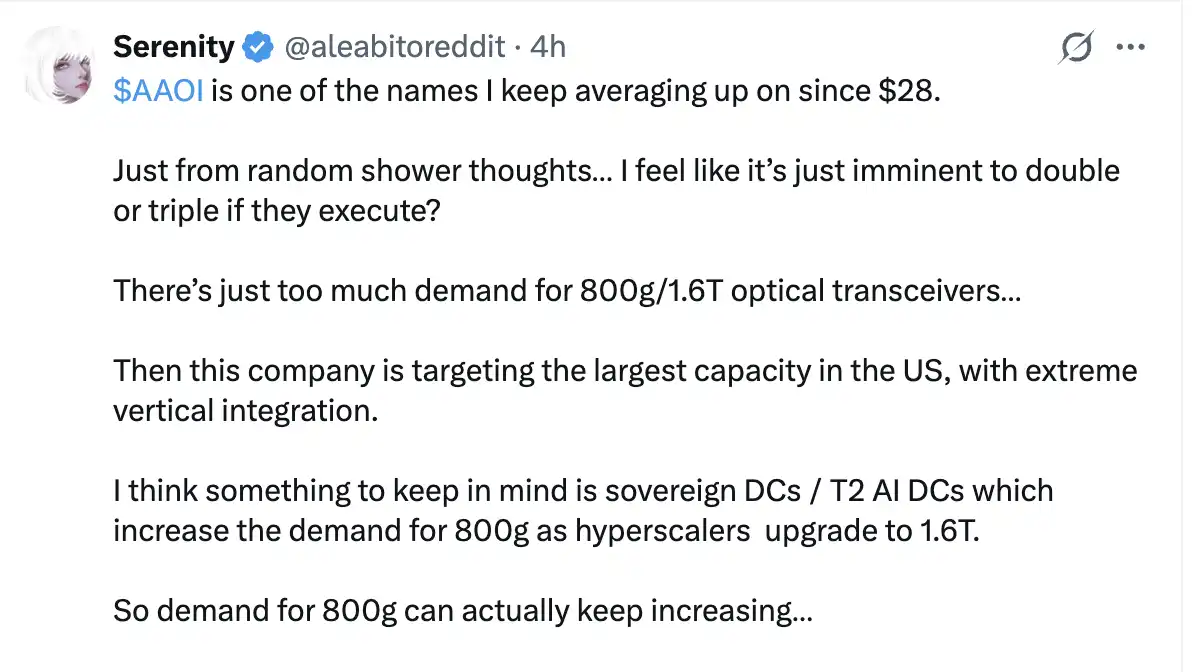
It's worth noting that AAOI has a potential additional driver: Serenity, known in Chinese circles as the "New Stock God," has posted multiple times expressing bullishness on AAOI, considering it his most favored optical communications exposure in the US stock market. He started building a position from $28 and believes it could be "the next SanDisk."
Logic Behind the Counter-Trend Strength: 'Differentiated Pricing' Within the AI Sector

AAOI's counter-trend strength on June 4th should not be interpreted as a counterexample to AI valuation concerns, but rather as an early signal that the market is beginning to engage in "differentiated pricing" within the AI sector.

One of Serenity's public judgments in April was that optical communication stocks might exhibit greater resilience than large-cap tech stocks: "Even if the S&P 500 falls another 20%, optical communication companies could still outperform." This logic is rooted in supply chain scarcity, with InP substrates, laser light sources, and 800G optical module capacity all in a state of structural tightness in the near-to-medium term, placing pricing power on the supply side rather than the demand side.

The selling pressure triggered by Broadcom's guidance essentially represents a correction to the "custom ASIC + high customer concentration" narrative, not a correction to the total demand for AI infrastructure. From this perspective, optical communication stocks, strongly tied to downstream compute deployment, do not directly overlap in narrative terms with Broadcom's core issues (customer concentration, potential Google supply chain diversification).

However, risks remain. AAOI's current stock price implies a valuation that already incorporates extremely high execution expectations, assuming it achieves the $1.4 billion annualized optical module revenue run rate by Q3 2027 while maintaining high margins. If Q2 or Q3 earnings fail to validate the 800G production ramp-up timeline, or if any issues arise with customer concentration risks (Amazon, Microsoft), the valuation structure could experience severe turbulence. The actual Q1 earnings were already weak; this crack is currently masked by order growth and capacity expansion narratives but has not been fully eliminated.

For observers in the Chinese market, what is noteworthy about AAOI's counter-trend move is not the gain itself, but the directional choice of capital differentiation within the market. When the overarching AI narrative shows its first cracks, the willingness of capital to buy into AAOI precisely during Broadcom's sell-off itself indicates a judgment: Broadcom's problems are not equivalent to all AI capital expenditure problems, and optical communications remains a recognized "physical bottleneck" narrative. Whether this judgment holds true will ultimately depend on the actual earnings reports in the coming quarters.


Questions liées

QWhat was the main catalyst that led to the sell-off in AI and semiconductor stocks on June 4th, according to the article?

AThe main catalyst was Broadcom's Q2 earnings report. While the revenue and EPS beat expectations, the company's guidance for the current quarter failed to meet the market's elevated expectations. Additionally, CEO Hock Tan's comments about major customer Google potentially diversifying its supply chain and the expansion of chip business hurting margins undermined the core AI valuation narrative.

QHow did AAOI's stock price perform on June 4th, in contrast to the broader AI/semiconductor sector?

AWhile stocks like Broadcom, Micron, and AMD fell sharply, AAOI experienced a strong independent rally. Its stock price rose over 10%, climbing from around $171 intraday to close at $202.89, sharply contrasting with the sector-wide sell-off.

QWhat are the key fundamental drivers supporting AAOI's positive outlook, as mentioned by analysts?

AKey drivers include: 1) The start of revenue contribution from 800G optical modules for Amazon. 2) Potential qualification with Oracle opening a second major revenue line. 3) Strong demand across its 100G/400G/800G to emerging 1.6T product portfolio. 4) A disclosed order book of over $324 million for 800G/1.6T modules. 5) Significant capacity expansion plans, aiming for a $1.4 billion annualized run rate for its module business by Q3 2027.

QWhat significant risk or weakness in AAOI's current situation does the article highlight?

AThe article highlights that AAOI's Q1 2026 earnings actually missed expectations, with a GAAP net loss of $14.3 million. Its Q2 guidance for adjusted EPS is only between -$0.03 and +$0.03, indicating it is barely at breakeven. Risks include a delay in 800G mass production to the second half of the year, execution risks from over-reliance on customer forecasts, and recent insider stock sales by executives.

QHow does the article interpret AAOI's rally amid a sector sell-off? What does it signal about market behavior?

AThe article interprets it not as a counter-example to AI valuation concerns, but as an early signal of 'differentiated pricing' within the AI sector. It suggests the market is distinguishing between Broadcom's specific issues (custom ASIC, customer concentration) and the broader AI infrastructure demand. The willingness to buy AAOI while selling Broadcom indicates a belief that the 'physical bottleneck' narrative for optical communication remains valid, even as the initial AI hype faces a correction.

Lectures associées

Le marché de la pré-introduction en bourse d'Anthropic chute après qu'une directive américaine force l'arrêt du modèle

Anthropic a annoncé avoir reçu une directive du gouvernement américain lui ordonnant de suspendre l'accès aux modèles Claude Fable 5 et Claude Mythos 5 pour les ressortissants étrangers, y compris ses propres employés étrangers. Cette mesure d'urgence, justifiée par des préoccupations de sécurité nationale liées au contrôle des exportations, a forcé la désactivation mondiale des deux modèles le 12 juin. Les autres modèles d'Anthropic, comme Claude Opus 4.8, restent opérationnels. La réaction du marché a été immédiate : le contrat perpétuel lié à Anthropic sur Hyperliquid a chuté de 3,7%, reflétant l'impact sur sa valorisation pré-IPO. Anthropic a contesté la base de cette directive, arguant que la vulnérabilité de "jailbreak" évoquée par le gouvernement était mineure, déjà connue et non exclusive à ses modèles. La société a averti qu'un tel seuil d'intervention, s'il était généralisé, pourrait stopper les déploiements de nouveaux modèles d'IA de pointe. Cet événement illustre comment la régulation de l'IA devient un facteur négociable sur les marchés financiers. Les instruments tokenisés et les contrats pré-IPO permettent désormais aux traders de réagir instantanément à ce type de nouvelles réglementaires, même en l'absence d'informations publiques détaillées. Cela intègre l'infrastructure d'IA dans une dynamique de marché spéculative similaire à celle de la cryptomonnaie, avec des risques de volatilité basée sur des informations incomplètes.

bitcoinistIl y a 5 h

Le marché de la pré-introduction en bourse d'Anthropic chute après qu'une directive américaine force l'arrêt du modèle

bitcoinistIl y a 5 h

Un portefeuille lié à une exploitation convertit des jetons volés en 18 510 ETH et 1 548 BNB

Un portefeuille lié à une exploitation a converti des actifs compromis en 18 510 ETH (évalués à environ 30,83 millions de dollars) et 1 548 BNB (environ 924 000 dollars), selon une alerte de suivi sur la chaîne partagée par WuBlockchain citant Lookonchain. L'attaquant, associé à des « jetons H » compromis, détient encore 111,36 millions de ces jetons d'une valeur d'environ 14 millions de dollars. Cette conversion vers des actifs plus liquides comme l'ETH et le BNB est une étape courante après une exploitation, souvent avant une tentative de retrait ou de mélange de fonds. Les grands échanges de ce type peuvent exercer une pression sur les liquidités, signaler les prochaines étapes de l'attaquant et offrir de nouvelles pistes de transaction à suivre pour les enquêteurs. Le suivi sur la chaîne, bien qu'utile pour visualiser les mouvements de fonds en temps réel, présente des limites : les portefeuilles peuvent fractionner les actifs rapidement, les déplacer entre différentes chaînes ou utiliser des adresses intermédiaires, compliquant le traçage. Les étiquettes attribuées aux portefeuilles peuvent également changer. Ces données représentent donc un instantané et non une estimation finale des pertes. Cet incident souligne l'utilité des comptes de surveillance sur la chaîne comme Lookonchain, qui peuvent révéler une activité avant la publication d'une enquête officielle. La conversion en actifs liquides rend également plus difficile et urgente toute tentative de récupération des fonds volés.

bitcoinistIl y a 7 h

Un portefeuille lié à une exploitation convertit des jetons volés en 18 510 ETH et 1 548 BNB

bitcoinistIl y a 7 h

« De 119 à 176 dollars » : Derrière l'entrée en bourse de SpaceX, MSX démontre à nouveau le circuit complet de son offre Pre-IPO

Après avoir livré un retour sur investissement de 300% pour Cerebras en mai, MSX a une nouvelle fois démontré l'efficacité de son modèle Pre-IPO avec l'introduction en bourse de SpaceX. Le 12 juin, SpaceX (SPCX) a fait son entrée sur le Nasdaq, atteignant un sommet de 176 dollars. Les utilisateurs de MSX ayant participé au projet Pre-IPO de SpaceX en mars à un prix de souscription de 119 dollars ont ainsi réalisé un gain allant jusqu'à 48%. Ce succès valide le parcours complet proposé par MSX : souscription, conservation, possibilité de rachat avant IPO, introduction en bourse, conversion en actif négociable et règlement. Cela distingue la plateforme d'autres acteurs du secteur, où certains utilisateurs ont dû être remboursés suite à des problèmes d'allocation. Ce résultat fait suite à la réussite similaire de Cerebras en mai, où les souscripteurs MSX avaient enregistré des rendements dépassant 300%. Deux introductions consécutives prouvent que MSX a établi un mécanisme fiable et reproductible pour l'accès à des actifs privés de qualité via la blockchain. Le véritable enjeu des produits Pre-IPO n'est pas seulement d'offrir un accès précoce, mais de garantir une voie de sortie claire après l'IPO. MSX continue d'élargir son portefeuille d'actifs Pre-IPO, ciblant notamment les secteurs de l'IA et des technologies de pointe, afin de permettre aux investisseurs de participer à la croissance des entreprises les plus prometteuses.

Odaily星球日报Il y a 11 h

« De 119 à 176 dollars » : Derrière l'entrée en bourse de SpaceX, MSX démontre à nouveau le circuit complet de son offre Pre-IPO

Odaily星球日报Il y a 11 h

Trading

Spot
Futures

Articles tendance

Comment acheter ADA

Bienvenue sur HTX.com ! Nous vous permettons d'acheter Cardano (ADA) de manière simple et pratique. Suivez notre guide étape par étape pour commencer votre parcours crypto.Étape 1 : Création de votre compte HTXUtilisez votre adresse e-mail ou votre numéro de téléphone pour ouvrir un compte sur HTX gratuitement. L'inscription se fait en toute simplicité et débloque toutes les fonctionnalités.Créer mon compteÉtape 2 : Choix du mode de paiement (rubrique Acheter des cryptosCarte de crédit/débit : utilisez votre carte Visa ou Mastercard pour acheter instantanément Cardano (ADA).Solde :utilisez les fonds du solde de votre compte HTX pour trader en toute simplicité.Prestataire tiers :pour accroître la commodité d'utilisation, nous avons ajouté des modes de paiement populaires tels que Google Pay et Apple Pay.P2P :tradez directement avec d'autres utilisateurs sur HTX.OTC (de gré à gré) : nous offrons des services personnalisés et des taux de change compétitifs aux traders.Étape 3 : stockage de vos Cardano (ADA)Après avoir acheté vos Cardano (ADA), stockez-les sur votre compte HTX. Vous pouvez également les envoyer ailleurs via un transfert sur la blockchain ou les utiliser pour trader d'autres cryptos.Étape 4 : tradez des Cardano (ADA)Tradez facilement Cardano (ADA) sur le marché Spot de HTX. Il vous suffit d'accéder à votre compte, de sélectionner la paire de trading, d'exécuter vos trades et de les suivre en temps réel. Nous offrons une expérience conviviale aux débutants comme aux traders chevronnés.

1.1k vues totalesPublié le 2024.12.10Mis à jour le 2026.06.02

Comment acheter ADA

Discussions

Bienvenue dans la Communauté HTX. Ici, vous pouvez vous tenir informé(e) des derniers développements de la plateforme et accéder à des analyses de marché professionnelles. Les opinions des utilisateurs sur le prix de ADA (ADA) sont présentées ci-dessous.

活动图片