Which Companies Has NVIDIA's "Three-Track Investment Architecture" Invested In?

marsbitPublié le 2026-06-04Dernière mise à jour le 2026-06-04

Résumé

NVIDIA's investment strategy operates through a "three-track architecture," not just its NVentures venture arm. Corporate Development handles massive strategic bets (e.g., $30B in OpenAI, $10B in Anthropic, $20B in Synopsys). NVentures, a small team, focuses on early-stage, financial investments across sectors like quantum computing (Alice & Bob, PsiQuantum), AI infrastructure (OpenRouter, Tensormesh), and biotech. The NVIDIA Inception accelerator provides non-monetary support. This system allows NVIDIA to nurture startups and lock in strategic partners, creating a vast AI ecosystem. This aggressive capital deployment has drawn scrutiny. Critics like Michael Burry and EU regulators question potential "circular financing," where NVIDIA's equity investments in companies (e.g., CoreWeave, OpenAI) facilitate those companies' purchases of NVIDIA hardware, potentially inflating revenue. Supporters view it as a necessary "virtuous cycle" to secure supply and demand in a compute-scarce market. While NVentures' smaller deals appear like traditional VC, its role within the larger, controversial investment framework remains a point of debate.

Author: Ada, Deep Tide TechFlow

Recently, NVentures, NVIDIA's venture capital arm, made a new investment in the French quantum computing company Alice & Bob, focusing on fault-tolerant quantum computing.

It is a common misconception to attribute all of NVIDIA's external investments under the name NVentures. In fact, the collective scale of this venture division's approximately 30 annual investments, established in 2021, pales in comparison to a single investment made casually by the Corporate Development team. The latter's $2 billion equity investment in Synopsys at the end of 2025 alone is several times larger than NVentures' cumulative investment amount over nearly three years.

To understand how NVIDIA uses capital to weave the AI ecosystem, one must start with the "Three-Track Architecture" of its investment system. The Corporate Development team handles strategic large-scale investments and mergers & acquisitions ranging from billions to hundreds of billions of dollars. NVentures is responsible for early-stage, broadly scoped financial investments across industries. NVIDIA Inception is a startup accelerator that provides resource connections without direct capital investment. These three parts work in synergy, forming the largest and fastest-paced capital deployment machine in Silicon Valley's history, and also becoming the core target of "circular financing" allegations in the eyes of short-sellers.

The True Face of NVentures: 2-Person Team, 79 Companies, 20 Unicorns

Although bearing NVIDIA's brand, NVentures' internal size is surprisingly small. According to private equity data firm Tracxn, as of May 2026, the entire team consists of only 2 people, having cumulatively invested in 79 companies, fostering 20 unicorns, including AI video generation platform Synthesia, clinical AI company Abridge, quantum computing company PsiQuantum, and others. In the past 12 months, the team completed 43 new investments, with 20 deals in the first five months of 2026 alone, indicating a significantly accelerated pace.

Leading NVentures is Mohamed "Sid" Siddeek, corporate vice president and head of NVentures. Siddeek's resume itself reflects NVIDIA's positioning for this division. He worked at Morgan Stanley in the late 1990s, accompanying Jensen Huang during NVIDIA's IPO roadshow; then served for nearly a decade as head of TMT & Telecom investments at the UAE sovereign wealth fund Mubadala; later managed enterprise software and healthcare investments at SoftBank's Vision Fund; and finally returned to NVIDIA in 2021 to establish NVentures.

Siddeek's own description of the investment scope is: "The real screening criteria are only two layers: the first is anywhere NVIDIA can reach, the second is which areas are investable." In an interview with Global Corporate Venturing, he revealed this means horizontal coverage across almost all industries AI can transform—healthcare, manufacturing, robotics, autonomous driving, quantum, etc.—and vertical coverage from underlying tools to the application layer, all within NVentures' investment scope.

Three-Track Architecture: Corp Dev for Strategy, NVentures for Early-Stage, Inception for Ecosystem

NVIDIA's external investment system consists of three distinct parts with clear division of labor.
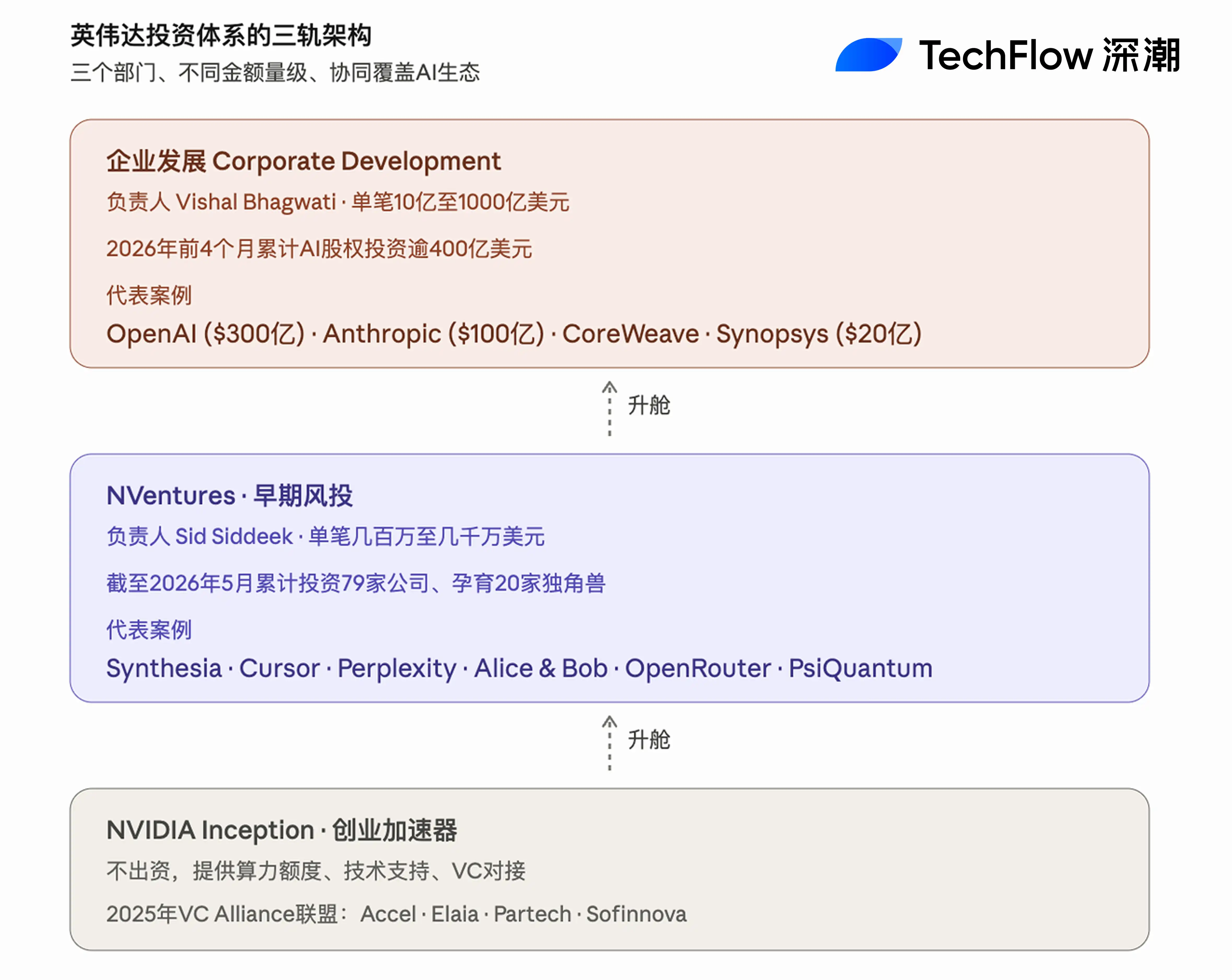
The first layer is the Corporate Development team, led by Vishal Bhagwati, responsible for all strategic-level large-scale investments, joint ventures, and M&A. The magnitude of deals on this track is completely different from NVentures. Representative moves from the second half of 2025 to the first half of 2026 include leading a $30 billion investment in OpenAI in February 2026 (as part of a roughly $110 billion funding round), with a commitment to potentially increase to $100 billion in the future; a $10 billion commitment to Anthropic in November 2025; a $2 billion injection into Synopsys at the end of 2025; a $2 billion follow-on investment in CoreWeave in early 2026, accompanied by a $6.3 billion cloud capacity purchase agreement; a $2 billion investment in Nebius in March 2026; and an equity commitment of up to $2 billion in xAI.

According to CNBC, in just the first four months of 2026, AI-related equity investments led by the Corporate Development team exceeded $40 billion. NVIDIA invested a total of $17.5 billion in private companies and infrastructure funds during fiscal year 2025.

The second layer is NVentures, led by Sid Siddeek, positioned as a traditional venture capital firm pursuing financial returns. Individual deal sizes range from a few million to tens of millions of dollars, primarily investing at Seed to Series B stages. Siddeek explicitly told Global Venturing that NVentures "primarily focuses on early-stage investments, while the Corporate Development team handles larger, more directly strategic investments." Behaviorally, NVentures predominantly participates as a co-investor, leading only about one-eighth of its investments, more often joining rounds led by top VCs like Accel, a16z, and Sequoia, leveraging the NVIDIA endorsement.

The third layer is NVIDIA Inception, essentially a startup accelerator program that does not directly invest capital but provides startups with NVIDIA hardware credits, technical support, market promotion, and VC connection channels. NVIDIA's upgraded "VC Alliance" launched in 2025, partnering with institutions like Accel, Elaia, Partech, and Sofinnova, distributes NVIDIA DGX Cloud Lepton compute credits to their portfolio companies, representing an extension of Inception in Europe.

There is a clear "funnel" relationship among the three. Inception discovers early-stage projects and integrates them into the NVIDIA ecosystem. Those with investment potential come into NVentures' view and may receive early-stage checks from a few million to tens of millions of dollars. When a company grows to a size significant enough to impact NVIDIA's strategic landscape (becoming a major customer, key supplier, or potential acquisition target), it "upgrades" to the Corporate Development team, entering cooperation frameworks worth billions or even hundreds of billions of dollars.

NVentures' Recent Moves: Quantum, Inference Routing, AI Security

NVentures' activity in May 2026 was notable. Just within the recent month, there have been four publicly disclosed deals. On May 22, French quantum computing company Alice & Bob announced NVentures participated in the extension of its €100 million Series B round. Alice & Bob's core technology is a fault-tolerant quantum computing architecture based on "cat qubits," deeply collaborating with NVIDIA's hybrid quantum-classical computing stack like CUDA-Q, cuQuantum, Dynamiqs, and NVQLink. On May 26, AI model routing platform OpenRouter completed a $113 million Series B round, with NVentures co-investing alongside Google CapitalG, Snowflake, and others. OpenRouter's business provides developers a unified interface to access APIs from dozens of different model providers globally. On May 28, AI inference infrastructure startup Tensormesh completed a $20 million seed extension round, with NVentures co-investing alongside CoreWeave, AMD, and others. On May 6, AI cybersecurity company Xbow completed a $35 million Series C extension, with NVentures participating.

Judging by the investment targets, NVentures' recent tilt clearly leans toward three directions: quantum computing (Alice & Bob, Quantinuum, PsiQuantum), AI biopharma (Relation Therapeutics, Genesis Therapeutics), and AI Agent & inference layer (OpenRouter, Tensormesh, etc.). This aligns with Siddeek's statement "anywhere NVIDIA can reach" and also corresponds precisely to the directions NVIDIA is investing in for its next-generation software stacks like CUDA-Q, CUDA-X, and Triton.

Geographically, NVentures' European deployment has notably accelerated. It completed 14 European investments in 2025, double the 7 investments in 2024.

Panoramic View of the Three-Tier Investment Portfolio

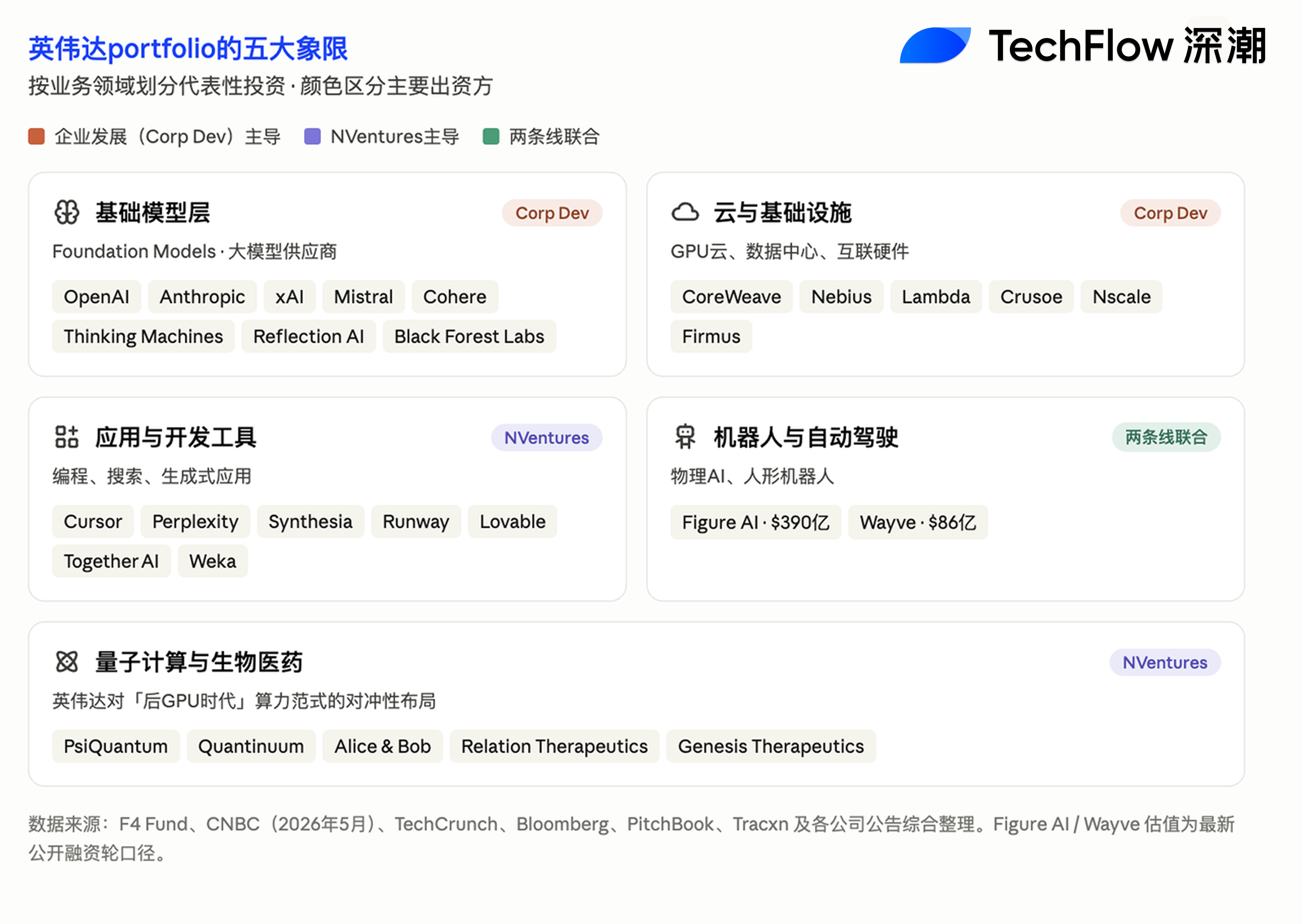
If we overlay the portfolios of the three investment tiers on the same map, NVIDIA's "capital radiation" on the AI ecosystem can be summarized into five main quadrants.

The foundation model layer includes OpenAI, Anthropic, xAI, Mistral, Cohere, Thinking Machines Lab, Reflection AI, Black Forest Labs. This layer is primarily funded by the Corporate Development team, with NVentures participating in smaller shares.

The cloud & infrastructure layer includes CoreWeave, Nebius, Lambda, Crusoe, Nscale, Firmus Technologies. This layer is also dominated by the Corporate Development team, with individual investments often reaching billions of dollars, accompanied by long-term compute purchase contracts.

The application & developer tools layer includes Cursor, Perplexity, Synthesia, Runway, Lovable, Together AI, Weka. NVentures has higher participation in this layer, with relatively smaller amounts.

The robotics & autonomous driving layer includes Figure AI (latest valuation $39 billion) and Wayve (valuation $8.6 billion). This involves combined efforts from both Corporate Development and NVentures.

The quantum computing & biopharma layer includes PsiQuantum, Quantinuum, Alice & Bob, Relation Therapeutics. This consists mainly of early-stage investments led by NVentures, serving as NVIDIA's hedging bets on post-GPU-era computing paradigms.

According to venture capital research firm F4 Fund, from 2025 to early 2026, in the investment rounds participated in by NVIDIA (Corporate Development + NVentures), at least 10 companies crossed the $1 billion valuation threshold, including OpenAI, Anthropic, xAI, Mistral, Figure AI, Cursor, Perplexity, Scale AI, Wayve, and others.
Controversy: Burry's Shorts and the Question of "Circular Financing"

However, NVIDIA's massive external investment landscape is attracting increasing scrutiny. The most representative criticism comes from hedge fund manager Michael Burry, famous from the movie "The Big Short."

According to Scion Asset Management's Q3 2025 13F filing, Burry established short positions against NVIDIA and Palantir before September 30, 2025, including put options for approximately 1 million NVIDIA shares, representing a nominal exposure of about $187 million based on the stock price at the time; and 50,000 put option contracts (each for 100 shares) on Palantir, with actual premium payments of about $9.2 million. Burry posted on his X account "Cassandra Unchained" with a screenshot from "The Big Short," captioning "Sometimes, we can see bubbles," and later retweeted a Bloomberg chart about NVIDIA's circular financing, directly pointing the finger at NVIDIA's capital deployment model.

Burry's specific accusations are technical. He estimated in a Substack post that between 2026 and 2028, cloud providers including Microsoft, Google, Oracle, and Meta would cumulatively understate depreciation by about $176 billion by extending the accounting depreciation period for NVIDIA GPUs, thereby inflating profits during that period. This accounting adjustment resonates with NVIDIA's equity investments in customers. The former gives buyers higher "paper profits" to absorb larger capital expenditures, while the latter directly provides buyers with funds to purchase NVIDIA hardware.

At the institutional level, similar suspicions are accumulating. The EU competition regulator explicitly included the "risk of circular spending" within NVIDIA's investment system in its review scope in March 2026. Seaport Research estimates that for every $1 of equity NVIDIA invests, it corresponds to about $3.5 in downstream chip purchase revenue. Bloomberg's March 2026 feature on "AI Circular Trades" mapped the dense web of fund flows among NVIDIA, CoreWeave, OpenAI, Oracle, and Anthropic. NVIDIA holds about a 7% stake in CoreWeave, CoreWeave uses NVIDIA GPUs as collateral for financing, in turn uses cash to purchase more GPUs from NVIDIA, and NVIDIA then signs a $6.3 billion cloud capacity purchase agreement, committing to absorb CoreWeave's excess capacity through 2032. NVIDIA committed up to $100 billion in investment to OpenAI, OpenAI commits to purchasing NVIDIA hardware and building a $300 billion data center via Oracle, and Oracle then purchases GPUs from NVIDIA. NVIDIA invests $10 billion in Anthropic, Anthropic commits to deploying Claude on Microsoft Azure, and Azure purchases NVIDIA Grace Blackwell and Vera Rubin systems.

Counterarguments from supporters also exist. Asset manager Janus Henderson characterized this model as a "virtuous cycle," arguing that in an era of extreme compute scarcity, binding supply and demand through "equity + long-term purchase contracts" is a reasonable commercial arrangement. Morningstar's analysis pointed out that NVIDIA's arrangement with CoreWeave to "commit to purchasing excess capacity" actually makes NVIDIA bear CoreWeave's inventory risk, thus constituting a constraint on the impulse to push hardware sales in the short term.

In this controversy, NVentures' position is rather delicate. Its early-stage, small-scale, co-investment-focused, and industry-dispersed investment style forms a stark contrast to the "circular trade" model of the Corporate Development team. Companies like Alice & Bob, Tensormesh, and OpenRouter, which NVentures invests in, are not large enough to form the "both NVIDIA customer and NVIDIA investee" cycle; their investment behavior is closer to the financial investment logic of a traditional CVC. However, from the perspective of NVIDIA's overall investment system, whether NVentures, to some extent, acts as the "compliant venture capital facade" in external disclosures, making it easier for outsiders to interpret NVIDIA's investment activities as normal venture capital behavior rather than systematic seller financing, is the unspoken but implied question from Burry and EU regulators.

NVIDIA's consistent official stance is that all investments are based on independent business judgment and are not linked to hardware sales. But market observers are increasingly quoting a phrase: in an era of compute shortage, whether to believe "the entanglement of equity and purchase contracts is coincidental" is itself a question of trust.


Cryptos en tendance

Questions liées

QWhat are the three parts of NVIDIA's investment system as described in the article?

AThe three-part system consists of: 1) The Corporate Development team, which handles strategic, large-scale investments and acquisitions worth billions to hundreds of billions of dollars. 2) NVentures, the venture capital arm that makes early-stage, financially-focused investments ranging from millions to tens of millions of dollars. 3) NVIDIA Inception, a startup accelerator program that provides resources and connections but does not make direct investments.

QWho leads the NVentures team and what is its typical investment role?

ANVentures is led by Mohamed 'Sid' Siddeek. Its typical investment role is that of a traditional VC seeking financial returns, primarily participating in early-stage rounds (Seed to Series B). It mostly acts as a co-investor in rounds led by top VCs like Accel or Sequoia, with only about one-eighth of its investments being lead roles.

QWhat are some recent investment areas for NVentures as of May 2026?

AAs of May 2026, NVentures's recent investments show a clear tilt towards three areas: Quantum Computing (e.g., Alice & Bob, Quantinuum, PsiQuantum), AI Biopharma (e.g., Relation Therapeutics, Genesis Therapeutics), and AI Agent & Inference Layer (e.g., OpenRouter, Tensormesh).

QWhat is the core criticism from Michael Burry regarding NVIDIA's investment activities?

AMichael Burry's core criticism revolves around the concept of 'circular financing.' He alleges that NVIDIA's equity investments in its customers (like AI companies and cloud providers) effectively provide them with funds to purchase NVIDIA hardware. This, combined with accounting practices that extend GPU depreciation periods for buyers, creates a loop that inflates reported profits and sustains demand for NVIDIA's products.

QAccording to the article, what is the "funnel" relationship between the three parts of NVIDIA's investment system?

AThere is a clear 'funnel' relationship: NVIDIA Inception discovers early-stage projects and brings them into the NVIDIA ecosystem. Promising companies from this pool may then attract NVentures for an early-stage investment. Finally, if a company grows to a size significant enough to impact NVIDIA's strategic landscape (as a key customer, supplier, or potential acquisition target), it 'graduates' to the Corporate Development team for multi-billion dollar strategic partnerships or investments.

Lectures associées

Ne pas investir n'est pas un laissez-passer pour Apple

Face aux géants technologiques comme Meta et Google qui font face à des critiques pour leurs dépenses d'investissement massives dans l'IA, Apple, bien qu'en retard dans ce domaine, se distingue par sa retenue budgétaire. Cette approche lui a même permis de retrouver brièvement la première place mondiale en termes de valorisation boursière. Le rapport trimestriel (T3 2026) d'Apple affiche des performances solides, avec un chiffre d'affaires en hausse de 16,4% et un bénéfice net en progression de 27,1%. L'iPhone et le Mac sont les principaux moteurs de cette croissance, compensant les résultats plus modestes de l'iPad (en baisse) et des services (ralentissement de la croissance). Cependant, le marché réagit négativement après la publication des résultats, en raison des perspectives prudentes pour le trimestre suivant. Apple anticipe des contraintes d'approvisionnement majeures, notamment pour les puces et la mémoire, entraînant des hausses de prix sur ses produits. Contrairement à ses concurrents qui investissent des milliards dans l'infrastructure IA, Apple maintient des dépenses d'investissement (capex) faibles, privilégiant les dépenses de R&D. Malgré cela, l'entreprise n'échappe pas aux répercussions de la frénésie de l'IA, qui exacerbe les tensions sur sa chaîne d'approvisionnement. Ce rapport marque la dernière conférence téléphonique de Tim Cook en tant que PDG, avant son départ prévu en septembre. Il exprime sa confiance dans l'avenir de l'entreprise.

marsbitIl y a 46 mins

Ne pas investir n'est pas un laissez-passer pour Apple

marsbitIl y a 46 mins

PA Figure | Une infographie pour comprendre les grands événements de l'écosystème Web3 en août 2026

Août 2026 s'annonce chargé pour l'écosystème Web3, marqué par plusieurs événements clés susceptibles d'influencer les marchés. L'agenda macroéconomique sera déterminant, avec la publication des données américaines sur l'emploi (non-farm payrolls) et l'inflation (CPI) de juillet, ainsi que les comptes-rendus de la Réserve Fédérale et le symposium annuel de Jackson Hole. Sur le front réglementaire, des développements majeurs sont attendus : le Sénat américain doit dévoiler un nouveau projet de loi (*CLARITY Act*), tandis que l'interdiction des transactions cryptos de l'UE envers la Biélorussie entre en vigueur. Les marchés devront également absorber des déblocages massifs de jetons (**ENA, AVAX, CONX, ZRO, KAITO**, etc.), susceptibles de créer de la volatilité. Par ailleurs, l'industrie continuera son consolidation, avec l'arrêt ou la refonte prévus de plusieurs services comme Exchange Art, Ctrl Wallet, Zapper, NFTfi et Summer.fi, incitant les utilisateurs à gérer leurs actifs en conséquence. Du côté des entreprises, les résultats du Q2 de **SpaceX, Circle et Nvidia** seront publiés, et des levées de fonds importantes sont au programme, notamment pour la société chinoise Moonshot AI (pré-IPO). Enfin, des événements sectoriels majeurs comme **Bitcoin Asia 2026** et le **China Digital Expo 2026** se tiendront. En résumé, le mois d'août sera structuré autour des anticipations macroéconomiques, de l'évolution réglementaire, des déblocages de tokens et de la consolidation continue du secteur.

marsbitIl y a 1 h

PA Figure | Une infographie pour comprendre les grands événements de l'écosystème Web3 en août 2026

marsbitIl y a 1 h

La voix la plus célèbre de « Cassandre » de Wall Street s'attaque cette fois à NVIDIA

Une récente divulgation de l’investisseur Michael Burry, connu pour avoir prédit la crise des subprimes et immortalisé dans « The Big Short », a relancé les débats sur le marché. Fin juin, il a annoncé avoir pris des positions à découvert sur plusieurs valeurs technologiques, dont Nvidia (à un prix d’entrée de 198,09 $), Tesla, Applied Materials, Caterpillar et l’ETF SOXX (semiconducteurs). Le 1er juillet, il a ajouté Micron à sa liste, avant d’augmenter fin juillet ses positions sur Nvidia, Micron et SOXX. Ses arguments portent principalement sur les pratiques comptables dans le secteur de l’IA : selon lui, la durée d’amortissement des puces (étirée à 6 ans par les géants du cloud comme Microsoft ou Google) ne reflète pas leur obsolescence rapide (2-3 ans), ce qui gonflerait artificiellement les profits. Il évoque également des risques de « financement circulaire hors bilan », où Nvidia pourrait garantir des prêts à des clients pour qu’ils achètent ses propres puces, créant ainsi une demande artificielle. Enfin, il critique les rachats d’actions de Nvidia, accusés de doper artificiellement le bénéfice par action – une affirmation que la société a contestée en soulignant des erreurs de calcul. Les réactions sont partagées. D’un côté, des voix comme Steve Eisman (autre figure de « The Big Short ») restent prudentes mais ne suivent pas la position découverte, notant la croissance soutenue des revenus et des investissements en IA. De l’autre, Jim Chanos, célèbre vendeur à découvert, partage l’inquiétude sur les écarts comptables mais préfère cibler d’autres acteurs financiers plutôt que les fabricants de puces. Historiquement, les appels de Burry ont connu des succès mitigés : corrects sur des crises structurelles (subprimes, COVID), mais souvent prématurés ou erronés sur des arguments de valorisation (Tesla, Nvidia en 2023). Aujourd’hui, les positions à découvert sur Nvidia restent marginales (environ 1,4 % des actions en circulation), même si les pertes cumulées des vendeurs à découvert sur la valeur dépassent 5 milliards de dollars. Pour les investisseurs, l’intérêt réside moins dans le suivi des positions de Burry que dans la méthodologie sous-jacente : scruter les flux de trésorerie, questionner les traitements comptables agressifs et identifier les risques structurels, surtout quand le marché semble euphorique. La question centrale n’est pas de savoir si Burry a raison cette fois, mais plutôt quels enseignements tirer de son analyse pour évaluer la solidité réelle de la bulle présumée de l’IA.

marsbitIl y a 1 h

La voix la plus célèbre de « Cassandre » de Wall Street s'attaque cette fois à NVIDIA

marsbitIl y a 1 h

Sélection de la semaine丨Émotions épiques sur le marché boursier, l'entrée en bourse de Changxin Tech redéfinit le paysage du stockage, Saylor vise à rétablir l'ancrage du STRC vers le 8 septembre

PANews présente un résumé hebdomadaire de contenus clés. Les marchés ont connu une volatilité significative, avec des indices boursiers sud-coréens subissant plusieurs interruptions et une chute des actions technologiques liées à l'IA. Dans ce contexte, le bitcoin apparaît comme un actif relativement stable. Le paysage technologique évolue rapidement. Le géant de la mémoire Longxin Technology a fait ses débuts en bourse avec une capitalisation importante, symbolisant une percée pour la DRAM nationale. Parallèlement, la convergence de l'IA, des agents autonomes et des besoins en calcul redéfinit les secteurs, des GPU aux infrastructures énergétiques, les entreprises de minage de bitcoin se repositionnant autour de la gestion de l'électricité. Dans le domaine crypto, l'innovation se poursuit. Les portefeuilles intelligents pour agents IA et les mécanismes de paiement programmables gagnent en importance, attirant l'attention de grandes plateformes. De nouveaux modèles économiques, comme le protocole à jeton FWA qui combine NFT et système de tirage, génèrent un fort engagement. Cependant, un décalage est observé entre la croissance des revenus des principaux protocoles et la performance de leurs jetons. Le secteur des Real World Assets (RWA) voit son volume augmenter mais peine à mobiliser ses actifs. Les perspectives macroéconomiques restent mitigées. La Réserve Fédérale américaine maintient des taux directeurs élevés, signalant une orientation durablement restrictive malgré des divisions internes. Des analystes comme Tom Lee considèrent les récentes corrections comme un assainissement nécessaire, affirmant que la logique de long terme du secteur reste intacte. Des personnalités anticipent un rôle accru du bitcoin dans le futur système monétaire. Les informations marquantes incluent : des mouvements réglementaires affectant les courtiers pour investisseurs chinois, le plan de développement technique d'Ethereum à horizon 2030, une importante migration de staking par Lido, et des performances boursières variées pour les entreprises liées à la crypto et à l'IA. Michael Saylor a également annoncé un objectif de réalignement pour le STRC autour du 8 septembre.

marsbitIl y a 1 h

Sélection de la semaine丨Émotions épiques sur le marché boursier, l'entrée en bourse de Changxin Tech redéfinit le paysage du stockage, Saylor vise à rétablir l'ancrage du STRC vers le 8 septembre

marsbitIl y a 1 h

Lorsque le marché commence à s'interroger sur les dépenses en capital liées à l'IA : Analyse complète des résultats du Q2 des cinq géants technologiques

À la fin juillet 2026, les résultats trimestriels d'Alphabet, Intel, Microsoft, Meta et Apple ont tous mis en évidence une croissance robuste des revenus et des bénéfices, largement portée par les investissements et la demande en IA. Cependant, les réactions des investisseurs ont divergé, soulignant un changement d'attention : le marché s'interroge désormais sur le calendrier du retour sur investissement de ces dépenses massives en capital. Alphabet a affiché une croissance record de son chiffre d'affaires et une performance cloud exceptionnelle, mais son augmentation des dépenses d'investissement, entraînant un flux de trésorerie libre négatif pour la première fois, a provoqué une chute de son cours. Intel, malgré ses meilleures ventes depuis quinze ans, a vu son rebond boursier anéanti après l'annonce d'une hausse significative de son budget d'investissement. À l'inverse, Microsoft, en abaissant ses prévisions de dépenses en capital et en promettant des flux de trésorerie positifs, a connu une forte hausse de son action. Meta, dont les dépenses ont explosé et le flux de trésorerie libre s'est effondré, a subi la plus forte vente. Enfin, Apple, malgré des résultats records, a vu son action chuter en raison de prévisions inférieures aux attentes, pointant des contraintes d'approvisionnement. En résumé, la demande en IA reste solide, mais le marché sanctionne désormais les entreprises dont les investissements massifs menacent à court terme la rentabilité et les flux de trésorerie, récompensant celles qui maîtrisent leur trajectoire financière.

Odaily星球日报Il y a 1 h

Lorsque le marché commence à s'interroger sur les dépenses en capital liées à l'IA : Analyse complète des résultats du Q2 des cinq géants technologiques

Odaily星球日报Il y a 1 h

Trading

Spot

Articles tendance

Comment acheter AR

Bienvenue sur HTX.com ! Nous vous permettons d'acheter Arweave (AR) de manière simple et pratique. Suivez notre guide étape par étape pour commencer votre parcours crypto.Étape 1 : Création de votre compte HTXUtilisez votre adresse e-mail ou votre numéro de téléphone pour ouvrir un compte sur HTX gratuitement. L'inscription se fait en toute simplicité et débloque toutes les fonctionnalités.Créer mon compteÉtape 2 : Choix du mode de paiement (rubrique Acheter des cryptosCarte de crédit/débit : utilisez votre carte Visa ou Mastercard pour acheter instantanément Arweave (AR).Solde :utilisez les fonds du solde de votre compte HTX pour trader en toute simplicité.Prestataire tiers :pour accroître la commodité d'utilisation, nous avons ajouté des modes de paiement populaires tels que Google Pay et Apple Pay.P2P :tradez directement avec d'autres utilisateurs sur HTX.OTC (de gré à gré) : nous offrons des services personnalisés et des taux de change compétitifs aux traders.Étape 3 : stockage de vos Arweave (AR)Après avoir acheté vos Arweave (AR), stockez-les sur votre compte HTX. Vous pouvez également les envoyer ailleurs via un transfert sur la blockchain ou les utiliser pour trader d'autres cryptos.Étape 4 : tradez des Arweave (AR)Tradez facilement Arweave (AR) sur le marché Spot de HTX. Il vous suffit d'accéder à votre compte, de sélectionner la paire de trading, d'exécuter vos trades et de les suivre en temps réel. Nous offrons une expérience conviviale aux débutants comme aux traders chevronnés.

698 vues totalesPublié le 2024.12.11Mis à jour le 2026.06.02

Comment acheter AR

Discussions

Bienvenue dans la Communauté HTX. Ici, vous pouvez vous tenir informé(e) des derniers développements de la plateforme et accéder à des analyses de marché professionnelles. Les opinions des utilisateurs sur le prix de AR (AR) sont présentées ci-dessous.

活动图片