Solana Takes Aim At Hyperliquid With Push For Fully Onchain Perps

bitcoinistPublié le 2026-06-02Dernière mise à jour le 2026-06-02

Résumé

The Solana Foundation has announced a new initiative to actively support teams building fully onchain perpetual futures (perps) on Solana. This move directly challenges the current market structure, exemplified by platforms like Hyperliquid, where much of the derivatives volume still relies on centralized exchanges or hybrid models with offchain components. Solana argues that its high-performance blockchain makes fully onchain perps viable without sacrificing speed or user experience, aiming to shift a lucrative trading segment entirely onchain. The Foundation seeks to back projects that prioritize onchain price discovery (like order books or RFQ systems) over pool-based models, require projects to be "Solana-first" with revenue routed back to the chain, and mandate open-source development. The support includes distribution, technical assistance, and capital for core perps protocols as well as complementary infrastructure.

Solana Foundation is moving to back teams building fully onchain perpetual futures, setting up a clear challenge to the market structure that has powered Hyperliquid’s rapid rise. The initiative targets one of crypto’s most lucrative trading segments: perps, where volume still sits largely on centralized exchanges or hybrid venues.

Solana Vs. Hyperliquid

The Foundation framed the push as a bid to move derivatives execution more fully onto Solana, without relying on the offchain components that still underpin much of the sector. “Perpetuals are one of the most important financial primitives in crypto,” the Foundation wrote on X. “Solana makes it viable to run them fully onchain, without sacrificing the performance real participants and institutions require.”

The timing is notable. Hyperliquid has become the reference point for onchain derivatives, turning perpetual futures into one of the strongest product-market-fit stories in crypto. While Solana did not name Hyperliquid in its announcement, the competitive subtext is hard to miss.

In its post, the Foundation argued that most perp volume still flows through centralized exchanges or through hybrid architectures that use offchain sequencers and matching engines. “We view that as a transitional state, not a permanent one,” the Foundation said. “We want to support teams building onchain perps, other derivatives, and the applications around them, that prioritize price discovery infrastructure. Our support takes several forms: distribution, technical assistance, and above all, capital.”

That language matters because it draws a line between merely settling crypto trades onchain and running the entire execution path onchain. The foundation said it wants to support systems where every order submission, oracle update, match, cancellation and settlement happens onchain. For a chain that has long marketed itself around high throughput and low latency, perps are an obvious stress test: the product requires fast updates, deep liquidity, competitive market making and credible settlement.

The Foundation also made clear that it is not looking for pool-based pricing models as the center of this effort. It said it is interested in “models where price is set based on two-sided flow, not pool-based or as a function of deposits,” including orderbooks, RFQ systems with genuinely competing makers, or alternative designs where active participants set bids and offers against each other.

That is where the Hyperliquid comparison becomes especially relevant. Hyperliquid’s success has shown that crypto traders will use onchain or semi-onchain derivatives venues when the trading experience is fast, liquid and expressive enough.

Solana Wants Revenue Back Onchain

The announcement also included a more ecosystem-specific requirement: teams should build “Solana-first.” The Foundation said it wants projects optimized for SOL’s design and culture, with application revenue structurally routed back to the chain, preferably at the protocol level from launch rather than left to future governance decisions.

That is a pointed detail. In the current perps market, the battle is not only over where traders execute, but where fees, order flow and liquidity incentives accrue. A successful Solana-native perps venue would not merely add another DeFi app; it could become a recurring source of transaction activity, MEV-adjacent flow, validator economics and ecosystem-level liquidity.

The Foundation also said it is open to teams that have already built offchain or hybrid perps products and want to migrate to a fully onchain model. “We’ll support existing teams with a live product that are willing to explore a fully onchain, on-Solana model,” it said.

Open source is another filter. “Onchain integrity means little if the code behind it can’t be inspected,” Solana Foundation wrote. “Contributing to Solana culturally means contributing in the open.”

The initiative is not limited to core perps protocols. Solana said it also wants complementary infrastructure, including frontend integrations, vaults, structured products, aggregators, advanced trading interfaces, market making operations and social trading applications. Grants may be available through Solana Foundation funding channels or local Superteam chapters.

At press time, SOL traded at $79.54.
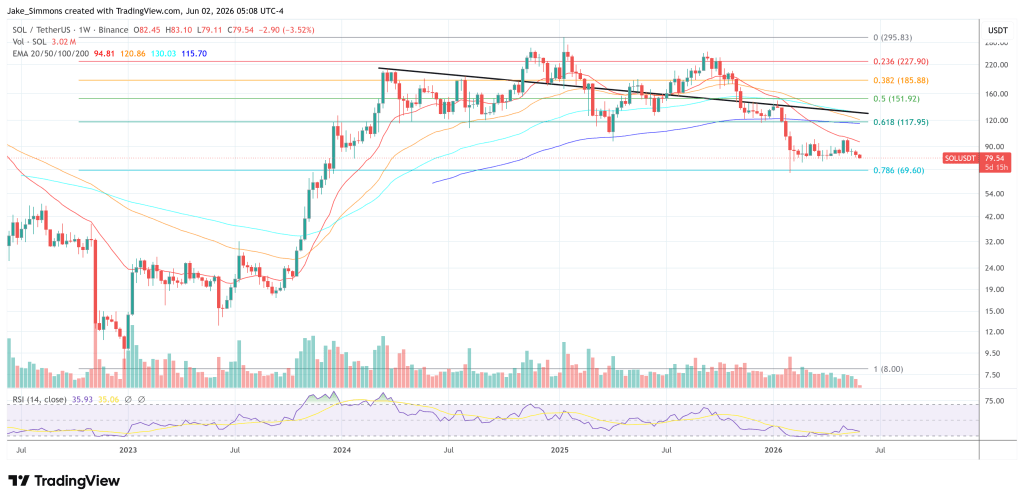
SOL remains in sideways trend, 1-week chart | Source: SOLUSDT on TradingView.com

Questions liées

QWhat is the primary goal of the Solana Foundation's new initiative as described in the article?

AThe primary goal of the Solana Foundation's initiative is to support teams building fully onchain perpetual futures and other derivatives on Solana. It aims to move derivatives execution more fully onto the blockchain without relying on offchain components, capturing revenue for the Solana ecosystem, and supporting models based on two-sided flow for price discovery.

QAccording to the article, which platform is positioned as the main competitive reference point for Solana's onchain perps push?

AThe main competitive reference point is Hyperliquid. The article states that Hyperliquid has become the reference point for onchain derivatives, and Solana's initiative sets up a clear challenge to the market structure that powered Hyperliquid's rapid rise.

QWhat specific type of pricing models is the Solana Foundation NOT interested in supporting for this initiative?

AThe Solana Foundation is not looking for pool-based pricing models as the center of this effort. It is interested in models where price is set based on two-sided flow, such as orderbooks, RFQ systems with competing makers, or designs where active participants set bids and offers against each other.

QBesides the core perps protocols, what other types of complementary infrastructure does Solana want to support through this initiative?

ASolana also wants to support complementary infrastructure including frontend integrations, vaults, structured products, aggregators, advanced trading interfaces, market making operations, and social trading applications.

QWhat are the key requirements or filters mentioned for teams interested in the Solana Foundation's support?

AKey requirements include building 'Solana-first' (optimized for SOL's design and culture), structuring application revenue to route back to the chain, being open to teams migrating from offchain/hybrid models, and committing to open-source development ('contributing in the open').

Lectures associées

Début de Warsh : le président de la Fed le plus au fait du Crypto de l'histoire apportera-t-il des surprises ou des chocs au marché ?

**Résumé :** Kevin Warsh, nouveau président de la Réserve fédérale américaine, s'apprête à tenir sa première conférence de presse monétaire. Sa nomination est historique : il est le premier président de la Fed à détenir personnellement des actifs numériques (investissements indirects dans Solana, dYdX, etc.), montrant une compréhension unique du secteur. Son dilemme est majeur : il doit faire face à une résurgence de l'inflation, qui exige une politique monétaire stricte (position "de faucon"), tout en répondant aux pressions politiques pour des baisses de taux. Parallèlement, son attitude envers les crypto-actifs diffère fondamentalement de celle de son prédécesseur. Il ne les considère pas comme de simples actifs spéculatifs, mais plutôt comme un "bon policier" pour la politique économique et une composante de la compétitivité américaine. Son impact potentiel sur le marché crypto s'articule autour de trois axes : 1. Un changement de paradigme réglementaire, passant de la prévention à l'intégration et à l'innovation. 2. Une reprixation des actifs liée aux taux d'intérêt, où sa clarté de communication pourrait réduire la prime d'incertitude. 3. Une légitimation accrue pouvant attirer les capitaux institutionnels traditionnels. Deux scénarios principaux sont envisagés pour sa première intervention : * **Scénario "Surprise"** : Un ton modéré ("de colombe") sur les taux combiné à des signaux favorables à l'innovation numérique pourrait booster le marché. * **Scénario "Choc"** : Un message excessivement restrictif sur les taux pourrait entraîner une vente généralisée des actifs risqués, y compris les cryptos. Bien qu'il ait dû vendre ses actifs crypto pour des raisons d'éthique, la compréhension intrinsèque de Warsh pour la technologie blockchain pourrait, à long terme, poser les bases d'une intégration plus structurelle des actifs numériques dans le système financier.

marsbitIl y a 4 h

Début de Warsh : le président de la Fed le plus au fait du Crypto de l'histoire apportera-t-il des surprises ou des chocs au marché ?

marsbitIl y a 4 h

XRP Ledger Lance le Rebranding XRPld Avec la Mise à Niveau Version 3.2.0

La version 3.2.0 du XRP Ledger (XRPL) est désormais disponible, introduisant une refonte majeure incluant le changement de nom du logiciel principal de « rippled » à « xrpld ». Cette mise à niveau se concentre principalement sur les améliorations des performances, de la sécurité et de l'évolutivité de l'infrastructure sous-jacente, plutôt que sur de nouvelles fonctionnalités utilisateur. Les principales avancées incluent des optimisations de mémoire pouvant réduire jusqu'à 40% l'utilisation de la mémoire serveur. Sur le plan de la sécurité, la modification `fixCleanup3_2_0` renforce plusieurs modules, notamment les coffres-forts à actif unique, le protocole de prêt, les échanges décentralisés et les jetons multi-usages. De nouveaux contrôles d'invariance garantissent la cohérence du registre après la suppression de comptes. Pour les développeurs, la mise à jour permet désormais de récupérer des informations sur les définitions du protocole et du serveur XRPL sans nécessiter de connexion active, facilitant ainsi la création de portefeuilles, d'explorateurs de blockchain et d'APIs. En termes d'évolutivité et de stabilité, les améliorations comprennent des tailles de bloc configurables, un stockage de base de données optimisé via nuDB, et le support optionnel de TLS/mutual TLS pour le serveur gRPC. Le port de peering par défaut est également passé du 51235 au 2459. Divers correctifs ont été apportés aux fonctions liées aux Market Makers Automatisés, aux paiements, aux séquestres de jetons et aux carnets d'ordres. Une note importante : les invariants de transaction ont été temporairement désactivés dans la v3.2.0 en raison d'un impact sur les performances, mais cela ne présente pas de risque pour la sécurité.

TheNewsCryptoIl y a 4 h

XRP Ledger Lance le Rebranding XRPld Avec la Mise à Niveau Version 3.2.0

TheNewsCryptoIl y a 4 h

L'AGI n'est pas l'arrivée, nouveau document de DeepMind : Vers l'ASI, le véritable progrès de l'IA ne fait que commencer

Si l'intelligence artificielle générale (IAG) était atteinte demain, quelle serait la prochaine étape ? Une étude de Google DeepMind suggère que l'IAG n'est pas un point final, mais une étape vers une superintelligence artificielle (ISA) dépassant les collectifs d'experts humains. L'étude distingue trois concepts : l'IAG (niveau médian humain), l'ISA (supérieure aux meilleurs collectifs humains dans presque tous les domaines) et l'IA universelle (limite théorique). Elle propose quatre voies potentielles vers l'ISA : 1. **Extension des ressources** : augmentation de la puissance de calcul, des données et des modèles. 2. **Évolution algorithmique** : améliorations incrémentales ou nouveaux paradigmes (apprentissage continu, utilisation d'outils, modèles du monde). 3. **Auto-amélioration récursive** : des IA plus performantes conçoivent la génération suivante, créant une boucle de rétroaction positive. 4. **Coordination multi-agents** : des systèmes IAG collaborant atteignent une intelligence collective supérieure. L'étude identifie six principaux goulets d'étranglement : 1. **Le mur des données** : les données humaines de haute qualité pourraient s'épuiser. 2. **Pressions économiques et ressources naturelles** : coûts énergétiques et matériels. 3. **Limites des paradigmes neuronaux actuels** : problèmes d'apprentissage continu, de raisonnement robuste, d'hallucinations. 4. **Difficulté croissante de la recherche**. 5. **Barrières à l'abstraction** : difficulté à former de nouveaux concepts fondamentaux. 6. **Régulation, gouvernance et réaction sociale**. Un défi crucial est l'évaluation des capacités de l'IA au-delà du niveau humain, nécessitant de nouveaux benchmarks. L'étude conclut que la progression vers l'ISA reste incertaine, soumise à des contraintes physiques et de ressources, et appelle à un effort de recherche interdisciplinaire pour mieux anticiper cette évolution.

marsbitIl y a 5 h

L'AGI n'est pas l'arrivée, nouveau document de DeepMind : Vers l'ASI, le véritable progrès de l'IA ne fait que commencer

marsbitIl y a 5 h

Trading

Spot
Futures

Articles tendance

Comment acheter PUSH

Bienvenue sur HTX.com ! Nous vous permettons d'acheter Push Protocol (PUSH) de manière simple et pratique. Suivez notre guide étape par étape pour commencer votre parcours crypto.Étape 1 : Création de votre compte HTXUtilisez votre adresse e-mail ou votre numéro de téléphone pour ouvrir un compte sur HTX gratuitement. L'inscription se fait en toute simplicité et débloque toutes les fonctionnalités.Créer mon compteÉtape 2 : Choix du mode de paiement (rubrique Acheter des cryptosCarte de crédit/débit : utilisez votre carte Visa ou Mastercard pour acheter instantanément Push Protocol (PUSH).Solde :utilisez les fonds du solde de votre compte HTX pour trader en toute simplicité.Prestataire tiers :pour accroître la commodité d'utilisation, nous avons ajouté des modes de paiement populaires tels que Google Pay et Apple Pay.P2P :tradez directement avec d'autres utilisateurs sur HTX.OTC (de gré à gré) : nous offrons des services personnalisés et des taux de change compétitifs aux traders.Étape 3 : stockage de vos Push Protocol (PUSH)Après avoir acheté vos Push Protocol (PUSH), stockez-les sur votre compte HTX. Vous pouvez également les envoyer ailleurs via un transfert sur la blockchain ou les utiliser pour trader d'autres cryptos.Étape 4 : tradez des Push Protocol (PUSH)Tradez facilement Push Protocol (PUSH) sur le marché Spot de HTX. Il vous suffit d'accéder à votre compte, de sélectionner la paire de trading, d'exécuter vos trades et de les suivre en temps réel. Nous offrons une expérience conviviale aux débutants comme aux traders chevronnés.

361 vues totalesPublié le 2024.12.13Mis à jour le 2026.06.02

Comment acheter PUSH

Discussions

Bienvenue dans la Communauté HTX. Ici, vous pouvez vous tenir informé(e) des derniers développements de la plateforme et accéder à des analyses de marché professionnelles. Les opinions des utilisateurs sur le prix de PUSH (PUSH) sont présentées ci-dessous.

活动图片