SpaceX and OpenAI Are Rushing to Go Public. Is Wall Street Ready?

marsbitPublié le 2026-05-22Dernière mise à jour le 2026-05-22

Résumé

SpaceX and OpenAI Rush to IPO: Is Wall Street Ready? SpaceX and OpenAI, led by former partners turned rivals Elon Musk and Sam Altman, are on a collision course to go public, igniting a potential Wall Street showdown. SpaceX filed for an IPO targeting a staggering $1.75-$2 trillion valuation. Its financials are starkly divided: while the Starlink (Connectivity) segment is profitable, these earnings are being consumed by massive losses in its core Aerospace business (rocket/Starship development) and the newly integrated AI business, formerly xAI. The entire IPO narrative hinges on investors betting that Starlink can fund Musk's long-term vision of orbital AI data centers, lunar infrastructure, and Mars colonization. OpenAI, following its legal victory over Musk, is reportedly preparing a secret IPO filing with a target to list by September. Its move is framed as a necessary "lifeline." Despite high revenue, OpenAI is burning cash at an alarming rate. Facing intense competition from rivals like Anthropic (which is nearing profitability) and pressure to sustain enormous compute costs, the IPO is seen as a critical step to secure public market funding for survival. Both companies present investors with a high-stakes gamble on future value versus present-day financial realities. SpaceX's valuation is a bet on unproven, capital-intensive space-based infrastructure. OpenAI's hinges on AI becoming a foundational platform, despite current monetization challenges and heavy losses. ...

By | TingtongTech (ID:tingtongtech), Author | Ke Chen, Editor | Xiafei Rao

No sooner had the "century lawsuit" between Elon Musk and Sam Altman concluded than their rivalry swiftly shifted to Wall Street.

On May 21, U.S. Pacific Time, SpaceX officially filed its S-1 IPO prospectus with the U.S. Securities and Exchange Commission, planning to list on NASDAQ under the ticker "SPCX" with a target valuation of $1.75 trillion to $2 trillion and a fundraising cap of $75 billion.

On the very same day, OpenAI was reportedly working with Goldman Sachs and Morgan Stanley to draft its IPO prospectus, potentially filing confidentially as early as May 22, aiming for an IPO as soon as September this year.

Former entrepreneurial partners, now courtroom and market adversaries, sent out their invitations to the capital market in the same week. But this is not a heartwarming tale of "former brothers joining forces to reach the shore." This is a head-to-head, cutthroat Wall Street battle.

In this drama, Musk is selling a "space AI" story. Altman narrates a script of transformation from a "non-profit charity" to an entity gripped by a thirst for profit.

For the audience outside the drama, the greater interest lies in who tells the better story in this IPO scramble, whose data looks more impressive, and who is the one most desperate to stay afloat by going public.

More importantly, are these tech giants spinning tales, or are they creating value? What kind of market will be left for investors and the industry after these two giants vie for a position on Wall Street?

-01- SpaceX: When There's No Profit, Stuff 'Dreams' into the Prospectus

This time, Musk is laying out a set of financial cards that are deeply contradictory.

Musk's target is grand. SpaceX plans to raise $75 billion with a valuation of $1.75 trillion to $2 trillion, with a target listing date around June 12. If achieved, SpaceX would be the largest IPO in human history, and Musk would become the world's first trillionaire.

However, key data revealed in the prospectus shows that in 2025, SpaceX had a net loss of $4.94 billion. The loss for Q1 2026 was even more staggering, nearing the annual 2025 figure at $4.28 billion, making a $2 trillion valuation seem far-fetched.

Breaking it down, SpaceX's business segments are "strikingly uneven in prosperity."
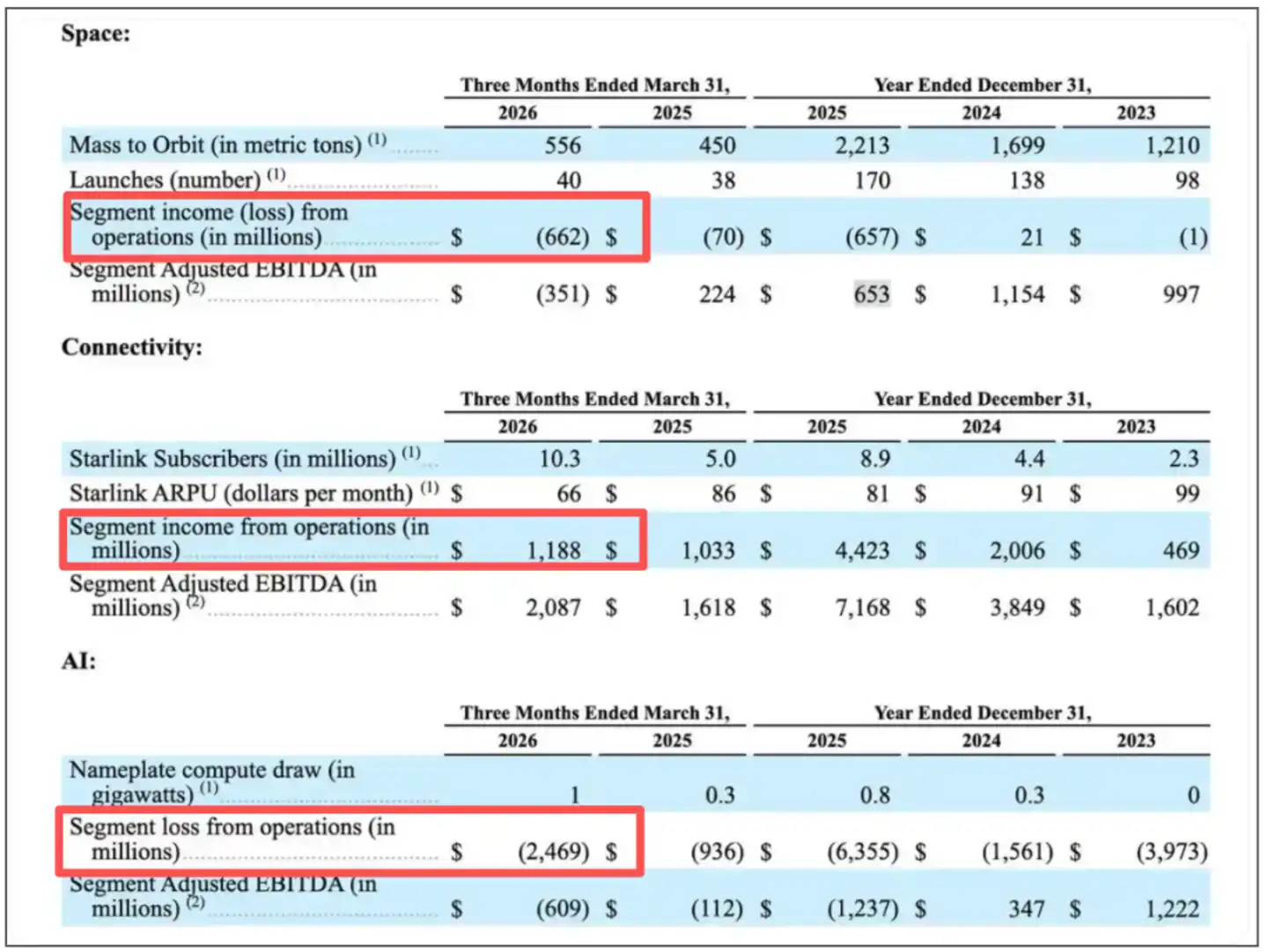
Figure: SpaceX's Three Major Business Segments Revenue and Profit

Source: SpaceX Prospectus

Among the three major segments — Aerospace, Connectivity/Starlink, and AI — the Connectivity business housing Starlink is the only one presentable. In Q1 2026, it generated $3.26 billion in revenue and $1.19 billion in operating profit, accounting for 69% of total revenue. A quarterly profit of $1.19 billion is an exceptionally strong number by any standard.

But the question is, where does Starlink's money go? The answer lies in the other two segments.

SpaceX's Aerospace business (rocket launches and the Starship project) had Q1 revenue of $619 million but lost $662 million. Data suggests SpaceX has already burned over $15 billion developing Starship.

However, what truly obliterates the profits is the AI business. After acquiring Musk's own AI startup, xAI, and integrating it into the "SpaceX AI" segment, it recorded a loss of $6.355 billion for the full year 2025 and another $2.469 billion in Q1 2026.

In other words, the hard-earned net profit from Starlink is not only entirely consumed by the other two segments but also ends up putting the company tens of billions of dollars further in the red.

From Musk's script, this is a beautiful plan: the earth-based "Starlink" makes money to fund the space-based "Space AI" and "Mars." This is likely why, before the IPO, Musk merged xAI into SpaceX.

From the market's perspective, SpaceX's IPO at this time essentially tests a proposition: can one "Starlink" actually support one "Mars" and one "Space AI"?

In other words, the $2 trillion valuation can be understood as Starlink contributing roughly $0.5 trillion, xAI's AI story contributing about $0.5 trillion, and the remaining $1 trillion is essentially a long-dated option on "space AI infrastructure."

Investors tolerated losses from Musk's "Starlink" because they believed that xAI's current black hole would transform into a second money-printing machine. According to SpaceX, the potential market size for AI-related ventures could reach $26.5 trillion around 2030. If this story holds, current losses aren't a problem.

More importantly, the money Musk is pouring into "space" comes with plenty of stories yet to be told.

Take the core orbital AI data center as an example. It is reported that SpaceX has applied to the FCC to deploy up to 1 million satellites, building a "satellite constellation with unprecedented computing power" in low Earth orbit to power advanced AI models.

SpaceX wrote in its prospectus, "We believe we are the only company with a commercially viable path to building orbital AI computing capabilities at scale," with plans to begin deployment as early as 2028.

Another foundational tool is Starship.

SpaceX has cumulatively invested over $15 billion in Starship R&D, with about $3 billion spent in 2025 alone. Starship is the transportation infrastructure for space AI infrastructure, moon landings, Mars colonization — everything. Without it, a space data center is just a castle in the sky.

Further down the line, there are even longer-term blueprints like lunar manufacturing infrastructure and Mars colonization.

Clearly, SpaceX's valuation incorporates a huge premium for investor expectations regarding the space economy, AI, and Musk himself.

Previously, commentators pointed out that what truly elevates SpaceX's valuation might not be any financial model, but investors' fear of missing out on the next Tesla.

Many analysts note that no matter how explosive SpaceX's data is, some analysts and investors will be willing to buy into it, essentially due to the credibility built by Tesla's stock surging over 2,700% in the past decade. The market's fear of "missing the next Tesla" is driving analysts to collectively abandon rationality.

Regardless, SpaceX's filing at this moment indicates Musk is ready to package a bundle of cash-burning dreams, massive losses, and his 85.1% control stake, and sell it to the world for $2 trillion.

-02-OpenAI: From 'Benefiting Humanity' to 'IPO for Cash Infusion'

If Musk's IPO is a valuation gamble, then Altman's IPO is a "life-saving cash infusion that cannot be avoided."

In comparison, although OpenAI's story is much more down-to-earth, the burn rate for large models and APIs is described as "rocketing."

On May 21, multiple media outlets reported that banks including Goldman Sachs and Morgan Stanley were assisting OpenAI in drafting its IPO prospectus. The company plans to confidentially file with regulators soon, possibly within days.

Some insiders also stated that OpenAI aims to launch its IPO as early as September, though the plans remain fluid and subject to change.

This means the AI behemoth, once valued at over $850 billion, is about to open its doors to the public market. Furthermore, many industry insiders believe Altman likely hopes to beat Musk to the punch.

After all, Altman has just settled Musk's lawsuit over "abandoning the public benefit mission." With this major stumbling block removed, OpenAI is fast-tracking its IPO schedule.

However, from the market's perspective, while OpenAI's move appears superficially as a "beachhead landing," its core resembles a "cash infusion and escape."

Peeling back the surface of an $850 billion valuation, OpenAI's substance isn't glamorous.

First, OpenAI needs money to survive. Public data shows OpenAI has about 960 million monthly active users and annualized revenue of around $25 billion — seemingly impressive. But it burns $57 billion a year, resulting in a net loss of $44 billion.

Additionally, OpenAI's monetization efficiency per user is problematic. For instance, competitor Anthropic generates $211 per monthly active user, while OpenAI only makes $25.

Previously, Altman has hinted on various occasions that annual computing power investment is astronomical. Without an IPO for a transfusion, although there's plenty of money in the private market, it will eventually run out. Leveraging the public market essentially means seeking fundraising from global retail investors.

Especially since OpenAI's so-called legal victory didn't actually secure a turning point for itself.

Many see Musk's loss in court as a key turning point for OpenAI's IPO. However, although the lawsuit was won, Musk's soul-searching questions haven't disappeared. A company born with a "non-profit" slogan yet eager to distribute profits wildly to shareholders (including Microsoft) is inherently contradictory in its governance structure.

Many analysts believe that choosing this timing for the IPO, Altman wants to strike while the iron is hot — while the舆论heat from "defeating Musk" is still present and before the口碑of GPT-5.5 cools completely — to quickly harvest the capital market.

Of course, a market commonplace is that OpenAI was once unique but is now being "besieged." Whether it's Anthropic eroding OpenAI's core user base at an astonishing speed or Google catching up step by step, it all indicates Altman must accelerate to take the market lead.

In particular, while ChatGPT is famous, in the enterprise market, Anthropic's Claude enjoys an excellent reputation. Reports indicate Anthropic's annualized revenue exceeds $30 billion, and its latest valuation is about to surpass $900 billion, a figure that has already overtaken OpenAI.

In this situation, if OpenAI doesn't go public soon, it will miss its chance. Once market attention is drawn away by an Anthropic IPO, or if the next "Strawberry" or "Orion" model fails to ignite the market as expected, OpenAI's valuation myth could shatter at any moment.

-03-Spinning Tales or Creating Value?

To make matters worse, Anthropic, also racing to go public alongside Musk and Altman, was recently reported to be nearing profitability.

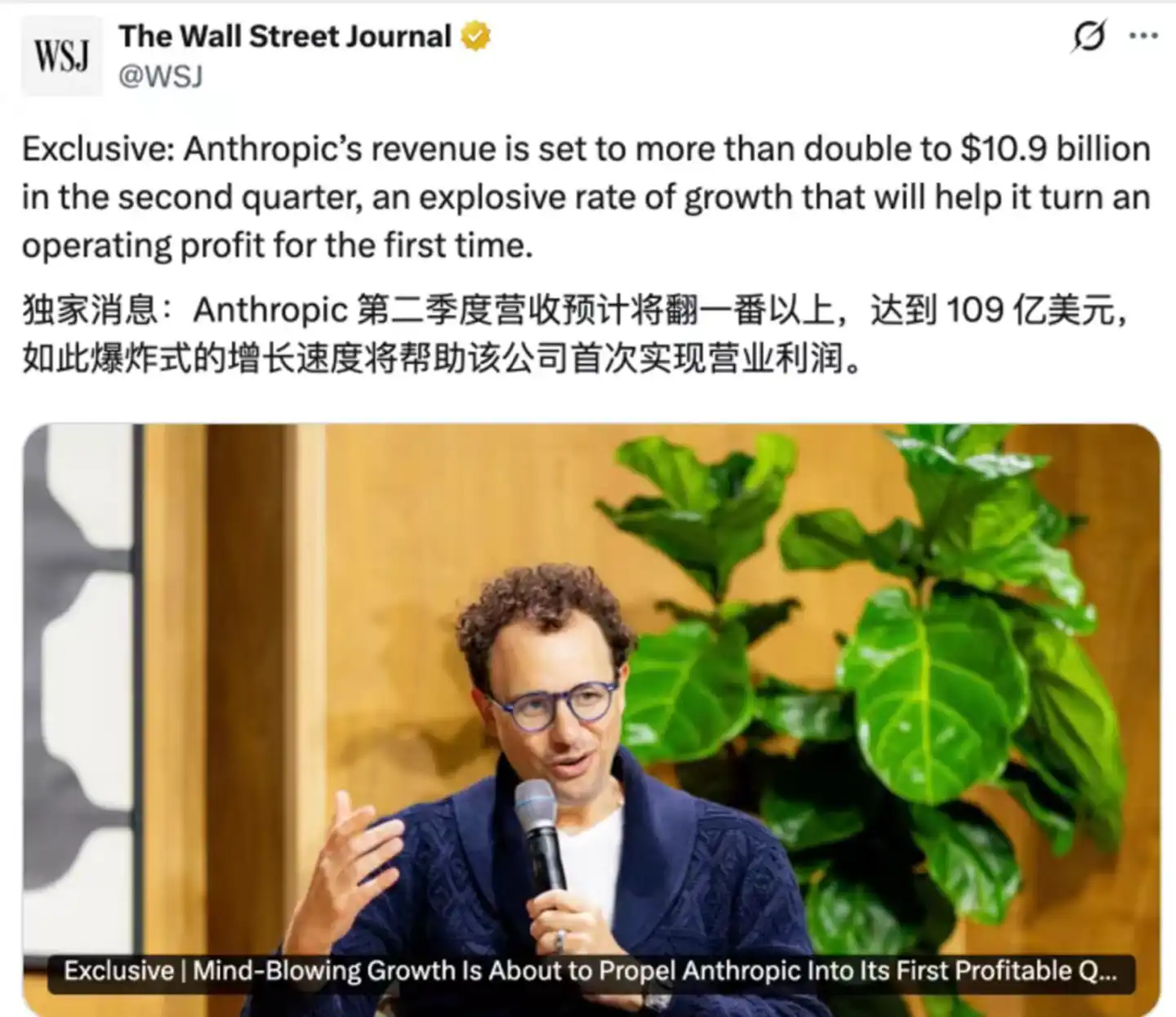
According to the latest media reports, Anthropic's revenue in Q2 this year is expected to more than double, reaching $10.9 billion, which would help the company achieve profitability for the first time.

This is not good news for either Musk or Altman, as there's still no answer as to when SpaceX and OpenAI will become profitable.
(Image sourced from the internet)

All this will undoubtedly accelerate industry involution. For both SpaceX and OpenAI, the immediate question is who will secure the IPO lead and obtain the "golden parachute."

For Musk, once SpaceX goes public, there will be two Musk concept stocks in the market. Tesla's story is about electric vehicle penetration and autonomous driving realization — narratives that have been repeatedly validated. SpaceX's story is about Starlink, space computing power, and Mars colonization — stories with longer realization cycles and imaginations less constrained.

For Altman, pushing OpenAI public allows his stock options and equity to be realized, transforming him from an "AI evangelist" into a "Silicon Valley magnate."

However, even as these two star companies may face their capital market coming-of-age, they still need to prove whether their trillion-dollar valuations are justified or bubbles.

The reality is, the market cares more about whether these companies are spinning tales or creating value.

As is well known, SpaceX's valuation is built on "long-term imagination." The problem is that this time, the "pie Musk is drawing" is excessively large.

Whether Musk's optimistic expectations materialize depends on whether Starship can launch on schedule, whether AI can find a commercial path in orbit, and whether space data centers can evolve from PPT slides to actual servers.

Even the prospectus admits these plans are "still in early stages, involve significant technological uncertainties, and may not achieve commercial viability." Market analysis also points out that SpaceX's price-to-sales ratio would be around 80x, far above the average of about 7x for the top 15 U.S. companies by market cap.

OpenAI's trillion-dollar valuation is built on the assumption that "large models will become the next-generation operating system."

Judging from current product forms, ChatGPT remains a conversational AI tool, and its business model hasn't broken free from the "pay-per-Token" framework.

OpenAI has also attempted emergency adjustments to mask its internal and external troubles, shutting down the cash-burning, barely-monetized Sora video project, and even rumored to be considering developing its own smartphone.

But investors aren't buying it. According to The Information, several underwriters have conducted soundings with public market investors, receiving rather lukewarm feedback. Major concerns include excessively high valuation, with a forward price-to-sales ratio of about 28x (based on projected 2026 revenue) far exceeding Nvidia's roughly 12x metric.

The above market reactions indicate these are not traditional IPOs but more like two capital scrambles.

Ultimately, the reason lies in the fact that neither SpaceX nor OpenAI are traditional companies.

SpaceX's dream is to build a Martian city; OpenAI aims to achieve AGI. Within Wall Street's narrative logic, this kind of grand, out-of-the-ordinary vision might be the only way to make investors accept astronomical valuations.

But the fact is, in SpaceX's prospectus, Musk holds 85% of the voting power, employing a dual-class share structure. This means that as long as he insists on the Mars colonization dream, the company must follow, regardless of investor opinion.

And OpenAI's various narratives consistently teach investors one thing: "Please believe we will improve; we're just facing some difficulties now."

In other words, both IPOs share a commonality: they aren't using beautiful profit curves to convince investors but are asking investors to pay for faith in a future "promise."

Of course, for the market, the only certainty in this capital game is that, whether for SpaceX or OpenAI, a successful listing will become one of the largest IPOs in history, bringing massive underwriting fees to Wall Street and astronomical personal wealth to the founders.

Simultaneously, retail investors may have to pay a considerable price to fill the enormous financial loss black hole.

And this is precisely the awkwardness of the capital market. If post-IPO stock performance disappoints, investors may conclude these companies were overvalued.

This inevitably recalls the 2021 tech stock frenzy. Back then, any company associated with cloud or SaaS enjoyed sky-high valuations, only to experience brutal corrections during the interest rate hike cycle. Many analysts believe, "To invest in these stocks, you need a strong heart."

Conversely, for these two super IPOs, investors need to think clearly: Are they willing to pay a higher premium for Mars colonization and orbital data centers? And are they willing to wait for years for the AGI vision?

After all, what lies between a bubble and a vision is not just repeated quarterly earnings misses, but a genuine capital valuation scramble for survival.

And Wall Street needs to prepare, because following these two will be even more stories.

(Header image and some supporting images are from AI.)

(Disclaimer: This article is for informational exchange only and does not constitute any investment advice.)


Cryptos en tendance

Questions liées

QWhat are the key financial challenges faced by SpaceX according to its IPO filing, and which of its business units is currently profitable?

AAccording to its IPO filing, SpaceX reported a net loss of $4.94 billion in 2025 and a $4.28 billion loss in Q1 2026. Its Starlink connectivity business is the only profitable unit, generating $1.19 billion in operating profit on $3.26 billion in revenue in Q1 2026. This profit, however, is used to fund the heavy losses in its other two divisions: its Space (rocket/Starship) business and its AI business (formerly xAI), which lost $662 million and $2.469 billion respectively in Q1 2026.

QWhy is OpenAI reportedly rushing to go public, and what are its main competitive and financial pressures?

AOpenAI is reportedly rushing to go public primarily to raise capital ('a transfusion') to sustain its operations, as it is burning through cash at a high rate. Financial pressures include an annual loss of $44 billion despite $25 billion in annual revenue. Competitively, rivals like Anthropic are growing rapidly, with higher revenue per user and potentially reaching profitability soon, threatening OpenAI's market leadership. The IPO also allows its leadership, like Sam Altman, to monetize their stakes.

QHow does the article characterize the core narratives or 'stories' that SpaceX and OpenAI are selling to investors in their IPOs?

AThe article characterizes SpaceX's narrative as selling a 'space AI' dream. It combines the near-term profitability of Starlink with the long-term, high-risk visions of orbital AI data centers, Starship as transport infrastructure, and ultimately Mars colonization. OpenAI's narrative is framed as a transformation from a 'non-profit for humanity' to a profit-driven entity, selling the story that AI large language models will become the next generation's operating system, despite current massive losses and business model challenges.

QWhat governance and control structure is highlighted for SpaceX post-IPO, and what concern does this raise?

AThe article highlights that post-IPO, Elon Musk will retain 85.1% voting control over SpaceX through a dual-class share structure. This raises the concern that investors will have little say in the company's direction. Musk can continue to pursue his long-term, capital-intensive visions like Mars colonization and orbital data centers ('follow the dream'), regardless of investor preferences for profitability or shorter-term returns.

QAccording to the article, what major risk do retail investors face with these mega-IPOs, and what historical market period is this situation compared to?

AThe article suggests retail investors risk paying a high premium for future promises that may not materialize, potentially leading to significant losses if the companies' financial performance disappoints after listing. It compares the situation to the tech stock frenzy of 2021, where companies related to cloud and SaaS commanded extremely high valuations only to experience a painful correction when interest rates rose, implying a similar 'bubble' risk exists here.

Lectures associées

Ne pas investir n'est pas un laissez-passer pour Apple

Face aux géants technologiques comme Meta et Google qui font face à des critiques pour leurs dépenses d'investissement massives dans l'IA, Apple, bien qu'en retard dans ce domaine, se distingue par sa retenue budgétaire. Cette approche lui a même permis de retrouver brièvement la première place mondiale en termes de valorisation boursière. Le rapport trimestriel (T3 2026) d'Apple affiche des performances solides, avec un chiffre d'affaires en hausse de 16,4% et un bénéfice net en progression de 27,1%. L'iPhone et le Mac sont les principaux moteurs de cette croissance, compensant les résultats plus modestes de l'iPad (en baisse) et des services (ralentissement de la croissance). Cependant, le marché réagit négativement après la publication des résultats, en raison des perspectives prudentes pour le trimestre suivant. Apple anticipe des contraintes d'approvisionnement majeures, notamment pour les puces et la mémoire, entraînant des hausses de prix sur ses produits. Contrairement à ses concurrents qui investissent des milliards dans l'infrastructure IA, Apple maintient des dépenses d'investissement (capex) faibles, privilégiant les dépenses de R&D. Malgré cela, l'entreprise n'échappe pas aux répercussions de la frénésie de l'IA, qui exacerbe les tensions sur sa chaîne d'approvisionnement. Ce rapport marque la dernière conférence téléphonique de Tim Cook en tant que PDG, avant son départ prévu en septembre. Il exprime sa confiance dans l'avenir de l'entreprise.

marsbitIl y a 45 mins

Ne pas investir n'est pas un laissez-passer pour Apple

marsbitIl y a 45 mins

PA Figure | Une infographie pour comprendre les grands événements de l'écosystème Web3 en août 2026

Août 2026 s'annonce chargé pour l'écosystème Web3, marqué par plusieurs événements clés susceptibles d'influencer les marchés. L'agenda macroéconomique sera déterminant, avec la publication des données américaines sur l'emploi (non-farm payrolls) et l'inflation (CPI) de juillet, ainsi que les comptes-rendus de la Réserve Fédérale et le symposium annuel de Jackson Hole. Sur le front réglementaire, des développements majeurs sont attendus : le Sénat américain doit dévoiler un nouveau projet de loi (*CLARITY Act*), tandis que l'interdiction des transactions cryptos de l'UE envers la Biélorussie entre en vigueur. Les marchés devront également absorber des déblocages massifs de jetons (**ENA, AVAX, CONX, ZRO, KAITO**, etc.), susceptibles de créer de la volatilité. Par ailleurs, l'industrie continuera son consolidation, avec l'arrêt ou la refonte prévus de plusieurs services comme Exchange Art, Ctrl Wallet, Zapper, NFTfi et Summer.fi, incitant les utilisateurs à gérer leurs actifs en conséquence. Du côté des entreprises, les résultats du Q2 de **SpaceX, Circle et Nvidia** seront publiés, et des levées de fonds importantes sont au programme, notamment pour la société chinoise Moonshot AI (pré-IPO). Enfin, des événements sectoriels majeurs comme **Bitcoin Asia 2026** et le **China Digital Expo 2026** se tiendront. En résumé, le mois d'août sera structuré autour des anticipations macroéconomiques, de l'évolution réglementaire, des déblocages de tokens et de la consolidation continue du secteur.

marsbitIl y a 58 mins

PA Figure | Une infographie pour comprendre les grands événements de l'écosystème Web3 en août 2026

marsbitIl y a 58 mins

La voix la plus célèbre de « Cassandre » de Wall Street s'attaque cette fois à NVIDIA

Une récente divulgation de l’investisseur Michael Burry, connu pour avoir prédit la crise des subprimes et immortalisé dans « The Big Short », a relancé les débats sur le marché. Fin juin, il a annoncé avoir pris des positions à découvert sur plusieurs valeurs technologiques, dont Nvidia (à un prix d’entrée de 198,09 $), Tesla, Applied Materials, Caterpillar et l’ETF SOXX (semiconducteurs). Le 1er juillet, il a ajouté Micron à sa liste, avant d’augmenter fin juillet ses positions sur Nvidia, Micron et SOXX. Ses arguments portent principalement sur les pratiques comptables dans le secteur de l’IA : selon lui, la durée d’amortissement des puces (étirée à 6 ans par les géants du cloud comme Microsoft ou Google) ne reflète pas leur obsolescence rapide (2-3 ans), ce qui gonflerait artificiellement les profits. Il évoque également des risques de « financement circulaire hors bilan », où Nvidia pourrait garantir des prêts à des clients pour qu’ils achètent ses propres puces, créant ainsi une demande artificielle. Enfin, il critique les rachats d’actions de Nvidia, accusés de doper artificiellement le bénéfice par action – une affirmation que la société a contestée en soulignant des erreurs de calcul. Les réactions sont partagées. D’un côté, des voix comme Steve Eisman (autre figure de « The Big Short ») restent prudentes mais ne suivent pas la position découverte, notant la croissance soutenue des revenus et des investissements en IA. De l’autre, Jim Chanos, célèbre vendeur à découvert, partage l’inquiétude sur les écarts comptables mais préfère cibler d’autres acteurs financiers plutôt que les fabricants de puces. Historiquement, les appels de Burry ont connu des succès mitigés : corrects sur des crises structurelles (subprimes, COVID), mais souvent prématurés ou erronés sur des arguments de valorisation (Tesla, Nvidia en 2023). Aujourd’hui, les positions à découvert sur Nvidia restent marginales (environ 1,4 % des actions en circulation), même si les pertes cumulées des vendeurs à découvert sur la valeur dépassent 5 milliards de dollars. Pour les investisseurs, l’intérêt réside moins dans le suivi des positions de Burry que dans la méthodologie sous-jacente : scruter les flux de trésorerie, questionner les traitements comptables agressifs et identifier les risques structurels, surtout quand le marché semble euphorique. La question centrale n’est pas de savoir si Burry a raison cette fois, mais plutôt quels enseignements tirer de son analyse pour évaluer la solidité réelle de la bulle présumée de l’IA.

marsbitIl y a 1 h

La voix la plus célèbre de « Cassandre » de Wall Street s'attaque cette fois à NVIDIA

marsbitIl y a 1 h

Sélection de la semaine丨Émotions épiques sur le marché boursier, l'entrée en bourse de Changxin Tech redéfinit le paysage du stockage, Saylor vise à rétablir l'ancrage du STRC vers le 8 septembre

PANews présente un résumé hebdomadaire de contenus clés. Les marchés ont connu une volatilité significative, avec des indices boursiers sud-coréens subissant plusieurs interruptions et une chute des actions technologiques liées à l'IA. Dans ce contexte, le bitcoin apparaît comme un actif relativement stable. Le paysage technologique évolue rapidement. Le géant de la mémoire Longxin Technology a fait ses débuts en bourse avec une capitalisation importante, symbolisant une percée pour la DRAM nationale. Parallèlement, la convergence de l'IA, des agents autonomes et des besoins en calcul redéfinit les secteurs, des GPU aux infrastructures énergétiques, les entreprises de minage de bitcoin se repositionnant autour de la gestion de l'électricité. Dans le domaine crypto, l'innovation se poursuit. Les portefeuilles intelligents pour agents IA et les mécanismes de paiement programmables gagnent en importance, attirant l'attention de grandes plateformes. De nouveaux modèles économiques, comme le protocole à jeton FWA qui combine NFT et système de tirage, génèrent un fort engagement. Cependant, un décalage est observé entre la croissance des revenus des principaux protocoles et la performance de leurs jetons. Le secteur des Real World Assets (RWA) voit son volume augmenter mais peine à mobiliser ses actifs. Les perspectives macroéconomiques restent mitigées. La Réserve Fédérale américaine maintient des taux directeurs élevés, signalant une orientation durablement restrictive malgré des divisions internes. Des analystes comme Tom Lee considèrent les récentes corrections comme un assainissement nécessaire, affirmant que la logique de long terme du secteur reste intacte. Des personnalités anticipent un rôle accru du bitcoin dans le futur système monétaire. Les informations marquantes incluent : des mouvements réglementaires affectant les courtiers pour investisseurs chinois, le plan de développement technique d'Ethereum à horizon 2030, une importante migration de staking par Lido, et des performances boursières variées pour les entreprises liées à la crypto et à l'IA. Michael Saylor a également annoncé un objectif de réalignement pour le STRC autour du 8 septembre.

marsbitIl y a 1 h

Sélection de la semaine丨Émotions épiques sur le marché boursier, l'entrée en bourse de Changxin Tech redéfinit le paysage du stockage, Saylor vise à rétablir l'ancrage du STRC vers le 8 septembre

marsbitIl y a 1 h

Lorsque le marché commence à s'interroger sur les dépenses en capital liées à l'IA : Analyse complète des résultats du Q2 des cinq géants technologiques

À la fin juillet 2026, les résultats trimestriels d'Alphabet, Intel, Microsoft, Meta et Apple ont tous mis en évidence une croissance robuste des revenus et des bénéfices, largement portée par les investissements et la demande en IA. Cependant, les réactions des investisseurs ont divergé, soulignant un changement d'attention : le marché s'interroge désormais sur le calendrier du retour sur investissement de ces dépenses massives en capital. Alphabet a affiché une croissance record de son chiffre d'affaires et une performance cloud exceptionnelle, mais son augmentation des dépenses d'investissement, entraînant un flux de trésorerie libre négatif pour la première fois, a provoqué une chute de son cours. Intel, malgré ses meilleures ventes depuis quinze ans, a vu son rebond boursier anéanti après l'annonce d'une hausse significative de son budget d'investissement. À l'inverse, Microsoft, en abaissant ses prévisions de dépenses en capital et en promettant des flux de trésorerie positifs, a connu une forte hausse de son action. Meta, dont les dépenses ont explosé et le flux de trésorerie libre s'est effondré, a subi la plus forte vente. Enfin, Apple, malgré des résultats records, a vu son action chuter en raison de prévisions inférieures aux attentes, pointant des contraintes d'approvisionnement. En résumé, la demande en IA reste solide, mais le marché sanctionne désormais les entreprises dont les investissements massifs menacent à court terme la rentabilité et les flux de trésorerie, récompensant celles qui maîtrisent leur trajectoire financière.

Odaily星球日报Il y a 1 h

Lorsque le marché commence à s'interroger sur les dépenses en capital liées à l'IA : Analyse complète des résultats du Q2 des cinq géants technologiques

Odaily星球日报Il y a 1 h

Trading

Spot

Articles tendance

Comment acheter ID

Bienvenue sur HTX.com ! Nous vous permettons d'acheter SPACE ID (ID) de manière simple et pratique. Suivez notre guide étape par étape pour commencer votre parcours crypto.Étape 1 : Création de votre compte HTXUtilisez votre adresse e-mail ou votre numéro de téléphone pour ouvrir un compte sur HTX gratuitement. L'inscription se fait en toute simplicité et débloque toutes les fonctionnalités.Créer mon compteÉtape 2 : Choix du mode de paiement (rubrique Acheter des cryptosCarte de crédit/débit : utilisez votre carte Visa ou Mastercard pour acheter instantanément SPACE ID (ID).Solde :utilisez les fonds du solde de votre compte HTX pour trader en toute simplicité.Prestataire tiers :pour accroître la commodité d'utilisation, nous avons ajouté des modes de paiement populaires tels que Google Pay et Apple Pay.P2P :tradez directement avec d'autres utilisateurs sur HTX.OTC (de gré à gré) : nous offrons des services personnalisés et des taux de change compétitifs aux traders.Étape 3 : stockage de vos SPACE ID (ID)Après avoir acheté vos SPACE ID (ID), stockez-les sur votre compte HTX. Vous pouvez également les envoyer ailleurs via un transfert sur la blockchain ou les utiliser pour trader d'autres cryptos.Étape 4 : tradez des SPACE ID (ID)Tradez facilement SPACE ID (ID) sur le marché Spot de HTX. Il vous suffit d'accéder à votre compte, de sélectionner la paire de trading, d'exécuter vos trades et de les suivre en temps réel. Nous offrons une expérience conviviale aux débutants comme aux traders chevronnés.

483 vues totalesPublié le 2024.12.12Mis à jour le 2026.06.02

Comment acheter ID

Discussions

Bienvenue dans la Communauté HTX. Ici, vous pouvez vous tenir informé(e) des derniers développements de la plateforme et accéder à des analyses de marché professionnelles. Les opinions des utilisateurs sur le prix de ID (ID) sont présentées ci-dessous.

活动图片