Perspective: Tokens on alt.fun are double-layered leverage

marsbitPublié le 2026-05-18Dernière mise à jour le 2026-05-18

Résumé

**Title:** Tokens on alt.fun are Double-Layered Leverage **Summary:** Tokens on alt.fun (like ALT) are not simple 5x leveraged bets on HYPE. Instead, they represent a **double layer of leverage**. The core mechanism involves HyperSwap V2 pools. After "graduation," these tokens are paired not with USDC, but with **HYPE5L**—a 5x long leverage token (LT) issued by BounceTech that tracks HYPE. Therefore, an alt.fun token's price in USDC is determined by multiplying two independent factors: 1. **AMM Exchange Rate:** The pool's ratio between the alt token and HYPE5L, driven by trading activity on alt.fun. 2. **LT Net Asset Value (NAV):** HYPE5L's value, which moves at approximately 5x the daily return of HYPE. This creates a compounding effect: * If HYPE rises 1%, HYPE5L's NAV rises ~5%. Profit-taking HYPE5L holders may then buy alt tokens, increasing demand and pushing the AMM exchange rate higher. The alt token's total gain thus exceeds 5%, potentially reaching 8-15%. * Conversely, if HYPE falls, losses are amplified beyond 5x due to combined NAV decline and AMM selling pressure. During crashes, large sell orders may fail due to non-atomic redemption paths, potentially trapping later sellers. In contrast, platforms like pump.fun pair tokens with stable assets like SOL, applying only the AMM amplifier to a 1x underlying asset. Alt.fun's use of a pre-leveraged quote asset (HYPE5L) fundamentally shifts the risk profile, creating a **second-order product with floating, of...

Author:798.eth

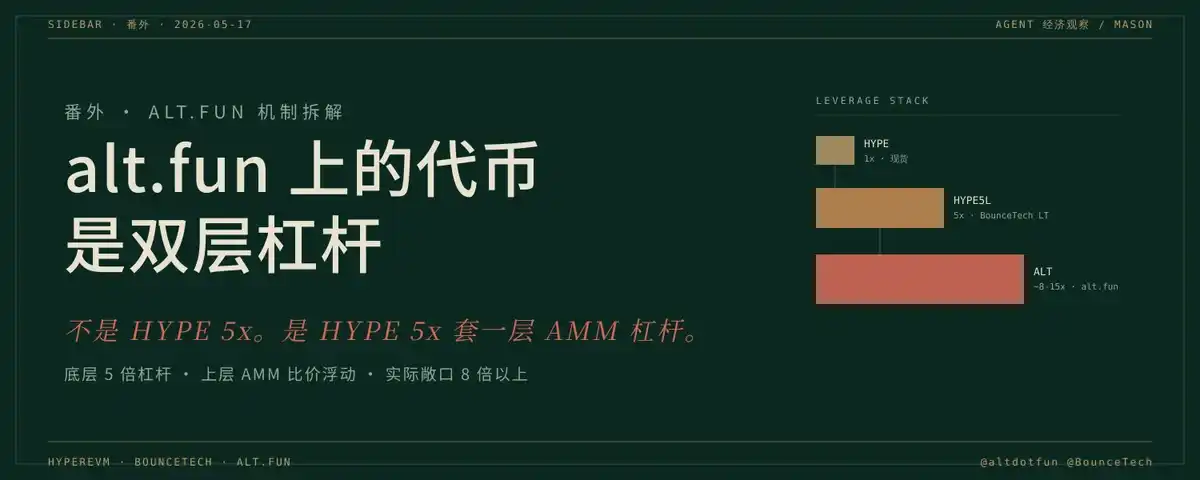
The alt tokens on alt.fun are not 5x leverage on HYPE. They are 5x leverage on HYPE with an additional layer of AMM leverage stacked on top.

This isn't obvious intuitively. You'll understand after reviewing the mechanism. First, let's look at current data for reference.

HYPE spot price is 42.84 USDC.

HYPE5L (the HYPE 5x long leverage token LT issued by BounceTech) has a current NAV of 0.870 USDC, which is a 13% decay from its issue price of 1 USDC.

In the HyperSwap V2 pool for the alt.fun flagship token ALT, there are 18.58 million ALT tokens and 129,400 HYPE5L tokens. 1 ALT equals 0.00697 HYPE5L. Converted to USDC price, that's 0.00606. The USDC price of ALT is the product of two things.

Note: After graduation, the pool contains no USDC; the paired asset is HYPE5L LT. This is the starting point for all understanding.

ALT's USDC price = The exchange rate of ALT to HYPE5L in the pool multiplied by HYPE5L's current NAV.

The first factor is the AMM price ratio. The fewer ALT and more HYPE5L in the pool, the higher the ratio, meaning ALT is more expensive. The opposite makes it cheaper. This factor is determined by buy/sell pressure and is unrelated to the HYPE price.

The second factor is the LT's Net Asset Value. When HYPE rises 1%, HYPE5L's NAV rises approximately 5%, and vice versa. This factor is determined by BounceTech's actual perp position on Hyperliquid and is unrelated to trading activity on alt.fun.

These two factors are independent. Multiply them together to get ALT's final USDC price.

Why this constitutes double-layered leverage.

HYPE rises 1%.

The second layer (LT) amplifies it to 5%. HYPE5L NAV rises 5%.

The first layer (AMM) will amplify further. When HYPE5L rises, holders who are making money may go to alt.fun to buy more alt tokens (leveraged exposure plus alt narrative exposure). This buying increases HYPE5L in the pool and decreases ALT, causing the AMM price ratio to rise. The same 1% HYPE increase is amplified once more in the AMM layer.

Ultimately, ALT's USDC price increase will likely be between 8% and 15%, depending on AMM pool depth and buying intensity. But it will always be greater than 5%.

The same logic applies in reverse when the price falls. If HYPE falls 1%, HYPE5L falls 5%, alt holders see amplified losses, and some start selling ALT for HYPE5L to redeem. Selling pressure pushes down the AMM price ratio, likely causing ALT's USDC price to fall between 8% and 15%.

When falling, there's also an asymmetric effect. The alt.fun docs themselves warn that large sell orders may revert due to the path not being atomic (the path from alt to HYPE5L to USDC redemption; if the order is large, the LT redemption on BounceTech's side can't handle it). This means when the pool is thin, retail investors wanting to stop losses can't. The first ones out sell at high prices, later ones at lower prices, and those after get stuck in the contract.

The five alt tokens backed by HYPE5L—ALT, HBULL, HYPE Life, BALD, HLC—are now all graduated. Every trade they make on HyperSwap V2 moves the AMM price ratio. Simultaneously, the HYPE price moves the HYPE5L NAV. The two layers stack.

HYPE5L is an LT issued by BounceTech. Theoretically 5x exposure, but due to frequent rebalancing, it suffers from volatility decay. In ranging markets, actual exposure is less than 5x; in trending markets, it's more than 5x.

So when you open the alt.fun UI and see an alt token labeled "HYPE 5x Long," the USDC price displayed in the UI is the result of the HYPE price being amplified by BounceTech's 5x leverage, then amplified again by the HyperSwap V2 AMM. You think you're buying 5x exposure to HYPE, but you're actually buying a floating exposure of 8x to 15x.

This floating exposure makes you earn much more than 5x when prices rise, and lose much more than 5x when prices fall. This is the full meaning of double-layered leverage.

Comparing with pump.fun makes it clearer.

Tokens on pump.fun are paired with SOL. SOL is a 1x exposure spot asset. If SOL falls 10%, a pump.fun token's USDC price falls 10% plus the AMM selling pressure, roughly 15% to 25%. The AMM is an amplifier, but the underlying asset has no leverage.

Tokens on alt.fun are paired with HYPE5L. HYPE5L is already a 5x exposure derivative. If HYPE falls 10%, HYPE5L falls 50%, and an alt token's USDC price falls 50% plus the AMM selling pressure, roughly 60% to 80%. The AMM is an amplifier, but the underlying asset itself already carries 5x leverage.

Both are launchpads, both use AMM pairing, but alt.fun, by changing the quote asset, pulls the overall risk curve to a completely different magnitude. This is not prominently highlighted anywhere on the alt.fun UI.

A final word for retail investors.

You open alt.fun, see a token labeled "HYPE 5x Long," and intuitively think this is 5x leveraged exposure to HYPE. That intuition is wrong.

The underlying leverage is 5x. The AMM layer adds another 1x to 2x of floating exposure. In trending markets, you outperform 5x by a lot. In ranging markets, volatility decay eats away at you. During a crash, large sells won't go through; early sellers exit at high prices, later ones get stuck in the contract.

This is not HYPE 5x long. It's a second-order product: HYPE 5x long wrapped in a layer of AMM leverage.

Not investment advice, just trying to figure things out clearly.

Cryptos en tendance

Questions liées

QAccording to the author, why is the alt token on alt.fun considered a double-layer leverage?

AThe author explains that the alt token is backed by HYPE5L (a 5x leveraged token) in its liquidity pool. This creates a two-layer effect: First, HYPE5L provides ~5x exposure to HYPE's price movements. Second, buying and selling pressure on the alt.fun AMM further amplifies the alt token's price relative to HYPE5L's NAV. This results in a total leverage that fluctuates, often between 8x to 15x, rather than a fixed 5x.

QWhat are the two independent factors that determine the USDC price of an alt token like ALT on alt.fun?

A1) The AMM exchange rate: The ratio between the alt token (e.g., ALT) and its paired asset (HYPE5L) in the HyperSwap V2 pool. This rate changes based on trading activity on alt.fun. 2) The NAV (Net Asset Value) of HYPE5L: The underlying value of the 5x leveraged token from BounceTech, which moves based on HYPE's price on Hyperliquid. The final USDC price is the product of these two factors.

QHow does the risk profile of an alt.fun token differ from a pump.fun token, according to the article?

AThe article states that pump.fun tokens are paired with SOL, which has 1x spot exposure. A drop in SOL leads to a drop in the token's USDC price plus AMM selling pressure. In contrast, alt.fun tokens are paired with HYPE5L, a 5x leveraged derivative. Therefore, a drop in HYPE leads to a magnified drop in HYPE5L's NAV (e.g., -50% for a -10% HYPE move), which is then further amplified by AMM selling pressure on alt.fun. This results in a significantly higher risk profile for alt.fun tokens.

QWhat potential issue does the article highlight for users trying to sell their alt tokens during a market downturn?

AThe article points out an asymmetric risk during downturns. Large sell orders may fail (revert) because the exit path is not atomic: selling alt for HYPE5L and then redeeming HYPE5L for USDC. If the sell pressure is high, BounceTech's redemption mechanism for the leveraged token (LT) might not be able to handle it. This means early sellers get out at a higher price, later sellers at a lower price, and some users may get stuck in the contract, unable to sell at all.

QWhat misconception does the author warn retail users about regarding the 'HYPE 5x Long' label on alt.fun?

AThe author warns that the intuitive understanding of a 'HYPE 5x Long' token is incorrect. It is not simply a 5x leveraged exposure to HYPE. Instead, it is a second-order product: a 5x leveraged token (HYPE5L) wrapped with an additional layer of variable leverage from the alt.fun AMM dynamics. The actual leverage fluctuates, often exceeding 5x, which is not clearly communicated on the platform's user interface.

Lectures associées

Les travaux de Vitalik sur les preuves des Rollups montrent que la scalabilité d'Ethereum passe toujours par la cryptographie

L'œuvre récente de Vitalik Buterin sur l'optimisation des preuves cryptographiques souligne que l'évolution de l'évolutivité d'Ethereum repose fondamentalement sur la cryptographie, et non uniquement sur les lancements de produits. Ses recherches techniques, axées sur les engagements polynomiaux et l'efficacité des preuves, visent à rendre les rollups plus performants. Ces systèmes, essentiels pour la mise à l'échelle, utilisent des preuves cryptographiques pour compresser et vérifier l'activité. Les optimiser permet des transactions moins chères et plus rapides, bénéfiques pour les utilisateurs finaux, sans compromettre la sécurité. Cette publication illustre la persistance de la culture de recherche d'Ethereum, qui se poursuit indépendamment des distractions du marché. Pour les investisseurs, ce travail technique ne génère pas d'action sur les prix immédiate, mais il est crucial pour la valeur à long terme du réseau. Il renforce la position d'Ethereum en tant que couche de règlement et d'exécution privilégiée pour les applications sérieuses. Dans un contexte médiatique chargé, cette actualité se distingue comme un point de données concret issu d'une source directe. Elle permet de mieux situer l'importance du développement des Layer 2 dans l'écosystème plus large, sans pour autant prétendre à une prédiction marchande définitive. L'approche recommandée est de la considérer comme une pièce contextuelle supplémentaire, dont la signification sera confirmée ou non par les activités de suivi.

bitcoinistIl y a 40 mins

Les travaux de Vitalik sur les preuves des Rollups montrent que la scalabilité d'Ethereum passe toujours par la cryptographie

bitcoinistIl y a 40 mins

Trading

Spot

Articles tendance

Comment acheter HYPE

Bienvenue sur HTX.com ! Nous vous permettons d'acheter Hyperliquid (HYPE) de manière simple et pratique. Suivez notre guide étape par étape pour commencer votre parcours crypto.Étape 1 : Création de votre compte HTXUtilisez votre adresse e-mail ou votre numéro de téléphone pour ouvrir un compte sur HTX gratuitement. L'inscription se fait en toute simplicité et débloque toutes les fonctionnalités.Créer mon compteÉtape 2 : Choix du mode de paiement (rubrique Acheter des cryptosCarte de crédit/débit : utilisez votre carte Visa ou Mastercard pour acheter instantanément Hyperliquid (HYPE).Solde :utilisez les fonds du solde de votre compte HTX pour trader en toute simplicité.Prestataire tiers :pour accroître la commodité d'utilisation, nous avons ajouté des modes de paiement populaires tels que Google Pay et Apple Pay.P2P :tradez directement avec d'autres utilisateurs sur HTX.OTC (de gré à gré) : nous offrons des services personnalisés et des taux de change compétitifs aux traders.Étape 3 : stockage de vos Hyperliquid (HYPE)Après avoir acheté vos Hyperliquid (HYPE), stockez-les sur votre compte HTX. Vous pouvez également les envoyer ailleurs via un transfert sur la blockchain ou les utiliser pour trader d'autres cryptos.Étape 4 : tradez des Hyperliquid (HYPE)Tradez facilement Hyperliquid (HYPE) sur le marché Spot de HTX. Il vous suffit d'accéder à votre compte, de sélectionner la paire de trading, d'exécuter vos trades et de les suivre en temps réel. Nous offrons une expérience conviviale aux débutants comme aux traders chevronnés.

764 vues totalesPublié le 2024.12.11Mis à jour le 2026.06.02

Comment acheter HYPE

Discussions

Bienvenue dans la Communauté HTX. Ici, vous pouvez vous tenir informé(e) des derniers développements de la plateforme et accéder à des analyses de marché professionnelles. Les opinions des utilisateurs sur le prix de HYPE (HYPE) sont présentées ci-dessous.

活动图片