Earnings Beat Expectations, $222 Million Chain Launch: Can Circle Escape the 'Interest Stock' Valuation Narrative?

marsbitPublié le 2026-05-12Dernière mise à jour le 2026-05-12

Résumé

Circle released its Q1 2026 financial results, with revenue of $6.94 billion missing expectations but adjusted EPS of $0.21 beating forecasts. USDC circulation grew 28% to $770 billion, and on-chain transaction volume surged 263% to $21.5 trillion. The same day, Circle announced it raised $222 million in a token pre-sale for its new Arc blockchain at a $3 billion valuation, led by a16z. It also unveiled Agent Stack, a suite of tools for AI agents to autonomously hold and transact in USDC. CEO Jeremy Allaire stated the company is evolving into a broader internet platform and operating system business. CRCL's stock price rose 16% on the news. Analysts are divided, with some viewing the strategic moves as an effort to shift Circle's valuation narrative away from reliance on USDC interest income and towards being an infrastructure platform and gateway to the AI agent economy. The success of this transition hinges on Arc's adoption and Agent Stack's competitiveness.

Author: Claude, Shenchao TechFlow

Shenchao Introduction: Circle released its Q1 2026 earnings, reporting adjusted EPS of $0.21 which beat expectations, but revenue of $694 million missed estimates. USDC circulation reached $77 billion, and on-chain transaction volume surged 263% to $215 trillion. On the same day, it announced the completion of a $222 million token pre-sale for the Arc blockchain at a $3 billion valuation, with a16z leading a $75 million investment and participation from BlackRock, Apollo, and others. The company also released the Agent Stack toolkit, enabling AI agents to autonomously hold USDC, initiate payments, and call services. CRCL stock soared 16% to $131.76 on the day, bringing year-to-date gains to 66%.

Circle is experiencing its most intense wave of strategic moves since its IPO.

On May 11th, the issuer of the world's second-largest stablecoin, USDC, simultaneously dropped three bombshells: Q1 2026 earnings, the completion of the Arc blockchain token pre-sale, and a new infrastructure toolkit for AI agents called Agent Stack. According to Cointelegraph, CRCL stock closed up nearly 16% at $131.76, hitting its highest level since March 18th and expanding year-to-date gains to 66%, with a market cap of approximately $35 billion.

Circle CEO Jeremy Allaire told CNBC, "We are becoming a broader internet platform company, we're getting into the operating systems business." He positioned Arc as a multi-stakeholder distributed network, analogous to mobile operating systems and cloud platforms.

Viewed together, these three events point to the same conclusion: Circle is attempting to escape the valuation narrative of being a 'one-trick pony' reliant on USDC interest income, and is pivoting towards becoming an infrastructure platform company.

Earnings: Revenue Misses, Profit Beats, USDC Transaction Volume Grows 263%

According to CoinDesk, Circle's Q1 2026 revenue was $694 million, up 20% year-over-year, but below Wall Street's consensus estimate of about $715 million. Adjusted earnings per share were $0.21, beating analyst expectations of $0.17. Adjusted EBITDA was $151 million, a 24% increase year-over-year. Net income was $55 million, down 15% mainly due to post-IPO equity incentive expenses and a 76% increase in operating expenses.

However, key operational metrics showed strong performance.
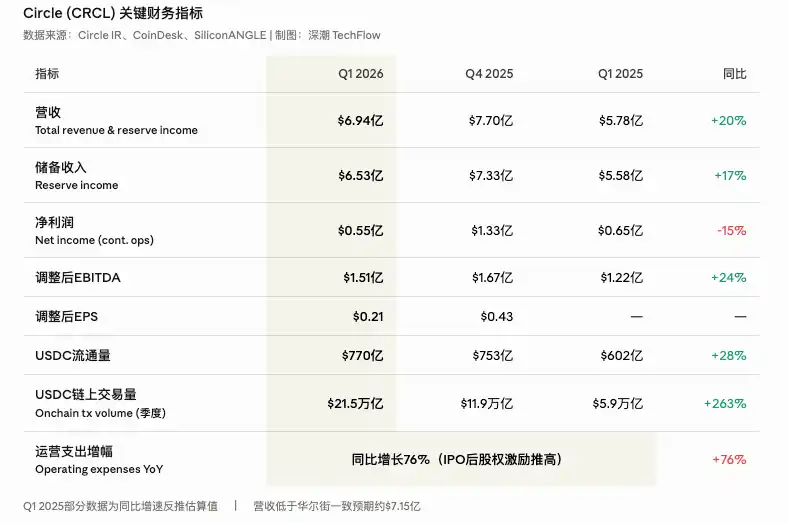
As of the end of Q1, USDC circulation reached $77 billion, up 28% year-over-year. More notably, on-chain USDC transaction volume reached $215 trillion for the quarter, skyrocketing 263% year-over-year. According to a Mizuho analyst report, adjusted USDC transaction volume for 2026 to date is approximately $2.2 trillion, surpassing Tether's USDT (approximately $1.3 trillion), capturing about 64% of adjusted stablecoin transaction volume to take the top spot. This is the first time USDC has led in this metric since 2019.

But the core reason for the revenue miss is clear: interest rates. Over 95% of Circle's revenue comes from interest income on USDC reserve assets. Q1 reserve revenue was $653 million, up 17% year-over-year. In Q4 2025, the reserve yield had already fallen 68 basis points year-over-year to 3.8%. The dampening effect of the interest rate cutting cycle on Circle's revenue is gradually becoming apparent. Even as USDC circulation continues to expand, declining rates remain a sword hanging overhead. This is precisely the underlying motivation for Circle's urgency in crafting its 'second growth curve' story.

Arc Token Pre-Sale: Building Its Own Blockchain, $3 Billion Valuation

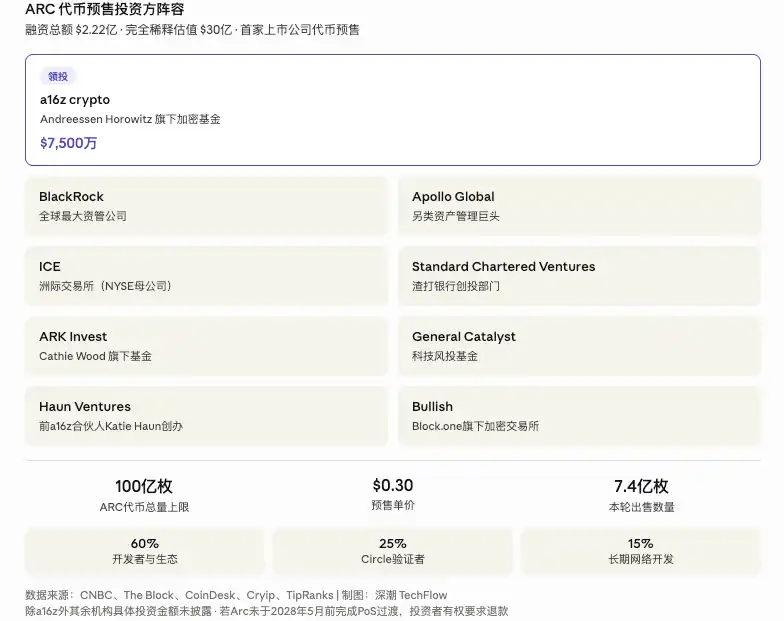
Disclosed alongside the earnings was the heavyweight news of the completion of the Arc blockchain token pre-sale. According to an exclusive CNBC report, Circle sold 740 million ARC tokens at a price of $0.30 per token, raising $222 million at a fully diluted valuation of $3 billion. This marks the first token pre-sale conducted by a publicly listed company.

a16z crypto led the round with a $75 million investment. Other participating investors formed a formidable lineup: BlackRock, Apollo Global Management, Intercontinental Exchange (ICE), Standard Chartered Ventures, ARK Invest, General Catalyst, Haun Ventures, and Bullish.
Currently, USDC heavily relies on third-party networks like Ethereum and Solana for settlement and on distributors like Coinbase to reach users. Building its own blockchain signifies Circle's desire to control more of the underlying infrastructure on which USDC operates. From a defensive perspective, with the GENIUS Act signed into law and the CLARITY Act scheduled for a preliminary vote in the Senate Banking Committee this week, the legalization of stablecoin regulation is lowering industry barriers to entry, potentially allowing banks and fintech companies to launch their own dollar tokens. By building its own network, Circle is attempting to lock in a first-mover advantage at the infrastructure layer before this competitive landscape fully materializes.

Circle explicitly stated in its earnings report that current performance guidance does not yet include "future Arc-related revenue streams," hinting that Arc could become an independent revenue source alongside USDC.

Agent Stack: When AI Agents Become the 'Customer'

The third card played on the same day was the Circle Agent Stack, a suite of financial infrastructure tools designed for AI agents.

According to Decrypt, Agent Stack consists of four core components: Agent Wallets allow AI agents to autonomously hold assets; Circle CLI allows developers and AI agents to build applications on the Circle platform; Agent Marketplace enables AI agents to browse, evaluate, and pay for services offered by other agents; Nanopayments, based on Circle Gateway, support gas-free USDC transfers as low as $0.000001.

Allaire stated in the press release, "Financial infrastructure has historically been built for humans, with manual onboarding flows, approvals, and payment flows. It was never designed for software that runs autonomously. Agent Stack is our first full-service suite built for AI agents themselves as customers, not just developers and enterprises."

Circle is betting on a future of machine-to-machine payments: AI agents autonomously transacting with each other, hiring each other's services, settling instantly on-demand, all conducted in USDC.

But Circle is not the only player; recently, Amazon partnered with Coinbase and Stripe, Google Cloud with the Solana Foundation, and MoonPay have all launched similar AI agent stablecoin payment solutions.

$35 Billion Valuation: Can It Hold?

CRCL's current market capitalization is approximately $35 billion, with a forward P/E ratio of about 135x, far above the industry median of around 33x. Citi analyst Peter Christiansen has a $243 price target, Bernstein's Gautam Chhugani has a $190 target, and all 12 analysts tracked by TipRanks give a 'Buy' rating, with a consensus target price of $138.50.

But some are applying the brakes. Compass Point downgraded CRCL to 'Sell' in April, warning that gross margins are narrowing in the first half of 2026 due to USDC supply shifting to lower-margin areas. Even per management guidance, non-reserve revenue (full-year $150-170 million) remains negligible compared to the reserve revenue engine. Whether Arc can transition from a whitepaper to a business line that genuinely contributes revenue is a core validation point for the second half of 2026.

William Blair analyst Andrew Jeffrey told clients that Circle stock "could remain volatile" in the near term, but the company has multiple positive catalysts stemming from its "significant stablecoin commercial advantages."

CRCL had already surged nearly 20% on May 4th when the bipartisan compromise version of the CLARITY Act was finalized. This week's preliminary vote in the Senate Banking Committee will be the next catalytic event. Analysts believe the Act essentially provides Circle with a "regulatory shield": compliance restrictions mean Circle is not required to distribute USDC reserve earnings to users, effectively preserving its profit margins under regulatory cover.

Having played its three cards, Circle's valuation narrative has shifted from a 'stablecoin interest income stock' to an 'infrastructure platform + AI agent economy gateway.' Whether this narrative materializes depends on the actual adoption of the Arc mainnet after its launch and Agent Stack's competitive performance in the machine-to-machine payments arena.


Questions liées

QWhat were the key highlights of Circle's Q1 2026 financial results, and what is the main concern regarding its revenue?

ACircle's Q1 2026 revenue was $6.94 billion, missing analyst estimates, but adjusted EPS of $0.21 exceeded expectations. USDC circulation reached $770 billion, and on-chain transaction volume surged 263% to $21.5 trillion. The main concern is that over 95% of revenue comes from interest on USDC reserves. With interest rates declining, this poses a significant risk to future revenue, driving Circle's need to develop new growth areas.

QWhat is the significance of Circle's Arc blockchain token presale, and which major investors participated?

AThe Arc blockchain token presale raised $222 million at a $3 billion fully diluted valuation. This marks the first token presale by a publicly traded company. Major investors include a16z crypto (leading $75 million), BlackRock, Apollo Global Management, ICE, Standard Chartered Ventures, ARK Invest, General Catalyst, Haun Ventures, and Bullish. Arc aims to give Circle more control over the underlying infrastructure for USDC and create a new, independent revenue stream beyond stablecoin interest.

QWhat is Circle Agent Stack, and what future trend does it represent for the company?

ACircle Agent Stack is a financial infrastructure toolkit designed for AI agents. Its core components include Agent Wallets for autonomous asset holding, a CLI for development, an Agent Marketplace for AI-to-AI service transactions, and Nanopayments for tiny, gasless USDC transfers. It represents Circle's bet on a future of machine-to-machine (M2M) payments, where AI agents autonomously trade, hire services, and settle transactions instantly using USDC, positioning Circle as an entry point to the AI agent economy.

QWhat is the current market valuation and analyst sentiment for Circle (CRCL), and what are the opposing views?

ACircle's market capitalization is approximately $35 billion, with a forward P/E ratio of about 135, significantly higher than the industry median. Analysts are generally bullish, with Citi setting a $243 price target and Bernstein at $190. TipRanks shows all 12 tracked analysts give a 'Buy' rating. However, Compass Point downgraded CRCL to 'Sell', citing narrowing gross margins and the still-insignificant contribution of non-reserve revenue compared to the core interest income business.

QHow is Circle attempting to change its valuation narrative, and what does its success depend on?

ACircle is attempting to shift its valuation narrative from being a 'stablecoin interest income stock' to an 'infrastructure platform + AI agent economy gateway.' This strategic pivot is driven by the launch of the Arc blockchain and the Agent Stack toolkit. The success of this new narrative depends on the actual adoption of the Arc mainnet after its launch and Circle's competitive performance in the emerging machine-to-machine payment sector against rivals like Amazon/Coinbase and Google Cloud/Solana.

Lectures associées

Début de Warsh : le président de la Fed le plus au fait du Crypto de l'histoire apportera-t-il des surprises ou des chocs au marché ?

**Résumé :** Kevin Warsh, nouveau président de la Réserve fédérale américaine, s'apprête à tenir sa première conférence de presse monétaire. Sa nomination est historique : il est le premier président de la Fed à détenir personnellement des actifs numériques (investissements indirects dans Solana, dYdX, etc.), montrant une compréhension unique du secteur. Son dilemme est majeur : il doit faire face à une résurgence de l'inflation, qui exige une politique monétaire stricte (position "de faucon"), tout en répondant aux pressions politiques pour des baisses de taux. Parallèlement, son attitude envers les crypto-actifs diffère fondamentalement de celle de son prédécesseur. Il ne les considère pas comme de simples actifs spéculatifs, mais plutôt comme un "bon policier" pour la politique économique et une composante de la compétitivité américaine. Son impact potentiel sur le marché crypto s'articule autour de trois axes : 1. Un changement de paradigme réglementaire, passant de la prévention à l'intégration et à l'innovation. 2. Une reprixation des actifs liée aux taux d'intérêt, où sa clarté de communication pourrait réduire la prime d'incertitude. 3. Une légitimation accrue pouvant attirer les capitaux institutionnels traditionnels. Deux scénarios principaux sont envisagés pour sa première intervention : * **Scénario "Surprise"** : Un ton modéré ("de colombe") sur les taux combiné à des signaux favorables à l'innovation numérique pourrait booster le marché. * **Scénario "Choc"** : Un message excessivement restrictif sur les taux pourrait entraîner une vente généralisée des actifs risqués, y compris les cryptos. Bien qu'il ait dû vendre ses actifs crypto pour des raisons d'éthique, la compréhension intrinsèque de Warsh pour la technologie blockchain pourrait, à long terme, poser les bases d'une intégration plus structurelle des actifs numériques dans le système financier.

marsbitIl y a 4 h

Début de Warsh : le président de la Fed le plus au fait du Crypto de l'histoire apportera-t-il des surprises ou des chocs au marché ?

marsbitIl y a 4 h

XRP Ledger Lance le Rebranding XRPld Avec la Mise à Niveau Version 3.2.0

La version 3.2.0 du XRP Ledger (XRPL) est désormais disponible, introduisant une refonte majeure incluant le changement de nom du logiciel principal de « rippled » à « xrpld ». Cette mise à niveau se concentre principalement sur les améliorations des performances, de la sécurité et de l'évolutivité de l'infrastructure sous-jacente, plutôt que sur de nouvelles fonctionnalités utilisateur. Les principales avancées incluent des optimisations de mémoire pouvant réduire jusqu'à 40% l'utilisation de la mémoire serveur. Sur le plan de la sécurité, la modification `fixCleanup3_2_0` renforce plusieurs modules, notamment les coffres-forts à actif unique, le protocole de prêt, les échanges décentralisés et les jetons multi-usages. De nouveaux contrôles d'invariance garantissent la cohérence du registre après la suppression de comptes. Pour les développeurs, la mise à jour permet désormais de récupérer des informations sur les définitions du protocole et du serveur XRPL sans nécessiter de connexion active, facilitant ainsi la création de portefeuilles, d'explorateurs de blockchain et d'APIs. En termes d'évolutivité et de stabilité, les améliorations comprennent des tailles de bloc configurables, un stockage de base de données optimisé via nuDB, et le support optionnel de TLS/mutual TLS pour le serveur gRPC. Le port de peering par défaut est également passé du 51235 au 2459. Divers correctifs ont été apportés aux fonctions liées aux Market Makers Automatisés, aux paiements, aux séquestres de jetons et aux carnets d'ordres. Une note importante : les invariants de transaction ont été temporairement désactivés dans la v3.2.0 en raison d'un impact sur les performances, mais cela ne présente pas de risque pour la sécurité.

TheNewsCryptoIl y a 5 h

XRP Ledger Lance le Rebranding XRPld Avec la Mise à Niveau Version 3.2.0

TheNewsCryptoIl y a 5 h

L'AGI n'est pas l'arrivée, nouveau document de DeepMind : Vers l'ASI, le véritable progrès de l'IA ne fait que commencer

Si l'intelligence artificielle générale (IAG) était atteinte demain, quelle serait la prochaine étape ? Une étude de Google DeepMind suggère que l'IAG n'est pas un point final, mais une étape vers une superintelligence artificielle (ISA) dépassant les collectifs d'experts humains. L'étude distingue trois concepts : l'IAG (niveau médian humain), l'ISA (supérieure aux meilleurs collectifs humains dans presque tous les domaines) et l'IA universelle (limite théorique). Elle propose quatre voies potentielles vers l'ISA : 1. **Extension des ressources** : augmentation de la puissance de calcul, des données et des modèles. 2. **Évolution algorithmique** : améliorations incrémentales ou nouveaux paradigmes (apprentissage continu, utilisation d'outils, modèles du monde). 3. **Auto-amélioration récursive** : des IA plus performantes conçoivent la génération suivante, créant une boucle de rétroaction positive. 4. **Coordination multi-agents** : des systèmes IAG collaborant atteignent une intelligence collective supérieure. L'étude identifie six principaux goulets d'étranglement : 1. **Le mur des données** : les données humaines de haute qualité pourraient s'épuiser. 2. **Pressions économiques et ressources naturelles** : coûts énergétiques et matériels. 3. **Limites des paradigmes neuronaux actuels** : problèmes d'apprentissage continu, de raisonnement robuste, d'hallucinations. 4. **Difficulté croissante de la recherche**. 5. **Barrières à l'abstraction** : difficulté à former de nouveaux concepts fondamentaux. 6. **Régulation, gouvernance et réaction sociale**. Un défi crucial est l'évaluation des capacités de l'IA au-delà du niveau humain, nécessitant de nouveaux benchmarks. L'étude conclut que la progression vers l'ISA reste incertaine, soumise à des contraintes physiques et de ressources, et appelle à un effort de recherche interdisciplinaire pour mieux anticiper cette évolution.

marsbitIl y a 6 h

L'AGI n'est pas l'arrivée, nouveau document de DeepMind : Vers l'ASI, le véritable progrès de l'IA ne fait que commencer

marsbitIl y a 6 h

Trading

Spot
Futures

Articles tendance

Comment acheter BEAT

Bienvenue sur HTX.com ! Nous vous permettons d'acheter Audiera (BEAT) de manière simple et pratique. Suivez notre guide étape par étape pour commencer votre parcours crypto.Étape 1 : Création de votre compte HTXUtilisez votre adresse e-mail ou votre numéro de téléphone pour ouvrir un compte sur HTX gratuitement. L'inscription se fait en toute simplicité et débloque toutes les fonctionnalités.Créer mon compteÉtape 2 : Choix du mode de paiement (rubrique Acheter des cryptosCarte de crédit/débit : utilisez votre carte Visa ou Mastercard pour acheter instantanément Audiera (BEAT).Solde :utilisez les fonds du solde de votre compte HTX pour trader en toute simplicité.Prestataire tiers :pour accroître la commodité d'utilisation, nous avons ajouté des modes de paiement populaires tels que Google Pay et Apple Pay.P2P :tradez directement avec d'autres utilisateurs sur HTX.OTC (de gré à gré) : nous offrons des services personnalisés et des taux de change compétitifs aux traders.Étape 3 : stockage de vos Audiera (BEAT)Après avoir acheté vos Audiera (BEAT), stockez-les sur votre compte HTX. Vous pouvez également les envoyer ailleurs via un transfert sur la blockchain ou les utiliser pour trader d'autres cryptos.Étape 4 : tradez des Audiera (BEAT)Tradez facilement Audiera (BEAT) sur le marché Spot de HTX. Il vous suffit d'accéder à votre compte, de sélectionner la paire de trading, d'exécuter vos trades et de les suivre en temps réel. Nous offrons une expérience conviviale aux débutants comme aux traders chevronnés.

405 vues totalesPublié le 2026.01.22Mis à jour le 2026.06.02

Comment acheter BEAT

Discussions

Bienvenue dans la Communauté HTX. Ici, vous pouvez vous tenir informé(e) des derniers développements de la plateforme et accéder à des analyses de marché professionnelles. Les opinions des utilisateurs sur le prix de BEAT (BEAT) sont présentées ci-dessous.

活动图片