Understanding $UORE in One Article: The V4 Hook Project That Packs Mining, Lottery, and NFTs into a Single Transaction

marsbitPublié le 2026-05-08Dernière mise à jour le 2026-05-08

Résumé

The article discusses the emergence of a new Ethereum project, $UORE, which leverages Uniswap V4's "Hook" mechanism to combine multiple DeFi and NFT functions into a single transaction. $UORE integrates on-chain mining, a lottery system, and generative pixel NFTs (called Orelings) directly into its Uniswap V4 liquidity pool. Each whole UORE token held automatically generates an Oreling NFT, with its rarity and a random "Hash" value determining its "Mining Power" for staking rewards. A daily token emission, subject to a 1% decay, is distributed to stakers. The project also includes a "Motherlode" lottery triggered by purchases and a deflationary mechanism with buy/sell taxes funding automatic buybacks and burns. The project is a fork of the earlier uPEG V4 Hook project, incorporating ideas from Solana's ORE. However, it faces challenges including high transaction gas fees (2-3x a normal swap due to multiple contract actions), significant complexity for users, and a potentially narrowing attention window as it is the fourth project in a trending but possibly cooling V4 Hook narrative. The founder's message, "Read the contracts and understand the mechanics before deploying capital," underscores its experimental and high-risk nature.

Curry, Shenchao TechFlow

Still FOMOing over Slonk, the hot Ethereum on-chain project from yesterday? Actually, a new narrative has arrived:

V4 Hook.

Over the past two weeks, Uniswap V4's Hook mechanism suddenly caught fire. SATO used Hooks to create an on-chain bonding curve, pushing its market cap to $40 million. uPEG rode the viral story of an unused Uniswap name draft to over $30 million in two weeks. Slonks crammed an AI model into a smart contract to mimic CryptoPunks, achieving 586 ETH in trading volume six days after launch.

Although these three projects have different playstyles, they all leverage Uniswap's V4 mechanism.

Now the fourth one is here.
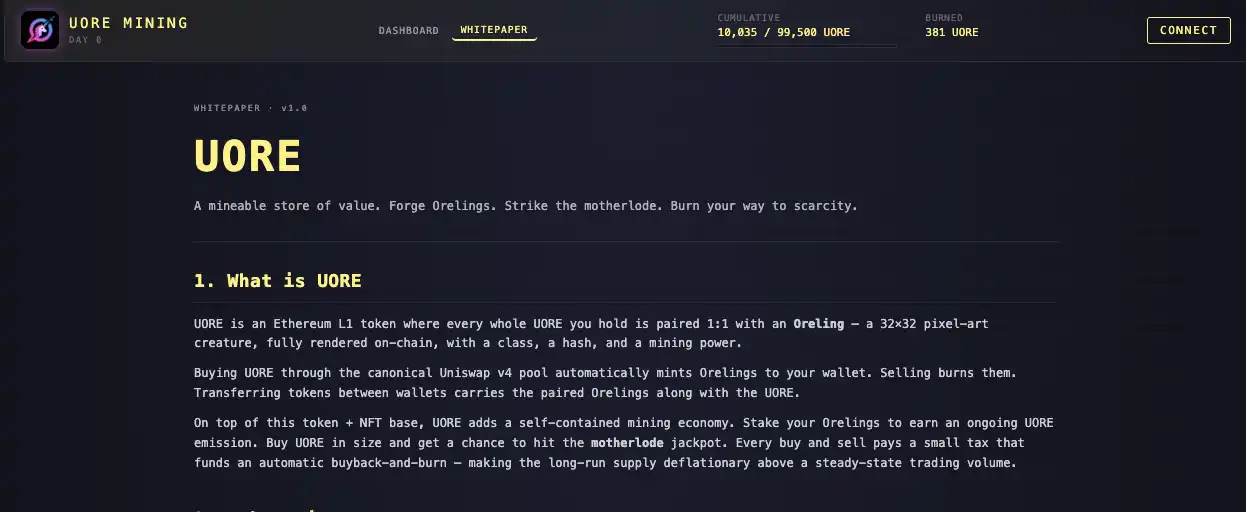
The new project is called $UORE, launched just yesterday. In one sentence, what it does is: Packaging on-chain mining, token-buying lottery, pixel NFT auto-generation, and a deflationary burn mechanism all into a single Uniswap V4 trading pool.

Because when you buy tokens in this pool, the contract will execute the aforementioned six things in the background simultaneously, the gas fee for one transaction is two to three times that of a regular swap...

Currently, if you open CT, you'll see everyone complaining about this high gas.

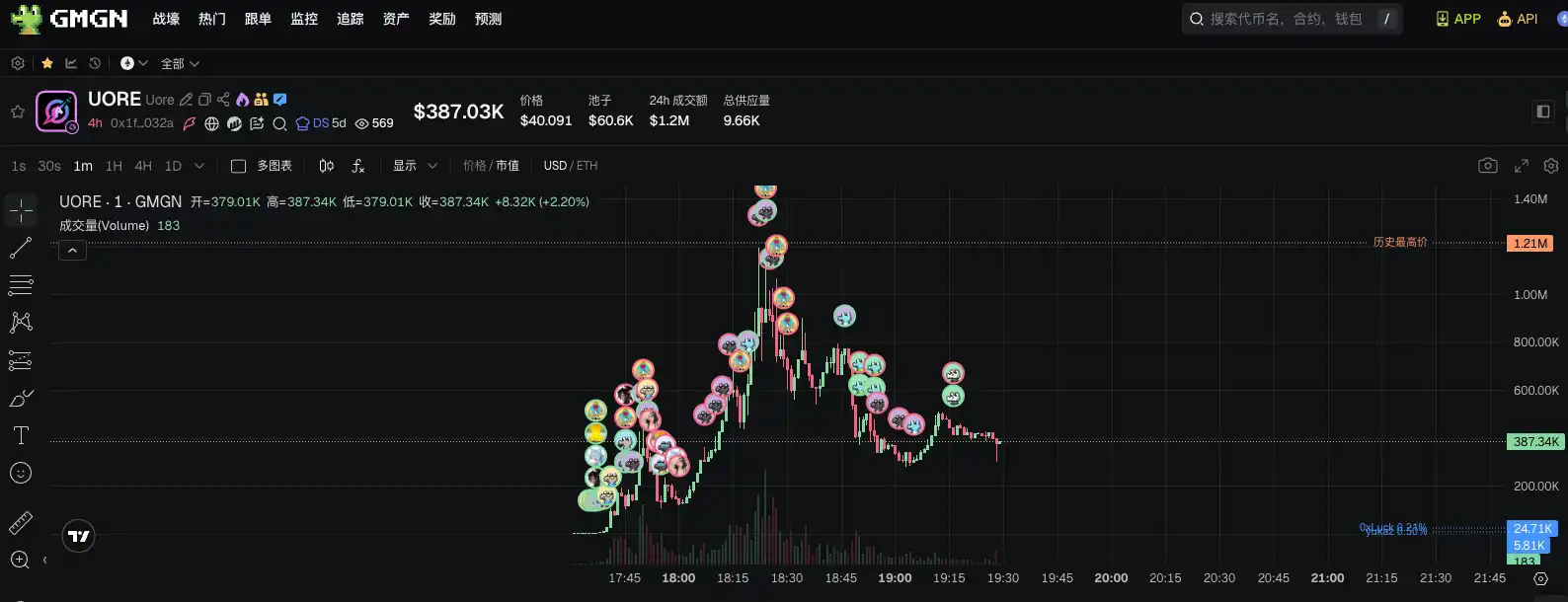
Regarding the token, according to GMGN data at the time of writing, $UORE reached a market cap of $1.2 million within hours of launch, then quickly dropped to $440k. The pool liquidity is only $64k, but the 24-hour trading volume is $1.2 million, meaning the money in the pool has turned over nearly twenty times.

However, there are only 741 holders, with a total supply of less than ten thousand tokens.
Currently, the risk appears extremely high. After some preliminary research, I personally think it's the most complex mechanism-wise among the V4 Hook ecosystem projects (the recent wave of new on-chain plays tends to make their mechanisms hard to understand...).

It is simultaneously a token, an NFT collection, a staking mine, and a lottery system. Moreover, these four things aren't independent; they are welded together.

Four-in-One Mine

For most NFT projects, the token and the NFT are separate things, bought and sold separately.

UORE is different. Its NFT is called Oreling, a 32×32 pixel miner character, embedded directly within the token. For every whole integer UORE token you hold in your wallet, you automatically have one corresponding Oreling.
The contract mints it for you when you buy tokens, burns it when you sell, and the Oreling moves with the token when transferred. You cannot buy an Oreling separately, nor can you detach it from UORE.

The traits of each Oreling are determined by the hash of the next block at the moment of minting. This means you don't know what kind of character you'll get when buying, not even the validators can see the result beforehand.

The differences between these characters aren't just about looks.

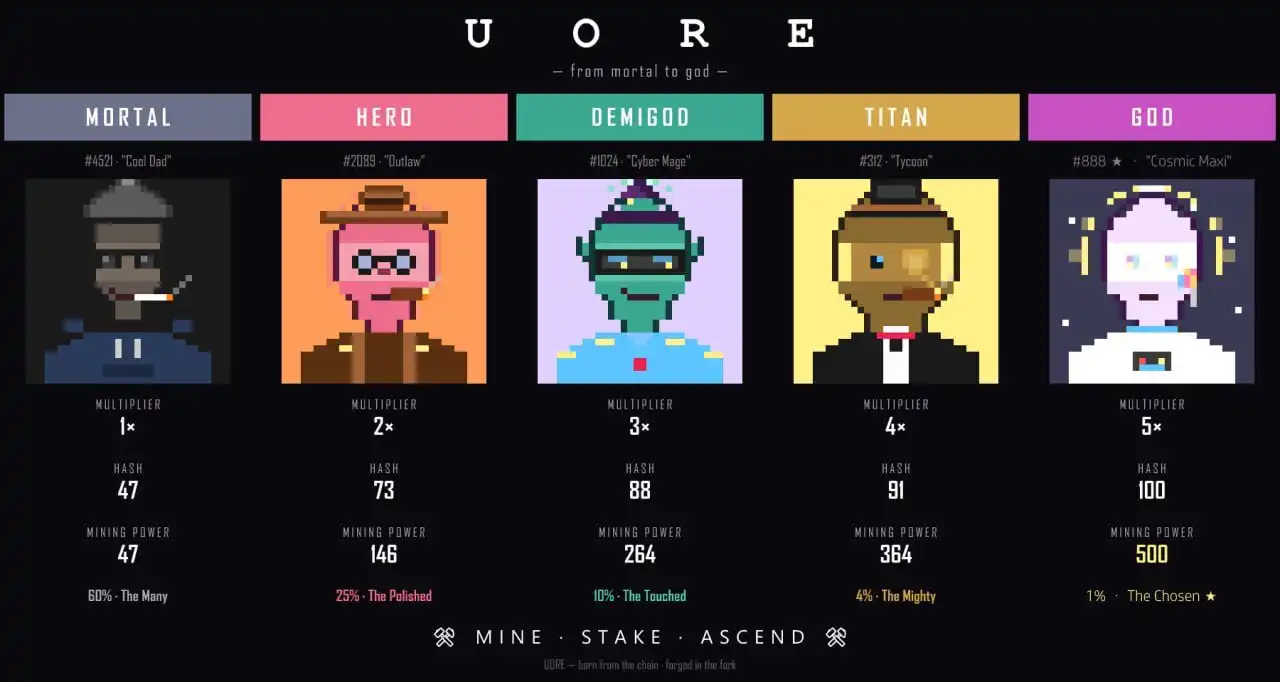
Each Oreling has a Class (rarity) and a Hash (a random number from 1 to 100). Multiplying the two gives its Mining Power.

The most common Mortal makes up 60% with a 1x multiplier; the rarest God has only a 1% chance with a 5x multiplier. If you're lucky and mint a God with Hash 100, its power is 500, over ten times that of a common miner.

What's the use of mining power? Classic play: staking.

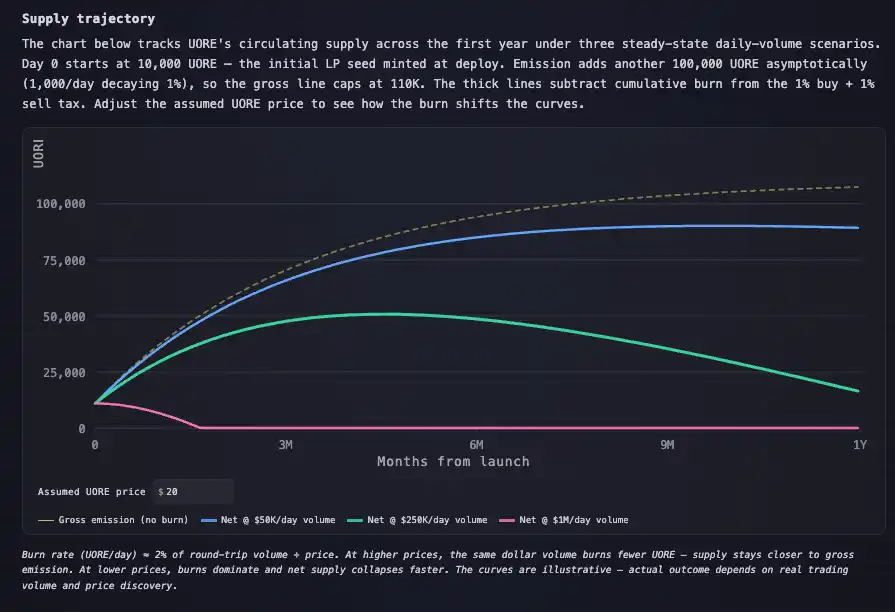
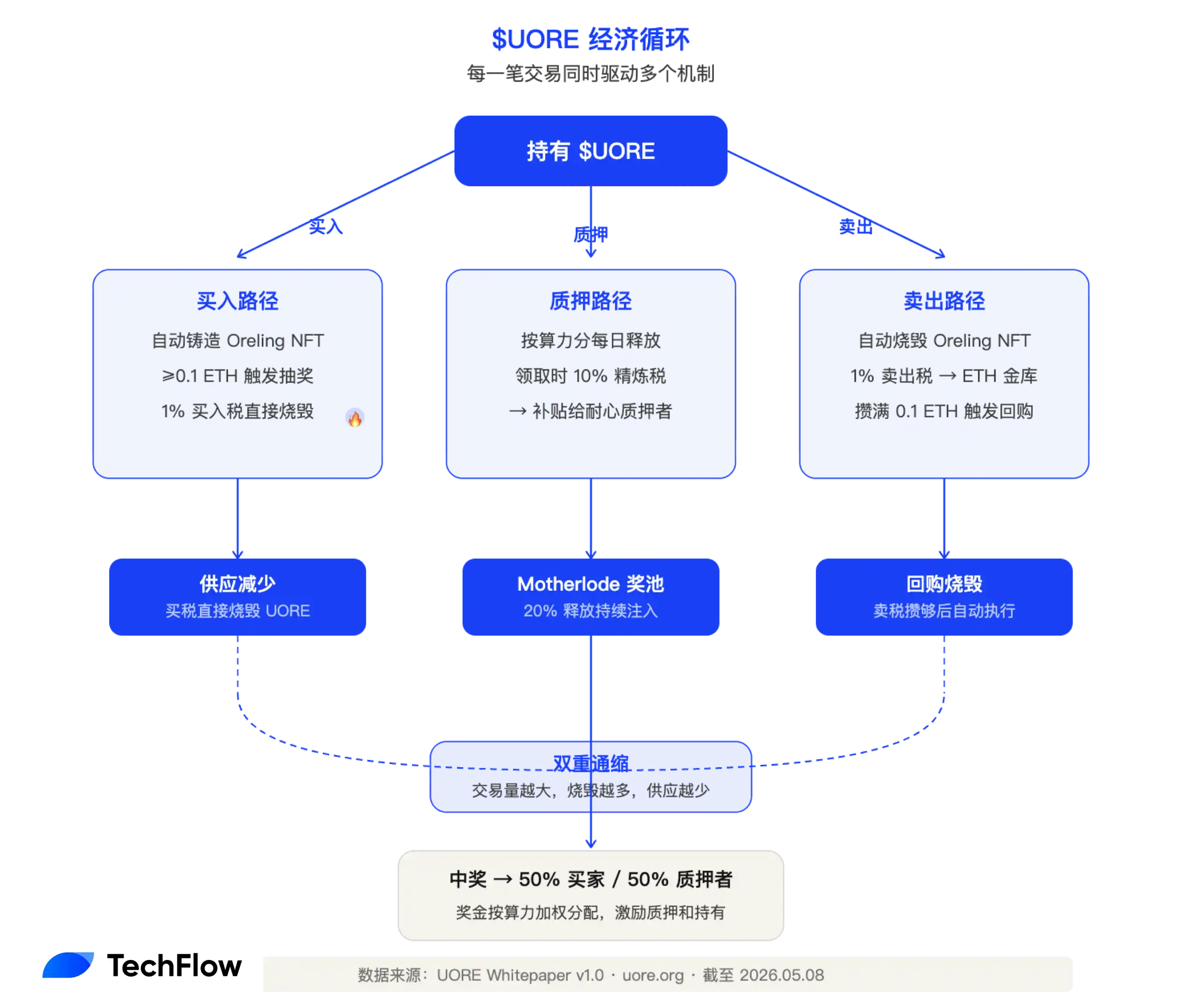
Stake your Oreling into the mine pool, and you start receiving a share of the daily UORE release proportional to your mining power. According to the project's whitepaper, 1000 UORE are released on the first day, then decaying by 1% daily, with a half-life of roughly 69 days. 80% of the release goes to stakers, 20% goes into the Motherlode prize pool.

This decay rate means 97% of the total emissions will be released within a year. The earlier you enter the mining game, the bigger your share of the pie.

There's a noteworthy design when claiming rewards: a 10% "refining tax" is deducted and redistributed to all stakers who haven't claimed yet. The whitepaper calls this the refined-ore boost.

In plain terms, those who claim later eat more of the taxes paid by others. People in a hurry to withdraw are subsidizing the patient ones.
Then there's the Motherlode, which translates to "lode prize".

Every time you buy UORE worth ≥ 0.1 ETH through the official channel, you automatically get a lottery ticket. The winning probability is linked to the purchase amount: 0.1 ETH gives about a 1/600 chance, 0.5 ETH about 1/200, and 1 ETH caps at 1/100. Buying over 1 ETH doesn't increase the probability further, preventing whales from farming chances.

If you win, the prize pool is split in half: 50% goes directly to the buyer, and 50% is randomly distributed to one staker (weighted by mining power). As of writing, there have only been 4 wins historically, with the largest prize being 6.4 UORE.

Finally, the deflationary flywheel.

Buying incurs a 1% tax directly burned, selling incurs a 1% tax sent to a buyback treasury. When the treasury accumulates 0.1 ETH, anyone can trigger an automatic buyback, and the bought-back UORE are all burned. As of writing, 58 buybacks have been executed, cumulatively burning 358 UORE.
Looking at the entire design, it's a minor innovation in token-NFT play, an old trick for creating scarcity, yet another Ponzi in economic model design.

The Project's Code is Forked, Its Playstyle is Frankensteined

UORE wasn't written from scratch.

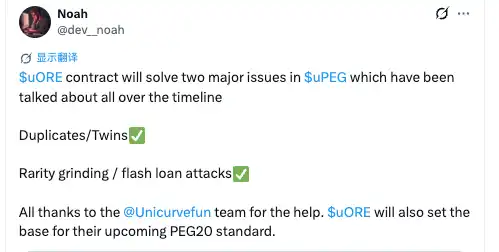
People in the community looked at the source code and found a folder named `reference/unipeg-hook-source/`. The founder, Noah, didn't hide it either. He directly stated on Twitter that UORE's contracts are forked from uPEG, and that he fixed two known issues with uPEG: duplicate NFT generation and flash loan attacks for farming rarity.
A quick look at this founder's profile shows a bio: "Ethereum dev & BAYC holder". On May 2nd, he tweeted his first post about UORE, saying the project combines the mining concept from Solana's ORE with the V4 Hook architecture of uPEG.

He also proactively @ mentioned Unicurvefun and Openpeg, asking if they could support Orelings trading once their markets go live.

From this public information, UORE's lineage is clear:

Solana ORE provided the "on-chain mining + lottery" gameplay template, uPEG provided the V4 Hook code skeleton, and Noah made improvements and assembled on top of these two.

Forking itself isn't the issue. I think the current problems are:

  1. Gas. There are reports on CT that each UORE transaction requires the Hook to execute six steps, consuming two to three times the gas of a normal swap. Swapping back and forth might leave little to no profit.
  2. Time window. The V4 Hook narrative was affected by uPEG's price drop, and subsequent projects will likely have lower ceilings. UORE is the fourth project in this wave of Hook hype, with the heat from the first three already cooling. The attention window for this sector waits for no one.
  3. Complexity. UORE is probably the most mechanically dense among these four projects. For an average user to understand the whole set of rules—Oreling rarity, mining power calculation, staking decay, refining tax, Motherlode probability, buyback trigger conditions—the barrier is high, and the official website is cryptic.

And the project's whitepaper is also interesting:
Read the contracts and understand the mechanics before deploying capital.

Translated into Chinese, this roughly means "Understand it first, don't blame me if you don't."

Combining insights from previous Hook projects, we can see this wave of on-chain trends features complex mechanism designs + massive information asymmetry. They have alpha potential, but the shelf life of that alpha is getting shorter.

SATO gave you a week, uPEG gave you a few days, and by the time it's UORE's turn, the time you have to understand the rules might be down to just a few hours...

By the time you understand it, the market move might be over.

Cryptos en tendance

Questions liées

QWhat is the core innovation or 'hook' of the $UORE project on Uniswap V4?

AThe $UORE project packages multiple mechanics into a single Uniswap V4 pool transaction. With one buy or sell, the contract simultaneously handles token swapping, NFT (Oreling) minting/burning, staking power calculation, participation in the Motherlode lottery, token buyback for burning, and applying transaction taxes.

QHow does the $UORE project integrate an NFT (Oreling) with its token?

AThe Oreling NFT is directly embedded into the $UORE token. Each whole number of $UORE tokens held in a wallet automatically corresponds to one Oreling. The NFT is minted when tokens are bought and burned when tokens are sold, and it cannot be traded separately from the token.

QWhat is the 'Motherlode' mechanism in $UORE and how does it work?

AThe Motherlode is a lottery prize pool. Buying $UORE through the official pool with ≥ 0.1 ETH automatically grants a lottery ticket. The winning probability scales with purchase amount up to a 1% max chance for 1 ETH purchases. If a buyer wins, 50% of the prize pool goes to them, and the other 50% is randomly distributed to a staker, weighted by their mining power.

QWhat are the main criticisms or potential risks mentioned about the $UORE project?

AThe article highlights several risks: very high gas fees (2-3x a normal swap), a short attention window as it's the fourth V4 Hook project in a fading trend, and high complexity which creates a barrier for understanding. Additionally, its liquidity is low, token distribution is concentrated, and the economic model is described as a Ponzi.

QAccording to the article, what existing projects did $UORE fork or draw inspiration from?

A$UORE's smart contracts are forked from the uPEG project, fixing known issues. Its core 'on-chain mining + lottery' gameplay concept is inspired by the ORE project on Solana. The founder combined these two templates to create $UORE on the Uniswap V4 Hook framework.

Lectures associées

Après trois trimestres consécutifs de baisse, le marché des cryptomonnaies pourra-t-il connaître une fenêtre de stabilisation au troisième trimestre ?

Le marché des cryptomonnaies a enregistré son pire trimestre depuis 2022, avec une capitalisation totale chutant de 12,6% à 2 100 milliards de dollars. Tous les indicateurs clés (volume des échanges, valeur des stablecoins) montrent une sortie nette de capitaux. Le Bitcoin a perdu 14,2% et l'Ethereum 25,4% sur le trimestre, rompant sa corrélation antérieure avec les actions technologiques. Les ETF spot américains sur le Bitcoin ont subi des rachats massifs, avec une sortie nette de 4,67 milliards de dollars au Q2, indiquant une pression de vente continue. Le resserrement de la politique de la Fed et les ventes d'entreprises comme Strategy ont accentué la déleveragisation du secteur. L'attention du marché se porte désormais presque exclusivement sur la réunion de la Fed fin juillet. Une position accommodante pourrait stabiliser le Bitcoin entre 68 000 et 84 000 dollars, tandis qu'un ton hawkish pourrait le faire osciller autour de 50 000-56 000 dollars. Parallèlement, la progression du *CLARITY Act*, une loi cruciale pour la clarté réglementaire, est au point mort au Sénat, réduisant les chances d'adoption en 2026 et maintenant une prime de risque élevée sur l'ensemble du secteur. Malgré ce contexte difficile, quelques secteurs résistent : les marchés de prédiction ont vu leur volume nominal augmenter de 48,7% et les biens collectionnables tokenisés ont progressé d'environ 143%. La tokenisation d'actifs du monde réel (RWA) continue également sa croissance régulière, portée par des fondamentaux indépendants du cycle crypto. Les bases d'un effondrement extrême semblent absentes, mais le marché est désormais guidé par les politiques monétaires, les prix et les attentes de taux, plutôt que par le simple récit haussier. La fin des sorties massives des ETF et le retour des achats des détenteurs à long terme pourraient indiquer une phase de stabilisation potentielle.

marsbitHier 08:42

Après trois trimestres consécutifs de baisse, le marché des cryptomonnaies pourra-t-il connaître une fenêtre de stabilisation au troisième trimestre ?

marsbitHier 08:42

The SpaceX Trade, Unlocked: SPCXON Débarque sur WEEX

En juin 2026, SpaceX a réalisé la plus grande introduction en bourse de l'histoire, mais l'accès à l'action a été limité pour de nombreux investisseurs en raison de restrictions régionales et de frictions liées aux courtiers. La plateforme WEEX propose désormais une solution via SPCXON/USDT, un instrument tokenisé sur le marché au comptant qui permet d'obtenir une exposition au cours de SpaceX en utilisant l'USDT, sans nécessiter de compte de courtage américain. SPCXON est un produit tokenisé construit sur l'infrastructure d'Ondo, conçu pour refléter l'économie de la détention d'actions SpaceX pour les traders éligibles en dehors des États-Unis, avec des dividendes réinvestis. Le cas d'investissement repose sur la croissance des revenus de Starlink et les progrès de Starship, malgré un valorisation déjà élevée et des risques liés à un flottant public réduit et à des déblocages d'actions internes à venir. Il est important de noter que SPCXON offre une exposition, et non la propriété directe d'actions ou de droits de vote. Son prix peut évoluer avec une prime ou une décote par rapport à la valeur liquidative. WEEX propose également d'autres produits tokenisés comme MSTRON et MUON dans un compte unifié, permettant une rotation entre crypto-monnaies et actions traditionnelles sans transfert de fonds. La plateforme souligne ainsi comment les barrières entre la finance traditionnelle et les actifs numériques s'estompent.

TheNewsCryptoHier 08:34

The SpaceX Trade, Unlocked: SPCXON Débarque sur WEEX

TheNewsCryptoHier 08:34

BIT Trading Moment : Le BTC reste sous la pression de l'EMA 200 hebdomadaire, un rejet pourrait relancer la baisse, les actions de stockage et de semi-conducteurs qui ont bondi cette nuit ont baissé en séance de nuit

**Résumé des marchés : Bitcoin sous pression, actions technologiques en réajustement** Le marché crypto poursuit son rebond, avec Bitcoin évoluant autour de 66 000 $. Il fait face à une résistance clé vers 68 000 $, niveau correspondant au coût moyen des investisseurs sur cinq mois. Les traders surveillent les moyennes mobiles clés (200 MA à ~63 333 $ et 200 EMA à ~68 328 $ en hebdomadaire). Une rupture au-dessus de 68 000 $ ouvrirait la voie à une hausse, tandis qu'un échec pourrait entraîner un retest des 63 000 $. L'analyse suggère que la dynamique actuelle ressemble à un rebond estival à faible liquidité plutôt qu'au début d'un véritable marché haussier. Sur le marché actions américain, après une forte séance mardi portée par les semi-conducteurs et les titres du stockage (Micron, AMD, Intel...), les contrats à terme indiquent une ouverture en baisse. Les secteurs ayant récemment bondi, comme les semi-conducteurs et le stockage, reculent en séance de nuit. Certaines valeurs se démarquent néanmoins, comme Super Micro Computer (SMCI), en hausse après des résultats et des perspectives robustes liées à la demande de serveurs IA. Des vents contraires persistent : les prix du pétrole (Brent >91$) et les rendements des obligations d'État américaines grimpent, ravivant les craintes inflationnistes. En Asie, les marchés ont suivi le rebond technologique américain, mais de manière hésitante. La tension reste forte sur le yen japonais, qui atteint son plus bas niveau depuis des décennies. **Points clés à surveiller :** * **Crypto :** Niveaux techniques de Bitcoin (68k$/63k$), flux des ETF spot. * **Actions :** Saison des résultats (Tesla, Alphabet, Intel...), activité d'AMD sur l'IA. * **Économie :** Données américaines sur l'emploi, décision de la BCE, tensions géopolitiques et prix de l'énergie.

marsbitHier 08:34

BIT Trading Moment : Le BTC reste sous la pression de l'EMA 200 hebdomadaire, un rejet pourrait relancer la baisse, les actions de stockage et de semi-conducteurs qui ont bondi cette nuit ont baissé en séance de nuit

marsbitHier 08:34

Gate Research Institute : La vague de « Wall Streetisation » des produits financiers cryptographiques, concurrence ou fusion ?

Le titre de l'article est : "Gate Institute : La vague de 'Wall Street-isation' des produits financiers cryptos, est-ce une compétition ou une fusion ?" Résumé en français (environ 1400 caractères) : Il y a dix-sept ans, Bitcoin fut créé avec une vision décentralisée et anti-establishment financier. Aujourd'hui, paradoxalement, son adoption massive passe souvent par des ETF émis par des géants comme BlackRock. Cet article analyse cette "Wall Street-isation" apparente des actifs cryptos : les institutions traditionnelles s'emparent-elles du pouvoir d'émission, de tarification, de garde et de distribution ? La réalité est plus nuancée. C'est une convergence à double sens. D'un côté, les plateformes cryptos comme Gate.io étendent leurs services aux actions traditionnelles (états-uniennes, hongkongaises, sud-coréennes), aux CFD et aux produits tokenisés, offrant un compte unifié. De l'autre, des courtiers traditionnels comme Robinhood intègrent les cryptomonnaies et explorent la tokenisation d'actions sur blockchain. Cette fusion vise à créer le "super-compte" financier de demain, où actions, cryptos, ETF et obligations tokenisées (RWA) coexistent dans une même interface, comblant les faiblesses de chaque écosystème. Les RWA, notamment les obligations d'État tokenisées, agissent comme une couche intermédiaire unificatrice. En conclusion, Wall Street n'a pas conquis la crypto, et la crypto n'a pas contourné Wall Street. Ils construisent ensemble une nouvelle forme de marché des capitaux, plus efficace et mondial, où l'idéal décentralisé persiste dans les protocoles, tandis qu'une expérience utilisateur unifiée émerge à l'interface.

marsbitHier 08:09

Gate Research Institute : La vague de « Wall Streetisation » des produits financiers cryptographiques, concurrence ou fusion ?

marsbitHier 08:09

Trading

Spot

Articles tendance

Comment acheter ONE

Bienvenue sur HTX.com ! Nous vous permettons d'acheter Harmony (ONE) de manière simple et pratique. Suivez notre guide étape par étape pour commencer votre parcours crypto.Étape 1 : Création de votre compte HTXUtilisez votre adresse e-mail ou votre numéro de téléphone pour ouvrir un compte sur HTX gratuitement. L'inscription se fait en toute simplicité et débloque toutes les fonctionnalités.Créer mon compteÉtape 2 : Choix du mode de paiement (rubrique Acheter des cryptosCarte de crédit/débit : utilisez votre carte Visa ou Mastercard pour acheter instantanément Harmony (ONE).Solde :utilisez les fonds du solde de votre compte HTX pour trader en toute simplicité.Prestataire tiers :pour accroître la commodité d'utilisation, nous avons ajouté des modes de paiement populaires tels que Google Pay et Apple Pay.P2P :tradez directement avec d'autres utilisateurs sur HTX.OTC (de gré à gré) : nous offrons des services personnalisés et des taux de change compétitifs aux traders.Étape 3 : stockage de vos Harmony (ONE)Après avoir acheté vos Harmony (ONE), stockez-les sur votre compte HTX. Vous pouvez également les envoyer ailleurs via un transfert sur la blockchain ou les utiliser pour trader d'autres cryptos.Étape 4 : tradez des Harmony (ONE)Tradez facilement Harmony (ONE) sur le marché Spot de HTX. Il vous suffit d'accéder à votre compte, de sélectionner la paire de trading, d'exécuter vos trades et de les suivre en temps réel. Nous offrons une expérience conviviale aux débutants comme aux traders chevronnés.

477 vues totalesPublié le 2024.12.12Mis à jour le 2026.06.02

Comment acheter ONE

Discussions

Bienvenue dans la Communauté HTX. Ici, vous pouvez vous tenir informé(e) des derniers développements de la plateforme et accéder à des analyses de marché professionnelles. Les opinions des utilisateurs sur le prix de ONE (ONE) sont présentées ci-dessous.

活动图片