Aave Is Surrendering the Throne of DeFi Lending Due to Its Own Stupidity

marsbitPublié le 2026-04-24Dernière mise à jour le 2026-04-24

Résumé

An article titled "Aave Is Giving Up Its Throne in DeFi Lending Due to Its Own Foolishness" discusses how Aave mishandled a crisis following a $292 million hack of rsETH from Kelp DAO, leading to significant outflows and reputational damage. After the hack, Aave failed to promptly reassure users or commit to covering potential bad debt—estimated between $123.7 million and $230.1 million—despite having sufficient reserves. This hesitation triggered panic, resulting in $17.2 billion in outflows and liquidity crises across multiple pools. The author argues that Aave’s poor crisis management and reluctance to act quickly exacerbated the situation, damaging its reputation as the "safest DeFi" platform. Meanwhile, competitor Spark, a fork of Aave V3, capitalized on the situation by attracting fleeing funds, growing its TVL by nearly $2 billion. Spark had previously delisted rsETH, avoiding any exposure to the hack. Its proactive communication and strategic positioning contrast sharply with Aave’s delayed response. Although Aave’s founder later announced a relief plan (DeFi United) with multiple partners and a personal donation, the damage to user trust and liquidity may be lasting. The article concludes that Aave’s missteps have allowed competitors like Spark, Morpho, and Jupiter Lend to challenge its dominant position in DeFi lending.

Original | Odaily Planet Daily (@OdailyChina)

Author | Azuma (@azuma_eth)

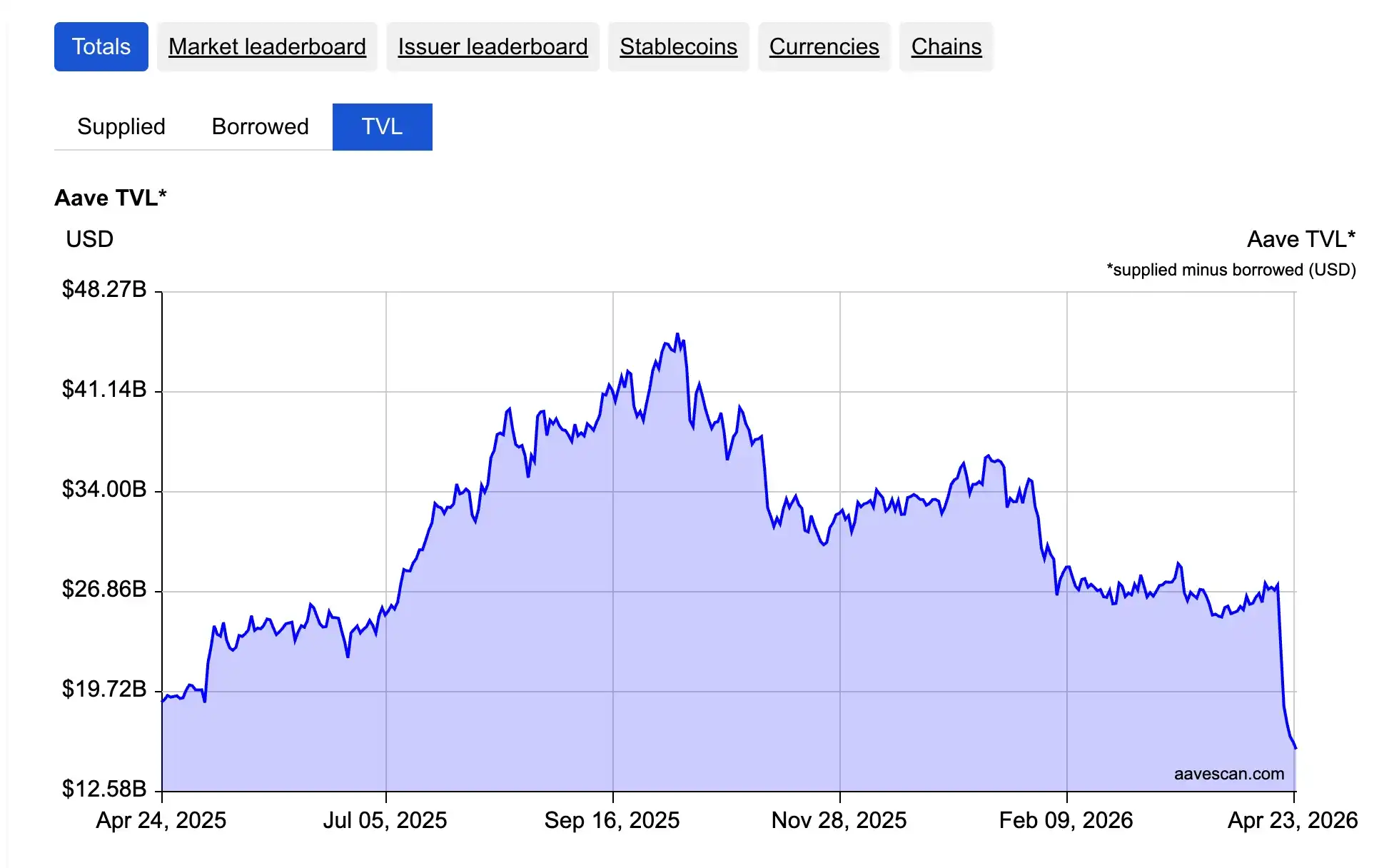
$292 million, this is the total amount of rsETH funds stolen from Kelp DAO; $17.2 billion, this is the scale of funds that have flowed out of Aave since the incident.

Aave is watching the community's panic sentiment ferment for several consecutive days due to its extremely foolish crisis PR strategy, thereby losing its once greatest advantage in the lending track—hundreds of billions of dollars in deposited funds and the user mindset label of "the safest DeFi".
  • Odaily Note: For background, please refer to "DeFi Hacked Again for $292 Million, Is Aave No Longer Safe?" and "The Tripartite Game Under the $290 Million Hole: Who Will Pay the Bill—Aave, L0, or Kelp?".

What Did Aave Do Wrong?

The details of the Kelp DAO hack need not be repeated; blaming Aave for why it granted rsETH such a high LTV is meaningless now. Here, I mainly want to discuss Aave's response strategy after the incident from the perspective of a long-term AAVE user.

First is the bad debt scale issue; Aave itself has done the math. Depending on the different handling of rsETH, there might be two possible bad debt scenarios—if the stolen loss is written off from all rsETH in circulation, it is expected to generate $123.7 million in bad debt; if the value of mainnet rsETH is protected and the loss is fully recorded in the mapped version of rsETH on Layer2, it is expected to generate $230.1 million in bad debt.

In either case, Aave has the capability to cover it with its reserves from Umbrella, the DAO treasury, and the team. I understand that Aave is unwilling to pay this money itself and wants the main responsible party, Kelp DAO, and the secondary responsible party, LayerZero, to contribute as much as possible. But the problem is that the other parties will think the same way—"Aave is so rich, the situation is so awkward, it should bear more." Therefore, in the short term, it is difficult for these three parties to reach a consensus, which implies that a solution that satisfies everyone is temporarily impossible.

But users cannot wait that long—Aave's yield levels have never been very competitive in the industry. Users who choose to deposit with Aave are all attracted by its reputation, security, and liquidity. However, the situation now is that in the most critical days after the incident, Aave consistently failed to give users some kind of bottom-line guarantee promise, but instead kept emphasizing "our code has no problems" and "how rsETH is accounted for is beyond Aave's control" to shift blame.

This is why panic sentiment kept fermenting within the community. Users tried every means to escape and avoid risk: those who could withdraw directly did so, and those who couldn't went to borrow from other pools first, causing the impact to gradually expand. So Aave's current situation is: on one hand, it faces continuous fund outflows; on the other hand, multiple pools are experiencing liquidity drying up due to utilization rates being maxed out.

This awkward situation could have been avoided (or at least not been this bad)... Since Aave can afford the money, why didn't it inject a dose of reassurance into the community from the beginning to prevent a bank run? At most, it's $230 million in bad debt (possibly less), and this money wouldn't necessarily be paid by Aave alone;后续 could continue to dispute with LayerZero and Kelp DAO.

Now, it's done. For the sake of a promised relief of at most $230 million, Aave watched $17.2 billion in deposited funds flow out (the number may continue to grow), and this doesn't even include the decline in AAVE's price these days... No matter how you calculate it, it's a huge loss.

What makes Aave even more uncomfortable is that the worse its situation becomes, the more relaxed opponents like LayerZero and Kelp DAO will be, because they will judge that Aave will be more motivated to solve the problem as soon as possible, which only puts Aave at a disadvantage in the game.

Having reached this point, Aave has brought this upon itself.

Behind Aave, Spark Is Watching Covetously

While Aave is suffering from headaches, the situation of its competitor Spark is booming and extremely positive. What is even more lamentable is that Spark is actually a competitor "personally incubated" by Aave.

Spark was originally a lending protocol forked and developed by Sky (formerly MakerDAO) based on the open-source code of Aave V3; both sides actually use the same underlying code logic. In return, there was once a profit-sharing agreement between Spark and Aave, but later Aave accused Spark of涉嫌 breaching the contract, and coupled with route differences, the two are now purely competitive.

Three months before the Kelp DAO theft, Spark had just removed support for rsETH (for details, please refer to "Same Day, Different Fate: Aave Embraces rsETH and Loses Nearly $200 Million, Spark Exits Unscathed"). You call it strategic conservatism or rigorous risk control, or even attribute it entirely to luck, but the result is that Spark was not affected at all in this incident—on this point alone, Spark can wantonly attack Aave's former "safest DeFi" label.

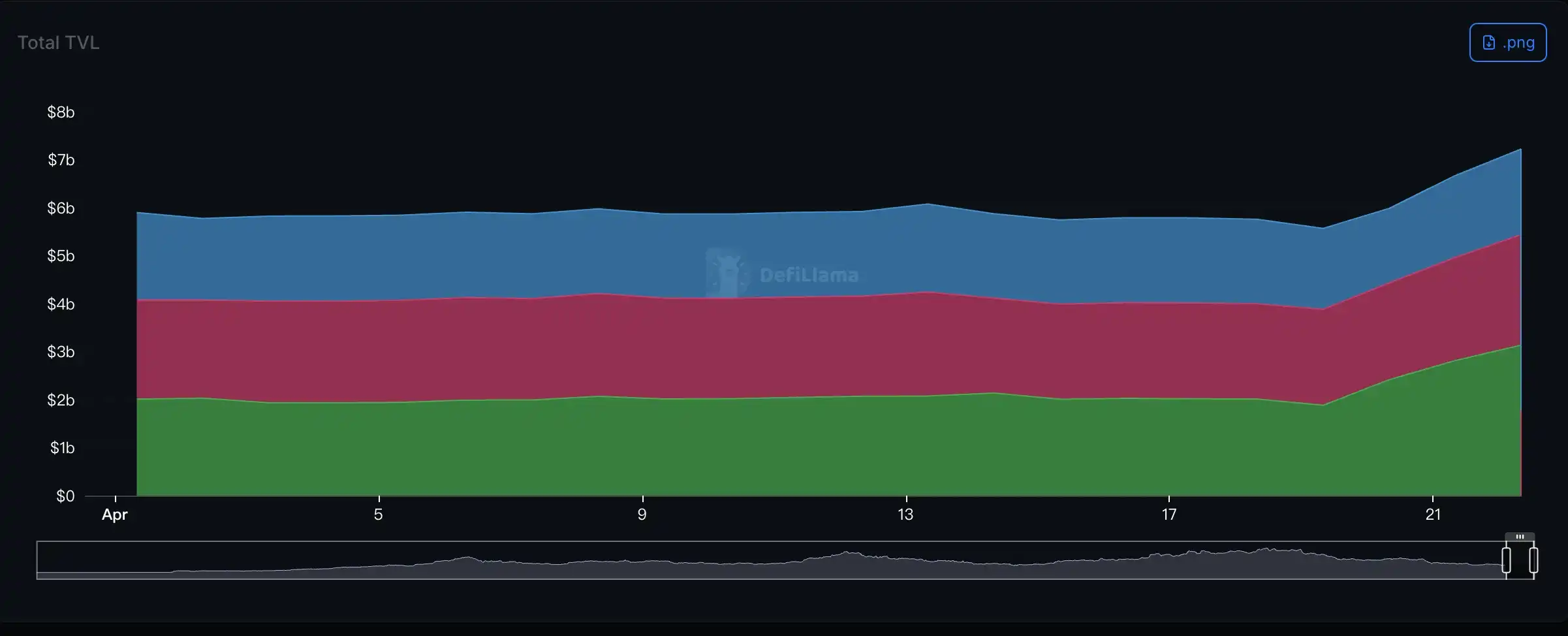
Thus, Spark became one of the safe havens for funds fleeing Aave. Since the incident, Spark's TVL has grown by nearly $2 billion (green part in the chart below). On the day of the incident, Justin Sun withdrew 53,665 ETH (worth $124 million) from Aave and subsequently deposited it into Spark. After continued accumulation in recent days, the total deposit has reached $1.3 billion—in the DeFi world, Brother Sun's operations are really something to learn.
On April 23, Upbit officially announced the launch of the Spark (SPK) Korean Won trading market. SPK, stimulated by this positive news, rose over 80% in a single day, significantly narrowing the market value gap between itself and AAVE.

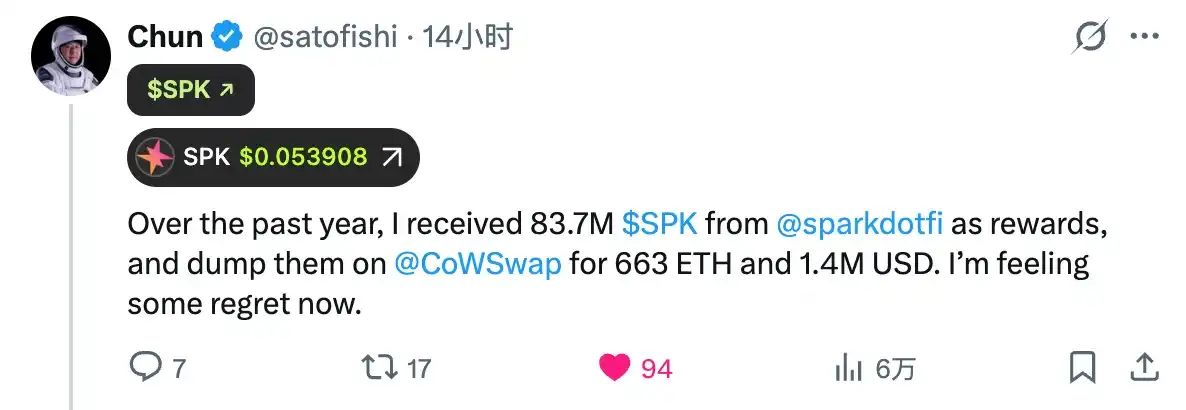
Even Wang Chun, founder of F2Pool, lamented on X: "In the past year, I received 83.7 million SPK rewards from Spark and sold them on CoWSwap for 663 ETH and $1.4 million. Now I kind of regret it."
Spark clearly realizes that this is a perfect opportunity to seize market share from Aave's mouth. Since the incident, Spark's Strategy Lead, MonetSupply, has almost become the most frequent KOL speaking out on this matter, posting dozens of times a day. Although his发言 can indeed help the public understand what happened, it objectively also加剧 the panic sentiment surrounding Aave.

But this is the purest商业 competition; MonetSupply just made the most correct choice.

Aave Is Losing the Throne of DeFi Lending

In the early morning of April 24, perhaps realizing the严峻 situation, Aave founder Stani announced on X the launch of a relief plan called DeFi United. Cooperative participants include LayerZero, Ethena, ether.fi, Ink Foundation, Golem Foundation, Trydo, etc. Stani personally will also donate 5,000 ETH to solve the current problem.

But the funds have already flowed out, and user trust has been severely damaged. Relying solely on this belated statement, Aave will find it difficult to regain deposited funds and user trust in the short term.

The DeFi lending track has long presented a pattern of "one superpower, multiple great powers," with Aave一直以来 having seemingly extremely solid leading advantages. But now, Aave is拱手 surrendering the throne. Behind it, challengers are coming aggressively; besides the booming Spark, other opponents like Morpho and Jupiter Lend also hope to take a bite out of Aave's share.

Last year, Stani bought a five-story luxury house in London for approximately $30 million, one of the most expensive transactions in the UK's sluggish luxury real estate market in the past year. I don't know if there is something like a "jinx," but with precedents like Su Zhu and others, it seems that big shots who consume conspicuously within the circle always run into some倒霉事.

I can't guess what Stani is thinking right now in his five-story luxury house.

Questions liées

QWhat was the main reason for the massive outflow of funds from Aave following the Kelp DAO hack?

AAave's extremely poor crisis management strategy, which failed to provide a timely and reassuring commitment to cover the potential bad debt, led to widespread community panic and a user rush to withdraw funds.

QWhat are the two potential bad debt scenarios calculated by Aave after the rsETH exploit?

AIf the stolen loss is written off from all rsETH in circulation, it would result in approximately $123.7 million in bad debt. If the value of mainnet rsETH is protected and the loss is fully attributed to the mapped version of rsETH on Layer 2, it would result in approximately $230.1 million in bad debt.

QWhich competitor protocol directly benefited from the funds flowing out of Aave, and what was a significant factor in its immunity to the hack?

ASpark Protocol directly benefited, with its TVL growing by nearly $2 billion. A significant factor was that Spark had removed support for rsETH three months prior to the hack, avoiding any exposure to the incident.

QWhat was the name of the key initiative announced by Aave founder Stani Kulechov in a belated attempt to address the crisis?

AStani Kulechov announced an initiative called 'DeFi United,' a relief plan involving partners like LayerZero and Ethena, to which he also personally pledged a donation of 5,000 ETH.

QAccording to the author, what is the fundamental reason users traditionally deposited funds into Aave, given its uncompetitive yield rates?

AUsers traditionally deposited into Aave due to its reputation for safety, security, and deep liquidity, not for competitive yield rates.

Lectures associées

Révision à la hausse de 50 % des expéditions de TPU de Google

Récemment, plusieurs institutions étrangères ont discrètement révisé à la hausse leurs prévisions d'expédition des unités de traitement Tensor (TPU) de Google, ajustant l'estimation pour 2027 de 10 millions à 15 millions d'unités, soit une augmentation de 50%. Cette révision positive impacte directement toute la chaîne d'approvisionnement en infrastructure de calcul pour l'IA. Les composants clés tels que les moteurs optiques NPO (associés 1:1 aux TPU), les modules optiques 1.6T, les commutateurs optiques OCS, les alimentations serveur, la fibre optique & les connecteurs MPO, et surtout le refroidissement liquide, bénéficient de cette dynamique. Le refroidissement liquide entre dans une phase d'accélération cruciale, car les nouvelles TPU à haute puissance rendent le refroidissement par air obsolète. Les prévisions indiquent un déploiement massif à partir de 2026. Les fabricants chinois, avec leur rapidité d'itération et leur capacité de production, saisissent cette opportunité pour pénétrer la chaîne d'approvisionnement de Google, remodelant le paysage concurrentiel. Parallèlement, la fibre optique, essentielle pour les interconnexions dans les centres de données d'IA, voit sa logique transformée : la demande explose tandis que l'offre (dépendante d'un cycle de production long de 18-24 mois pour les préformes) est tendue, conduisant à des contrats à long terme et une stabilisation des prix. Les exportations chinoises de fibre devraient capturer une part significative de ce marché. En résumé, la hausse des prévisions pour les TPU de Google renforce la visibilité sur la croissance pour les deux prochaines années, déplaçant l'accent des investissements vers les infrastructures de soutien au calcul, dont le refroidissement liquide et la fibre optique sont des bénéficiaires majeurs, aux côtés des composants optiques et des alimentations serveur.

marsbitIl y a 44 mins

Révision à la hausse de 50 % des expéditions de TPU de Google

marsbitIl y a 44 mins

Une fois l'effervescence autour des cryptomonnaies retombée, que veut vraiment Wall Street ?

Lorsque la frénésie autour des cryptomonnaies s’est dissipée, Wall Street a clairement montré ce qu’elle cherchait vraiment : non pas des récits de décentralisation, mais une infrastructure financière contrôlable, génératrice de rendements et conforme à la réglementation, construite sur des registres distribués. Le mouvement est mené par des acteurs comme BlackRock et Securitize. Le fonds BUIDL de BlackRock, un fonds de bons du Trésor américains à court terme tokenisés, a atteint une taille stable de 25 à 28 milliards de dollars, devenant un actif refuge sur la chaîne. Securitize, valorisé à 12,5 milliards de dollars, s’apprête à être coté au NYSE, qui prévoit de construire avec lui un système de règlement et de compensation d’actions fonctionnant 24h/24 sur une blockchain. Parallèlement, des produits structurés comme le futur ETF BITA de BlackRock transforment la volatilité du Bitcoin en un revenu stable, en vendant systématiquement des options d’achat couvertes sur son propre ETF spot IBIT. Ce mécanisme convertit un actif spéculatif en un produit de revenu standardisé, attirant ainsi les investisseurs institutionnels prudents. Dans le domaine des paiements, les stablecoins sont repensés comme de purs outils de transaction. Des entreprises comme Stripe et Mastercard intègrent des stablecoins conformes (USDC, PYUSD) pour permettre des règlements transfrontaliers instantanés et réduire les fonds gelés dans le système bancaire traditionnel. La législation GENIUS de 2025 a conforté ce modèle en interdisant les dividendes sur les stablecoins et en renforçant la surveillance du blanchiment d'argent. En résumé, Wall Street adopte la technologie blockchain pour reproduire et améliorer ses propres systèmes : titres traditionnels tokenisés, produits de revenu dérivés, et réseaux de paiement efficaces. L’objectif n’est pas de remplacer la finance traditionnelle, mais de la rendre plus efficace, plus liquide et entièrement intégrée au crédit souverain du dollar.

marsbitIl y a 1 h

Une fois l'effervescence autour des cryptomonnaies retombée, que veut vraiment Wall Street ?

marsbitIl y a 1 h

S’attacher au char de SpaceX : comment Cursor a atteint 60 milliards de dollars

L'article retrace l'ascension fulgurante de Cursor, une licorne de l'IA pour la programmation, fondée par le jeune prodige Michael Truell et ses camarades du MIT. De ses débuts comme simple éditeur de code alternatif, Cursor a explosé en 2023 en intégrant l'IA, atteignant des revenus annuels de plusieurs milliards de dollars et des millions d'utilisateurs. Cette croissance s'est accompagnée de défis structurels. Cursor était initialement très dépendant des modèles d'Anthropic, un partenaire qui est ensuite devenu un concurrent direct avec le lancement de Claude Code. Pour survivre, Cursor a déclaré l'état d'urgence et accéléré le développement de son propre modèle, Composer. Cependant, développer un modèle de pointe nécessite une puissance de calcul colossale. Pour y parvenir, Cursor s'est tourné vers SpaceX d'Elon Musk au printemps 2025, formant un partenariat stratégique. En échange de l'accès aux supercalculateurs de SpaceX, Cursor contribue à améliorer les capacités de programmation de Grok, le modèle d'IA de Musk. Cet accord inclut une option d'acquisition potentielle de Cursor par SpaceX pour 600 milliards de dollars. L'article souligne les tensions entre l'ambition de Cursor de devenir une entreprise indépendante de classe mondiale et les réalités de la dépendance aux fournisseurs de modèles et à la guerre des puces. La culture interne exigeante, avec ses processus de recrutement controversés incluant des essais de travail non rémunérés, reflète cette intensité. L'histoire de Cursor pose une question centrale : deviendra-t-elle l'éditeur de code de référence de la nouvelle génération, ou sera-t-elle finalement absorbée comme une pièce dans l'échiquier stratégique des géants de l'IA ?

marsbitIl y a 1 h

S’attacher au char de SpaceX : comment Cursor a atteint 60 milliards de dollars

marsbitIl y a 1 h

Trading

Spot
Futures

Articles tendance

Comment acheter AAVE

Bienvenue sur HTX.com ! Nous vous permettons d'acheter Aave Protocol (AAVE) de manière simple et pratique. Suivez notre guide étape par étape pour commencer votre parcours crypto.Étape 1 : Création de votre compte HTXUtilisez votre adresse e-mail ou votre numéro de téléphone pour ouvrir un compte sur HTX gratuitement. L'inscription se fait en toute simplicité et débloque toutes les fonctionnalités.Créer mon compteÉtape 2 : Choix du mode de paiement (rubrique Acheter des cryptosCarte de crédit/débit : utilisez votre carte Visa ou Mastercard pour acheter instantanément Aave Protocol (AAVE).Solde :utilisez les fonds du solde de votre compte HTX pour trader en toute simplicité.Prestataire tiers :pour accroître la commodité d'utilisation, nous avons ajouté des modes de paiement populaires tels que Google Pay et Apple Pay.P2P :tradez directement avec d'autres utilisateurs sur HTX.OTC (de gré à gré) : nous offrons des services personnalisés et des taux de change compétitifs aux traders.Étape 3 : stockage de vos Aave Protocol (AAVE)Après avoir acheté vos Aave Protocol (AAVE), stockez-les sur votre compte HTX. Vous pouvez également les envoyer ailleurs via un transfert sur la blockchain ou les utiliser pour trader d'autres cryptos.Étape 4 : tradez des Aave Protocol (AAVE)Tradez facilement Aave Protocol (AAVE) sur le marché Spot de HTX. Il vous suffit d'accéder à votre compte, de sélectionner la paire de trading, d'exécuter vos trades et de les suivre en temps réel. Nous offrons une expérience conviviale aux débutants comme aux traders chevronnés.

452 vues totalesPublié le 2024.12.11Mis à jour le 2026.06.02

Comment acheter AAVE

Discussions

Bienvenue dans la Communauté HTX. Ici, vous pouvez vous tenir informé(e) des derniers développements de la plateforme et accéder à des analyses de marché professionnelles. Les opinions des utilisateurs sur le prix de AAVE (AAVE) sont présentées ci-dessous.

活动图片