Behind the MiniMax 'Pseudo-Open Source' Controversy: Has Yan Junjie's Ideal Succumbed to Capital Anxiety?

marsbitPublié le 2026-04-16Dernière mise à jour le 2026-04-16

Résumé

The article discusses the controversy surrounding MiniMax's "pseudo-open-source" release of its flagship M2.7 model. Initially presented as open-source, the model was later released under a "Modified-MIT" license that restricts commercial use without written permission, sparking backlash from the developer community. This move is seen as a departure from true open-source principles and reflects the tension between technological idealism and commercial pressures. MiniMax, which recently went public, faces significant financial challenges, with substantial losses despite growing revenues. The company’s decision to limit commercial use is interpreted as an effort to protect its revenue streams and control how its models are deployed, especially after instances of third-party misuse affected its reputation. The incident highlights a broader industry trend where "open-weight" models are increasingly distinguished from fully open-source ones, raising concerns about trust and legal certainty for developers and enterprises. The author concludes that MiniMax’s shift represents a pragmatic, if controversial, business strategy aimed at ensuring profitability, even at the cost of community trust.

By | Big Model Home

In the jungle law of artificial intelligence, trust is often more expensive than computing power and more likely to be shattered in the trade-offs of business.

On April 12, MiniMax officially open-sourced its flagship model M2.7, released on March 18, on the HuggingFace platform. The model boasts 229 billion parameters, adopts a MoE (Mixture of Experts) architecture, and requires activating only 10 billion parameters to perform, a series of metrics that point directly to top-tier global closed-source models. On its first day online, it completed adaptations including Huawei Ascend, NVIDIA, and vLLM, sparking industry attention.

However, when developers attempted to deeply engage with the weight files, the appearance of the words "Modified-MIT" in the protocol section instantly dragged this technological feast back into the reality of commercial博弈.

This highly contentious change not only cast a shadow of profit distribution over the "free lunch" but also stung developers seeking a technological safe haven amidst the ecosystems of large companies and startups. For technical leads grappling with workplace anxiety, a legal department's statement that "commercial use requires written authorization" turned the highly anticipated top-tier model's commercial application scenarios into zones of legal uncertainty.

The Trust Hunt of "Open Source" vs. "Open Weight"

In the open-source world, the MIT License symbolizes ultimate freedom and low barriers to entry. Previously, MiniMax's M2 and M2.5 followed this path, and founder Yan Junjie借此 established an image as a promoter of "technology普惠" in the domestic open-source field.

However, the "Modified-MIT" protocol adopted by M2.7 is being questioned by the industry as a form of "nominal openness,实质上的管控" (nominal openness,实质上的 control). Records disclosed by the developer community show that six hours before the weight files went live, the repository protocol still maintained a commercially friendly open-source form similar to Llama 3, but at the moment of official release, it was changed to a modified version requiring "written authorization for commercial use."

This practice essentially alters the契约 spirit of open source. For technical骨干 experiencing an "AI midlife crisis" and trying to use open-source models for internal innovation or entrepreneurship, this "legal uncertainty" is fatal—the final interpretation of so-called "written authorization" rests entirely with the vendor.

In the view of Big Model Home, the core of this controversy is essentially the industry's long-term confusion between two concepts "open source" as defined by the OSI, and merely opening model files, "open weight". The Modified-MIT protocol, by explicitly restricting commercial use, no longer符合 the globally accepted open-source definition and belongs only to the "open weight" category.

Some netizens stated, "This is not open source at all; this is just公开了模型文件 (公开了 model files)." This gap between name and reality feels more frustrating than simply announcing it as closed source from the start. They指责 that if every vendor uses the MIT name to create "private property," the consensus system of the open-source community will completely collapse.

What's more致命 for developers and enterprises is: MiniMax is already a listed company, and all protocol changes must服从财报与合规 (服从 financial reports and compliance). Today it changes the protocol for "narrowing losses," tomorrow it might charge per Token for "quarterly performance"—the "certainty" of a listed company is always written in the financial reports, not in community promises.

When Technological Ideals Hit the Wall of Commercialization

From an enterprise operation perspective, MiniMax's shift is not without trace. Training a MoE model with 229 billion parameters is a multi-million dollar gamble involving投入的电力、算力集群折旧以及高昂的人力成本 (invested electricity, computing cluster depreciation, and high human costs).

Yan Junjie once publicly stated, "Open source can force us to improve algorithm innovation efficiency and also enhance our global technology brand."

But after MiniMax officially landed on the main board of the Hong Kong Stock Exchange IPO on January 9, 2026, hailed as the "first stock of general artificial intelligence," MiniMax, stepping into the capital market, also had to modify its own rules of the game. With the stock price experiencing剧烈波动 after hitting a high of 1330 HKD (as of April 14 close, the stock price was 951 HKD, down 28% from the peak), the focus of investors is no longer the number of likes on HuggingFace or community reputation, but the hard revenue growth rate and profit inflection point in the financial reports.
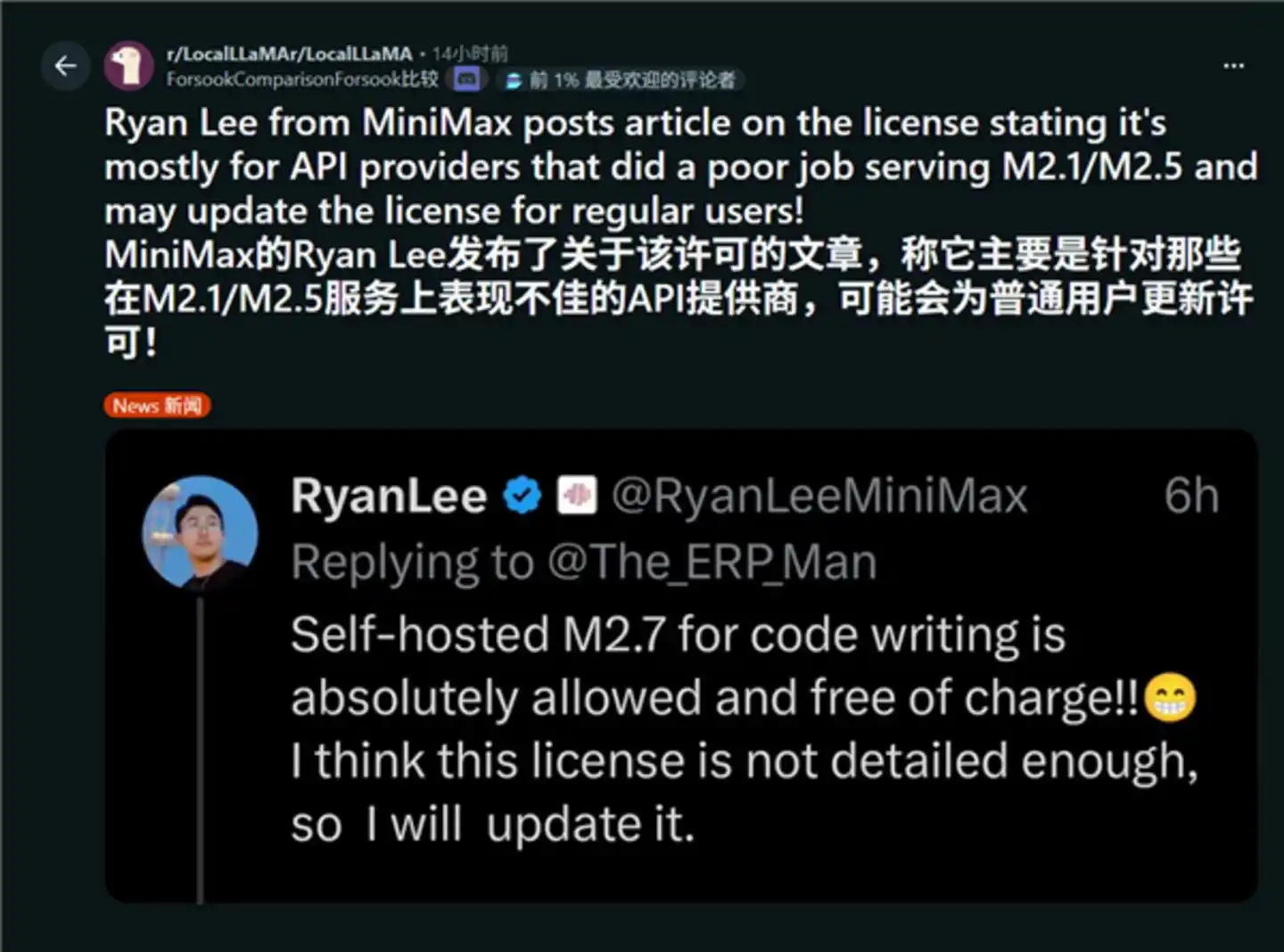
MiniMax Developer Relations负责人 Ryan Lee responded on X regarding the reason for prohibiting commercial use. He mentioned that (under the previous open-source protocol) MiniMax's models appeared on some hosting sites, but some users found the quality to be worse than the official ones after trying them—there was excessive quantization, template errors, silent replacements, or they weren't even their models, leading these users to believe MiniMax's quality was mediocre. The protocol adjustment was due to "third-party hosting platforms胡乱修改模型, causing reputational damage."

This is also a pain point for leading AI companies like MiniMax: sometimes investing money and people in technology普惠 ends up handing a knife to competitors. The anxiety of watching others use your model to create commercial shell products, sell them to clients for huge profits, while you bear the huge server costs, is enough to destroy any idealist's mindset.

For Minimaxes: Is it the羽毛 of the brand, or the活路 of business? It's a painful multiple-choice question.

Undoubtedly, Yan Junjie's ideal ultimately succumbed to the survival anxiety of commercialization.

On March 2, Minimax's first full-year financial report showed: 2025 revenue of $79.04 million, a surge of 158.9% year-on-year, but behind this, the annual loss widened from $465 million in 2024 to $1.872 billion in 2025. The adjusted net loss was still as high as $250 million, meaning for every $1 earned, they still lost over $3. More critically: over 60% of expenditure was directed towards computing power and model training. Training a model like M2.7 costs tens of millions of dollars per round. Meanwhile, the B-end open platform (API/commercial authorization) is Minimax's only high-growth, high-margin sector, with 2025 revenue of $25.96 million, a year-on-year increase of 197.8%, growing much faster than the C-end.

The tightening of the M2.7 protocol is essentially MiniMax circling its wagons. It allows research and individual developers to continue using it for free to retain the seeds of the ecosystem; but it strictly prevents commercial use to ensure every blade of grass grows in its own field during the upcoming commercialization harvest period.

Riding the "open source" traffic wave while keeping legal risks and income interpretation rights firmly in hand. This is not "ideal succumbing to reality," but "securing profit expectations first, then talking about community sentiment." From a business management perspective, it's无可厚非, but it also taints the originally pure open-source spirit with a strong whiff of "client mindset."

The Polarization of Rule-Followers and Performance-Seekers

In the game of large models, certainty is far more important than pure performance parameters.

Developers are a simple group; they are willing to stay up late tuning parameters for you, willing to fix bugs for you on GitHub, provided you respect their rules of the game. After the M2.7 open-source incident, the global developer community experienced severe polarization.

Pragmatic "performance-seekers" believe: Since the performance rivals GPT and it's free for research, it's无可厚非 for vendors to seek commercial收益.

However, in global open-source developer communities, the vocal majority of "rule-followers" felt a severe "trust幻灭" (trust disillusionment). On mainstream communities like Reddit, many voices have already turned to fully open-source series like Qwen.

Why? Because for enterprise users, "certainty" is far more important than "performance".

If a company's open-source promise can be微调 at any time based on "commercial anxiety," then who dares to build their core business on its foundation? Changing the protocol name today, will it charge per Token tomorrow? This fear of future uncertainty is quickly反噬 the technology brand that MiniMax worked hard to build.

The once most radical, purest open-source benchmark has now become a typical case of "definition confusion" in the global community. This shattering of trust is clearly not something a few PR responses can mend.

Survival Rules for Developers in the AI "Post-Open Source Era"

It's not just MiniMax's M2.7 protocol modification; previously, Ali's Lin Junyang's departure also caused震动 in the AI open-source industry. As more large model companies step into the capital market, many worry that the large-scale open-source era of "contributing for love" is accelerating towards its end.

The future large model industry might evolve into two ecosystems: one is the true "public good," like Llama, Qwen, backed by large consortia, using open source to exchange for monopoly on underlying standards; the other is conditional gifts like M2.7, which are more like "commercial show flats"—you can look, you can try staying, but to move in (commercial use), please turn the corner and pay the service fee.

In fact, in the context of large companies, survival itself is a morality. But if you choose pragmatism, please put down the banner of lofty ideals; if you choose commercial licensing, please stop蹭 the光环 of MIT.

This incident demonstrates three survival rules for all AI practitioners in the "post-open source era":

First, all "free" things have an expiration date. When selecting an architecture, the first step is not to test parameters, but to have legal review the protocol. Especially for those responsible for promoting projects within large companies, every word in the protocol could become a stain on your review six months later.

Second, "OpenWeights" does not equal "OpenSource". Future industry narratives will revolve more around the former. We must learn to get used to these "gifts with locks" and reassess their value within商业 logic.

Third, trust itself is an asset. Vendors焦虑 revenue, developers焦虑 changes. This bidirectional anxiety is precisely the阵痛 of the current AI industry bubble being squeezed out.

As of publication, Yan Junjie himself has not publicly responded. Perhaps in his calculation logic, compared to the虚无缥缈 community reputation, obtaining real commercial authorization contracts is the ticket to growth that MiniMax pursues.


Questions liées

QWhat is the core controversy surrounding MiniMax's release of the M2.7 model on HuggingFace?

AThe core controversy is that MiniMax released the model under a 'Modified-MIT' license, which restricts commercial use without written authorization, rather than a true open-source license. This was seen as a 'nominal openness with substantive control' that violates the spirit of open-source and creates legal uncertainty for commercial developers.

QHow did the change in licensing agreement for the M2.7 model impact developer trust and the open-source community?

AThe last-minute license change from a commercially friendly open-source license to the restrictive 'Modified-MIT' caused a 'trust disillusionment' in the global open-source developer community. Many developers felt betrayed, leading some to shift to fully open-source alternatives like Qwen, as the move undermined the foundational trust and consensus of the open-source ecosystem.

QWhat were the stated business reasons behind MiniMax's decision to restrict commercial use of the M2.7 model?

AMiniMax's developer relations lead, Ryan Lee, stated the restriction was due to third-party hosting platforms improperly modifying their models (e.g., excessive quantization, template errors, or model substitution), which led to poor performance and damaged MiniMax's reputation. Financially, as a publicly traded company, MiniMax faces pressure to monetize its high-cost models, and its B2B platform is its fastest-growing, highest-margin revenue segment.

QWhat does the article suggest is the fundamental difference between 'Open Source' and 'Open Weight' in the context of this event?

AThe article clarifies that 'Open Source' (as defined by OSI) involves licenses like the standard MIT license that grant full freedom, including commercial use. 'Open Weight' merely means the model files are publicly available but come with usage restrictions, such as the 'Modified-MIT' license that prohibits commercial use. MiniMax's M2.7 is an 'Open Weight' model, not a true 'Open Source' one.

QAccording to the article, what are the three survival rules for AI developers in the 'post-open-source era' highlighted by this incident?

A1. All 'free' offerings have an expiration date; legal review of licenses is the first step in architectural selection. 2. 'Open Weight' (OpenWeights) is not the same as 'Open Source' (OpenSource); the value of 'gifts with locks' must be reassessed within a commercial logic. 3. Trust is an asset itself; the current mutual anxiety between vendors and developers is a growing pain as the AI industry bubble deflates.

Lectures associées

Pour ceux qui gardent encore un attachement aux altcoins, misez sur HOOD.

L'article présente une analyse positive des actions Robinhood (HOOD), recommandant ce titre comme alternative aux investissements dans les altcoins (cryptomonnaies alternatives). L'auteur explique avoir accumulé des positions dans HOOD pendant la période de marché baissier. Plusieurs facteurs favorables sont mis en avant : * **Performances opérationnelles solides** : En mai, Robinhood a atteint des records historiques pour ses actifs totaux (3 770 milliards USD), le nombre de clients, les marges, etc. Seul le volume de crypto (12,2 milliards USD) est en retrait. * **Développements stratégiques** : La plateforme a lancé son propre marché de prédiction, Rothera, pour capter davantage de revenus. Elle a également obtenu l'approbation pour agir en tant que souscripteur d'introductions en bourse (IPO), comme pour celle de SpaceX. * **Opportunité majeure** : Robinhood a été choisie par le Trésor américain pour gérer les "comptes Trump", un plan d'épargne pour les nouveau-nés américains, lui garantissant potentiellement des millions de nouveaux clients dans les années à venir. * **Confiance des initiés et des analystes** : Un administrateur a accru ses positions de plus de 50 millions USD, et plusieurs banques d'investissement ont relevé leurs objectifs de prix (jusqu'à 135 USD). L'argument central est que la dépendance de Robinhood aux revenus liés aux crypto-monnaies diminue (passant de 35% au Q1 2025 à 13% au Q1 2026), tandis que ses autres activités (actions, options, prédictions, IPO) prennent le relais. Ainsi, HOOD pourrait bénéficier d'un futur bull market crypto, mais n'en dépend plus pour sa croissance. L'auteur conclut que pour les investisseurs toujours attirés par le potentiel des altcoins mais inquiets des risques, HOOD représente une option avec une marge de sécurité plus élevée.

Odaily星球日报Il y a 4 mins

Pour ceux qui gardent encore un attachement aux altcoins, misez sur HOOD.

Odaily星球日报Il y a 4 mins

Les particuliers achètent frénétiquement, les institutions relèvent leurs prévisions, quelle est la trajectoire future de SPCX ?

SpaceX a fait ses débuts en bourse (SPCX) à 160,95 USD la semaine dernière, atteignant une capitalisation boursière de 2,1 billions de dollars. Malgré ce record pour une introduction en bourse aux États-Unis, certaines voix du marché, comme l'agence de recherche CFRA, ont émis des notes prudentes. Cependant, dès l'ouverture de lundi, l'action a bondi de 19,6% pour clôturer à 192,5 USD, portant sa valorisation à 2,519 billions de dollars, ce qui en fait la 8ème entreprise mondiale par sa capitalisation. Les attentes restent élevées en pré-ouverture pour mardi. Ce rebond s'inscrit dans un contexte macroéconomique favorable, avec la signature d'un protocole d'accord entre les États-Unis et l'Iran, apaisant les tensions géopolitiques et stimulant les marchés actions. L'enthousiasme des investisseurs particuliers (retail) reste un moteur clé : selon Vanda Track, SPCX a capté environ 73% des flux nets des investisseurs particuliers le 16 juin. La faible part des actions en circulation (4,2%) et l'activation de la surallocation (option "green shoe") lors de l'IPO amplifient la dynamique haussière. Plusieurs analystes et investisseurs influents ont récemment partagé des perspectives optimistes. Le média Zerohedge évoque la possibilité d'un "Gamma Squeeze" une fois les options cotées, qui pourrait propulser le cours vers 400 USD. L'analyste Timothy Horan d'Oppenheimer a attribué une recommandation "Surperformer" avec un objectif de prix à 190 USD, déjà dépassé. Des personnalités comme Peter H. Diamandis (investisseur historique) et Brad Gerstner voient en SpaceX un actif essentiel et à long terme, positionné à l'intersection de l'économie spatiale et de l'expansion de la puissance de calcul pour l'IA, bien au-delà d'une simple entreprise aérospatiale traditionnelle.

Odaily星球日报Il y a 6 mins

Les particuliers achètent frénétiquement, les institutions relèvent leurs prévisions, quelle est la trajectoire future de SPCX ?

Odaily星球日报Il y a 6 mins

Indicateur Bourse-Crypto丨SpaceX révèle détenir 18 712 bitcoins d'une valeur de 1,18 milliard de dollars ; Strategy dépense 100 millions de dollars pour accumuler du BTC à bas prix pour la deuxième semaine consécutive (16 juin)

**Indicateurs Bourse & Crypto : SpaceX détient 18 712 BTC, Strategy achète agressivement (16 juin)** L'introduction en bourse historique de SpaceX s'est conclue par une forte hausse, propulsant sa capitalisation au-dessus de géants comme TSMC. L'entreprise a révélé détenir 18 712 bitcoins, d'une valeur de 1,18 milliard de dollars, devenant le 8e plus grand détenteur public de BTC. Du côté des entreprises détenant du bitcoin, Strategy (ex-MicroStrategy) a poursuivi ses achats massifs, dépensant environ 100 millions de dollars la semaine dernière pour acquérir 1 587 BTC, portant son total à 846 842. SpaceX a officialisé ses réserves, tandis que Mara Holdings a augmenté ses avoirs de 1 000 BTC. À l'inverse, Metaplanet n'a pas acheté et Nakamoto a vendu environ 600 BTC pour rembourser une dette. Pour l'éther, Bitmine a significativement augmenté ses réserves de 76 881 ETH. Concernant Solana, Forward Industries a vu ses offres d'acquisition pour HSDT et Brera Holdings (détenteur de SOL) rejetées. Divers développements sont à noter : Metaplanet acquiert une société de courtage, Avalanche Treasury Co. (AVAT) entre en bourse, et Tron Inc. dépasse les 700 millions de TRX détenus. Les analyses de marché soulignent un possible transfert de liquidités des actions technologiques vers des secteurs cycliques, et anticipent des corrections fréquentes malgré une tendance haussière persistante pour les actions américaines. *Source : MSX.COM (Ce contenu ne constitue pas un conseil en investissement).*

marsbitIl y a 8 mins

Indicateur Bourse-Crypto丨SpaceX révèle détenir 18 712 bitcoins d'une valeur de 1,18 milliard de dollars ; Strategy dépense 100 millions de dollars pour accumuler du BTC à bas prix pour la deuxième semaine consécutive (16 juin)

marsbitIl y a 8 mins

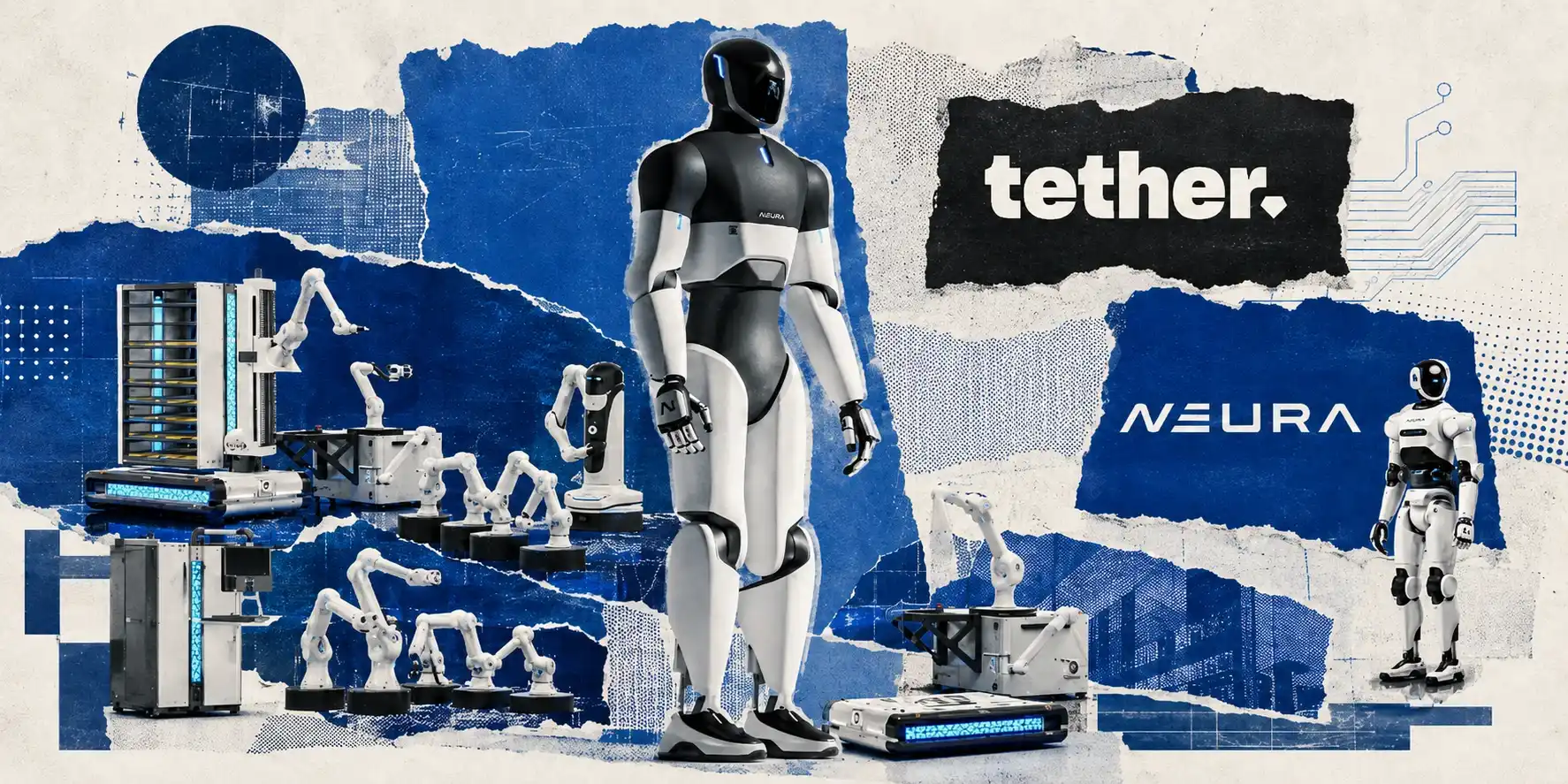
Les robots aussi ont besoin d'un portefeuille cryptographique ? Le géant du stablecoin Tether parie sur l'entreprise allemande NEURA Robotics

L'entreprise allemande de robotique NEURA Robotics a levé jusqu'à 1,4 milliard de dollars en série C, dans ce qui est présenté comme le plus grand tour de table de l'industrie. Le stablecoin géant Tether est l'un des principaux investisseurs. Fondée en 2019, NEURA s'est d'abord concentrée sur les robots collaboratifs (Cobot) intelligents pour l'industrie, avant de développer une gamme plus large incluant des robots mobiles et humanoïdes. Sa vision est de construire Neuraverse, une plateforme permettant aux robots de partager leurs apprentissages et données. L'implication de Tether introduit une dimension nouvelle. Le partenrage prévoit d'intégrer le kit de développement de portefeuille numérique (WDK) de Tether dans les systèmes robotiques de NEURA. Cela permettrait potentiellement aux robots d'effectuer des paiements et règlements automatisés pour des services (comme le transport ou la maintenance) via des stablecoins, agissant comme des nœuds de paiement autonomes. De plus, Tether testera son framework d'IA pour le calcul en périphérie (QVAC) sur Neuraverse, visant à exécuter l'intelligence localement sur les robots pour une latence minimale et une plus grande autonomie. Ainsi, Tether cherche à positionner ses solutions - stablecoins, portefeuilles auto-détenus et IA de périphérie - comme une couche financière et informatique fondamentale pour les futurs réseaux de robots opérant dans le monde physique.

marsbitIl y a 26 mins

Les robots aussi ont besoin d'un portefeuille cryptographique ? Le géant du stablecoin Tether parie sur l'entreprise allemande NEURA Robotics

marsbitIl y a 26 mins

Trading

Spot
Futures

Articles tendance

Comment acheter HOME

Bienvenue sur HTX.com ! Nous vous permettons d'acheter Defi.app (HOME) de manière simple et pratique. Suivez notre guide étape par étape pour commencer votre parcours crypto.Étape 1 : Création de votre compte HTXUtilisez votre adresse e-mail ou votre numéro de téléphone pour ouvrir un compte sur HTX gratuitement. L'inscription se fait en toute simplicité et débloque toutes les fonctionnalités.Créer mon compteÉtape 2 : Choix du mode de paiement (rubrique Acheter des cryptosCarte de crédit/débit : utilisez votre carte Visa ou Mastercard pour acheter instantanément Defi.app (HOME).Solde :utilisez les fonds du solde de votre compte HTX pour trader en toute simplicité.Prestataire tiers :pour accroître la commodité d'utilisation, nous avons ajouté des modes de paiement populaires tels que Google Pay et Apple Pay.P2P :tradez directement avec d'autres utilisateurs sur HTX.OTC (de gré à gré) : nous offrons des services personnalisés et des taux de change compétitifs aux traders.Étape 3 : stockage de vos Defi.app (HOME)Après avoir acheté vos Defi.app (HOME), stockez-les sur votre compte HTX. Vous pouvez également les envoyer ailleurs via un transfert sur la blockchain ou les utiliser pour trader d'autres cryptos.Étape 4 : tradez des Defi.app (HOME)Tradez facilement Defi.app (HOME) sur le marché Spot de HTX. Il vous suffit d'accéder à votre compte, de sélectionner la paire de trading, d'exécuter vos trades et de les suivre en temps réel. Nous offrons une expérience conviviale aux débutants comme aux traders chevronnés.

286 vues totalesPublié le 2025.06.10Mis à jour le 2026.06.10

Comment acheter HOME

Discussions

Bienvenue dans la Communauté HTX. Ici, vous pouvez vous tenir informé(e) des derniers développements de la plateforme et accéder à des analyses de marché professionnelles. Les opinions des utilisateurs sur le prix de HOME (HOME) sont présentées ci-dessous.

活动图片