US-Iran War: Why Did Turkey Sell Off 58.4 Tons of Gold in Two Weeks?

marsbitPublié le 2026-03-30Dernière mise à jour le 2026-03-30

Résumé

Turkish Central Bank sold approximately 58.4 tons of gold, worth over $8 billion, within two weeks in March 2026, as a response to a severe financial crisis triggered by the U.S.-Israel military operation against Iran. The conflict led to Iran blocking the Strait of Hormuz, causing oil prices to surge over 40% and cutting off natural gas supplies to Turkey, which relies heavily on energy imports. This resulted in a plunging Turkish lira, massive foreign capital flight, and rapid depletion of foreign reserves. To defend the currency and meet urgent dollar demands, Turkey utilized gold swaps—temporarily exchanging gold for dollars with agreements to repurchase later—rather than outright sales, to avoid market panic and preserve long-term reserves. The move highlights Turkey's vulnerability to energy shocks and its strategic use of gold reserves for liquidity during crises. If the conflict persists, further gold sales may be necessary, adding downward pressure on global gold prices.

Author: Le Ming

A recent figure that has stunned global financial markets has emerged: the Turkish central bank sold off approximately 58.4 tons of gold in just two weeks, worth over $8 billion. Of this, 6 tons were reduced in the week of March 13, and 52.4 tons were sharply cut in the week of March 20.

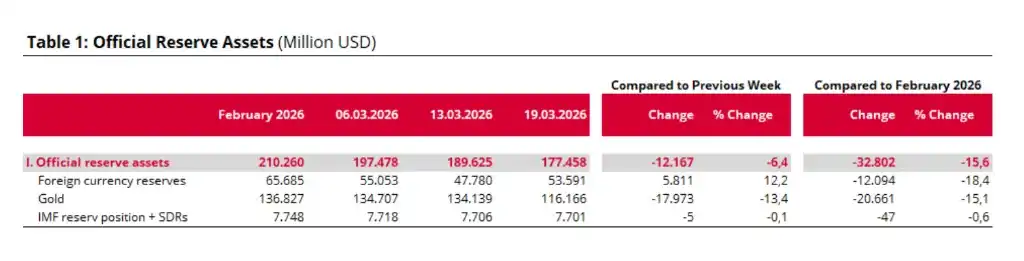
The weekly data from the Turkish central bank clearly outlines this picture: from March 13 to 19, the market value of gold reserves plummeted from $134.1 billion to $116.2 billion, evaporating nearly $18 billion in a single week; meanwhile, foreign exchange reserves (excluding gold) actually increased by $5.8 billion.

Between the decline and the rise, the traces of a "gold for foreign exchange" operation are unmistakable.

Over the past decade, Turkey has been one of the world's most aggressive gold buyers, with gold reserves rising from 116 tons in 2011 to over 820 tons.

Why suddenly sell off such hard-earned assets on a large scale within two weeks?

The answer is three words: to survive.

Trigger: A War That Pushed Turkey into a "Perfect Storm"

On February 28, the United States and Israel jointly launched a military operation codenamed "Epic Fury," launching airstrikes on Iranian nuclear facilities, military bases, and government buildings.

Iran retaliated and effectively blockaded the Strait of Hormuz—a passage for 20% of the world's seaborne oil and 20% of LNG trade.

Brent crude surged from $73 per barrel before the war to over $106, a rise of more than 40%. The International Energy Agency defined it as the "most severe global energy security challenge in history."

For most countries, this was a shock; but for Turkey, it was a survival crisis.

Turkey relies on imports for 90% of its oil and 98% of its natural gas. Every $10 increase in oil prices adds $4.5 to $7 billion to the current account deficit. Based on post-war oil prices, the annual energy import cost could surge by about $15 billion.

An even more fatal blow came on March 24—when Israel airstriked Iran's South Pars gas field, Iran subsequently halted natural gas exports to Turkey. Iran is Turkey's second-largest pipeline natural gas supplier, accounting for about 13% to 14% of its natural gas imports. The 25-year contract for this pipeline is set to expire in July 2026, and the war directly dashed prospects for renewal.

Simply put, Turkey's situation is: its energy bill suddenly doubled, a key gas source was cut off, and no equivalent replacement could be found in the short term.

Transmission Chain: Foreign Exchange Reserves Buckled First

Energy imports require settlement in US dollars, so importers scrambled for dollars, and the lira plummeted.

In the 16 trading days since the conflict began, the lira hit a record low against the dollar 11 times, reaching about 44.35 lira per dollar on March 25.

Behind this was the accelerated withdrawal of foreign investors: in three weeks, foreign capital outflows from Turkish bonds reached $4.7 billion, with $1.2 billion flowing out of the stock market, while carry trade positions shrank from a record $61.2 billion in January to below $45 billion.

The Turkish central bank was thus forced to launch a "lira defense battle." In just the first week of March, it sold over $8 billion in foreign exchange. In the three weeks ending March 19, the central bank cumulatively consumed about $25 to $30 billion in foreign exchange reserves. Net reserves, after deducting swaps, plummeted from $54.3 billion before the war to $43 billion.

Turkey's weekly data fully records this process: foreign exchange reserves (excluding gold) fell from $55 billion on March 6 to $47.8 billion on March 13—first using foreign exchange ammunition. By March 19, foreign exchange reserves rebounded to $53.6 billion, but gold reserves simultaneously plummeted from $134.1 billion to $116.2 billion—foreign exchange ammunition was nearly exhausted, and gold began to be used.

This is a textbook example of an emergency defense sequence: "first use foreign exchange, then use gold."

Figure: Foreign exchange data released by the Turkish central bank
Gold Swaps: Why "Sell" Instead of "Pawn"?

The key to understanding this operation is: more than half of Turkey's gold reduction was done through swaps, not direct sales.

The essence of a gold swap is "exchanging gold for foreign exchange, with redemption upon maturity." The central bank transfers gold to the counterparty (usually a primary investment bank) in exchange for an equivalent amount of US dollars, while signing a forward contract to repurchase the gold at a slightly higher price in the future. It is a short-term financing behavior, not a permanent liquidation.

The central bank chose swaps over outright sales for at least three reasons.

First, to retain long-term positions. If the oil price surge is judged to be a temporary shock, swaps can address the urgent need, and the gold can be redeemed later, avoiding the destruction of a decade of accumulation.

Second, to reduce the impact on gold prices. Directly dumping 60 tons of gold could trigger a cliff-like plunge in the market, in turn causing a significant devaluation of its remaining over $100 billion in gold reserves. Swaps are conducted quietly in the over-the-counter market, with much less impact.

Third, a buffer at the domestic political level. Gold is an "anti-inflation totem" in the hearts of the Turkish people. Announcing large-scale gold sales could easily trigger panic, while swaps can maintain a certain degree of ambiguity technically.

This operation was completed quickly within two weeks thanks to a key pre-arrangement: Turkey stored about 111 tons of gold, worth about $30 billion, at the Bank of England. This gold could be used for foreign exchange intervention without logistical constraints—no need for cross-border physical transport, directly pledged and liquidated in the City of London.

Pressure on Gold Prices

Turkey has a historical pattern: selling gold during crises and buying back after crises.

The 2018 lira crisis, the 2020 pandemic shock, the 2023 earthquake—each time the central bank reduced gold to provide liquidity but resumed accumulation afterward. Analysts generally believe that the operation in March 2026 continues this pattern.

But this judgment has a core premise: the war cannot be prolonged.

Swap agreements come with holding costs and interest. If the war continues, energy prices remain anchored at over $100 for the long term, and Turkey's foreign exchange earning capacity cannot cover the soaring energy bill, then these "temporary swaps" will never be redeemed, effectively becoming "permanent fire sales."

Therefore, in the coming weeks, if the war continues, Turkey will need to continue turning its $135 billion in gold reserves into a lifeline.

Although Turkey prefers to "pledge" gold to obtain foreign exchange liquidity, these transactions still substantially increase the downward pressure on the gold market. In the London over-the-counter market, when the Turkish central bank transfers tens of tons of gold as collateral to international counterparties (such as investment banks) in exchange for US dollars, these financial institutions, to hedge their own position risks, typically conduct corresponding short-selling or selling operations in the spot or futures derivative markets.

Therefore, the liquidity of this batch of gold will eventually be transmitted to the market, indirectly increasing supply and depressing prices.

Conclusion

The Turkish central bank's sale of 60 tons of gold in two weeks is not panic, not speculation, but a rational self-rescue by a country highly dependent on energy imports after its ally bombed its largest energy supplier, facing the triple blow of depleted foreign exchange, a plummeting lira, and a cut-off of natural gas supply.

Figure: The market is frantically shorting the lira, partly betting that the war will not end soon and partly betting that Turkey will ultimately not hold out.
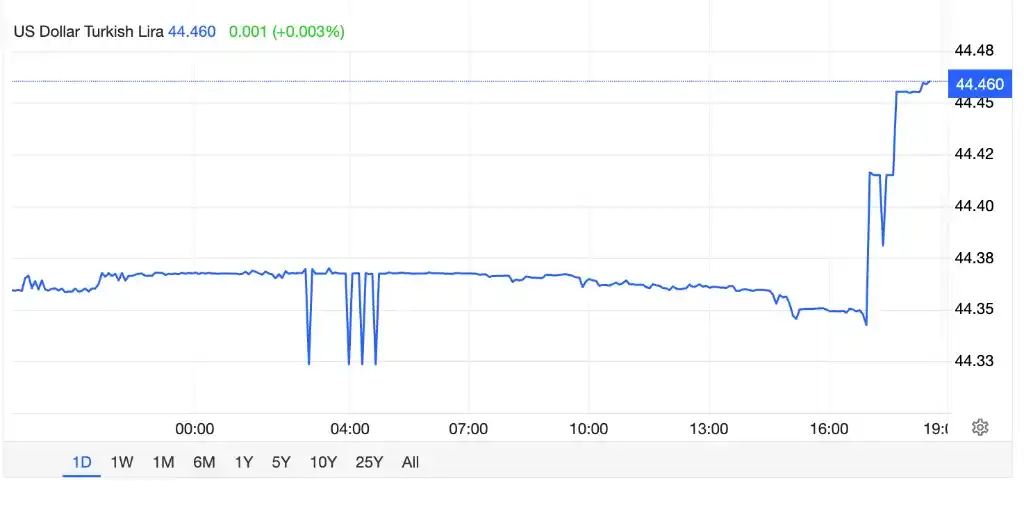
As the war prospects worsen, Turkey still needs to continue to withstand the pressure.


Cryptos en tendance

Questions liées

QWhy did Turkey's central bank sell 58.4 tons of gold in just two weeks?

ATo survive a severe financial crisis triggered by the US-Israel war with Iran, which caused a surge in energy import costs, a collapse of the Turkish lira, and a critical depletion of foreign exchange reserves.

QWhat was the immediate trigger for Turkey's financial crisis in March 2026?

AThe US-Israel military operation 'Epic Rage' against Iran, which led to Iran blocking the Strait of Hormuz and cutting off natural gas exports to Turkey, causing oil prices to soar over 40%.

QHow did the Turkish central bank's gold sales operation work, and why was it done through swaps?

AOver half of the gold was减持 via swaps, not direct sales. This 'pawned' the gold to international banks for immediate USD liquidity, with an agreement to buy it back later. This was done to preserve long-term reserves, minimize market impact, and avoid domestic political panic.

QWhat impact did the energy crisis have on Turkey's currency and foreign reserves?

AThe lira hit record lows against the dollar 11 times in 16 trading sessions. The central bank burned through $250-300 billion in foreign reserves in three weeks defending it, forcing it to then use its gold reserves as a last resort.

QHow could the ongoing war turn Turkey's temporary gold swaps into a permanent loss?

AIf the war continues and energy prices remain high, Turkey may be unable to generate enough foreign exchange to redeem the gold from the swap agreements, effectively forcing a permanent sale.

Lectures associées

Après trois trimestres consécutifs de baisse, le marché des cryptomonnaies pourra-t-il connaître une fenêtre de stabilisation au troisième trimestre ?

Le marché des cryptomonnaies a enregistré son pire trimestre depuis 2022, avec une capitalisation totale chutant de 12,6% à 2 100 milliards de dollars. Tous les indicateurs clés (volume des échanges, valeur des stablecoins) montrent une sortie nette de capitaux. Le Bitcoin a perdu 14,2% et l'Ethereum 25,4% sur le trimestre, rompant sa corrélation antérieure avec les actions technologiques. Les ETF spot américains sur le Bitcoin ont subi des rachats massifs, avec une sortie nette de 4,67 milliards de dollars au Q2, indiquant une pression de vente continue. Le resserrement de la politique de la Fed et les ventes d'entreprises comme Strategy ont accentué la déleveragisation du secteur. L'attention du marché se porte désormais presque exclusivement sur la réunion de la Fed fin juillet. Une position accommodante pourrait stabiliser le Bitcoin entre 68 000 et 84 000 dollars, tandis qu'un ton hawkish pourrait le faire osciller autour de 50 000-56 000 dollars. Parallèlement, la progression du *CLARITY Act*, une loi cruciale pour la clarté réglementaire, est au point mort au Sénat, réduisant les chances d'adoption en 2026 et maintenant une prime de risque élevée sur l'ensemble du secteur. Malgré ce contexte difficile, quelques secteurs résistent : les marchés de prédiction ont vu leur volume nominal augmenter de 48,7% et les biens collectionnables tokenisés ont progressé d'environ 143%. La tokenisation d'actifs du monde réel (RWA) continue également sa croissance régulière, portée par des fondamentaux indépendants du cycle crypto. Les bases d'un effondrement extrême semblent absentes, mais le marché est désormais guidé par les politiques monétaires, les prix et les attentes de taux, plutôt que par le simple récit haussier. La fin des sorties massives des ETF et le retour des achats des détenteurs à long terme pourraient indiquer une phase de stabilisation potentielle.

marsbitHier 08:42

Après trois trimestres consécutifs de baisse, le marché des cryptomonnaies pourra-t-il connaître une fenêtre de stabilisation au troisième trimestre ?

marsbitHier 08:42

The SpaceX Trade, Unlocked: SPCXON Débarque sur WEEX

En juin 2026, SpaceX a réalisé la plus grande introduction en bourse de l'histoire, mais l'accès à l'action a été limité pour de nombreux investisseurs en raison de restrictions régionales et de frictions liées aux courtiers. La plateforme WEEX propose désormais une solution via SPCXON/USDT, un instrument tokenisé sur le marché au comptant qui permet d'obtenir une exposition au cours de SpaceX en utilisant l'USDT, sans nécessiter de compte de courtage américain. SPCXON est un produit tokenisé construit sur l'infrastructure d'Ondo, conçu pour refléter l'économie de la détention d'actions SpaceX pour les traders éligibles en dehors des États-Unis, avec des dividendes réinvestis. Le cas d'investissement repose sur la croissance des revenus de Starlink et les progrès de Starship, malgré un valorisation déjà élevée et des risques liés à un flottant public réduit et à des déblocages d'actions internes à venir. Il est important de noter que SPCXON offre une exposition, et non la propriété directe d'actions ou de droits de vote. Son prix peut évoluer avec une prime ou une décote par rapport à la valeur liquidative. WEEX propose également d'autres produits tokenisés comme MSTRON et MUON dans un compte unifié, permettant une rotation entre crypto-monnaies et actions traditionnelles sans transfert de fonds. La plateforme souligne ainsi comment les barrières entre la finance traditionnelle et les actifs numériques s'estompent.

TheNewsCryptoHier 08:34

The SpaceX Trade, Unlocked: SPCXON Débarque sur WEEX

TheNewsCryptoHier 08:34

BIT Trading Moment : Le BTC reste sous la pression de l'EMA 200 hebdomadaire, un rejet pourrait relancer la baisse, les actions de stockage et de semi-conducteurs qui ont bondi cette nuit ont baissé en séance de nuit

**Résumé des marchés : Bitcoin sous pression, actions technologiques en réajustement** Le marché crypto poursuit son rebond, avec Bitcoin évoluant autour de 66 000 $. Il fait face à une résistance clé vers 68 000 $, niveau correspondant au coût moyen des investisseurs sur cinq mois. Les traders surveillent les moyennes mobiles clés (200 MA à ~63 333 $ et 200 EMA à ~68 328 $ en hebdomadaire). Une rupture au-dessus de 68 000 $ ouvrirait la voie à une hausse, tandis qu'un échec pourrait entraîner un retest des 63 000 $. L'analyse suggère que la dynamique actuelle ressemble à un rebond estival à faible liquidité plutôt qu'au début d'un véritable marché haussier. Sur le marché actions américain, après une forte séance mardi portée par les semi-conducteurs et les titres du stockage (Micron, AMD, Intel...), les contrats à terme indiquent une ouverture en baisse. Les secteurs ayant récemment bondi, comme les semi-conducteurs et le stockage, reculent en séance de nuit. Certaines valeurs se démarquent néanmoins, comme Super Micro Computer (SMCI), en hausse après des résultats et des perspectives robustes liées à la demande de serveurs IA. Des vents contraires persistent : les prix du pétrole (Brent >91$) et les rendements des obligations d'État américaines grimpent, ravivant les craintes inflationnistes. En Asie, les marchés ont suivi le rebond technologique américain, mais de manière hésitante. La tension reste forte sur le yen japonais, qui atteint son plus bas niveau depuis des décennies. **Points clés à surveiller :** * **Crypto :** Niveaux techniques de Bitcoin (68k$/63k$), flux des ETF spot. * **Actions :** Saison des résultats (Tesla, Alphabet, Intel...), activité d'AMD sur l'IA. * **Économie :** Données américaines sur l'emploi, décision de la BCE, tensions géopolitiques et prix de l'énergie.

marsbitHier 08:34

BIT Trading Moment : Le BTC reste sous la pression de l'EMA 200 hebdomadaire, un rejet pourrait relancer la baisse, les actions de stockage et de semi-conducteurs qui ont bondi cette nuit ont baissé en séance de nuit

marsbitHier 08:34

Gate Research Institute : La vague de « Wall Streetisation » des produits financiers cryptographiques, concurrence ou fusion ?

Le titre de l'article est : "Gate Institute : La vague de 'Wall Street-isation' des produits financiers cryptos, est-ce une compétition ou une fusion ?" Résumé en français (environ 1400 caractères) : Il y a dix-sept ans, Bitcoin fut créé avec une vision décentralisée et anti-establishment financier. Aujourd'hui, paradoxalement, son adoption massive passe souvent par des ETF émis par des géants comme BlackRock. Cet article analyse cette "Wall Street-isation" apparente des actifs cryptos : les institutions traditionnelles s'emparent-elles du pouvoir d'émission, de tarification, de garde et de distribution ? La réalité est plus nuancée. C'est une convergence à double sens. D'un côté, les plateformes cryptos comme Gate.io étendent leurs services aux actions traditionnelles (états-uniennes, hongkongaises, sud-coréennes), aux CFD et aux produits tokenisés, offrant un compte unifié. De l'autre, des courtiers traditionnels comme Robinhood intègrent les cryptomonnaies et explorent la tokenisation d'actions sur blockchain. Cette fusion vise à créer le "super-compte" financier de demain, où actions, cryptos, ETF et obligations tokenisées (RWA) coexistent dans une même interface, comblant les faiblesses de chaque écosystème. Les RWA, notamment les obligations d'État tokenisées, agissent comme une couche intermédiaire unificatrice. En conclusion, Wall Street n'a pas conquis la crypto, et la crypto n'a pas contourné Wall Street. Ils construisent ensemble une nouvelle forme de marché des capitaux, plus efficace et mondial, où l'idéal décentralisé persiste dans les protocoles, tandis qu'une expérience utilisateur unifiée émerge à l'interface.

marsbitHier 08:09

Gate Research Institute : La vague de « Wall Streetisation » des produits financiers cryptographiques, concurrence ou fusion ?

marsbitHier 08:09

Trading

Spot

Articles tendance

Comment acheter WAR

Bienvenue sur HTX.com ! Nous vous permettons d'acheter WAR (WAR) de manière simple et pratique. Suivez notre guide étape par étape pour commencer votre parcours crypto.Étape 1 : Création de votre compte HTXUtilisez votre adresse e-mail ou votre numéro de téléphone pour ouvrir un compte sur HTX gratuitement. L'inscription se fait en toute simplicité et débloque toutes les fonctionnalités.Créer mon compteÉtape 2 : Choix du mode de paiement (rubrique Acheter des cryptosCarte de crédit/débit : utilisez votre carte Visa ou Mastercard pour acheter instantanément WAR (WAR).Solde :utilisez les fonds du solde de votre compte HTX pour trader en toute simplicité.Prestataire tiers :pour accroître la commodité d'utilisation, nous avons ajouté des modes de paiement populaires tels que Google Pay et Apple Pay.P2P :tradez directement avec d'autres utilisateurs sur HTX.OTC (de gré à gré) : nous offrons des services personnalisés et des taux de change compétitifs aux traders.Étape 3 : stockage de vos WAR (WAR)Après avoir acheté vos WAR (WAR), stockez-les sur votre compte HTX. Vous pouvez également les envoyer ailleurs via un transfert sur la blockchain ou les utiliser pour trader d'autres cryptos.Étape 4 : tradez des WAR (WAR)Tradez facilement WAR (WAR) sur le marché Spot de HTX. Il vous suffit d'accéder à votre compte, de sélectionner la paire de trading, d'exécuter vos trades et de les suivre en temps réel. Nous offrons une expérience conviviale aux débutants comme aux traders chevronnés.

575 vues totalesPublié le 2024.12.11Mis à jour le 2026.06.02

Comment acheter WAR

Discussions

Bienvenue dans la Communauté HTX. Ici, vous pouvez vous tenir informé(e) des derniers développements de la plateforme et accéder à des analyses de marché professionnelles. Les opinions des utilisateurs sur le prix de WAR (WAR) sont présentées ci-dessous.

活动图片