Deconstructing the Capital Game of Public Chain Pharos: A $950 Million Valuation Propped Up by Photovoltaic and Other Assets, A Shell Transaction Under Layers of Betting?

marsbitPublié le 2026-03-15Dernière mise à jour le 2026-03-15

Résumé

The article investigates the recent $247.3 million investment by Hong Kong-listed GCL New Energy into the Layer 1 blockchain project Pharos at a $950 million valuation. It reveals the deal is not a straightforward investment but a complex, multi-stage transaction bound by stringent performance milestones. The core of the agreement is a set of mutual, conditional investments. Pharos must first purchase up to $1.5 billion HKD worth of GCL shares. However, GCL's reciprocal investment in Pharos tokens is contingent upon a series of strict, performance-based vesting conditions. The entire deal is split into five tranches, each unlocking only if the Pharos token lists on an exchange without falling below its issue price and maintains a high fully diluted valuation (FDV) over successive three-month periods. If any condition fails, the entire agreement can be terminated. The article questions the legitimacy of the $950 million valuation, which was calculated based on a purported $250 million in Total Value Locked (TVL). Notably, over half of this TVL is claimed to be from real-world assets (RWA), specifically photovoltaic and power station assets linked to GCL—a highly unconventional method for valuing a Layer 1 blockchain. Furthermore, the mainnet is not yet live, and the TVL figure is unverified by independent data platforms. The author suggests the deal is a "capital game" designed to boost GCL's stock price, which saw suspicious pre-announcement surges, and to create hype for ...

Author: Gu Yu, ChainCatcher

After several months, the Layer1 public chain sector has recently seen another financing round at the billion-dollar valuation level. Pharos, which claims to be a high-performance parallel Layer 1 public chain, announced an upgrade in its capital cooperation with the Hong Kong Stock Exchange-listed company GCL New Energy. GCL New Energy completed an investment subscription in Pharos at a valuation of $950 million, with an amount of $24.73 million.

GCL New Energy is a well-known domestic private photovoltaic power generation enterprise, mainly engaged in the development, construction, operation, and management of solar power stations. This aligns very well with Pharos's key RWA development direction, making it seem like a transaction of positive strategic significance for both parties.

However, this transaction has also raised many questions in the market. Given the current dismal secondary market, can projects in the Layer1 and RWA sectors really achieve billion-dollar valuations in the primary market? Would a listed company easily invest in such high-risk assets?

A Mutually Binding Betting Transaction

Many details hidden in the complex announcements show that this is not a conventional direct financing transaction, but a bundled deal involving mutual investment, phased settlements, and market value betting. Moreover, all core settlement conditions are firmly in the hands of GCL New Energy. If any condition is not met, this transaction will be nothing more than an empty document without any substantive binding force.

Among them, Pharos's share subscription in GCL New Energy is a preconditioned investment. It will subscribe for a maximum of 183,480,000 new shares in the company at a price of HK$1.05, worth approximately HK$150 million. This price represents a 15% discount compared to GCL New Energy's current price (HK$1.23).

This transaction seems to favor Pharos, but GCL New Energy is clearly well-versed in financial operations and has set five stringent settlement thresholds for this share subscription. If any batch of settlement conditions is not met, all subsequent settlements will be terminated, and the entire agreement is valid for only 18 months. Specifically, this investment is divided into five batches of settlements, with unlocking conditions all tied to the listing performance of the Pharos Token:

The first batch, accounting for 50%, will only proceed if the Pharos Token is successfully approved for listing on relevant Web3 exchanges and the opening price is not lower than the company's agreed investment price (calculated based on a $950 million valuation). If the listing fails or the opening price falls below the issue price, the company has the right not to proceed with the settlement.

The second batch, accounting for 12.5%, will only proceed if the daily average FDV (Fully Diluted Valuation) of the Pharos Token in the first three months after listing is not less than $760 million.

The unlocking conditions for the subsequent three batches are roughly similar, with the main difference being the calculation periods for the average FDV: the fourth to sixth months, the seventh to ninth months, and the ninth to twelfth months, respectively.

Once the Pharos Token meets the settlement conditions, Pharos's share subscription in GCL New Energy will take effect accordingly, and GCL New Energy's subscription for the Pharos Token will also take effect simultaneously, with the same unlocking ratio.

In other words, after the successful listing of the Pharos Token, Pharos will immediately settle a HK$75 million share subscription with GCL New Energy, while GCL New Energy will acquire Pharos Tokens worth approximately HK$96.73 million at a valuation of $950 million.

For GCL New Energy, this is an almost risk-free transaction. On one hand, it can obtain HK$75 million in share subscription funds, and on the other hand, if the Pharos Token performs well, it can acquire tokens worth nearly HK$100 million at the initial listing valuation, offering considerable profit margin.

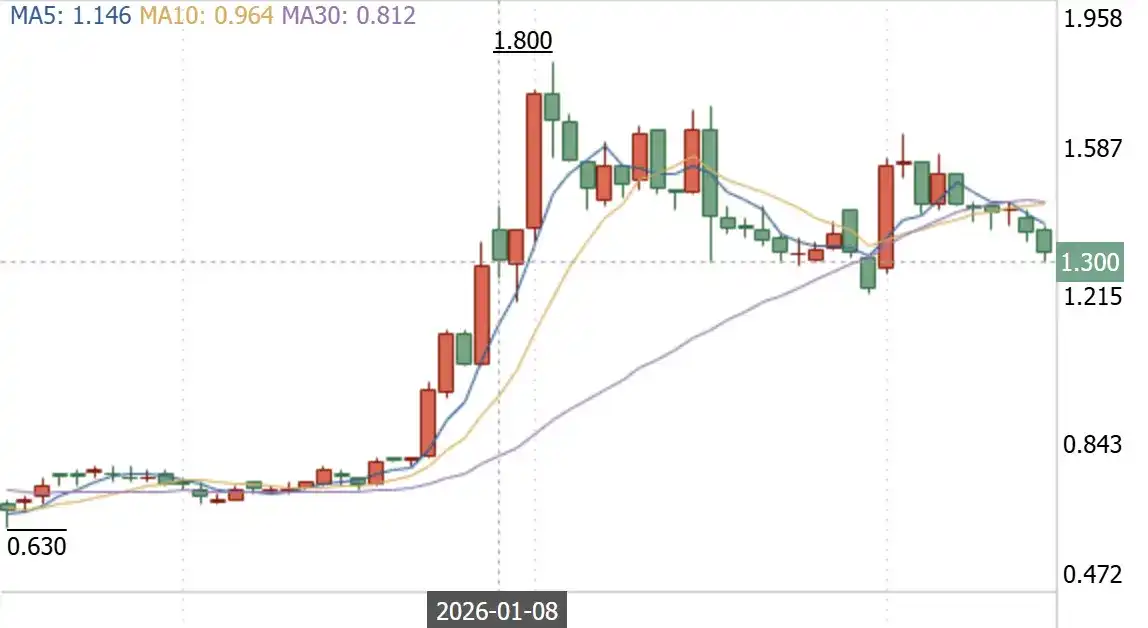
The positive news has already been reflected in the stock price. Although GCL New Energy first disclosed its cooperation with Pharos on January 8, its stock price had already risen significantly a week earlier, climbing from HK$0.8 to HK$1.3 on the announcement day, and later reaching a peak of HK$1.8. Since then, it has been on a downward trend. In the trading market, this is a typical "rat trading" pattern.
Another potential issue is that Pharos has previously disclosed a cumulative financing of only $8 million, equivalent to HK$62.61 million. Therefore, even if the pre-investment conditions are met, this funding gap may pose a challenge for Pharos.
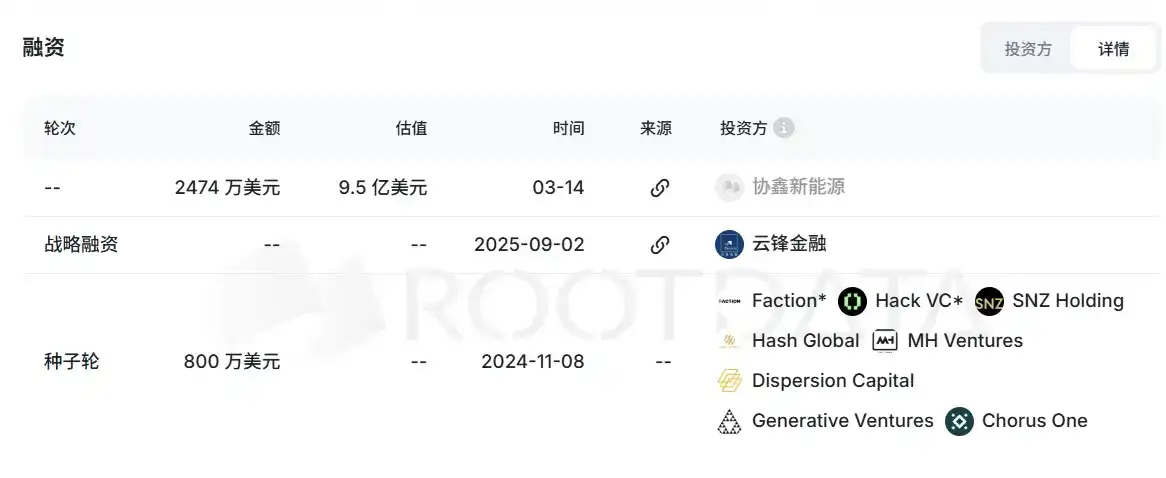
Source: RootData

How Was the $950 Million Valuation Derived?

Another interesting piece of information is that GCL New Energy also detailed in the agreement why it valued Pharos at $950 million. According to the agreement, this investment valuation is primarily based on the on-chain total value locked (TVL). In the Layer1 sector, the average ratio of fully diluted valuation (FDV) to total value locked (TVL) for Ethereum, BSC, Hyperliquid, Tron, and Avalanche is 10x, with a median of 6x. Monad, which has a similar technical route, has a ratio of 10x.
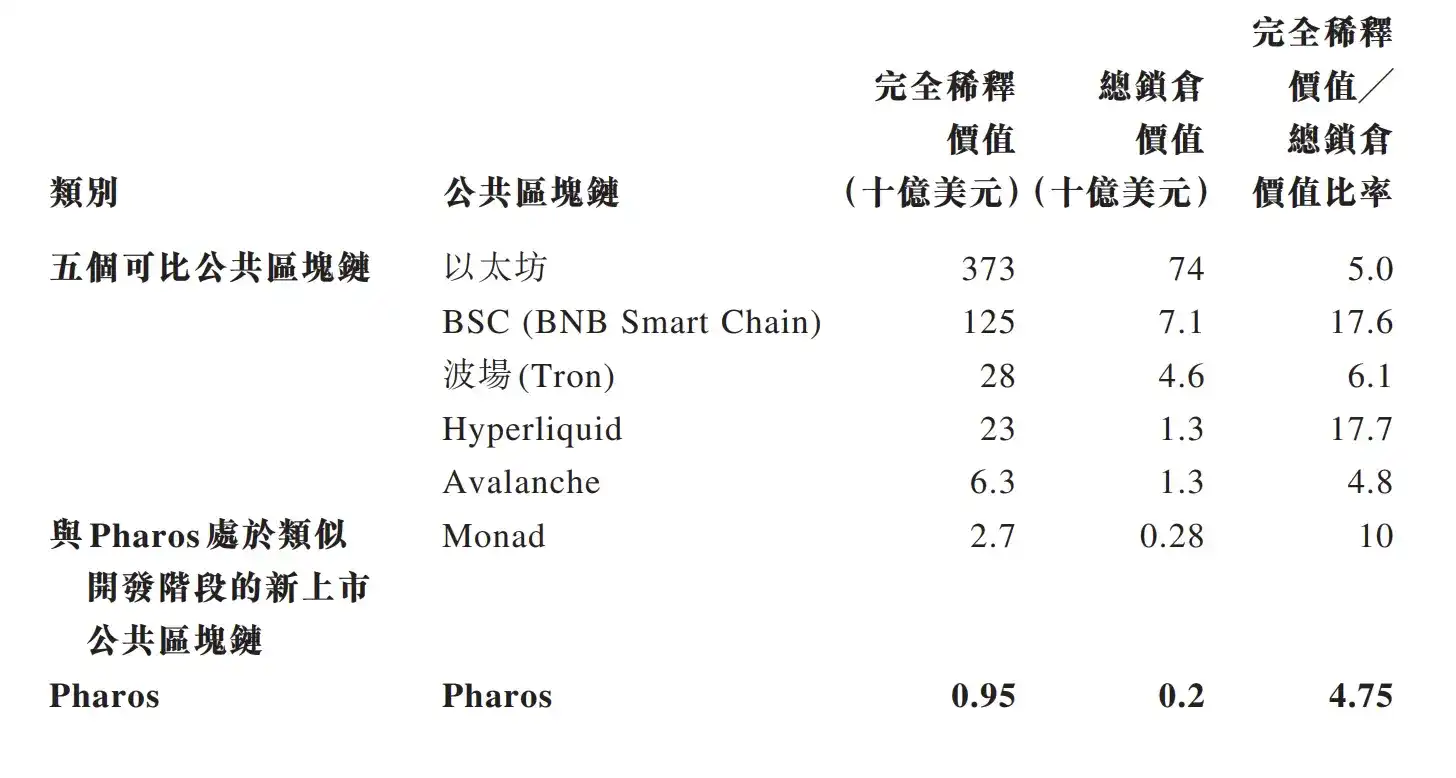
Therefore, both parties decided to set the calculation coefficient for Pharos at 4.75x. Since Pharos's current total value locked is $250 million, and calculated with a 20% discount, the initial valuation should be $950 million.

Regarding the types of on-chain locked assets, the agreement disclosed that currently, among all locked assets in Pharos, 51% come from new energy assets of distributed photovoltaic operators and centralized power station operators, and 49% come from financial assets of fund management companies and credit asset issuers.

In other words, Pharos's total value locked includes physical assets in its calculation, specifically power station and photovoltaic assets closely related to the parties involved in this transaction. This calculation method sets a precedent in the Layer1 industry.

In fact, Pharos's mainnet has not yet been officially announced as launched. Professional on-chain data statistics platforms like DeFiLlama do not include Pharos's locked data, and the $250 million figure is entirely a unilateral disclosure from the project team.

The premature stock price movement, combined with the layers of betting conditions in the agreement and the inflated valuation calculation, makes it easy to see the true purpose of this transaction: For GCL New Energy, this may be a financial operation to hype the stock price and boost the company's market value by leveraging crypto concepts. For Pharos, it is an attempt to rely on the listed company's physical assets to create a high-valuation buzz and build momentum for the subsequent token listing. Both parties get what they need, but leave the risks to the market and subsequent investors.

When a实体产业 company injects physical assets into a Layer1 project and then calculates a valuation several times the value of those physical assets to easily create a $950 million valuation, isn't this capital game too outrageous? Does the crypto market really need such RWA?


Questions liées

QWhat is the nature of the capital cooperation between Pharos and GCL New Energy, and what is the announced valuation?

AThe capital cooperation involves GCL New Energy investing in the Layer 1 blockchain Pharos at a valuation of $950 million. The investment amount is $24.73 million. The deal is structured as a mutual investment with staged closings and market cap-based performance warrants, not a straightforward equity purchase.

QWhat are the specific conditions (warrants) that GCL New Energy set for the investment to be executed?

AThe investment is split into five tranches with strict unlocking conditions tied to the performance of the Pharos Token post-listing. The first tranche (50%) requires the token to be listed on an exchange at or above the initial offering price. Subsequent tranches require the token's fully diluted valuation (FDV) to maintain specific averages over 3-month periods (e.g., $760 million for the second tranche) for the 12 months following listing.

QHow was the $950 million valuation for Pharos calculated, and what is controversial about it?

AThe valuation was calculated by applying a multiple of 4.75 to a reported Total Value Locked (TVL) of $250 million, with a 20% discount. The TVL figure controversially includes real-world assets (RWA) like photovoltaic power stations and financial assets, not just crypto assets. This method is unprecedented in the Layer 1 sector, and the $250M TVL is a self-reported figure as the mainnet is not yet live on major tracking sites.

QWhat potential market manipulation is suggested by the article regarding GCL New Energy's stock price?

AThe article suggests potential 'rat trading' (insider trading or market manipulation), as GCL New Energy's stock price experienced a significant rise from HK$0.8 to HK$1.3 in the week *before* the official announcement of the deal with Pharos was made public on January 8th.

QWhat is the article's overall conclusion about the strategic purpose of this deal for both companies?

AThe article concludes the deal is a capital game where GCL New Energy aims to boost its stock price by leveraging crypto hype, while Pharos aims to create a high-valuation narrative backed by real-world assets to generate momentum for its upcoming token listing. The complex warrant structure transfers all risk to the market and future investors, making the $950M valuation appear inflated and the transaction potentially hollow.

Lectures associées

Début de Warsh : le président de la Fed le plus au fait du Crypto de l'histoire apportera-t-il des surprises ou des chocs au marché ?

**Résumé :** Kevin Warsh, nouveau président de la Réserve fédérale américaine, s'apprête à tenir sa première conférence de presse monétaire. Sa nomination est historique : il est le premier président de la Fed à détenir personnellement des actifs numériques (investissements indirects dans Solana, dYdX, etc.), montrant une compréhension unique du secteur. Son dilemme est majeur : il doit faire face à une résurgence de l'inflation, qui exige une politique monétaire stricte (position "de faucon"), tout en répondant aux pressions politiques pour des baisses de taux. Parallèlement, son attitude envers les crypto-actifs diffère fondamentalement de celle de son prédécesseur. Il ne les considère pas comme de simples actifs spéculatifs, mais plutôt comme un "bon policier" pour la politique économique et une composante de la compétitivité américaine. Son impact potentiel sur le marché crypto s'articule autour de trois axes : 1. Un changement de paradigme réglementaire, passant de la prévention à l'intégration et à l'innovation. 2. Une reprixation des actifs liée aux taux d'intérêt, où sa clarté de communication pourrait réduire la prime d'incertitude. 3. Une légitimation accrue pouvant attirer les capitaux institutionnels traditionnels. Deux scénarios principaux sont envisagés pour sa première intervention : * **Scénario "Surprise"** : Un ton modéré ("de colombe") sur les taux combiné à des signaux favorables à l'innovation numérique pourrait booster le marché. * **Scénario "Choc"** : Un message excessivement restrictif sur les taux pourrait entraîner une vente généralisée des actifs risqués, y compris les cryptos. Bien qu'il ait dû vendre ses actifs crypto pour des raisons d'éthique, la compréhension intrinsèque de Warsh pour la technologie blockchain pourrait, à long terme, poser les bases d'une intégration plus structurelle des actifs numériques dans le système financier.

marsbitIl y a 2 h

Début de Warsh : le président de la Fed le plus au fait du Crypto de l'histoire apportera-t-il des surprises ou des chocs au marché ?

marsbitIl y a 2 h

XRP Ledger Lance le Rebranding XRPld Avec la Mise à Niveau Version 3.2.0

La version 3.2.0 du XRP Ledger (XRPL) est désormais disponible, introduisant une refonte majeure incluant le changement de nom du logiciel principal de « rippled » à « xrpld ». Cette mise à niveau se concentre principalement sur les améliorations des performances, de la sécurité et de l'évolutivité de l'infrastructure sous-jacente, plutôt que sur de nouvelles fonctionnalités utilisateur. Les principales avancées incluent des optimisations de mémoire pouvant réduire jusqu'à 40% l'utilisation de la mémoire serveur. Sur le plan de la sécurité, la modification `fixCleanup3_2_0` renforce plusieurs modules, notamment les coffres-forts à actif unique, le protocole de prêt, les échanges décentralisés et les jetons multi-usages. De nouveaux contrôles d'invariance garantissent la cohérence du registre après la suppression de comptes. Pour les développeurs, la mise à jour permet désormais de récupérer des informations sur les définitions du protocole et du serveur XRPL sans nécessiter de connexion active, facilitant ainsi la création de portefeuilles, d'explorateurs de blockchain et d'APIs. En termes d'évolutivité et de stabilité, les améliorations comprennent des tailles de bloc configurables, un stockage de base de données optimisé via nuDB, et le support optionnel de TLS/mutual TLS pour le serveur gRPC. Le port de peering par défaut est également passé du 51235 au 2459. Divers correctifs ont été apportés aux fonctions liées aux Market Makers Automatisés, aux paiements, aux séquestres de jetons et aux carnets d'ordres. Une note importante : les invariants de transaction ont été temporairement désactivés dans la v3.2.0 en raison d'un impact sur les performances, mais cela ne présente pas de risque pour la sécurité.

TheNewsCryptoIl y a 2 h

XRP Ledger Lance le Rebranding XRPld Avec la Mise à Niveau Version 3.2.0

TheNewsCryptoIl y a 2 h

L'AGI n'est pas l'arrivée, nouveau document de DeepMind : Vers l'ASI, le véritable progrès de l'IA ne fait que commencer

Si l'intelligence artificielle générale (IAG) était atteinte demain, quelle serait la prochaine étape ? Une étude de Google DeepMind suggère que l'IAG n'est pas un point final, mais une étape vers une superintelligence artificielle (ISA) dépassant les collectifs d'experts humains. L'étude distingue trois concepts : l'IAG (niveau médian humain), l'ISA (supérieure aux meilleurs collectifs humains dans presque tous les domaines) et l'IA universelle (limite théorique). Elle propose quatre voies potentielles vers l'ISA : 1. **Extension des ressources** : augmentation de la puissance de calcul, des données et des modèles. 2. **Évolution algorithmique** : améliorations incrémentales ou nouveaux paradigmes (apprentissage continu, utilisation d'outils, modèles du monde). 3. **Auto-amélioration récursive** : des IA plus performantes conçoivent la génération suivante, créant une boucle de rétroaction positive. 4. **Coordination multi-agents** : des systèmes IAG collaborant atteignent une intelligence collective supérieure. L'étude identifie six principaux goulets d'étranglement : 1. **Le mur des données** : les données humaines de haute qualité pourraient s'épuiser. 2. **Pressions économiques et ressources naturelles** : coûts énergétiques et matériels. 3. **Limites des paradigmes neuronaux actuels** : problèmes d'apprentissage continu, de raisonnement robuste, d'hallucinations. 4. **Difficulté croissante de la recherche**. 5. **Barrières à l'abstraction** : difficulté à former de nouveaux concepts fondamentaux. 6. **Régulation, gouvernance et réaction sociale**. Un défi crucial est l'évaluation des capacités de l'IA au-delà du niveau humain, nécessitant de nouveaux benchmarks. L'étude conclut que la progression vers l'ISA reste incertaine, soumise à des contraintes physiques et de ressources, et appelle à un effort de recherche interdisciplinaire pour mieux anticiper cette évolution.

marsbitIl y a 4 h

L'AGI n'est pas l'arrivée, nouveau document de DeepMind : Vers l'ASI, le véritable progrès de l'IA ne fait que commencer

marsbitIl y a 4 h

Trading

Spot
Futures

Articles tendance

Comment acheter SHELL

Bienvenue sur HTX.com ! Nous vous permettons d'acheter MyShell (SHELL) de manière simple et pratique. Suivez notre guide étape par étape pour commencer votre parcours crypto.Étape 1 : Création de votre compte HTXUtilisez votre adresse e-mail ou votre numéro de téléphone pour ouvrir un compte sur HTX gratuitement. L'inscription se fait en toute simplicité et débloque toutes les fonctionnalités.Créer mon compteÉtape 2 : Choix du mode de paiement (rubrique Acheter des cryptosCarte de crédit/débit : utilisez votre carte Visa ou Mastercard pour acheter instantanément MyShell (SHELL).Solde :utilisez les fonds du solde de votre compte HTX pour trader en toute simplicité.Prestataire tiers :pour accroître la commodité d'utilisation, nous avons ajouté des modes de paiement populaires tels que Google Pay et Apple Pay.P2P :tradez directement avec d'autres utilisateurs sur HTX.OTC (de gré à gré) : nous offrons des services personnalisés et des taux de change compétitifs aux traders.Étape 3 : stockage de vos MyShell (SHELL)Après avoir acheté vos MyShell (SHELL), stockez-les sur votre compte HTX. Vous pouvez également les envoyer ailleurs via un transfert sur la blockchain ou les utiliser pour trader d'autres cryptos.Étape 4 : tradez des MyShell (SHELL)Tradez facilement MyShell (SHELL) sur le marché Spot de HTX. Il vous suffit d'accéder à votre compte, de sélectionner la paire de trading, d'exécuter vos trades et de les suivre en temps réel. Nous offrons une expérience conviviale aux débutants comme aux traders chevronnés.

195 vues totalesPublié le 2025.02.28Mis à jour le 2026.06.02

Comment acheter SHELL

Discussions

Bienvenue dans la Communauté HTX. Ici, vous pouvez vous tenir informé(e) des derniers développements de la plateforme et accéder à des analyses de marché professionnelles. Les opinions des utilisateurs sur le prix de SHELL (SHELL) sont présentées ci-dessous.

活动图片