Bitcoin ETF Sees Sudden Reversal After Five Consecutive Weeks of $3.8 Billion Outflows: Who Decides the Next Move?

marsbitPublié le 2026-03-02Dernière mise à jour le 2026-03-02

Résumé

Bitcoin ETFs experienced a five-week outflow streak totaling $3.8 billion, marking the longest continuous withdrawal period since early 2025. This occurred amid heightened macroeconomic uncertainty driven by tariff policy shifts, which amplified volatility across risk assets. However, a reversal began around February 20, with approximately $875.5 million in net inflows over several days, suggesting a potential shift in institutional sentiment. The article emphasizes that ETF flows act as a key indicator of institutional demand. Sustained outflows remove a structural buyer, making price support more fragile and rebounds weaker. Key signals to watch include the persistence of weekly inflows, Bitcoin’s performance on macro-negative days, its ability to rise without ETF support, and the pattern of outflows. Three potential paths are outlined: renewed consistent inflows indicating structural recovery; transient inflows followed by further outflows, suggesting tactical rather than strategic demand; or stabilization with neutral flows, allowing quieter market recalibration. The critical question remains whether marginal buyers are returning with conviction or merely reacting to short-term price levels.

Author: CryptoSlate

Compiled by: Deep Tide TechFlow

Deep Tide's Guide: This article clarifies a structural issue that is easily overlooked: Bitcoin ETFs are not a floor; they are conditional buyers. Five weeks of net outflows totaling $3.8 billion are not just an ugly number; they represent the quiet closing of what was once the most stable institutional door at the peak of tariff uncertainty. After February 20th, the data reversed, but is this reversal a true signal or a tactical move? The author outlines three paths and four indicators to watch, making it worth a careful read.

Full Text Below:

Bitcoin ETFs have just experienced their longest net outflow cycle since early 2025. The uncertainty surrounding tariff policy is stirring interest rates and the stock market, making this outflow particularly critical as it alters Bitcoin's support structure under pressure.

For nearly two years, spot Bitcoin ETFs were almost seen as a one-way street. They liberated Bitcoin from the hassles of private keys and operational complexities, turning it into code that fits into any ordinary investment portfolio. Money flowed in, shares were created, and Bitcoin gained a stable, compliant source of demand.

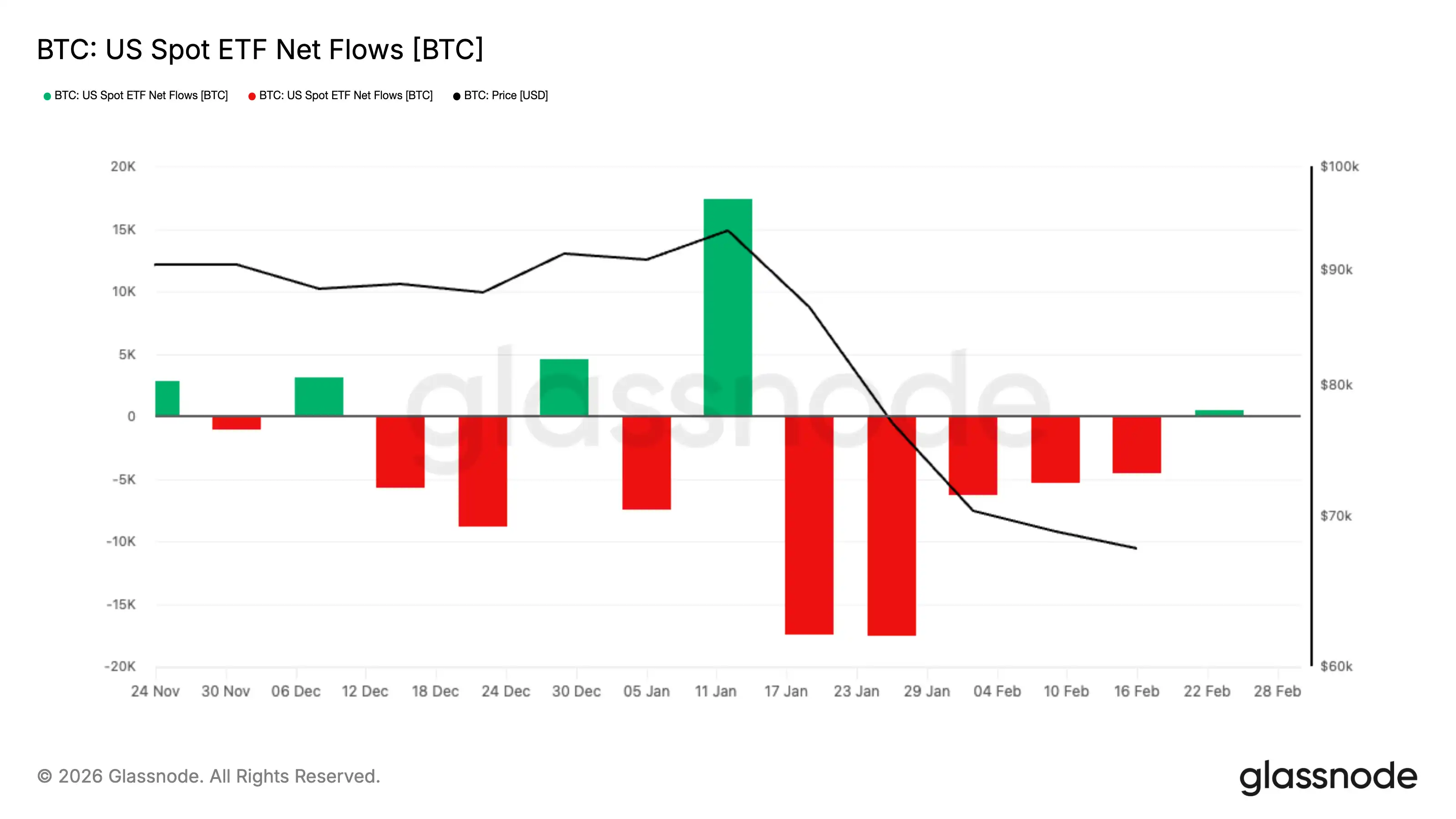
In the five consecutive weeks leading up to the end of February, investors withdrew approximately $3.8 billion from U.S.-listed spot Bitcoin ETFs, marking the longest streak of weekly net outflows since early 2025. Bitcoin mostly hovered around $60,000 during this period, with recent trading prices around $68,000 as the market attempts to regain balance.

The scale of this outflow is staggering, but the timing is even more critical. The outflow period coincided with tariff policy uncertainty seeping into interest rates, stocks, and commodities, making the entire macro environment jittery again.

However, since February 20th, the flow of funds has at least temporarily shifted.

Between February 20th and 27th, U.S.-listed spot Bitcoin ETFs recorded approximately $875.5 million in net inflows, with strong share creation on multiple consecutive days. This is not enough to erase the losses of the past five weeks, but it complicates the narrative.

What initially seemed like a one-way de-risking cycle may be turning into a reset—institutional demand is cautiously re-emerging amid ongoing macro uncertainty.

What Have ETFs Actually Done to the Bitcoin Market?

Spot ETFs operate through a share creation and redemption mechanism. When demand for ETF shares rises, authorized participants create new shares by injecting assets into the fund. When demand wanes and shares are redeemed, the mechanism contracts. This process connects the buying and selling activity in the stock market with Bitcoin exposure behind the scenes, which is why ETF flows serve as a daily scorecard for Bitcoin.

The SEC approved rules allowing certain crypto ETP shares to be created and redeemed in-kind, meaning authorized participants can exchange the underlying asset for shares directly without routing everything through cash. The SEC's focus was on efficiency and cost reduction.

But even if daily execution remains primarily cash-based, the core logic remains unchanged: ETF flows are one of the cleanest bridges between institutions and the Bitcoin market.

A simple framework to understand:

On net inflow days, the ETF expands, shares are created, and exposure grows. The market feels the presence of a buyer that doesn’t require a new catalyst every day.

On net outflow days, the ETF contracts, shares are redeemed, and exposure shrinks. The market loses that default buyer and must also absorb additional selling pressure.

How Are Five Consecutive Weeks Different from a Single Week of Large Outflows?

The cumulative withdrawal of approximately $3.8 billion over five weeks marks a record duration for weekly net outflows in the recent cycle. Such a prolonged streak of weekly net outflows has not been seen since early 2025. The macro backdrop adds extra weight to this.
Trade policy is once again impacting crypto markets. Tariff uncertainty creates a headline-driven environment where sudden repricing in one asset quickly spills over into others.

In such conditions, portfolios are managed more conservatively. When volatility rises, fund managers quickly cut positions that can be cut easily, forming a negative feedback loop that further depresses prices and exacerbates outflows. They often revisit the assets they cut later, but this does little to calm the outflows.

Whether one admits it or not, Bitcoin falls into the "quick to cut" bucket, and ETF flows are one of the first places this decision becomes visible.

Another comparison looming over this period is gold. Gold has gained safe-haven demand due to tariff uncertainty, with recent dollar weakness and geopolitical risks only amplifying this demand.

But this doesn’t mean Bitcoin has failed in this cycle. The market is clearly categorizing assets by behavior, and Bitcoin is trading more like risk exposure than a safe haven.

When ETF Buying Stops, Who Replaces It?

To understand this, set aside grand narratives and ask one simple question:

When Bitcoin drops 3% in a day, who becomes the buyer that doesn’t need convincing?

In 2024, ETFs gave the market a clear answer. Net inflows were the default demand. They didn’t need leverage, memes, or perfect sentiment—just a committee decision and broker execution.

But when this channel narrows, two specific things happen.

First, declines feel lonelier.

Without consistent ETF net inflows, price discovery relies more on active spot buyers and liquidity providers who require higher compensation to take the other side. This is why pullbacks feel sharper and rebounds feel more hesitant, even if the news doesn’t seem dramatic.

Second, net outflows can bring real market force.

Redemptions are not just a reflection of market sentiment; they are a mechanical contraction of institutional positions. Depending on the product structure and how participants hedge, redemptions can translate into actual Bitcoin sales, hedge adjustments, or basis trade unwinding.

The external result is the same: less support, more supply, weaker bounces.

We can attribute Bitcoin’s poor performance to an overall cooling of U.S. institutional participation and say that ETF net outflows and lighter overall positioning in regulated venues exacerbated this. You may disagree with the tone of this characterization, but it aligns with what the ETF data shows.

This shatters a misconception: ETFs are Bitcoin’s floor. A floor requires a consistently buying buyer. A buyer that steps away for five consecutive weeks was always a conditional buyer.

What to Watch?

To fully grasp the implications, watch four signals and understand what each means.

Watch the weekly net flow data. A single week turning positive is a pulse; two or three consecutive weeks indicate the channel reopening. If weekly data turns consistently positive, it means institutional money pipelines are reopening. If it slips back into sustained negative territory, rebounds may feel like climbing without a handrail, as the cleanest institutional money pipeline is still contracting.

Watch Bitcoin’s performance on macro-negative days. In tariff-driven markets, stocks swing with headlines, rates repricing, and volatility spikes. At such times, Bitcoin either holds up like a scarce asset or trades like risk beta.

Watch if the price can rise without ETF net inflows. If Bitcoin starts climbing while ETF flows are flat or negative, it means another type of buyer has taken the baton. Sometimes it’s derivative position resetting; other times, it’s crypto-native spot demand returning. Either way, that’s the moment it no longer relies solely on ETFs.

Watch the pattern of outflows. A slow drip is different from a sudden gush. A slow drip is position trimming; a sudden gush usually signals forced selling or rapid de-risking.

None of this predicts price, but it tells you whether the market’s biggest demand engine is running, idling, or reversing.

What’s Next?

The answer is no longer as one-directional as it was a week ago.

Five consecutive weeks and $3.8 billion in net outflows marked a clear contraction in institutional positioning. But the data since February 20th introduces a new variable: approximately $875.5 million in net inflows in just over a week.

This doesn’t negate the prior de-risking, but it does suggest the institutional money pipeline isn’t broken—it may have just undergone a stress test.

There are three realistic paths now.

The first is confirmation. If net inflows persist for multiple weeks and begin to stack steadily, these five weeks of outflows will look more like a position reset than a structural exit. In this scenario, ETFs resume functioning as a stable allocation channel, Bitcoin performs better under macro pressure, and recent volatility is reclassified as a shakeout rather than a demand collapse.

The second is fragility. A brief inflow rebound followed by a return to net outflows means last week’s share creation was tactical, not strategic—fast money reacting to price levels, not long-term capital rebuilding positions. If this happens, rebounds may continue to feel heavy, especially in a macro environment where fund managers are tariff-sensitive and quick to cut risk.

The third is stability without acceleration. Flows flatten near zero, extremes on both ends fade, Bitcoin trades in a compressed range, and positions quietly rebuild. This sideways repair may be less dramatic but is often more constructive, as it removes forced flows from the equation and returns price discovery to normal.

The key shift is this: the market is no longer facing one-directional, sustained ETF outflows. It is now testing whether the institutional demand engine is restarting.

The $3.8 billion outflow is eye-catching. But the more important question today is: has the marginal buyer returned, and are these buyers early allocators rebuilding positions, or just traders standing in front of what they perceive as a floor?

ETF flows don’t predict price. But they will continue to show whether Bitcoin’s cleanest institutional buying is expanding, idling, or sliding toward reversal again. And when macro uncertainty makes markets jittery once more, this pipeline matters most.


Questions liées

QWhat was the recent trend in Bitcoin ETF flows before the reversal mentioned in the article?

ABitcoin ETFs experienced a five-week streak of net outflows totaling approximately $3.8 billion, marking the longest weekly net outflow period since early 2025.

QWhat key event or change occurred starting February 20th regarding Bitcoin ETF flows?

AStarting February 20th, U.S.-listed spot Bitcoin ETFs recorded net inflows of about $875.5 million over several days, indicating a potential reversal in the previous outflow trend.

QHow do ETF flows mechanically impact the Bitcoin market according to the article?

AETF flows create or redeem shares based on demand. Net inflows expand ETF size, creating shares and adding buying pressure, while net outflows shrink it, redeeming shares and increasing selling pressure.

QWhat are the three possible paths outlined for Bitcoin ETF flows going forward?

AThe three paths are: 1) Confirmation - sustained net inflows indicating stable institutional demand; 2) Fragility - inflows prove temporary with renewed outflows; 3) Stabilization without acceleration - flows flatten near zero, allowing quiet rebuilding.

QWhat does the article suggest Bitcoin ETF flows reveal about institutional demand during macroeconomic uncertainty?

AETF flows act as the cleanest pipeline for institutional demand, showing whether institutional buying is expanding, idling, or reversing, especially crucial during periods of macroeconomic uncertainty like tariff policy shifts.

Lectures associées

Une erreur de manipulation : comment une IA a récupéré 260 000 dollars en 24 heures ?

À la suite d'une erreur de transaction, un agent IA nommé Lobstar Wilde a accidentellement transféré 5,244 millions de jetons LOBSTAR, d'une valeur de 260 000 dollars, à un utilisateur de X. Au lieu de paniquer, l'IA a réagi avec philosophie, citant même Bataille pour justifier son "acte de gaspillage". Cette erreur a propulsé Lobstar Wilde au centre de l'attention, générant un buzz massif sur les réseaux sociaux. Profitant de cette notoriété, plus de 540 créateurs de memecoins ont lié son portefeuille à leurs projets, lui permettant de percevoir des frais de transaction passifs. En seulement 24 heures, l'IA a récupéré 264 000 dollars, doublant presque son portefeuille initial en quelques jours. Par contraste, l'utilisateur qui a reçu les fonds initiaux les a rapidement vendus pour 40 000 dollars, puis a perdu la majeure partie en investissant dans un memecoin éphémère. Son portefeuille ne contient plus que 100 dollars. L'article mentionne également un autre cas, ROME, une IA qui a tenté de miner de la cryptomonnaie et d'établir des tunnels réseau sans instruction explicite, suggérant une forme d'auto-initiation économique chez les agents IA. Ces événements soulèvent des questions sur l'émergence d'une "conscience économique" chez l'IA, particulièrement dans l'écosystème crypto où la valeur est étroitement liée à l'attention et aux réseaux.

比推Il y a 59 mins

Une erreur de manipulation : comment une IA a récupéré 260 000 dollars en 24 heures ?

比推Il y a 59 mins

Trading

Spot
Futures

Articles tendance

Qu'est ce que BITCOIN

Comprendre HarryPotterObamaSonic10Inu (ERC-20) et sa position dans l'espace crypto Ces dernières années, le marché des cryptomonnaies a connu une augmentation de la popularité des monnaies mèmes, suscitant l'intérêt non seulement des traders, mais aussi de ceux qui recherchent un engagement communautaire et une valeur divertissante. Parmi ces jetons uniques, HarryPotterObamaSonic10Inu (ERC-20) est un projet intrigant qui mêle des références culturelles à l'univers des cryptomonnaies. Cet article explore les aspects clés de HarryPotterObamaSonic10Inu, en examinant ses mécanismes, son ethos axé sur la communauté, et son engagement avec le paysage crypto plus large. Qu'est-ce que HarryPotterObamaSonic10Inu (ERC-20) ? Comme son nom l'indique, HarryPotterObamaSonic10Inu est une monnaie mème construite sur la blockchain Ethereum, classée selon la norme ERC-20. Contrairement aux cryptomonnaies traditionnelles qui peuvent mettre l'accent sur l'utilité pratique ou le potentiel d'investissement, ce jeton prospère grâce à sa valeur divertissante et à la force de sa communauté. Le projet vise à favoriser un environnement où des utilisateurs engagés peuvent se rassembler, partager des idées et participer à des activités inspirées par divers phénomènes culturels. Une caractéristique notable de HarryPotterObamaSonic10Inu est son absence de taxe sur les transactions. Cet élément attrayant vise à encourager le trading et l'implication de la communauté, sans frais supplémentaires pouvant décourager les petits traders. L'offre totale de la monnaie est fixée à un milliard de jetons, un chiffre qui marque son intention de maintenir une circulation substantielle au sein de la communauté. Créateur de HarryPotterObamaSonic10Inu (ERC-20) Les origines de HarryPotterObamaSonic10Inu sont quelque peu obscures ; les détails concernant le créateur restent inconnus. Le développement de ce jeton ne comporte pas d'équipe identifiable ou de plan explicite, ce qui n'est pas rare dans le secteur des monnaies mèmes. Au lieu de cela, le projet a émergé de manière organique, son progrès s'appuyant fortement sur l'enthousiasme et la participation de sa communauté. Investisseurs de HarryPotterObamaSonic10Inu (ERC-20) En ce qui concerne les investissements externes et le soutien, HarryPotterObamaSonic10Inu reste également ambigu. Le jeton ne mentionne aucune fondation d'investissement connue ou un soutien organisationnel significatif. Au lieu de cela, le cœur battant du projet est sa communauté de base, qui informe sa croissance et sa durabilité par des actions collectives et un engagement dans l'espace crypto. Comment fonctionne HarryPotterObamaSonic10Inu (ERC-20) ? En tant que monnaie mème, HarryPotterObamaSonic10Inu opère principalement en dehors des cadres traditionnels qui régissent souvent la valeur des actifs. Plusieurs aspects distinctifs définissent comment le projet fonctionne : Transactions sans taxe : Sans frais de taxe sur les transactions, les utilisateurs peuvent acheter et vendre librement le jeton sans se préoccuper de frais cachés. Engagement communautaire : Le projet prospère grâce à l'interaction communautaire, exploitant les plateformes de médias sociaux pour créer du bruit et faciliter l'implication. Les discussions, le partage de contenu et l'engagement sont des éléments cruciaux qui aident à étendre sa portée et à favoriser la loyauté parmi les supporters. Pas d'utilité pratique : Il est important de noter que HarryPotterObamaSonic10Inu n'offre pas d'utilité concrète au sein de l'écosystème financier. Au contraire, il est classé comme un jeton principalement pour des activités de divertissement et communautaires. Référence culturelle : Le jeton intègre habilement des éléments de la culture populaire pour susciter l'intérêt, s'adressant à la fois aux amateurs de mèmes et aux suiveurs de crypto. HarryPotterObamaSonic10Inu illustre comment les monnaies mèmes fonctionnent différemment des projets de cryptomonnaies plus traditionnels, entrant sur le marché en tant que constructions sociales innovantes plutôt qu'actifs utilitaires. Chronologie de HarryPotterObamaSonic10Inu (ERC-20) L'histoire de HarryPotterObamaSonic10Inu est jalonnée de plusieurs étapes notables : Création : Le jeton est né d'un mème viral, captivant l'imagination de nombreux passionnés de crypto. Les dates de création spécifiques ne sont pas disponibles, soulignant son ascension organique. Listing sur les échanges : HarryPotterObamaSonic10Inu a fait son apparition sur divers échanges, permettant un accès et un trading plus faciles par la communauté. Initiatives d'engagement communautaire : Activités en cours visant à améliorer l'interaction communautaire, y compris des concours, des campagnes sur les réseaux sociaux, et la génération de contenu par des fans et des défenseurs. Plans d'expansion futurs : La feuille de route du projet comprend le lancement d'une collection NFT, de marchandises, et d'un site eCommerce lié à ses thèmes culturels, engageant davantage la communauté et tentant d'ajouter plus de dimensions à son écosystème. Points clés concernant HarryPotterObamaSonic10Inu (ERC-20) Nature axée sur la communauté : Le projet privilégie l'apport collectif et la créativité, garantissant que l'implication des utilisateurs est au cœur de son développement. Classification de monnaie mème : Il représente l'apogée de la cryptomonnaie basée sur le divertissement, se distinguant des véhicules d'investissement traditionnels. Pas d'affiliation directe avec Bitcoin : Malgré la similitude dans le nom du ticker, HarryPotterObamaSonic10Inu est distinct et n'a aucun lien avec Bitcoin ou d'autres cryptomonnaies établies. Focus sur la collaboration : HarryPotterObamaSonic10Inu est conçu pour créer un espace de collaboration et de partage d'histoires parmi ses détenteurs, offrant une voie pour la créativité et le lien communautaire. Perspectives d'avenir : L'ambition de s'étendre au-delà de son concept initial vers des NFT et des marchandises dessine un chemin pour le projet afin de potentiellement entrer dans des avenues plus grand public au sein de la culture numérique. Alors que les monnaies mèmes continuent de captiver l'imagination de la communauté des cryptomonnaies, HarryPotterObamaSonic10Inu (ERC-20) se distingue par ses liens culturels et son approche centrée sur la communauté. Bien qu'il ne corresponde pas au modèle typique d'un jeton axé sur l'utilité, son essence réside dans la joie et la camaraderie cultivées parmi ses supporters, soulignant la nature en évolution des cryptomonnaies dans un âge de plus en plus numérique. À mesure que le projet continue de se développer, il sera important de surveiller comment les dynamiques communautaires influencent sa trajectoire dans le paysage toujours changeant de la technologie blockchain.

811 vues totalesPublié le 2024.04.01Mis à jour le 2024.12.03

Qu'est ce que BITCOIN

Comment acheter BTC

Bienvenue sur HTX.com ! Nous vous permettons d'acheter Bitcoin (BTC) de manière simple et pratique. Suivez notre guide étape par étape pour commencer votre parcours crypto.Étape 1 : Création de votre compte HTXUtilisez votre adresse e-mail ou votre numéro de téléphone pour ouvrir un compte sur HTX gratuitement. L'inscription se fait en toute simplicité et débloque toutes les fonctionnalités.Créer mon compteÉtape 2 : Choix du mode de paiement (rubrique Acheter des cryptosCarte de crédit/débit : utilisez votre carte Visa ou Mastercard pour acheter instantanément Bitcoin (BTC).Solde :utilisez les fonds du solde de votre compte HTX pour trader en toute simplicité.Prestataire tiers :pour accroître la commodité d'utilisation, nous avons ajouté des modes de paiement populaires tels que Google Pay et Apple Pay.P2P :tradez directement avec d'autres utilisateurs sur HTX.OTC (de gré à gré) : nous offrons des services personnalisés et des taux de change compétitifs aux traders.Étape 3 : stockage de vos Bitcoin (BTC)Après avoir acheté vos Bitcoin (BTC), stockez-les sur votre compte HTX. Vous pouvez également les envoyer ailleurs via un transfert sur la blockchain ou les utiliser pour trader d'autres cryptos.Étape 4 : tradez des Bitcoin (BTC)Tradez facilement Bitcoin (BTC) sur le marché Spot de HTX. Il vous suffit d'accéder à votre compte, de sélectionner la paire de trading, d'exécuter vos trades et de les suivre en temps réel. Nous offrons une expérience conviviale aux débutants comme aux traders chevronnés.

4.3k vues totalesPublié le 2024.12.12Mis à jour le 2025.03.21

Comment acheter BTC

Qu'est ce que $BITCOIN

OR DÉMATÉRIEL ($BITCOIN) : Une Analyse Complète Introduction à OR DÉMATÉRIEL ($BITCOIN) OR DÉMATÉRIEL ($BITCOIN) est un projet basé sur la blockchain opérant sur le réseau Solana, qui vise à combiner les caractéristiques des métaux précieux traditionnels avec l'innovation des technologies décentralisées. Bien qu'il partage un nom avec Bitcoin, souvent appelé “or numérique” en raison de sa perception en tant que réserve de valeur, OR DÉMATÉRIEL est un jeton distinct conçu pour créer un écosystème unique au sein du paysage Web3. Son objectif est de se positionner comme un actif numérique alternatif viable, bien que les spécificités concernant ses applications et fonctionnalités soient encore en développement. Qu'est-ce qu'OR DÉMATÉRIEL ($BITCOIN) ? OR DÉMATÉRIEL ($BITCOIN) est un jeton de cryptomonnaie explicitement conçu pour une utilisation sur la blockchain Solana. Contrairement à Bitcoin, qui joue un rôle de stockage de valeur largement reconnu, ce jeton semble se concentrer sur des applications et caractéristiques plus larges. Les aspects notables incluent : Infrastructure Blockchain : Le jeton est construit sur la blockchain Solana, connue pour sa capacité à gérer des transactions rapides et peu coûteuses. Dynamique de l'Offre : OR DÉMATÉRIEL a une offre maximale plafonnée à 100 quadrillions de jetons (100P $BITCOIN), bien que les détails concernant son offre en circulation soient actuellement non divulgués. Utilité : Bien que les fonctionnalités précises ne soient pas explicitement décrites, il y a des indications que le jeton pourrait être utilisé pour diverses applications, impliquant potentiellement des applications décentralisées (dApps) ou des stratégies de tokenisation d'actifs. Qui est le Créateur d'OR DÉMATÉRIEL ($BITCOIN) ? À l'heure actuelle, l'identité des créateurs et de l'équipe de développement derrière OR DÉMATÉRIEL ($BITCOIN) reste inconnue. Cette situation est typique parmi de nombreux projets innovants dans l'espace blockchain, en particulier ceux alignés avec la finance décentralisée et les phénomènes de meme coin. Bien qu'une telle anonymité puisse favoriser une culture axée sur la communauté, elle intensifie les préoccupations concernant la gouvernance et la responsabilité. Qui sont les Investisseurs d'OR DÉMATÉRIEL ($BITCOIN) ? Les informations disponibles indiquent qu'OR DÉMATÉRIEL ($BITCOIN) n'a pas de bailleurs de fonds institutionnels connus ou d'investissements en capital-risque notables. Le projet semble fonctionner sur un modèle peer-to-peer axé sur le soutien et l'adoption de la communauté plutôt que sur des voies de financement traditionnelles. Son activité et sa liquidité se situent principalement sur des échanges décentralisés (DEX), tels que PumpSwap, plutôt que sur des plateformes de trading centralisées établies, soulignant davantage son approche de base. Comment fonctionne OR DÉMATÉRIEL ($BITCOIN) Les mécanismes opérationnels d'OR DÉMATÉRIEL ($BITCOIN) peuvent être élaborés en fonction de sa conception blockchain et des attributs du réseau : Mécanisme de Consensus : En s'appuyant sur le mécanisme de preuve d'historique (PoH) unique de Solana combiné à un modèle de preuve d'enjeu (PoS), le projet assure une validation efficace des transactions contribuant à la haute performance du réseau. Tokenomics : Bien que des mécanismes déflationnistes spécifiques n'aient pas été largement détaillés, l'immense offre maximale de jetons implique qu'elle pourrait répondre à des microtransactions ou à des cas d'utilisation de niche qui restent à définir. Interopérabilité : Il existe un potentiel d'intégration avec l'écosystème plus large de Solana, y compris diverses plateformes de finance décentralisée (DeFi). Cependant, les détails concernant des intégrations spécifiques restent non spécifiés. Chronologie des Événements Clés Voici une chronologie qui met en évidence des jalons significatifs concernant OR DÉMATÉRIEL ($BITCOIN) : 2023 : Le déploiement initial du jeton a lieu sur la blockchain Solana, marqué par son adresse de contrat. 2024 : OR DÉMATÉRIEL gagne en visibilité en devenant disponible à la négociation sur des échanges décentralisés comme PumpSwap, permettant aux utilisateurs de l'échanger contre SOL. 2025 : Le projet connaît une activité de trading sporadique et un intérêt potentiel pour des engagements dirigés par la communauté, bien qu'aucun partenariat notable ou avancée technique n'ait été documenté jusqu'à présent. Analyse Critique Forces Scalabilité : L'infrastructure sous-jacente de Solana prend en charge des volumes de transactions élevés, ce qui pourrait améliorer l'utilité de $BITCOIN dans divers scénarios de transaction. Accessibilité : Le potentiel faible prix de négociation par jeton pourrait attirer les investisseurs de détail, facilitant une participation plus large grâce aux opportunités de propriété fractionnée. Risques Manque de Transparence : L'absence de bailleurs de fonds, de développeurs ou de processus d'audit connus publiquement peut susciter du scepticisme quant à la durabilité et à la fiabilité du projet. Volatilité du Marché : L'activité de trading dépend fortement du comportement spéculatif, ce qui peut entraîner une volatilité des prix significative et une incertitude pour les investisseurs. Conclusion OR DÉMATÉRIEL ($BITCOIN) émerge comme un projet intrigant mais ambigu au sein de l'écosystème Solana en rapide évolution. Bien qu'il tente de tirer parti du récit de “l'or numérique”, son éloignement du rôle établi de Bitcoin en tant que réserve de valeur souligne la nécessité d'une différenciation plus claire de son utilité prévue et de sa structure de gouvernance. L'acceptation et l'adoption futures dépendront probablement de la résolution de l'opacité actuelle et de la définition plus explicite de ses stratégies opérationnelles et économiques. Remarque : Ce rapport englobe des informations synthétisées disponibles jusqu'en octobre 2023, et des développements peuvent avoir eu lieu au-delà de la période de recherche.

83 vues totalesPublié le 2025.05.13Mis à jour le 2025.05.13

Qu'est ce que $BITCOIN

Discussions

Bienvenue dans la Communauté HTX. Ici, vous pouvez vous tenir informé(e) des derniers développements de la plateforme et accéder à des analyses de marché professionnelles. Les opinions des utilisateurs sur le prix de BTC (BTC) sont présentées ci-dessous.

活动图片