Crypto Morning Brief: Backpack Plans to Offer Equity to Stakers, WLFI Claims USD1 Was Attacked

marsbitPublié le 2026-02-24Dernière mise à jour le 2026-02-24

Résumé

Crypto Daily Digest: Key market developments include Backpack's announcement to offer equity to token stakers, allocating 20% of company shares for this program. WLFI reported an attack on its USD1 stablecoin, claiming attackers targeted co-founder accounts to spread FUD and short the token, but the stablecoin held its peg due to its 1:1 asset backing. In policy news, the Trump administration is considering new national security tariffs on six industries, including batteries and telecom equipment. Tether will discontinue its offshore yuan stablecoin (CNH₮) due to low demand. Meanwhile, China’s regulatory approach now distinguishes RWA tokens from virtual currencies, allowing conditional overseas issuance. Ethereum Foundation established a dedicated DeFi team to support permissionless and censorship-resistant protocols. Meme coin TRUMP unveiled a growth plan involving up to 5% of its supply for ecosystem expansion. Bitcoin miner Bitdeer clarified its BTC sales are for liquidity preparation amid land acquisition plans. Other highlights: SBI Holdings launched a $64.5M blockchain bond offering XRP rewards, and private credit firm Blue Owl Capital sold $1.4B in loan assets, sparking concerns about market stress. Market analysis sections cover AI agent teams, yen carry trade impacts on Bitcoin, and shifting institutional capital from tokens to equity.

Author: Deep Tide TechFlow

Yesterday's Market Dynamics

US Media: Trump Administration Considers New National Security Tariffs on Six Major Industries, Covering Batteries, Pig Iron, and Iron Fittings, etc.

According to the Wall Street Journal, the Trump administration is considering imposing new "national security tariffs" on six industries. Sources familiar with the matter revealed that the scope of the tariffs under consideration may cover large batteries, pig iron and iron fittings, plastic pipes, industrial chemicals, as well as power grid and telecommunications equipment industries. These tariffs will be levied under Section 232 of the Trade Expansion Act of 1962. The new US tariffs on the six major industries will be implemented separately from the new global 15% tariff. It is currently unclear when the investigations, which are the responsibility of the Department of Commerce, will be announced, and when the tariffs will ultimately be imposed. Section 232 requires a lengthy investigation before tariffs can be imposed, but once implemented, the president can modify them unilaterally.

US Trade Representative: US Bilateral Trade Agreements Remain Valid After Supreme Court Tariff Ruling

According to Jinshi, US Trade Representative Greer said on CBS's "Face the Nation" on Sunday that those agreements reached with countries such as the EU and South Korea are still valid. He sought to distinguish these agreements from the 15% global tariff that Trump announced plans to implement on Saturday. Greer said: "We want them to understand that these deals will be successful deals. We will fully support these deals. We also expect our partners to fully support these deals." He also stated that other US trade tools, including means to investigate the trade practices of other countries, will provide the US with advantages. He spoke with EU officials this weekend and will also communicate with officials from other major US trading partners to convey a message of reassurance.

WLFI Response: Attacker Hacked WLFI Co-founder's Account to Spread FUD and Heavily Short, But the Attack Was Not Successful

World Liberty Financial officially issued an announcement on social media stating:

"This morning, a coordinated attack was launched against USD1. The attacker hacked the accounts of several WLFI co-founders, hired KOLs to spread panic, and heavily opened short positions on WLFI, attempting to profit from this artificially created chaos.

But this attack was not successful.

Thanks to USD1's robust minting and redemption mechanism and fully 1:1 asset backing, USD1's trading price has remained stable at par value. No fraudster can shake the long-term commitment of the entire WLFI team and co-founders to USD1.

Reminder to users: Please only obtain accurate information through verified official channels."

Meme Coin TRUMP Team Plans to Deploy No More Than 5% of Tokens for Ecosystem Growth Plan

According to official news, the Meme coin TRUMP team announced the next phase of development, focusing on improving market liquidity depth, expanding application scenarios, and promoting long-term value growth through more disciplined capital operations. Based on community feedback, the project will simultaneously advance three initiatives: a revenue and liquidity plan, institutional-grade market structure optimization, and strategic inventory management, to improve trading quality and strengthen the ecosystem.

In terms of liquidity, holders will soon be able to participate in the revenue plan through the Kamino vault, receiving TRUMP and stablecoin rewards. The related incentive scale exceeds $10 million at most to support on-chain liquidity and DEX capital efficiency. At the same time, new professional market makers will strengthen liquidity support in centralized and decentralized markets, improving price discovery capabilities and trading execution stability.

In addition, TRUMP will, according to the public token unlock schedule, strategically use no more than 5% of the unlocked tokens in the coming months for ecological investments, partnerships, and growth plans. This includes an ecological fund of up to $3.5 million, potential acquisitions and partnerships, as well as entertainment and gaming layouts promoted by The TRUMP Game Studio, with the first project being the Web3 game TRUMP Billionaires Club.

Bitdeer Responds to Bitcoin Sale Decision: Preparing Liquidity in Advance for Land Acquisition, Hashrate Growth Plan Unchanged

Bitdeer (BTDR), the bitcoin mining company under Wu Jihan, stated, "The company's decision to sell bitcoin should not cause market-level concerns. This move is aimed at preparing liquidity in advance for several non-binding power land acquisition opportunities currently under evaluation. The company emphasizes that the hashrate will continue to grow, and it will continue to mine for the benefit of shareholders."

Ethereum Foundation Establishes DeFi Team to Support New Protocol Development, Reiterates Belief in "DeFipunk" Philosophy

According to The Block, the Ethereum Foundation is establishing a dedicated decentralized finance (DeFi) department under its Application Relations team to support new protocol development. The Foundation appointed Charles St. Louis, former CEO of DELV and MakerDAO governance architect, as DeFi Protocol Expert, and Ivan (ivangbi), co-founder of Gearbox Protocol, as DeFi Coordinator.

The Ethereum Foundation stated: "We want to see DeFi flourish, but we have a clear view of what it should be: permissionless, censorship-resistant, privacy-first, self-custodial, and open-source." St. Louis added on platform X: "The Ethereum Foundation believes in DeFipunk: not finance that is slightly better than traditional finance, but finance that would not be possible without Ethereum."

The team will support existing DeFi projects while focusing on the development of "tomorrow's DeFi," including innovative directions such as user-controlled artificial intelligence and high-throughput on-chain futures markets.

Backpack Plans to Offer Company Equity to Token Stakers, Company Has Already Reserved 20% of Equity for This Plan

According to Decrypt, the cryptocurrency exchange Backpack plans to allow holders of its upcoming token to obtain company equity through staking. According to a statement by Backpack CEO Armani Ferrante on social media, users can convert their staked tokens into company equity at a fixed ratio after staking for at least one year. The company has already reserved 20% of its equity for this plan.

Ferrante stated that this move aims to improve the existing model, as many projects have failed to deliver on the promise of supporting tokens based purely on utility value. The exchange has not yet announced a token issuance date but has asked users to verify their personal information to determine eligibility for claiming.

Tether Announces Discontinuation of Support for Offshore RMB Stablecoin CNH₮

February 21, according to an official announcement, Tether announced on February 20, 2026, that it will gradually phase out its CNH₮ stablecoin service. Effective immediately, Tether has stopped issuing new CNH₮ tokens and will completely terminate redemption support after one year.

This decision is based on changes in market conditions, low product interest, and limited community demand relative to other assets. Holders of CNH₮ are advised to redeem their assets as soon as possible and must complete the operation before the redemption deadline.

Director of Shanghai Finance and Development Laboratory: Regulators Distinguish RWA Tokens from Virtual Currency for the First Time and Do Not Mandate Absolute Decentralization

Caixin published an article "Strict Management of Overseas RWA," in which Zeng Gang, Director and Chief Expert of the Shanghai Finance and Development Laboratory, stated that the 42nd document jointly issued by eight departments adopts a regulatory framework of "prohibition domestically, strict management overseas," distinguishing RWA tokens from virtual currency for the first time. The China Securities Regulatory Commission (CSRC) has designated "asset-backed security tokens" as the first operable type of RWA, opening a specific path for compliant overseas issuance by domestic enterprises. The regulatory authorities neither deny the potential value of RWA tokens as new financing tools nor relax risk prevention. The 42nd document emphasizes the use of "encryption technology and distributed ledger or similar technology" and does not mandate absolute decentralization. The core principle is: the entire process of overseas issuance must ensure that domestic entities do not come into contact with token transactions, funds entering the country must go through compliant cross-border investment and foreign exchange management channels, and an event reporting mechanism must be established post-issuance to ensure that major events are reported to the CSRC in a timely manner.

US Private Credit Giant Blue Owl Capital Announces Sale of Approximately $1.4 Billion in Loan Assets

According to CoinDesk, US private credit giant Blue Owl Capital announced the sale of approximately $1.4 billion in loan assets to match investor redemption demands from its retail-oriented private credit fund (Blue Owl Capital Corp II). The fund will return about 30% of its net asset value (NAV) to qualified investors, with the assets sold at a price equivalent to 99.7% of face value. Affected by this, Blue Owl stock (OWL) fell nearly 15% this week, with a cumulative decline of over 50% compared to the same period last year; stocks of other private equity firms such as Blackstone, Apollo Global, and Ares Management also fell significantly.

Experts compare this to the "canary in the coal mine" signal before the 2007 financial crisis (such as the Bear Stearns hedge fund collapse), warning that overexpansion in the private credit market (especially AI-related investments) may trigger systemic risks, credit crunches, and bank contagion. If the pressure intensifies, forcing central banks to cut interest rates and inject liquidity, it could replay the post-2020 pandemic scenario, injecting momentum into the Bitcoin and crypto markets and driving the next bull run.

SBI Holdings Launches 10 Billion Yen On-Chain Bond, Rewarding Investors with XRP

According to CoinDesk, Japanese financial giant SBI Holdings announced the issuance of an on-chain bond "SBI START Bonds" worth 10 billion yen (approximately $64.5 million). The bond targets retail investors and is issued, managed, and settled entirely on the blockchain platform "ibet for Fin." Qualified investors (holding an SBI VC Trade account and investing over 100,000 yen) can receive XRP rewards equivalent to the investment amount at the time of issuance and subsequent interest payment dates (until 2029), with every 100,000 yen corresponding to 200 yen worth of XRP. The bond has a three-year term and offers a fixed interest rate. Secondary trading will commence on the Osaka Digital Exchange on March 25, 2026.

Market Dynamics
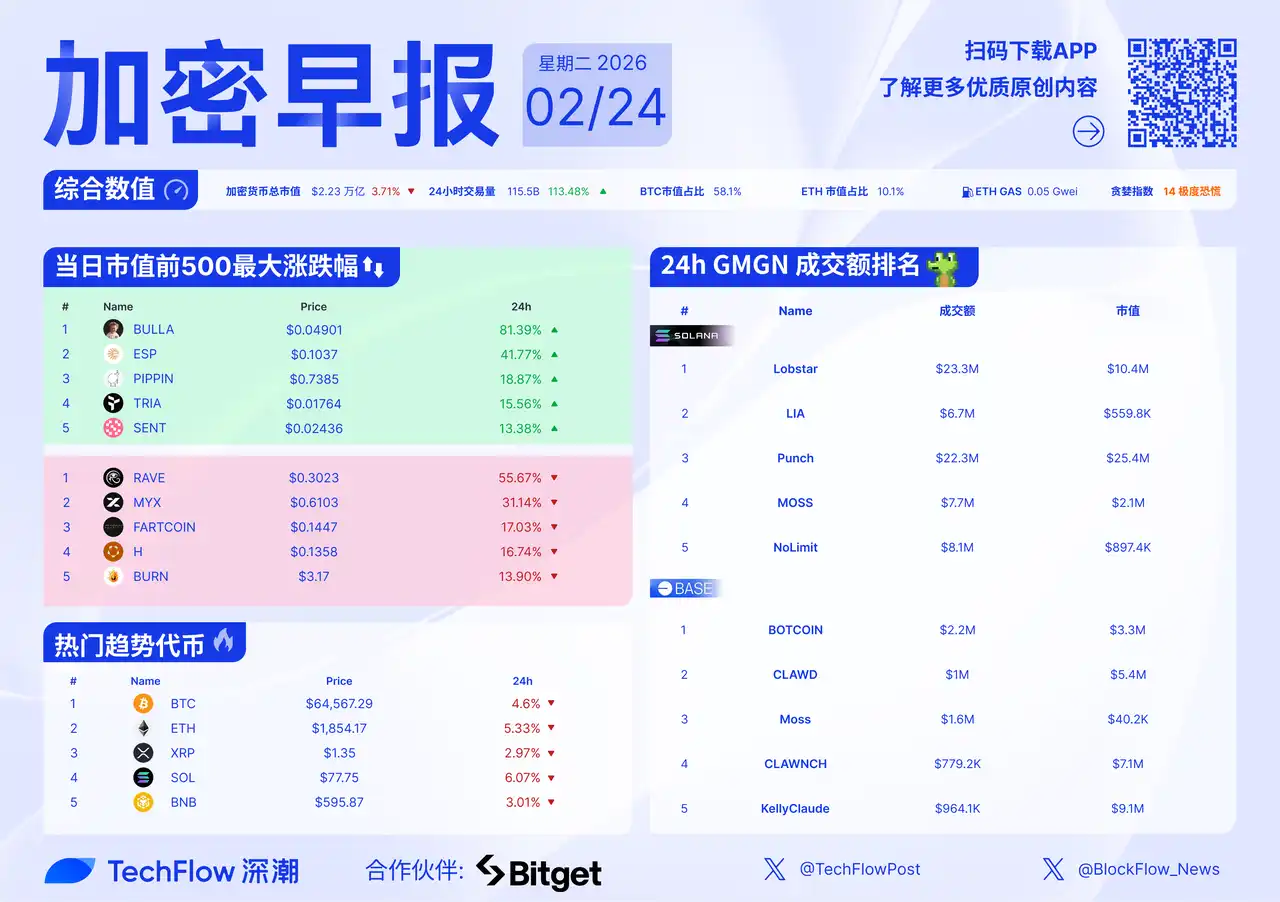
Recommended Reading

Google Senior AI Product Manager: 6 Agents Take Over My Daily Tasks, Costing Less Than $400 per Month, Running 24/7

This article details how to build a team of autonomous AI Agents that work together through six different role-based Agents to complete tasks such as research, content creation, code review, and newsletter production. The author shares practical experience, including file structure, cost details, problem-solving, and step-by-step setup suggestions.

In-Depth Analysis: Unwinding of Yen Carry Trade Triggers Chain Reaction of Bitcoin Selling

This article analyzes the mechanism by which the unwinding of the yen carry trade affects Bitcoin price volatility through cross-asset deleveraging and liquidity conditions. Through yen exchange rate fluctuations and official statements, it reveals the potential impact of yen financing channels on the global risk situation and crypto markets, and provides a five-signal early warning framework to identify deleveraging windows.

80% of New Tokens Fall Below Issue Price, Institutional Capital Shifting from Tokens to Crypto Equity

This article explores the capital flow trends in the cryptocurrency market, pointing out that institutional investors are gradually shifting from tokens to crypto equity investments. Behind this trend are the dual drivers of institutional compliance requirements and realistic valuation systems. The article analyzes the price performance of new tokens after listing, noting that most tokens depreciate quickly after listing, while crypto-related IPO and M&A activities have grown significantly. The article also explains why investors prefer crypto equity and the difference between tokens and real businesses.

Wintermute CEO: The Crypto Industry Is Lost, Only Personal Sovereignty Is the Path Worth Taking

This article is a manifesto on the philosophy of the crypto industry written by Wintermute CEO Evgeny Gaevoy, analyzing the current state of the crypto industry and future path choices. Starting from the concept of the "Golden Path" in "Dune," he criticizes the current迷失 (lost state) of the crypto industry and emphasizes the importance of personal sovereignty and independence, while analyzing three possible future development paths and emphasizing the necessity of building systems that cannot be controlled.

First Rise in the Year of the Horse, AI Stocks Go Crazy

This article discusses in detail the performance of the AI large model field in the capital market, focusing on the soaring stock prices of two domestic AI large model companies in the Hong Kong stock market—Zhipu and MiniMax—and the wealth creation effect behind them. The article also mentions the financing situation of other AI large model enterprises and future competition trends in the capital market.

Cryptos en tendance

Questions liées

QWhat is Backpack's plan for its token stakers and how much equity has been reserved for this initiative?

ABackpack plans to allow its upcoming token holders to stake their tokens for at least one year to receive company equity at a fixed ratio. The company has reserved 20% of its equity for this program.

QAccording to WLFI, what was the nature of the attack on USD1 and what was the outcome?

AWLFI stated that attackers hacked the accounts of several WLFI co-founders, hired KOLs to spread FUD (Fear, Uncertainty, and Doubt), and took large short positions on WLFI in an attempt to profit from the artificially created chaos. The attack was unsuccessful, and the price of USD1 remained stable at its face value due to its robust minting and redemption mechanism and full 1:1 asset backing.

QWhat major decision did Tether announce regarding its CNH₮ stablecoin and what was the reason behind it?

ATether announced it will gradually cease its CNH₮ (offshore Chinese yuan) stablecoin service. It has stopped issuing new CNH₮ tokens and will completely terminate redemption support after one year. This decision was based on changing market conditions, low product interest, and limited community demand relative to other assets.

QWhat new team has the Ethereum Foundation established and what are its core principles for DeFi?

AThe Ethereum Foundation has established a dedicated DeFi team under its Ecosystem Support Program. The team's core principles for DeFi are that it should be permissionless, censorship-resistant, privacy-first, self-custodial, and open-source. They refer to this belief as 'DeFipunk'—finance that is not just slightly better than traditional finance, but finance that would not be possible without Ethereum.

QWhat significant move did the Japanese financial giant SBI Holdings make involving XRP?

ASBI Holdings issued a 10 billion yen (approximately $64.5 million) on-chain bond called 'SBI START Bonds' on the 'ibet for Fin' blockchain platform. Qualified retail investors who hold an SBI VC Trade account and invest over 100,000 yen will receive XRP rewards equivalent to 200 yen for every 100,000 yen invested, both at issuance and on subsequent interest payment dates until 2029.

Lectures associées

Tendances du marché américain (22 juin) : Le protocole d’Hormuz vacille, le PCE de jeudi et Micron détermineront l’orientation des semi-conducteurs

**Résumé : Perspectives des marchés américains (22 juin) – Tensions sur l’accord du détroit d’Ormuz, la PCE de jeudi et les résultats de Micron orienteront la tendance des semi-conducteurs** Les négociations américano-iraniennes, fragilisées par la fermeture du détroit d’Ormuz samedi et la suspension des pourparlers dimanche après le départ de la délégation iranienne, représentent un risque géopolitique majeur pour les marchés en début de semaine, influençant directement les cours du pétrole et des valeurs énergétiques. Sur les marchés, les semi-conducteurs ont été le moteur la semaine dernière, avec l'indice Philadelphia Semiconductor atteignant un record. L'attention se porte désormais sur jeudi 25 juin, jour charnière avec la publication de l'indice PCE de mai et des résultats de Micron Technology. Le PCE, attendu en hausse, pourrait renforcer les anticipations de resserrement monétaire de la Fed. Les résultats et les prévisions de Micron, notamment sur la visibilité de l'offre HBM jusqu'en 2027 et les progrès du HBM4, serviront de test crucial pour la narrative IA, d'autant plus que l'assemblée générale de Nvidia et le possible lancement de GPT-5.6 d'OpenAI auront lieu à la même période. En somme, la semaine sera déterminée par deux axes : l'évolution géopolitique dans le golfe Persique et la solidité des fondamentaux de l'IA, incarnée par Micron et Nvidia. La volatilité pourrait offrir des opportunités si les données de jeudi répondent aux attentes du marché.

marsbitIl y a 31 mins

Tendances du marché américain (22 juin) : Le protocole d’Hormuz vacille, le PCE de jeudi et Micron détermineront l’orientation des semi-conducteurs

marsbitIl y a 31 mins

Point de vue : Le triangle impossible est un faux problème

L'industrie de la cryptographie a construit les systèmes cryptographiques les plus puissants de l'histoire, mais échoue à protéger la vie privée financière des utilisateurs. Par défaut, chaque transaction, chaque détention est publique, ce qui constitue un frein majeur à l'adoption par les capitaux institutionnels. La blockchain est essentiellement un ordinateur partagé, lent et coûteux, dont la seule valeur est de fonctionner sans autorisation ni administrateur central. Pendant une décennie, le secteur s'est focalisé sur le "trilemme" (décentralisation, extensibilité, sécurité), un problème désormais largement résolu. Le véritable obstacle est ailleurs. La finance est l'application idéale car l'enregistrement sur le registre *est* l'actif lui-même. Cependant, son adoption est limitée à une niche ("les assez aisés"). Les grandes institutions et les individus lambdas restent en retrait à cause de deux défauts structurels : 1) L'incertitude légale (en voie de résolution via une régulation comme le GENIUS Act) et 2) Le manque de confidentialité. La transparence de la chaîne n'est pas une vertu, mais une taxe. Elle expose les utilisateurs au MEV (environ 1,8 milliard de dollars extraits sur Ethereum) et rend impossible la gestion discrète de trésorerie pour les institutions. Ironiquement, ce système bâti sur la cryptographie ne crypte pas l'activité financière de base. La solution n'est pas une opacité totale, mais une confidentialité sélective avec preuves cryptographiques. Il est possible de prouver sa solvabilité, sa conformité KYC ou le respect de limites de risque sans révéler les données sous-jacentes. Cela réconcilie vie privée et conformité. Une blockchain avec confidentialité par défaut et divulgation prouvable est une pure amélioration. Elle supprime la "fuite" tout en conservant les garanties de consensus. C'est le pont qui permettra à l'économie numérique de plusieurs billions de dollars de migrer vers le système pour lequel elle a été conçue. Le plus puissant système cryptographique apprend enfin à garder un secret.

marsbitIl y a 34 mins

Point de vue : Le triangle impossible est un faux problème

marsbitIl y a 34 mins

OpenAI « le plus ouvert » jamais, Codex ne privilégie plus uniquement GPT

OpenAI réalise son « ouverture la plus significative » en permettant à Codex, son assistant de programmation intelligent, de ne plus être exclusivement lié à ses propres modèles GPT. Désormais, les développeurs peuvent configurer Codex pour qu'il fonctionne avec des modèles open source locaux, comme ceux fournis par Ollama ou LM Studio, en utilisant un mode spécifique (--oss) ou en configurant manuellement des « fournisseurs de modèles ». Cette évolution, saluée par la communauté, offre une plus grande flexibilité : réduction des coûts (évitant la facturation au token des modèles OpenAI), respect de la vie privée (traitement local des données) et liberté de choisir le modèle le plus adapté à chaque tâche. Cependant, l'intégration nécessite que les modèles externes soient compatibles avec le protocole d'interface « Responses API » d'OpenAI, ou qu'une couche de conversion (comme un routeur local) soit mise en place pour les modèles utilisant d'autres standards, comme l'API « Chat Completions ». En ouvrant cette « couche d'accès aux modèles », OpenAI semble vouloir transformer Codex en une plateforme ou un écosystème central pour le développement assisté par IA, où la valeur réside moins dans le modèle spécifique que dans l'outil et son interface standardisée. Cette stratégie pourrait repositionner la concurrence autour des normes d'interface plutôt que des performances brutes des modèles, tout en offrant aux développeurs des avantages pratiques immédiats en termes de contrôle et d'économie.

marsbitIl y a 1 h

OpenAI « le plus ouvert » jamais, Codex ne privilégie plus uniquement GPT

marsbitIl y a 1 h

Quand 500 millions de personnes abandonnent ChatGPT

Il y a trois ans et demi, ChatGPT a révolutionné le monde en devenant l'application à la croissance la plus rapide de l'histoire, atteignant rapidement un milliard d'utilisateurs mensuels. Cependant, un tournant symbolique a été atteint : pour la première fois, sa part de marché mondiale est tombée sous les 50%, à 46,4% en mai 2026 selon Sensor Tower. Le marché des assistants IA, autrefois dominé par un seul acteur, entre désormais dans une phase de comparaison, de fidélisation et de monétisation. Les principaux concurrents, Gemini (27,7%) et Claude (10,3%), grignotent des parts grâce à leurs atouts distincts : l'intégration à l'écosystème Google pour le premier, et une forte spécialisation dans les tâches de productivité (rédaction, code, texte long) pour le second. Les utilisateurs, de moins en moins loyaux, migrent facilement vers l'outil le plus performant pour un besoin spécifique. La phase de « déjeuner gratuit » s'achève. Si les téléchargements d'applications IA continuent (environ 2,3 milliards au premier semestre 2026), la croissance ralentit. La monétisation devient cruciale. Les dépenses des utilisateurs dans ces apps devraient dépasser 4,2 milliards de dollars sur la même période. Claude se distingue avec un taux d'abonnement payant de 13% parmi ses utilisateurs. ChatGPT, de son côté, explore activement la publicité, désormais visible par 17% de ses utilisateurs quotidiens, afin de compléter les revenus des abonnements et de couvrir les coûts exorbitants de l'infrastructure IA. Ce changement de paysage reflète la normalisation de l'IA. L'émerveillement initial fait place à des exigences pratiques : fiabilité, intégration, prix et spécialisation. L'enjeu pour les entreprises comme OpenAI, dont la consommation de trésorerie explose (37 milliards de dollars au T1 2026), est de construire un modèle économique durable dans une concurrence féroce. ChatGPT a perdu son statut quasi monopolistique, mais c'est le signe que l'IA assistantielle, désormais partagée entre plusieurs acteurs majeurs et une myriade de solutions verticales, est bel et bien entrée dans le quotidien.

marsbitIl y a 1 h

Quand 500 millions de personnes abandonnent ChatGPT

marsbitIl y a 1 h

Trading

Spot
Futures

Articles tendance

Comment acheter WLFI

Bienvenue sur HTX.com ! Nous vous permettons d'acheter Official World Liberty Financial (WLFI) de manière simple et pratique. Suivez notre guide étape par étape pour commencer votre parcours crypto.Étape 1 : Création de votre compte HTXUtilisez votre adresse e-mail ou votre numéro de téléphone pour ouvrir un compte sur HTX gratuitement. L'inscription se fait en toute simplicité et débloque toutes les fonctionnalités.Créer mon compteÉtape 2 : Choix du mode de paiement (rubrique Acheter des cryptosCarte de crédit/débit : utilisez votre carte Visa ou Mastercard pour acheter instantanément Official World Liberty Financial (WLFI).Solde :utilisez les fonds du solde de votre compte HTX pour trader en toute simplicité.Prestataire tiers :pour accroître la commodité d'utilisation, nous avons ajouté des modes de paiement populaires tels que Google Pay et Apple Pay.P2P :tradez directement avec d'autres utilisateurs sur HTX.OTC (de gré à gré) : nous offrons des services personnalisés et des taux de change compétitifs aux traders.Étape 3 : stockage de vos Official World Liberty Financial (WLFI)Après avoir acheté vos Official World Liberty Financial (WLFI), stockez-les sur votre compte HTX. Vous pouvez également les envoyer ailleurs via un transfert sur la blockchain ou les utiliser pour trader d'autres cryptos.Étape 4 : tradez des Official World Liberty Financial (WLFI)Tradez facilement Official World Liberty Financial (WLFI) sur le marché Spot de HTX. Il vous suffit d'accéder à votre compte, de sélectionner la paire de trading, d'exécuter vos trades et de les suivre en temps réel. Nous offrons une expérience conviviale aux débutants comme aux traders chevronnés.

702 vues totalesPublié le 2025.09.01Mis à jour le 2026.06.02

Comment acheter WLFI

Discussions

Bienvenue dans la Communauté HTX. Ici, vous pouvez vous tenir informé(e) des derniers développements de la plateforme et accéder à des analyses de marché professionnelles. Les opinions des utilisateurs sur le prix de WLFI (WLFI) sont présentées ci-dessous.

活动图片