Forbes Editorial: The Most Accurate Short Signal in the Crypto World?

marsbitPublié le 2026-02-06Dernière mise à jour le 2026-02-06

Résumé

Forbes magazine covers have become an infamous bearish signal in the crypto world, often marking the peak of market cycles just before major crashes. The article highlights three key examples: 1. **CZ (2018)**: Featured on the cover during Bitcoin's downturn from its late-2017 high. Bitcoin fell 58% after the issue. 2. **SBF (2021)**: Called "crypto's most powerful man" before FTX collapsed 13 months later, wiping out billions. 3. **Michael Saylor (2025)**: Dubbed "The Bitcoin Alchemist" near Bitcoin's $104K peak. A year later, Bitcoin dropped 40%, and his company faced $6.5B in unrealized losses. The "magazine cover indicator" suggests mainstream media attention often coincides with market euphoria and impending reversals. While Sun Yuchen’s March 2025 cover briefly defied the trend (as Bitcoin continued rising), multiple crypto covers in quick succession were themselves a signal of overheated sentiment. The conclusion: bull markets don’t end in panic—they end on magazine covers. When a trend becomes too popular and even non-traders are talking about it, it may be time to reconsider positions.

Author: Curry, Deep Tide TechFlow
Bitcoin recently hit $60,000, marking the largest single-day drop since the FTX collapse.

Michael Saylor's company, Strategy (formerly MicroStrategy), holds 713,000 bitcoins with an average cost of $76,052. As of last night, the unrealized loss reached $6.5 billion. The stock price has plummeted from a high of $457 last year to $110, wiping out more than three-quarters of its value.

However, a year ago, Saylor graced the cover of the renowned magazine Forbes. The headline read:

The Bitcoin Alchemist. At that time, Bitcoin was priced at $104,000, and Saylor's net worth was $9.4 billion.

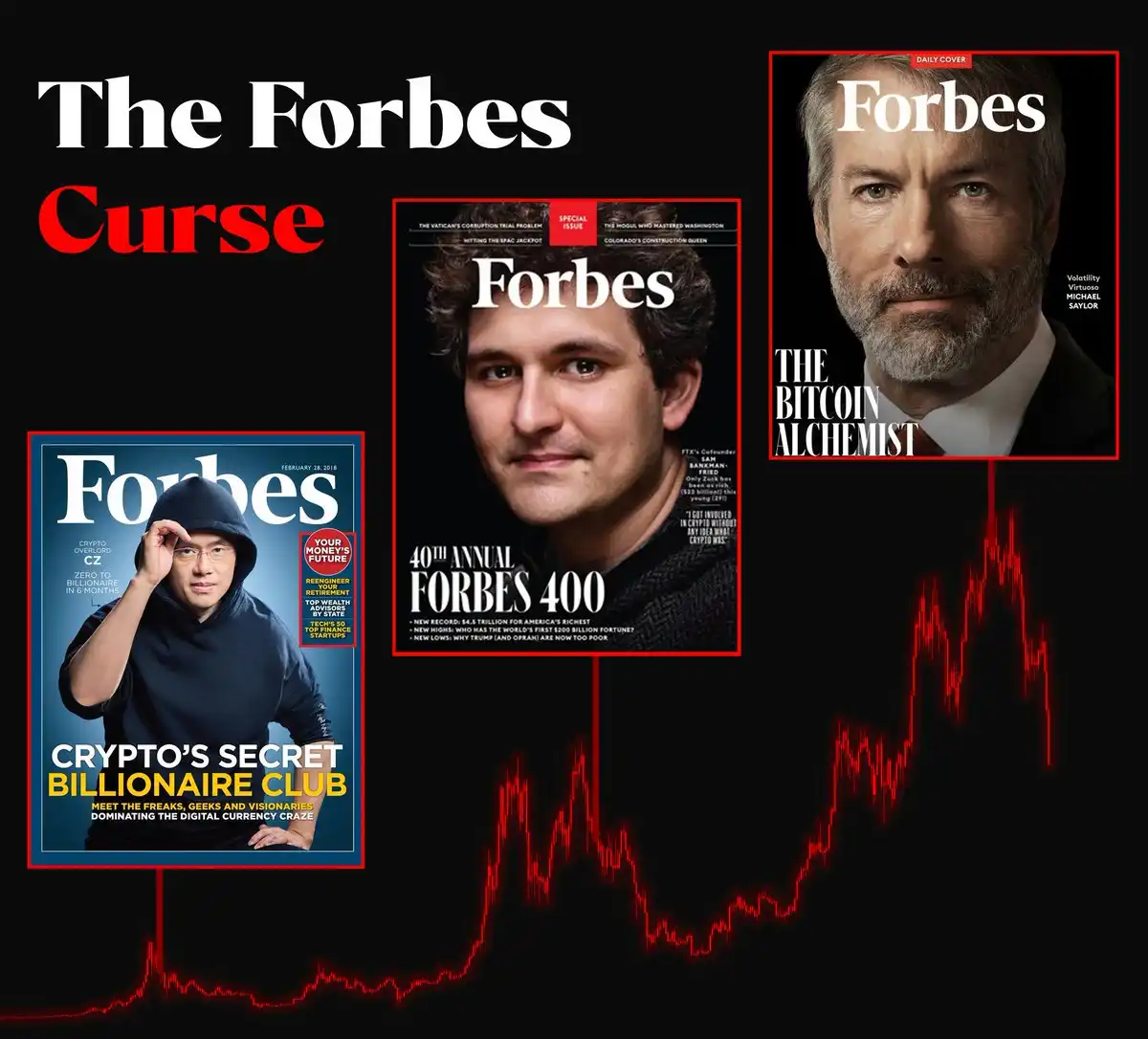
Now, a chart circulating on Twitter lines up three Forbes covers with Bitcoin's price chart. Each cover perfectly marks the starting point of a sharp decline.

Of these three individuals, one has been to prison, one is currently in prison, and the third just lost $6.5 billion.

The Cover: Captured at the Peak of Hype

The first crypto figure to appear on a Forbes cover was CZ.

In February 2018, Forbes featured a cover titled "Crypto's Secret Billionaire Club," with CZ standing in the center, hoodie on, exuding a rugged aura. The fine print read:

From zero to billionaire in just 6 months.

At that time, Bitcoin had just fallen from nearly $20,000 at the end of 2017 to around $7,600. Forbes estimated CZ's net worth to be at least $1.1 billion. Binance, only six months old, was already the world's largest exchange by trading volume.

After the cover was released, Bitcoin briefly rebounded to $10,000. Then, it went nowhere but down.

By December 2018, Bitcoin had fallen to $3,156. From the day the cover was published, the decline was:

58%.

CZ's later story is well-known. On Forbes' 2025 global billionaires list, CZ's net worth was $62.9 billion, ranking first in the crypto industry.

But he hasn't appeared on the cover since.

The second Forbes cover featured Sam Bankman-Fried.

In October 2021, Forbes released its 40th Forbes 400 Richest Americans list, with SBF as the cover star. Under 30 years old, with a net worth of $26.5 billion, he ranked as the 41st richest person in the U.S.

On the cover, he wore his signature gray T-shirt, with curly hair, looking like a college student who had just pulled an all-nighter playing League of Legends.

In hindsight, the magazine's tone was surreal. Forbes called him "the most powerful person in the crypto industry," praising him for building an exchange while donating to charity, a blend of Wall Street and Silicon Valley.

When the cover was released, Bitcoin was around $60,000, just a step away from its then-all-time high of $69,000.

Thirteen months later, FTX collapsed.

SBF had misappropriated over $8 billion in customer funds to cover losses at his other company, Alameda Research. In November 2022, users rushed to withdraw their assets, and FTX couldn't meet the demand. Within a week, the world's third-largest exchange went bankrupt. Bitcoin plummeted from $20,000 to $16,000.

Eventually, SBF was arrested in his luxury apartment in the Bahamas.

He was convicted on all seven charges and sentenced to 25 years in prison. Forbes later created a "30 Under 30 Hall of Shame," with SBF prominently featured.

From cover to handcuffs:

13 months.

The third was Michael Saylor.

On January 30, 2025, the Forbes cover featured "The Bitcoin Alchemist." Bitcoin had just broken through $100,000, and Saylor's net worth had surged from $1.9 billion the previous year to $9.4 billion, nearly a fivefold increase. His company, MicroStrategy, saw its stock price rise 700% in a year and was newly included in the Nasdaq 100 index.

The Forbes article recorded a detail:

On New Year's Eve, Saylor hosted a 500-person party at his estate in Miami. Dancers waved orange Bitcoin glow balls, and outside, a 154-foot yacht named Usher ferried institutional investors and crypto industry leaders to the event.

At the time, Saylor told Forbes:

"We've put a crypto reactor in the middle of the company, sucking in capital and spinning it. Volatility drives everything." This statement was, of course, sincere. Saylor's alchemy boils down to one thing: issuing debt to buy Bitcoin.

When the Forbes cover was released, Bitcoin was at $104,000. One year and six days later, it's at $63,000. A decline of:

40%.

Saylor said on an earnings call that Strategy had built a "digital fortress."

The last crypto mogul to call his company a "fortress" was SBF. That was in June 2022. Five months later, FTX went bankrupt.

The Cover: Both Praise and Curse

There's an old Wall Street concept called the "magazine cover indicator":

When a trend makes it to the cover of a mainstream magazine, that trend has often already peaked.

The reasoning is simple. Forbes editors aren't prophets; like all retail investors, they only notice a story when it's at its most hyped.

The moment a magazine deems "someone in some industry worthy of a cover" is precisely the moment when market frenzy has reached its peak.

The cover isn't the cause of the curse; it's a symptom of the bubble.

However, there was one brief exception to this rule.

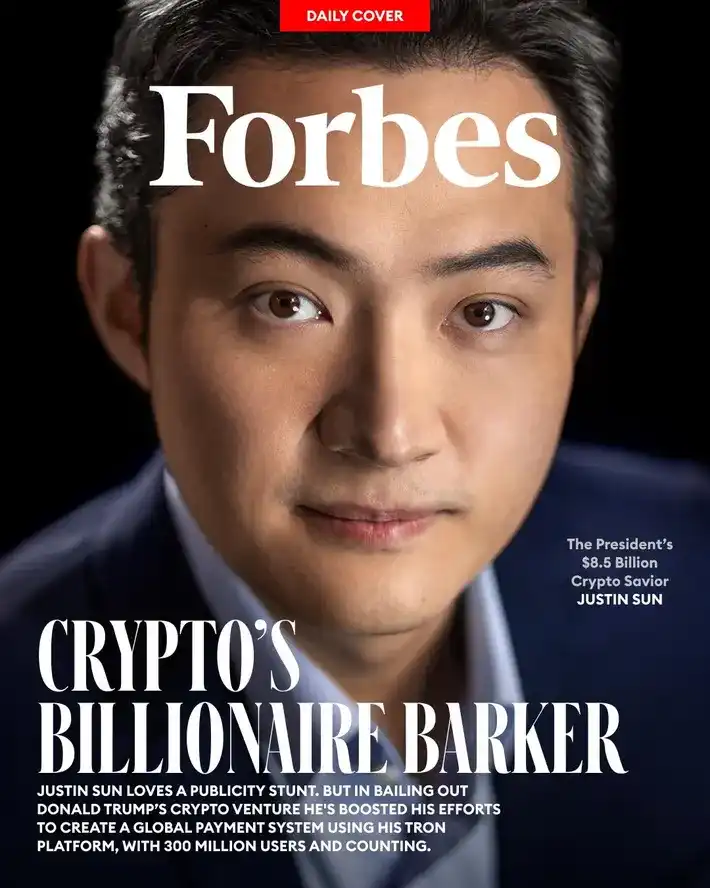
In March of last year, Justin Sun graced the Forbes cover with the headline "The Crypto Billionaire Who Helped the Trump Family Make $400 Million."

When the cover was released, Bitcoin was at $87,000. It didn't crash; instead, it rallied to a historic high of $126,000 in October.
Did the curse fail?

Not entirely. When Sun appeared on the cover, it was only two months after Saylor's. One cover in January, another in March—the密集 appearance of crypto figures on mainstream magazine covers was itself a signal. It indicated that the industry's narrative had become so hot that even Forbes editors felt one issue wasn't enough.

When covers start appearing in clusters, in hindsight, the peak of a bull market might have a checklist of symptoms:

Forbes covers, taxi drivers discussing crypto, relatives asking how to open an account... If two out of three signals appear, it's time to think about your position.

So, the real question isn't "Is the Forbes cover accurate?" but rather:

When everyone around you is telling the same story, when that story is so good that even people who don't trade crypto have heard of it, when mainstream media starts deifying figures in an industry...

Are you the one still buying, or the one already selling?

Bull markets don't end in panic. They end on magazine covers.

It's just that the cover stars may change, but the long bear market is always paid for by me.

Questions liées

QWhat is the 'magazine Cover Indicator' mentioned in the article, and how does it relate to the cryptocurrency market?

AThe 'Magazine Cover Indicator' is an old Wall Street concept suggesting that when a trend or person makes the cover of a mainstream magazine like Forbes, it often signals that the trend has peaked and is about to reverse. In the context of the cryptocurrency market, the article argues that Forbes covers featuring crypto billionaires like CZ, SBF, and Michael Saylor have each coincided with the start of a major price crash, as the cover is a symptom of peak market euphoria and mainstream attention.

QAccording to the article, what happened to Bitcoin's price after Michael Saylor appeared on the cover of Forbes?

AAccording to the article, when Michael Saylor appeared on the cover of Forbes on January 30, 2025, Bitcoin was priced at $104,000. One year and six days later, the price had fallen to $63,000, representing a decline of 40%.

QWho were the three crypto figures featured on Forbes covers, and what were their respective outcomes?

AThe three crypto figures featured on Forbes covers were: 1. CZ (Changpeng Zhao): Featured in February 2018. Bitcoin fell 58% after his cover. He later became the wealthiest person in crypto but faced legal issues. 2. Sam Bankman-Fried (SBF): Featured in October 2021. FTX collapsed 13 months later, and SBF was arrested and sentenced to 25 years in prison. 3. Michael Saylor: Featured in January 2025. His company, MicroStrategy, faced billions in unrealized losses on its Bitcoin holdings, and the price fell 40% after the cover.

QWhy does the article claim that a Forbes cover is a symptom of a market top and not the cause of a crash?

AThe article claims that a Forbes cover is a symptom, not a cause, because magazine editors are not prophets. They only feature a trend or person on the cover when the story is at its most popular and mainstream attention is at its peak. This moment of maximum hype and widespread recognition often coincides with the top of a market cycle, making the cover an indicator of excessive euphoria rather than a catalyst for the subsequent decline.

QWhat exception to the 'Forbes cover curse' does the article mention, and how does it explain this anomaly?

AThe article mentions that Justin Sun (Sun Yuchen) appeared on the cover of Forbes in March of an unspecified year (likely 2025), and instead of crashing, Bitcoin's price continued to rise to a new all-time high of $126,000 by October. The article explains this anomaly by stating that the curse wasn't entirely broken. The fact that crypto figures appeared on Forbes covers so frequently (Saylor in January, Sun in March) was itself a signal that the market narrative was overheated. The high frequency of covers was a symptom of the peak, even if the immediate crash for one specific cover was delayed.

Lectures associées

Début de Warsh : le président de la Fed le plus au fait du Crypto de l'histoire apportera-t-il des surprises ou des chocs au marché ?

**Résumé :** Kevin Warsh, nouveau président de la Réserve fédérale américaine, s'apprête à tenir sa première conférence de presse monétaire. Sa nomination est historique : il est le premier président de la Fed à détenir personnellement des actifs numériques (investissements indirects dans Solana, dYdX, etc.), montrant une compréhension unique du secteur. Son dilemme est majeur : il doit faire face à une résurgence de l'inflation, qui exige une politique monétaire stricte (position "de faucon"), tout en répondant aux pressions politiques pour des baisses de taux. Parallèlement, son attitude envers les crypto-actifs diffère fondamentalement de celle de son prédécesseur. Il ne les considère pas comme de simples actifs spéculatifs, mais plutôt comme un "bon policier" pour la politique économique et une composante de la compétitivité américaine. Son impact potentiel sur le marché crypto s'articule autour de trois axes : 1. Un changement de paradigme réglementaire, passant de la prévention à l'intégration et à l'innovation. 2. Une reprixation des actifs liée aux taux d'intérêt, où sa clarté de communication pourrait réduire la prime d'incertitude. 3. Une légitimation accrue pouvant attirer les capitaux institutionnels traditionnels. Deux scénarios principaux sont envisagés pour sa première intervention : * **Scénario "Surprise"** : Un ton modéré ("de colombe") sur les taux combiné à des signaux favorables à l'innovation numérique pourrait booster le marché. * **Scénario "Choc"** : Un message excessivement restrictif sur les taux pourrait entraîner une vente généralisée des actifs risqués, y compris les cryptos. Bien qu'il ait dû vendre ses actifs crypto pour des raisons d'éthique, la compréhension intrinsèque de Warsh pour la technologie blockchain pourrait, à long terme, poser les bases d'une intégration plus structurelle des actifs numériques dans le système financier.

marsbitIl y a 4 h

Début de Warsh : le président de la Fed le plus au fait du Crypto de l'histoire apportera-t-il des surprises ou des chocs au marché ?

marsbitIl y a 4 h

XRP Ledger Lance le Rebranding XRPld Avec la Mise à Niveau Version 3.2.0

La version 3.2.0 du XRP Ledger (XRPL) est désormais disponible, introduisant une refonte majeure incluant le changement de nom du logiciel principal de « rippled » à « xrpld ». Cette mise à niveau se concentre principalement sur les améliorations des performances, de la sécurité et de l'évolutivité de l'infrastructure sous-jacente, plutôt que sur de nouvelles fonctionnalités utilisateur. Les principales avancées incluent des optimisations de mémoire pouvant réduire jusqu'à 40% l'utilisation de la mémoire serveur. Sur le plan de la sécurité, la modification `fixCleanup3_2_0` renforce plusieurs modules, notamment les coffres-forts à actif unique, le protocole de prêt, les échanges décentralisés et les jetons multi-usages. De nouveaux contrôles d'invariance garantissent la cohérence du registre après la suppression de comptes. Pour les développeurs, la mise à jour permet désormais de récupérer des informations sur les définitions du protocole et du serveur XRPL sans nécessiter de connexion active, facilitant ainsi la création de portefeuilles, d'explorateurs de blockchain et d'APIs. En termes d'évolutivité et de stabilité, les améliorations comprennent des tailles de bloc configurables, un stockage de base de données optimisé via nuDB, et le support optionnel de TLS/mutual TLS pour le serveur gRPC. Le port de peering par défaut est également passé du 51235 au 2459. Divers correctifs ont été apportés aux fonctions liées aux Market Makers Automatisés, aux paiements, aux séquestres de jetons et aux carnets d'ordres. Une note importante : les invariants de transaction ont été temporairement désactivés dans la v3.2.0 en raison d'un impact sur les performances, mais cela ne présente pas de risque pour la sécurité.

TheNewsCryptoIl y a 4 h

XRP Ledger Lance le Rebranding XRPld Avec la Mise à Niveau Version 3.2.0

TheNewsCryptoIl y a 4 h

L'AGI n'est pas l'arrivée, nouveau document de DeepMind : Vers l'ASI, le véritable progrès de l'IA ne fait que commencer

Si l'intelligence artificielle générale (IAG) était atteinte demain, quelle serait la prochaine étape ? Une étude de Google DeepMind suggère que l'IAG n'est pas un point final, mais une étape vers une superintelligence artificielle (ISA) dépassant les collectifs d'experts humains. L'étude distingue trois concepts : l'IAG (niveau médian humain), l'ISA (supérieure aux meilleurs collectifs humains dans presque tous les domaines) et l'IA universelle (limite théorique). Elle propose quatre voies potentielles vers l'ISA : 1. **Extension des ressources** : augmentation de la puissance de calcul, des données et des modèles. 2. **Évolution algorithmique** : améliorations incrémentales ou nouveaux paradigmes (apprentissage continu, utilisation d'outils, modèles du monde). 3. **Auto-amélioration récursive** : des IA plus performantes conçoivent la génération suivante, créant une boucle de rétroaction positive. 4. **Coordination multi-agents** : des systèmes IAG collaborant atteignent une intelligence collective supérieure. L'étude identifie six principaux goulets d'étranglement : 1. **Le mur des données** : les données humaines de haute qualité pourraient s'épuiser. 2. **Pressions économiques et ressources naturelles** : coûts énergétiques et matériels. 3. **Limites des paradigmes neuronaux actuels** : problèmes d'apprentissage continu, de raisonnement robuste, d'hallucinations. 4. **Difficulté croissante de la recherche**. 5. **Barrières à l'abstraction** : difficulté à former de nouveaux concepts fondamentaux. 6. **Régulation, gouvernance et réaction sociale**. Un défi crucial est l'évaluation des capacités de l'IA au-delà du niveau humain, nécessitant de nouveaux benchmarks. L'étude conclut que la progression vers l'ISA reste incertaine, soumise à des contraintes physiques et de ressources, et appelle à un effort de recherche interdisciplinaire pour mieux anticiper cette évolution.

marsbitIl y a 5 h

L'AGI n'est pas l'arrivée, nouveau document de DeepMind : Vers l'ASI, le véritable progrès de l'IA ne fait que commencer

marsbitIl y a 5 h

Trading

Spot
Futures

Articles tendance

Comment acheter LA

Bienvenue sur HTX.com ! Nous vous permettons d'acheter Lagrange (LA) de manière simple et pratique. Suivez notre guide étape par étape pour commencer votre parcours crypto.Étape 1 : Création de votre compte HTXUtilisez votre adresse e-mail ou votre numéro de téléphone pour ouvrir un compte sur HTX gratuitement. L'inscription se fait en toute simplicité et débloque toutes les fonctionnalités.Créer mon compteÉtape 2 : Choix du mode de paiement (rubrique Acheter des cryptosCarte de crédit/débit : utilisez votre carte Visa ou Mastercard pour acheter instantanément Lagrange (LA).Solde :utilisez les fonds du solde de votre compte HTX pour trader en toute simplicité.Prestataire tiers :pour accroître la commodité d'utilisation, nous avons ajouté des modes de paiement populaires tels que Google Pay et Apple Pay.P2P :tradez directement avec d'autres utilisateurs sur HTX.OTC (de gré à gré) : nous offrons des services personnalisés et des taux de change compétitifs aux traders.Étape 3 : stockage de vos Lagrange (LA)Après avoir acheté vos Lagrange (LA), stockez-les sur votre compte HTX. Vous pouvez également les envoyer ailleurs via un transfert sur la blockchain ou les utiliser pour trader d'autres cryptos.Étape 4 : tradez des Lagrange (LA)Tradez facilement Lagrange (LA) sur le marché Spot de HTX. Il vous suffit d'accéder à votre compte, de sélectionner la paire de trading, d'exécuter vos trades et de les suivre en temps réel. Nous offrons une expérience conviviale aux débutants comme aux traders chevronnés.

356 vues totalesPublié le 2025.06.04Mis à jour le 2026.06.02

Comment acheter LA

Discussions

Bienvenue dans la Communauté HTX. Ici, vous pouvez vous tenir informé(e) des derniers développements de la plateforme et accéder à des analyses de marché professionnelles. Les opinions des utilisateurs sur le prix de LA (LA) sont présentées ci-dessous.

活动图片