Crypto Market Infrastructure Is Unprecedentedly Perfect, So Why Has the Investment Environment Hit Rock Bottom?

比推Publié le 2026-01-28Dernière mise à jour le 2026-01-28

Résumé

The crypto market infrastructure and regulatory environment are more robust than ever, yet the investment climate is arguably at its worst. Arca CIO Jeff Dorman critiques the industry's failed attempt to position cryptocurrencies as broad macro trading tools, which has led to extreme correlation among all crypto assets, eroding differentiation. While assets like gold and silver have recently outperformed Bitcoin, the industry continues to neglect token subtypes that function like equities—such as DePIN, DeFi, and CeFi tokens—which generate actual cash flows and could appeal to traditional investors managing over $600 trillion in assets. Dorman calls for a return to fundamental analysis, emphasizing that tokens are merely a "wrapper" and that their underlying value drivers, sectors, and economic models should be the focus, rather than treating all cryptocurrencies as a single asset class. The current high correlation and lack of dispersion in returns have made the investment landscape dull compared to the healthier, more nuanced market of 2020-2021.

Author: Jeff Dorman (Arca CIO)

Compiled by: Deep Tide TechFlow

Original title: The Crypto Market Five Years Ago Was Actually Healthier Than Now


Deep Tide Introduction:

Is the crypto market becoming increasingly dull? Arca Chief Investment Officer Jeff Dorman writes that although infrastructure and regulatory environments have never been stronger, the current investment environment is the "worst in history."

He sharply criticizes industry leaders' failed attempts to forcibly transform cryptocurrencies into "macro trading tools," leading to extreme convergence in correlations among various assets. Dorman calls for a return to the essence of "tokens as securities packaging," focusing on equity-like assets such as DePIN and DeFi that have cash flow generation capabilities.

At a time when gold is surging while Bitcoin is relatively weak, this in-depth reflective article provides an important perspective for re-examining Web3 investment logic.

Full text below:

Bitcoin is facing an unfortunate situation

Most investment debates exist because people are on different time horizons, so they often "talk past each other," even though technically both sides are correct. Take the debate between gold and Bitcoin as an example: Bitcoin enthusiasts tend to say that Bitcoin is the best investment because its performance over the past 10 years has far exceeded that of gold.
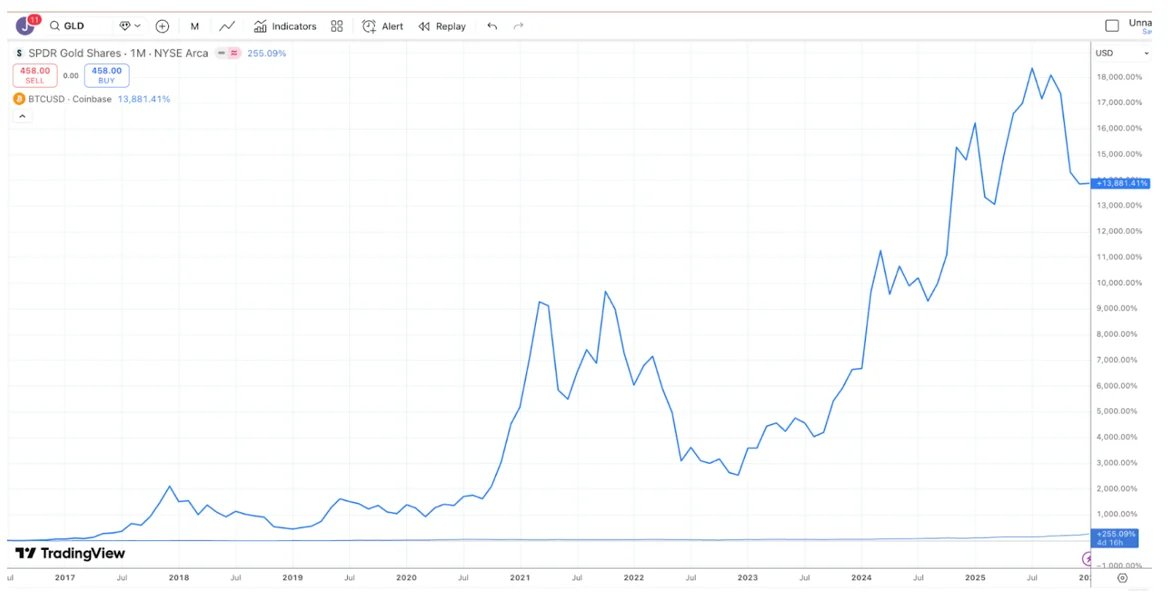
Caption: Source TradingView, comparison of Bitcoin (BTC) vs. gold (GLD) returns over the past 10 years

Gold investors, on the other hand, tend to believe that gold is the best investment and have recently been "mocking" Bitcoin's weakness, as gold has significantly outperformed Bitcoin over the past year (the same goes for silver and copper).
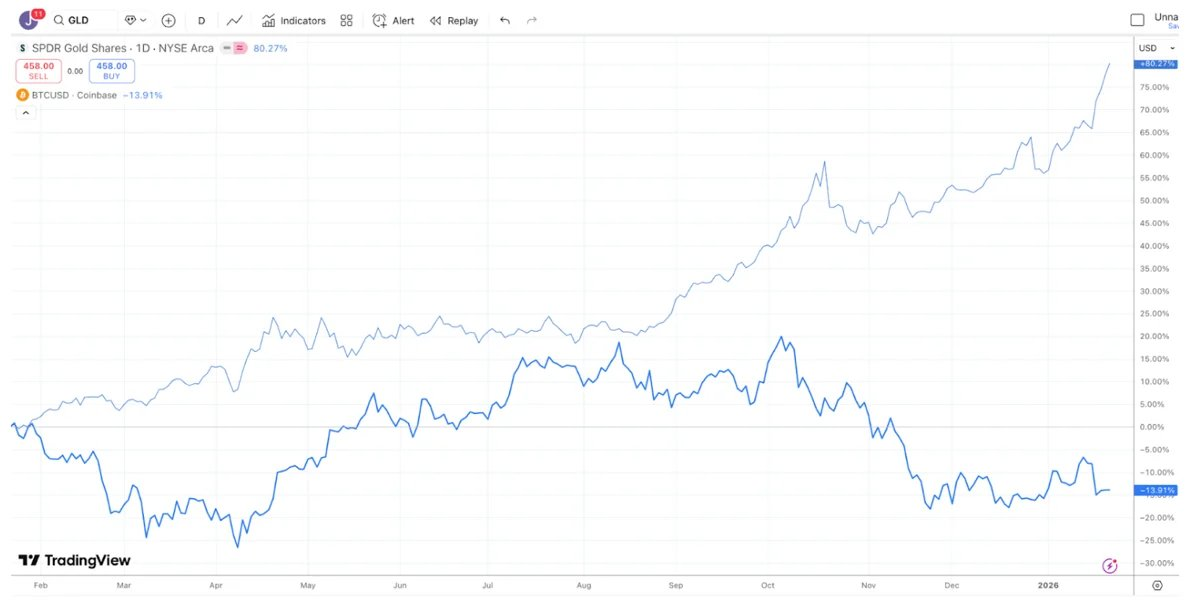
Caption: Source TradingView, comparison of Bitcoin (BTC) vs. gold (GLD) returns over the past 1 year

Meanwhile, over the past 5 years, the returns of gold and Bitcoin have been almost identical. Gold tends to do nothing for long periods, then skyrocket when central banks and trend followers buy; Bitcoin tends to have sharp rallies followed by significant crashes but ultimately moves higher.
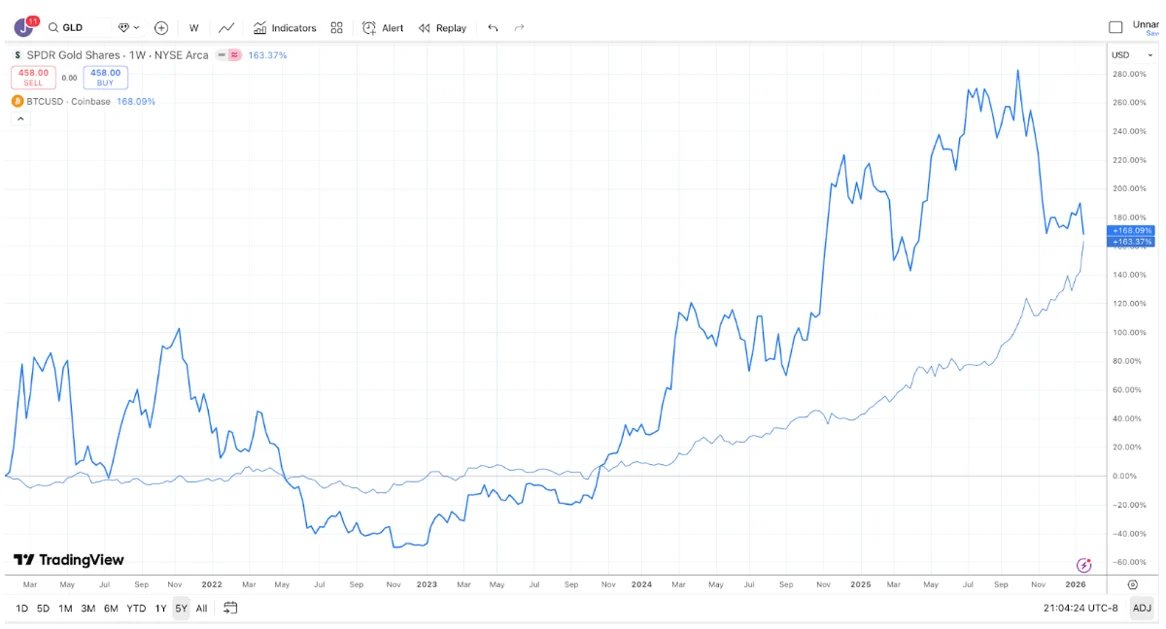
Caption: Source TradingView, comparison of Bitcoin (BTC) vs. gold (GLD) returns over the past 5 years

Therefore, depending on your investment horizon, you can almost win or lose any argument about Bitcoin vs. gold.

Even so, it's undeniable that recently gold (and silver) have shown strength relative to Bitcoin. To some extent, this is somewhat ironic (or pathetic). The largest companies in the crypto industry have spent the past 10 years trying to cater to macro investors rather than true fundamental investors, and now these macro investors are saying, "Never mind, we'll just buy gold, silver, and copper instead." We have long called for a shift in the industry's thinking. There are over $600 trillion in entrusted assets, and the buyers of these assets are a much stickier investor base. There are many digital assets that look more like bonds and stocks, issued by companies that generate revenue and conduct token buybacks, yet market leaders have, for some reason, decided to ignore this token sub-sector.

Perhaps Bitcoin's recent poor performance relative to precious metals will be enough for large brokers, exchanges, asset managers, and other crypto leaders to realize that their attempt to turn cryptocurrencies into an all-encompassing macro trading tool has failed. Instead, they might start focusing on and educating that $600 trillion pool of investors who prefer to buy cash-flow generating assets. It's not too late for the industry to start paying attention to those quasi-equity tokens that carry cash-flow generating tech businesses (like various DePIN, CeFi, DeFi, and token issuance platform companies).

Then again, if you just keep moving the "finish line," Bitcoin is still king. So, more likely than not, nothing will change.

Asset Differentiation

The "good old days" of crypto investing seem like a thing of the past. Back in 2020 and 2021, it seemed like every month brought a new narrative, sector, use case, and new type of token, with positive returns coming from all corners of the market. Although the growth engines of blockchain have never been stronger (thanks to legislative progress in Washington, stablecoin growth, DeFi, and RWA tokenization), the investment environment has never been worse.

A sign of market health is dispersion and low cross-market correlation. You want healthcare and defense stocks to move differently from tech and AI stocks; you want emerging market stocks to move independently of developed markets. Dispersion is generally seen as a good thing.

2020 and 2021 are largely remembered as "everything goes up" markets, but that wasn't entirely true. It was rare to see the entire market move in lockstep. More commonly, one sector would rise while another fell. Gaming surged while DeFi might have been falling; DeFi surged while "Dino" L1 tokens fell; Layer-1s surged while the Web3 sector fell. A diversified crypto portfolio actually smoothed returns and often lowered the overall portfolio's beta and correlation. Liquidity came and went as interest and demand shifted, but performance was diverse. This was very exciting. The massive inflow into crypto hedge funds in 2020 and 2021 made sense because the investable universe was expanding and returns were differentiated.

Fast forward to today, and the returns of all "crypto-wrapped" assets look identical. Since the flash crash on October 10th, the declines across sectors are almost indistinguishable. No matter what you hold, or how the token captures economic value, or what the project's trajectory is... the returns are largely the same. This is very frustrating.
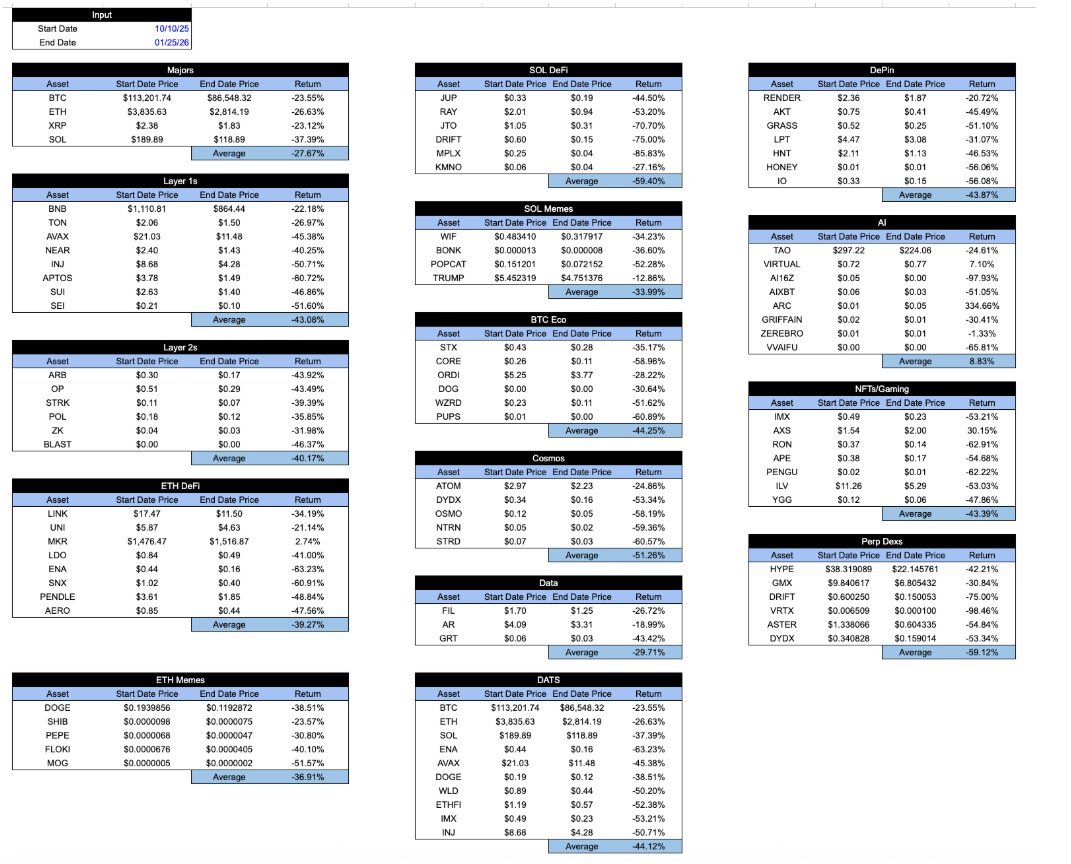
Caption: Arca internal calculations and CoinGecko API data for a sample of representative crypto assets

During market booms, this table looks slightly more encouraging. "Good" tokens tend to outperform "bad" tokens. But a healthy system should actually be the opposite: you want good tokens to perform better during bad times, not just during good times. Here is the same table from the low on April 7th to the high on September 15th.
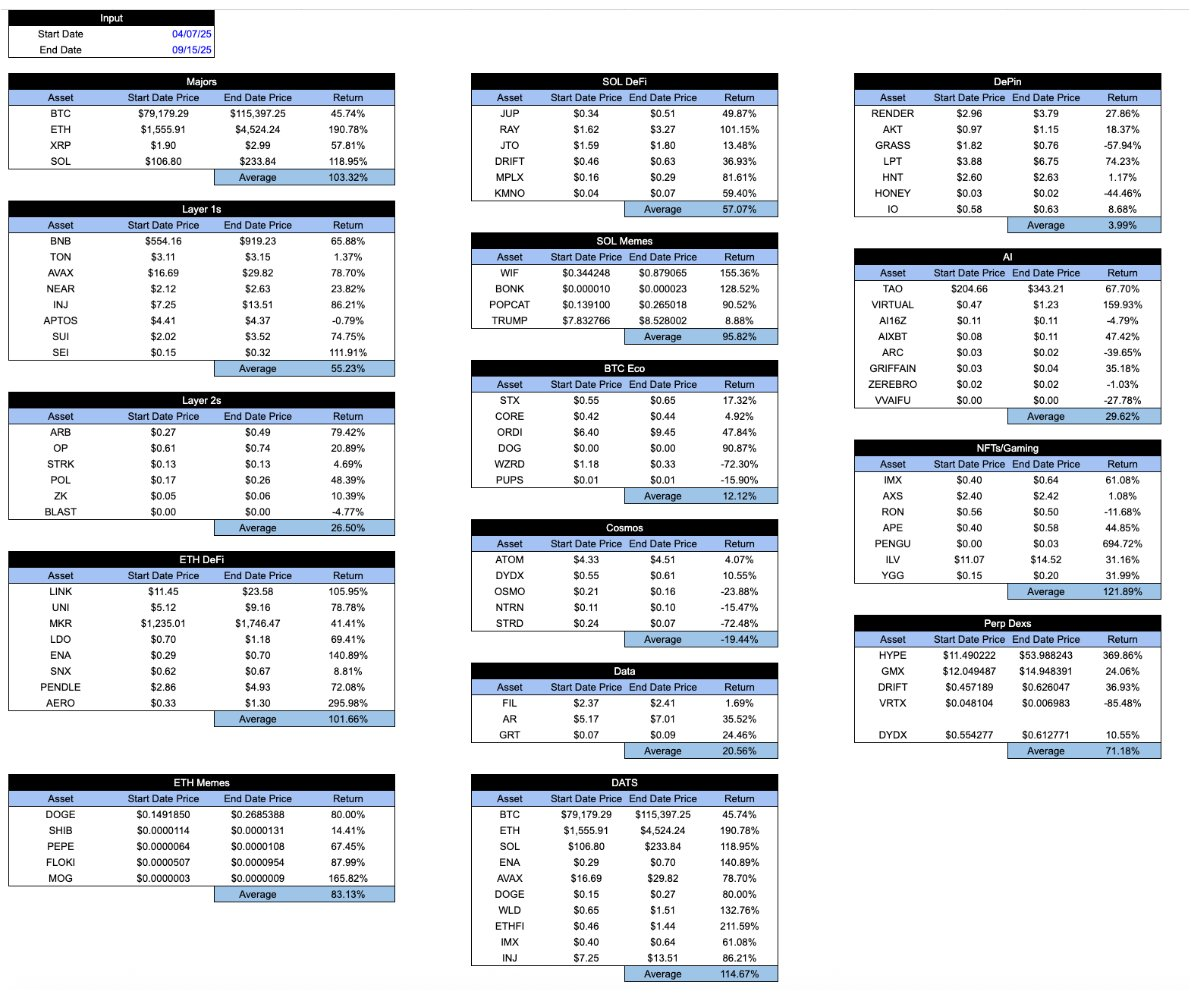
Caption: Arca internal calculations and CoinGecko API data for a sample of representative crypto assets

Interestingly, when the crypto industry was in its infancy, market participants worked very hard to differentiate between different types of crypto assets. For example, I published an article in 2018 where I categorized crypto assets into 4 types:

  1. Cryptocurrencies/money

  2. Decentralized protocols/platforms

  3. Asset-backed tokens

  4. Pass-through securities

At the time, this classification method was quite unique and attracted many investors. Importantly, crypto assets were evolving, from just Bitcoin, to smart contract protocols, asset-backed stablecoins, to equity-like pass-through securities. Researching different growth areas was a major source of alpha, and investors wanted to understand the various valuation techniques required to assess different asset types. Most crypto investors back then didn't even know when unemployment data was released or when FOMC meetings were held, and rarely looked to macro data for signals.

After the 2022 crash, these different types of assets still exist. Nothing has fundamentally changed. But there has been a huge change in how the industry markets itself. The "gatekeepers" decided that Bitcoin and stablecoins were the only things that mattered; the media decided they didn't want to write about anything except TRUMP tokens and other memecoins. Over the past few years, not only has Bitcoin outperformed most other crypto assets, but many investors have even forgotten these other asset types (and sectors) exist. The business models of the underlying companies and protocols haven't become less relevant, but the assets themselves have become more correlated due to investor flight and market makers dominating price action.

This is why Matt Levine's recent article about tokens was so surprising and well-received. In just 4 short paragraphs, Levine accurately described the differences and nuances between various tokens. It gives me some hope that this kind of analysis is still possible.
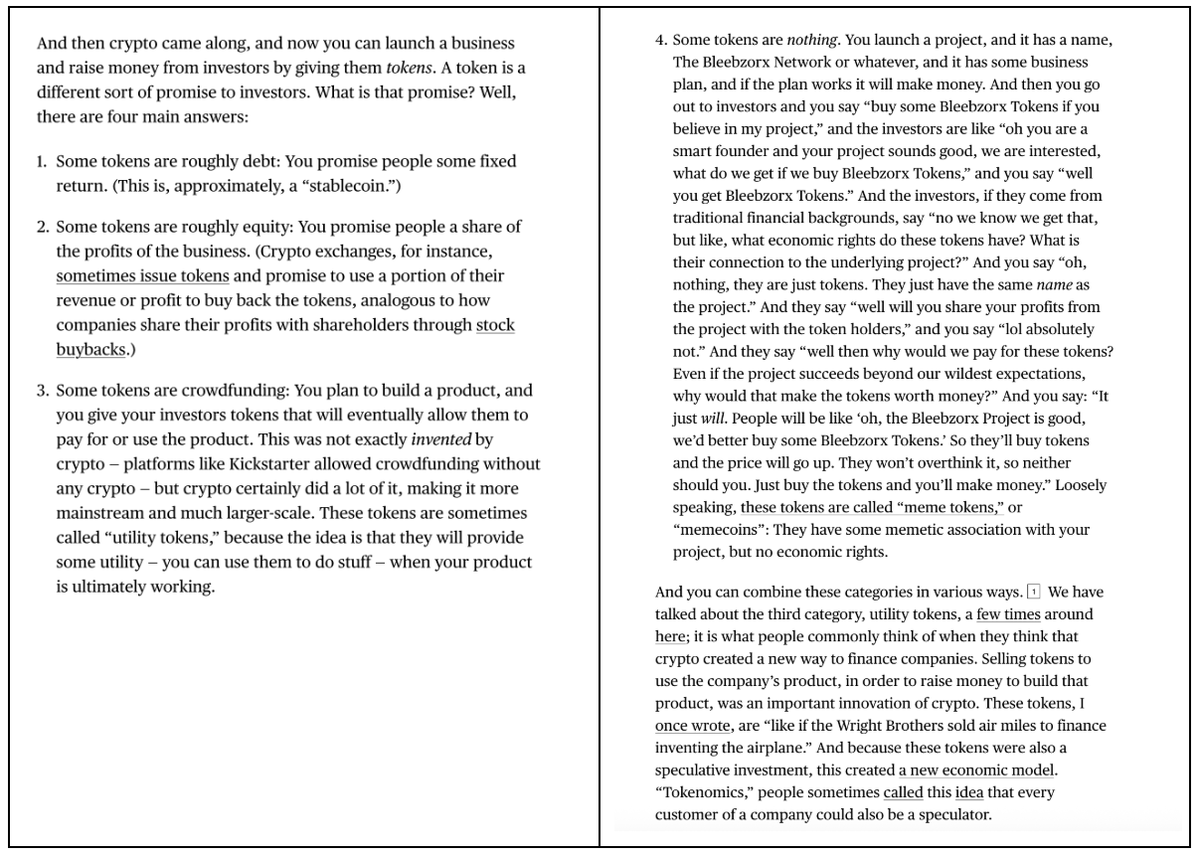
The leading crypto exchanges, asset managers, market makers, OTC desks, and pricing services still call everything besides Bitcoin an "altcoin" and seem to only write macro research, bundling all "cryptocurrencies" together as one giant asset. Take Coinbase, for example – they seem to have only a very small research team led by one primary analyst (David Duong) whose focus is primarily on macro research. I have nothing against Mr. Bitcoin (Mr. Duong) – his analysis is excellent. But who goes to Coinbase specifically for macro analysis?

Imagine if leading ETF providers and exchanges only wrote generically about ETFs, saying things like "ETFs are down today!" or "ETFs react negatively to inflation data." They would be laughed out of business. Not all ETFs are the same just because they use the same "wrapper," and those selling and promoting ETFs understand this. What's inside the ETF matters most, and investors seem to be able to intelligently differentiate between ETFs, mainly because industry leaders help their clients understand this.

Similarly, a token is just a "wrapper." As Matt Levine eloquently described, what's inside the token matters. The type of token matters, the sector matters, its properties (inflationary or amortizing) matter.

Perhaps Levine isn't the only one who understands this. But he does a better job explaining the industry than those who actually profit from it.


Twitter:https://twitter.com/BitpushNewsCN

Bitpush TG Discussion Group:https://t.me/BitPushCommunity

Bitpush TG Subscription: https://t.me/bitpush

Original link:https://www.bitpush.news/articles/7606655

Questions liées

QWhy does the author believe the current crypto investment environment is the 'worst ever' despite strong infrastructure and regulation?

AThe author believes the investment environment is poor because all crypto assets have become highly correlated and move in lockstep, eliminating dispersion and differentiation. Market leaders have focused excessively on marketing crypto as a macro tool rather than educating investors about fundamental differences between asset types, causing a loss of alpha opportunities and making diversified portfolios ineffective.

QWhat is the main criticism the author has against crypto industry's attempt to appeal to macro investors?

AThe main criticism is that the industry's attempt to position crypto as a broad macro trading tool has failed, as macro investors are instead choosing traditional assets like gold and silver. The author argues the industry should instead focus on educating the massive $600 trillion pool of investors who prefer cash-flow generating, quasi-equity tokens that resemble stocks and bonds.

QHow does the author contrast the market behavior of 2020-2021 with the current market?

AIn 2020-2021, the market had healthy dispersion where different sectors (e.g., Gaming, DeFi, Layer-1s) moved independently, allowing for diversified portfolios to smooth returns. Today, all crypto assets are highly correlated and move uniformly, regardless of their fundamentals or value capture mechanisms, making the market monotonous and frustrating for investors.

QWhat does the author suggest is the key to improving the investment landscape for crypto assets?

AThe author suggests returning to the essence of tokens as 'securities wrappers' and focusing on fundamental analysis of what is inside the token—such as cash-flow generating businesses in DePIN, DeFi, or token issuance platforms—rather than treating all crypto as a homogeneous macro asset. Industry leaders should educate investors on these nuances.

QWhy does the author reference Matt Levine's article on tokens?

AThe author references Matt Levine's article because it accurately describes the differences and nuances between various token types in just a few paragraphs, highlighting that what matters is the content inside the token wrapper. This gives hope that nuanced analysis is still possible and needed, contrasting with the industry's current homogenized approach.

Lectures associées

Début de Warsh : le président de la Fed le plus au fait du Crypto de l'histoire apportera-t-il des surprises ou des chocs au marché ?

**Résumé :** Kevin Warsh, nouveau président de la Réserve fédérale américaine, s'apprête à tenir sa première conférence de presse monétaire. Sa nomination est historique : il est le premier président de la Fed à détenir personnellement des actifs numériques (investissements indirects dans Solana, dYdX, etc.), montrant une compréhension unique du secteur. Son dilemme est majeur : il doit faire face à une résurgence de l'inflation, qui exige une politique monétaire stricte (position "de faucon"), tout en répondant aux pressions politiques pour des baisses de taux. Parallèlement, son attitude envers les crypto-actifs diffère fondamentalement de celle de son prédécesseur. Il ne les considère pas comme de simples actifs spéculatifs, mais plutôt comme un "bon policier" pour la politique économique et une composante de la compétitivité américaine. Son impact potentiel sur le marché crypto s'articule autour de trois axes : 1. Un changement de paradigme réglementaire, passant de la prévention à l'intégration et à l'innovation. 2. Une reprixation des actifs liée aux taux d'intérêt, où sa clarté de communication pourrait réduire la prime d'incertitude. 3. Une légitimation accrue pouvant attirer les capitaux institutionnels traditionnels. Deux scénarios principaux sont envisagés pour sa première intervention : * **Scénario "Surprise"** : Un ton modéré ("de colombe") sur les taux combiné à des signaux favorables à l'innovation numérique pourrait booster le marché. * **Scénario "Choc"** : Un message excessivement restrictif sur les taux pourrait entraîner une vente généralisée des actifs risqués, y compris les cryptos. Bien qu'il ait dû vendre ses actifs crypto pour des raisons d'éthique, la compréhension intrinsèque de Warsh pour la technologie blockchain pourrait, à long terme, poser les bases d'une intégration plus structurelle des actifs numériques dans le système financier.

marsbitIl y a 9 h

Début de Warsh : le président de la Fed le plus au fait du Crypto de l'histoire apportera-t-il des surprises ou des chocs au marché ?

marsbitIl y a 9 h

XRP Ledger Lance le Rebranding XRPld Avec la Mise à Niveau Version 3.2.0

La version 3.2.0 du XRP Ledger (XRPL) est désormais disponible, introduisant une refonte majeure incluant le changement de nom du logiciel principal de « rippled » à « xrpld ». Cette mise à niveau se concentre principalement sur les améliorations des performances, de la sécurité et de l'évolutivité de l'infrastructure sous-jacente, plutôt que sur de nouvelles fonctionnalités utilisateur. Les principales avancées incluent des optimisations de mémoire pouvant réduire jusqu'à 40% l'utilisation de la mémoire serveur. Sur le plan de la sécurité, la modification `fixCleanup3_2_0` renforce plusieurs modules, notamment les coffres-forts à actif unique, le protocole de prêt, les échanges décentralisés et les jetons multi-usages. De nouveaux contrôles d'invariance garantissent la cohérence du registre après la suppression de comptes. Pour les développeurs, la mise à jour permet désormais de récupérer des informations sur les définitions du protocole et du serveur XRPL sans nécessiter de connexion active, facilitant ainsi la création de portefeuilles, d'explorateurs de blockchain et d'APIs. En termes d'évolutivité et de stabilité, les améliorations comprennent des tailles de bloc configurables, un stockage de base de données optimisé via nuDB, et le support optionnel de TLS/mutual TLS pour le serveur gRPC. Le port de peering par défaut est également passé du 51235 au 2459. Divers correctifs ont été apportés aux fonctions liées aux Market Makers Automatisés, aux paiements, aux séquestres de jetons et aux carnets d'ordres. Une note importante : les invariants de transaction ont été temporairement désactivés dans la v3.2.0 en raison d'un impact sur les performances, mais cela ne présente pas de risque pour la sécurité.

TheNewsCryptoIl y a 9 h

XRP Ledger Lance le Rebranding XRPld Avec la Mise à Niveau Version 3.2.0

TheNewsCryptoIl y a 9 h

L'AGI n'est pas l'arrivée, nouveau document de DeepMind : Vers l'ASI, le véritable progrès de l'IA ne fait que commencer

Si l'intelligence artificielle générale (IAG) était atteinte demain, quelle serait la prochaine étape ? Une étude de Google DeepMind suggère que l'IAG n'est pas un point final, mais une étape vers une superintelligence artificielle (ISA) dépassant les collectifs d'experts humains. L'étude distingue trois concepts : l'IAG (niveau médian humain), l'ISA (supérieure aux meilleurs collectifs humains dans presque tous les domaines) et l'IA universelle (limite théorique). Elle propose quatre voies potentielles vers l'ISA : 1. **Extension des ressources** : augmentation de la puissance de calcul, des données et des modèles. 2. **Évolution algorithmique** : améliorations incrémentales ou nouveaux paradigmes (apprentissage continu, utilisation d'outils, modèles du monde). 3. **Auto-amélioration récursive** : des IA plus performantes conçoivent la génération suivante, créant une boucle de rétroaction positive. 4. **Coordination multi-agents** : des systèmes IAG collaborant atteignent une intelligence collective supérieure. L'étude identifie six principaux goulets d'étranglement : 1. **Le mur des données** : les données humaines de haute qualité pourraient s'épuiser. 2. **Pressions économiques et ressources naturelles** : coûts énergétiques et matériels. 3. **Limites des paradigmes neuronaux actuels** : problèmes d'apprentissage continu, de raisonnement robuste, d'hallucinations. 4. **Difficulté croissante de la recherche**. 5. **Barrières à l'abstraction** : difficulté à former de nouveaux concepts fondamentaux. 6. **Régulation, gouvernance et réaction sociale**. Un défi crucial est l'évaluation des capacités de l'IA au-delà du niveau humain, nécessitant de nouveaux benchmarks. L'étude conclut que la progression vers l'ISA reste incertaine, soumise à des contraintes physiques et de ressources, et appelle à un effort de recherche interdisciplinaire pour mieux anticiper cette évolution.

marsbitIl y a 10 h

L'AGI n'est pas l'arrivée, nouveau document de DeepMind : Vers l'ASI, le véritable progrès de l'IA ne fait que commencer

marsbitIl y a 10 h

Kraken Lance des Perpétuelles Pré-IPO pour OpenAI et Anthropic avec un Effet de Levier Jusqu'à 5x

Kraken élargit son offre de produits dérivés en lançant des contrats perpétuels pré-IPO sur OpenAI et Anthropic, permettant aux traders éligibles de prendre des positions longues ou courtes sur ces sociétés privées d'intelligence artificielle avant leur introduction en bourse. Ces produits offrent un effet de levier allant jusqu'à 5x. Ces contrats "pre-IPO perps" diffèrent des perpétuels crypto traditionnels car ils s'exposent à des entreprises privées, dont l'évaluation est moins transparente et dépend de tours de financement, de transactions secondaires et des anticipations de calendrier d'IPO. Cette complexité rend la gestion des risques plus délicate, d'autant plus avec l'effet de levier. Ce lancement illustre la tendance des plateformes de trading crypto à s'étendre au-delà des actifs numériques pour offrir une exposition à des marchés alternatifs, comme les entreprises privées, habituellement difficiles d'accès. Bien que cela ouvre de nouvelles opportunités de spéculation sur des thèmes d'investissement porteurs comme l'IA, cela soulève également des questions sur la protection des investisseurs, la liquidité et la source des prix. Kraken met en garde les traders sur les risques spécifiques de ces produits et les invite à bien comprendre l'exposition sous-jacente avant d'utiliser l'effet de levier.

bitcoinistIl y a 11 h

Kraken Lance des Perpétuelles Pré-IPO pour OpenAI et Anthropic avec un Effet de Levier Jusqu'à 5x

bitcoinistIl y a 11 h

Trading

Spot
Futures

Articles tendance

Comment acheter ROCK

Bienvenue sur HTX.com ! Nous vous permettons d'acheter Rock Dao (ROCK) de manière simple et pratique. Suivez notre guide étape par étape pour commencer votre parcours crypto.Étape 1 : Création de votre compte HTXUtilisez votre adresse e-mail ou votre numéro de téléphone pour ouvrir un compte sur HTX gratuitement. L'inscription se fait en toute simplicité et débloque toutes les fonctionnalités.Créer mon compteÉtape 2 : Choix du mode de paiement (rubrique Acheter des cryptosCarte de crédit/débit : utilisez votre carte Visa ou Mastercard pour acheter instantanément Rock Dao (ROCK).Solde :utilisez les fonds du solde de votre compte HTX pour trader en toute simplicité.Prestataire tiers :pour accroître la commodité d'utilisation, nous avons ajouté des modes de paiement populaires tels que Google Pay et Apple Pay.P2P :tradez directement avec d'autres utilisateurs sur HTX.OTC (de gré à gré) : nous offrons des services personnalisés et des taux de change compétitifs aux traders.Étape 3 : stockage de vos Rock Dao (ROCK)Après avoir acheté vos Rock Dao (ROCK), stockez-les sur votre compte HTX. Vous pouvez également les envoyer ailleurs via un transfert sur la blockchain ou les utiliser pour trader d'autres cryptos.Étape 4 : tradez des Rock Dao (ROCK)Tradez facilement Rock Dao (ROCK) sur le marché Spot de HTX. Il vous suffit d'accéder à votre compte, de sélectionner la paire de trading, d'exécuter vos trades et de les suivre en temps réel. Nous offrons une expérience conviviale aux débutants comme aux traders chevronnés.

221 vues totalesPublié le 2024.12.13Mis à jour le 2026.06.02

Comment acheter ROCK

Discussions

Bienvenue dans la Communauté HTX. Ici, vous pouvez vous tenir informé(e) des derniers développements de la plateforme et accéder à des analyses de marché professionnelles. Les opinions des utilisateurs sur le prix de ROCK (ROCK) sont présentées ci-dessous.

活动图片