InfoFi Narrative Collapses, Kaito, Cookie, and Others Shut Down Related Products

marsbitPublié le 2026-01-15Dernière mise à jour le 2026-01-15

Résumé

The InfoFi narrative, which gained significant traction in the crypto industry, experienced a sudden collapse following an announcement by X's product lead, Nikita Bier, regarding changes to the platform’s API policy. The new policy prohibits applications that reward users for posting on X, citing concerns over AI-generated spam and low-quality replies. This decision effectively undermines the core functionality of many InfoFi projects that rely on X’s API to access user data and distribute tokenized rewards. Key projects, Kaito and Cookie, quickly responded to the policy shift. Kaito announced it would pivot toward Kaito Studio, a more selective, brand-driven platform that moves beyond the crypto space. Its founder, Yu Hu, emphasized a broader focus beyond cryptocurrency. Similarly, Cookie decided to shut down its Snaps platform but is developing Cookie Pro, a real-time crypto market intelligence tool, while exploring potential future adaptations in line with X’s guidelines. The abrupt policy change highlights the vulnerability of InfoFi models that depend heavily on-platform engagement metrics. While some projects, such as those focused on monetizing narratives rather than direct posting rewards, may remain unaffected, the incident marks a significant shift for the attention economy within crypto. The evolution of InfoFi may continue in new forms, but its current iteration has been severely disrupted.

Author: Gu Yu, ChainCatcher

At 1:16 AM Beijing time on January 16, the crypto industry was once again as the highly popular InfoFi narrative suddenly collapsed. Kaito, Cookie, and others successively announced the shutdown of InfoFi-related products and attempted to pivot, with their token prices plummeting by nearly 20% at one point.
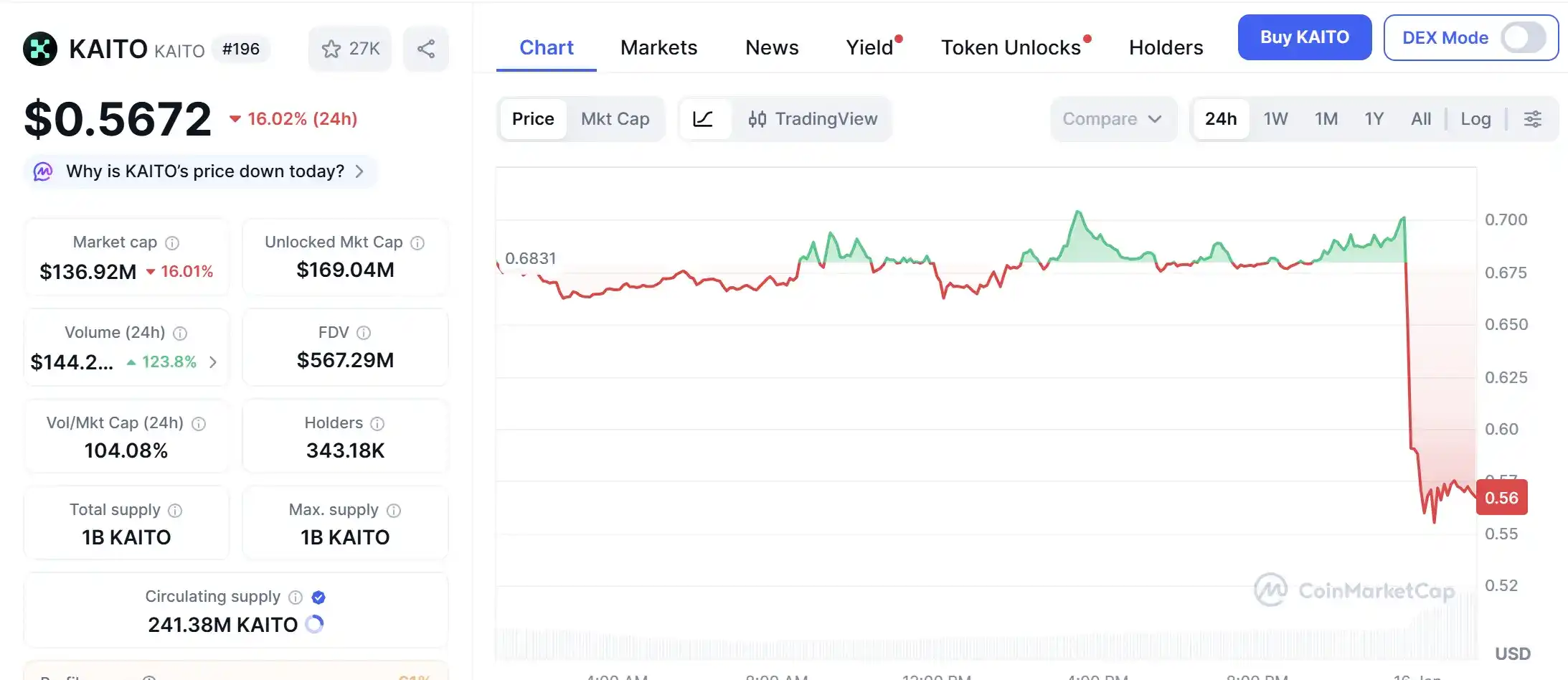
And this was all triggered by a tweet from X Product Lead Nikita Bier. Nikita Bier stated that the team is revising its developer API policy and will no longer allow any applications that reward users for posting on the X platform (e.g., "infofi"). This has led to the platform being flooded with a large amount of AI spam and reply spam.

"We have revoked the API access for these applications, so your X experience should start to improve soon (once the bots realize they are no longer being paid)." Nikita Bier said.

Since most InfoFi projects rely on the X product API to obtain user tweet data and determine reward schemes, once the API is disabled, the vast majority of content for such products will stop updating, losing their foundation.

An hour after the news was released, projects like Kaito and Cookie quickly issued response statements on their official Twitter accounts, showing that they had anticipated and prepared for this situation. Let's first see how they specifically responded.

Kaito: To Focus More on Areas Beyond Crypto

Kaito stated that in response to the large number of spam tweets, the project tried stricter eligibility reviews, higher leaderboard thresholds, social + on-chain screening mechanisms, and different incentive mechanisms. However, due to platform-wide X algorithm changes and the launch of other InfoFi projects with varying thresholds, the problem of low-quality and spam information remains widespread across the cryptocurrency field.

After discussions with the X team, both parties agreed that a completely permissionless distribution system is no longer feasible and does not meet the needs of high-quality brands, serious content creators, or X as a platform.

Next, Kaito will focus on launching Kaito Studio, which will be closer to a traditional tiered marketing platform where brands can selectively collaborate with creators based on established criteria and clear project scopes.

Kaito founder Yu Hu said that the past few months have been busy with the development of Kaito Studio, hence the low profile on social media and announcements, with little mention of project construction and strategic adjustments. Additionally, he personally met with some large brands outside the cryptocurrency field to learn from the successful experiences of traditional industry.

"We should no longer build and create for cryptocurrency, but for the broader world." Yu Hu believes that 2026 will be the year Kaito transcends CT as its main platform and cryptocurrency as its primary vertical.

Cookie: To Launch Real-Time Crypto Market Wallet Tool

Cookie posted that deciding to shut down the Snaps platform and all active creator campaigns was a difficult and sudden decision, but it was necessary to maintain the integrity of the Cookie data layer and products.

After discussions with the X team regarding its API and X usage policies, Cookie decided to immediately shut down Snaps and all ongoing activities.

However, the project still holds hope for the future of the Snaps product. "Currently, we are actively negotiating with X to determine if Snaps can continue to operate in a new form." Cookie believes, "We have always firmly believed that we fully comply with all of X's rules and policies. We will await confirmation and guidance from X on whether creator activities (such as Snaps) can operate in any form in the future."

At the same time, Cookie also proposed future product iteration plans, "For the past six months, we have been developing Cookie Pro—a real-time market intelligence tool for the cryptocurrency field, planned for official launch in the first quarter."

Has InfoFi Fallen?

It is undeniable that InfoFi has brought much vitality and change to the industry in recent years. It combines information and finance, creating a mechanism that evaluates user contributions based on the attention generated by their content (e.g., views, comments, and shares) and links it to token rewards.

In essence, InfoFi transforms attention from an abstract concept into quantifiable and tradable data. User participation shifts from simple content consumption to productive activity, and projects can more targetedly provide rewards to their content contributors.

However, when attention becomes the standard for rewards, the purpose of creating content now shifts from providing information or encouraging meaningful engagement to merely seeking rewards. And generative AI makes content creation easier, leading to the rapid spread of bulk content lacking real information or insight.

Several key members of the X team have mentioned the decline in Twitter content quality brought by InfoFi, so projects like Kaito have tried to optimize their algorithmic solutions, but never expected X to directly block this path from its foundation.

It is worth noting, however, that not all InfoFi projects incentivize users to post for rewards. For example, projects like xHunt and Ethos that rely on the X API primarily use the API to obtain tweet data for scoring and other operations. The impact of this X API policy adjustment on these projects is not yet known and requires further observation.

Additionally, some types of InfoFi projects mainly focus on the monetization of industry hotspot narratives, such as Noise and Narrative, and are expected to be largely unaffected.

Now that the InfoFi narrative has quickly collapsed, the attention economy and creator economy remain key focuses of the entire internet industry. In the future, InfoFi may reappear in front of the public in new forms and concepts.


Questions liées

QWhat major event led to the collapse of the InfoFi narrative and the shutdown of products like Kaito and Cookie?

AThe collapse was triggered by X's product lead Nikita Bier announcing a revision to the developer API policy, which no longer allows applications that reward users for posting on X (such as 'infofi') due to the proliferation of AI-generated spam and low-quality replies.

QHow did Kaito respond to X's API policy change, and what is their new strategic direction?

AKaito responded by shifting focus to Kaito Studio, a more traditional graded marketing platform where brands can selectively collaborate with creators based on set criteria. They aim to expand beyond the cryptocurrency领域 and target broader industries.

QWhat product did Cookie announce it was developing after shutting down its Snaps platform?

ACookie announced it is developing 'Cookie Pro,' a real-time market intelligence tool for the cryptocurrency space, planned for launch in the first quarter.

QWhy did X decide to restrict API access for InfoFi applications according to the article?

AX restricted API access because InfoFi applications incentivized users to post content primarily for rewards, leading to an influx of low-quality, AI-generated spam that degraded the overall user experience on the platform.

QAre all types of InfoFi projects affected equally by X's API policy change, as per the article?

ANo, not all InfoFi projects are equally affected. Projects like xHunt and Ethos that use X API for data scoring may be impacted, while others like Noise and Narrative, which focus on monetizing industry narratives, are expected to remain largely unaffected.

Lectures associées

L'amende de Futu est-elle une bonne nouvelle pour Hyperliquid ?

L'article analyse comment les pénalités infligées par les autorités chinoises à des courtiers comme Futu pour leurs activités transfrontalières illégales pourraient profiter à Hyperliquid, une plateforme de trading décentralisée. Alors que les canaux d'investissement transfrontaliers traditionnels se ferment, les capitaux pourraient se tourner vers des alternatives comme Hyperliquid, comme le suggère la hausse de son token HYPE suite à l'annonce des sanctions. Hyperliquid, une petite équipe basée à Singapour, génère des revenus mensuels importants en permettant des transactions de produits dérivés sans KYC, sans limites de position et sans surveillance du marché comme le font les bourses traditionnelles (CME, ICE). Ces dernières le critiquent, notamment pour ses contrats sur le pétrole qui fonctionnent en week-end quand elles sont fermées, brisant ainsi leur "monopole temporel". L'article souligne le succès récent des contrats perpétuels Pre-IPO sur Hyperliquid (via Trade.xyz), comme ceux pour Cerebras et SpaceX, qui ont démontré une découverte de prix très précise par rapport aux marchés traditionnels. La force perçue de Hyperliquid réside dans son modèle "sans visage" : ses contrats synthétiques (comme SPCX pour SpaceX) ne sont adossés à aucun actif physique réel, ce qui les rend difficiles à cibler par des actions en justice ou réglementaires, contrairement à des concurrents plus traditionnels comme PreStocks ou Ondo. Cependant, l'article note aussi les risques : l'absence de KYC pose des problèmes de sécurité nationale potentiels, et la décentralisation du protocole, bien que théoriquement robuste, repose sur un nombre limité de validateurs identifiables. La pression réglementaire, illustrée par la visite de son co-fondateur à Washington, reste une menace réelle. En définitive, l'avantage principal de Hyperliquid pourrait être sa capacité à opérer en continu, offrant un accès là où les marchés traditionnels sont fermés.

marsbitIl y a 16 mins

L'amende de Futu est-elle une bonne nouvelle pour Hyperliquid ?

marsbitIl y a 16 mins

Le premier rapport de Mythos est sorti : des milliards d'appareils exposés dans le monde, 10 000 vulnérabilités critiques découvertes en 30 jours

Premier rapport de Mythos dévoilé : des milliards d'appareils vulnérables dans le monde, 10 000 failles critiques découvertes en 30 jours. Le programme « Glasswing » d'Anthropic, utilisant le modèle d'IA avancé Claude Mythos Preview, a publié ses résultats après un mois d'opération. En collaboration avec une cinquantaine d'acteurs majeurs de l'informatique et des infrastructures critiques, il a identifié plus de 10 000 vulnérabilités logicielles de haut niveau. Parmi les réalisations notables : la découverte de 2 000 failles (dont 400 critiques) chez Cloudflare, la correction de 271 vulnérabilités dans Firefox 150, et même la détection d'un bogue vieux de 27 ans dans OpenBSD. Le modèle a également démontré des capacités offensives en construisant des chaînes d'exploitation complètes. De manière plus concrète, il a permis d'intercepter une tentative de fraude de 1,5 million de dollars dans une banque partenaire. L'analyse de plus de 1 000 projets open source essentiels a révélé 23 019 failles, dont 6 202 considérées comme critiques ou graves par l'IA. Une vérification humaine indépendante a confirmé un taux de vrais positifs de 90,6%, validant 1 094 vulnérabilités sérieuses. Un exemple frappant est la découverte d'une faille logicielle majeure dans la bibliothèque cryptographique wolfSSL, utilisée par des milliards d'appareils IoT. Cette efficacité sans précédent a créé un nouveau défi : la capacité humaine à corriger les failles ne suit plus le rythme de leur découverte. Des mainteneurs de logiciels libres ont demandé à ralentir les signalements. En réponse, Anthropic propose des outils comme Claude Security pour générer automatiquement des correctifs et a ouvert certains de ses frameworks d'analyse. Anthropic reste prudent quant à une publication générale de Mythos, en raison des risques de mauvaise utilisation par des acteurs malveillants. La société préconise l'accélération des cycles de correction, les mises à jour forcées et le renforcement des mesures de sécurité de base. L'objectif final est de rendre le code mondial bien plus robuste, réduisant considérablement les cyberattaques.

marsbitIl y a 1 h

Le premier rapport de Mythos est sorti : des milliards d'appareils exposés dans le monde, 10 000 vulnérabilités critiques découvertes en 30 jours

marsbitIl y a 1 h

Vitalik Buterin défend sa vision à long terme face aux inquiétudes sur le prix du token

Vitalik Buterin, co-fondateur d'Ethereum, a répondu aux préoccupations concernant le rôle de la Fondation Ethereum, soulignant que son objectif principal n'est pas la valorisation du token ETH mais la poursuite de sa vision à long terme. Il a affirmé que la Fondation resterait concentrée sur ses objectifs fondamentaux : décentralisation du protocole, sécurité informatique, recherche et résistance à la censure, plutôt que de concurrencer les blockchains à haut débit. Ces déclarations interviennent alors que le prix de l'ETH avoisine les 2 094 $, en baisse de plus de 50% par rapport à son record d'août 2025, et après des départs notables de la Fondation et des ventes d'ETH par d'importants investisseurs. Buterin a comparé les réserves de tokens, notant que la Fondation Ethereum ne détient qu'environ 0,16% de l'offre totale d'ETH, un pourcentage bien inférieur à celui d'autres fondations. Face aux critiques, notamment concernant l'impact de la mise à jour Dencun sur les revenus du réseau, Buterin a insisté sur la priorité accordée à la "longévité". Il a précisé que la Fondation utiliserait ses ressources pour soutenir la recherche, ce qui devrait réduire les ventes futures d'ETH. Bien que la Fondation ait retiré 21 270 ETH d'un protocole de staking en mai, cela ne signifie pas nécessairement qu'ils seront vendus.

TheNewsCryptoIl y a 3 h

Vitalik Buterin défend sa vision à long terme face aux inquiétudes sur le prix du token

TheNewsCryptoIl y a 3 h

Trading

Spot
Futures

Articles tendance

Comment acheter COOKIE

Bienvenue sur HTX.com ! Nous vous permettons d'acheter Cookie DAO (COOKIE) de manière simple et pratique. Suivez notre guide étape par étape pour commencer votre parcours crypto.Étape 1 : Création de votre compte HTXUtilisez votre adresse e-mail ou votre numéro de téléphone pour ouvrir un compte sur HTX gratuitement. L'inscription se fait en toute simplicité et débloque toutes les fonctionnalités.Créer mon compteÉtape 2 : Choix du mode de paiement (rubrique Acheter des cryptosCarte de crédit/débit : utilisez votre carte Visa ou Mastercard pour acheter instantanément Cookie DAO (COOKIE).Solde :utilisez les fonds du solde de votre compte HTX pour trader en toute simplicité.Prestataire tiers :pour accroître la commodité d'utilisation, nous avons ajouté des modes de paiement populaires tels que Google Pay et Apple Pay.P2P :tradez directement avec d'autres utilisateurs sur HTX.OTC (de gré à gré) : nous offrons des services personnalisés et des taux de change compétitifs aux traders.Étape 3 : stockage de vos Cookie DAO (COOKIE)Après avoir acheté vos Cookie DAO (COOKIE), stockez-les sur votre compte HTX. Vous pouvez également les envoyer ailleurs via un transfert sur la blockchain ou les utiliser pour trader d'autres cryptos.Étape 4 : tradez des Cookie DAO (COOKIE)Tradez facilement Cookie DAO (COOKIE) sur le marché Spot de HTX. Il vous suffit d'accéder à votre compte, de sélectionner la paire de trading, d'exécuter vos trades et de les suivre en temps réel. Nous offrons une expérience conviviale aux débutants comme aux traders chevronnés.

224 vues totalesPublié le 2025.07.23Mis à jour le 2025.07.23

Comment acheter COOKIE

Discussions

Bienvenue dans la Communauté HTX. Ici, vous pouvez vous tenir informé(e) des derniers développements de la plateforme et accéder à des analyses de marché professionnelles. Les opinions des utilisateurs sur le prix de COOKIE (COOKIE) sont présentées ci-dessous.

活动图片