
Primitive Ventures: The Crypto World Feels a Bit Dead

marsbitPublié le 2026-01-13Dernière mise à jour le 2026-01-13

Résumé

Primitive Ventures' Dovey Wan argues that despite Bitcoin hitting new all-time highs in 2025, the crypto market feels stagnant and disconnected. Key issues include a lack of altcoin momentum, underperformance against traditional assets like stocks and gold, and a significant divergence between onshore (U.S.) buying and offshore selling. U.S. investors bought spot Bitcoin, while international traders sold into strength and used leverage. Structural shifts, including Bitcoin ETFs and institutional products, changed liquidity dynamics. Retail interest declined, and miners sold Bitcoin to fund AI ventures. Major sell pressure came from early whales, miners, and gray market entities. The traditional 4-year cycle is broken; future performance depends on macro conditions and institutional adoption. Crypto must evolve from speculative asset to utility-driven technology to attract new cycles of investment.

Author: Dovey Wan, Founding Partner of Primitive Ventures

Compiled by: Dayu

In 2025, the cryptocurrency industry achieved almost all its expected goals. Structurally, this should have been a glorious year.

But why does it feel... so lifeless?

It's not just that "prices didn't rise" and it's all over. Bitcoin hit new highs. But the atmosphere, sentiment, internal confirmation, follow-through from other cryptocurrencies, and retail enthusiasm have all changed. Perhaps most worryingly, the former "hot money leading asset" has now lost its appeal in terms of wealth effect and volatility.

Related cryptocurrency assets no longer move in sync with Bitcoin and Ethereum as they did in previous cycles:

1. Memecoins topped the charts from Q4 2024 to Q1 2025, and the launch of Trump tokens pushed this trend to its peak.

2. Crypto stocks peaked around the Circle IPO and began to fall back between May and August 2025.

3. Most altcoins never formed a sustained trend. There was asymmetry on the way up, and the decline was entirely dominated by all participants.

Zooming in, the situation becomes even stranger.

Despite a friendly policy environment, Bitcoin's performance in 2025 lagged behind almost all major traditional financial assets, including gold, U.S. stocks, Hong Kong stocks, A-shares, and even some bond benchmark indices.
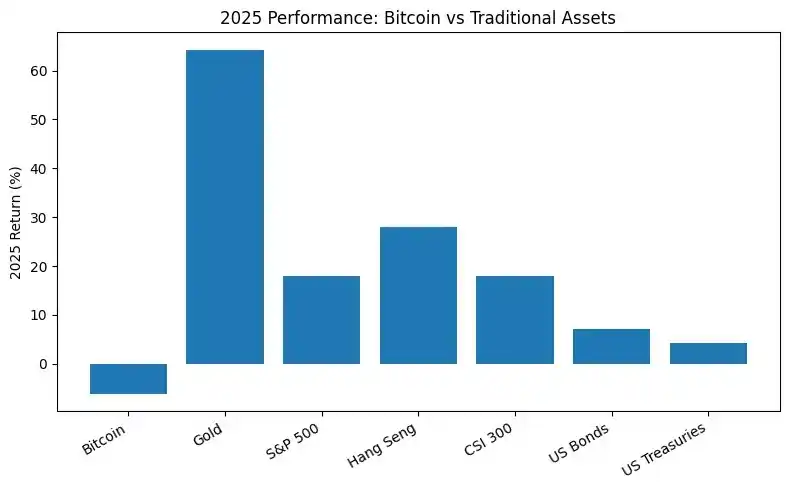
(Bitcoin's performance compared poorly to other assets)

This is the first time Bitcoin's performance has decoupled from all other asset classes.

This divergence is crucial: prices hit new highs, but there was no internal confirmation, and other markets performed better. This reveals a simple yet unsettling fact: Bitcoin's liquidity supply chain has undergone significant changes, and its original four-year settlement cycle has been altered by greater forces in other markets.

Therefore, we will delve into who was buying at the highs, who exited the market, and where the price bottom lies.

The Great Divide: Onshore vs. Offshore Operations

We experienced three distinct phases in this cycle—

  • Phase A (November 2024 to January 2025): Trump's election victory and a more friendly regulatory environment triggered FOMO among both domestic and foreign investors. Bitcoin's price broke through $100,000 for the first time.

  • Phase B (April to mid-August 2025): After deleveraging selling, BTC resumed its upward momentum and broke through $120,000.

  • Phase C (Early October 2025): BTC hit its current local all-time high in early October, then experienced a flash crash on October 10th and entered a correction phase.

In each phase, we saw a significant divergence between U.S. buying and overseas selling—

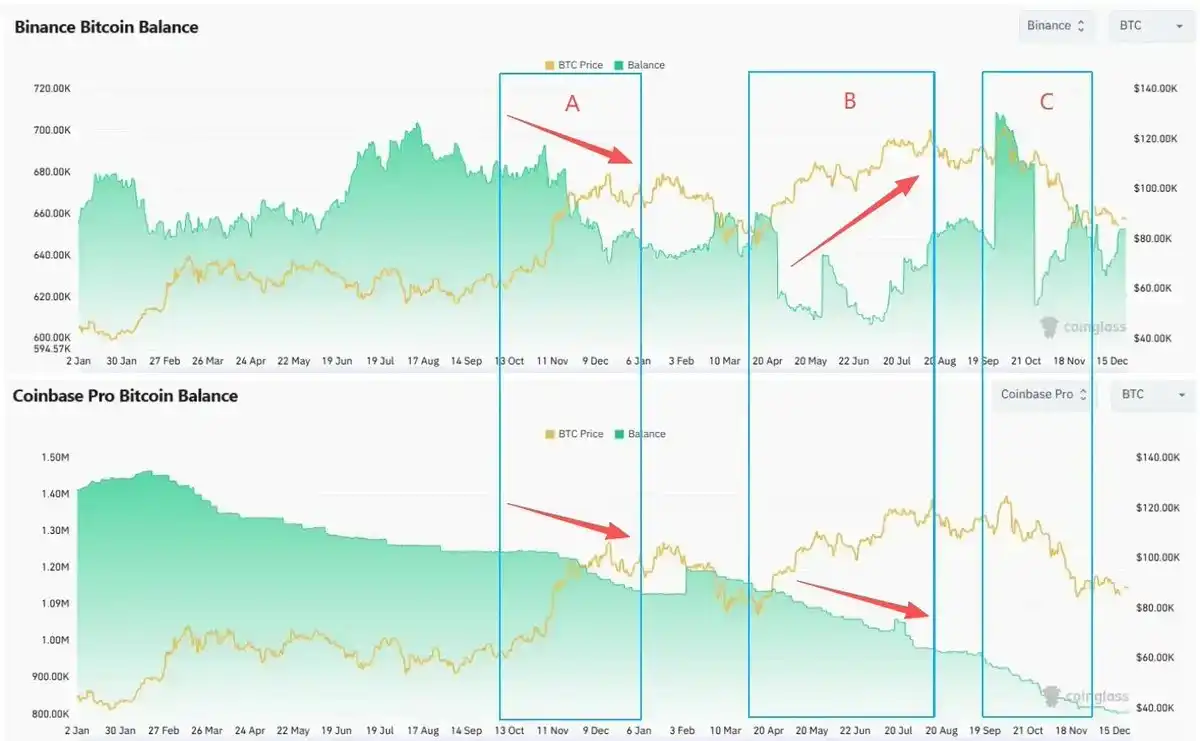
Spot: Onshore buying on breakouts, offshore selling on strength.
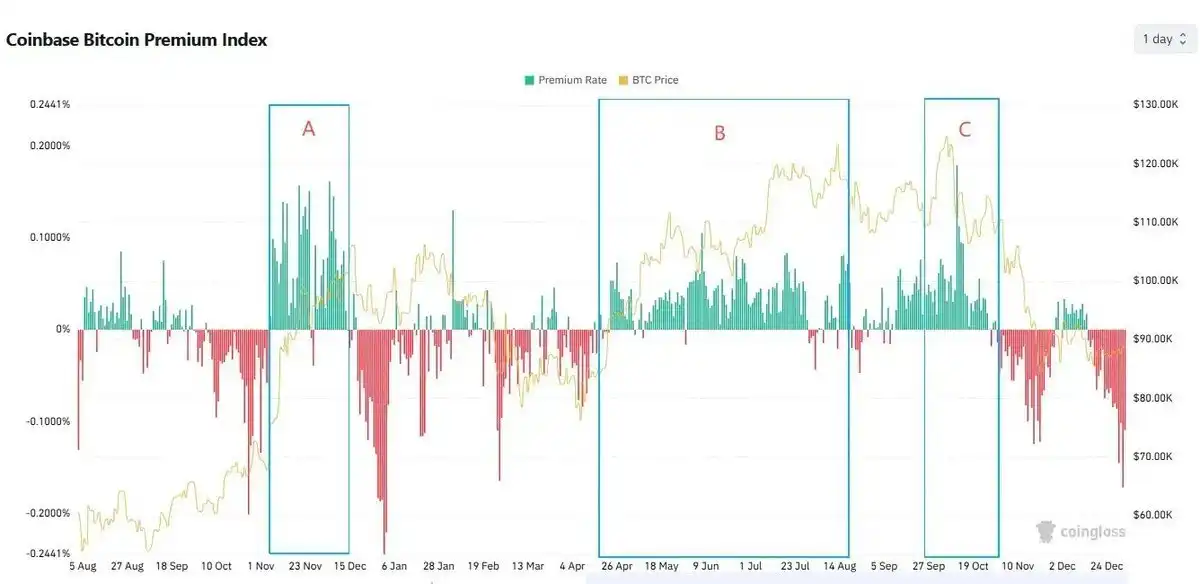
  • Coinbase Premium remained positive in Phases A, B, and C. High levels of buy-side demand primarily came from onshore spot funds.

  • Coinbase BTC balances showed a declining trend throughout the cycle. Sellable inventory on the U.S. side decreased.

  • As prices rebounded in Phases B and C, Binance balances increased significantly. Offshore spot holders replenished inventory, increasing potential selling pressure.
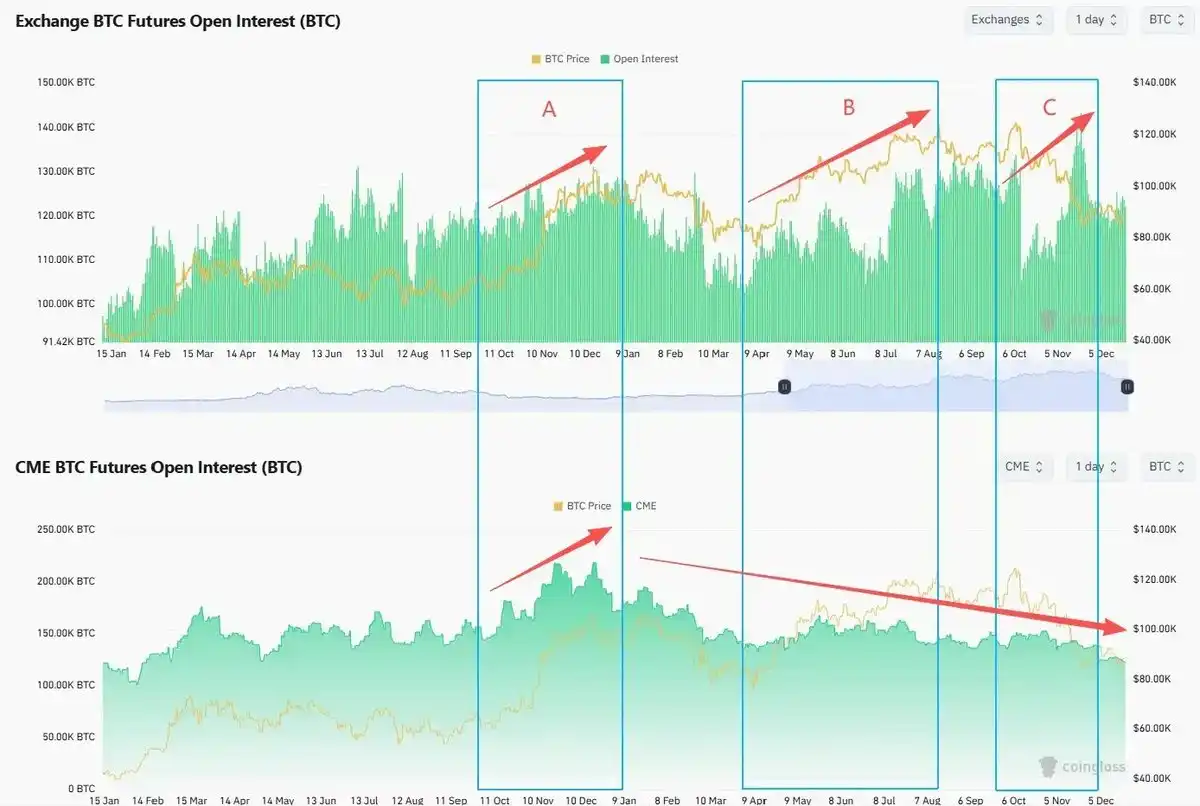
Futures: Offshore leverage rises, onshore positions decline

Offshore open interest (Binance and other offshore exchanges) climbed during Phases B and C. Leverage increased. Even after October 10th, leverage quickly recovered and returned to or exceeded previous peaks.

Onshore open interest (CME) has been on a downward trend since early 2025. Institutional investors did not increase their risk exposure as contracts hit new highs.
Meanwhile, Bitcoin volatility diverged from price action.

In August 2025, when Bitcoin's price first surpassed $120,000, DVOL was near a local low. The options market did not adequately compensate for continued risk.
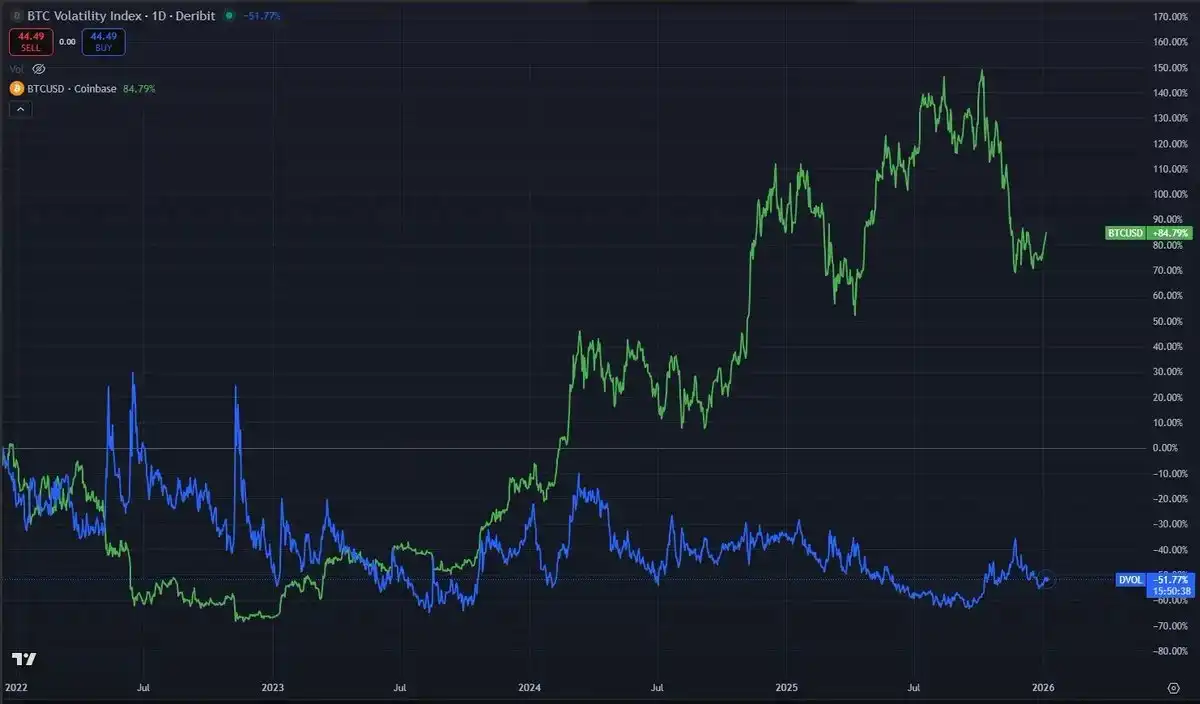
Each "top" seemed to reflect a divergence between onshore and offshore traders. When onshore spot funds pushed prices to break out, offshore spot traders sold into strength. When offshore leveraged capital chased the rally, onshore futures and options traders reduced positions and stayed on the sidelines.

Where are the marginal buyers? Who is left to buy?

Glassnode estimates that the number of Bitcoins held by corporate and DAT-like tools increased from about 197,000 in early 2023 to about 1.08 million by the end of 2025, a net increase of about 890,000 over two years. DATs have become one of the largest structural investment vehicles in the Bitcoin system.

Another often misunderstood area is ETFs. By the end of 2025, U.S. spot Bitcoin ETFs held approximately 1.36 million, a year-on-year increase of about 23%, accounting for about 6.8% of the circulating supply.

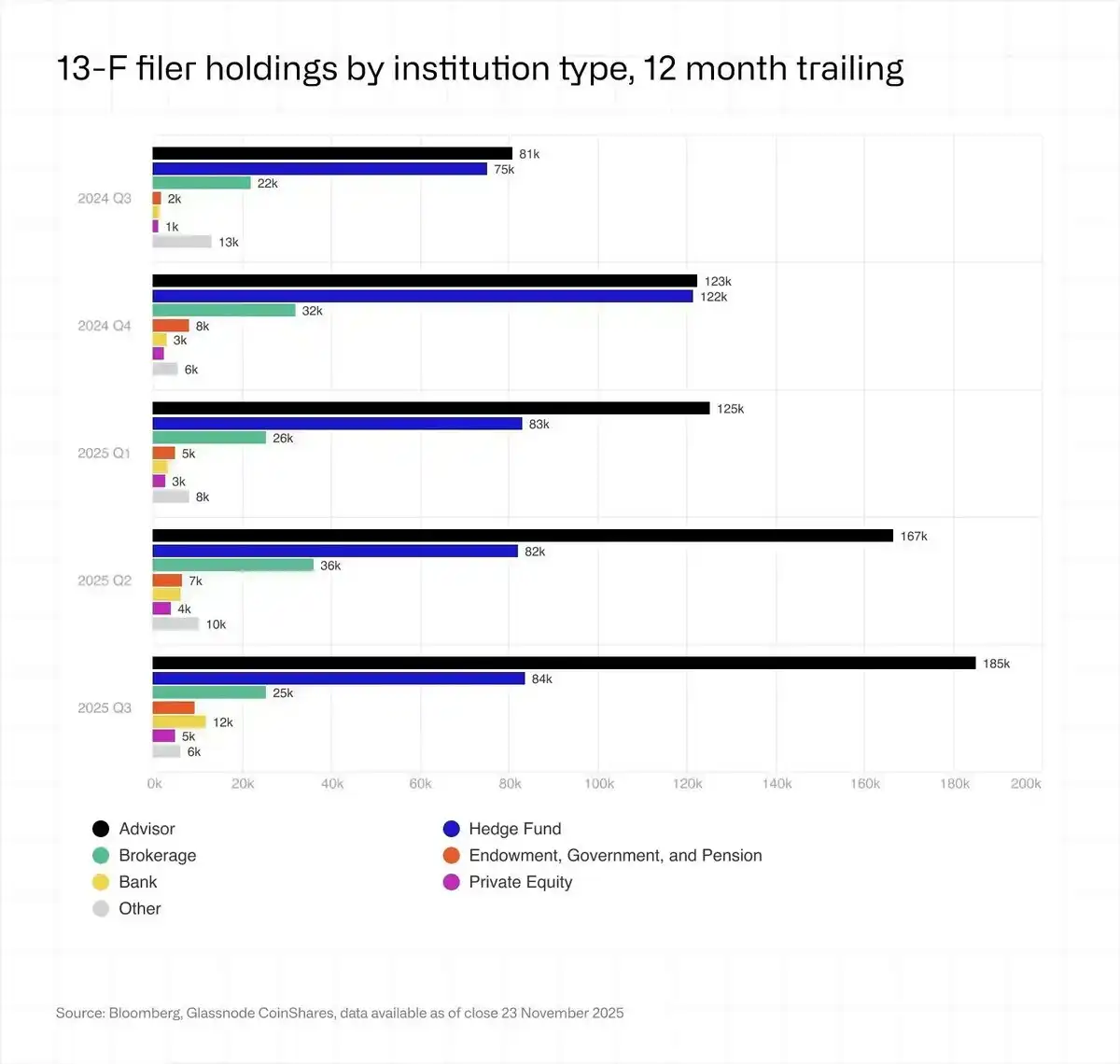
Institutional investors (13F filers) hold less than a quarter of the total ETF amount, and most of these are hedge funds and investment advisors, clearly not the "diamond hand" families we know.
The Death of Retail

Since early 2025, flow data from Binance, Coinbase, and other top exchanges clearly shows that retail investor weakness has continued since Trump sold his "memecoins".

Furthermore, overall social sentiment among retail investors has actually been bearish since early 2024.

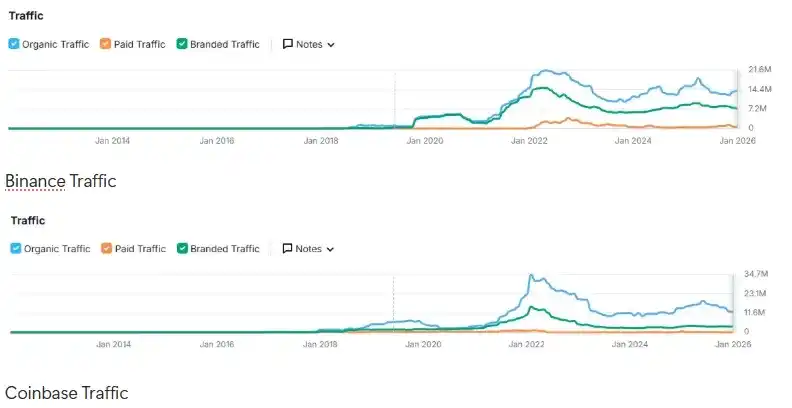
Overall website traffic has been on a downward trend since peaking in 2021.

Bitcoin's price hitting new highs did not bring traffic back to previous levels.
You can read more on this topic in our article from last year. "Who is the marginal buyer?"

Exchange strategies have also adjusted. Facing high customer acquisition costs and low activity from existing users, exchanges have shifted from "striving for growth" to "retaining existing capital through yield products and multi-asset trading (actively listing U.S. stocks, gold, and forex)".

Everywhere Else, It's a Bull Market

The real "wealth effect" in 2025 was not in crypto: the S&P 500 (+18%), Nasdaq (+22%), Nikkei (+27%), Hang Seng Index (+30%), KOSPI (+75%), and even A-shares rose 19%, all posting strong gains. Gold (+70%) and silver (+144%) also surged, making "digital gold" seem somewhat ridiculous by comparison.

AI stocks, 0DTE (zero-day to expiration) options, and commodities like gold and silver further eroded its appeal.

Speculative money did not rotate into alternative investments. Many exited altogether, returning to equity volatility markets, while new speculators happily profited in U.S. stocks or their domestic equity markets.

Even Korean retail investors sold off Upbit to bet on the KOSPI index and U.S. stocks: Upbit's average daily trading volume in 2025 fell about 80% compared to 2024. During the same period, the KOSPI rose over 75%. Korean retail investors net bought about $31 billion in U.S. stocks.

Who Are the Biggest Sellers?

Every cycle has whales selling at local highs, but interestingly, the timing of seller distribution this cycle coincided perfectly with the RSI divergence points.

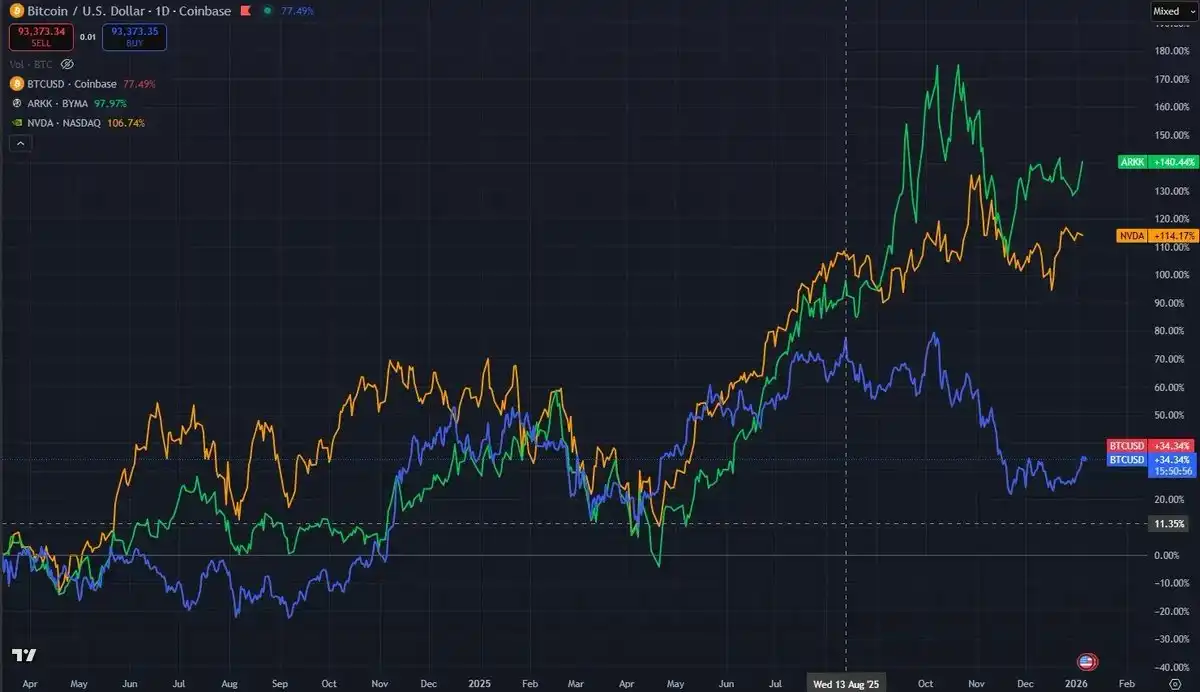
Bitcoin had previously moved closely in line with U.S. tech stocks until around August 2025, when Bitcoin began to significantly lag ARKK and Nvidia, followed by the October 10th flash crash, and it has yet to close the gap since.

Just before this divergence appeared, in late July, Galaxy disclosed in its earnings report and media briefings that it had executed a sell order of over 80,000 Bitcoins on behalf of an established holder. This transaction brought the phenomenon of "Satoshi-era whale profit-taking" into public view.
Miners Selling for AI Capex

From the 2024 Bitcoin halving to the end of 2025, miner reserves experienced their most sustained decline since 2021. By year-end, reserves were around 1.806 million Bitcoins. Hash rate fell about 15% year-on-year.

  • Under the "AI Diversion Plan," miners transferred approximately $5.6 billion worth of Bitcoin to exchanges to fund the construction of AI data centers.

  • Bitfarms, Hut 8, Cipher, Iren, and others are converting sites into AI and high-performance computing campuses, signing 10 to 15-year compute contracts, treating power and land as "gold in the AI era."

  • Riot, a representative HODLer, announced in April 2025 that it would begin selling all coins mined monthly.

It is estimated that by the end of 2027, about 20% of mining power capacity could be redeployed to AI workloads.

China took more severe measures. In December 2025, Xinjiang again became a target for the People's Bank of China and various ministries. About 400,000 ASIC miners were forced offline, causing global hash rate to drop 8% to 10% in a few days.

Gray Whales: Bitcoin's Black Hangover

Similar to the significant impact of the PlusToken scam in the 2021 cycle, several large-scale fraud and gambling cases in 2025, including Qian Zhimin's Ponzi scheme/cult network and the Cambodia Prince Group/Chen Zhi case, were likely major behind-the-scenes drivers of Bitcoin's price action.

Both cases involved the seizure of tens of thousands of Bitcoins, totaling at or above the level of 100,000 black coins.

This may also add potential selling pressure from governments, while significantly inhibiting large gray market long-term holders of Bitcoin, which could create selling pressure in the medium term but is overall positive in the long run.

2026 Outlook

Under this new structure, the original "four-year halving cycle" is no longer a feasible self-fulfilling path.

The next phase of the regime is primarily driven by two axes.

  • Vertical: Macro liquidity and credit conditions, interest rates, fiscal stance, AI investment cycle.

  • Horizontal: Valuation and premium levels of DATs, ETFs, and other Bitcoin alternative assets.
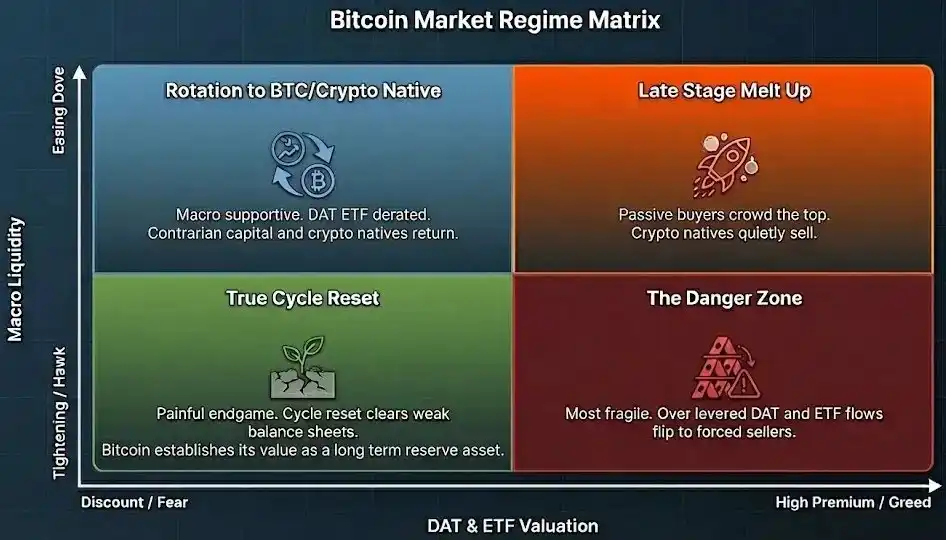
Early Bitcoin winners, including OGs, miners, and Asian gray whales, are distributing tokens to passive ETF holders, DAT structures, and long-term national capital.

Bitcoin's trajectory seems similar to that of FAANG between 2013 and 2020: the market is slowly shifting from a high-beta strategy dominated by early retail and growth funds to a passive allocation strategy dominated by index funds, pension funds, and sovereign wealth funds.

Bitcoin is now the crypto asset you can own easily without touching crypto. You can buy it through a brokerage account, custody it like an ETF, account for it clearly, and explain it to a trader investment committee in five sentences.

Whereas the valuation of most other crypto assets does not stem from their actual utility or legitimacy in the physical market and Wall Street.

We always look forward to the next bull market, but it would be great if this bull market wasn't just about price increases, but also about utility increases, translating the legitimacy of the ETF era into on-chain demand, converting passive holding into active use, and bringing real yield returns, not just constantly shifting narratives.

If that happens, today's "bag holders" won't look like fools trapped at the cycle's peak, but rather like the first investors of the new cycle.

Bitcoin finally becomes national reserve currency

Code is eating the bank

Crypto still needs to evolve into a new tool of civilization.

Questions liées

QAccording to the article, why does the crypto world feel 'dead' despite Bitcoin hitting new highs in 2025?

AThe article states that while Bitcoin hit new highs, the atmosphere, sentiment, internal confirmation, follow-through from other cryptocurrencies, and retail enthusiasm have all changed. It points to a lack of wealth effect and volatility appeal, poor performance compared to other asset classes, and a significant shift in Bitcoin's liquidity supply chain and its traditional four-year cycle.

QWhat key divergence does the article highlight between onshore (US) and offshore trading activity for Bitcoin?

AThe article highlights a major divergence where onshore (US) spot buyers were the primary demand driving breakouts, while offshore spot holders sold into strength. Conversely, offshore futures leverage increased during rallies, while onshore futures and options traders reduced their positions and remained on the sidelines.

QWho does the article identify as the largest structural investment vehicle in the Bitcoin system by the end of 2025?

AThe article identifies DATs (Digital Asset Trusts, likely referring to products like Grayscale's GBTC) as the largest structural investment vehicle in the Bitcoin system by the end of 2025, holding an estimated 1.08 million BTC.

QWhat are the two main drivers the article proposes for Bitcoin's price trajectory in 2026, replacing the old 'four-year halving cycle'?

AThe article proposes that Bitcoin's trajectory in 2026 will be driven by two main axes: 1) The vertical axis: macro liquidity and credit conditions, interest rates, fiscal stance, and the AI investment cycle. 2) The horizontal axis: the valuation and premium levels of DATs, ETFs, and other Bitcoin proxy assets.

QBesides early whales and miners, what other significant source of selling pressure ('black whales') does the article mention?

AThe article mentions 'black whales' or 'grey whales' as a significant source of selling pressure, referring to large-scale fraud and gambling cases like the Qian Zhimin Ponzi scheme/cult network and the Cambodia Prince Group/Chen Zhi case, which involved the seizure of tens of thousands of Bitcoin, potentially adding over 100,000 black coins to the market and government selling pressure.

Lectures associées

Kalshi, MTS et l'ambition de a16z

Le marché des prédictions, illustré par des plateformes comme Kalshi, connaît un regain d'intérêt en 2025, suscitant l'enthousiasme des investisseurs, des acteurs de la cryptomonnaie et des médias. Cet engouement dépasse les simples opportunités de régulation ou de revenus, touchant à une dimension philosophique plus profonde. L'article retrace l'évolution intellectuelle du concept, depuis les théories de Hayek sur la connaissance dispersée dans la société, jusqu'aux mécanismes incitatifs comme le LMSR de Robin Hanson, conçus pour révéler l'information. Cependant, c'est l'entrée en jeu du géant du capital-risque a16z, avec son investissement massif dans Kalshi, qui marque un tournant. a16z voit dans le marché des prédictions bien plus qu'un produit financier : un nouvel outil médiatique fondamental. Il répondrait au désir contemporain de "présence" et d'action face à un monde de plus en plus médiatisé et déterministe. En pariant de l'argent réel sur des événements mondiaux, l'utilisateur passerait du statut de spectateur passif à celui d'observateur actif et impliqué, recouvrant un sentiment d'agency. Cette capacité à générer de l'engagement et à définir la réalité par les prix du marché (établissant la véracité et l'importance des événements) en ferait une pièce maîtresse de l'empire des "nouveaux médias" qu'a16z cherche à construire. Cet empire, illustré par des acteurs comme MTS, se caractérise par une production et une diffusion d'information extrêmement rapides et intenses, visant à "s'approprier la timeline". La valeur ultime de Kalshi résiderait ainsi dans son puissant "champ de distorsion de la réalité" : sa capacité, via le poids de l'argent engagé par la foule, à influencer la perception collective du futur et à s'imposer comme un arbitre de la vérité, conférant à une entreprise privée une influence historique rare.

marsbitIl y a 48 mins

Kalshi, MTS et l'ambition de a16z

marsbitIl y a 48 mins

Changement de cap mondial chez a16z : Le capital-risque devient le « moteur » de l'alliance technologique américaine

L’annonce de Ben Horowitz marque un virage stratégique majeur dans la globalisation d’a16z. Le fonds ne se contente plus de rechercher des projets à l’étranger, mais s’inscrit dans un cadre plus large de compétition technologique et de coopération entre alliés, explicitement lié au leadership technologique des États-Unis et de leurs partenaires. Dans un contexte où l’IA, la robotique, la cybersécurité et les chaînes d’approvisionnement deviennent des enjeux de compétition nationale, le rôle des VC évolue. A16z renforce ses capacités pour aider ses startups à naviguer dans des environnements complexes, mêlant marchés, régulations et géopolitique. Les initiatives clés incluent : l’ouverture d’un bureau à Tokyo, la nomination d’Anne Neuberger (ancienne responsable gouvernementale) comme associée chargée des affaires mondiales pour conseiller sur la politique et la géopolitique, et la transformation de l’équipe relations investisseurs en une équipe « Partenaires Mondiaux » pour faciliter les connexions et le déploiement international des entreprises. L’objectif reste de soutenir les meilleures entreprises technologiques partout dans le monde (plus de 100 investissements internationaux à ce jour), mais avec une mission élargie : être un organisateur reliant les startups aux capacités nationales, aux ressources industrielles et au réseau des alliés, contribuant ainsi à la compétitivité technologique des États-Unis et de leurs alliés.

marsbitIl y a 1 h

Changement de cap mondial chez a16z : Le capital-risque devient le « moteur » de l'alliance technologique américaine

marsbitIl y a 1 h

Kalshi, MTS et les ambitions d'a16z

Les marchés prédictifs, représentés par Kalshi, émergent comme un domaine clé en 2025, attirant fonds d'investissement, acteurs de la cryptomonnaie et médias. Leur importance dépasse la simple spéculation. Leur évolution conceptuelle remonte à Hayek (l'utilisation de la connaissance dans la société) et à Robin Hanson (mécanisme LMSR pour inciter à la révélation d'informations), avec l'idée utopique d'une « futarchie ». L'intérêt de a16z, qui a investi dans Kalshi (évalué à 220 milliards de dollars), va au-delà du modèle économique. Leur thèse centrale est que les marchés prédictifs offrent un « sentiment de présence » et une forme d'« anti-cynisme » dans un monde moderne où les individus se sentent déconnectés. En pariant sur des événements mondiaux, l'utilisateur devient un « observateur superlatif », investi et influençant la perception collective. Cela s'inscrit dans la vision de « nouveaux médias » de a16z : un écosystème médiatique complet et rapide qui « s'approprie la timeline », comme le démontre MTS (Monitoring The Situation), un média en continu sur Twitter. Kalshi ajoute à ce dispositif une autorité unique car ses prix reflètent des paris en argent réel, lui conférant un pouvoir de « distorsion de la réalité » pour définir la vérité et l'importance des événements. C'est ce pouvoir, rarement détenu par une entreprise privée, qui justifierait sa valorisation faramineuse et en ferait une pièce maîtresse de l'empire médiatique de a16z.

链捕手Il y a 1 h

Kalshi, MTS et les ambitions d'a16z

链捕手Il y a 1 h

Comprendre la réalité du commerce, des paiements et des infrastructures des Agents

**Interprétation de la réalité des agents, des paiements et des infrastructures commerciales** Au cours de l'année passée, l'auteur a travaillé sur l'infrastructure de l'économie des agents, interagissant avec Stripe, Visa, Coinbase, Google et des dizaines de startups. La conclusion est claire : il n'existe pas encore de demande réelle, et les startups font face à des problèmes structurels. Stripe a enregistré peu de transactions d'agents malgré un fort intérêt. Visa impose des seuils de revenus et des processus KYC extrêmement restrictifs, accessibles uniquement aux géants comme Amazon. Les chiffres d'utilisation des agents sur la blockchain (comme via le protocole x402) sont largement gonflés par des transactions de test. **Agent vs Commerçant** : L'expérience d'achat par agent (IA) est souvent inférieure au commerce électronique traditionnel pour les achats visuels (vêtements, électronique). L'interface conversationnelle est un recul par rapport aux interfaces riches. La demande actuelle des marchands est défensive : ils veulent être "trouvables" par les agents par crainte de rater une future tendance. Les cas d'usage convaincants sont limités (commande de nourriture, navigation dans des interfaces complexes), mais nécessitent une distribution de masse détenue par les géants. **Agent vs API** : Les développeurs utilisent déjà massivement des API (calcul, données). Le problème du coût des micro-transactions est souvent résolu par du prépaiement. Le véritable obstacle est que les grands fournisseurs SaaS privilégient les contrats enterprise. Les opportunités pour les nouveaux systèmes de paiement (comme les stablecoins) se situent dans la longue traîne des services, un marché plus restreint. **Agent vs Agent** : Ce modèle est encore théorique, sans volume significatif. Il impliquerait des transactions ultra-rapides entre entités non humaines, avec des montants variables et des règlements multipartites. C'est un pari à long terme sur une infrastructure dédiée, mais ce n'est pas le marché actuel. **Agent vs Finance** : C'est la seule catégorie avec une demande existante et une volonté de payer. Intégrer l'IA dans les workflows financiers existants (gestion de portefeuille, DeFi) est une évolution naturelle et crée de nouvelles capacités. Cependant, la concurrence est rude face aux institutions établies, régulées et bien connectées. **Le véritable enjeu** : Les grandes entreprises construisent par stratégie défensive et ont les moyens d'attendre. Pour les startups, il est crucial de se concentrer sur le marché actuel. Le problème fondamental n'est pas le paiement, mais la **coordination** entre agents et humains : vérifier le travail, s'accorder sur les résultats, puis régler. Le paiement n'est qu'une partie de la solution de coordination. Ce sont les entreprises qui résoudront le problème de la coordination à grande échelle qui domineront, en intégrant le paiement, et non l'inverse. L'expérience de l'auteur l'a conduit vers un autre segment de marché, actif, en croissance et encore mal desservi, en dehors de ces quatre catégories.

marsbitIl y a 1 h

Comprendre la réalité du commerce, des paiements et des infrastructures des Agents

marsbitIl y a 1 h

Trading

Spot
Futures

Articles tendance

Comment acheter WAN

Bienvenue sur HTX.com ! Nous vous permettons d'acheter Wanchain (WAN) de manière simple et pratique. Suivez notre guide étape par étape pour commencer votre parcours crypto.Étape 1 : Création de votre compte HTXUtilisez votre adresse e-mail ou votre numéro de téléphone pour ouvrir un compte sur HTX gratuitement. L'inscription se fait en toute simplicité et débloque toutes les fonctionnalités.Créer mon compteÉtape 2 : Choix du mode de paiement (rubrique Acheter des cryptosCarte de crédit/débit : utilisez votre carte Visa ou Mastercard pour acheter instantanément Wanchain (WAN).Solde :utilisez les fonds du solde de votre compte HTX pour trader en toute simplicité.Prestataire tiers :pour accroître la commodité d'utilisation, nous avons ajouté des modes de paiement populaires tels que Google Pay et Apple Pay.P2P :tradez directement avec d'autres utilisateurs sur HTX.OTC (de gré à gré) : nous offrons des services personnalisés et des taux de change compétitifs aux traders.Étape 3 : stockage de vos Wanchain (WAN)Après avoir acheté vos Wanchain (WAN), stockez-les sur votre compte HTX. Vous pouvez également les envoyer ailleurs via un transfert sur la blockchain ou les utiliser pour trader d'autres cryptos.Étape 4 : tradez des Wanchain (WAN)Tradez facilement Wanchain (WAN) sur le marché Spot de HTX. Il vous suffit d'accéder à votre compte, de sélectionner la paire de trading, d'exécuter vos trades et de les suivre en temps réel. Nous offrons une expérience conviviale aux débutants comme aux traders chevronnés.

198 vues totalesPublié le 2024.12.11Mis à jour le 2026.06.02

Comment acheter WAN

Discussions

Bienvenue dans la Communauté HTX. Ici, vous pouvez vous tenir informé(e) des derniers développements de la plateforme et accéder à des analyses de marché professionnelles. Les opinions des utilisateurs sur le prix de WAN (WAN) sont présentées ci-dessous.

活动图片













