After Terra’s fall to Earth, get ready for the stablecoin era

CointelegraphPublié le 2022-07-10Dernière mise à jour le 2022-07-10

Résumé

Did May’s algorithmic stablecoin crashes kill the concept, or is there still a role for fiat-pegged cryptocurrencies?

Stablecoins were supposed to be the boring uncle of the crypto world — safe, sensible and dull. They’re probably not what Satoshi Nakamoto had in mind, but they’re supposed to be a reassuring haven of calm and utility away from the turbulence of pure-play cryptocurrencies.

With values pegged to fiat currencies, stablecoins were intended to be useful rather than to offer get-rich-quick schemes. They play an important role in the cryptocurrency ecosystem by providing a safer place to store capital without having to cash out entirely, and allowing assets to be denominated in fiat currencies rather than volatile tokens.

However, events in May demonstrated that crypto stability is still elusive. With governments slow to react, Terra’s LUNA token — which has since been renamed Luna Classic (LUNC) — dropped to close to zero in value, wiping out $60 billion along the way. The obvious conclusion would be that the stablecoin experiment has failed. But I believe Terra’s fall to Earth is the precursor to a new era where stablecoins will become established, accepted and beneficial components of the global economic system. And the regulation that is only now dropping into place already looks well past its sell-by date.

Not all stablecoins were born equal

If that seems unlikely right now, the failure of a few stablecoins does not write off the entire concept. Other stablecoins have been constructed on solid ground and are performing as expected.

What’s happening is a clearout of the algorithmic stablecoins. These are coins that were never fit for purpose because they were built on insecure foundations. There were always critics: Some called out Terra as a Ponzi scheme and argued that it, and other algorithmics, would only hold value if more and more people bought them.

Algorithmic stablecoins are unregulated and not backed by equivalent amounts of the underlying fiat currency — or by anything, for that matter. Instead, they deploy smart contracts to create or destroy the available supply of tokens to adjust the price. It’s a system that worked, backed up by an artificially high interest-paying mechanism called Anchor, while enough people believed in it. Once that trust started to evaporate in early May, the flood gates opened in a classic, old-world bank run.

But there are other classes of stablecoin that are backed by assets, including fiat currencies. Tether (USDT), the world’s biggest stablecoin by market capitalization, has published its asset register to demonstrate that its token is fully backed by assets held in a reserve. Tether’s value against the dollar has remained consistent, including through the current turmoil, with only a relatively minor blip on May 12 when it declined in value to $0.97.

Circle CEO Jeremy Allaire wrote in his Twitter account that USD Coin (USDC), the second-largest stablecoin by value, is entirely backed with different assets.
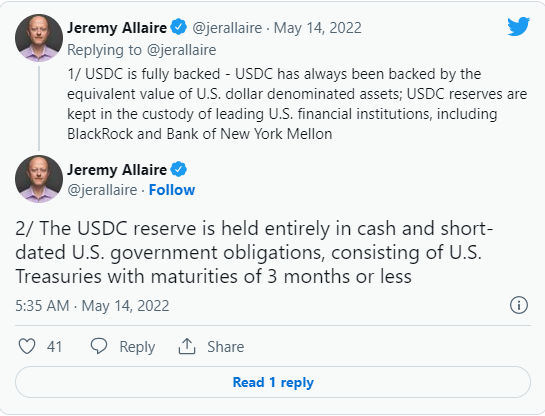
USDC has performed even better than Tether at its primary task: tracking the U.S. dollar.

Regulators were slow to react…

Regulators were stepping up their focus on stablecoins before the Terra meltdown, though perhaps a little late, given what has happened. In the United States, President Joe Biden signed his Executive Order on Ensuring Responsible Development of Digital Assets on March 9 — to an unexpected chorus of approval from the broader crypto industry.

In early April, the United Kingdom announced its intentions to regulate as-of-yet-unspecified stablecoins. The same month, a leading member of the U.S. Senate Banking Committee, Senator Patrick Toomey, introduced the “Stablecoin Transparency of Reserves and Uniform Safe Transactions Act of 2022,” dubbed the Stablecoin TRUST Act for short, addressing cryptocurrencies whose prices are pegged to the U.S. dollar or other assets.

Ironically, in an interview with the Financial Times published on May 6, as Terra began its descent toward zero value, Senator Toomey called on regulators to do more to regulate stablecoins “before some bad thing happens.” However, even he seems not to have predicted how quickly things were going to unfold:

“He pushed back against some of the stricter measures being promoted by Democrats, who believe stablecoins are now worth so much money that their operators should be regulated like banks.”

Since then, things have started to move more quickly. Once the Terra route began, from about May 5, regulators quickly stepped up their level of vigilance. In a report issued on May 9, the U.S. Federal Reserve said stablecoins were “vulnerable to runs” and lacked transparency about their assets. And Treasury Secretary Janet Yellen recently commented on the urgent need for guardrails, saying it would be “highly appropriate” for lawmakers to enact legislation as soon as this year.

Elsewhere, in June, Japan became one of the first countries — and by far the largest economy — to regulate a form of non-fiat digital money when its parliament approved the regulation of yen-linked stablecoins. This was not Terra-collapse related but based on a regime first proposed by Japan’s Financial Services Agency in March 2021. The new law guarantees face-value redemption, restricts stablecoin creation to regulated institutions, and requires stricter Anti-Money Laundering measures.

…and are missing the point

Despite these warnings and emerging policy steps, what seems to be missing is a clear distinction between algorithmic and asset-backed stablecoins. In my view, asset-backed fiat stablecoins should be regulated by governments and have capital adequacy rules and restrictions on what can be done with reserves.

Algo stablecoins, if they survive as a class, should come with extensive health warnings about the risks that remain on consumers’ shoulders. Algos are the latest in a long line of innovations — the next won’t be long in coming, and regulators won’t be ready for it either. The reality is that people need to take care of their own assets and wealth. Any fully decentralized environment always requires that people protect their own assets closely and with vigilance.

And compounding the sense that reality is outstripping regulators’ ability to keep up, the existence of fully backed coins, such as USDC, seems to remove any need for the U.S. government to develop its own central bank digital currency, or what some call the “digital dollar.”

Darkest before the dawn

At the time of writing, we are only a few weeks past the Terra collapse. As a result, stablecoins are under a cloud, and the long-term impact on the broader ecosystem of blockchain tokens, which remain under pressure since prices peaked in September 2021, is still unclear.

Many commentators are reveling in the crypto gloom, stoking the latent skepticism many people feel about the entire crypto project unleashed by Satoshi Nakamoto.

In my opinion, as far as stablecoins are concerned, it’s a case of being “darkest before the dawn.” Most people did not — and still do not — understand that all stablecoins were not born equal. Algorithmic stablecoins, as is now obvious, were a disaster waiting to happen. Fully backed stablecoins — ideally within the regulatory environment being planned or adopted in the U.S., U.K. and Japan, among others — are a perfectly sensible option with important roles to play in the hybrid crypto-fiat economies of the future. Their time has come.

Lectures associées

L'écume des matchs nuls du football : Polymarket révèle les écarts extrêmes de gains et pertes lors de la Coupe du Monde

Un utilisateur nommé "fishalive" a réalisé un gain d'environ 9 millions de dollars sur Polymarket en pariant contre la victoire de l'Espagne et sur l'écart de buts (+2,5) du Cap-Vert lors du match nul 0-0 de la Coupe du Monde 2026. Avec seulement 400 000 $ de mise initiale, ses contrats se sont réglés à hauteur de plus de 13 millions de dollars. Ce résultat a entraîné des pertes massives pour d'autres parieurs qui avaient misé lourdement sur la victoire des favoris comme l'Espagne, les Pays-Bas et la Belgique, dont un pari de 8,6 millions de dollars sur la Belgique anéanti par un match nul contre l'Égypte. L'article explique que les paris simples sur la victoire d'une équipe, bien que très probables, deviennent sans valeur en cas de match nul. Les gains asymétriques importants proviennent plutôt de contrats couvrant ce risque, comme les paris "l'équipe ne gagnera pas" ou les handicaps. Le marché des prédictions pour cette Coupe du Monde a dépassé 2,5 milliards de dollars de volume sur Polymarket. La transparence de la blockchain, le règlement rapide et l'aspect émotionnel du tournoi attirent l'attention au-delà de la cryptosphère. La tendance devrait voir les parieurs se tourner vers des contrats couvrant le risque de match nul. Le secteur fait également face à des défis réglementaires croissants, les autorités américaines et espagnoles s'interrogeant sur la qualification de ces marchés comme paris ou produits financiers.

Foresight NewsIl y a 14 mins

L'écume des matchs nuls du football : Polymarket révèle les écarts extrêmes de gains et pertes lors de la Coupe du Monde

Foresight NewsIl y a 14 mins

ChatGPT perd la moitié de sa part de marché : de la domination à la concurrence en trois ans et demi

Il y a trois ans et demi, ChatGPT a révolutionné l'Internet en devenant l'application à la croissance la plus rapide de l'histoire. Cependant, selon un rapport de Sensor Tower, sa part de marché mondiale est désormais tombée sous les 50% pour la première fois, s'établissant à 46,4% en mai 2026. Elle reste le premier assistant IA, mais ne domine plus le marché. Les principaux concurrents, Gemini (27,7%) et Claude (10,3%), gagnent du terrain. Gemini profite de l'écosystème Google, tandis que Claude se distingue par ses performances dans les tâches de productivité comme l'écriture et le code. Les utilisateurs, devenus moins fidèles, choisissent l'outil le plus adapté à chaque contexte. Le secteur entre dans une phase de concurrence et de monétisation. Les dépenses des utilisateurs dans les applications IA devraient dépasser 4,2 milliards de dollars au premier semestre 2026. ChatGPT teste désormais la publicité, et Claude affiche un fort taux de conversion vers ses offres payantes. Malgré une croissance robuste, OpenAI, comme ses rivaux, fait face à des coûts opérationnels faramineux, liés à l'entraînement des modèles. Le marché des assistants IA généraux se consolide autour de trois acteurs majeurs, laissant des opportunités dans des niches verticales. La chute de la part de ChatGPT symbolise la normalisation de l'IA. Les utilisateurs ne s'émerveillent plus ; ils comparent, critiquent et exigent de la fiabilité et de la valeur. L'IA perd son statut de nouveauté pour devenir un outil du quotidien, dans un paysage concurrentiel où aucun leader n'est assuré.

marsbitIl y a 26 mins

ChatGPT perd la moitié de sa part de marché : de la domination à la concurrence en trois ans et demi

marsbitIl y a 26 mins

La Coupe du monde a commencé, voici ceux qui ont "fait fortune" et ceux qui "se sont ruinés" sur les marchés de prédiction

La Coupe du Monde a commencé, entraînant une croissance exponentielle des volumes sur les marchés de prédiction. Selon un rapport de Bernstein, l'édition 2026 devrait générer jusqu'à 10 milliards de dollars de transactions et plus de 3 milliards de dollars de capitaux supplémentaires pour les paris sportifs. Les plateformes comme Polymarket sont le théâtre de gains spectaculaires et de pertes tout aussi importantes. Du côté des gains, des traders ont réalisé des profits impressionnants. Un utilisateur (@mintblade) a remporté 9,24 millions de dollars en une journée avec 4 paris gagnants, dont un pari de 7,03 millions de dollars sur la non-victoire de l'Iran. Un nouveau portefeuille (@Fishalive) a transformé 4,22 millions de dollars en 13,28 millions en pariant contre l'Espagne lors de son match nul contre le Cap-Vert, réalisant un profit de 9,06 millions de dollars. D'autres, comme @LEEEROYJENKINS et @endlessFate, ont également engrangé des gains de plusieurs millions. Cependant, il y a aussi des perdants. Le match nul entre l'Espagne et le Cap-Vert a notamment coûté 999 000 dollars à un utilisateur (@betoor619) qui avait massivement parié sur une victoire espagnole. Un autre trader (@weatherman12) a perdu 1,81 million de dollars en pariant contre l'Argentine, qui a battu l'Algérie 3-0 grâce à un triplé de Lionel Messi. Odaily rappelle que les paris sur les événements sportifs sont soumis à d'importantes incertitudes et que les suivis de positions ("copy trading") doivent être abordés avec une extrême prudence.

Odaily星球日报Il y a 1 h

La Coupe du monde a commencé, voici ceux qui ont "fait fortune" et ceux qui "se sont ruinés" sur les marchés de prédiction

Odaily星球日报Il y a 1 h

La fortune de Musk dépasse la capitalisation du Bitcoin : La spéculation autour de la flambée de SpaceX

La fortune personnelle d’Elon Musk a atteint environ 1,32 trillion de dollars, dépassant ainsi la capitalisation boursière du Bitcoin, estimée à 1,29 trillion de dollars. Cette situation fait suite à l’introduction en bourse de SpaceX, dont l’action a bondi de plus de 50 % en une semaine, portant sa valorisation à près de 2 700 milliards de dollars. Ce renversement s’explique en partie par le recul du marché cryptographique, qui a vu sa valeur totale chuter de 4,21 à 2,23 billions de dollars sur un an, tandis que le Bitcoin a perdu plus de 50 % depuis son pic de fin 2025. Les capitaux spéculatifs se détournent progressivement des crypto-actifs au profit d’actifs comme SpaceX. L’engouement pour SpaceX est particulièrement fort parmi les investisseurs particuliers, notamment en Corée du Sud, où ceux-ci ont acheté pour près de 800 millions de dollars d’actions dès le premier jour de cotation. Les produits à effet de levier liés à SpaceX ont également connu des volumes d’échanges records. Cependant, des doutes subsistent quant à la valorisation de l’entreprise, qui a enregistré une perte nette de 4,94 milliards de dollars en 2025 et de 4,27 milliards au premier trimestre 2026. Les investisseurs misent largement sur la vision d’Elon Musk, qui promet un chiffre d’affaires de 1 000 milliards de dollars d’ici 2030 grâce à Starlink, l’IA et d’autres projets. Ce cap symbolique montre que le plus grand pari spéculatif du marché ne se situe plus nécessairement dans les crypto-monnaies, mais dans une société spatiale cotée en bourse.

marsbitIl y a 1 h

La fortune de Musk dépasse la capitalisation du Bitcoin : La spéculation autour de la flambée de SpaceX

marsbitIl y a 1 h

Trading

Spot
Futures
活动图片