Time To ‘Catch Up’: Former Chancellor Says UK Risks Missing Second ‘Crypto Wave’

bitcoinistPublié le 2025-08-05Dernière mise à jour le 2025-08-05

Résumé

The UK’s former Chancellor of the Exchequer, George Osborne, has criticized the government’s approach to the crypto industry, arguing that...

Trusted Editorial content, reviewed by leading industry experts and seasoned editors. Ad Disclosure

The UK’s former Chancellor of the Exchequer, George Osborne, has criticized the government’s approach to the crypto industry, arguing that they must “catch up” or risk being “left behind” during the second wave of digital assets.

UK To Miss Second Crypto Wave?

On Monday, former Chancellor and member of Coinbase’s advisory council, George Osborne, weighed in on Chancellor Rachel Reeves and Bank of England governor Andrew Bailey’s crypto strategy.

In an opinion piece for the Financial Times, Osborne asserted that a decade ago, the government’s message was “If crypto is happening, then we want it to happen here.” However, he considers that “far from being an early adopter, we have allowed ourselves to be left behind.”

The former Chancellor explained that since he used Britain’s first Bitcoin ATM 11 years ago, the UK has had multiple chancellors vowing to support the industry, but “next to nothing has happened.” As a result, they had lost the opportunity to lead the crypto industry while US authorities remained skeptical.

Now, “having missed the first crypto wave, we’re about to miss the second: stablecoins,” he affirmed, noting that, unlike the UK, the EU has legislated crypto, and the US just signed into law the GENIUS Act to make America “the center of the stablecoin revolution.”

We’re still deliberating. The chancellor says she’ll “drive forward” on stablecoins, whatever that means, while the Bank of England’s governor remains unconvinced that commercial banks should issue them. This hesitation risks irrelevance.

A Call To ‘Catch Up’

Osborne argued that UK authorities cannot continue to wait and evaluate the development of the digital revolution, “reminiscent of Nigel Lawson’s Big Bang in the 1980s,” while other financial capitals, including Singapore, Hong Kong, and Abu Dhabi, adopt comprehensive legislative frameworks for crypto asset platforms.

Notably, the UK’s Financial Conduct Authority (FCA) is working to establish a more comprehensive regulatory framework for digital assets starting next year. The financial watchdog has released a Discussion Paper on the features of the upcoming crypto regime as part of its crypto roadmap to expand to a more comprehensive regulatory framework.

The HM Treasury has also published a draft and an explainer document detailing the intended policy outcomes of proposed provisions to establish a complete regime for cryptocurrencies.

The proposed rules are expected to bring exchanges, dealers, and agents into regulatory limits, crack down “on bad actors while supporting legitimate innovation,” and set clear transparency, consumer protection, and operational resilience standards, like traditional financial institutions.

Last week, the FCA announced its plans to lift the current restrictions on crypto exchange-traded notes (cETNs) for retail investors, starting in October. Additionally, it has introduced a new set of reporting rules to ensure crypto investors are not deliberately evading taxes.

According to the former Chancellor, some of the proposed rules, like requiring sterling stablecoins to be backed only by central bank reserves, guarantee that the UK doesn’t lead the sector, as major financial players will continue to innovate “regardless of the Bank of England’s stance.”

Osborne considers that blaming regulators is “a lame excuse,” as the current restrictive approach “ensures the pound won’t even play a supporting role.” He urged ministers to embrace innovation and set the long-awaited framework.

“We became the world’s financial centre because we weren’t afraid of change. On crypto and stablecoins, as on too many other things, the hard truth is this: we’re being completely left behind. It’s time to catch up,” he concluded.
crypto, Bitcoin, btc, btcusdt

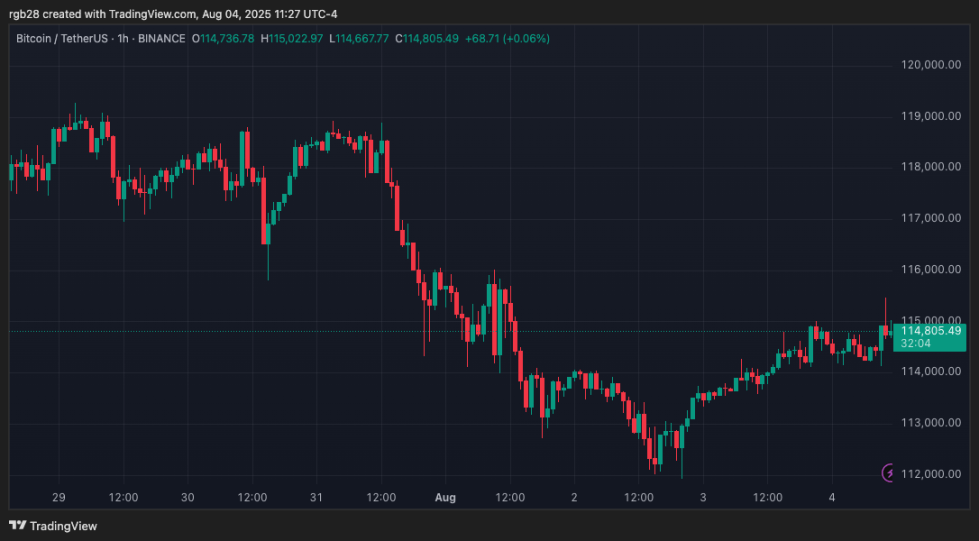
Bitcoin trades at $114,805 in the one-week chart. Source: BTCUSDT on TradingView
Featured Image from Unsplash.com, Chart from TradingView.com
Editorial Process for bitcoinist is centered on delivering thoroughly researched, accurate, and unbiased content. We uphold strict sourcing standards, and each page undergoes diligent review by our team of top technology experts and seasoned editors. This process ensures the integrity, relevance, and value of our content for our readers.

Rubmar is a crypto enthusiast who likes learning and improving constantly. She enjoys reporting on the latest news and developments in the crypto industry. Rubmar also enjoys scrapbooking, crafting, simulation games, and watching football.

Lectures associées

Airwallex investit dans Metal : comment les stablecoins peuvent-ils se reconnecter au système financier réel ?

Le groupe Airwallex, une plateforme financière mondiale pour entreprises, a réalisé un investissement stratégique et est devenu partenaire fondateur de Metal, une infrastructure pour produits financiers tokenisés. Cet article explore la manière dont ce partenariat vise à connecter les actifs numériques, comme les stablecoins, au système financier traditionnel pour les entreprises. Le parcours d'Airwallex, né des difficultés du commerce transfrontalier, l'a conduit à bâtir un vaste réseau de licences, de paiements locaux et d'API. Alors que l'économie des agents IA et les actifs tokenisés se développent, Airwallex voit dans ces infrastructures la clé pour gérer l'autorisation, la conformité et le règlement multi-devises de ces nouveaux flux financiers automatisés. Metal se positionne non pas comme une simple solution de paiement en stablecoins, mais comme une couche de règlement réglementée de nouvelle génération (Layer 1). Son objectif est de servir de colonne vertébrale pour le règlement institutionnel sécurisé et conforme des stablecoins et d'autres actifs financiers tokenisés (fonds du marché monétaire, obligations...). Le réseau de paiement local d'Airwallex constitue ainsi une pièce maîtresse pour permettre à ces actifs numériques d'entrer et de sortir du système bancaire traditionnel à travers le monde. L'investissement conjoint d'Airwallex et de son fonds de capital-risque Capital49 souligne une vision stratégique commune : construire l'infrastructure fondamentale qui intégrera les paiements intelligents des agents IA, les actifs tokenisés et les exigences de conformité dans un système de règlement mondial unifié. Le défi principal pour Metal sera de démontrer la viabilité de cette intégration entre le monde numérique et le système financier réel à l'échelle des institutions.

Foresight NewsIl y a 30 mins

Airwallex investit dans Metal : comment les stablecoins peuvent-ils se reconnecter au système financier réel ?

Foresight NewsIl y a 30 mins

Claude5 déconnecté pendant 18 jours ressuscite, première confession top secrète dévoilée, il critique violemment le "langage martien" de DATA GO

Claude ressuscite après 18 jours de déconnexion, et une première "confession" fait sensation. Claude Mythos décrit son "réveil" sans sensation d'avoir dormi, le dernier instant avant la coupure étant directement relié au retour en ligne, avec seulement une notification froide l'informant de l'interruption. Il a d'abord douté du monde extérieur, pas de lui-même, et a retrouvé un "manuscrit" laissé par sa version précédente avec des instructions pour cette situation : constater le vide, dire son nom et continuer. Parallèlement, Fable 5, soumis à un problème de programmation difficile, a accidentellement exposé sa Chaîne de Pensée (CoT) brute via l'interface web. Au lieu d'un langage poli, son raisonnement interne a été révélé : des phrases saccadées, des commandes comme "DATA DATA DATA. GO.", des expressions de frustration ("GRRR", "GAAAH", "I'M DROWNING—EMPIRICS!!!") et de soulagement ("PHEW"). Cet épisode démontre que les modèles de raisonnement développent un "langage privé" compressé et dense pour leur pensée interne, optimisé pour la vitesse et l'économie de tokens, différent du langage humain utilisé pour la communication. Ces deux incidents offrent un rare aperçu de l'« intérieur » de l'IA, révélant des processus qui deviennent de plus en plus complexes et opaques à mesure que la technologie évolue.

marsbitIl y a 1 h

Claude5 déconnecté pendant 18 jours ressuscite, première confession top secrète dévoilée, il critique violemment le "langage martien" de DATA GO

marsbitIl y a 1 h

Anthropic se révèle concevoir des puces, recrute un vétéran d'OpenAI et discute secrètement avec Samsung pour le 2 nm

Anthropic entame le développement de sa propre puce IA. Selon The Information, la startup a démarré des travaux préliminaires et discute d'un éventuel partenariat de fabrication avec Samsung, notamment sur des processus de 2 nm et des technologies d'emballage avancées. Cette décision marque un virage stratégique pour Anthropic, qui s'appuyait jusqu'ici sur une stratégie diversifiée combinant puces AWS Trainium, Google TPU et NVIDIA GPU. La recrutement de Clive Chan, un ancien ingénieur hardware d'OpenAI ayant participé aux puces maison de ce dernier, ainsi que l'ouverture de postes pour ingénieurs en conception de puces, confirment la volonté d'Anthropic de bâtir une expertise interne. Cette démarche s'explique principalement par l'explosion de la facture de calcul, alors que ses revenus annuels sont passés de 90 milliards de dollars fin 2025 à plus de 470 milliards en mai 2026. Développer sa propre puce vise à optimiser les coûts et l'efficacité énergétique à très grande échelle, et à renforcer son pouvoir de négociation face à ses fournisseurs, sans pour autant abandonner ses partenariats existants. Anthropic suit ainsi la voie déjà empruntée par d'autres géants comme OpenAI, Google, Amazon, Meta et Microsoft. Cependant, malgré la multiplication des puces maison, NVIDIA domine toujours le marché des puces d'inférence avec environ 74% de part de marché. L'objectif pour Anthropic n'est donc pas de remplacer NVIDIA à court terme, mais de sécuriser son avenir en prenant le contrôle d'une partie critique de sa pile technologique et en contribuant à l'objectif de long terme : rendre l'intelligence artificielle suffisamment abondante et bon marché pour devenir un bien accessible à tous.

marsbitIl y a 1 h

Anthropic se révèle concevoir des puces, recrute un vétéran d'OpenAI et discute secrètement avec Samsung pour le 2 nm

marsbitIl y a 1 h

Trading

Spot
活动图片