Stablecoins Accumulate an Extra $4B After GENIUS Act – Join the Crypto Revolution With Best Wallet

bitcoinistPublié le 2025-07-25Dernière mise à jour le 2025-07-25

Résumé

The GENIUS Act was passed just a week ago, and already, $4 billion has poured into stablecoins. This surge shows...

Trusted Editorial content, reviewed by leading industry experts and seasoned editors. Ad Disclosure

The GENIUS Act was passed just a week ago, and already, $4 billion has poured into stablecoins. This surge shows just how quickly stablecoins are gaining traction, confirming their role as a major player in the digital asset space.

Not only is this stablecoin bill a green light for the industry, but it also signals a new era for cryptocurrencies and wallets.

With clearer regulations and increased institutional interest, we’re entering a phase where crypto could become a mainstream financial tool.

And Best Wallet is stepping up at the perfect time. This non-custodial crypto wallet offers a secure and seamless way to manage fiat-backed cryptos, alongside other digital assets, as institutional adoption takes off.

GENIUS Act Pushes Stablecoin Market Cap to $270B+

Since the GENIUS Act has been in effect, the total stablecoin market has surpassed $270B, partly driven by over $4B in new inflows.

Fiat-backed stablecoins, such as $USDT and $USDC, are thriving, accounting for 85% of the entire stablecoin market.

Under the GENIUS Act, issuers of these cryptos must maintain full reserves, undergo regular audits, and hold a legitimate license—measures designed to enhance trust and boost credibility in the crypto sector.

It’s a major advancement since algorithmic stablecoins (which are now banned) came into play, as they’ve proven vulnerable in the past. Just look at the Terra collapse, for instance.

Yes, crypto-backed stablecoins like $DAI are still relevant, as evidenced by its $5.36B market cap. But fiat-backed ones are taking over the spotlight.

Major institutions are taking notice, and Anchorage Digital is leading the charge. As the only federally chartered U.S. crypto bank, Anchorage is teaming up with Ethena Labs to launch its stablecoin issuance platform, set to introduce the highly anticipated $USDtb stablecoin.
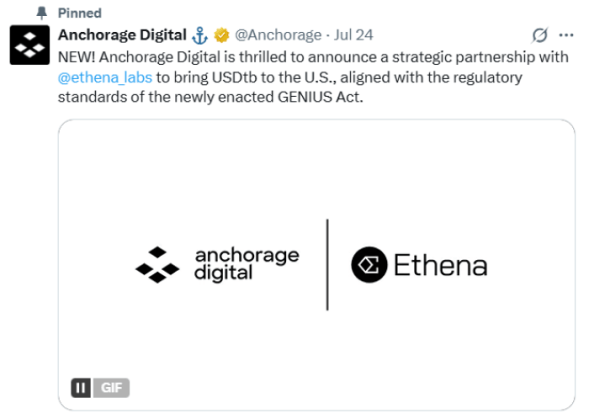
Anchorage Digital stablecoin platform
Source: X (Anchorage Digital)

Yesterday, asset management titan WisdomTree also introduced $USDW, a regulated, dollar-backed stablecoin designed to enable dividend-paying tokenized assets.

TradFi companies aren’t sitting on the sidelines, either. Several major banks, including Bank of America and Citibank, are preparing to launch their own stablecoins once the regulatory dust settles.

This rapid shift in market sentiment provides Best Wallet with the ideal environment to thrive. As digital assets, mainstream and stablecoins have become a core part of finance, and you’ll need a secure and simple wallet to hold.

Best Wallet Secures Stablecoin Investments

Best Wallet makes it easy to buy, store, send, and swap fiat-backed stablecoins like $USDT, plus other major cryptos – like $ETH and $BTC – without giving up custody or control.

It’s multi-chain, multi-wallet, and fully private. It doesn’t require KYC or middlemen. Hence, it’s our #1 anonymous crypto wallet.

And it has lots of attractive features in the pipeline to help you up your trading stance. This includes exclusive wallet market insights so you can buy, sell, and manage crypto more effectively.

Best Wallet market insights
Source: Best Wallet

One of its most standout upcoming developments, however, is Best Card. Once launched, the crypto debit card will enable you to spend your crypto on the move,hassle-free.

Not forgetting that Best Wallet’s also preparing to support over 60 blockchain networks, debut its own NFT gallery, rewards hub, and in-app crypto news feed.

And all of these developments couldn’t come at a better time – just as regulation clears and crypto goes mainstream.

To get the most out of the Best Wallet ecosystem, however, you’ll want to purchase $BEST, its native token. Then, you can also enjoy governance rights, lower transaction fees, higher staking rewards (currently at a 96% APY), and easier access to the best crypto presales.

The demand for the token is already evident. $BEST has raised over $14M in presales, backed heavily by crypto whales, with three in particular injecting $49.5K, $25K, and $18.7K into the project.

$BEST to Triple in Price as Stablecoins Go Mainstream

The writing is on the wall: regulation is here, institutions are on board, and stablecoins are quickly becoming a key asset in modern finance.

As this new chapter in regulated digital finance unfolds, the tools you use to interact with crypto are more essential than ever.

Best Wallet is positioning itself as a major player in the space, thanks to its unwavering focus on privacy, flexibility, and powerful trading features.

Still, to get the most out of this non-custodial wallet, you’ll want to purchase $BEST, and you can do just that for as little as $0.025385. Though it’s best to act fast for 183% less, as the upcoming app developments could propel it to $0.072.

This isn’t investment advice. DYOR and don’t invest more than you’d be sad to lose.

Editorial Process for bitcoinist is centered on delivering thoroughly researched, accurate, and unbiased content. We uphold strict sourcing standards, and each page undergoes diligent review by our team of top technology experts and seasoned editors. This process ensures the integrity, relevance, and value of our content for our readers.

Leah is a British journalist with a BA in Journalism, Media, and Communications and nearly a decade of content writing experience. Over the last four years, her focus has primarily been on Web3 technologies, driven by her genuine enthusiasm for decentralization and the latest technological advancements. She has contributed to leading crypto and NFT publications – Cointelegraph, Coinbound, Crypto News, NFT Plazas, Bitcolumnist, Techreport, and NFT Lately – which has elevated her to a senior role in crypto journalism. Whether crafting breaking news or in-depth reviews, she strives to engage her readers with the latest insights and information. Her articles often span the hottest cryptos, exchanges, and evolving regulations. As part of her ploy to attract crypto newbies into Web3, she explains even the most complex topics in an easily understandable and engaging way. Further underscoring her dynamic journalism background, she has written for various sectors, including software testing (TEST Magazine), travel (Travel Off Path), and music (Mixmag). When she's not deep into a crypto rabbit hole, she's probably island-hopping (with the Galapagos and Hainan being her go-to's). Or perhaps sketching chalk pencil drawings while listening to the Pixies, her all-time favorite band.

Lectures associées

Les fonctionnalités d'agents intelligents de Doubao et Qianwen seront retirées le 15 juillet

Le 4 juillet, les plateformes d’IA Doubao et Tongyi Qianwen ont annoncé la suppression imminente de leurs fonctionnalités d’agents intelligents. Doubao a confirmé que ses agents seront désactivés le 15 juillet, redirigeant les utilisateurs vers l’application Mao Xiang. De son côté, Tongyi Qianwen a indiqué que les agents personnalisés et les interactions personnalisées cesseront le 10 juillet, avec une fermeture complète le 15 juillet, après quoi les configurations et l’historique des conversations ne seront plus accessibles. Cette décision touche des scénarios d’utilisation personnalisés centraux pour les utilisateurs, tels que le jeu de rôle, les assistants spécialisés et les agents outils. Le choix de la date du 15 juillet n’est pas un hasard : elle correspond à l’entrée en vigueur du Règlement intérimaire sur la gestion des services d’interaction personnalisée en IA, qui renforce les exigences en matière de contrôle du temps d’écran, de vérification d’identité des mineurs et de modération des contenus. Face à cette régulation, les plateformes adoptent une démarche proactive pour réduire les risques de conformité. Elles offrent toutefois une période de transition aux utilisateurs pour sauvegarder leurs données via des captures d’écran ou des exports, avant suppression définitive prévue en octobre pour Doubao. Au-delà des pressions réglementaires, des défis économiques expliquent également ce retrait. Les agents personnalisés, bien que générateurs de trafic, consomment beaucoup de ressources informatiques tout en ayant une faible valeur commerciale directe. Dans une phase où l’IA doit prouver sa viabilité économique, les plateformes réorientent leurs ressources vers des services à plus haute valeur, notamment pour les entreprises, comme en témoigne l’ouverture récente de Qianwen aux développeurs et marques tiers.

marsbitIl y a 42 mins

Les fonctionnalités d'agents intelligents de Doubao et Qianwen seront retirées le 15 juillet

marsbitIl y a 42 mins

Pourquoi Codex et ChatGPT ont-ils fusionné ? Quel avenir pour Codex ? Un responsable clé d'OpenAI répond à toutes les questions

En 2026, Codex est le produit d'IA à la croissance la plus remarquable, avec une multiplication par cinq de ses utilisateurs actifs hebdomadaires depuis janvier, atteignant désormais 5 millions. Cette croissance exponentielle, particulièrement rapide parmi les travailleurs du savoir non-développeurs, a été catalysée par le lancement de son application de bureau en février, offrant une interface optimisée. Dans une interview, Andrew Ambrosino, responsable de l'application de bureau Codex, aborde les transformations profondes induites par l'IA. Aujourd'hui, le coût de la « mise en œuvre » (coder) s'est effondré. Ce qui devient rare et précieux est le **goût** – la capacité de curation, de jugement et de prise de décision parmi une multitude de possibilités. Ce « goût » englobe l'esthétique, la pensée systémique, le sens de la direction et la sémantique des interactions. Il explique pourquoi l'IA peine encore à bien concevoir : l'évaluation du design est subjective et culturelle, contrairement au code qui a des critères objectifs (compilation, fonction). De plus, la conception nécessite une compréhension des abstractions profondes et des relations structurelles au sein d'un système, ce qui reste un défi. Andrew souligne que le succès d'un produit d'IA dépend moins de son interface que des **capacités du modèle au moment du lancement**. La même application Codex aurait échoué si elle était sortie quelques mois plus tôt, avant une progression cruciale du modèle. Concernant les rôles au sein des équipes, les frontières entre ingénieur, designer et chef de produit s'estompent, mais les compétences spécifiques de chaque métier restent cruciales. La tendance est à l'élargissement des responsabilités, non à la suppression des spécialisations. Enfin, il détaille la fusion entre Codex et ChatGPT. L'observation clé est que la frontière entre outil de développement et outil de travail généraliste s'efface. Codex, initialement conçu pour les développeurs, était massivement utilisé par tous les métiers. Plutôt que de créer des applications séparées, la vision est de construire une **« base centrale » (home base)** unique et suffisamment générique. Cette plateforme servirait de point de départ pour toutes les tâches, capable d'interagir de manière transparente avec les outils spécialisés existants (comme Excel ou Premiere Pro) via des connecteurs, plutôt que de tout recréer en interne. L'objectif est de devenir l'assistant universel qui orchestre le travail de l'utilisateur à travers son écosystème numérique.

marsbitIl y a 50 mins

Pourquoi Codex et ChatGPT ont-ils fusionné ? Quel avenir pour Codex ? Un responsable clé d'OpenAI répond à toutes les questions

marsbitIl y a 50 mins

Trading

Spot
活动图片