Trump Shares ‘Greatest Bitcoin Explanation Of All Time’—Is It A Hint?

bitcoinistPublié le 2025-07-21Dernière mise à jour le 2025-07-21

Résumé

In a late‑night Truth Social post on July 21, President Donald Trump embedded a video of Coin Center research director Peter Van Valkenburgh’s 2018 Senate...

Trusted Editorial content, reviewed by leading industry experts and seasoned editors. Ad Disclosure

In a late‑night Truth Social post on July 21, President Donald Trump embedded a video of Coin Center research director Peter Van Valkenburgh’s 2018 Senate testimony and declared it the “greatest Bitcoin explanation of all time,” urging supporters to watch the full clip.

The video, recorded during a Banking Committee hearing on the nascent crypto ecosystem, presents Van Valkenburgh’s core argument that Bitcoin is “the world’s first public digital payments infrastructure.” “It lets you send and receive value to and from anyone in the world using nothing more than a computer and an internet connection,” he tells lawmakers, later calling the protocol “a computer‑science breakthrough” that could rival “the birth of the Internet” for its impact on human freedom.

Report On The Strategic Bitcoin Reserve Incoming?

Trump’s public endorsement lands on the eve of a self‑imposed deadline. On January 23 the president signed Executive Order 14178, instructing a high‑level Working Group on Digital Asset Markets to deliver—within 180 days—a sweeping set of legislative and regulatory recommendations on cryptocurrencies. The report is due July 22.

Rumors circulating on X suggest that tomorrow’s document will, for the first time, publish an official inventory of federal Bitcoin holdings, consolidate those coins into the Strategic Bitcoin Reserve created by a March 6 order, and outline “budget‑neutral” mechanisms to expand the reserve without new taxpayer outlays.

Independent tallies suggest the numbers are substantial. Chainalysis estimates that wallets controlled by US agencies contain roughly 200,000 BTC—about $20.4 billion at current prices—making Washington the largest sovereign holder of Bitcoin.

However, it is not quite clear if the US government still owns all of them. In December 2024, weeks before Trump’s inauguration, a federal judge authorized the Justice Department to liquidate 69,370 BTC seized from the Silk Road hacker known as “Individual X,” a haul then worth about $6.5 billion. Prior to the election, coins were transferred to Coinbase Prime under the Biden administration.

Trump’s March order takes the opposite tack, forbidding sales of reserve Bitcoin and directing Treasury and Commerce to devise cost‑neutral acquisition strategies.

The president’s post also caps “Crypto Week.” On Friday Trump signed the GENIUS Act, the first federal statute governing dollar‑backed stablecoins, while the House advanced the CLARITY Act and the Anti‑CBDC Surveillance State Act, measures that would shift much enforcement to the Commodity Futures Trading Commission and bar a Federal Reserve digital currency.

Whether the Working Group’s report will echo Van Valkenburgh’s assertion that “Bitcoin is the world’s first globally accessible public money” remains to be seen. But with the president now personally amplifying that message—and with the policy blueprint due within hours—Washington’s next move on crypto will soon move from speculation to the public record.

At press time, BTC traded at $118,216.
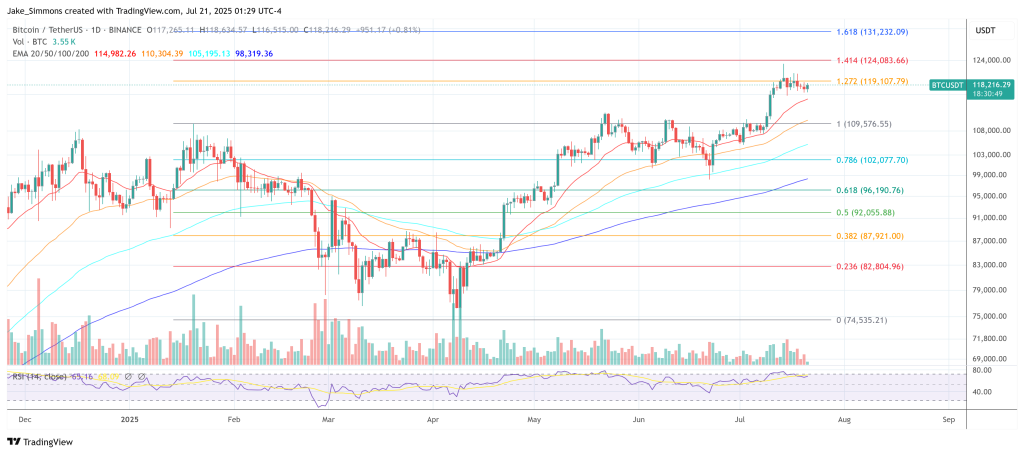
Bitcoin price
BTC stalls below the 1.272 Fib, 1-day chart | Source: BTCUSDT on TradingView.com
Featured image from YouTube, chart from TradingView.com
Editorial Process for bitcoinist is centered on delivering thoroughly researched, accurate, and unbiased content. We uphold strict sourcing standards, and each page undergoes diligent review by our team of top technology experts and seasoned editors. This process ensures the integrity, relevance, and value of our content for our readers.

Jake Simmons has been a Bitcoin enthusiast since 2016. Ever since he heard about Bitcoin, he has been studying the topic every day and trying to share his knowledge with others. His goal is to contribute to Bitcoin's financial revolution, which will replace the fiat money system. Besides BTC and crypto, Jake studied Business Informatics at a university. After graduation in 2017, he has been working in the blockchain and crypto sector. You can follow Jake on Twitter at @realJakeSimmons.

Lectures associées

Comment la feuille de route 'Lean' d'Ethereum pourrait remodeler l'ETH au cours des 4 prochaines années

Le développement d'Ethereum entre dans une nouvelle phase avec l'introduction de « Lean Ethereum », un plan de restructuration étalé sur 3 à 4 ans visant à remplacer les composants fondamentaux du protocole. Cette feuille de route prévoit l'intégration de technologies avancées comme les STARKs récursifs, la cryptographie post-quantique, le gaz multidimensionnel et une nouvelle architecture d'état pour améliorer l'évolutivité et la sécurité. Elle inclut également une augmentation des limites de gaz pour réduire les coûts de transaction et accélérer la finalité. Les développements pratiques actuels se concentrent sur deux défis majeurs : la sécurité post-quantique, testée via des réseaux de développement spécifiques (PQ Devnets), et une gestion d'état plus évolutive utilisant des arbres de Verkle et des modèles d'expiration d'état. L'objectif est de réduire les coûts de validation et les temps de synchronisation des nœuds. L'initiative « Glamsterdam » jette également les bases techniques de cet avenir en simplifiant le protocole et en préparant l'augmentation des capacités. L'ensemble de ces évolutions vise à renforcer la résilience à long terme d'Ethereum tout en préservant la compatibilité avec les applications existantes, assurant ainsi une croissance stable pour la prochaine décennie.

ambcryptoIl y a 49 mins

Comment la feuille de route 'Lean' d'Ethereum pourrait remodeler l'ETH au cours des 4 prochaines années

ambcryptoIl y a 49 mins

Dernier article long de Fei-Fei Li : Lorsque la génération vidéo, la robotique et NVIDIA se disent tous des modèles du monde, nous avons besoin d'une taxonomie

Dans un article, Li Fei-Fei propose une taxonomie pour clarifier le terme largement utilisé et souvent confus de « modèle du monde » en IA. Elle s'appuie sur le cadre classique du POMDP (processus de décision markovien partiellement observable) où un agent exécute des actions qui modifient l'état du monde, et reçoit en retour des observations. Elle distingue trois catégories fonctionnelles de « modèles du monde » selon leur sortie dans cette boucle : 1. **Le moteur de rendu (Renderer)** : Génère des observations (pixels visuels). Son critère est la fidélité visuelle (ex : Sora, Genie). Commercialement mature, il a une limite car la beauté ne garantit pas l'exactitude physique. 2. **Le simulateur (Simulator)** : Génère ou modélise des états du monde, avec une représentation géométrique et physiquement précise (ex : Omniverse de NVIDIA). C'est le pont clé et sous-estimé, car il sert à la fois aux humains (visualisation) et aux machines (entraînement de robots, planification). Il travaille sur la structure même du monde (géométrie, physique). 3. **Le planificateur (Planner)** : Génère des actions. À partir d'une observation et d'un but, il détermine la prochaine action d'un agent (ex : modèles vision-langage-action). C'est le plus excitant mais le moins mature, avec un écart important entre les démonstrations en labo et un déploiement réel fiable. Li Fei-Fei argue que le simulateur est le pivot crucial, car la maîtrise de la simulation fournit une base pour le rendu et la planification. La tendance actuelle est à la fusion de ces trois catégories, reposant sur l'idée qu'elles partagent une compréhension sous-jacente commune du monde. L'objectif final est un modèle du monde unifié capable de basculer entre ces fonctions. Cette convergence redéfinira l'intelligence spatiale, permettant aux machines non seulement de parler du monde (via le langage) mais de le comprendre, de l'imaginer et d'interagir avec lui.

marsbitIl y a 5 h

Dernier article long de Fei-Fei Li : Lorsque la génération vidéo, la robotique et NVIDIA se disent tous des modèles du monde, nous avons besoin d'une taxonomie

marsbitIl y a 5 h

Trading

Spot
活动图片