Coinbase Rebrands Wallet Experience Under Base App: Adding Social And App Features

bitcoinistPublié le 2025-07-18Dernière mise à jour le 2025-07-18

Résumé

Base, the Ethereum layer-2 network built by Coinbase, has officially unveiled a major evolution in its product strategy with the...

Trusted Editorial content, reviewed by leading industry experts and seasoned editors. Ad Disclosure

Base, the Ethereum layer-2 network built by Coinbase, has officially unveiled a major evolution in its product strategy with the launch of the Base App—a reimagined version of the Coinbase Wallet. This move marks the beginning of a new chapter, positioning Base as a frontrunner in the race to build the first true “everything app” for Web3.

More than just a rebrand, the Base App represents a fundamental shift in vision. Inspired by platforms like WeChat, the app bundles trading, payments, messaging, social features, and dApp discovery into a single user interface. The goal? To onboard the next wave of users beyond the crypto-native community and push blockchain-powered experiences into the mainstream.

The Layer-2 chain is aiming to offer a seamless, blockchain-native environment where users can chat, transact, invest, and interact without needing multiple apps or complex wallets. The timing aligns with growing calls for better user experience in Web3, and the company is betting that vertical integration through the chain can deliver it.

Base Unveils Web3 “Everything App” At Los Angeles Conference

The launch of the new Base App was officially announced during a conference in Los Angeles, where the company laid out its vision for a blockchain-native future. In a promotional video shared during the event, the company declared: “Coinbase Wallet is now much more than a wallet. Your new home to create, earn, trade, discover apps, and chat with friends all in one place.”

The message was clear: The app isn’t just an upgrade—it’s a full transformation into a multi-functional Web3 platform designed to rival the utility of mainstream tech super apps. The video continued, “Move money. Bring your identity wherever you go. Own your social graph. Use markets 24/7. Chat with your friends.”

This sweeping vision includes tight integration with decentralized exchanges like Aerodrome Finance and Uniswap, enabling seamless token trading within the app. Users can access markets, execute trades, and interact with DeFi protocols without leaving the platform.

Coinbase CEO and co-founder Brian Armstrong echoed this strategic shift on X, writing: “Coinbase Wallet has evolved. The Base app is your new onchain home to post, earn, trade, chat, and connect.”

By combining DeFi, social media, identity, and communication, Base is positioning itself as a serious contender to build Web3’s first mass-market application. Whether this new direction succeeds will depend on adoption beyond the crypto-native crowd, but the foundation is being laid.

Coinbase (COIN) Nears Major Resistance

Coinbase Global Inc. (NASDAQ: COIN) is approaching a critical resistance level, with its stock trading at $398.20 after gaining +2.88% this week. The weekly chart shows a strong bullish trend, fueled by momentum that began in mid-May. After clearing prior resistance around $320, COIN is now testing the psychologically important $400 level—a zone that previously marked a major rejection point in early 2022.
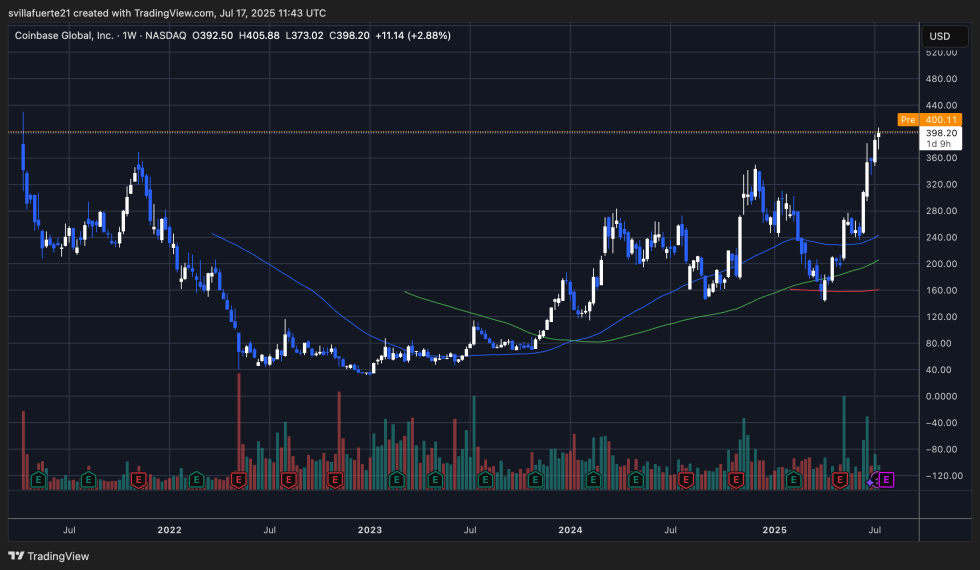
COIN testing critical resistance | Source: COIN chart on TradingView

Volume has picked up significantly during this recent rally, signaling strong institutional and retail participation. Technically, the 50-week moving average has crossed above the 100-week, confirming medium-term bullish momentum. Additionally, the 200-week moving average is flattening, which suggests the long-term downtrend may be ending.

A decisive breakout and close above $400 would open the door for a move toward the $450–$475 range, with the $500 mark acting as a potential magnet if bullish momentum continues. However, if the $400 barrier holds, a pullback to the $340–$360 area is likely, especially if broader market conditions weaken.

Featured image from Dall-E, chart from TradingView

Editorial Process for bitcoinist is centered on delivering thoroughly researched, accurate, and unbiased content. We uphold strict sourcing standards, and each page undergoes diligent review by our team of top technology experts and seasoned editors. This process ensures the integrity, relevance, and value of our content for our readers.

Sebastian's journey into the world of crypto began four years ago, driven by a fascination with the potential of blockchain technology to revolutionize financial systems. His initial exploration focused on understanding the intricacies of various crypto projects, particularly those focused on building innovative financial solutions. Through countless hours of research and learning, Sebastian developed a deep understanding of the underlying technologies, market dynamics, and potential applications of cryptocurrencies. As his knowledge grew, Sebastian felt compelled to share his insights with others. He began actively contributing to online discussions on platforms like X and LinkedIn, focusing on fintech and crypto-related content. His goal was to expose valuable trends and insights to a wider audience, fostering a deeper understanding of the rapidly evolving crypto landscape. Sebastian's contributions quickly gained recognition, and he became a trusted voice in the online crypto community. To further enhance his expertise, Sebastian pursued a UC Berkeley Fintech: Frameworks, Applications, and Strategies certification. This rigorous program equipped him with valuable skills and knowledge regarding Financial Technology, bridging the gap between traditional finance (TradFi) and decentralized finance (DeFi). The certification deepened his understanding of the broader financial landscape and its intersection with blockchain technology. Sebastian's passion for finance and writing is evident in his work. He enjoys delving into financial research, analyzing market trends, and exploring the latest developments in the crypto space. In his spare time, Sebastian can often be found immersed in charts, studying 10-K forms, or engaging in thought-provoking discussions about the future of finance. Sebastian's journey as a crypto analyst and investor has been marked by a relentless pursuit of knowledge and a dedication to sharing his insights. His ability to navigate the complex world of crypto, combined with his passion for financial research and communication, makes him a valuable asset to the industry. As the crypto landscape continues to evolve, Sebastian remains at the forefront, providing valuable insights and contributing to the growth of this revolutionary technology.

Lectures associées

Dernier article long de Fei-Fei Li : Lorsque la génération vidéo, la robotique et NVIDIA se disent tous des modèles du monde, nous avons besoin d'une taxonomie

Dans un article, Li Fei-Fei propose une taxonomie pour clarifier le terme largement utilisé et souvent confus de « modèle du monde » en IA. Elle s'appuie sur le cadre classique du POMDP (processus de décision markovien partiellement observable) où un agent exécute des actions qui modifient l'état du monde, et reçoit en retour des observations. Elle distingue trois catégories fonctionnelles de « modèles du monde » selon leur sortie dans cette boucle : 1. **Le moteur de rendu (Renderer)** : Génère des observations (pixels visuels). Son critère est la fidélité visuelle (ex : Sora, Genie). Commercialement mature, il a une limite car la beauté ne garantit pas l'exactitude physique. 2. **Le simulateur (Simulator)** : Génère ou modélise des états du monde, avec une représentation géométrique et physiquement précise (ex : Omniverse de NVIDIA). C'est le pont clé et sous-estimé, car il sert à la fois aux humains (visualisation) et aux machines (entraînement de robots, planification). Il travaille sur la structure même du monde (géométrie, physique). 3. **Le planificateur (Planner)** : Génère des actions. À partir d'une observation et d'un but, il détermine la prochaine action d'un agent (ex : modèles vision-langage-action). C'est le plus excitant mais le moins mature, avec un écart important entre les démonstrations en labo et un déploiement réel fiable. Li Fei-Fei argue que le simulateur est le pivot crucial, car la maîtrise de la simulation fournit une base pour le rendu et la planification. La tendance actuelle est à la fusion de ces trois catégories, reposant sur l'idée qu'elles partagent une compréhension sous-jacente commune du monde. L'objectif final est un modèle du monde unifié capable de basculer entre ces fonctions. Cette convergence redéfinira l'intelligence spatiale, permettant aux machines non seulement de parler du monde (via le langage) mais de le comprendre, de l'imaginer et d'interagir avec lui.

marsbitIl y a 6 h

Dernier article long de Fei-Fei Li : Lorsque la génération vidéo, la robotique et NVIDIA se disent tous des modèles du monde, nous avons besoin d'une taxonomie

marsbitIl y a 6 h

Trading

Spot
活动图片