Deaton Fights For The XRP Army—Again: New Legal Battle Begins

bitcoinistPublié le 2025-07-10Dernière mise à jour le 2025-07-10

Résumé

XRP investors are at the centre of a securities-fraud class action that accuses former Linqto chief executive William Sarris of...

Trusted Editorial content, reviewed by leading industry experts and seasoned editors. Ad Disclosure

XRP investors are at the centre of a securities-fraud class action that accuses former Linqto chief executive William Sarris of secretly imposing mark-ups of up to 60 percent on pre-IPO Ripple shares and other highly sought-after private-company equity like Uphold and Kraken sold through special-purpose vehicles on the fintech’s platform.

The 61-page complaint—Maxwell v. Sarris, filed on 9 July 2025 in the US District Court for the Southern District of New York—alleges that Sarris and unnamed accomplices acted as unregistered broker-dealers, used misleading offering exemptions and failed to deliver legal title to any of the underlying shares.

XRP Army’s Legal Champion Is Back

According to the filing, would-be purchasers were told the SPVs “held the same equity that insiders owned,” yet Linqto neither transferred the stock nor disclosed the hefty mark-ups baked into the purchase price—conduct the plaintiffs say violates Section 10(b) of the Securities Exchange Act and FINRA Rule 2040. Linqto’s own bankruptcy papers, lodged a day earlier in the Southern District of Texas, concede “historical failures to follow US laws governing the sale and marketing of private-company interests.”

Lead counsel John E. Deaton—best known for representing XRP holders in SEC v. Ripple—contends that Sarris “damaged the mission of democratising access to Silicon Valley” and misled ordinary investors: “People believed they were buying shares of Ripple, shares of SpaceX, but that’s not what they were buying.”

Because Sarris is sued in his personal capacity, Deaton argues the litigation is not stayed by Linqto’s Chapter 11 petition of 8 July 2025. The company, now led by chief executive Dan Siciliano, has secured up to $60 million in debtor-in-possession financing and says court oversight is “the only way forward” to emerge as “a profitable, law-abiding organisation” while it cooperates with SEC and FINRA investigations.

Investor outreach has proved challenging. Deaton scheduled an X Spaces session for 7:30 p.m. EST on 9 July, but abandoned the effort after repeated crashes, posting instead: “The spaces keeps crashing. We will set up a conference call early next week via phone line. I won’t do a Zoom link again because it got bombed last time.” He also reassured international users: “Anything I do includes ALL Linqto customers, regardless of where you live.”

Meanwhile, restructuring jockeying has begun. Shareholder Sapien Group says it has marshalled a majority bloc of equity and may seek to dismiss the Chapter 11 case, while Deaton has signalled plans to engage the creditors’ committee—a move endorsed by forensic accountant Rob Loh, who wrote that the panel “will have real power in the bankruptcy process.” Deaton confirmed: “Rob is correct. We will have a real say in what happens in the bankruptcy.”

Regulatory pressure is mounting on multiple fronts: Linqto disclosed parallel probes by the SEC and FINRA, and former chief revenue officer Gene Zawrotny is pursuing a wrongful-termination claim in California state court, alleging retaliation for flagging compliance failures. Deaton is now also turning up the pressure on behalf of the XRP community—particularly those who believed they were purchasing legitimate pre-IPO shares of Ripple.

At press time, XRP traded at $2.42.
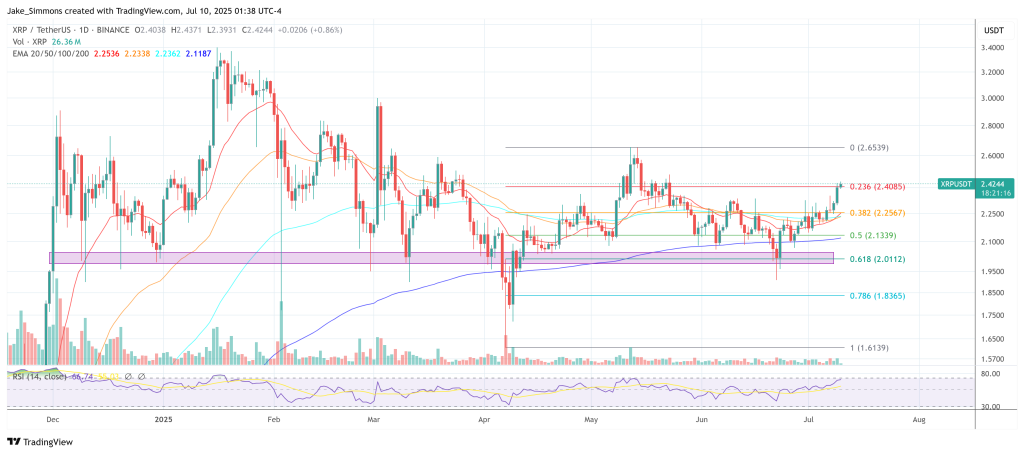
XRP price
XRP rises above the 0.236 Fib, 1-day chart | Source: XRPUSDT on TradingView.com
Featured image from YouTube, chart from TradingView.com
Editorial Process for bitcoinist is centered on delivering thoroughly researched, accurate, and unbiased content. We uphold strict sourcing standards, and each page undergoes diligent review by our team of top technology experts and seasoned editors. This process ensures the integrity, relevance, and value of our content for our readers.

Jake Simmons has been a Bitcoin enthusiast since 2016. Ever since he heard about Bitcoin, he has been studying the topic every day and trying to share his knowledge with others. His goal is to contribute to Bitcoin's financial revolution, which will replace the fiat money system. Besides BTC and crypto, Jake studied Business Informatics at a university. After graduation in 2017, he has been working in the blockchain and crypto sector. You can follow Jake on Twitter at @realJakeSimmons.

Lectures associées

Q-Day : Le compte à rebours avant que l'informatique quantique ne mette fin aux cryptomonnaies ?

**Q-Day et la Cryptographie : La Menace Quantique sur les Cryptomonnaies** L'avènement de l'ordinateur quantique tolérant aux fautes (CRQC) représente une menace existentielle pour les cryptomonnaies en raison de sa capacité à casser les algorithmes de chiffrement asymétrique actuels (comme ECDSA) via l'algorithme de Shor. Le "Q-Day", point critique où cette capacité devient pratique, est estimé entre 2035 et 2045. Les blockchains, par leur nature immuable et décentralisée, sont particulièrement vulnérables. Le risque est immédiat pour les actifs dont la clé publique est déjà exposée sur la chaîne (ex : certaines anciennes adresses Bitcoin). La migration vers la cryptographie post-quantique (PQC), comme les algorithmes basés sur les réseaux (ML-KEM/DSA) ou les hachages (SLH-DSA), est donc urgente. Cependant, cette transition est extrêmement complexe : * **Pour Bitcoin** : Le défi principal est la gouvernance et la gestion sociale des UTXO historiques à risque. Une mise à jour progressive par soft fork est privilégiée, mais elle se heurte à l'inflation de la taille des signatures PQC et à un dilemme éthique sur le gel éventuel des actifs non migrés. * **Pour Ethereum** : La migration nécessite une refonte à plusieurs niveaux (comptes, consensus, couche de données). La stratégie repose sur l'agilité cryptographique, l'abstraction de compte pour les utilisateurs et des solutions techniques comme leanXMSS couplé à un zkVM pour compresser les grandes signatures. La fenêtre d'action confortable est estimée à 5-8 ans. L'industrie doit se coordonner à l'échelle de l'écosystème (protocoles, portefeuilles, bourses). La menace quantique n'anéantira pas la blockchain, mais force une reconfiguration fondamentale de ses bases cryptographiques, testant sa résilience technique et sociale.

marsbitIl y a 54 mins

Q-Day : Le compte à rebours avant que l'informatique quantique ne mette fin aux cryptomonnaies ?

marsbitIl y a 54 mins

Compte à rebours pour Q-Day : L'informatique quantique va-t-elle mettre fin aux cryptomonnaies ?

La cryptographie moderne est vulnérable face aux ordinateurs quantiques, en particulier l'algorithme de Shor, menaçant les systèmes actuels comme RSA et ECC. Le « Q-Day », moment où les ordinateurs quantiques pourront casser ces cryptosystèmes, est estimé entre 2035 et 2045. La cryptographie post-quantique (PQC) se développe, avec des algorithmes comme ML-KEM, ML-DSA et SLH-DSA normalisés par le NIST, pour garantir une sécurité durable. Dans le domaine de la blockchain, le Bitcoin et l'Ethereum sont particulièrement exposés. Pour Bitcoin, le risque principal concerne les UTXO dont la clé publique est déjà exposée sur la chaîne. La migration vers des algorithmes PQC se heurte à des défis techniques (signatures plus volumineuses) et à un dilemme de gouvernance concernant les fonds dormants. Ethereum, grâce à son agilité cryptographique et à l'abstraction de compte, pourrait adopter une approche plus graduelle, notamment via ses L2. La transition ne sera pas uniquement technique, mais nécessitera un large consensus social et une coordination à l'échelle de l'écosystème. Le véritable enjeu n'est pas l'absence de solutions, mais la capacité de l'écosystème à migrer de manière coordonnée avant que les risques quantiques ne deviennent une réalité économique. La fenêtre d'action confortable est estimée à 5-8 ans.

链捕手Il y a 1 h

Compte à rebours pour Q-Day : L'informatique quantique va-t-elle mettre fin aux cryptomonnaies ?

链捕手Il y a 1 h

Trading

Spot
活动图片