Trump Vs. Musk Gets Ugly—Could Crypto Take A Hit In The Crossfire?

bitcoinistPublié le 2025-07-08Dernière mise à jour le 2025-07-08

Résumé

US President Donald Trump lashed out at Elon Musk on Truth Social late Sunday after Musk revealed plans for a...

Trusted Editorial content, reviewed by leading industry experts and seasoned editors. Ad Disclosure

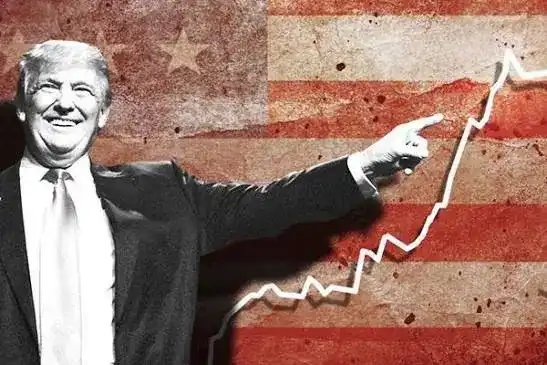
US President Donald Trump lashed out at Elon Musk on Truth Social late Sunday after Musk revealed plans for a new political group.

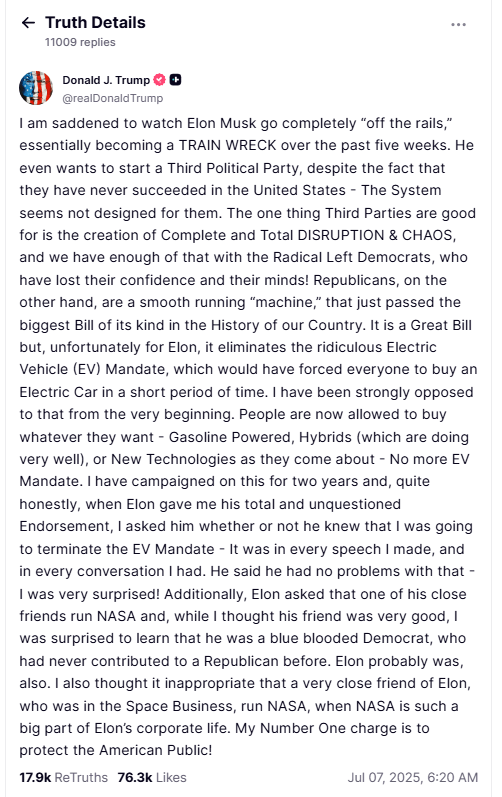
Musk had posted on X on July 5 that he wanted to launch the “America Party.” Trump fired back on July 6, calling the move a sign that Musk has gone “completely ‘off the rails,’ essentially becoming a “Train Wreck” over the past five weeks.”

America Party Faces Early Questions

According to Musk’s July 5 post, he wants a third option for voters fed up with the two main parties. Based on reports, he’s yet to file formal paperwork or outline how the America Party would win ballot access in key states.

Trump pointed out that third parties have never broken through in modern US politics. He also took a shot at Democrats, saying they’ve “lost their confidence and their minds” over his recent crypto projects.
Source: Truth Social

Musk Pushes Back On Big Spending Bill

In recent weeks, Musk criticized what he called the “Big Beautiful Bill,” a massive spending package in Congress. He wrote on X that it was a “disgusting abomination” packed with “pork.”

Trump responded by reminding Musk that he plans to end the federal electric vehicle mandate, something Musk supposedly agreed to without complaint. That swipe hints at a deeper split over how much the government should steer clean‑energy policy.

Market Traders Keep Watching

Cryptocurrency prices barely budged after Trump’s post. Bitcoin remains above $108,000 and has held that level since early summer. Dogecoin – the memecoin that has been closely associated with Musk – trades near $0.16, bouncing off that mark several times in the last 24 hours.

Total crypto market cap currently at $3.32 trillion. Chart: TradingView

TRUMP coin dipped to about $8.47 following Trump’s comments, then bounced right back as fans shrugged it off. Based on reports from crypto analysts, the feud could still add volatility if it drags regulators or big investors into the fray.

What Third Parties Really Need

History shows that building a new party takes more than social‑media polls. You need grassroots organizers, hundreds of thousands of petition signatures and millions in funding.

Musk’s fanbase might help with online buzz, but turning clicks into real voters is a different challenge. Trump noted this gap and cast doubt on whether Musk has a plan beyond stirring the pot on X.

Next Moves Could Matter

It’s still early days. If Musk files with the Federal Election Commission or names state directors, the story will shift from rumor to reality. And if Trump follows up with threats to pull back support for Tesla or SpaceX contracts, markets might start to pay closer attention.

For now, though, it’s mostly a public spat. Both men are used to moving markets, including crypto, with a single tweet or post, but so far neither side has shown the playbook that would really change the game.

Featured image from Nine, chart from TradingView

Editorial Process for bitcoinist is centered on delivering thoroughly researched, accurate, and unbiased content. We uphold strict sourcing standards, and each page undergoes diligent review by our team of top technology experts and seasoned editors. This process ensures the integrity, relevance, and value of our content for our readers.

Christian, a journalist and editor with leadership roles in Philippine and Canadian media, is fueled by his love for writing and cryptocurrency. Off-screen, he's a cook and cinephile who's constantly intrigued by the size of the universe.

Lectures associées

Q-Day : Le compte à rebours avant que l'informatique quantique ne mette fin aux cryptomonnaies ?

**Q-Day et la Cryptographie : La Menace Quantique sur les Cryptomonnaies** L'avènement de l'ordinateur quantique tolérant aux fautes (CRQC) représente une menace existentielle pour les cryptomonnaies en raison de sa capacité à casser les algorithmes de chiffrement asymétrique actuels (comme ECDSA) via l'algorithme de Shor. Le "Q-Day", point critique où cette capacité devient pratique, est estimé entre 2035 et 2045. Les blockchains, par leur nature immuable et décentralisée, sont particulièrement vulnérables. Le risque est immédiat pour les actifs dont la clé publique est déjà exposée sur la chaîne (ex : certaines anciennes adresses Bitcoin). La migration vers la cryptographie post-quantique (PQC), comme les algorithmes basés sur les réseaux (ML-KEM/DSA) ou les hachages (SLH-DSA), est donc urgente. Cependant, cette transition est extrêmement complexe : * **Pour Bitcoin** : Le défi principal est la gouvernance et la gestion sociale des UTXO historiques à risque. Une mise à jour progressive par soft fork est privilégiée, mais elle se heurte à l'inflation de la taille des signatures PQC et à un dilemme éthique sur le gel éventuel des actifs non migrés. * **Pour Ethereum** : La migration nécessite une refonte à plusieurs niveaux (comptes, consensus, couche de données). La stratégie repose sur l'agilité cryptographique, l'abstraction de compte pour les utilisateurs et des solutions techniques comme leanXMSS couplé à un zkVM pour compresser les grandes signatures. La fenêtre d'action confortable est estimée à 5-8 ans. L'industrie doit se coordonner à l'échelle de l'écosystème (protocoles, portefeuilles, bourses). La menace quantique n'anéantira pas la blockchain, mais force une reconfiguration fondamentale de ses bases cryptographiques, testant sa résilience technique et sociale.

marsbitIl y a 4 h

Q-Day : Le compte à rebours avant que l'informatique quantique ne mette fin aux cryptomonnaies ?

marsbitIl y a 4 h

Compte à rebours pour Q-Day : L'informatique quantique va-t-elle mettre fin aux cryptomonnaies ?

La cryptographie moderne est vulnérable face aux ordinateurs quantiques, en particulier l'algorithme de Shor, menaçant les systèmes actuels comme RSA et ECC. Le « Q-Day », moment où les ordinateurs quantiques pourront casser ces cryptosystèmes, est estimé entre 2035 et 2045. La cryptographie post-quantique (PQC) se développe, avec des algorithmes comme ML-KEM, ML-DSA et SLH-DSA normalisés par le NIST, pour garantir une sécurité durable. Dans le domaine de la blockchain, le Bitcoin et l'Ethereum sont particulièrement exposés. Pour Bitcoin, le risque principal concerne les UTXO dont la clé publique est déjà exposée sur la chaîne. La migration vers des algorithmes PQC se heurte à des défis techniques (signatures plus volumineuses) et à un dilemme de gouvernance concernant les fonds dormants. Ethereum, grâce à son agilité cryptographique et à l'abstraction de compte, pourrait adopter une approche plus graduelle, notamment via ses L2. La transition ne sera pas uniquement technique, mais nécessitera un large consensus social et une coordination à l'échelle de l'écosystème. Le véritable enjeu n'est pas l'absence de solutions, mais la capacité de l'écosystème à migrer de manière coordonnée avant que les risques quantiques ne deviennent une réalité économique. La fenêtre d'action confortable est estimée à 5-8 ans.

链捕手Il y a 5 h

Compte à rebours pour Q-Day : L'informatique quantique va-t-elle mettre fin aux cryptomonnaies ?

链捕手Il y a 5 h

Trading

Spot
活动图片