Altcoin Season Index Points To Possible Bottom Despite Bitcoin Dominance

bitcoinistPublié le 2025-07-08Dernière mise à jour le 2025-07-08

Résumé

Altcoin season has remained elusive despite expectations that it would have begun early in 2025. This has led to calls...

Trusted Editorial content, reviewed by leading industry experts and seasoned editors. Ad Disclosure

Altcoin season has remained elusive despite expectations that it would have begun early in 2025. This has led to calls that there has been a change in the cycle and perhaps the concept of an altcoin season no longer applies. The Bitcoin dominance has also remained quite high during this time, with altcoins falling rapidly with each decline. However, the Altcoin Season Index is currently pointing to a possible bottom for altcoins.

Altcoin Season Index Bounces From Low Score Of 11

The Altcoin Season Index is an index which ranks the performance of the top 50 altcoins against the performance of Bitcoin on a scale of 1-100. In the case where the top 50 coins are performing better than Bitcoin on a 90-day period, it is considered altcoin season. Whereas in the case where the Bitcoin price is still outperforming the top 50 altcoins, excluding stablecoins and asset-backed tokens, then it is considered a Bitcoin season.

Presently, the Bitcoin price is still well ahead of the top 50 altcoins, as shown by its dominance still ranging above 65%. This has significantly reduced the chances of an alt season as the focus is still heavily on Bitcoin during this time. Even more concerning is the fact that the Bitcoin price has continued to outperform Ethereum, which is often the leader of the altcoin season.

According to data from Blockchain Center, the Altcoin Season Index is currently sitting at a low score of 27 at the time of this writing. This remains quite low but has been a major step-up from the low score of 11 that was recorded back in June following the market crash.
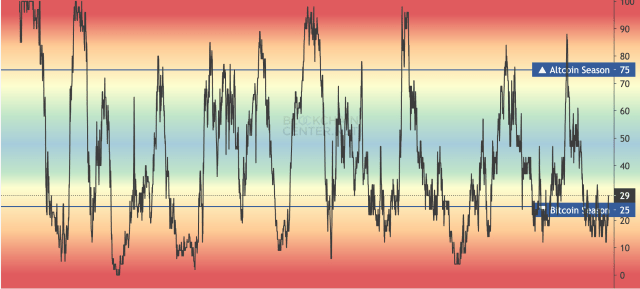
Altcoin Season Index
Source: Blockchain Center

Usually, when the index is this low, it often signals that the end of the downtrend is close and the bottom could be in. However, there could still be some ways to go, given that historically, the index has bottomed below 10 before the alt season begins.

This is seen throughout the history of the market, where the altcoin index had fallen below 8 back in 2020 before the legendary altcoin season of 2021. Then again, bottoming at a score of 4 back in 2023 before the 2024 rally.

Nevertheless, the index being this low does suggest that the bottom is either in or will be in soon. The next step would be a decline in the Bitcoin dominance, likely toward the 40% territory, and Ethereum outperforming the Bitcoin price to fully signal the entrance of the altcoin season.

Altcoins market chart from TradingView.com
Altcoins view for another recovery | Source: Crypto Total Market Cap Excluding BTC on TradingView.com
Featured image from Dall.E, chart from TradingView.com
Editorial Process for bitcoinist is centered on delivering thoroughly researched, accurate, and unbiased content. We uphold strict sourcing standards, and each page undergoes diligent review by our team of top technology experts and seasoned editors. This process ensures the integrity, relevance, and value of our content for our readers.

Scott Matherson is a leading crypto writer at Bitcoinist, who possesses a sharp analytical mind and a deep understanding of the digital currency landscape. Scott has earned a reputation for delivering thought-provoking and well-researched articles that resonate with both newcomers and seasoned crypto enthusiasts. Outside of his writing, Scott is passionate about promoting crypto literacy and often works to educate the public on the potential of blockchain.

Lectures associées

Q-Day : Le compte à rebours avant que l'informatique quantique ne mette fin aux cryptomonnaies ?

**Q-Day et la Cryptographie : La Menace Quantique sur les Cryptomonnaies** L'avènement de l'ordinateur quantique tolérant aux fautes (CRQC) représente une menace existentielle pour les cryptomonnaies en raison de sa capacité à casser les algorithmes de chiffrement asymétrique actuels (comme ECDSA) via l'algorithme de Shor. Le "Q-Day", point critique où cette capacité devient pratique, est estimé entre 2035 et 2045. Les blockchains, par leur nature immuable et décentralisée, sont particulièrement vulnérables. Le risque est immédiat pour les actifs dont la clé publique est déjà exposée sur la chaîne (ex : certaines anciennes adresses Bitcoin). La migration vers la cryptographie post-quantique (PQC), comme les algorithmes basés sur les réseaux (ML-KEM/DSA) ou les hachages (SLH-DSA), est donc urgente. Cependant, cette transition est extrêmement complexe : * **Pour Bitcoin** : Le défi principal est la gouvernance et la gestion sociale des UTXO historiques à risque. Une mise à jour progressive par soft fork est privilégiée, mais elle se heurte à l'inflation de la taille des signatures PQC et à un dilemme éthique sur le gel éventuel des actifs non migrés. * **Pour Ethereum** : La migration nécessite une refonte à plusieurs niveaux (comptes, consensus, couche de données). La stratégie repose sur l'agilité cryptographique, l'abstraction de compte pour les utilisateurs et des solutions techniques comme leanXMSS couplé à un zkVM pour compresser les grandes signatures. La fenêtre d'action confortable est estimée à 5-8 ans. L'industrie doit se coordonner à l'échelle de l'écosystème (protocoles, portefeuilles, bourses). La menace quantique n'anéantira pas la blockchain, mais force une reconfiguration fondamentale de ses bases cryptographiques, testant sa résilience technique et sociale.

marsbitIl y a 7 h

Q-Day : Le compte à rebours avant que l'informatique quantique ne mette fin aux cryptomonnaies ?

marsbitIl y a 7 h

Compte à rebours pour Q-Day : L'informatique quantique va-t-elle mettre fin aux cryptomonnaies ?

La cryptographie moderne est vulnérable face aux ordinateurs quantiques, en particulier l'algorithme de Shor, menaçant les systèmes actuels comme RSA et ECC. Le « Q-Day », moment où les ordinateurs quantiques pourront casser ces cryptosystèmes, est estimé entre 2035 et 2045. La cryptographie post-quantique (PQC) se développe, avec des algorithmes comme ML-KEM, ML-DSA et SLH-DSA normalisés par le NIST, pour garantir une sécurité durable. Dans le domaine de la blockchain, le Bitcoin et l'Ethereum sont particulièrement exposés. Pour Bitcoin, le risque principal concerne les UTXO dont la clé publique est déjà exposée sur la chaîne. La migration vers des algorithmes PQC se heurte à des défis techniques (signatures plus volumineuses) et à un dilemme de gouvernance concernant les fonds dormants. Ethereum, grâce à son agilité cryptographique et à l'abstraction de compte, pourrait adopter une approche plus graduelle, notamment via ses L2. La transition ne sera pas uniquement technique, mais nécessitera un large consensus social et une coordination à l'échelle de l'écosystème. Le véritable enjeu n'est pas l'absence de solutions, mais la capacité de l'écosystème à migrer de manière coordonnée avant que les risques quantiques ne deviennent une réalité économique. La fenêtre d'action confortable est estimée à 5-8 ans.

链捕手Il y a 7 h

Compte à rebours pour Q-Day : L'informatique quantique va-t-elle mettre fin aux cryptomonnaies ?

链捕手Il y a 7 h

Trading

Spot
活动图片